Application of Common Sense Computing for
the Development of a Novel Knowledge-Based
Opinion Mining Engine
A thesis submitted in accordance with the requirements of the University of Stirling for the degree of Doctor of Philosophy
by
Erik Cambria
Principal Supervisor: Amir Hussain (University of Stirling, UK) Additional Supervisor: Catherine Havasi (MIT Media Laboratory, USA)
Industrial Supervisor: Chris Eckl (Sitekit Solutions Ltd, UK)
Department of Computing Science & Mathematics University of Stirling, Scotland, UK
Declaration
I, Erik Cambria, hereby declare that this work has not been submitted for any other degree at this University or any other institution and that, except where reference is made to the work of other authors, the material presented is original.
Abstract
The ways people express their opinions and sentiments have radically changed in the past few years thanks to the advent of social networks, web communities, blogs, wikis and other online collaborative media. The distillation of knowledge from this huge amount of unstructured information can be a key factor for marketers who want to create an image or identity in the minds of their customers for their product, brand, or organisation. These online social data, however, remain hardly accessible to computers, as they are specifically meant for human consumption. The automatic analysis of online opinions, in fact, involves a deep understanding of natural language text by machines, from which we are still very far.
Hitherto, online information retrieval has been mainly based on algorithms relying on the textual representation of web-pages. Such algorithms are very good at retrieving texts, splitting them into parts, checking the spelling and counting their words. But when it comes to interpreting sentences and extracting meaningful information, their capabilities are known to be very limited. Existing approaches to opinion mining and sentiment analysis, in particular, can be grouped into three main categories: keyword spotting, in which text is classified into categories based on the presence of fairly unambiguous affect words; lexical affinity, which assigns arbitrary words a probabilistic affinity for a particular emotion; statistical methods, which calculate the valence of affective keywords and word co-occurrence frequencies on the base of a large training corpus. Early works aimed to classify entire documents as containing overall positive or negative polarity, or rating scores of reviews.
Such systems were mainly based on supervised approaches relying on manually la-belled samples, such as movie or product reviews where the opinionist’s overall positive or negative attitude was explicitly indicated. However, opinions and sentiments do not occur only at document level, nor they are limited to a single valence or target. Contrary or complementary attitudes toward the same topic or multiple topics can be present across the span of a document. In more recent works, text analysis granu-larity has been taken down to segment and sentence level, e.g., by using presence of opinion-bearing lexical items (single words or n-grams) to detect subjective sentences, or by exploiting association rule mining for a feature-based analysis of product reviews. These approaches, however, are still far from being able to infer the cognitive and af-fective information associated with natural language as they mainly rely on knowledge bases that are still too limited to efficiently process text at sentence level.
In this thesis, common sense computing techniques are further developed and ap-plied to bridge the semantic gap between word-level natural language data and the concept-level opinions conveyed by these. In particular, the ensemble application of graph mining and multi-dimensionality reduction techniques on two common sense knowledge bases was exploited to develop a novel intelligent engine for open-domain opinion mining and sentiment analysis. The proposed approach, termed sentic com-puting, performs a clause-level semantic analysis of text, which allows the inference of both the conceptual and emotional information associated with natural language opinions and, hence, a more efficient passage from (unstructured) textual information to (structured) machine-processable data.
The engine was tested on three different resources, namely a Twitter hashtag repos-itory, a LiveJournal database and a PatientOpinion dataset, and its performance com-pared both with results obtained using standard sentiment analysis techniques and using different state-of-the-art knowledge bases such as Princeton’s WordNet, MIT’s ConceptNet and Microsoft’s Probase. Differently from most currently available opin-ion mining services, the developed engine does not base its analysis on a limited set of
affect words and their co-occurrence frequencies, but rather on common sense concepts and the cognitive and affective valence conveyed by these. This allows the engine to be domain-independent and, hence, to be embedded in any opinion mining system for the development of intelligent applications in multiple fields such as Social Web, HCI and e-health. Looking ahead, the combined novel use of different knowledge bases and of common sense reasoning techniques for opinion mining proposed in this work, will, eventually, pave the way for development of more bio-inspired approaches to the design of natural language processing systems capable of handling knowledge, retrieving it when necessary, making analogies and learning from experience.
Dedication
In memory of John McCarthy (September 4th, 1927 - October 24th, 2011), who helped design the foundation of today’s Internet-based computing and coined the term for a frontier of research he helped pioneer, AI.
Acknowledgements
The humble accomplishment of this thesis would not have been possible without the contribution of many individuals, to whom I express my appreciation and gratitude. Firstly, I am deeply indebted to my research supervisors, specifically: Amir Hussain, my principal supervisor and founding Head of COSIPRA Lab at Stirling, who gave me the opportunity to work on this exciting project, guided me every step of the way, funded my research and training visits to the project’s prestigious partner institutions, and was an immense source of inspiration throughout; Catherine Havasi, whose guidance, encouragement and support in the past three years has been simply invaluable; and Chris Eckl, who helped me to look at my research from many different points of view. I am also grateful to all the other mentors and colleagues who supported me during my short term scientific missions and internships, in particular Robert Speer, Kenneth Arnold, Dustin Smith, Jason Alonso and Henry Lieberman, who assisted me in get-ting started, using and further developing common sense compuget-ting tools (both during my research visits at MIT Media Lab and remotely), Campbell Grant, for his critical opinions and sound advice about the commercial aspects of my research work, Anna Esposito, for her unwavering support within the COST 2102 program, Thomas Maz-zocco and Marco Grassi, for their invaluable research contributions, Joseph Lyons, for his help in the design and refinement of the Hourglass model, and James Munro, for the support and the data provided for the development of patient centred applications. Special thanks also go to Praphul Chandra and Sudhir Dixit, who helped me expand the horizons of my research during my internship at Hewlett-Packard Labs India (within
the Innovations for the Next Billion Customers Initiative) in Bangalore, Tariq Durrani, Tieniu Tan, Cheng-Lin Liu and Chengqing Zong, for their guidance during my research visit at the National Laboratory of Pattern Recognition (NLPR) in the Institute of Automation of the Chinese Academy of Sciences (within the China-Scotland SIPRA programme) in Beijing, and Haixun Wang and Yangqiu Song, for helping me improve my skills and expertise in the field of knowledge-based systems during my internship at Microsoft Research Asia (within the Probase Project) in Beijing.
A last, but not least, acknowledgement goes to my family and all the old and new friends who, in the past three years, have cheered me up in difficult moments, celebrated with me for my achievements and never blamed me for being often far away from them. This PhD was the best experience of my life as it gave me the possibility to: work shoulder to shoulder with scientists from top research institutes, get in touch with both far West and far East cultures, meet special people who will always be part of my life, and even exchange ideas with beautiful minds such as Tim Berners-Lee, the inventor of the Web, Bebo White, Web pioneer in the United States, and Marvin Minsky, one of the fathers of AI.
Contents
1 Introduction 1 1.1 The Thesis . . . 2 1.1.1 Motivations . . . 3 1.1.2 Aims . . . 7 1.1.3 Original Contributions . . . 10 1.2 Publications Arising . . . 121.2.1 Accepted for Publication . . . 13
1.2.2 Under Review . . . 15
1.2.3 In Preparation . . . 16
2 Background 17 2.1 Opinion Mining and Sentiment Analysis . . . 18
2.1.1 The Buzz Mechanism . . . 18
2.1.2 Origins and Peculiarities . . . 19
2.1.3 Sub-Tasks . . . 21
2.2 Main Approaches to Opinion Mining . . . 23
2.2.1 From Heuristics to Discourse Structure . . . 24
2.2.2 From Coarse to Fine Grained . . . 25
2.2.3 From Keywords to Concepts . . . 26
2.3 Towards Machines with Common Sense . . . 28
2.3.2 Knowledge Representation . . . 31
2.3.3 History . . . 37
2.3.4 The Open Mind Common Sense Project . . . 41
2.3.5 Sentic Computing . . . 45
2.4 Conclusions . . . 47
3 Sentic Knowledge Base Design 49 3.1 AffectNet: An Affective Common Sense Knowledge Base . . . 51
3.1.1 ConceptNet . . . 51
3.1.2 Affective Blending . . . 54
3.2 The Hourglass of Emotions: A Novel Emotion Categorisation Model . . 57
3.2.1 Categorical Versus Dimensional Approaches . . . 59
3.2.2 A New Cognitive Model for Representing Human Emotions . . . 62
3.3 Open Mind Common Sentics: An Emotion-Sensitive IUI . . . 69
3.3.1 Games for Knowledge Acquisition . . . 69
3.3.2 Collecting Affective Common Sense Knowledge . . . 74
3.4 Isanette: A Common and Common Sense Knowledge Base . . . 81
3.4.1 Probase . . . 81
3.4.2 Building the Instance-Concept Matrix . . . 83
3.5 Conclusions . . . 87
4 Sentic Knowledge Base Handling 88 4.1 AffectiveSpace: A Novel Representation of Affective Common Sense . . 89
4.1.1 Building the Vector Space . . . 91
4.1.2 Adjusting the Vector Space . . . 93
4.1.3 Transforming the Vector Space . . . 95
4.2 Sentic Medoids: Clustering Affective Common Sense Concepts . . . 97
4.2.1 Partitioning Around Medoids . . . 97
4.3 Sentic Activation: A Two-Level Affective Reasoning Framework . . . 101
4.3.1 Unconscious Reasoning . . . 102
4.3.2 Conscious Reasoning . . . 103
4.4 SenticNet: A Publicly Available Semantic Resource for Opinion Mining 106 4.4.1 Building SenticNet . . . 106
4.4.2 Encoding SenticNet . . . 107
4.4.3 Working with SenticNet . . . 109
4.5 Conclusions . . . 110
5 Sentic Knowledge Base Exploitation 111 5.1 Opinion Mining Engine: A Semantics and Sentics Extraction Tool . . . 112
5.1.1 Pre-Processing Module . . . 113 5.1.2 Semantic Parser . . . 113 5.1.3 Isanette Module . . . 115 5.1.4 AffectiveSpace Module . . . 116 5.1.5 Output Example . . . 117 5.1.6 Evaluation . . . 118
5.2 Development of Social Web Systems . . . 124
5.2.1 Troll Filtering . . . 125
5.2.2 Social Media Marketing . . . 129
5.2.3 Sentic Album . . . 139
5.3 Development of HCI Systems . . . 153
5.3.1 Sentic Avatar . . . 154
5.3.2 Sentic Chat . . . 162
5.3.3 Sentic Corner . . . 165
5.4 Development of E-Health Systems . . . 170
5.4.1 Crowd Validation . . . 171
5.4.2 Sentic PROMs . . . 174
6 Concluding Remarks 181
6.1 Summary of Contributions . . . 182
6.1.1 Techniques . . . 183
6.1.2 Tools . . . 183
6.1.3 Applications . . . 184
6.2 Limitations and Future Work . . . 185
6.2.1 Limitations . . . 185
6.2.2 On-Going Work . . . 187
6.2.3 Future Work . . . 188
List of Figures
2.1 Tree of Porphyry. Porphyry presented the basis of Aristotle’s thought as a tree-like scheme of dichotomous divisions, which indicates that the process continues until the lowest species is reached. . . 35 2.2 An Open Mind project on OCR: handwritten characters are presented to
e-citizens whose judgements (here 4 versus 9) are returned to the Open Mind host and used to train the classifier. . . 43 2.3 The cumulative analogy process allows to perform comparisons between
concepts in a knowledge base, represented as a matrix, and hence to infer new information about similar concepts. . . 44 2.4 Opinion mining engine preview. Different techniques, e.g., graph
min-ing and dimensionality reduction, are employed on two common sense knowledge bases for open-domain sentiment analysis. . . 48 3.1 ConceptNet represents the information in the Open Mind corpus as a
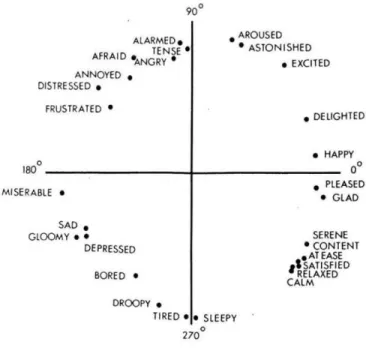
directed graph where nodes are concepts and labelled edges are assertions of common sense that interconnect them. . . 53 3.2 Russell’s circumplex model is one of the earliest examples of dimensional
emotion representations. In the snippet, direct circular scaling coordi-nates are provided for 28 affect words. . . 60 3.3 Whissell’s model is a bi-dimensional representation of emotions, in which
affect words are displayed. The diagram shows the position of some of these words in the<activation, evaluation> space. . . 61
3.4 The Pleasantness emotional flow. Within each affective dimension, the passage from a sentic level to another is regulated by a Gaussian function that models how stronger emotions induce higher emotional sensitivity. 65 3.5 The 3D model and the net of the Hourglass of Emotions: since affective
states are represented according to their strength (from strongly positive to null to strongly negative), the model assumes a hourglass shape. . . . 66 3.6 Hourglass compound emotions of second level: by combining basic
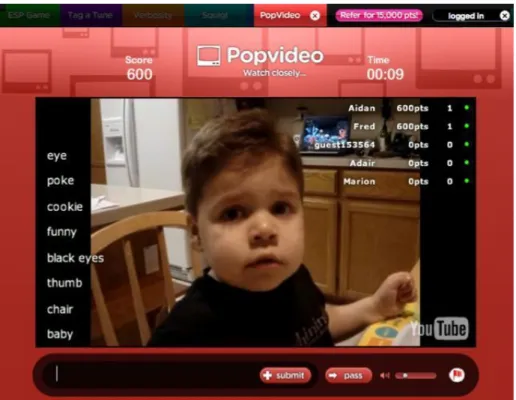
emo-tions pairwise it is possible to obtain complex emoemo-tions resulting from the activation of two of the four affective dimensions. . . 68 3.7 A screenshot of PopVideo. Two or more players are shown the same
video, which originates from various sources, and have to timely describe the objects that appear in the video in order earn points. . . 71 3.8 A screenshot of Concept Game, a turn-based single player game taking
advantage of the Facebook platform for adding competitive flavors and social aspects to the collection of common sense knowledge. . . 72 3.9 A typical output obtained by inserting some text into Open Mind
Com-mon Sentics interface. The system provides a list of extracted concepts, their valence and polarity, a list of sentics, and a polarity value. . . 77 3.10 A screenshot of the Hourglass Game. The GWAP aims to collect affective
common sense knowledge from the general public by engaging users in a game where precision and speed are awarded. . . 79 3.11 A screenshot of Sentic Pet. Icons in the up-right corner specify the
abilities of pets, while icons in the up-left corner allow players to train or test these according to different modalities (bottom-left corner). . . . 80 3.12 A snippet of Probase. The taxonomy consists of concepts (e.g.,emerging
markets), instances (e.g., “China”), attributes and values (e.g., “China’s population is 1.3 billion”), and relationships between concepts. . . 82
4.1 A sketch of AffectiveSpace. Affectively positive concepts (in the bottom-left corner) and affectively negative concepts (in the up-right corner) are floating in the multi-dimensional vector space. . . 93 4.2 Accuracy values achieved by testing AffectiveSpace on BACK, with
di-mensionality spanning from 1 to 250. The best trade-offbetween preci-sion and efficiency is obtained by using 100 singular values. . . 96 4.3 A two-dimensional projection (first and second eigenmoods) of
Affec-tiveSpace. From this visualisation, it is evident that concept density is usually higher near the centre of the space. . . 98 4.4 Sentic medoids conveniently organise AffectiveSpace by iteratively
select-ing appropriate centroids, in order to minimise the sum of dissimilarities between these and the other concepts within the same cluster. . . 100 4.5 SenticNet is a Semantic Web aware AI resource in which Open Mind
concepts are identified using the ConceptNet Web API, and statements are encoded in RDF/XML format on the base of HEO. . . 109 5.1 Opinion mining engine block diagram. After performing a first skim of
the input text, the engine extracts concepts from it and, hence, infers related semantics and sentics. . . 115 5.2 Troll filtering process. Once extracted, semantics and sentics are used
to calculate blog posts’ level of trollness, which is then stored in the interaction database for the detection of malicious behaviours. . . 126 5.3 Merging different ontologies. The combination of HEO, WNA, OMR
and FOAF provides a comprehensive framework for the representation of social media affective information. . . 134 5.4 A screenshot of the social media marketing tool. The faceted
classifica-tion interface allows the user to quickly and efficiently navigate through both the explicit and implicit features of the different products. . . 136
5.5 Sentics extraction evaluation. The process extracts sentics from natural language posts in the LiveJournal database, and then compare inferred emotional labels with the relative mood-tags in the database. . . 138 5.6 Sentic Album’s annotation module. Online personal pictures are
anno-tated at three different levels: content level (PIL), concept level (opinion mining engine) and context level (Context Deviser). . . 144 5.7 Sentic Album’s SQL-level storage module. Image statistics are saved
into the Content DB, semantics and sentics are stored into the Concept DB, while timestamp and geolocation are saved into the Context DB. . 147 5.8 Sentic Album’s search and retrieval module. The IUI allows to browse
personal images both by performing keyword-based queries in the search box and by adding or removing constraints on the facet properties. . . . 150 5.9 Sentic Avatar’s architecture. The system mainly consists of two
mod-ules for managing the avatar’s inputs and outputs, and two modmod-ules for performing affective common sense reasoning. . . 156 5.10 Tracked facial feature points according to MPEG4 standard (on the left)
and corresponding facial parameters (on the right). The variations of such distances and angles are exploited for affect recognition. . . 158 5.11 A screenshot of the Affective Analysis Module output. The integration
of the extracted multi-modal emotional information takes place into the Whissell space, in terms of activation and evaluation. . . 161 5.12 A few screenshots of sentic chat IUI. Stage and actors gradually change,
according to the semantics and sentics associated with the on-going con-versation, in order to provide a more immersive chat experience. . . 164 5.13 Sentic Corner generation process. The semantics and sentics extracted
from the user’s micro-blogging activity are exploited to retrieve relevant audio, video, visual, and textual information. . . 166
5.14 Sentic Corner web interface. The multi-modal information obtained by means of Sentic Tuner, Sentic TV, Sentic Slideshow, and Sentic Library is encoded in RDF/XML for multi-faceted browsing. . . 169 5.15 The semantics and sentics stack. Semantics are built on the top of data
and metadata. Sentics, in turn, are built on the top of semantics, as they the represent the affective information associated with these. . . . 172 5.16 The crowd validation schema. PatientOpinion’s stories are encoded in
a machine-accessible format, in a way that they can be compared with the official ratings provided by NHS Choices and each NHS trust. . . 173 5.17 Sentic PROMs prototype on iPad. The new interface allows patients to
assess their health status and health-care experience both in a structured (questionnaire) and unstructured (free text) way. . . 177
List of Tables
1.1 List of most popular companies that are leveraging sentiment analysis tools to track and dissect how consumers feel about products and services of their own and also of the competition. . . 9 3.1 Comparison between WordNet and ConceptNet. While WordNet synsets
contain vocabulary knowledge associated with concepts, ConceptNet as-sertions convey knowledge about what such concepts are used for. . . . 52 3.2 Some examples of LiveJournal posts where affective information is not
conveyed explicitly through affect words. Such implicit information, however, can be inferred by analysing the semantics and sentics. . . 57 3.3 Some existing definition of basic emotions. The most widely adopted
model for affect recognition is Ekman’s, although is one of the poorest in terms of number of emotions. . . 59 3.4 The sentic levels of the Hourglass model. Labels are organised into
four affective dimensions with six different levels each, whose combined activity constitutes the ‘total state’ of the mind. . . 67 3.5 The second-level emotions generated by pairwise combination of the
sen-tic levels of the Hourglass model. The co-activation of different levels gives birth to different compound emotions, e.g., love and frustration. . 67 3.6 Comparison between Probase and two popular common knowledge bases.
Probase overcomes problems such as incompleteness of WordNet hyper-nyms or inaccuracy and biased knowledge of Freebase. . . 84
4.1 Distribution of concepts through the Pleasantness dimension. The af-fective information associated with most concepts appear to concentrate around the centre of the Hourglass, rather than its extremes. . . 95 5.1 An overview of recent model-based affect recognition and sentiment
anal-ysis systems. Studies are divided by techniques applied, number of cat-egories of the model adopted, corpora and knowledge base used. . . 114 5.2 Structured output example of opinion mining engine. For each clause,
the engine detects the opinion target, the category it belongs to, and the affective information associated with it. . . 118 5.3 Precision values relative to Twitter evaluation. Probase and Isanette
perform significantly better than WordNet and ConceptNet, as these usually lack factual knowledge concepts. . . 123 5.4 F-measure values relative to LiveJournal evaluation. WordNet,
Concept-Net and AffectConcept-Net perform consistently better than Probase as this is based on semantic rather than affective relatedness of concepts. . . 123 5.5 F-measure values relative to PatientOpinion evaluation. The ensemble
application of Isanette and AffectNet represents the best trade-off be-tween topic spotting and affect recognition. . . 124 5.6 Precision, recall, and F-measure values relative to the troll filter
eval-uation. The AffectiveSpace process performs consistently better than Isanette and AnalogySpace in detecting troll posts. . . 128 5.7 Evaluation results of the sentics extraction process. Precision, recall and
F-measure rates are calculated for ten different moods by comparing the engine output with the relative LiveJournal mood-tag. . . 139 5.8 System performance test. Assessment of Sentic Album’s accuracy in
inferring the cognitive (topic tags) and affective (mood tags) information associated with the conceptual metadata typical of personal photos. . . 152
5.9 Perceived utility of the different interface features by 18 Picasa regular users. Participants particularly appreciated the usefulness of concept facets and timeline, for search and retrieval tasks. . . 153 5.10 Confusion matrix obtained combining the five classifiers. Success rates
forneutral,joyandsurpriseare very high but the system tends to confuse
disgustwithfear,angerwithdisgustand fear withsurprise. . . 159 5.11 Confusion matrix obtained after considering human assessment.
Suc-cess ratios considerably increase, meaning that the adopted classification strategy is consistent with human classification. . . 160 5.12 Precision, recall, and F-measure rates associated with Ekman’s basic
emotions (plus neutral) obtained by concurrently employing the opinion mining engine and the Facial Expression Analyser. . . 162 5.13 Values associated with the perceived consistency with chat text of stage
change and actor alternation. The evaluation was performed on a 130-minute chat session operated by a pool of 6 regular chat users. . . 164 5.14 Relevance of audio, video, visual, and textual information assembled by
Sentic Corner over 80 tweets. Possibly because of their larger datasets, Sentic Tuner and Sentic Slideshow are the best-performing modules. . . 170
List of Abbreviations
3NF Third Normal FormAI Artificial Intelligence
AKAPU Average Knowledge Acquired Per User
ANN Artificial Neural Network
API Application Programming Interface
BACK Benchmark for Affective Common sense Knowledge
BCNF Boyce-Codd Normal Form
CF-IOF Concept Frequency - Inverse Opinion Frequency
CMC Computer Mediated Communication
CRF Conditional Random Field
CRM Customer Relationship Management
DAG Directed Acyclic Graph
DAU Daily Active User
DL Description Logic
EQ Emotional Quotient
FMRI Functional Magnetic Resonance Imaging
FOAF Friend Of A Friend
FOL First Order Logic
GUI Graphic User Interface
GWAP Game With A Purpose
HCI Human Computer Interaction
HEO Human Emotion Ontology
HRQoL Health Related Quality of Life
HTML Hyper Text Markup Language
HVS Human Visual System
ICA Independent Component Analysis
IM Instant Messaging
IT Information Technology
IUI Intelligent User Interface
KNN K-Nearest Neighbor
KR Knowledge Representation
JSON JavaScript Object Notation
LSA Latent Semantic Analysis
LSR Label Sequential Rules
MDS Multi-Dimensional Scaling
MLP Multi-Layer Perceptron
MMO Massively Multiplayer Online
MVE Minimum Volume Ellipsoid
NB Na¨ıve Bayes
NELL Never-Ending Language Learning
NMF Non-negative Matrix Factorisation
NLP Natural Language Processing
NP Nondeterministic Polynomial
OCR Optical Character Recognition
OMCS Open Mind Common Sense
OMR Ontology for Media Resources
OWL Ontology Web Language
PAM Partitioning Around Medoids
PCA Principal Component Analysis
POS Part Of Speech
PROM Patient Reported Outcome Measure
RDBMS Relational Database Management Systems
RDF Resource Description Framework
SKOS Simple Knowledge Organisation System
SQL Structured Query Language
SNN Sentic Neural Network
SVD Singular Value Decomposition
SVM Support Vector Machine
TF-IDF Term Frequency - Inverse Document Frequency
TMS Truth Maintenance System
TSVD Truncated Singular Value Decomposition
UGC User Generated Content
UML Unified Modeling Language
VSM Vector Space Model
XML Extensible Markup Language
W3C World Wide Web Consortium
Chapter 1
Introduction
We can understand almost anything, but we can’t understand how we understand.
Albert Einstein
In a world in which millions of people express their opinions about commercial products in blogs, wikis, forums, chats, and social networks, the distillation of knowledge from this huge amount of unstructured information can be a key factor for marketers who want to create an image or identity in the minds of their customers for their product, brand, or organisation [1]. The automatic analysis of online opinions, however, involves a deep understanding of natural language text by machines, from which we are still very far [2]. Online information retrieval, in fact, is still mainly based on algorithms relying on the textual representation of web-pages [3].
Such algorithms are very good at retrieving texts, splitting them into parts, checking the spelling, and counting their words. But when it comes to interpreting sentences and extracting useful information for users, their capabilities are still very limited. In this thesis, common sense computing techniques are further developed and applied
to bridge the cognitive and affective gap between word-level natural language data and the concept-level opinions conveyed by these. In particular, two common sense knowledge bases were designed, together with a novel emotion categorisation model, and graph mining and multi-dimensionality reduction techniques were applied on them to infer cognitive and affective information from natural language and, hence, develop opinion-mining systems in fields such as Social Web, HCI, and e-health.
The structure of the thesis is as follows: this chapter presents motivations, aims and contributions of the research hereby presented, chapter 2 illustrates the state of the art of opinion mining and sentiment analysis together with past and recent developments in the field of common sense computing, chapter 3 shows the methods employed to build the knowledge bases on which the opinion mining engine is based, chapter 4 explains in detail the strategies adopted to perform reasoning on such knowledge bases, chapter 5 discusses how to exploit the knowledge bases for the development of opinion mining systems in different fields, chapter 6, eventually, comprises concluding remarks and future work.
1.1
The Thesis
This thesis is the result of an industrial CASE (Cooperative Awards in Science and Engineering) research project, funded by the UK Engineering and Physical Sciences Research Council (EPSRC grant reference No. EP/G501750/1), which was born from the collaboration between the University of Stirling, the MIT Media Laboratory (Cam-bridge, USA) and Sitekit Labs (Portree, Scotland), the research branch of Sitekit Solu-tions Ltd., a software vendor specialised in content management system (CMS) devel-opment. The initial aim of the project was to further develop and apply software agent and natural language processing (NLP) technologies in order to blend the Open Mind database with any given ontology and, hence, build a novel intelligent software engine for text auto-categorisation. Soon after the start of the project, it has been consensually chosen to focus the research work on the fields of opinion mining and sentiment
analy-sis, which have recently become more and more popular for their potential implications on areas such as e-commerce, e-tourism, and e-health. Although commonly used inter-changeably to denote the same field of study, opinion mining and sentiment analysis actually focus on polarity detection and emotion recognition, respectively. Since the identification of sentiment is often exploited for detecting polarity, however, the two fields are usually combined under the same umbrella or even used as synonyms.
The primary researcher of the project was Erik Cambria, working under the prin-cipal academic supervision of Amir Hussain, founding Head of the Cognitive Signal Image Processing and Control Research (COSIPRA) Laboratory in the Department of Computing Science and Mathematics at Stirling University, and with industrial super-vision of Chris Eckl, research director at Sitekit Labs. The research has been carried out in collaboration with Catherine Havasi of MIT Media Laboratory, who was part of the research team that pioneered the Common Sense Computing Initiative, which was further developed as part of the project in the context of opinion mining and sentiment analysis. In this section, motivations for the thesis are illustrated (subsection 1.1.1), together with the main aims of the research (subsection 1.1.2) and the original contri-butions arising from the doctoral work (subsection 1.1.3).
1.1.1 Motivations
Opinions play a primary role in decision-making processes. Whenever people need to make a choice, they are interested in hearing others’ opinions. When this choice in-volves consuming valuable resources (e.g., spending time and money to buy products or services), in particular, people strongly rely on their peers’ past experiences. Just a few years ago, the main sources for collecting such information were friends, acquaintances and, in some cases, specialised magazine or web sites.
The advent of Web 2.0 has provided people with new tools, e.g., forums, blogs, social network and contents sharing services, that allow them to create and share, in a time and cost efficient way, their own contents, ideas and opinions with virtually the millions
of people connected to the World Wide Web. This has made available by click a new and oceanic source of information and opinions and has provided a powerful communication medium to share knowledge and to get advantage from others’ experiences [4].
Currently, over 75,000 new blogs are created daily, along with 1.2 million new posts each day, and more and more people in the modern world rely on opinions, reviews and recommendations collected from these and related websites. The Web has made available the opinions of a vast pool of people that are neither our personal acquaintances nor well-known professional critics. People, in fact, are not just naturally keen on listening to others’ advice but also naturally inclined to give others advice. Web users are often happy to share both their positive and negative real-world experiences for different reasons, e.g., because they benefited from others’ reviews and want to give back to the community, because they seek for a sense of togetherness in adversity, for cathartic complaining, for supporting a product they really like, because it is a way to express themselves, because they think their opinions are important for others.
When people have a strong feeling about a specific product or service they tried, they feel like expressing it. If they loved it, they want others to enjoy it. If they hated it, they want to warn others away. This huge amount of useful information, however, is mainly unstructured, that is in natural language, as it is specifically produced for human consumption and, hence, it is not directly machine-processable. The opportunity to capture the opinions of the general public about social events, political movements, company strategies, marketing campaigns, and product preferences has raised more and more interest both in the scientific community, for the exciting open challenges, and in the business world, for the remarkable fallouts in marketing and financial market prediction.
This has led to the emerging fields of opinion mining and sentiment analysis, which deal with information retrieval and knowledge discovery from text using data mining and NLP techniques to distil knowledge and opinions from the huge amount of informa-tion on the World Wide Web. Mining opinions and sentiments from natural language,
however, is an extremely difficult task as it involves a deep understanding of most of the explicit and implicit, regular and irregular, syntactical and semantic rules proper of a language.
Opinion mining is a branch of the broad field of text data mining [5] and refers generally to the process of extracting interesting and non-trivial patterns or knowledge from unstructured text documents. It can be viewed as an extension of data mining or knowledge discovery from (structured) databases [6, 7]. As the most natural form of storing information is text, opinion mining is believed to have a commercial potential higher than that of data mining. Opinion mining, however, is also a much more complex task as it involves dealing with text data that are inherently unstructured and fuzzy. It is a multi-disciplinary research area that involves the adoption of techniques in fields such as text analysis, information retrieval and extraction, auto-categorisation, machine learning, clustering and visualisation.
Most of the existing approaches to opinion mining and sentiment analysis rely on the extraction of a vector representing the most salient and important text features, which is later used for classification purposes. Some of the most commonly used features are term frequency [8] and presence [9]. The latter is a binary-valued feature vectors in which the entries merely indicate whether a term occurs (value 1) or not (value 0) formed a more effective basis for review polarity classification. This is indicative of an interesting difference between typical topic-based text categorisation and polarity classification. While a topic is more likely to be emphasised by frequent occurrences of certain keywords, overall sentiment may not usually be highlighted through repeated use of the same terms.
Other term-based features are often added to the features vector. Position is one of these, in consideration of how the position of a token in a text unit can affect the way in which the token affect the sentiment of the text. Also the presence n-grams, typically bi-grams and tri-grams are often taken into account as useful features. Some methods also relies on the distance between terms. Part of speech (POS) information (nouns,
adjectives, adverbs, verbs, etc.) is also commonly exploited in general textual analysis as a basic form of word sense disambiguation [10]. Certain adjectives, in particular, have been proved to be good indicators of sentiment and sometimes have been used to guide feature selection for sentiment classification. In other works, eventually, the detection of sentiments was performed through selected phrases, which were chosen via a number of pre-specified POS patterns, most including an adjective or an adverb [11]. All such approaches mainly rely on parts of text in which opinions and sentiments are explicitly expressed, e.g., polarity terms, affect words and their co-occurrence frequen-cies. Opinions and sentiments, however, are often conveyed implicitly through context and domain dependent concepts, which make purely syntactical approaches ineffective. To this end, novel approaches that go beyond mere word-level sentiment analysis are needed. Such approaches should employ new techniques capable to better grasp the conceptual rules that govern sentiment and the clues that can convey these concepts from realisation to verbalisation in the human mind. Next-generation opinion mining systems need broader and deeper common sense knowledge bases and more cognitive and affective inspired reasoning methods, in order to better understand natural lan-guage opinions and sentiments and, hence, more efficiently bridge the gap between (unstructured) textual information and (structured) machine-processable data.
In this context, a novel approach at the crossroads between affective computing and common sense computing is proposed. Such an approach, termed sentic comput-ing [12], exploits both computer and social sciences to better recognise, interpret and process opinions and sentiments over the Web. What led to the development of sen-tic computing, primarily, is the need for better accuracy in sentiment analysis when switching between different domains. Currently available keyword-based approaches, in fact, may perform nicely on a specific dataset but they have very low accuracy if the domain changes. Because sentic computing is based on latent/implicit features associated with concepts, it allows open-domain opinion mining. The novelty of the approach, in particular, lies in:
1. its multi-disciplinarity (not only computational, but also biologically-inspired and psychologically-motivated);
2. its semantic-based analysis (not only based on word co-occurrence frequencies, but also on the cognitive and affective information associated with natural language); 3. its fine-grained classification (not only at document, page or paragraph level, but
also at sentence and clause level).
To achieve this, sentic computing involves the use of AI and Semantic Web tech-niques, for knowledge representation and inference; mathematics, for carrying out tasks such as graph mining and multi-dimensionality reduction; linguistics, for discourse analysis and pragmatics; psychology, for cognitive and affective modelling; sociology, for understanding social network dynamics and social influence; finally ethics, for un-derstanding related issues about the nature of mind and the creation of emotional machines.
1.1.2 Aims
Today, opinion mining and sentiment analysis find applications in several different sce-narios and there is a good number of companies, large and small, that include the analysis of opinions and sentiments as part of their mission. In current product review websites, such as Epinions1, Yelp2, and RateItAll3, feedback and reviews are explicitly solicited within the web interface. Opinion mining techniques can be exploited for the creation and automated upkeep of review and opinion aggregation websites, in which opinions are continuously gathered from the Web and not restricted to just product reviews but also to wider topics such as political issues and brand perception. Opinion mining and sentiment analysis have also a great potential as sub-component technology for other system. They can enhance the capabilities of customer relationship manage-ment (CRM) and recommendation systems allowing, for example, to find out which
1http://epinions.com 2http://yelp.com
features customers are particularly interested in or to exclude from the recommenda-tions items that have received very negative feedbacks [13, 14]. Similarly they can be used in email or other types of communication to detect and exclude ‘flames’, i.e., overly heated or antagonistic language, and to enhance anti-spam systems. Also, online systems that display advertisements as sidebars can use opinion mining techniques to detect web-pages that contain sensitive content inappropriate for ads placement [15].
Business intelligence is also one of the main factors behind corporate interest in the field of sentiment analysis [16]. Nowadays, companies invest more and more money in marketing strategies and they are constantly interested in both collecting and predict-ing the opinions and the attitudes of the general public towards their products and brands. The design of automatic tools capable to crawl reviews and opinions over the Web in real-time and to create condensed versions of them represents one of the most active research and development area. Several companies, in fact, already provide tools to track public viewpoints on a large scale by offering graphical summarisations of trends and opinions in the blogosphere (Table 1.1). The development of such systems, moreover, is not only important for commercial purposes but also for government in-telligence applications able to monitor increases in hostile or negative communications [17]. All of these tools, however, are still mainly keyword based and, hence, often fail to meet the gold standards of human annotators. The fundamental aim of this thesis is to go beyond such approaches by developing two common sense knowledge bases to bridge the cognitive and affective gap between word-level natural language data and the concept-level opinions conveyed by these. Unlike keyword-based meth-ods, sentic computing uses affective ontologies and common sense reasoning tools for a concept-level analysis of natural language text. Specifically, the ensemble application of graph mining and multi-dimensionality reduction techniques is employed, together with a novel emotion categorisation model, on two common sense knowledge bases, in order to design an open-domain opinion mining engine capable to infer the cognitive and affective information associated with natural language text.
Company Founded Headquarters Web Link
Vocus 1992 USA http://vocus.com
Kantar 1993 UK http://www.kantar.com
Cymphony 1996 USA http://www.cymfony.com
Alterian 1997 USA http://alterian.com
Factiva 1999 USA http://dowjones.com/factiva
Brandimensions 2001 Canada http://brandprotect.com
Attensity 2000 USA http://attensity.com
Converseon 2001 USA http://converseon.com
Lithium 2001 USA http://lithium.com
Lexalytics 2003 USA http://lexalytics.com
MotiveQuest 2003 USA http://www.motivequest.com
Visible Technologies 2003 USA http://visibletechnologies.com
Evolve24 2004 USA http://evolve24.com
Clarabridge 2005 USA http://clarabridge.com
Collective Intellect 2005 USA http://collectiveintellect.com
Radian6 2006 Canada http://radian6.com
Rapid-I 2006 UK http://rapid-i.com
Luminoso 2011 USA http://lumino.so
Table 1.1: List of most popular companies that are leveraging sentiment analysis tools to track and dissect how consumers feel about products and services of their own and also of the competition.
Such engine has been exploited for the development of emotion-sensitive systems in fields such as social data mining, multimedia management, personalisation and persua-sion, human-computer interaction, intelligent user interfaces, social media marketing, and patient-centred applications. In order to evaluate the different facets of the engine from different perspectives, three different resources, namely a Twitter4 hashtag repos-itory, a LiveJournal5 database and a PatientOpinion6 dataset, were used and results obtained using Princeton’s WordNet7, MIT’s ConceptNet8 and Microsoft’s Probase9 were compared. The first resource is a collection of 3,000 tweets crawled from Bing10 web repository by exploiting Twitter hashtags as category labels, which is useful to test the engine’s target spotting performance. In particular, hashtags about electronics (e.g., IPhone, XBox, Android and Wii), companies (e.g., Apple, Microsoft and Google),
4http://twitter.com 5http://livejournal.com 6http://patientopinion.org.uk 7http://wordnet.princeton.edu 8http://conceptnet5.media.mit.edu 9http://research.microsoft.com/probase 10http://bing.com
countries, cities, operative systems and cars were selected. In order to test the re-source’s consistency and reliability, a manual evaluation of 100 tweets was performed, which showed that hashtags are accurate to 89%.
The second resource is a 5,000 blogpost database extracted from LiveJournal, a virtual community of more than 23 millions users who keep a blog, journal or diary. An interesting feature of this website is that bloggers are allowed to label their posts with both a category and a mood tag, by choosing from predefined categories and mood themes. Since the indication of mood tags is optional, posts are likely to reflect the true mood of the authors, which is not always true for category tags. After a manual evaluation of 200 posts, in fact, the category tags turned out to be very noisy (53% accuracy). The mood tags, however, showed a good enough reliability (89% accuracy) so they were used to test the engine’s affect recognition performance. The third resource, eventually, is a dataset obtained from PatientOpinion, a social enterprise pioneering an online feedback service for users of the UK national health service to enable people to share their recent experience of local health services online. It is a manually tagged dataset of 2,000 patient opinions that associates to each post a category (namely, clinical service, communication, food, parking, staff and timeliness) and a positive or negative polarity. It was used to test the detection of opinion targets and the polarity associated with these.
There are no ethical issues involved in the data used in the experimentation as tweets, blogposts, and patient opinions were all anonymised. In order to guarantee full anonymity, moreover, the text associated with tweets, blogposts, and patient opinions has never been wholly reported in the proposed tables and examples.
1.1.3 Original Contributions
Relying solely on traditional methods to develop computer systems with a new set of affect-sensitive functionalities is insufficient [18] because today user emotions are still far from being on the radar of computing methods. This is where insights gleaned
from a century and a half of scientific study on human emotions can become useful for the development of affect-sensitive interfaces. Despite the extensive literature in emo-tion research, however, the affective computing literature has been primarily driven by computer scientists and AI researchers who have remained agnostic to the contro-versies inherent in the underlying psychological theory. Instead, they have focused their efforts on the technical challenges of developing emotion-sensitive computer in-terfaces. However, ignoring the important debates has significant limitations because a functional affective computing application can never be completely divorced from underlying emotion theory [19].
Blending scientific theories of emotion with the practical engineering goals of analysing sentiments in natural language text and developing affect-sensitive interfaces is one of the main contributions of this thesis. Recently, many research activities focusing on the extraction of cognitive and affective information from natural language text have gained ground under the umbrella of opinion mining and sentiment analysis. The reason of this trend lies on the ever-growing amount of valuable data available through the Web in the form of news, reviews, blogs, chats, tweets, etc. Sentiment analysis, however, is a multi-faceted and multi-disciplinary problem that requires a deep understanding of natural language.
Existing reported solutions and currently available systems are still far from per-fect or fail to meet the satisfaction level of the end users. The main issue may be that there are many conceptual rules that govern sentiment and the possibly unlimited clues that can convey these concepts from realisation to verbalisation in the human mind. Recent efforts in this context have been carried about through research works published in reputed conferences through special tracks and workshops, e.g., TREC-BLOGtracks since 2006,Sentiment and Subjectivity in Textworkshop in COLING-ACL 2006,SemEval 2007 Task#14: Affective Text,TAC 2008 Opinion Summarisationtask,
Emotion, Metaphor, Ontology and Terminology (EMOT) in LREC 2008, Social Data on the Web(SDoW) workshop from 2008,Workshop on Opinion Mining and Sentiment
Analysis(WOMSA) in 2009,Topic-Sentiment Analysis for Mass Opinion Measurement
(TSA) in CIKM 2009,Computational Approaches to Analysis and Generation of Emo-tion in Text in NAACL 2010,Workshop on Computational Approaches to Subjectivity and Sentiment Analysis (WASSA) in ECAI 2010 and in ACL 2011.
The research work hereby presented has laid the basis for a novel multi-disciplinary approach to opinion mining and sentiment analysis, namely sentic computing, that exploits both computer and social sciences to better recognise, interpret and process opinions and sentiments over the Web. In particular, two common sense knowledge bases for concept-level opinion mining have been developed, together with novel graph mining and multi-dimensionality reduction techniques to perform reasoning on it, to enable the analysis of text not only at document, page or paragraph level but also at sentence and clause level. Evidence of the impact of the approach is found in the presence of sentic computing in high impact factor journals and top AI conferences (see section 1.2), and in its adoption by several leading American, British, and Asian companies, including: Zoral Inc., Luminoso Inc., Abies Ltd., Patient Opinion Ltd., Sitekit Solutions Ltd., HP Labs India, and Microsoft Research Asia. For these reasons, sentic computing has also been recently put forward as impact case study to the UK Research Excellence Framework (REF) by the University of Stirling.
1.2
Publications Arising
The following papers have resulted from the research presented in this thesis. In partic-ular, subsection 1.2.1 lists the publications relevant to the thesis work that have been accepted for publication as books, journal papers, book chapters, conference and work-shop proceedings, subsection 1.2.2 cites the research work that has been submitted and is currently under review, subsection 1.2.3 finally names those papers that are being currently edited and have not been submitted yet.
1.2.1 Accepted for Publication
1. E. Cambria, M. Grassi, A. Hussain and C. Havasi. Sentic Computing for So-cial Media Marketing11. In press: Multimedia Tools and Applications, Springer-Verlag (2012)
2. E. Cambria, T. Mazzocco, A. Hussain and C. Eckl. Sentic Medoids: Organis-ing Affective Common Sense Knowledge in a Multi-Dimensional Vector Space12. LNCS, vol. 6677, pp. 601-610. Springer-Verlag, Berlin Heidelberg (2011)
3. E. Cambria, A. Hussain and C. Eckl. Bridging the Gap Between Structured and Unstructured Health-Care Data Through Semantics and Sentics13. In: Proceed-ings of ACM WebSci, Koblenz (2011)
4. E. Cambria, I. Hupont, A. Hussain, E. Cerezo and S. Baldassarri. Sentic Avatar: Multi-Modal Affective Conversational Agent with Common Sense14. LNCS, vol. 6456, pp. 81-95. Springer-Verlag, Berlin Heidelberg (2011)
5. E. Cambria, A. Hussain and C. Eckl. Sentic Robots. In: Proceedings of ICMC, pp. 150, Venice (2011)
6. A. Lascu, E. Cambria, M. Grassi and S. Negulescu. Human Semiotics Ontology. In: Proceedings of ICMC, pp. 152, Venice (2011)
7. M. Grassi, E. Cambria, A. Hussain and F. Piazza. Sentic Web: A New Paradigm for Managing Social Media Affective Information15. Cognitive Computation 3(3), pp. 480-489, Springer-Verlag (2011)
8. E. Cambria, R. Speer, C. Havasi and A. Hussain. SenticNet: A Publicly Available Semantic Resource for Opinion Mining16. In: Proceedings of AAAI CSK, pp. 14-18, Arlington (2010) 11http://springerlink.com/content/q1vq625w2x27x4r7 12http://springerlink.com/content/y87t46v473528w4x 13http://journal.webscience.org/478/1/94_paper.pdf 14http://springerlink.com/content/v408824460u4kl46 15http://springerlink.com/content/v730647036834122
9. E. Cambria, P. Chandra, A. Sharma and A. Hussain. Do Not Feel The Trolls17. In: Proceedings of ISWC, Shanghai (2010)
10. E. Cambria, A. Hussain, T. Durrani, C. Havasi, C. Eckl and J. Munro. Sentic Computing for Patient Centered Applications18. In: Proceedings of IEEE ICSP, pp. 1279-1282, Beijing (2010)
11. E. Cambria, A. Hussain, C. Havasi and C. Eckl. SenticSpace: Visualising Opin-ions and Sentiments in a Multi-Dimensional Vector Space19. LNAI, vol. 6279, pp. 385-393. Springer-Verlag, Berlin Heidelberg (2010)
12. E. Cambria, A. Hussain, C. Havasi, C. Eckl and J. Munro. Towards Crowd Validation of the UK National Health Service20. In: Proceedings of ACM WebSci, Raleigh (2010)
13. E. Cambria, A. Hussain, C. Havasi and C. Eckl. Sentic Computing: Exploitation of Common Sense for the Development of Emotion-Sensitive Systems21. LNCS, vol. 5967, pp. 148-156. Springer-Verlag, Berlin Heidelberg (2010)
14. E. Cambria, A. Hussain, C. Havasi and C. Eckl. AffectiveSpace: Blending Com-mon Sense and Affective Knowledge to Perform Emotive Reasoning22. In: Pro-ceedings of CAEPIA, pp. 32-41, Seville (2009)
15. E. Cambria, A. Hussain, C. Havasi and C. Eckl. Common Sense Computing: From the Society of Mind to Digital Intuition and Beyond23. LNCS, vol. 5707, pp. 252-259. Springer-Verlag, Berlin Heidelberg (2009)
16. E. Cambria, A. Hussain, C. Havasi and C. Eckl. Application of Common Sense
17http://sdow.semanticweb.org/2010/pub/sdow2010_paper_1.pdf 18http://ieeexplore.ieee.org/xpls/abs_all.jsp?arnumber=5657072 19http://springerlink.com/content/t6515hw286334534 20http://journal.webscience.org/352/2/websci10.pdf 21 http://springerlink.com/content/9305u22257427j24 22http://scholar.tdg-seville.info/Resources/Cambria2009.pdf 23http://springerlink.com/content/x24367q25p221p75
Computing to Enable the Development of Next-Generation Semantic Web Appli-cations24. In: Proceedings of ACM WebSci, Athens (2009)
1.2.2 Under Review
1. E. Cambria and A. Hussain. Sentic Album: Content, Concept and Context Based Online Personal Photo Management System. Submitted to: Cognitive Compu-tation, Springer-Verlag
2. E. Cambria, A. Hussain, C. Havasi, and C. Eckl. SenticNet 2: A Semantic and Affective Resource for Opinion Mining and Sentiment Analysis. Submitted to: IEEE Transactions on Affective Computing
3. E. Cambria, A. Hussain, T. Benson, and C. Eckl. Sentic PROMs: Applica-tion of Sentic Computing to the Development of a Novel Unified Framework for Measuring Health-Care Quality. Submitted to: Elsevier Expert Systems with Applications
4. E. Cambria, A. Hussain and C. Eckl. Open Mind Common Sentics: Collect-ing Affective Common Sense Knowledge. Submitted to: LNCS, Springer-Verlag, Berlin Heidelberg
5. E. Cambria, A. Hussain and A. Livingstone. The Hourglass of Emotions. Sub-mitted to: LNCS, Springer-Verlag, Berlin Heidelberg
6. E. Cambria, A. Hussain, Y. Song and H. Wang. Blending Common and Common Sense Knowledge for Open-Domain Sentiment Analysis. Submitted to: KR12, Rome
7. E. Cambria and A. Hussain. Sentic Agents. Submitted to: ICACII11, Taipei 8. E. Cambria, A. Hussain, H. Atassi, A. Abel and M. Grassi. Towards IMACA:
Intelligent Multimodal Affective Conversational Agent. Submitted to: LREC12,
Istanbul
9. I. Hupont, E. Cambria, A. Hussain, E. Cerezo, and S. Baldassarri. Sentic Max-ine: Multi-Modal Affective Fusion and Emotional Paths. Submitted to: ACM Transactions on Interactive Intelligent Systems
10. E. Cambria, M. Grassi and A. Hussain. Sentic Computing for Social Media Anal-ysis, Representation and Retrieval. Submitted to: Computer Communications and Networks, Springer-Verlag
1.2.3 In Preparation
1. E. Cambria and A. Hussain. A Two-Level Architecture for Affective Common Sense Reasoning. To be submitted to: AAAI12, Toronto
2. E. Cambria, A. Hussain, and P. Chandra. Clustering Social Networks Using Interaction Semantics and Sentics. To be submitted to: ISNN12, Shenyang 3. E. Cambria, J. Zhang and A. Hussain. Application of Machine Translation
Tech-niques for Common Sense Knowledge Transfer. To be submitted to: CSK12, Boston
4. E. Cambria, T. Mazzocco and A. Hussain. Sentic Neural Networks: a Novel Cognitive Model for Affective Common Sense Reasoning. To be submitted to: BICS12, Shenyang
5. E. Cambria, A. Hussain and E. Yang. Application of Sentic Computing for the Development of Emotion-Sensitive Robots. To be submitted to: IEEE ICSP12, Beijing
6. Q. Wang, E. Cambria and A. Hussain. Common-Sense-Aided Pattern Recogni-tion. To be submitted to: BICS12, Shenyang
7. E. Cambria, A. Hussain and G. Huang. ELM-Based Affective Common Sense Reasoning. To be submitted to: ELM12, Singapore
Chapter 2
Background
The good opinion of mankind, like the lever of Archimedes, with the given fulcrum, moves the world.
Thomas Jefferson
The World Wide Web represents one of the most revolutionary applications in the history of computing and human communication, which is keeping on changing how information is disseminated and retrieved, how business is conducted and how people communicate with each other. As the dimension of the Web increases, the technologies used in its development and the services provided to its users are developing constantly. Even if just few years have passed, in fact, Web 1.0’s static and read-only HTML pages seem now just an old memory. Today the Web has become a dynamic and interactive reality in which more and more people actively participate by creating, sharing and consuming contents. In this way, the World Wide Web configures itself not only as a ‘Web of data’ but also as a ‘Web of people’ where data and users are interconnected in an unbreakable bond.
This chapter shows how and why online opinions are important in the Web 2.0 era (section 2.1) and illustrates existing approaches and depths of analysis in mining and characterising such opinions (section 2.2). Eventually, the chapter comprises a back-ground section on common sense computing, which is hereby exploited to go beyond merely syntactical approaches to sentiment analysis (section 2.3), and some concluding remarks (section 2.4).
2.1
Opinion Mining and Sentiment Analysis
The passage from a read-only to a read-write Web made users more enthusiastic about interacting, sharing and collaborating through social networks, online communities, blogs, wikis and other online collaborative media. In the last years this collective intelligence has spread to many different areas of the Web, with particular focus on fields related to our everyday life such as commerce, tourism, education and health.
The online review of commercial services and products, in particular, is an action that users usually perform with pleasure, to share their opinions about services they have received or products they have just bought, and it constitutes immeasurable value for other potential buyers. This trend opened new doors to enterprises that want to reinforce their brand and product presence in the market by investing in online advertis-ing and positionadvertis-ing, that is in social media marketadvertis-ing. The reasons why opinion minadvertis-ing is attracting so much attention from both the academic and the business world, in par-ticular, can be found in the dynamics behind the buzz mechanism (subsection 2.1.1), in the motivating factors that gave birth to the field (subsection 2.1.2), and in the sub-tasks that make it different from standard information retrieval (subsection 2.1.3).
2.1.1 The Buzz Mechanism
What mainly makes social media marketing work is the buzz mechanism [20]. A buzz replicates a message through user-to-user contact, rather than purchasing some adver-tising or promoting a press release. The message does not have to necessarily deal
with the product. Many successful viral campaigns, in fact, have spread thanks to a compelling message, with the company logo included incidentally. At the heart of buzz is an understanding that the natural, spontaneous networks that comprise the social universe are the most effective means of reaching people in a meaningful way. The power of marketing lies, therefore, not in pushing information to the masses but in effectively tapping those individuals who wield influence over others. The marketers who are winning are the ones using consumers and culture to their advantage, crafting messages with consumers rather than throwing messages at them.
In confirmation of the growing interest in this novel approach to marketing, sev-eral academic and commercial tools, e.g., OASYS1 [21], ESSE [22], Luminoso2 [23], Factiva3, NM Incite4, Attensity5, and Converseon6, have been developed to provide companies (and users) with a way to analyse the blogosphere on a large scale in or-der to extract information about the trend of the opinions relative to their products. Nevertheless most of the existing tools and the research efforts are limited to a po-larity evaluation or a mood classification according to a very limited set of emotions. In addition, such methods mainly rely on parts of text in which emotional states are explicitly expressed and hence they are unable to capture opinions and sentiments that are expressed implicitly.
2.1.2 Origins and Peculiarities
The term ‘opinion mining’ first appears in a paper by Dave et al. [24] dated 2003, which envisioned the ideal opinion mining tool as capable to “process a set of search results for a given item, generating a list of product attributes (quality, features, etc.) and aggregating opinion about each of them (poor, mixed, good)”. From this early definition, the term opinion mining has been later extended to refer more generally
1http://oasys.umiacs.umd.edu/oasys 2http://lumino.so 3http://dowjones.com/factiva 4http://nmincite.com 5http://attensity.com 6http://converseon.com
to the computational techniques for extracting, classifying, understanding and assess-ing the opinions expressed in various online news sources, social media comments and other user-generated contents (UGCs). The introduction of the term ‘sentiment’ to the automatic analysis of evaluative text and tracking of the predictive judgements was first introduced in 2001 by Das and Chen [25] and Tong [26] in the context of market sentiment analysis. In the context of NLP, the term sentiment can be intended either as the emotions or the polarity conveyed by text. Strictly speaking, sentiment anal-ysis consists in inferring affective information from text while opinion mining mainly concerns polarity detection. However, since the identification of sentiment, affect, sub-jectivity, and other emotional states is often propaedeutic to polarity detection [27], opinion mining and sentiment analysis are strictly connected and, therefore, commonly used interchangeably to denote the same field of study.
The manifesto of opinion mining and sentiment analysis as a unified field can be seen in the extensive review paper published by Pang and Lee [16] in 2008. This sur-vey covers techniques and approaches that promise to directly enable opinion-oriented information-seeking systems. The authors’ focus is on methods that seek to address the new challenges raised by sentiment-aware applications, as compared to those that are already present in more traditional fact-based analysis. They include material on summarisation of evaluative text and on broader issues regarding privacy, manipula-tion, and economic impact that the development of opinion-oriented information-access services gives rise to. To the inexpert eye, opinion mining and sentiment analysis might look like the same as fields such as traditional text mining or fact-based analysis. More-over, since sentiment classification deals with a relatively small number of classes, it might look like an easy task compared to text auto-categorisation.
Opinion mining, however, is a very complex task even at its more basic level of sentiment polarity classification, which is a case of binary classification. The extraction of opinion polarity from text can be performed by comparing words extracted from text with a set of keywords with positive valence (e.g., love, wonderful, best, great,
superb, still, beautiful) and negative valence (e.g., bad, worst, stupid, waste, boring), as in the case of topic-based binary classification. The identification of a right set of keywords for mining opinions, however, is not a trivial task. Even when machine learning techniques are employed to select keywords from training corpora, the level of accuracy is still very low if compared to the performance of typical topic-based binary classification [9]. The main reason is that, differently from topics, sentiments can often be expressed in a more subtle manner, making it difficult to be identified by any of a sentence or document’s terms when considered in isolation.
In addition, sentiment and subjectivity are quite context and domain dependent. This is true not only for changes in vocabulary but also because even the exact same expression can indicate different sentiment in different domains. The concept ‘go read the book’, for example, most likely indicates positive sentiment for book reviews, but negative sentiment for movie reviews; as well as the adjective unpredictable may have a negative orientation in a car review (e.g., ‘unpredictable steering’), but it could have a positive orientation in a movie review (e.g., ‘unpredictable plot’).
2.1.3 Sub-Tasks
One of the most common sub-tasks of opinion mining is polarity classification and the assignment of degrees of positivity, that is, given an opinionated piece of text wherein it is assumed that the overall opinion is about one single issue or item, classify the opinion as falling under one of two opposing sentiment polarities, or locate its position on the continuum between these two polarities. Much work on sentiment polarity classification has been conducted in the context of reviews of evaluative opinions (e.g., ‘thumbs up’ versus ‘thumbs down’ or ‘like’ versus ‘dislike’).
In addition, polarity classification can be also applied to identifying ‘pro and con’ expressions that can be used in individual reviews to evaluate the pros and cons that have influenced the judgements of a product and that make such judgements more trustworthy. Another instance of binary sentiment classification is agreement detection,
that is, given a pair of text documents, deciding whether they should receive the same or differing sentiment-related labels. The more general problem of rating inference, where one must determine the author’s evaluation with respect to a multi-point scale (e.g., one to five stars for a review) can be viewed as a multi-class text categorisation problem. Other common sub-tasks of opinion mining and sentiment analysis are subjectivity detection and opinion identification. The capability of distinguishing if a text, or parts of it, are subjective or objective can be particularly beneficial for a more effective sentiment classification. Mihalcea et al. showed evidence that the complexity of this task is superior than subsequent polarity classification [28]. Wilson et al. remarked how classifying a piece of text as expressing a neutral opinion for rating inference does not equal classifying that piece of text as objective [29]. A piece of text can also have a polarity without necessarily containing an opinion, for example a news article can be classified into good or bad news without being subjective.
The classification of a piece of text as subjective or objective can be useful in several situations. For example, being able to distinguish in opinionated texts where the authors do explicitly express their sentiment through statements (e.g., “this laptop is great”) and where they provide objective information (e.g., “the laptop has long battery life”) is used to help determine the overall sentiment. Hatzivassiloglou and Wiebe examined the effects of adjective orientation and gradability on sentence subjectivity to detect if a sentence is subjective [30] while other projects address subjectivity detection at sub-sentence level. Wiebe et al. presented a comprehensive survey of subjectivity recognition using different clues and features [31].
Typically, sentiment analysis is performed over an on-topic document, e.g., on the result of a topic-based search engine. However, several studies suggested that managing these two task jointly can be beneficial for the overall performance. According to Riloff et al., topic-based text filtering and subjectivity filtering are complementary, in the context of experiments in information extraction [32]. For example, off-topic passages of a document could contain irrelevant affective information and result misleading for