UNIVERSITY OF THE WESTERN CAPE
AN EXAMINATION OF THE RELATIONSHIP BETWEEN
LEARNER AND TEACHER MOTIVATION AND
SELF-EFFICACY IN RELATION TO THE INTENTION OF
LEARNERS TO DROP OUT OF SCHOOL
PORTIA DAVIDSE 8613490
Full Thesis submitted in fulfilment of the requirements for the degree MA (CFS) in the Department of Social Work, Faculty of Community and Health Sciences,
University of the Western Cape
SUPERVISOR: PROFESSOR N ROMAN
NOVEMBER 2015
ABSTRACT
Learner and teacher motivation are vital to the study of learner retention or dropout rates in schools. Together with self-efficacy of both teachers and learners, its effect on learner retention rates in South African secondary schools can no longer be ignored. The aim of this research was to examine the relationships of learner and teacher motivation and self-efficacy with learners’ intention to drop out of high school. The Self-Determination Theory (SDT) and Bandura’s Theory of Self-efficacy were adopted to explain the relationship between studied variables. A quantitative methodology was used with a cross-sectional comparative design. The sample consisted of 625 learners and 111 teachers from 5 randomly selected high schools in the Metro North (from 43 government high schools) and 5 randomly selected schools in Metro East (from 42 government high schools) Education Districts in the Western Cape. Fifty percent of the schools were considered low income schools based on the school fees requirement. The data were collected using self-report questionnaires consisting of four sections, Demographic Information, the Motivational Index, Self-efficacy and Dropout Perceptions. The data were analysed with the Statistical Package for Social Sciences (SPSS V23). The current study found no significant relationships between teacher and learner motivation and self-efficacy. However, there was a significant negative relationship between teacher self-efficacy and learners’ intention to drop out of school. There was also a significant positive relationship between learner motivation and learners’ intention to drop out of school. Further research should be conducted to establish the reasons why there are a negative relationship between teacher efficacy and learner self-efficacy. Also why a large number of learners, especially those from low socio-economic schools, seem more motivated to leave school than to persist. A further investigation is also required into the predictive factors which lead to learner vulnerability to drop out of school.
KEYWORDS and DEFINITION OF TERMS Intrinsic motivation
It is defined as the doing of an activity for its inherent satisfactions rather than for some separable consequence (Ryan & Deci, 2000).
Extrinsic motivation
It is a construct that pertains whenever an activity is done in order to attain some separable outcome (Ryan & Deci, 2000).
Amotivation
Amotivation is the absence of the intention to act and this may be because the learner does not feel competent, cannot see the contingencies between behaviours performed and expected results, or does not value the activity (Deci, Pelletier, & Ryan, 1991).
Self-efficacy
Individuals possess a self- system that enables them to exercise a measure of control over their thoughts, dealings, and actions (Bandura, 1986, 2004, 2008).
Learner Retention
It is the continued participation of a learner in the formal schooling system until the completion of the compulsory schooling phase. Learner retention is the complement of dropout. It is an indicator of the quality of the schooling education system (Ministerial Committee on Learner Retention in the South African Schooling System, DOE, 2008).
Dropout
Dropping out has been seen as leaving school or a group for practical reasons, necessities or disillusionment with the system from which the individual in question leaves (Branson et al., 2013; Kalkhali et al., 2013;Burres & Roberts, 2012).
Self-Determination Theory
It is a macro theory that looks at human motivation, wellness and development (Deci & Ryan, 2008). The theory puts forward that individuals are able to motivate themselves to their fullest potential and to work towards a cohesive self (Deci & Ryan, 2004).
DECLARATION
I declare that AN EXAMINATION OF THE RELATIONSHIP BETWEEN LEARNER AND TEACHER MOTIVATION AND SELF-EFFICACY IN RELATION TO THE INTENTION OF LEARNERS TO DROP OUT OF SCHOOL is my own work and that all sources that I have used or quoted have been indicated and acknowledged by means of complete references.
______________________________________ __________________ Portia Davidse (Mrs) Date
Student No: 8613490
ACKNOWLEGEMENTS
To all my teachers and mentors over the years who through your commitment to quality education, validated the knowledge contained in this thesis.
To my supervisor, Professor Nicolette Roman, for your passion for learning and unfailing support from start to finish of this thesis. Your contribution was enormous.
Thanks to all the committed principals and dedicated teachers who allowed me to do my research at your schools (Bellville High School, Bernadino Heights High School, Durbanville High School, Eben Dönges High School, Masibambane High School, Sarepta High School, Scottsdene High School, Westcliff High School, Fisantekraal High School, Monument Park High School).
Thanks to all the learners who participated in the research. Your energy and zest for life was a constant reminder of the reasons why I embarked on this journey.
Most of all, thanks to my husband, Tanswell Davidse, for your continued love and support, and to my two beautiful children, Matthew and Tehila, who opened chambers of love in my heart that is beyond words.
TABLE OF CONTENTS
CHAPTER 1 INTRODUCTION ... 1
1.1 BACKGROUND AND RATIONALE ... 1
1.2 THEORETICAL FRAMEWORK ... 4
1.3 PROBLEM STATEMENT ... 13
1.4 RESEARCH QUESTIONS ... 14
1.5 AIM AND OBJECTIVES ... 14
1.5.1 AIM ... 14
1.5.2 OBJECTIVES ... 14
1.5.3 HYPOTHESES ... 15
1.6 METHODOLOGY AND RESEARCH DESIGN ... 15
1.7 SIGNIFICANCE OF THE STUDY ... 16
1.8 STRUCTURE OF THESIS ... 16
CHAPTER 2THEORETICAL FRAMEWORK ... 20
2.1 INTRODUCTION ... 20 2.2 SELF-DETERMINATION THEORY ... 20 2.2.1 MOTIVATION ... 22 2.2.2 LEARNER MOTIVATION ... 25 2.2.3 TEACHER MOTIVATION ... 27 2.3 TEACHERS ... 28 2.3.1 MOTIVATION TO WORK ... 28
2.3.2 MOTIVATION TO TEACH ... 29
2.4 BANDURAS THEORY ON SELF-EFFICACY (SE) ... 29
2.4.1 SELF-BELIEF ... 30
2.5 SELF–EFFICACY AND ITS ORIGINS ... 31
2.5.1 PAST PERFORMANCE ... 31
2.5.2 VICARIOUS EXPERIENCE ... 32
2.5.3 VERBAL PERSUASION AND AFFIRMATION ... 32
2.6 SELF-EFFICACY AND DIMENSIONS ... 33
2.6.1 VARIATIONS OF SELF-EFFICACY ... 34
2.6.2 SELF-CONCEPTS AND SELF-EFFICACY ... 34
2.7 ROLE OF SELF-EFFICACY IN ACADEMIC PERFORMANCE ... 35
2.7.1 MOTIVATION TO LEARN ... 36
2.7.2 LEARNER ANXIETY ... 36
2.7.3 FAMILIARITY ... 37
2.7.4 PERCEIVED CONTROL ... 38
2.8 CONCLUSION ... 38
CHAPTER 3 LITERATURE REVIEW ... 40
3.1 INTRODUCTION ... 40
3.2 HIGH SCHOOL DROPOUT OF LEARNERS ... 40
3.3 LEARNER RETENTION AND POSSIBLE CAUSES OF DROPOUT ... 44
3.3.1 THE PUSH FACTORS ... 46 3.3.2 THE PULL FACTORS ... 46
3.3.3 FALLING OUT FACTORS ... 46
3.3.4 KEY DIFFERENCES BETWEEN PUSH,PULL AND FALLING OUT FACTORS ... 47
3.4 DROPOUT: A RESULT OF INTERRELATED FACTORS ... 48
3.5 GRADUAL DROP IN LEARNER NUMBERS ... 49
3.5.1 SYSTEMIC PRESSURE ... 49
3.5.2 STANDARDISED ASSESSMENTS AND EXTERNAL EXAMINATION ... 50
3.5.3 PRESSURE ON PRINCIPALS... 50
3.5.4 LACK OF CURRICULUM SUPPORT ... 51
3.6 LEARNER PROMOTIONS AND EXAMINATIONS ... 52
3.7 PREDICTIVE FACTORS OF LEARNER DROPOUT ... 53
3.8 IMPLICATIONS OF LEARNER DROPOUT ... 54
3.8.1 EFFECT ON THE ECONOMY ... 55
3.8.2 LEARNER DROPOUT AND POVERTY ... 56
3.9 THE ROLE OF TEACHERS IN LEARNER DROPOUT ... 57
3.10 FACTORS AFFECTING TEACHER MOTIVATION ... 58
3.11 TEACHER SELF-EFFICACY ... 60
3.12 JOB SATISFACTION FOR TEACHERS ... 61
3.13 POSSIBLE SOURCES FOR JOB SATISFACTION FOR TEACHERS ... 64
3.14 CONCLUSION ... 66 CHAPTER 4 METHODOLOGY ... 68 4.1 INTRODUCTION ... 68
4.2 METHODOLOGY ... 68
4.3 RESEARCH DESIGN ... 68
4.4 POPULATION SAMPLE ... 69
4.5 INSTRUMENTS OF THE STUDY ... 71
4.5.1 INSTRUMENTS FOR LEARNERS ... 71
4.5.2 INSTRUMENTS FOR TEACHERS ... 74
4.6 PILOT STUDY ... 77
4.6.1 CHALLENGES IDENTIFIED DURING THE PILOT STUDY ... 78
4.6.2 CHANGES MADE TO THE INSTRUMENTS ... 79
4.7 DATA COLLECTION PROCEDURE FOR THE MAIN STUDY ... 80
4.8 DATA ANALYSIS ... 81
4.9 RELIABILITY AND VALIDITY ... 82
4.10 ETHICAL CONSIDERATIONS ... 83
4.10.1 PROTECTING VULNERABLE RESEARCH PARTICIPANTS ... 84
4.11 CONCLUSION ... 85
CHAPTER 5 RESULTS ... 86
5.1 INTRODUCTION ... 86
5.2 SECTION A: AN OVERVIEW OF THE STUDY ... 87
5.2.1 THE AIM OF THE STUDY ... 87
5.2.2 THE OBJECTIVES OF THE STUDY ... 87
5.2.3 HYPOTHESIS ... 87
5.3 SECTION B: DEMOGRAPHIC PROFILE OF LEARNERS AND TEACHERS ... 87
5.4 MOTIVATION FOR TEACHERS AND LEARNERS ... 93
5.4.1 C1:TEACHER MOTIVATION ... 93
5.4.2 C2:LEARNER MOTIVATION ... 94
5.5 SELF-EFFICACY FOR TEACHERS AND LEARNERS ... 96
5.5.1 D1:SELF- EFFICACY FOR TEACHERS ... 96
5.5.2 D2:SELF-EFFICACY FOR LEARNERS ... 104
5.6 LEARNER INTENTION TO DROP OUT OF HIGH SCHOOL... 111
5.6.1 E1:TEACHERS’ PERSPECTIVE REGARDING LEARNER DROPOUT ... 111
5.6.2 E2:LEARNERS’ INTENTION TO DROP OUT ... 115
5.7 RELATIONSHIPS BETWEEN VARIABLES ... 117
5.8 A COMPARISON OF TEACHERS AND LEARNERS BASED ON SOCIO-ECONOMIC STATUS ... 120
5.8.1 G1:SOCIO-ECONOMIC STATUS OF TEACHERS ... 121
5.8.2 G2:SOCIO-ECONOMIC STATUS OF LEARNERS ... 122
5.9 SUMMARY OF FINDINGS ... 123
CHAPTER 6 DISCUSSION, CONCLUSION AND RECOMMENDATIONS ... 125
6.1 INTRODUCTION ... 125
6.2 MOTIVATION LEVELS OF HIGH SCHOOL TEACHERS AND THEIR LEARNERS. ... 125
6.1.2 LEARNER MOTIVATION AND DROPOUT VULNERABILITY ... 128
6.2.2 TEACHER MOTIVATION AND THEIR PERCEPTION ON LEARNER DROPOUT ... 129
6.3 SELF-EFFICACY LEVELS OF HIGH SCHOOL LEARNERS AND TEACHERS 129 6.3.1 SELF-EFFICACY OF LEARNERS ... 130
6.3.2 SELF-EFFICACY OF TEACHERS ... 131
6.4 LEARNER DROPOUT FROM SCHOOL ... 133
6.4.1 TEACHER PERSPECTIVE OF WHY LEARNERS DROP OUT OF SCHOOL ... 134
6.4.2 LEARNER PERSPECTIVE OF WHY THEY DROP OUT OF SCHOOL ... 135
6.5 MOTIVATION, SELF-EFFICACY AND THE INTENTION OF LEARNERS TO DROP OUT OF SCHOOL ... 136
6.6 COMPARING LOW AND HIGH SOCIO-ECONOMIC SCHOOLS ... 138
6.6.1 LEARNERS ... 138 6.6.2 TEACHERS ... 139 6.7 LIMITATIONS ... 141 6.8 RECOMMENDATIONS ... 142 6.8.1 LEARNER RESEARCH ... 143 6.8.2 TEACHER RESEARCH ... 144
6.8.3 DROPOUT PREVENTION STRATEGIES ... 144
6.9 CONCLUSION ... 146 REFERENCE LIST 143
LIST OF TABLES AND FIGURES Table 1.1 Enrolment figures from Grade 8- 12 from 2003 to 2013
Table 1.2 Learner dropout rates by Grade Source: Presidency, National Income Dynamics Study, and Wave1 (2008) and Wave 2 (2010)
Table 3.1 Predictive factors of Learner Dropout and the positive impact of Vocational Training
Table 4.1 List of schools in Metro North and East Table 5.1: A coding guide to the variables
Table 5.2 Biographic information of learners and teachers Table 5.3 Demographic information of learners
Table 5.4 Demographic information of teachers Table 5.5 School related factors of learners.
Table 5.6 Means and SD of items for Teacher Motivation for job interest/enjoyment Table 5.7 Total Mean and Standard Deviation scores for teacher motivation.
Table 5.8 Means and SD of items for Learner Motivation
Table 5.9 an overview of the Mean scores of Learner Motivation
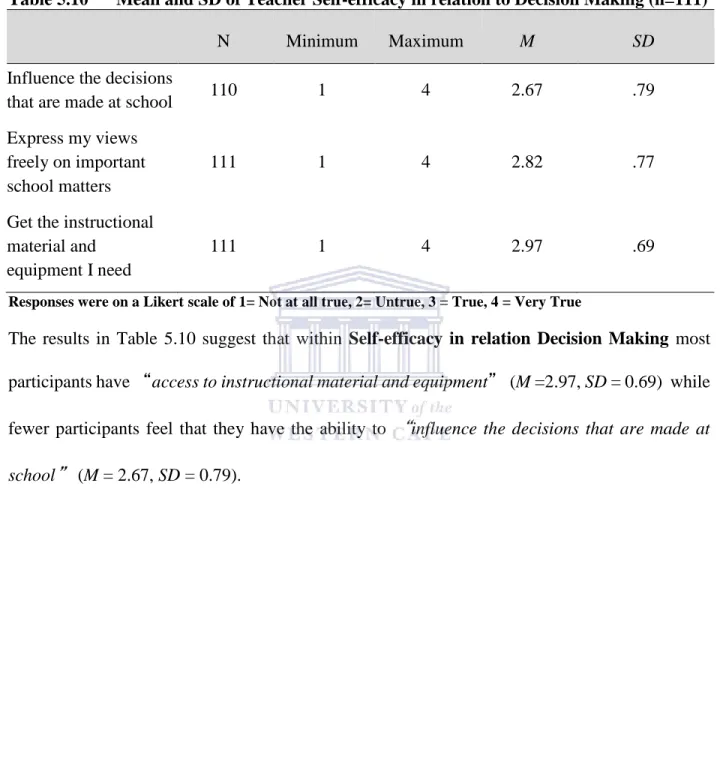
Table 5.10 Mean and Standard Deviation of the Teacher Self-efficacy in relation Decision Making
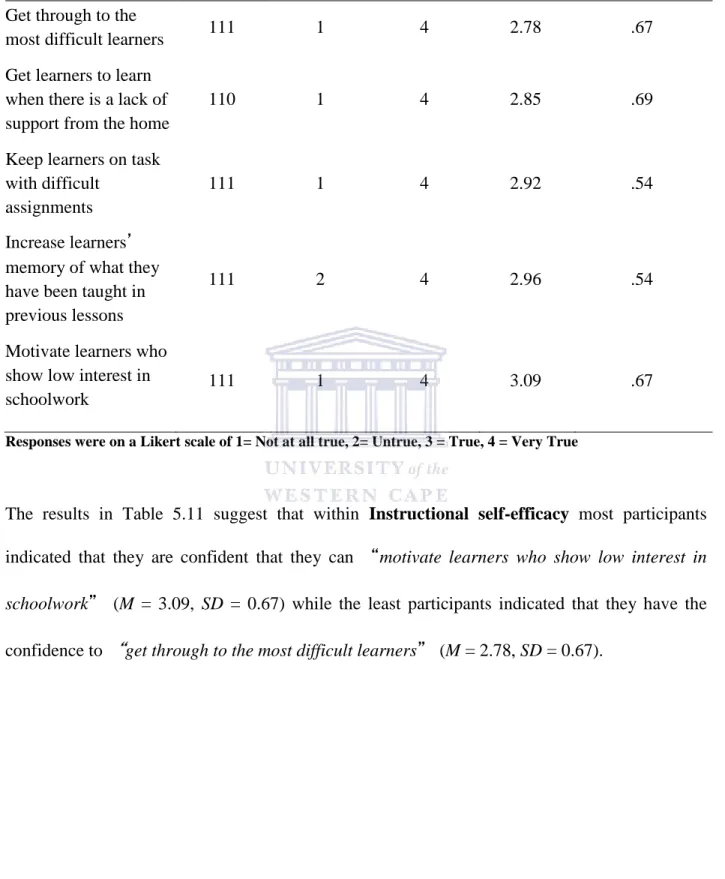
Table 5.11 Means and SD of items for Instructional SE
Table 5.12 Means and SD of items for class management and learner discipline control Table 5.13 Means and SD of items for Teachers’ effort
Table 5.14 Means and SD of items regarding TSE and perceived choice
Table 5.15 Means and SD of items for SE and Value of teachers Table 5.16 Means and SD of items for TSE Reduce school dropout Table 5.17 An overview of the Mean scores of Teacher Self-efficacy
Table 5.18 Means and SD of items for Self-Efficacy in Enlisting Social Resources Table 5.19 Means and SD of items for Self-Efficacy for Academic Achievement Table 5.20 Means and SD of items for Self-Efficacy for Self-Regulated Learning Table 5.21 Means and SD of items for Self-Efficacy for Leisure (spare, free) Time Skill Table 5.22 Means and SD of items for Self-Efficacy for Leisure Time Skill
Table 5.23 Means and SD of items for Self-efficacy for enlisting Parental and Community Support
Table 5.24 An overview of the Mean scores of Learner Self-efficacy Table 5.25 Why do learners sometimes consider to drop out of school? Table 5. 26 When do you think learners drop out of school
Table 5.27 Why do you think learners sometimes feel unsure about continuing their studies year after year
Table 5.28 An overview of the Mean scores and SD regarding teacher’s ability to recognize and influence learner dropout
Table 5.29 I sometimes consider dropping out of school Table 5. 30 I intend to drop out of school…
Table 5.31 An overview of the Mean scores of Learner Intention to Drop out of school Table 5.32 Correlations of Learners and Teachers
Table 5.33 Comparison of low and high socio-economic groups for teacher variables
Table 5.34 Comparison of low and high socio-economic groups for learner variables Figure 6.1 The Dropout Process
APPENDICES
Appendix A: Information Sheet
Appendix B: Consent Form for Teachers
Appendix C: Consent Form for Learners Appendix D: Demographics for Teachers
Appendix E: Demographics for Learners
Appendix F: Questionnaire: Motivation for Teachers Appendix G: Questionnaire: Motivation for learners
Appendix H: Questionnaire: Self-efficacy for Teachers Appendix I: Questionnaire: Self-efficacy for Learners
Appendix J: Questionnaire: Learners’ Intention to Drop Out of School (Teachers)
Appendix K: Questionnaire: Intention to Drop Out of School (Learners)
CHAPTER 1
INTRODUCTION
1.1 Background and Rationale
Education has long been seen as the cornerstone of nation building and economic progress for all countries (UNESCO, 2015). Twenty years into democracy, South Africa has now come to a crossroads within the education domain where the alarmingly high dropout rates from its high schools can no longer be ignored (Carm, 2013). The stark reality is that more learners are leaving the educational system than those remaining in the system (Education Statistics SA, 2006-2013). Learner retention and dropout rates in South African high schools represent a significant problem that affect thousands of children each year. Statistics show that there has been a consistent drop in the retention rate of about 50% over the last decade within South African schools (Education Statistics in South Africa 2002-2013; SNAP Survey 2006-2013).
The learners’ intention not to complete their high school career is not just an educational problem but a significant social problem as well (Branson et al., 2013; Burres & Roberts, 2012; Khalkhali, Sharifi & Nikyar, 2013). It has enormous psychological, economic and social ramifications (Khalkhali et al., 2013). There is strong evidence that dropouts may undergo a loss of self-esteem, are unemployed, sick, succumb to anti-social behaviour, turn to drugs, and become a financial burden to society (Khalkhali et al., 2013). According to Khalkhali et al. (2013), within a South African context, this phenomenon spells slow death as the nation is already charged with alarmingly high levels of unemployment and illiteracy. Learners, who drop out of school, seem not to have the desire to carry out the academic tasks required of them and lack the perseverance
or motivation to complete their school career (Barron & Darling-Hammond, 2008). Learners who lack motivation could feel frustrated, discontented and eventually unproductive. (Bosman, 2012; Eggan & Kauchack, 2007; Green-Demers & Pelletier, 2003; Santrock, 2008; Woolfolk, 2007; Woolfolk, 2010).
According to Bosman (2012), motivation is a process or a force that maintains, directs and sustains behaviour towards a goal. An absence of academic motivation could be termed educational amotivation (Hidi & Harackiewicz, 2000). Self-Determination Theory states that, behaviour can be affected through intrinsic motivation (pleasure and interest related motives), extrinsic motivation (parents, teachers, friends) and amotivation (Bosma, 2012; Deci & Ryan, 1985; 2002). In addition to amotivation, learners who drop out of school could also experience low levels of self-efficacy (self-confidence) (Mojavezi & Tamiz, 2012). Al these critical factors of intrinsic motivation, amotivation and self-efficacy also known as confidence, may play a crucial role in understanding why a learner considers dropping out of the education system.
Researchers are of the opinion that self- efficacy is important for the ability to apply appropriate strategies in order to execute a task (Claysen & Shaffet, 2006; Mojavezi & Tamiz, 2012; Muijs & Reynolds, 2001: Nauta, 2004). According to Bandura (1991, p.568), when perceived self-efficacy is high, more ambitious challenges are pursued, and a greater goal commitment is applied but when self-efficacy is low or absent, then failure is viewed as a likely outcome. It has been suggested that students who are most detached from school, have little belief in their academic ability (Skinner, 1995) and that students attribute their academic difficulties to their low perceived competence (Newhart, 2014; Sultan, 2012). Reflecting on the perceptions of Bandura (1991), regarding the positive effects of self-efficacy, it can be hypothesized that increased levels of self-confidence
within learners and their teachers, could have a positive impact on the retention rates within South African high schools.
Together with learners, teachers are arguably the most valuable asset to any academic institution. (Magno & Sembrano, 2007; Santrock 2008; Schunk, 2008). According to Woolfolk (2010), teachers could be perceived to be the midwives of the South African young democracy with its very young educational aspirations. Thus placing an intense demand for teachers to create a healthy environment conducive to growth and untapped potential (Barr, 2011). According to researchers (Magno & Sembrano, 2007), teachers need to be motivated to not only teach but ensure that they offer support to keep learners. This support, by teachers, could have a positive effect on learner retention in schools (NASP, 2009).
According to Sylvia and Hutchinson (1985) teacher motivation is based on the freedom to try new ideas, achievement of appropriate responsibility levels, and intrinsic work elements. They explain that true job satisfaction is derived from the gratification of higher order needs, -social relations, esteem, and actualisation, rather than lower order needs such as pay incentives. Magno and Sembrano, (2007) suggest that personal teacher self-efficacy has been defined as the confidence in one’s ability to teach efficiently and that appropriate teaching methods would achieve desired academic outcomes. Research on efficacy of teachers suggests that behaviours such as persistence on task, taking risks, and use of innovations could relate to degrees of effectiveness (Claysen & Shaffet, 2006; Mojavezi & Tamiz, 2012; Muijs & Reynolds, 2001; Nauta, 2001). Scientists confirm that the more teachers are allowed to remain on task and be innovative in their approach, the higher their levels of self-efficacy (Mojavezi & Tamiz, 2012). Motivation and self-efficacy of both learners and teachers may be necessary to improve learner retention in schools and subsequently reduce learner dropout. However, what the relationship is between these variables
are unclear. The purpose of this study will therefore be to examine the relationship between teacher motivation and self-efficacy and learner motivation and self-efficacy in relation to the learners’ intention to drop out of school.
1.2 Theoretical Framework
This study adopted Self-Determination Theory (SDT) as the conceptual framework for the study of motivation among learners and teachers as it explores those factors crucial to optimum educational performance and the achievement of the individual’s goals (Deci & Ryan, 2004; 2008). Self-Determination Theory is a theory of motivation. It is concerned with supporting natural or intrinsic tendencies to behave in productive and healthy ways. The theory was initially developed by Deci and Ryan (2004). The theory states that people are centrally concerned with motivation and how to move others to act (Deci & Ryan, 2004-2008). According to Deci and Ryan (2004), motivation is proven to be an essential ingredient in achieving desired outcomes regardless of the field of interest, especially in education (Deci & Ryan, 2004-2008).
Banduras Theory on Self–Efficacy (1994; 2002) was employed in the study of self-efficacy of learners as well as self-efficacy of teachers (Walker & Slear, 2011; Wolters & Daugherty, 2007). Self-determination theory proposes that both learners and teachers with high levels of self-confidence could have a positive effect on goal orientated educational behaviour and performance of both learners and teachers (Mojavezi & Tamiz, 2012).
1.2.1 Self-Determination Theory (SDT)
SDT is a macro-theory that looks at human motivation, wellness and development (Deci & Ryan, 2008). The theory indicates that individuals can motivate themselves to their fullest potential and
to work towards a cohesive sense of self (Deci & Ryan, 2004). According to Deci (2004) an individual can develop to his/her fullest potential when their needs are fulfilled or satisfied. Within SDT, there is a set of requirements that need to be met to achieve optimal functioning and psychological health (Deci & Ryan, 2008). The theory looks primarily at three such innate human needs: the need for competence, relatedness and autonomy (or self-determination) (Deci & Ryan, 2000; Roman, 2008). According to Deci and Ryan (2008), competence involves comprehending how to achieve various external and internal outcomes and being active in performing the required actions; relatedness means developing secure and satisfying connections with others in one’s social milieu; and autonomy refers to being self-initiating and self-regulating of one’s actions.( Deci & Ryan, 1985,1991, Vallerand &Pelletier,1991). The satisfaction of all of these needs is required to achieve the desired results (Deci & Ryan, 2000).
Self-determination theory distinguishes three kinds of motivation: intrinsic motivation, extrinsic motivation, as well as amotivation (Eggen & Kauchek 2007; Omrod, 2008; Reeve 2005; Ryan & Deci, 2000; Woolfolk, 2007). Scientists believe that motivation is situated along a continuum ranging from high to low self-determination, and which vary according to the degree of behavioural regulation (Deci & Ryan, 2000). Amotivation could therefore be seen as the absence of the intention to act (Eggen & Kauchek 2007). The absence of motivation to act in a positive way towards realising their academic goals, may be because these learners do not feel competent, cannot see the contingencies between behaviours performed and expected results (Deci, Pelletier, & Ryan, 1991). On the continuum, intrinsic motivation represents the highest degree of self-determined motivation (Deci & Ryan, 2000). Scientists are persuaded that intrinsic motivation occurs in situations in which people feel free to perform activities they find stimulating and that offer them a chance to learn (Deci, Pelletier, & Ryan, 1991).
Extrinsic motivation, in contrast, takes place when people carry out a task because they value the results associated with it (for example public acknowledgement, extrinsic rewards) more than the activity itself (Deci, Pelletier, & Ryan, 1991). Researchers found that many learners cannot predict the outcome of their behaviour nor can they see the motive behind it (Legault, Green-Demers & Belletere, 2006; Woolfolk, 2010). According to Legault (2006), learners who are amotivated feel detached from their actions and would invest little time and effort into its effects. This detachment from their actions, could resulting in individuals who perceive their actions as beyond their control (Legault, Green-Demers & Belletere, 2006). The state of amotivation has been likened to learned helplessness (Abramson, Seligman, & Teasdale, 1987). In the classroom, amotivation could associated with boredom, poor concentration and higher stress levels at school (Baker, 2004; Vallerant, 1997). Motivational deficit and a lack of self-efficacy (low self-confidence) may prove to be key ingredients in maintaining high levels of learner retention rates in high schools (Legault, Green-Demers & Belletere: 2006,; Vallerand & Bissennette, 1992; Vallerant 1997).
According to Deci and Ryan (1985, 1991), Self-Determination theory, when applied to education, is concerned primarily with encouraging learners to value education and to esteem themselves worthy of academic achievements and excellence. These outcomes are revelations of being intrinsically motivated and internalising values and regulatory processes (Deci, Pellertier, & Ryan, 1991). Research suggests that these processes of valued education and a healthy self-esteem, result in high –quality learning and conceptual understanding as well as enhanced personal growth and adjustment (Deci, Pellertier, & Ryan, 1991).
According to Hines (2013) the belief that teachers possess about their competency or self-efficacy to impact student learning, changes teacher performance. Science is of the opinion that teachers who believe that they can make a difference will do just that (Hines, 2013). Findings show that
teachers with a strong sense of self-efficacy may portray a greater sense of instructional resilience. (Walker & Slear, 2011). This feeling of resilience in instruction may cause and increased possibility that the pursued instructional strategy will be performed successfully (Hines, 2013). Research suggests as teacher self-efficacy increases, learner self-efficacy and performance also increases (Walker & Slear, 2011).
Findings suggest that teacher effectiveness and self-efficacious behaviours are based on years of teaching experience (Walker & Slear, 2011). Wolters and Daugherty (2007) found significantly low levels of self-efficacy among less experienced teachers. According to Wolters and Daugherty (2007), when teachers feel competent to execute a task and can administer changes, they would be motivated to assume responsibility for their actions. According to Wolters and Daugherty (2007) teachers could also take on more complicated and challenging tasks when their self-efficacy levels are high. Walker and Slear (2011) are also of the opinion that an atmosphere of power and competence is a strong catalyst for teacher satisfaction, learner productivity and lower learner dropout rates. Teachers who are confident in their ability to execute their subject objectives and positively influence their learners may be better equipped to see changers within learner behaviour. Early detection of changes in the behaviour of a potential dropout is crucial to sustainable retention rates within South African high schools (Walker and Slear, 2011)
Dropping out has been seen as leaving school for reasons that may seem to justify leaving the system (Branson, 2013; Burres & Roberts, 2012; Kalkhali., 2013). According Branson (2013), the results of dropping out of school may impose a tremendous cost on the economy, not just on those who fail to obtain a Senior Certificate. Scientists (Branson, 2013; Burres & Roberts, 2012; Kalkhali, 2013) believe that the risks of a troubled education system and high dropout rate may lead to:
Low self-esteem
Dropouts may have a harder time finding and maintaining jobs
Lower earnings
Dropouts are less likely to be active labour force participants
Higher criminal activity and incarceration rates
A life of poverty
Vulnerable to abusive relationships
Single parenting
Teen pregnancy
More likely to draw on public funds for health care and welfare
Less liable to contribute to tax revenues over their lifetime
Financial obligation to society (Branson, 2013; Burres & Roberts, 2012; Kalkhali , 2013). The high dropout rate in schools may have a knock-on effect on the economy of a country and could stunt economic and social growth (Green, King, and Miller-Dawkins, 2010). The reality of the adverse effect of weak learner retention within South African Schools has called for an urgent enquiry into the causes of the dropout problem within its high schools.
Learner dropout from high schools could be a critical feature in eradicating poverty by 2030 as planned by the South African government (Statistics SA, 2014). Managing poverty within South African borders have proven to be a challenge of mammoth proportions as poverty levels dropped slightly between 2006 and 2011, reaching a low of 20.2% for extreme poverty and 45.5% for moderate poverty, according to the Poverty Trends in the South Africa (Statistics SA, 2014). The report suggests three measures of poverty, with extreme poverty defined in terms of a "food poverty line" below which people are unable to purchase enough food for an adequate diet. Less
extreme poverty is defined in terms of a "lower-bound poverty line" below which, people can afford an adequate diet but would have to sacrifice food to purchase non-food items; and an "upper-bound poverty line" marking the level at which people can buy both enough food and non-food items (Statistics SA, 2014).
Trading Economics (2016) reveal that high school dropouts place tremendous pressure on an already alarming 24.50 percent unemployment rate in South Africa. With a population of 52 98 million and with a life expectancy of 56.10 years, it is most likely that these dropouts become the responsibility of the state and taxpayers for their basic needs, thus condemned to a life of poverty (Statistics SA, 2014).
Reducing poverty is seen as the world’s greatest challenge and in South Africa it is seen as one of the countries three most major threats, the other two being unemployment and inequality (Triegaardt, 2006). According to the latest statistics, more than 12 million people in South Africa live in poverty (Statistics SA, 2015). A report by the International Labour Organisation (ILO) claims that South Africa is projected to have the 8th highest unemployment rate in the world by the end of 2015 (Business Tech, 2015). It is, therefore, imperative that education be seen as an integral tool to eradicate poverty, inequality and unemployment in South Africa and that the gradual reduction of learner numbers be viewed intensely and objectively.
As this study mainly focuses on the causes and implications of high school dropout rates in South Africa, it is important to look at a comparative analysis of the class of 2003 to 2013 in South African schools. Statistics reveal (refer to Table 1.1) that these cohorts show a relatively steady decrease in learner numbers from Grade 8 and every year thereafter with a drastic decrease in learner retention from Grade 11 through to Grade 12.
Table 1.1 Enrolment figures from Grade 8- 12 from 2003 to 2013
Sources:
Education Statistics in South Africa 2002-2013
SNAP Survey 2006-2013
Statistics Education South Africa at a Glance 2003-2005
Department of Education South Africa .
The 2011 cohort in Table 1:1 shows an alarming decrease in matric enrolment (Grade 12 - 534498) than when they started their high school career in Grade 8 in 2007 (904565) (Education Statistics in South Africa, 2002-2013; SNAP Survey, 2006-2013). The Grade 12 cohort of 2013 had an enrolment of 958564 in 2009 (Grade 8) and a completion roll of 562112 in their final matric examination (Education Statistics in South Africa, 2002-2013; SNAP Survey, 2006-2013). These
Year GRADE 8 GRADE9 GRADE 10 GRADE 11 GRADE 12
2003 952488 880683 1073009 714639 452048 2004 985132 891930 1034145 806554 480646 2005 1023329 905393 1043081 814589 511884 2006 991555 942340 1063915 862900 538972 2007 904565 931510 1086865 891318 593667 2008 899097 877143 1047874 873152 566460 2009 958564 8980178 988207 851525 570849 2010 965394 974521 1006549 808997 5434498 2011 6713502 1049904 1094189 847738 534498 2012 934885 1058852 1065329 835932 512303 2013 562112
statistics are a clear indication that strategies to improve learner retention in South African high schools should be looked at urgently and should therefore be top on the priority list of intervention strategies. Dropout statistics and trends have to be evaluated objectively in order to fully grasp the magnitude of the challenge at hand.
Table 1.2 below is a NationalIncome Dynamics Study of the Learner dropout rates by grade. The table depicts the dropout rate per one thousand learners per grade from grade one to grade 12. The table displays a gradual drop in the learner numbers in every grade. However, after grade nine, the dropout rate spikes with more than two hundred learners per thousand. Between Grade 11 and Grade 12, the learner roll crashes even more with a higher than fifty percent difference in learner totals than when their cohort started school in grade one twelve years earlier.
Table 1.2 Learner dropout rates by Grade Source: Presidency, National Income Dynamics Study, and Wave 1 (2008) and Wave 2 (2010)
GHS 2003-2005 2006-2008 2009-2011 Grade Retention Rate per 1000 (%) Dropout rate % Retention Rate per 1000 (%) Dropout rate % Retention Rate per 1000 (%) Dropout rate % Zero education 1000 2.0 1000 1.8 1000 1.1 Grade 1 980 0.3 983 0.2 989 0.2 Grade 2 977 0.4 980 0.4 987 0.3 Grade 3 973 0.9 976 0.5 985 0.6 Grade 4 964 1.3 971 1.1 979 0.9 Grade 5 951 1.8 961 1.6 970 1.3 Grade 6 935 3.1 945 3.1 957 1.9 Grade 7 906 5.2 916 5.2 939 3.7 Grade 8 858 7.5 868 7.4 904 5.7 Grade 9 793 11.1 804 11.3 853 9.9 Grade 10 705 18.5 713 17.5 769 17.5 Grade 11 575 27.6 588 28.3 634 28.3 Grade 12 416 38.2 422 39.34 455 39.34
Source: General Household Surveys (GHS): 2003-2011; Basic Educator, Macro Indicator Report, 2013
For the most recent cohort in Table 1.2, shows that 989 children per 1000 completed grade 1. As seen in Table 1.2, the dropout rate increases with each grade level. The dropout rates peak in
Grades 10 and 11: 17.5% of those who attain Grade 10 achieve no more education, and 28.3% of those who attain Grade 11 do not attain matric. This estimate of 28.3% is probably a slight underestimation because in the last couple of years the matric pass rate has been above 70%. This underestimation could be due to participants indicating that they have attained Grade 12 when in fact they participated but did not pass Grade 12. Table 1.2 also highlights the critical grades where learner dropout seem to peak. Furthermore, the statistics also suggest that not much progress has been made to decrease learner dropout rates within South African schools regardless of amendments in educational policies or curriculum changes. It may therefore be an imperative to begin understanding the underlying factors, which may increase learner dropouts in schools. Thus, the purpose of the current study was to examine the relationship between teacher and learner motivation and self-efficacy in relation to learners’ intention to drop out of school.
1.3 Problem Statement
Motivation is essential to education because it provides the energy and direction that learners need to be successful at school (Mojavezi & Tamiz, 2012). If all activities that learners had to undertake in the classroom were fun and interesting, there would be no need to study motivation. Unfortunately, learners have to do many tasks that they do not like, are not interested in, do not feel competent in (Bosman, 2012). The lack of interest by learners requires that teachers should ensure that learners feel capable that they can do the task, and that they find tasks meaningful, exciting and purposeful (Boekarts, 2010). Such positive self-efficacy, according to Boekarts (2010), is considered to be a predictor of learner success and ultimately, remaining in school. The high learner dropout rate in South African high schools may be a strong indication that learners who leave school prematurely may lack the motivation and self-efficacy to remain in schools. The
high levels of learner exodus from schools may indicate that teachers may lack the motivation and self-efficacy to believe that they can make a difference in the lives of these learners in order to keep them in schools (Reeve 2005; Woolfolk, 2007). The high dropout rate in high schools may be a strong call to further research in the area of teacher self-efficacy in relation to learner motivation and academic achievement (Wolters, 2007).
1.4 Research Questions
What are the motivation levels of learners and teachers?
What are the self-efficacy levels of learners and teachers?
What is the intention for learners to drop out of school?
Is there a relationship between learner and teacher motivation and self-efficacy in relation to the intention of learners to drop out of school?
1.5 Aim and Objectives
1.5.1 Aim
The aim of the study was to determine the relationship of learner and teacher motivation and self-efficacy with intention of learners to drop out of school.
1.5.2 Objectives
The objectives of the study were to:
Establish the motivation and self-efficacy levels of high school learners and teachers;
Assess the intention of learners to drop out of school;
Determine the relationship of learner and teacher motivation and self-efficacy with the intention of learners to drop out of school.
Compare learner and teacher motivation, self-efficacy and the intention of learners to drop out of school between low and high socio-economic schools.
1.5.3 Hypotheses
1. There will be a significant relationship between learners and teachers motivation, self-efficacy and learner’s intention to drop out of school.
2. There are significant differences in motivation and self-efficacy levels between teachers and learners at high and low socio-economic schools as well as significant differences in learner dropout rates at high and low socio-economic school.
1.6 Methodology and Research Design
The study used a quantitative approach with a cross-sectional comparative research design to compare in terms of motivation and self-efficacy of learners as well as teachers and its effect on the learner retention rate in high schools. Denzin and Lincoln (2000) state that quantitative research tends to highlight the measurement and analysis of various cause and effect relationships between variables. It is also a method where data is gathered in the form of numbers and are analysed using statistical measures (Terre Blanche, Durrheim, & Painter, 2006). In a cross-sectional comparative design, the time dimension is considered as only providing a snapshot of the current status of an issue and does not consider the issue longitudinally (Babbie & Mouton, 2007). Since the study
aimed to compare motivation and self-efficacy of both teachers and learners within South–African schools and, at a given point in time, a comparative cross-sectional design has been implemented. 1.7 Significance of the Study
The results from this research study may help a number of individuals; (i) parents and guardians, (ii) schools as well as (iii) Community Organisations (iv) Curriculum Advisors (v) area and circuit managers. Parents, guardians and teachers will be aware of the role learner and teacher motivation and self-efficacy could play in their learners ‘intrinsic ability to be task orientated and ultimately complete their school career. Schools will be able to recognise potential learners with low levels of motivation and self-efficacy and those learners who are at risk to drop out of school. Teachers with low motivation levels and with a low sense of self-efficacy could be identified and given the necessary support by School Management Teams (SMT), and Curriculum advisors in order to ensure that all learners and teachers perform to their full potential and produce work of high standard and excellence. Community organisations will have an idea of the collective views that learners foster concerning their educational future. These views, positive or negative in nature, may be the springboard for future vocational training and intervention strategies. This research may also add to current international debates in this area of research.
1.8 Structure of Thesis Chapter One
This chapter is an introduction to the study of the relationship between learner and teacher motivation and self-efficacy in relation to the intention of learners to drop out of school. It also looks at the research questions, aims, objectives, definitions, the significance of the study and ethical questions.
Chapter Two
This chapter examines and explores the theoretical framework of this study. The purpose of this chapter is to build a theoretical perspective of Self-Determination Theory and its influence on motivation of learners and teachers as well as the adverse effects of amotivation within education. This chapter also explores Bandura’s Theory on Self-Efficacy. Both theories will be employed to examine their influence on learner retention rates within high schools.
Chapter Three
This chapter explores literature on high school dropout as well as possible causes of learner dropout and its effects in South African education and various other countries. The chapter also explores the gradual drop of learner numbers and the potential reasons for the progressive fall of learner numbers in schools. Furthermore, the chapter examines the Push, Pull and Falling out Framework and its effect on learner dropout in high schools. The chapter also looks at the predictive factors of learner dropout as well as possible vocational programs. In addition, the chapter explores the effects of dropout on the economy of a country by studying its influence on unemployment and poverty. Finally, the chapter examines those factors contributing to teacher motivation, job satisfaction of teachers, job dissatisfaction of teachers as well as possible sources of job satisfaction for teachers.
Chapter Four
Chapter four of the study commences with a description of the methodology and research design that were employed to answer the research questions. This is followed by an in-depth investigation into the different data collection methods that were used by the researcher. The chapter progresses on to examine the concepts, trustworthiness and ethics. In conclusion, an analysis of the manner in which the data was collected through the various questionnaires and the focus groups which were teachers and learners.
Chapter Five
This chapter provides an analysis of the findings as well as presentation using tables. Descriptive quantitative results are analysed. Using the Statistical Package for the social Sciences 22 (SPSS) as these are presented. The statistical presentation represents the descriptives of learner and teacher demographics, teacher and learner motivation and self-efficacy. Furthermore, the chapter presents the correlations between teacher and learner variables as well as comparisons between low and high socio-economic schools. Finally, this chapter presents a summary of the findings of this study. Chapter Six
The quantitative study is an examination of the relationship between learner and teacher motivation and self-efficacy in relation to the intention of learners to drop out of school. The current study is a presentation of the comparative study of the relationship between the motivation and self-efficacy of learners and teachers and their influence on the high school dropout rate in South Africa. The findings of Chapter 5 are examined in relation to the aims and hypotheses of the thesis discussed in Chapter 1 and integrating the theoretical framework discussed in Chapter 2. This
chapter also elaborates on Motivation and self-efficacy of learners and teachers and learner dropout as well as the impact of socio-economic schools. Finally, the limitations and recommendations of the study are discussed and presented.
The next chapter, Theoretical Framework as Chapter 2, follows.
CHAPTER 2
THEORETICAL FRAMEWORK
2.1 Introduction
This chapter examines and explores the theoretical framework of this study. The purpose of this chapter is to build a theoretical perspective of Self-Determination Theory and its influence on motivation of learners and teachers as well as the adverse effects of amotivation within education. This chapter also explores Bandura’s Theory on Self-Efficacy. Both theories will be employed to understand the possible influences on learner dropout rates within high schools.
2.2 Self-Determination Theory
Self-Determination Theory is a theory of motivation. The theory focuses on supporting natural or intrinsic tendencies to behave inefficient and healthy ways. The method was initially developed by Deci and Ryan (2000). The theory states that people are primarily concerned with motivation and how to activate themselves or others to action. Parents, teachers, coaches and managers everywhere, are concerned with how to motivate those people they mentor. Regardless of race, creed or gender, all individuals struggle to find the energy, get mobilized or persist at a task or work. Often people are moved by external factors such as rewards, grades, appraisals, or the opinions of others. However, just as well, people tend to be motivated from within, by curiosity, interest, or values. These intrinsic motivations might not be externally rewarded or supported, but they have sufficient inherent energy to sustain passions, creativity and sustained efforts (Deci & Ryan, 2000).
SDT gives a detailed explanation of the basic psychological needs that are inherent in human life and focuses primarily on three such innate needs: the need for competence, relatedness and autonomy (or self-determination) (Deci & Ryan, 2000). Research claims that competence involves understanding how to achieve various external and internal outcomes and being efficacious in performing the required task or action (Deci & Ryan, 2000). According to Deci and Vallerand (1991), relatedness involves developing secure and satisfying connections with others in one’s social sphere, and autonomy refers to being self-initiating and self-regulating of one’s behaviour. Occasions to gratify any of these three basic human needs contribute to people being motivated as opposed to amotivated. Furthermore, opportunities to satisfy the need for autonomy are fundamental for people to be self-determined rather than controlled (Deci & Ryan, 2000).
Self-Determination Theory indicates that (a) people are inherently motivated to internalize the management of seemingly irrelevant but valid activities; (b) there are two different ways through which such internalization can be expressed, resulting in qualitatively various ways of self-regulation; and (c) the social milieu influences in which the internalization process and regulatory style occur (Deci & Ryan, 1985). According to Deci & Ryan (2000) the two types of internalization processes are introjection, which involves taking in a value or regulatory process but not accepting it as one's own e.g. when a learner prepares for an examination using only the notes given to him in class. Integration occurs through which the regulation is integrated with one's core sense of self e.g. when a learner uses more material than what was given in class because of interest in the subject matter (Deci, 1994). Introjection leads to internally controlling regulation, whereas integration results in self-determination (Deci, 1994). Deci et al. (1994), conducted an experiment, which confirmed their hypothesis that three facilitating contextual factors such as, providing a meaningful rationale, acknowledging the person’s feelings, and conveying choice,
all promote internalization (Deci, 1994). The subsequent self-regulation of behaviour is evidence of this (Deci & Ryan, 2000). Deci & Ryan (2000) concluded that integration seems to take place when the social context, in this case, the classroom, supports self-determination and introjection happen when the social context does not support self-determination (Deci, 1994).Thus creating a classroom environment where both learner and teacher have space and time to explore beyond the boundaries of prescribed texts and curriculum pace setters. Researchers believe that teachers and learners can be actively engaged in an activity such as the enjoyment of solving algebraic equations or be passively disengaged such as following pre-set steps of how to solve algebraic problems but never learning how to employ the same rules elsewhere in mathematics (Ryan & Deci, 2000). Scientists believe that learners will operate in either sphere, of full engagement or passive engagement, if the social environment lends itself to whichever scenario (Ryan & Deci, 2000). Specific factors have been investigated that reinforce versus thwart intrinsic motivation, self-regulation, and well-being. These factors include the basic psychological needs for competence, autonomy, and relatedness (Deci & Ryan, 2000). Deci and Ryan (2000) suggest that these needs will either be satisfied or frustrated due to a supportive or non-supportive/controlling environment. This central aspect of SDT has been studied within contexts such as health care, education, work, sport, religion, and psychotherapy (Ryan & Deci, 2000). The current study will focus primarily on motivation within education.
2.2.1 Motivation
The construct “motivation” has been described in various ways by authors and researchers over the years. According to Baron, Henley, McGibbon and McCarthy (2002), “Motivation” is derived from the Latin term “movere” which means “to move”. The question is, what “
moves” individuals to behave in a particular way and what fuels their actions? Motivation is also perceived on a continuum starting at intrinsic motivation on the one end of the spectrum and amotivation on the opposite end of the spectrum (Baron, Henley, McGibbon, & McCarthy, 2002). Deci and Ryan (2002) defines amotivation as motivational deficit or feelings of helplessness and alienation. Amotivated individuals cannot see a link between their actions and subsequent outcomes of these actions (Pelletier, Fortier, Vallerand, & Briere, 2001). These individuals may feel disconnected from their actions and may lack self-control and invest little or no effort into accomplishing the task. Within a class set-up, amotivation has also been associated with boredom (Vallerand & Pelletier, 1991), poor concentration as well as high stress levels (Baker, 2004). Boredom and poor concentration may be key indicators of early symptoms of the intention to drop out of school (Pelletier, 2001). There are convincing evidence that amotivation is multidimensional in nature, suggesting that there are different sources that may lead learners to be amotivated (Pelletier, Fortier, Vallerand, & Briere, 2001). Learners may feel that a particular behaviour might not be effective in achieving their goals, or learners may not have the self-confidence (self-efficacy) about their ability to achieve their objectives (Bandura, 1997). Pelletier, Fortier, Vallerand, & Briere, (2001) also reiterates the notion that some learners may be reluctant to perform a task as they may feel that they are unable to sustain the necessary effort needed to maintain the required behaviour. Resulting in amotivation that in turn may lead to the first stage of dropout also seen as the stage where learners consider the possibility of dropping out. Research shows that these thoughts of consideration to dropping out start long before the actual intention is acted upon by the learner (Pelletier et al., 2001).
Graham and Weiner (1992) grappled with probing questions like, why some learners achieve their goals regardless of extreme adversity while others give up at the slightest provocation and why
some learners set such high goals for themselves that failure is inevitable? Or how do some teachers manage to achieve their professional goals regardless of adverse working conditions (Graham & Weiner, 1992). This study, therefore, seeks to find a relationship between intrinsically motivated learners as well as their teachers. The researcher will also seek to find reasons why seemingly capable learners and teachers may display an inability to muster the courage to perform in challenging circumstances. Lacking the drive to persist and persevere at a given task, regardless of their potential and natural abilities (Graham & Weiner, 1992).
Applying Self-Determination Theory (SDT) to an educational framework is concerned primarily with motivating learners’ enthusiasm and interest in learning, esteeming education and portraying confidence in their potential and attributes (Gagné & Deci, 2005; Reeve, Deci, & Ryan, 2002). Deci, Vallerand, Pelletier and Ryan (1991) proposed that these manifestations and outcomes are evidence of being intrinsically motivated, internalizing values and regulatory processes. Research within the academic framework seem to indicate that enthusiasm, confidence and interest in learning could be a highly beneficial undertaking (Gagné & Deci, 2005; Reeve, Deci, & Ryan, 2002). Research suggests that these processes result in high-quality learning and conceptual understanding as well as boosting personal growth and adjustment (Deci et al., 2005). SDT expounds why autonomously-motivated learners flourish, and why leaners benefit when teachers support their autonomy (Gagné & Deci, 2005; Reeve, Deci, & Ryan, 2002). Ree ve (2002) has observed that autonomy-supportive teachers assist optimum performance by anticipating which academic approaches enhance self-determination and competence within learners. SDT has further shown that individual's motivating style is pliable and subject to change and that teachers can learn how to be more autonomy supportive with learners (Deci & Ryan, 2002). Researchers
are of the opinion that the effort to integrate learners' motivational resources such as self-determination into the school curriculum may require asking teachers to acquire new teaching methods and skills and to embrace conceptual change (Clift, 2005; Ward, 2002;). In South Africa, where change within education is the order of the day, new methods may prove to be a daunting task for both teachers and learners. Implementing major changes within education, too quickly, could be risky and too demanding for South African teachers and learners. Which may lead to amotivation (Clift, 2005; Ward, 2002). Only extensive research may alleviate the stresses of academic change.
2.2.2 Learner Motivation
According to Shen, Wingert, Li, Sun, and Rukavina (2008), learners lacking motivation could be classified into four categories: their ability beliefs, effort ideas, the value placed on tasks and characteristics placed on a task. In his interview sessions with learners, Carlson (1995) found that alienated learners felt that acquiring an education was not personally important and that those learners had a small perception of competence and adherence. Carlson (1995) believes that those learners are most likely to be passive in class, fake illness, or absent. These findings were confirmed by Ntoumanis (2004) who studied British School children, and reported that amotivation resulted from learned helplessness beliefs and was often evident in non-attendance, little involvement in class, and low intention and self-determination to pursue educational goals. All these factors may be an indication of an overall state of alienation and helplessness (Deci & Ryan, 2002). Research by Deci & Ryan (2002) confirms that the dimensions of amotivation may be negatively correlated with teacher in–school effort and class setup. Thus reinforcing the notion that learners’amotivation status are directly associated with their class environment (Shen, 2008).
In their early years of development, learners spend more than 15,000 hours in schools (Jusoff, 2009). Schools, therefore, play an imperative role in socializing that in turn has a significant influence on the course of people’s lives and ultimately on society (Jost, 2000). According to Jost (2000), ideal school systems are ones that succeed in promoting in students a genuine enthusiasm for learning, accomplishment and a strong sense of voluntary involvement in the educational enterprise. Research (e.g.,) indicates that it is this interest and free will that lead to students’display of greater flexibility in problem-solving and more efficient knowledge acquisition. These qualities also invoke a strong sense of personal worth and social responsibility (Butler-Kisber, 2011).
Researchers are of the opinion that learning is about conceptual understanding and being flexible in the application of knowledge (Ryan, 1991; Tuckman & Monetti, 2012). Tuckman and Monetti (2012) are convinced that the acquisition of facts are important but by no means enough for excellent education. Researchers maintain that the central features of optimal adjustment are feeling good about oneself and acting volitionally to satisfy one’s needs while being fully aware and concerned about the social environment (Sullivan, 2012; Assistance, 2012; Casner- Lotto, 2006; Futures, 1999). Sullivan et al (2012) confirms that to just fit in or conform to social demands is a non-optimal form of adjustment and may even suppress social development. SDT (Ryan & Deci, 2000) indicates that work is at its optimal potential when the educational context stimulates a strong sense of motivation in its learners. According to Ryan (1991), Tuckman and Monetti (2012), the greatest conceptual learning seems to occur under similar motivational conditions that endorse and foster personal growth and adjustment. These conditions empower
learners to rise above social challenges and regulate their behaviour to achieve their personal goals (Ryan, 1991; Tuckman & Monetti, 2012).
2.2.3 Teacher Motivation
Together with learners, teachers are arguably the most valuable assets to any academic institution (Magno & Sembrano, 2007; Santrock, 2008; Schunk et al., 2008; Woolfolk, 2010). Woolfolk (2010) believes that teachers need to be motivated to not only teach but ensure that they offer support and continuous encouragement to keep learners in school. Another reason for using SDT especially in the arena of teacher motivation is that it makes explicit predictions concerning motivational consequences. According to Woolfolk (2010) SDT can be used to examine important outcomes such as the impact of motivated teachers on the academic performance of the learners in their care. Woolfolk (2010) could convey that self-efficacious teachers may be able to detect early in the dropout process (Refer to figure 6.1) which learners show a decline in self-confidence levels and who may be at risk of dropping out of school.
Frederick, Manning, Ryan, and Deci (1996) clearly reveal that the two self-determined forms of motivation (intrinsic motivation and self-determined extrinsic motivation) result in positive outcomes, positive feelings, relatedness and autonomy respectively. DeCharm (1968) confirms that the need for autonomy refers to people's need to feel they are the source of their actions, and it represents the notion of choice. The necessity of competence refers to individual’s desires, in this case, teachers, to interact proficiently or effectively with their social milieu (Martin & Sugarman, 1993). The need for relatedness refers to individuals desire to feel connected with others and to experience a sense of belonging in a particular social context (Baumeister, 1995). Scientific evidence conveys that when teachers are not entirely engaged in an activity or does not
feel that what they do have lasting value, they might feel disillusioned and even be at risk of completely opting out and thus losing interest to employ creative strategies to intervene destructive behavior in their learners (Baumeister, 1995).
2.3 Teachers
2.3.1 Motivation to Work
Maslow (1943) sought to understand what motivates people. He was of the opinion that people are motivated by a set of rewards or unconscious desires. He identifies a hierarchy of needs of which includes five motivational needs (Maslow, 1943, 1954). The five -stage model can be divided into basic (or deficiency) needs e.g. physiological, safety, love and esteem and growth needs (self-actualisation). The five-stage needs could be described as 1) biological and physiological needs – air, food, drink, shelter warmth, sex, sleep; 2) Safety needs – protection from elements , security, order, law, stability, freedom from fear; 3) Social needs- belonging, affection and love – from work group, family, friends, romantic relationships; 4) Esteem needs – achievement, mastery, independence, status, dominance, prestige, self-respect, respect from others; 5) Self-actualisation needs- realising personal potential, self-fulfilment, seeking personal growth, and peak experiences (McLeod, 2007). According to Maslow, the deficiency needs seem to motivate people when they are unmet. He also conveys that when one need is satisfied, an individual would seek to fulfil the next one (Maslow, 1943). He believes that the need to fulfil those needs will become stronger the longer they are not granted. McLeod (2007) reiterates that each person is capable of achieving the highest level of self-actualisation provided that all the other needs are met. We could assume that teachers would be motivated to teach and be able to meet all their academic goals if their needs (as mentioned above) are met.
2.3.2 Motivation to Teach
Research findings have affirmed that people are intrinsically motivated to work hard, are dedicated and always want to feel proud of their accomplishments (Beck, 1983; Roos, 2005). Sylvia and Hutchinson (1985) have reiterated that given the ideal circumstances, in this case the classroom, there would be no limit to what could be achieved and produced. It is thus crucial to investigate and determine which factors promote teacher motivation and which factors have an adverse influence on their ability to achieve their academic goals. According to Sylvia and Hutchinson (1985) teacher motivation is based on the freedom to try new ideas, achievement of appropriate responsibility levels, and intrinsic work elements. High levels of teacher motivation and self-efficacy may prove to be essential components for teacher productivity regardless of external factors such as pay incentives or resources (Sylvia and Hutchinson, 1985).
2.4 Bandura’s Theory on Self-Efficacy (SE)
Self-efficacy, an element within social cognitive theory, is also seen as a person’s belief that he/she is capable of executing a particular task successfully (Bandura, 1977, 1997). Bandura believes that the subjects have confidence in themselves that they have the capability to achieve whichever goals they have set out. Self-efficacy is thus supported by the notion that it is a form of self-confidence (Kanter, 2006) or even a task-specific version of self-esteem (Brockner, 1988). Bandura believes that Self-efficacy has three dimensions: (1) magnitude, the level of task difficulty a person believes he or she can attain e.g. a learner will attempt more difficult reading material as he/she increase in his ability to read more difficult texts; (2) strength, the conviction regarding magnitude as strong or weak e.g. a learner will press on to achieve a matriculation certificate regardless of the inevitable challenges in the various grades leading up to Grade 12; and (3)
generality, the degree to which the expectation is generalized across situations e.g. learners will attempt challenging activities in relation to their expectation of success and goal achievements.. Thus, learners can do whatever they put their mind on, and they can realise any goal that they perceive as possible (Bandura, 1977, 1997).
Albert Bandura’s (1986) theory on self-efficacy revolves around the opinion that people’s beliefs in their ability are based on how they perceive themselves as opposed to how others see them. He believes that the basis for all human functioning is rooted in the concept of self-efficacy. Kanter (2006) believes that self-efficacy refers to people's judgment of their capabilities to organise and execute courses of action required attaining designated types of performance show According to Bandura (1977), self-efficacy is the fuel behind personal achievement, personal well-being, motivation, and perseverance. The perception is that people are the authors of their truth about who they believe they are, and what they perceive to be reality (Bandura, 1977).
2.4.1 Self- Belief
Researchers (Claysen & Shaffet, 2006; Mojavezi & Tamiz, 2012; Muijs & Reynolds, 2001; Nauta, 2004) show that appropriate strategies are needed to perform a task successfully. Claysen and Shaffet (2006) are certain that self-efficacy is of the utmost importance to achieve ones goals. According to Bandura (1991), with increased levels of self-efficacy, more resourceful challenges are pursued, and subjects become more goal orientated. However when self-efficacy is low then failure is seen as inevitable Bandura, (1991). Mojavezi and Tamiz (2012) believe that people with low self-efficacy lack the strength and motivation to attempt to succeed as their perception of eminent failure clouds their judgement. Among the mechanisms of personal agency, none is more