Evaluation of BRCA1 Gene Mutations Frequency in Breast
Cancer Patients
Fulla AL-Riyahee
College of Education, Basra University, Basra, Iraq Abstract
Breast cancer is the most frequent carcinoma in females. The present study aimed to shed light on the association between the breast cancer incidence and BRAC1 gene mutations. This study was carried out on two groups of 30breast cancer patients and 10 of healthy control. Polymerase chain reaction (PCR) for exon 2 of BRCA1 was performed to detect the gene mutations.The results showed 21(70%) samples were negative to BRCA1gene mutation while 9 (30%) samples were positive to it, which was a significant difference (p value=0.0984 <0.05). The statistical analysis showed no significant differences in the frequency of BRCA1 gene mutation with age and family history. In correlation with the tumor stage, the highest percentage of BRCA1gene mutation positive samples 7(77.77%) were stage II that statistically no significant differences from percentage of stage III.In conclusion, the BRCA1 gene mutation may play a key role in breast cancer incidence and have a relatively high frequency in tumor stage II .
Keywords: Breast cancer, BRCA1 Gene ,mutation 1- Introduction
Breast cancer is the most frequent carcinoma in females and the second most common cause of cancer related mortality in women (Bombonati and Dennis , 2011) . It is the most commonly diagnosed malignancy in women around the world, especially in the Western countries. It accounts for almost one fifth of deaths caused by cancer (Winer et al., 2001). Every year, one million new cases are reported worldwide, representing 18% of the total number of cancer in women. It has been established that one out of eight women (in USA) and one out of 10 women (in UK) (Evans and Lalloo , 2002) will develop breast cancer at some point in her life. An Iraqi studies shown that the number of breast cancer cases are steadily rising since the 1991 war (Berchuck , 1999 ; Jasim , 2004). The genetic contribution to breast cancer risk is indicated by the increased incidence of breast cancer among women with a family history of the disease and by the observation of families in which multiple members have breast cancer in a pattern compatible with autosomal dominant inheritance of cancer susceptibility. Linkage analysis studies of families have led to the identification of highly penetrant genes as the possible cause of inherited cancer risk in many cancer-prone families (Hall et al., 1990). However, mutations in these genes are rare, and account for no more than 5–10% of breast cancer cases. It is probably that other background genetic factors contribute to the etiology of breast malignancies, Hopper(2001). Autosomal dominant inherited predisposition to breast cancer is characterized by early age at onset, bilaterally, vertical transmission through both maternal and paternal lines, and familial association with tumors of other organs. Identification of the
BRCA1 and BRCA2 genes marked an important step in understanding the molecular bases of the hereditary
susceptibility to cancer (Wooster et al.,1995). BRCA1gene appears to be responsible for disease in 45% of families with multiple cases of breast cancer only and up to 90% of families with both breast and ovarian cancer. BRCA1 is mapped to chromosome 17q21 (Hall et al., 1990) ; it contains 24 exons and encodes a protein of 220 KDa, composed of 1863 amino acids. BRCA1 contains only two recognizable protein motifs, a RING finger domain near the N-terminus and a BRCT domain at the C-terminus. The phenotype for BRCA-related tumors appears to be heterogeneous, and to date is better characterized in BRCA1 than in BRCA2 (Phillips,2000). Different types of mutation have been found in the BRCA1 gene and predispose to development of cancer. The most common of them is the frame shift mutation at position 185 in exon 2, involving deletion of adenine and guanine (185 del AG mutation) (Bonatti et al., 2006). The identification and study of this mutation could facilitate early diagnosis and proper counseling for breast cancer. In this study, we analyzed the frequency of the 185 del AG mutation (exon 2) of BRCA1 gene BRCA1 gene mutation in 30 breast cancer samples using conventional polymerase chain reaction and estimate the hypothesis that there is an association between risk for developing breast cancer and BRCA1 gene mutation.
2-Materials and Methods
Patients and clinical samples: the blood samples from 30 patients with different stages of newly diagnosed breast cancer were provided by Tumor center/ Alsader Hospital /Missan during the period from December 2015 to March 2016. 20 blood samples from healthy donors were used as a control in this study. From each sample, 2
2-1 DNA extraction and Polymerase chain reaction
DNA was extracted from frozen blood samples by the gSYNCDNA Mini method (Geneaid/ Taiwan) according to the “frozen blood protocol”.
Polymerase chain reaction (PCR) of exon 2BRCA1was performed using an ABI thermal cycler (Applied Biosystems / Korea). The primer sequences used are shown in Table 1, (Alpha DNA/Canada). PCR amplification was performed in a total volume of 25 µl containing, 5 µl dNTPs, 1 µl of each primer, master mix (Promega/USA),12.5 µl, and nuclease free water 5.5 µl. The following program was used : 1 cycle at 95°C for 5 minutes followed by 33 cycles at 94°C for 1 minute, 58°C for 1 minute and 72°C for 1 minute, 1 cycle at 72°C for 10 minutes. The PCR amplification products were separated by2% agarose gel electrophoresis and visualized by exposure to ultraviolet light after ethidium bromide staining.
Table 1: Primers used in polymerase chain reaction.
Primer Sequence Size/bp
BRCA1-F 5'-GAAGTTGTCATTTTATAAACCTTT-3'
262
BRCA1-R 5'-TGTCTTTCTTCCCTAGTATGT-3'
2-2 Statistical analysis
The overall frequency of exon 2 BRCA1mutations were computed for all 30 cases with respect to age at diagnosis, family history of breast cancer, and tumor stages. Differences in proportions were evaluated using the Z- test for proportions comparing.
3- Results
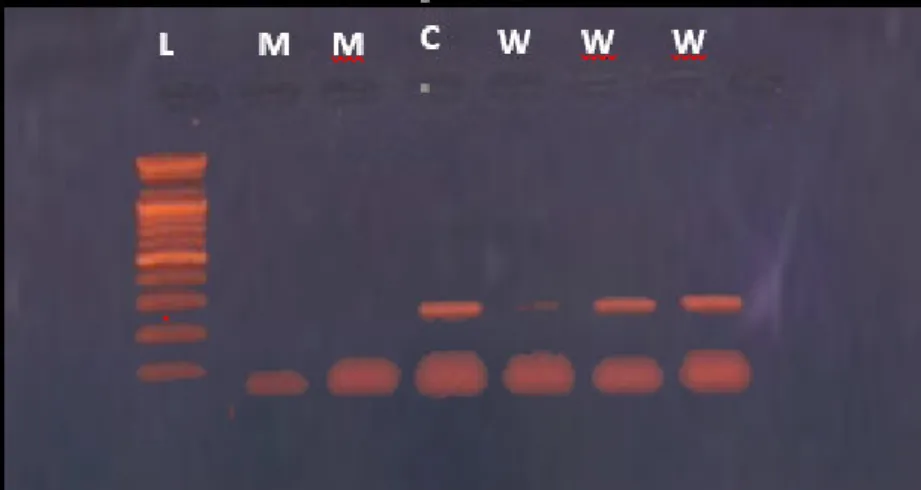
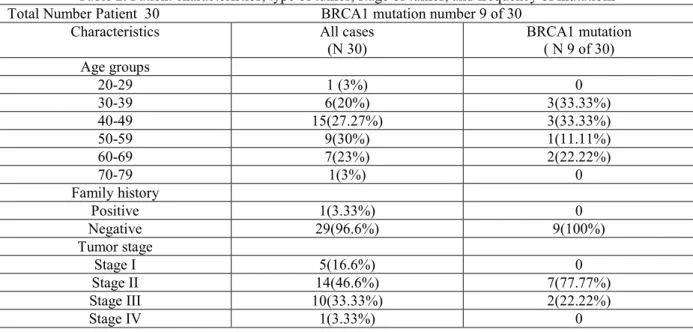
In the present study the patients’ age range was 25-70 years and the median is 49 years with high frequency of patients in the range of 40-49 years. According to the family history, 29(96.6%) of patients had negative family history which statistically high significance differences (p value=0.0151 <0.01) in comparison with patients that have positive family history1(3.33%). The distribution of patients according to the tumor stages showed that 5(16.6%) out of total patients were stage I, 14(46.6%) were stage II, 10(33.33%) were stage III, and 1 (3.33%) were stage IV. Relation between BRCA1gene mutations and clinicopathologic parameters, are listed in Table 2. The results of the present study showed that, out of the 30 samples with breast cancer and ten samples of Healthy controls examined for exon2 of BRCA1gene mutation,9(30%) samples were positive, which was significantly higher (p value=0.0984 <0.05) in compare with healthy controls that showed no mutation for
BRCA1gene and 21(70%) of samples were negative for BRCA1 gene mutation (Fig. 1) .
In correlation with age groups, the present study showed statistically significant differences in the frequency of BRCA1gene mutation with age while no significant differences with family history since all mutant samples were negative for family history. In correlation with tumor stage the results of the present study showed that the highest percentage of BRCA1gene mutation positive patients 7(77.77%) were stage II that statistically no significant differences from percentage of stage III BRCA1gene mutation positive patients 2(22.22%) (p value= 0. 192),while both stage I and IV showed no mutation.
Figure 1.PCR products analysis for BRCA1 gene mutation in breast cancer samples. L: 100 bp DNA ladder, M: mutant tumor sample, C: control, W: wild sample .
Table 2. Patient characteristics, type of tumor, stage of tumor, and frequency of mutations Total Number Patient 30 BRCA1 mutation number 9 of 30
Characteristics All cases
(N 30) BRCA1 mutation ( N 9 of 30) Age groups 20-29 1 (3%) 0 30-39 6(20%) 3(33.33%) 40-49 15(27.27%) 3(33.33%) 50-59 9(30%) 1(11.11%) 60-69 7(23%) 2(22.22%) 70-79 1(3%) 0 Family history Positive 1(3.33%) 0 Negative 29(96.6%) 9(100%) Tumor stage Stage I 5(16.6%) 0 Stage II 14(46.6%) 7(77.77%) Stage III 10(33.33%) 2(22.22%) Stage IV 1(3.33%) 0 4-Discussion
Multiple menstrual and reproductive events; menarche, pregnancy, breast feeding may alter breast cancer risk. Studies have also consistently identified an elevated risk of contra lateral breast cancer in BRCA mutation carriers.
In the present study, the frequency of BRCA1 mutation was 30% in the patients. These results have some similarity to that reported by Lahad et al. (1997) who found the mutation in 19% of breast cancer patients in Ashkenazi Jewish. However our result was higher than 1.2% reported by Peelen et al. (1997), Santarosa et al. (1999) who found the mutation in 10% of Italian females with familial breast cancer, and El gezeery et al.(2008) who found the mutation in 4(10%) in Egyptian female patients with breast cancer. This variation in the frequency may be attributed to the ethnic differences, on the other hand the results were much lower than that of Al-mashdani who detected BRCA1 mutations in 30 cases (83.33%) of Iraqi patients(Jumaa , 2013), and lower than the frequency of BRCA1 exon 2 mutation which found in 55% (11/20) patients of breast cancer and only 20% (2/10) healthy control subjects carried this mutation by Mohammad et al.(2014). The age is an important risk factor for breast cancer as the risk increases with age, so occurrence of breast cancer in young age group gives strong implication for the presence of inherited genetic predisposition for breast cancer (Lahad et al., 1997). In the present study, two patients with BRCA1 mutation were below 40 years (22.22%). Several studies found frequencies of 3.5%, 6.7%, 8%, 9% and 20% in the patients below 40 years of age (El gezeery et al., 2008 ; Sue Richards et al., 1997 ; Peto et al., 1999). In the present study the other 7 patients carrying the mutation were above 40 years (77.77%). Other studies reported frequencies of 1.9% 2% and 13% in patients above 40 years of age (El gezeery et al., 2008 ; Peto et al., 1999 ; Abeliovich et al ., 1997). Although the differences between the results of many studies conducted in different populations, most of these studies concluded that BRCA1 gene mutation is a strong candidate for early onset breast cancer than in late onset breast cancer. This was inconsistent with our results as the frequency of the mutation was higher in the old age group.
A positive family history of breast cancer usually reflects genetic susceptibility and it can be considered as one of the strongest risk factors for the disease (Margolin & Lindblom , 2006). In the present study, all the 9 mutant patients (100%) had negative family history. Our finding is lower than 13.5 % reported by El gezeery et al.(2008) 7.4% reported by Friedman et al. (1995) and 5.8% reported by Guranet al. (2005) in patients with positive family history. In conclusion, we noticed that the result of present study different from that reported previously which indicated that BRCA1 gene mutation account for no more than 5–10% of breast cancer cases in compare with our results 30%. These differences may be due to multiple reasons including choosing of random samples instead of particular samples with definite family history as followed in other studies, the other reason is may be related with environmental factors and geographical disruption of the samples which showed that the frequent of this gene mutation in Iraqi patients is differs from that obtained from the previous studies, we also noticed that sometimes there is either omission from hospital side or secrecy from patients side in getting or providing real information about family history which leading in result to get inaccurate family history. Until
testing at the time of breast cancer diagnosis are changing this treatment regimen. 5-Conclusions
In conclusion, There was a surprising high degree of BRCA1 gene mutation carriage rate, BRCA1 gene mutations were found to have a relatively high frequency in tumor stage II in the study.
Acknowledgments
The author would like to thank all patients who provided us with required samples to perform this study, great thankful also staff of Tumor center/ Alsader Hospital /Missan, for cooperation in part of sample collection and preservation.
References
Abeliovich, D., Kaduri, L., Lerer, I., Weinberg,N., Amir,G., Sagi,M., Zlotogora, J., Heching , N. &Peretz , T. (1997). The founder mutations 185delAG and 5382insC in BRCA1 and 6174delT in BRCA2 appear in 60% of ovarian cancer and 30% of early-onset breast cancer patients among Ashkenazi women. Am J
Hum Genet.;60:505 .
Berchuck Jaffer, S.G. (1999). Cytogenetic study of breast cancer in Iraq. M.S.cthesis. College of Science,Baghdad University.
Bombonati, A. & Dennis C. Sgroi. (2011). The Molecular Pathology of Breast Cancer Progression. J
Pathol.223(2): 307–317.
Bonatti, F., Pepe, C., Tancredi, M., Lombardi,G., Aretini,P., Sensi, E., Falaschi,E., Cipollini,G, Bevilacqua,G.& Caligo ,M.A. (2006). RNA-based analysis of BRCA1 and BRCA2 gene alterations.Cancer Genet
Cytogenet:170:93-101.
El gezeery, A., Mahmoud, N., Moustafa, A., Mahrous, H., Mahmoud, H.& El-menam N.(2008).BRCA1 gene mutation in familial breast cancer. Turkish Journal of Cancer. 38, No. 4, 167-174.
Evans, D. & Lalloo, F. (2002). Risk assessment and management of high risk familial breast cancer. J Med
Genet.39(12): 865–871.
Friedman, L.S., Szabo, C.I., Ostermeyer, E.A., Dowd ,P., Butler ,L., Park, T., Lee, M.K., Goode, E.L., Rowell , S.E. & King , M-C. (1995). Novel inherited mutations and variable expressivity of BRCA1 alleles, including the founder mutation 185delAG in Ashkenazi Jewish families. Am J Hum Genet.;57:1284-97. Güran, S., Ozet, A., Dede, M., Gille, J.J. & Yenen MC. (2005). Hereditary breast cancer syndromes in a Turkish
population. Results of molecular germline analysis. Cancer Genetic Cytogenet.;160:164-8.
Hall, J.M., Lee, M.K, Newman, B. Morrow, J.E. , Anderson, L.A., Huey, B. & King , M-C.(1990). Linkage of early-onset familial breast cancer to chromosome 17q21. Science; 250: 1684–1689.
Hopper, J.L. (2001). More breast cancer genes? Breast Cancer Res; 3: 154–157.
Jasim, S.L.(2004). Genetic polymorphism of breast tumor using polymerase chain reaction based techniques. Ph.D thesis. College of Science, Baghdad University.
Jumaa SH. S.(2013). Molecular detection of KRAS, BRCA1, BRCA2, and PIK3CA genes mutations in Iraqi breast cancer patients and their families.Ph.D thesis. Genetic Engineering and Biotechnology Institute, Baghdad University.
Lahad, E.L., Catane, R., Eisenberg, S., Kaufman ,B, Hornreich ,G., Lishinsky , E., Shohat , M., Barbara, L., Beller,W.U., Lahad, A.& Halle, D.. (1997). Founder BRCA1 and BRCA2 mutations in Ashkenazi Jewish: Frequency and differential penetrance in ovarian cancer and in breast/ovarian cancer families.
Am J Hum Genet.;60:1059-67
Margolin, S. & Lindblom, A.(2006). Familial breast cancer, underlying genes and clinical implications: a review.
Crit Rev Oncog.;12:75-113.
Mohammad, S. A. R. , Mohammad A. M. , Ifad, K. A. & Wala'a, N. B. (2014). Prevalence of BRCA1/2 Gene Mutation Carriage Rate among Local Iraqi Population .Medical Journal of Babylon-Vol. 11- No. 2 . Peelen, T., Van Vliet, M., Peter-Bosch, A., Mieremet, R., Szabo,C., van den Ouweland, A.M., Hogervorst,F.,
Brohet, R., Ligtenberg, M.J., Teugels, E., van der Luijt, R., van der Hout, A.H., Gille, J.J., Pals,G., Jedema, I., Olmer, R., van Leeuwen,I., Newman,B., Plandsoen, M., van der Est ,M., Brink, G., Hageman, S., Arts,P.J., Bakker, M.M. & Devilee, P. (1997). A high proportion of noval mutations in BRCA1 with stronger founder effects among Dutch and Belgian hereditary breast and ovarian cancer families. Am J Hum Genet.;60:1041-9.
Peto ,J., Collins, N., Barfoot, R., Sheila, S. William, W., Nazneen, R., Douglas, F. E., Christopher, E., Judith ,D.& Michael, R.S. (1999). Prevalence of BRCA1 and BRCA2 Gene Mutations in patients with Early-Onset Breast Cancer. J Nat Cancer Inst.;91:943-9.
Phillips, K.A. (2000). Immunophenotypic and pathologic differences between BRCA1 and BRCA2 herditary breast cancers. J ClinOnco.; 18: 107S–112S.
Sue Richards ,C., Patricia, A.. W., Benjamin, B., R.,Lois, C.F., Alfred A. B., Gretchen, K., Dunn,J.K. & Sharon E. P. (1997). Screening for 185delAG in the Ashkenazim. Am J Hum Genet.;60:1085-98.
Santarosa, M., Dolcetti, R., Magri, M.D, Crivellari, D., Tibiletti ,MG., Gallo, A., Tumolo, S., Della Puppa ,L., Furlan, D., Boiocchi, M.& Viel A.. (1999). BRCA1 and BRCA2 gene: role in hereditary breast and ovarian cancer in Italy. Int J Cancer;83:5-9.
Winer E.P., Morrow M., Osborne C.K.. & Harris J.R. (2001).Cancer of the breast. In: Cancer: Principles and Practice of Oncology. eds. De Vita Jr VT, Hellman S, Rosenberg SA. Philadelphia:Lippincott Williams & Wilkins; 1264-1333.
Wooster, R., Bignell, G., Lancaster, J. Swift S, Seal S, Mangion, J., Collins, N., Gregory, S., Gumbs, C. & Micklem G. (1995). Identification of the breast cancer susceptibility gene BRCA2. Nature; 378: 789– 792.