LINEAR OPTIMIZATION METHOD ON SINGLE VALUED
NEUTROSOPHIC SET AND ITS SENSITIVITY ANALYSIS
˙IRFAN DEL˙I1 ,§
Abstract. Recently, decision making problems has prompted extensive awareness, es-pecially multi-attribute decision-making problem in single valued neutrosophic sets. Given the inherent characteristics of this case, a multi-attribute decision-making problem with a single valued neutrosophic sets(SVN-sets) is explored with both weights and attribute ratings expressed by single valued neutrosophic information. Firstly, some basic con-cepts concerning SVN-sets are reviewed for the subsequent analysis. Secondly, a linear optimization method of SVN-sets are developed to describe the sensitivity analysis of attribute weights which give changing intervals of attribute weights in which the ranking order of the alternatives is required to remain unchanging. Finally, we presented an illustrative example to show its applicability and effectiveness.
Keywords: Single valued neutrosophic set, linear optimization, sensitivity analysis, multi-attribute decision making.
AMS Subject Classification: 03B52, 03E72
1.
Introduction
Since the increasing lack of knowledge or data about multi attribute decision-making
(MADM) problems, decicion makers are more and more overwhelmed to make a sound
de-cision. To model the uncertain information some set theory developed such fuzzy set theory
[39], intuitionistic fuzzy set theory [1] and neutrosophic sets [31] introduced. The
neutro-sophic set theory which is characterized by a truth-membership degree,
indeterminacy-membership degree and falsity-indeterminacy-membership degree to describe the uncertainty and
fuzzi-ness more objectively than fuzzy set theory [39] and intuitionistic fuzzy set. Up to now,
researches on neutrosophic set theory roughly fall into two groups: theory and
applica-tion. A lot of work on the neutrosophic set theory has been done such as; on the theory
[11, 12, 16, 17, 19, 21, 34] and on application [4, 5, 9, 18, 33, 20]. Also, Nguyen et al.
[27] presented an application based on biomedical diagnoses, Liu et al. [25] developed
some aggregation operators including score and accuracy functions and Peng et al. [30]
proposed outranking approach for single-valued neutrosophic sets.
1 Muallim Rıfat Faculty of Education, 7 Aralık University, 79000 Kilis, Turkey. e-mail: [email protected]; ORCID: https://orcid.org/0000-0003-1875-1067.
§ Manuscript received: April 20, 2018; accepted: March 12, 2019.
TWMS Journal of Applied and Engineering Mathematics Vol.20, No.1 cI¸sık University, Department of Mathematics, 2020; all rights reserved.
Single valued neutrosophic numbers and their application to multi-criteria decision
making problems proposed in [13, 37]. Based on the single valued neutrosophic
num-bers, various applications have been proposed for fusing neutrosophic number
informa-tion such triangular neutrosophic numbers [2, 6, 23], trapezoidal neutrosophic numbers
[3, 5, 10, 22] and interval trapezoidal neutrosophic numbers [8, 15]. During the last five
years, the researchers are paying more attention to this neutrosophic numbers and have
ef-fectively applied it to the different situations in applications; on critical path problem[24],
on Maclaurin symmetric mean operators[26, 35], on power aggregation operators[36], on
VIKOR method [29], on intuitionistic fuzzy multi objective LPP into LCP [28] and so on.
Li[14] gave sensitivity analysis and a linear weighted averaging method based on
in-tuitionistic fuzzy sets. Neutrosophic sets sensitivity analysis based on linear weighted
averaging method is yet to appear in the literature. Therefore, in this study we developed
a method and sensitivity analysis by expanding linear weighted averaging method and
sensitivity analysis of intuitionistic fuzzy sets [14] to neutrosophic sets.
2.
Preliminaries
We start by introducing the concepts that are connected with the present paper.
Definition 2.1.
[39]
Let
X
=
{
x
1, x
2, ..., x
n}
be a fixed set. A fuzzy set K in X is an
object having the form
K
=
{
µ
X(x)/x
:
x
∈
X
}
which is characterized by a function: membership function
µX
:
X
→
[0,
1]
with the
condition for all
x
∈
X.
Definition 2.2.
[1]
Let
X
=
{
x
1, x
2, ..., x
n}
be a fixed set. A intuitionistic fuzzy set L in
X is an object having the form
L
=
{h
x, µ
L(x), γ
L(x)
i
:
x
∈
X
}
which are characterized by two functions: membership function
µ
L:
X
→
[0,
1]
and
non-membership function
γL
:
X
→
[0,
1], with the condition
0
≤
µL(x) +
γL(x)
≤
1, for all
x
∈
X.
Definition 2.3.
[34]
Let
X
=
{
x
1, x
2, ..., x
n}
be a fixed set. A single valued neutrosophic
set(SVN-set) A in X is an object having the form
A
=
{h
x,
(TA(x), IA(x), FA(x))
i
:
x
∈
X
}
.
which are characterized by three functions: truth-membership function
TA
:
X
→
[0,
1],
indeterminacy-membership function
I
A:
X
→
[0,
1]
and falsity-membership function
F
A:
X
→
[0,
1], with the condition
0
≤
TA(x) +
IA(x) +
FA(x)
≤
3, for all
x
∈
X.
Peng et al. [30] and Ye [38] gave the operations of SVN-sets as: Assume that A and B
be two SVN-sets. Then
(1)
A
+
B
=
{h
x,
(T
A(x) +
T
B(x)
−
T
A(x)T
B(x), I
A(x)I
B(x), F
A(x)F
B(x))
i
:
x
∈
X
}
(2)
A.B
=
{h
x,
(T
A(x)T
B(x), I
A(x)+I
B(x)
−
I
A(x)I
B(x), F
A(x)+F
B(x)
−
F
A(x)F
B(x))
i
:
x
∈
X
}
(3)
(4)
A
ξ=
h{
x,
(TA(x)
ξ,
1
−
(1
−
IA(x))
ξ,
1
−
(1
−
FA(x))
ξ)
i
:
x
∈
X
}
where
ξ
∈
R.
For convenience, [30] used the notation
h
T, I, F
i
instead of
h
x,
(TA(x), IA(x), FA(x))
i
for a single valued neutrosophic element of
x
∈
X.
Definition 2.4.
[30]
Let
X
=
{
x
1, x
2, ..., xn
}
be a set of alternatives,
U
=
{
o
1, o
2, ..., om
}
be the set of attributes. The ratings (or evaluations) of alternatives
x
j∈
X(j
= 1,
2, ..., n)
on attributes
oi
∈
U
are expressed with SVN-number
Aij
=
h
Tij
, Iij
, Fij
i
. Then
[Aij
]m
×n=
x
1x
2· · ·
x
no
1h
T
11, I
11, F
11i
h
T
12, I
12, F
12i
· · ·
h
T
1n, I1n, F1ni
o
2h
T
21, I
21, F
21i
h
T
22, I
22, F
22i
· · ·
h
T
2n, I
2n, F
2ni
..
.
..
.
..
.
. ..
..
.
om
h
Tm
1, Im
1, Fm
1i
h
Tm
2, Im
2, Fm
2i
· · ·
h
Tmn, Imn, Fmn
i
is called a decision making matrix.
By using
[32], If we get weighted vector of attribute set U as
ω
= (ω
1, ω
2, ..., ωm) = (
h
α
1, β
1, γ
1i
,
h
α
2, β
2, γ
2i
, ...,
h
αm, βm, γm
i
)
then, we present weighted decision making matrix
[ ¯
A
ij]
m×n=
ω[A
ij]
m×nas;
[ ¯
A
ij]
m×n=
x
1x
2· · ·
x
no
1h
T
¯
11,
I
¯
11,
F
¯
11i
h
T
¯
12,
I
¯
12,
F
¯
12i
· · ·
h
T
1n,I
¯
1n,F
¯
1ni
o
2h
T
¯
21,
I
¯
21,
F
¯
21i
h
T
¯
22,
I
¯
22,
F
¯
22i
· · ·
h
T
2n,
I
¯
2n,
F
¯
2ni
..
.
..
.
..
.
. ..
..
.
om
h
Tm
¯
1,
Im
¯
1,
Fm
¯
1i
h
Tm
˜
2,
Im
¯
2,
Fm
¯
2i
· · ·
h
Tmn,
Imn,
¯
Fmn
¯
i
where
h
Tij
¯
,
Iij
¯
,
Fij
¯
i
=
ωiAij
=
h
αi, βi, γi
ih
Tij
, Iij
, Fij
i
=
h
αiTij
, βi
+
Iij
−
βiIij, γi
+
Fij
−
γiFij
i
Based on arithmetic average operator of Ye
[38]
we defined comprehensive evaluation of
each alternative
x
j∈
X(j
= 1,
2, ..., n), denoted
V
j, is given by;
V
j=
mX
i=1
h
T
¯
ij,
I
¯
ij,
F
¯
iji
=
h
T
j, I
j, F
ji
Then Liu et al.
[25]
proposed score and accuracy function to compare two alternatives
as;
(1)
score function of
Vj
(j=1,2,...,n), denoted
s(Vj
), defined as;
s(V
j) = 2 +
T
j−
F
j−
I
j(2)
accuracy function of
V
j(j=1,2,...,n), denoted
a(V
j), defined as;
a(Vj) =
Tj
−
Fj
and then for
s, t
∈ {
1,
2, ..., n
}
,
(a)
If
s(V
s)
< s(V
t), then
V
sis smaller than
V
t, denoted by
V
s< V
t(b)
If
s(Vs) =
s(Vt);
(ii)
If
s(V
t) =
s(V
s), then
V
tand
V
sare the same, denoted by
V
t=
V
s3.
Sensitivity analysis
In this section, we present a method is called sensitivity analysis by inspiration from Li
[14].
Definition 3.1.
(Sensitivity analysis)
Let
[A
ij]
m×nbe a decision making matrix,
ω
=
(ω
1, ω
2, ..., ωm) = (
h
α
1, β
1, γ
1i
,
h
α
2, β
2, γ
2i
, ...,
h
αm, βm, γm
i
)
be a weighted vector and
ω
0
=
(
h
α
1, β
1, γ
1i
,
h
α
2, β
2, γ
2i
, ...,
h
αk+∆αk, βk
+∆βk, γk+∆γk
i
, ...,
h
αm, βm, γm
i
)
Tbe a changed
weighted vector where
∆α
k,
∆β
kand
∆γ
kare increments of
α
k,
β
kand
γ
k, respectively.
Then, comprehensive evaluation
V
jof the alternative
x
jis given as:
V
j=
P
mi=1,i6=kω
iA
ij+
ω
kA
kj=
h
x
j, y
j, z
ji
+
h
α
kT
kj, β
k+
I
kj−
β
kI
kj, γ
k+
F
kj−
γ
kF
kji
=
h
xj
+
αkTkj
−
xjαkTkj
, yj(βk
+
Ikj
−
βkIkj), zj
(γk
+
Fkj
−
γkFkj
)
i
where
h
xj
, yj
, zj
i
=
m
X
i=1,i6=k
ωiAij
and
ω
kA
kj=
h
α
k, β
k, γ
kih
T
kj, I
kj, F
kji
=
h
α
kT
kj, β
k+
I
kj−
β
kI
kj, γ
k+
F
kj−
γ
kF
kji
Therefore, we have:
Tj
=
xj
+
αkTkj
−
xj
αkTkj
,
I
j=
y
j(β
k+
I
kj−
β
kI
kj)
and
Fj
=
zj(γ
k+
F
kj−
γ
kF
kj).
Likewise, the changed comprehensive evaluation
V
j0of the alternative
x
jwith the weight
change of the attribute
o
kcan be calculated as follows;
V
j0=
h
x
j, y
j, z
ji
+
h
(α
k+ ∆α
k)T
kj, β
k+ ∆β
k+
I
kj−
(β
k+ ∆β
k)I
kj, γ
k+ ∆γ
k+
F
kj−
(γ
k+ ∆γ
k)F
kji
=
h
x
j+
α
kT
kj+ ∆α
kT
kj−
x
jα
kT
kj−
x
j∆α
kT
kj, y
j(β
k+
I
kj−
β
kI
kj)+
yj
(∆βk
−
∆βkIkj
), zj
(γk
+
Fkj
−
γkFkj) +
zj
(∆γk
−
∆γkFkj
)
i
=
h
T
j+ ∆α
kT
kj(1
−
x
j), I
j+ ∆β
ky
j(1
−
I
kj), F
j+ ∆γ
kz
j(1
−
F
kj)
i
where
ωkAkj
=
h
αk
+ ∆αk, βk
+ ∆βk, γk
+ ∆γk
ih
Tkj
, Ikj
, Fkj
i
=
h
(α
k+ ∆α
k)T
kj, β
k+ ∆β
k+
I
kj−
(β
k+ ∆β
k)I
kj,
γ
k+ ∆γ
k+
F
kj−
(γ
k+ ∆γ
k)F
kji
Similarly, the changed comprehensive evaluations
V
s0and
V
t0of the alternatives
xs
and
x
twith the weight change of the attribute
o
kis given as:
V
s0=
h
x
s, y
s, z
si
+
h
(α
k+ ∆α
k)T
ks, β
k+ ∆β
k+
I
ks−
(β
k+ ∆β
k)I
ks,
γk
+ ∆γk
+
Fks
−
(γk
+ ∆γk)Fks
i
=
h
T
s+ ∆α
kT
ks(1
−
x
s), I
s+ ∆β
ky
s(1
−
I
ks), F
s+ ∆γ
kz
s(1
−
F
ks)
i
and
V
t0=
h
x
t, y
t, z
ti
+
h
(α
k+ ∆α
k)T
kt, β
k+ ∆β
k+
I
kt−
(β
k+ ∆β
k)I
kt,
γk
+ ∆γk
+
Fkt
−
(γk
+ ∆γk)Fkt
i
respectively, where
Ts
=
xs
+
α
kT
ks−
xsα
kT
ks,
I
s=
y
s(β
k+
I
ks−
β
kI
ks)
Fs
=
zs(γ
k+
F
ks−
γ
kF
ks),
T
t=
x
t+
α
kT
kt−
x
tα
kT
kt,
It
=
yt(βk
+
Ikt
−
βkIkt)
and
Ft
=
zt(γk
+
Fkt
−
γkFkt).
Then, we can calculate the scores of
V
j0,
V
s0, and
V
t0as follows:
s(V
j0)
= 2 +
T
j−
I
j−
F
j+ ∆α
kT
kj(1
−
x
j)
−
∆β
ky
j(1
−
I
kj)
−
∆γ
kz
j(1
−
F
kj)
s(V
s0)
= 2 +
T
s−
I
s−
F
s+ ∆α
kT
ks(1
−
x
s)
−
∆β
ky
s(1
−
I
ks)
−
∆γ
kz
s(1
−
F
ks)
s(V
t0)
= 2 +
T
t−
I
t−
F
t+ ∆α
kT
kt(1
−
x
t)
−
∆β
ky
t(1
−
I
kt)
−
∆γ
kz
t(1
−
F
kt)
Also, we can obtain the accuracies of
V
j0,
V
s0, and
V
t0as follows:
a(V
j0)
=
T
j−
F
j+ ∆α
kT
kj(1
−
x
j)
−
∆γ
kz
j(1
−
F
kj)
a(V
s0)
=
T
s−
F
s+ ∆α
kT
ks(1
−
x
s)
−
∆γ
kz
s(1
−
F
ks)
a(V
t0)
=
T
t−
F
t+ ∆α
kT
kt(1
−
x
t)
−
∆γ
kz
t(1
−
F
kt)
Soppose that the ranking the alternatives
x
j, x
sand
x
tis
x
j> x
s> x
t. When the
weight
ωt
of the attribute
ok
is changed to
ω
t0, if the ranking order of the alternatives
x
j, x
sand
x
tare required to remain unchanging, then
V
0
j
,
V
0
s
and
V
0
t
should satisfy either
(1)
s(V
j0)
> s(V
s0) and
s(V
s0)
> s(V
t0)
or
(2)
s(V
j0) =
s(V
s0),
s(V
s0) =
s(V
t0),
a(V
j0)
> a(V
s0),and
a(V
s0)
> a(V
t0).
Therefore, we have following inequalities;
(1)
s(V
j0)
> s(V
s0)
s(V
s0)
> s(V
t0)
0
≤
α
k+ ∆α
k+
β
k+ ∆β
k+
γ
k+ ∆γ
k≤
3,
0
≤
α
k+ ∆α
k≤
1
0
≤
β
k+ ∆β
k≤
1
0
≤
γk
+ ∆γk
≤
1
(2)
s(V
j0) =
s(V
s0)
s(V
s0) =
s(V
t0)
a(V
j0)
> a(V
s0)
a(V
s0)
> a(V
t0)
0
≤
α
k+ ∆α
k+
β
k+ ∆β
k+
γ
k+ ∆γ
k≤
3,
0
≤
αk
+ ∆αk
≤
1
0
≤
β
k+ ∆β
k≤
1
0
≤
γk
+ ∆γk
≤
1
and
4.
A Linear Optimization Method based on sensitivity analysis of SVN-sets
In this section, we give a method, which is called linear weighted averaging method, for
sensitivity analysis of SVN-weights of the attributes;
Let
X
=
{
x
1, x
2, ..., x
n}
be a set of alternatives,
O
=
{
o
1, o
2, ..., o
m}
be the set of
attributes.
Algorithm:
Step 1
:
Input decision making matrix [A
ij]
m×n;
Step 2
:
Determine the weighted vector for attributes
ω
= (
h
αi
, βi, γi
i
)mx
1Step 3
:
Find the weighted decision making matrix [ ¯
Aij
]m
×n;Step 4
:
Calculate
Vj
=
P
mi=1
h
Tij
¯
,
Iij
¯
,
Fij
¯
i
=
h
Tj
, Ij
, Fj
i
of the alternatives
xj
∈
X(j
= 1,
2, ..., n);
Step 5
:
Rank the alternatives by using score and accuracy functions based
V
j(j
=
1,
2, ..., n) according to Definition 2.4;
Step 6
:
Compute the sensitivity analysis of weights of the attributes in the linear
optimization method based Definition 3.1;
5.
Application
Asssume that
X
=
{
x
1, x
2, x
3}
be a set of alternatives and
O
=
{
o
1, o
2, o
3}
be the set of
attributes. Then, a decision maker wants to select the best alternative considering three
attribute. Therefore decision progress is given as;
Step 1
:
Decision making matrix [Aij
]
3×3entered as;
[Aij
]
3×3=
h
0.7,
0.1,
0.8
i h
0.7,
0.6,
0.8
i h
0.1,
0.4,
0.7
i
h
0.5,
0.2,
0.8
i h
0.4,
0.2,
0.3
i h
0.2,
0,
1,
0.9
i
h
0.1,
0.1,
0.6
i h
0.8,
0.5,
0.4
i h
0,
6,
0.3,
0.7
i
Step 2
:
The weighted vector is determined as
ω
= (
h
0.2,
0.9,
0.8
i
,
h
0.8,
0.4,
0.9
i
,
h
0.7,
0.6,
0.3
i
)
Step 3
:
Weighted decision making matrix [ ¯
Aij
]
3×3found as;
[ ¯
Aij
]
3×3=
h
0.14,
0.91,
0.96
i
h
0.14,
0.96,
0.96
i
h
0.02,
0.94,
0.94
i
h
0.40,
0.52,
0.98
i h
0.32,
0.52,
0.93,
i h
0.16,
0,
46,
0.99
i
h
0.07,
0.64,
0.72
i
h
0.56,
0.80,
0.58
i
h
0,
42,
0.72,
0.79
i
Step 4
:
The
Vj
of the alternatives
xj
∈
X(j
= 1,
2, ..., n) calculated as;
V
1=
h
1
−
(1
−
0.14)(1
−
0.40)(1
−
0.07),
0.91
×
0.52
×
0.64,
0.96
×
0.98
×
0.72
i
=
h
0.52012,
0.30285,
0.67738
i
V
2=
h
1
−
(1
−
0.14)(1
−
0.32)(1
−
0.56),
0.96
×
0.52
×
0.80,
0.96
×
0.93
×
0.58
i
=
h
0.74269,
0.39936,
0.51782
i
and
V
3=
h
1
−
(1
−
0.02)(1
−
0.16)(1
−
0.42),
0.94
×
0.46
×
0.72,
0.94
×
0.99
×
0.79
i
=
h
0.52254,
0.31133,
0.73517
i
Step 5
:
The scores of
V
j(j
= 1,
2,
3) are calculated as;
s(V
1) = 1.53990
s(V
2) = 1.82550
and
s(V
3) = 1.47604
respectively. Then we have get
x
2> x
1> x
3.
Step 6
:
We computed the sensitivity analysis of weight
ω
2of the attribute
o
2in the
linear optimization method based Definition 3.1 as;
(Similarly, the analysis can be make for
ω
1and
ω
3)
Firstly, we assume that only weight
ω
2=
h
α
2, β
2, γ
2i
of the attribute
o
2is
changed to the weight ¯
ω
2=
h
α
2+ ∆α
2, β
2+ ∆β
2, γ
2+ ∆γ
2i
and the weights of
other attributes
oi(i
= 1,
3) remain the same as the original weights
ω
1and
ω
3.
Then, we have the systems of inequalities as follows:
s(V
20)
> s(V
10)
s(V
10)
> s(V
30)
0
≤
α
2+ ∆α
2+
β
2+ ∆β
2+
γ
2+ ∆γ
2≤
3,
0
≤
0.8 + ∆α
2≤
1
0
≤
0.4 + ∆β
2≤
1
0
≤
0.9 + ∆γ
2≤
1
where
s(V
10)
= 2 +
T
1−
I
1−
F
1+ ∆α
2T
21(1
−
x
1)
−
∆β
2y
1(1
−
I
21)
−
∆γ
2z
1(1
−
F
21)
= 1.35176 + 0.31992∆α
2−
0.27955∆β
2−
0.01382∆γ
2s(V
20)
= 2 +
T
2−
I
2−
F
2+ ∆α
2T
22(1
−
x
2)
−
∆β
2y
2(1
−
I
22)
−
∆γ
2z
2(1
−
F
22)
= 1.38793 + 0.12109∆α
2−
0.36864∆β
2−
0.03898∆γ
2s(V
30)
= 2 +
T
3−
I
3−
F
3+ ∆α
2T
23(1
−
x
3)
−
∆β
2y
3(1
−
I
23)
−
∆γ
2z
3(1
−
F
23)
= 1.30498 + 0.09094∆α
2−
0.36547∆β
2−
0.00743∆γ
2T
1=
0.45614
I
1=
0.41467
F
1=
0.68982
T
2=
0.71847
I
2=
0.46694
F
2=
0.86360
T
3=
0.50436
I
3=
0.45752
F
3=
0.74186
which can be simplified into the system of inequalities as follows:
0.03628
−
0.19883∆α
2−
0.08909∆β
2−
0.02515∆γ
2>
0
0,
04667 + 0,
22898∆α
2+ 0,
08592∆β
2−
0,
00640∆γ
2>
0
−
0.8
≤
∆α
2≤
0.2
−
0.4
≤
∆β
2≤
0.6
−
0.9
≤
∆γ
2≤
0.1
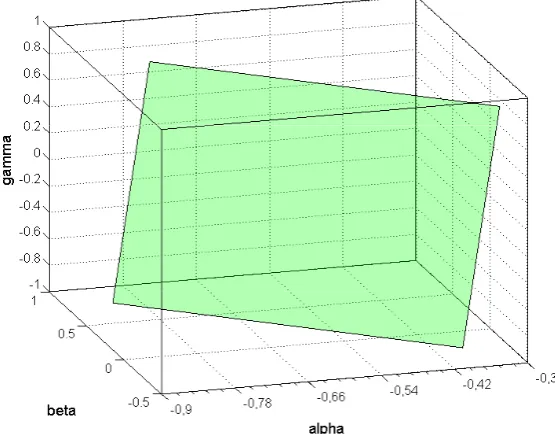
Some solutions of the system is given by Fig. 1.
Likewise,we assume that only weight
ω
1=
h
α
1, β
1, γ
1i
of the attribute
o
1is changed
Figure 1.
Some solutions of the system
oi
(i
= 2,
3) remain the same as the original weights or that only weight
ω
3=
h
α
3, β
3, γ
3i
of the attribute
o
3is changed to the weight ¯
ω
3=
h
α
3+ ∆α
3, β
3+ ∆β
3, γ
3+ ∆γ
3i
and the
weights of other attributes
o
i(i
= 1,
2) remain the same as the original weights, then the
solutions can easily be made in a similar way for
o
1and
o
3.
6.
Conclusion
In this study, we proposed a a linear optimization method of SVN-sets to describe the
sensitivity analysis of attribute weights. Also we an application which show its
appli-cability and effectiveness. Finally, we applied our proposed method to a multi-attribute
decision-making problem to demonstrate its feasibility and stability in solution. Since our
paper still has some limitations, in future studies we will study on different methods by
combining other objective methods for determining criteria weights in netrosophic sets.
References
[1] Atanassov K.T., (1999). Intuitionistic fuzzy sets, Pysica-Verlag A Springer-Verlag Company, New York.
[2] Basset M.A., Mohamed M., Hussien A.N., Sangaiah A.K., (2018). A novel group decision-making model based on triangular neutrosophic numbers, Soft Compututing, 22, 6629-6643.
[3] Basset A.B., Mohamed M., Sangaiah A.K., (2018). Neutrosophic AHP-Delphi group decision making model based on trapezoidal neutrosophic numbers, J. Ambient Intell. Human Comput., 9, 1427-1443. [4] Basset M.A., Mohamed M., Smarandache F., (2018). A hybrid neutrosophic group ANP-TOPSIS
framework for supplier selection problems, Symmetry, 10(226) 1-21.
[5] Biswas P., Pramanik S., Giri B.C., (2016). TOPSIS method for multi-attribute group decision-making under single-valued neutrosophic environment, Neural Comput. Appl. 27(3) 727–737.
[7] Biswas P., Pramanik S., Giri B.C., (2018). TOPSIS strategy for MADM with trapezoidal neutrosophic numbers, Neutrosophic Sets and Systems, 19, 29–39.
[8] Biswas P., Pramanik S., Giri B.C., (2018). T-Distance measure MADM strategy with interval trape-zoidal neutrosophic numbers, Neutrosophic Sets and Systems, 19, 40–46.
[9] Biswas P., Pramanik S., Giri B.C., (2018). Neutrosophic TOPSIS with group decision making, Stud. Fuzz. Soft Comput., Springer, Cham, 543–585.
[10] Broumi S., Talea M., Bakali A., Smarandache F., Patro S.K., (2019). Minimum Spanning Tree Problem with single-valued trapezoidal neutrosophic numbers, Studies in Fuzziness and Soft Computing, Soft Comput., 22, Springer Nature Switzerland AG.
[11] Broumi S., Dey A., Bakali A., Talea M., Smarandache F., Son L.H., Koley D., (2017). Uniform single valued neutrosophic graphs, Neutrosophic Sets and Systems, 17, 42–49.
[12] Deli I., (2017). Interval-valued neutrosophic soft sets and its decision making, Int. J. Mach. Learn. Cybern., 8(2) 665–676.
[13] Deli I., Subas Y., (2017). A ranking method of single valued neutrosophic numbers and its applica-tions to multi-attribute decision making problems, International Journal of Machine Learning and Cybernatics, 8(4) 1309–1322.
[14] Li D.F., (2014). Decision and game theory in management with intuitionistic fuzzy sets, Studies in Fuzziness and Soft Computing, Volume 308, Springer, Springer Heidelberg New York Dordrecht London.
[15] Giri B.C., Molla M.U., Biswas P., (2018). TOPSIS method for MADM based on interval trapezoidal neutrosophic number,Neutrosophic Sets and Systems, 22, 151–167.
[16] Georgiev K., (2005). A simplification of the neutrosophic sets. Neutrosophic logic and intuitionistic fuzzy sets, in: Proceedings of the 9th International Conference on IFSs, Sofia, Bulgaria.
[17] Jha S., Kumar R., Son L.H., Chatterjee J.M., Khari M., Yadav N., Smarandache F., (2018). Neutrosophic soft set decision making for stock trending analysis, Evolv. Syst., http://dx.doi.org/10.1007/s12530-018-9247-7.
[18] Jha S., Son L.H., Kumar R., Priyadarshini I., Smarandache F., Long H.V., (2019). Neutrosophic image segmentation with dice coefficients, Measurement, 134, 762–772.
[19] Ju D., Ju Y., Wang A., (2018). Multiple attribute group decision making based on Maclaurin symmet-ric mean operator under single-valued neutrosophic interval 2-tuple linguistic environment, J. Intell. Fuzzy Syst., 34(4) 2579–2595.
[20] Kahraman C., Otay I., (eds.), (2019). Fuzzy multi criteria decision making using neutrosophic sets, Studies in Fuzziness and Soft Computing, 369, Springer Nature Switzerland AG.
[21] Karaaslan F., (2018). Gaussian single-valued neutrosophic numbers and its application in multi-attribute decision making, Neutrosophic Sets and Systems, 22, 101–117.
[22] Liang R.X., Wang J.Q., Li L., (2018). Multi-criteria group decision-making method based on interde-pendent inputs of single-valued trapezoidal neutrosophic information, Neural Comput. and Applic., 30, 241-260.
[23] Liu P., Zhang X.H., (2018). Some maclaurin symmetric mean operators for single-valued trapezoidal neutrosophic numbers and their applications to group decision making, Int. J. Fuzzy Syst., 20(1) 45-61.
[24] Mohamed M., Zhou Y.Q., Baset M.A., Smarandache F., (2017). A critical path problem using trian-gular neutrosophic number, Neutrosophic Operational Research I, section X, Pons Brussels.
[25] Liu P., Chu Y., Li Y., Chen Y., (2014). Some generalized neutrosophic number Hamacher aggregation operators and their application to group decision making, International Journal of Fuzzy Systems, 16(2) 242–255.
[26] Liu P., Liu X., (2018). The neutrosophic number generalized weighted power averaging operator and its application in multiple attribute group decision making, Int. J. Mach. Learn. Cybern., 9(2) 347–358. [27] Nguyen G.N., Ashour A.S., Dey N., (2017). A survey of the state-of-the-arts on neutrosophic sets in
biomedical diagnoses, Int. J. Mach. Learn. Cybern., 10(1) 1–13.
[28] Porchelvi R.S., Umamaheswari M., (2018). A Study on intuitionistic fuzzy multi objective LPP into LCP with neutrosophic triangular numbers approach, Journal of Applied Science and Computations, 5(9) 570–576.
[29] Pramanik S., Mallick R., (2018). VIKOR based MAGDM strategy with trapezoidal neutrosophic numbers, Neutrosophic Sets and Systems, 22, 118–129.
[31] Smarandache F., (1998). Neutrosophy: Neutrosophic Probability, Set and Logic, American Research Press, Rehoboth, USA 105p.
[32] S¸ahin R., Yiˇgider M., (2014). A Multi-criteria neutrosophic group decision making metod based TOP-SIS for supplier selection, http://arxiv.org/abs/1412.5077.
[33] Tuan T.M., Chuan P.M., Ali M., Ngan T.T., Mittal M., Son L.H., (2018). Fuzzy and neutrosophic modeling for link prediction in social networks, Evolv. Syst., http://dx.doi.org/10.1007/s12530-018-9251-y.
[34] Wang H., Smarandache F., Zhang Y.Q., Sunderraman R., (2010). Single valued neutrosophic sets, Multisp. Multistruct, 4, 410–413.
[35] Wang J.Q., Yang Y., Li L., (2018). Multi-criteria decision-making method based on single valued neutrosophic linguistic Maclaurin symmetric mean operators, Neural Comput. Appl., 30(5) 1529– 1547.
[36] Wu X., Qian J., Peng J.J., Xue C.C., (2018). A multi-criteria group decision making method with possibility degree and power aggregation operators of single trapezoidal neutrosophic numbers, Sym-metry, 10(590) 1–21.
[37] Ye J., (2017). Some weighted aggregation operators of trapezoidal neutrosophic numbers and their multiple attribute decision making method, Informatica, 28(2) 387–402.
[38] Ye J., (2014). A multicriteria decision-making method using aggregation operators for simplified neu-trosophic sets, Journal of Intelligent and Fuzzy Systems, 26, 2459–2466.
[39] Zadeh L.A., (1965). Fuzzy Sets, Information and Control, 8, 338–353.