Volume 3, Issue 2, 2016
133
Available online at www.ijiere.com
International Journal of Innovative and Emerging
Research in Engineering
e-ISSN: 2394 – 3343 p-ISSN: 2394 – 5494
Mining User Queries with Markov Chain: Application to Content
Based Image Retrieval System
Ms.T.Nithya
a, S.Gayathri
a, E.Krishma
ba AP(Sr.Gr.)/IT 1, Velalar College of Engineering and Technology, Erode and India. bFinal year,B.Tech/IT 2,Velalar College of Engineering and Technology, Erode and India.
ABSTRACT:
The knack to explore through images based on their contented based image retrieval, a skill which uses ocular stuffing to explore images from large scale image databases according to users' safety. Markov chain models are worn to depict the lay fruition of low-level visual descriptors extracted from the semantic indexing model. Suggest a semantic indexing algorithm which uses mutually passage and image salvage system. Media professionals keenly employ visual archives as a resource for reusable stuff. Archives are aggressive to reinvent themselves in the visage of smarmy digital operations and mounting user bases. Yet, surprisingly, very tiny has been done to scrutinize how content-based image retrieval will affect the searches of professionals probing in the visual annals. So the primary goal is to explore how content-based image hunt which enhances the recital of customary library rescue. Then, this venture agency the effect of combining them for queries typical of professionals probing an archive.
The queries used present are not based on real-world queries, and generally no physically twisted metadata (which is often present in the real world) is incorporated in the experiments. The project takes into account the information desires and retrieval facts previously present in the audiovisual archive, and reveal that retrieval recital can be radically enhanced when content-based methods are useful to search. This thesis is the first step that the perform of a visual archive has been taken into report for quantitative repossession appraisal. To disembark at the main result, the project proposes an costing tactic customized to the detailed desires and status of the visual archive, which are typically missed by offered valuation initiatives. The project utilizes logged searches, content purchases, session information, and simulators to create realistic query sets and relevance judgments.
Keywords: Image retrieval, Video retrieval, Semantic indexing, Image re-ranking, Keyword expansion.
I. INTRODUCTION
Generally, data mining (sometimes called data or knowledge discovery) is the itinerary of analyzing data from sundry perspectives and abridgment it into handy information - information that can be worn to amplify revenue, cuts costs, or both. Data mining software is one of a quantity of critical tackle for analyzing data. It allows users to analyze data from various diverse magnitude or angles, categorize it, and recapitulate the affairs notorious. Technically, data mining is the route of verdict correlations or patterns amid dozens of fields in large relational databases.
Data mining involves the utilize of classy data scrutiny utensils to ascertain formerly strange, legal patterns and affairs in bulky data set. These utensils can embrace statistical models, mathematical algorithm and contraption erudition methods. Consequently, data mining consists of more than assortment and managing data, it also includes analysis and prediction. Classification technique is competent of dispensation a wider assortment of records than waning and is growing in esteem. The intent of this paper
To re-grade upshot is efficient in stipulations of more than two aspect spaces.
To Simulation query formation is conceded out.
To Time slump in incisive.
To upshot competence is superior.
To precise Re-grade of upshot.
To manifold trait legroom based hunt is doable.
Keyword extension
Illustration query extension
Image puddle expansion.
II. RELATEDWORK
Volume 3, Issue 2, 2016
134 X.Chen [1] [2010] described the KIS mission can be regarded as an excessive crate of intention-strict image search, in which the query aims to outstandingly trace a solitary true retort. Locating the exclusive image for a query, however, poses new challenges over existing information rescue approaches. Their involvement in TRECVID this year focuses on how to acclimatize habitual information salvage, specifically image explore, methods to KIS in both mechanical and interactive locale. In mechanical KIS, as there exists a solitary true answer for each query, the input queries are probable to present unique information locating a unique article but not a wide-ranging theme casing a number of pertinent images.Therefore, query formulation is one of our focuses in routine KIS. On the other end of the scale, our accent in interactive KIS is two-fold. First, an intuitive and user-friendly user edge is residential to assist the browsing of returned images.
B. Comparinng click-through data to purchase decisions for retrival evaluation
K. Hofmann [2] [2010] described the customary reclamation appraisal uses unambiguous bearing judgments which are pricey to amass. Relevance assessments anecdotal from couched opinion such as click-through facts can be serene cheaply, but may be less consistent. They compared assessments resultant from click-through statistics to another spring of couched feed-back that we presuppose to be vastly analytic of bearing: procure decisions. Evaluating recovery runs based on a plot of an audio-visual annals, they found harmony between scheme rankings and procure decisions to be amazingly high.They investigated the use of acquire and click figures for evaluating rescue systems in a viable locale. They create system rankings based on clicks to be seal to alike to those based on procure decisions when considering queries that resulted in a acquire. The high harmony between organism rankings based on pay for decisions and those based on clicks is somewhat startling as there is a patent variation in the size of the evoke bases.
C. Search behaviour of media professionals at an auto visuals archive:A Transaction log analysis
B. Huurnink [3] [2011] described the audiovisual stuff for reclaim in new programs is an vital bustle for rumor producers, documentary makers, and other media professionals. Such professionals are classically served by an audiovisual screen annals. They reported on a cram of the deal logs of one such records. The scrutiny includes an inquiry of viable orders made by the media professionals and a portrayal of sessions, queries, and the content of stipulations recorded in the logs.
One of their type findings is that there is a brawny claim for petite pieces of audio-visual stuff in the archive. In addition, while searchers are generally able to swiftly steer to a utilizable audio-visual televise, it takes them longer to lay an order when purchasing a clause of a televise than when purchasing an intact broadcast.
Another key ruling is that queries chiefly consist of (parts of) broad-cast titles and of right names. Their remarks entail that it may be favorable to bloat support for fine-grained entrée to audiovisual fabric, for example, through blue-collar segmentation or content-based scrutiny.
D. Today’s and tomorrow’s retrieval pratice in the audio visual archive
G.M.Snoek [4] [2012] described the content-based image salvage is budding to the spot where it can be used in real-world rescue practices. One such observe is the audiovisual library, whose users increasingly entail fine-grained entrance to relay television substance. They investigated to what scope content-based image retrieval methods can progress explore in the audiovisual annals. In particular, they projected an appraisal tactic bespoke to the precise desires and circumstances of the audiovisual collection, which are typically missed by existing appraisal initiatives.They utilized logged searches and comfortable purchases from an existing audiovisual annals to craft sensible query sets and bearing judgments. To echo the salvage perform of both the archive and the image retrieval community as personally as doable, our experiments with three image seek engines integrate archive-created record entry as well as state-of-the-art multimedia content scrutiny fallout.
E. Representations of keypoint-based semantic concept detection:A Comprehensive study
Y.-G. Jiang [5] [2013] describe the narrow keypoints extracted as prominent image patches, an image can be described as a “bag-of-visual-words (BoW)” and this illustration has appeared hopeful for article and sight taxonomy. The routine of BoW features in semantic theory discovery for large-scale multimedia databases is focus to various depiction choices. In this paper, they conducted a inclusive cram on the depiction choices of BoW, including lexis size, weighting plot, stop word amputation, trait choice, spatial information, and illustration bi-gram.They accessible realistic insights in how to optimize the feat of BoW by choosing apposite representation choices. For the weighting scheme, they elaborated a soft-weighting routine to levy the impact of a visual remark to an figure. They experimentally prove that the soft-weighting outperforms other popular weighting schemes such as TF-IDF with a hefty periphery.
III.EXISTINGSYSTEM
In thesis loom will be accessible in the scaffold of an online image salvage coordination where users hunt for metaphors by submitting queries that are ready of keywords. The queries twisted by the users of a explore engine are semantically polished, the keywords representing terse semantics when compared to passage in credentials or other lexis related presentations. The aspire is to recover user pleasure by recurring metaphors that have a privileged prospect to be customary (downloaded) by the abuser. The conjecture is that the users hunt for similes by issuing queries, each query being an controlled set of keywords. The structure responds with a list of images. The user can download or disregard the returned images and concern a new query instead.
Volume 3, Issue 2, 2016
135 happens by the structure patently from the abuser. At the taxing phase the structure uses the annotations presented from the guidance phase but also the keyword consequence prospect weights also evaluated during the exercise phase to revisit imagery that superior reflect the user’s preferences and progress user fulfillment. The existing system is to seek through images based on their satisfied based image retrieval, a technique which uses visual stuffing to search metaphors from large scale image databases according to users' benefit. But the intact user queries are elected by erratically. An image retrieval system is a computer system for browsing, probing and retrieving images from a huge image database.
IV.PROPOSEDSYSTEM
The proposed system loom covers all existing system methods. Moreover, imitation query bent is passed out using combining all the query phrases set by end users. Markov chain is practical to excavate user queries. In addition, it includes three prevailing content-based image retrieval methods according to the basis of image salvage data: transcripts, detectors, and low-level features. Together, these three sources have been widely utilized in the content-based image retrieval society. Transcript-based search: utilizes mechanical speech gratitude transcripts and contraption paraphrase of spoken dialog to retrieve image given a textual query. Low-level feature-based search: allows unswerving entrée to visual information by representing key frames in terms of low-level visual descriptors, which are then harmonized to query images. Detector-based search: utilizes shot-Detector-based exposure scores for a given human-defined concept—such as a horse, a telephone, or a musical instrument.
The explore toil covers all keyword growth, visual query extension and image pool expansion as in the existing system. In addition, the re-status upshot is proficient in terms of more than two trait spaces (text query and visual image query). Options are provided to riddle the rummage around by file types such as gray scale, RGB and TIFF (Tagged Image File Format) images.The investigate work also presents a lithe and valuable re-level way, called CR-Re-standing, to progress the rescue efficacy. To bid high exactness on the top-ranked outcome, CR-Re-place employs a Cross-allusion (CR) tactic to blend multimodal cues.
Specifically, multimodal features are former utilized discretely to re-rank the preliminary returned fallout at the huddle echelon, and then all the ranked clusters from dissimilar modalities are politely worn to surmise the shots with lofty bearing. Untried outcome illustrate that the explore eminence, chiefly on the top-ranked fallout, is superior radically. The new scheme is being to widen to abolish the drawbacks in the existing system.
V. FUSIONBASEDIMAGESEARCHRE-RANKING
Search locomotive consequences are repeatedly inclined towards a firm facet of a query or towards a assured denotation for vague query provisos. Diversification of search outcome offers a way to furnish the user with a superior objective upshot situate escalating the prospect that a user finds at least one deed suiting her information necessitate. In this critique, to present a re-ranking loom based on minimizing discrepancy of Web seek outcome to progress area exposure in the top-k results. Web explore engines repeatedly show the same result continually for poles apart queries within the alitop-ke search assembly, in spirit forgetting when the same credentials were previously revealed to users. Depending on prior user dealings with the recurring domino effect, and the minutiae of the conference, to show that occasionally the recurring results should be promoted, while some other epoch they should be demoted. The three key charity are made to the image search re-grade. The first role is that numerous modalities are painstaking alone during clustering and cluster ranking processes. It means that re-ranking at the group level is conducted discretely in separate feature spaces, which provides a leeway for offering higher precision on the top-ranked credentials. The multimodal features are first concatenated into a exclusive facet, and the ensuing clustering and cluster standing are then implemented once in the beyond single feature legroom. The jiffy role is defining a tactic for selecting some query-germane shots to convey users’ query target.
VI. MULTIFUSIONRE-RANKINGALGORITHM
Input: Image and Query tag Output: Ranking Images
Step 1: Select Image outline local Database Step 2: Select Detector base Image in to database. Step 3: Search image
Step 4: The user utterly relates the retrieved (down-loaded) images.
Step 5: Assuming Markovian chain transitions in the order of the keywords the aim of the proposed approach . Step 6: The new probability (based on M + m key-words) is calculated by the recurrent formula
pi (K1, K2) = M pi (K1, K2) + m / M + m This procedure constructs a Markov chain where each keyword corresponds to a state.
Step 7: Compare directly the probability vectors πi and πj calculated in the previous step for two images
VII. EXPERIMENTAL RESULTS
A. Image weight similarity analysis
Table 1.1 describes the trial effect in Marko chain model with image weight resemblance analysis. The table contains image query and image similarity load value details are show.
Volume 3, Issue 2, 2016
136 necessitate for matrix burgeoning since, according to an eigen value rotting of P is enough to calisthenics FG at any n, only the powers of the eigen values need to be premeditated.
Table 1. Image weight Similarity
Fig 1 describes the tentative outcome in Marko chain model with image credence similarity analysis. The fig contains image query and image similarity weight value minutiae are show.
Fig 1. Image Weight Similarity
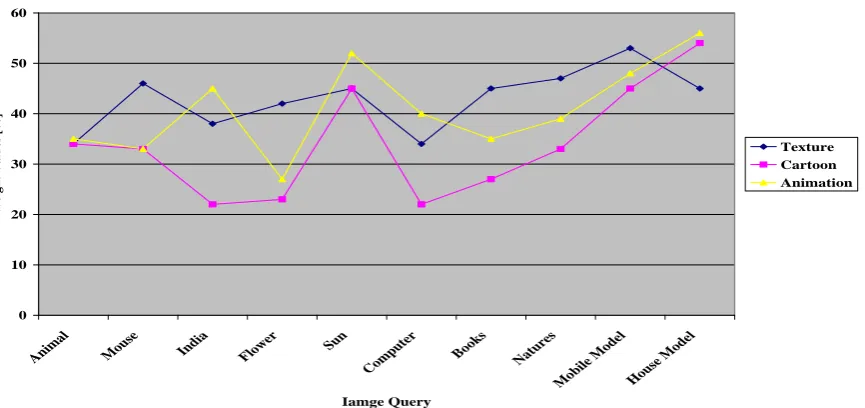
Table 2 describes the tentative result in projected multi fusion re grade algorithm with image cataloging weight similarity scrutiny. The table contains image query and image texture, cartoon, animation arrangement image likeness weight value details are show.
Fig 2 describes the trial result in proposed multi fusion re ranking algorithm with image sorting weight similarity analysis. The figure contains image query and image texture, cartoon, animation taxonomy image similarity weight value facts are show.
Image Weight Similarity for Marko Chain Model
0 10 20 30 40 50 60
Animal Mouse India Flower Sun Computer Books Natures Mobile Model
House Model Image Query
Wei
gh
t
Va
lues [%]
Image Weight Similarity
S.NO IMAGE QUERY IMAGE WEIGHT
1 Animal 37
2 Mouse 45
3 India 36
4 Flower 32
5 Sun 38
6 Computer 39
7 Books 48
8 Natures 49
9 Mobile Model 46
Volume 3, Issue 2, 2016
137 Table 2. Image Classification Weight Similarity
Fig 2. Image Classification Weight Similarity
B. Performance analysis
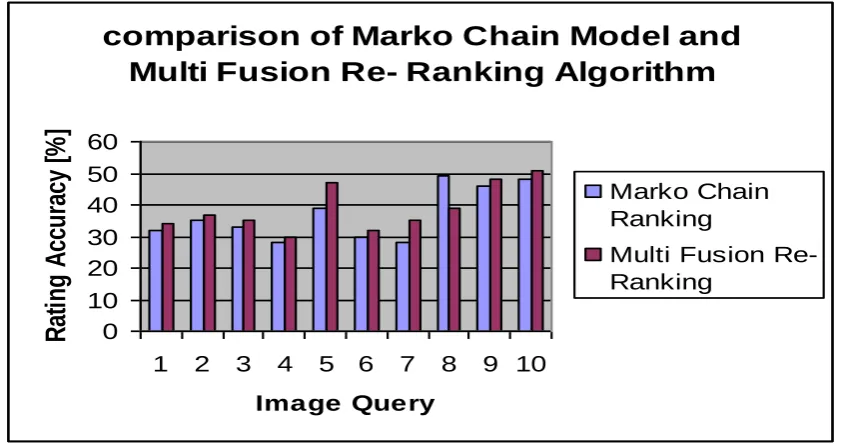
Table 3 describes the link of untried upshot in Marko Chain model and Multi Fusion Re- ranking algorithm with image taxonomy weight correspondence scrutiny. The table contains image query and image texture, cartoon, animation cataloging image resemblance weight value niceties are show.
Table 3. Comparison of Marko chain and Multi Fusion Re Ranking Algorithm
S.NO IMAGE QUERY IMAGE CLASSIFICATION WEIGHT
Marko Chain Ranking
Multi Fusion Re-Ranking
1 Animal 32 34
2 Mouse 35 37
3 India 33 35
4 Flower 28 30
5 Sun 39 47
6 Computer 30 32
7 Books 28 35
8 Natures 49 39
9 Mobile Model 46 48
10 House Model 48 51
Image Classification Weight Similarity- Multi Fusion Re-ranking Algorithm
0 10 20 30 40 50 60
Animal Mouse India Flower Su
n
Compu ter
Books Natures
Mobile Model House Model Iamge Query
Weight
Values [
%]
Texture Cartoon Animation
S.NO IMAGE QUERY IMAGE CLASSIFICATION WEIGHT
Texture Cartoon Animation
1 Animal 34 34 35
2 Mouse 46 33 33
3 India 38 22 45
4 Flower 42 23 27
5 Sun 45 45 52
6 Computer 34 22 40
7 Books 45 27 35
8 Natures 47 33 39
9 Mobile Model 53 45 48
Volume 3, Issue 2, 2016
138 Fig 3 describes the assessment of tentative result in Marko Chain model and Multi Fusion Re- ranking algorithm with image sorting weight similarity analysis. The figure contains image query and image texture, cartoon, animation sorting image match weight value fine points are show.
Fig 3. Comparison of Marko chain and Multi Fusion Re Ranking Algorithm
The aspiration of the proposed scaffold is to incarcerate user goal and is achieved in various ladder. The addict intent is first approximately captured by classifying the query image into one of the crude semantic categories and choosing a suitable weight schema accordingly. The adaptive visual similarity obtained from the elected eight schemas is used in all the following steps. Then according to the inquiry keywords and the query image provided by the user, the user target is further captured in two aspects:
Finding further query keywords (called Query classified expansion) recitation user objective more exactly
Finding a huddle of images (called visual query expansion) which are both visually and semantically unswerving with the query image.
The keyword extension recurrently co-occurs with the query keywords and the illustration extension is visually alike to the query image. Moreover, it is obligatory that all the images in the collect of visual query expansion contain the equivalent keyword expansion.
Therefore, the keyword development and visual increase bear each other and are obtained all together. In the later steps, the keyword expansion is used to develop the image puddle to include more images relevant to user goal, and the visual query expansion is used to hear visual and textual parallel metrics which healthier reflect user intent.
VIII. CONCLUSION
The query satisfied taxonomy based image retrieval scheme via retrieving the images through online. The new Indexing way for mining user queries by crucial keyword weight is a connectivity gauge between Monrovian states modeled after the user queries. The proposed system is vigorously skilled by the queries of the same users that will be served by the system. Consequently, the targeting is more exact, compared to other systems that use peripheral means of non-dynamic or non-adaptive nature to delineate keyword weight.
In addition, the thesis investigated how query content-based image rescue can recover searches in the visual annals. The hope search engine pooled physically fashioned archive metadata and automatically generated query pleased metadata. It functional the search engine to queries resultant from the logged searches of media professionals. It is establish that for queries taken frankly from a hunt log, content-based image retrieval was of narrow use. Closer scrutiny deep-rooted that this was because search queries were being formulated in terms of the limited metadata accessible in the system, such as agenda title and broadcast date.
In addition, the purchases used as weight judgments were habitually for whole programs, so that shot-level salvage could not be accurately assessed. Therefore we asked an archive worker to act as a query inventor, studying the searched from the archive’s logs and reformulating them as they might be issued in an archive with content-based image rescue capabilities.
REFERENCES
[1] X.Chen, J.Yuan, L.Nie, Z.-J.Zha, S.Yan and T.-S.Chua, “TRECVID 2010 known-item search by NUS,” in Proc. TRECVID, 2010.
comparison of Marko Chain Model and
Multi Fusion Re- Ranking Algorithm
0
10
20
30
40
50
60
1
2
3
4
5
6
7
8
9 10
Image Query
R
at
in
g
A
cc
u
ra
cy
[
%
]
Marko Chain
Ranking
Volume 3, Issue 2, 2016
139 [2] K. Hofmann, B. Huurnink, M. Bron, and M. de Rijke, “Comparing click-through data to purchase decisions for
retrieval evaluation,” in Proc. SIGIR, 2010, pp. 761–762.
[3] B. Huurnink, L. Hollink, W. van den Heuvel, and M. de Rijke, “The search behavior of media professionals at an audiovisual archive: A transaction log analysis,” JASIST,vol.61,no.6,2011.
[4] B.Huurnink, C.G.M.Snoek, M.deRijke,and A.W.M.Smeulders, “Today’s and tomorrow’s retrieval practice in the audiovisual archive,” in Proc. CIVR,2012,ACM.
[5] Y.-G. Jiang, J. Yang, C.-W. Ngo, and A. G. Hauptmann, “Representations of keypoint-based semantic concept detection: A comprehensive study,” IEEE Trans. Multimedia, vol. 12, pp. 42–53, 2013.
[6] M. Lux, K. Schoeffmann, M. del Fabro, M. Kogler, and M. Taschwer, “ITEC-UNIKLU known-item search submission,” in Proc. TRECVID, 2010.
[7] C. G. M. Snoek and A. W. M. Smeulders, “Visual-concept search solved?,” IEEE Comput., vol. 43, no. 6, pp. 76–78, 2010.