IJE TRANSACTIONS C: Aspects Vol. 30, No. 6, (June 2017) 895-903
Please cite this article as: A. R. Tavakolpour-Saleh, SH. Zare, H. Badjian, Multi-objective Optimization of Stirling Heat Engine Using Gray Wolf Optimization Algorithm, International Journal of Engineering (IJE), TRANSACTIONS C: Aspects Vol. 30, No. 6, (June 2017) 895-903
International Journal of Engineering
J o u r n a l H o m e p a g e : w w w . i j e . i r
Multi-objective Optimization of Stirling Heat Engine Using Gray Wolf Optimization
Algorithm
A. R. Tavakolpour-Saleh*, SH. Zare, H. Badjian
Department of Mechanical and Aerospace Engineering, Shiraz University of Technology, Shiraz, Iran
P A P E R I N F O
Paper history:
Received 11 February 2017
Received in revised form 16 March 2017 Accepted 21 April 2017
Keywords: Stirling Engine Power Output Pressure Loss Thermal Efficiency Gray Wolf Optimizion Multi-objective Optimization
A B S T R A C T
The use of meta-heuristic optimization methods have become quite generic in the past two decades. This paper provides a theoretical investigation to find optimum design parameters of the Stirling heat engines using a recently presented nature-inspired method namely the gray wolf optimization (GWO). This algorithm is utilized for the maximization of the output power/thermal efficiency as well as minimization of the pressure loss. The linear programming technique is employed for analyzing the multi-objective problem and the result is compared with the three individually computed costs of the aforementioned cost functions. The results show that the new meta-heuristic algorithm (i.e. GWO) yields acceptable results in quality compared to the other presented methods such as TOPSIS and Bellman-Zadeh.
doi: 10.5829/ije.2017.30.06c.10
NOMENCLATURE
𝑛𝑟 Engines rotation speed 𝑁𝑅 Number of gauzes of the matrix
s Stroke 𝐷𝑐 Piston diameter
𝑝𝑚 Mean effective pressure 𝐷𝑅 Regenerator diameter
𝑇𝐻 Heat source temperature L Regenerator’s length
𝑇𝐿 Heat sink temperature 𝛥𝑝𝑡ℎ𝑟𝑜𝑢𝑡
The pressure drop due to the internal friction produced by the regenerator
𝛥𝑇𝐿
The temperature difference between the working
fluid and the heat source 𝛥𝑝𝑓
The pressure drop due to the mechanical resistance of engine parts
𝛥𝑇𝐻
The temperature difference between the working
fluid and the heat sink 𝛥𝑝𝑤 The pressure drop due to the piston speed
R Gas constant 𝛥𝑝𝑖 Total pressure loss
τ Ratio of the extreme temperatures 𝜌𝑠𝑡 Density
γ Specific heat ratio λ Ratio of volume during the regenerative processes
(compression ratio)
𝜇′ Defined parameter in the text 𝑄
ℎ
The heat transfer between the working fluid and the heat source
𝑚𝑔 Mass of the gas 𝛥𝑄𝑅 The heat loss through the two regenerators
f Coefficient related to the friction contribution 𝑄𝐻 The total released heat from the heat source
𝑋 Vector of decision variables
.
𝑄𝐻 Heat transfer rate
𝑋1
Optimistic evaluations related to regeneration
losses 𝐶𝑣𝑔 Specific volumetric heat of the gas
𝑋2
Pessimistic evaluations related to regeneration
losses 𝜂 Efficiency
*
Corresponding Author’s Email: [email protected] (A. R. Tavakolpour-Saleh)y Second adjusting coefficient 𝜂𝑐 Carnot efficiency
M Defined parameter in the text 𝜂𝐼𝐼,𝑖𝑟𝑟 Second law irreversible efficiency
𝑚𝑅 Defined parameter in the text 𝜂𝐼𝐼,𝑖𝑟𝑟(𝑋) Deficient regenerating
d Wire diameter 𝜂𝐼𝐼,𝑖𝑟𝑟(𝛥𝑝)
The effect of mechanical friction, piston speed and pressure drop in regenerator
b Coefficient value between 0 and 2 𝜂′ Defined parameter in the text
B Defined parameter in the text h Heat transfer coefficient
𝐴𝑅 Regenerator area 𝑣 Viscosity of the working gas
𝐶𝑝 Specific pressure heat Pr Prandtl number
1. INTRODUCTION
Due to the dramatic consumption of fossil fuels, significant attention is devoted to the renewable energy and energy-efficient conversion systems. The researchers have found that the world needs a clean energy in order to break the dependency to fossil fuels. Accordingly, the Stirling engines are invented as one of the most promising sustainable energy technologies in recent years [1]. The Stirling engines are external combustion engines that convert heat into mechanical energy by means of the expansion and contraction of a contained working fluid, usually a gas. The first Stirling engine was invented in 1816 by Robert Stirling [2].
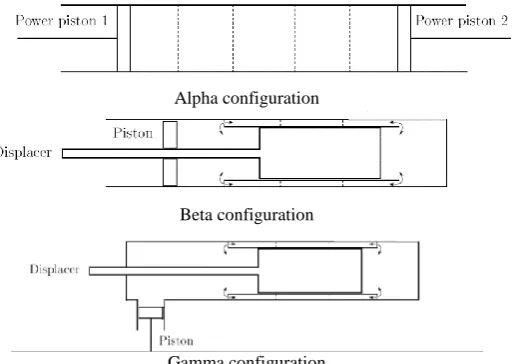
The Stirling engines can be classified into three categories namely alpha, beta and gamma configurations. The alpha type consists of two separate cylinders, each containing its own power piston. This configuration is a conventional design as demonstrated in Figure 1. This structure requires more seals because it has two pistons instead of just a single one. With the additional seals, there is more chance of leakage losses which can degrade engine performance [3-5]. The beta configuration invented by Robert Stirling, has been widely employed ever since. The beta type have a power piston and a displacer in the same cylinder where the compression space of the engine is placed between the top side of the power piston and the bottom side of
the displacer [6-8]. The beta configuration of the Stirling engine is shown in Figure 1. The gamma type Stirling engines are similar to the beta types, differing only in that the power piston and the displacer piston are placed in separate chambers (Figure 1). Furthermore, there are two compression spaces in both power and displacer cylinders [9-11].
So far, several mathematical models have been provided for the analysis of the Stirling engine behavior. In recent years, researchers attempted to propose methods in order to optimize performance of the Stirling engines. Accordingly, they applied the Meta-heuristic optimization techniques to obtain the design parameters of Stirling engine in order to optimize the performance of these engines. Meta-heuristic optimization techniques have become very popular over the last two decades. Kraitong and Mahkamov [12] studied the optimal design parameters of a desired Stirling engine using genetic algorithm (GA). The governing thermodynamic equations of the desired Stirling engine were first determined and then, four engine parameters including bores and strokes of the power and displacer pistons were extracted using a GA. Ahmadi et al. [13] applied NSGA-II technique for optimization of desired Stirling engine. Maximization of output power, overall thermal efficiency, and minimization of the pressure loss were intended as objective functions in his study.
Alpha configuration
Beta configuration
Gamma configuration
897 A. R. Tavakolpour-Saleh et al. / IJE TRANSACTIONS C: Aspects Vol. 30, No. 6, (June 2017) 895-903
Ahmadi et al. [14] studied the optimal output power of a reversible Stirling cycle including a perfect regeneration. Genetic algorithm (GA) was employed for the optimization of this reversible desired Stirling engine. Ahmadi et al. [15] used NSGA-II algorithm for dimensionless thermo-economic optimization of solar dish-Stirling engine. Later, Ahmadi et al. [16] proposed the NSGA-II algorithm for optimization of solar dish-Stirling engine.
Based on the outlined literature, to the best of our knowledge, only a few advanced optimization algorithms like GA and NSAGII have been employed by the researchers for the optimization of Stirling engines. But, these techniques require tuning of several parameters. In other words, the proper tuning of the specific parameters of the algorithms is an essential issue which affects the performance of the optimization procedure. The improper tuning of algorithms' parameters either increases the computational endeavor or yields the local optimal solution [17]. Furthermore, the specific parameters of an algorithm, such as population size and the number of iterations are to be intended. The burden on the designer will be reduced if there is no need to tune at least some of the parameters needed by the algorithm. Thus, to overcome the problem of tuning the algorithm parameters, a recently accomplished parameter-less algorithm known as Grey Wolf Optimizer (GWO) algorithm [17] is employed in the present research for the multi-objective optimization of desired Stirling engine. However, there is a question here: why GWO is applied to obtain design parameters of desired Stirling engines? The answer to this question can be summarized into three main factors: this method is simple, flexible and local optima avoidance [17].
In this research, maximization of output power, overall thermal efficiency and minimization of the pressure loss are addressed. Accordingly, an attempt is made to see if there is any improvement possible in the design of Stirling engines by applying an advanced optimization algorithm known as GWO technique. The reason for selection of the GWO algorithm is that it is robust, simple, flexible, parameter-less and gives optimal solutions with less number of function evaluations and less computational endeavor. The GWO technique is employed in the present research for simultaneously optimizing the three objectives considered by Ahmadi et al. [13] for the design of desired Stirling engines.
2. GENERAL PRINCIPLES
A Stirling engine is a closed-cycle regenerative heat engine that operates by cyclic compression and expansion of the working fluid at different temperatures, such that there is a net conversion of heat energy to
mechanical work. A great deal of inventions based on the very first proposed Stirling engine [18], were presented in variable shapes and sizes.
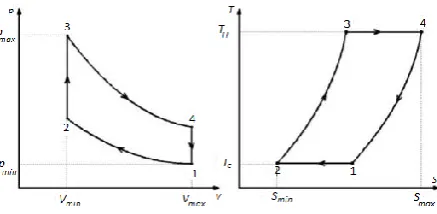
2. 1. Stirling Cycle There are four main thermal processes in the Stirling cycles as illustrated in Figure 2. In this figure, both the p-V and T-S diagrams are demonstrated. The thermal efficiency of the Stirling engine is equal to the Carnot cycle utilizing an ideal regenerator. Heat transfer from the working fluid to the external sink at constant temperature 𝑇𝐶 occurs at process 1-2 which is an isothermal compression process. By pushing the working fluid to the cold area of the cylinder, the power piston changes its position from the bottom dead center (BDC) to the top dead center (TDC), producing work equal to the area under process 1-2. Another main features of the Stirling cycle is the heat transfer from the regenerator to the working fluid in a constant volume heating process 2-3. Pushing the working fluid to the regenerator is the result of shifting the displacer from the TDC to the BDC. This causes an increase in temperature of the working fluid while keeping the volume at a constant value. In the next process, the heat is added to the working fluid at high temperature from an external source. In this process, the working fluid is expanded achieving the pressure at state 4 while the temperature is held at a constant value. The work exerted by the working fluid can be found by computing the area under process 3-4. At the final stage, the power piston travels from BDC to TDC resulting in pressure and temperature drops by moving throughout the regenerator. The heat is then transferred to the regenerator in the process 4-1 and the cycle will continue to the stage 1-2 [19-21].
2. 2. Mathematical Model of the Stirling Heat Engine
2. 2. 1. Pressure Evaluation Due to the incomplete regeneration processes, additional external heat is required in order to have an ideal Stirling cycle. Moreover, an equivalent heat exists due to the incomplete heat rejection of regenerator to the working fluid.
These two irreversibilities plus the working fluid friction passing through the regenerator cause the pressure loss in the thermodynamic cycle. The pressure loss is mathematically modeled here as previously presented by Ahmadi et al. [13]. Thus, one can define the pressure loss terms introduced in literatures [22-25] as:
∑ 𝛥𝑃𝑖= 𝛥𝑃𝑡ℎ𝑟𝑜𝑢𝑡+ 𝛥𝑃𝑓+ 𝛥𝑃𝑤 (1)
The terms 𝛥𝑃𝑡ℎ𝑟𝑜𝑢𝑡, 𝛥𝑃𝑓 and 𝛥𝑃𝑤 are defined as the pressure drops due to the internal friction produced by the regenerator, mechanical resistance of engine parts and piston speed, respectively which are individually defined as:
𝛥𝑃𝑡ℎ𝑟𝑜𝑢𝑡=15𝛾[2𝑅(𝜏+1)(𝑇𝑝𝑚 𝐿+𝛥𝑇𝐿). (
(𝑠.𝑛𝑟)2 900 )] . 𝑁. (
𝐷𝑐2 𝑁𝑅𝐷𝑅2)
2
(2)
𝛥𝑃𝑓= (0.94 + 0.0015𝑠𝑛𝑟). 105 3𝜇′. (1 −
1
𝜆) 𝑤ℎ𝑒𝑟𝑒 𝜇 ′=
1 − 1 3𝜆
(3)
𝛥𝑃𝑤= (𝑠𝑛𝑟60) .(1+𝜆).(1+𝜏)4𝑝𝑚 . (𝜆𝑙𝑛𝜆𝜆−1) . √𝛾𝑅. (√𝑇𝐿+𝛥𝑇1 𝐿) ×
[1 + √𝑇𝐻−𝛥𝑇𝐻𝑇 𝐿+𝛥𝑇𝐿]
(4)
2. 2. 2. Output Power and Thermal Efficiency Evaluation The heat loss through the two regenerators (Δ𝑄𝑅) is presented as:
Δ𝑄𝑅= 𝑚𝑔𝐶𝑣𝑔𝑋(𝑇𝐻− 𝛥𝑇𝐻− 𝑇𝐿− 𝛥𝑇𝐿)
(5) The heat transfer between the working fluid and the heat source can be calculated as:
𝑄ℎ= 𝑚𝑔(1 − 𝛥𝑝𝑤.
(𝜆+1)(𝜏+1)
4𝑝𝑚 ) −
𝑏𝛥𝑝𝑡ℎ𝑟𝑜𝑢𝑡
2𝑝𝑚 −
𝑓𝛥𝑝𝑓 𝑝𝑚) × 𝑅(𝑇𝐻− 𝛥𝑇𝐻)𝑙𝑛𝜆
(6)
Thus, one can obtain the total released heat from the heat source in the following way:
𝑄𝐻= 𝑄ℎ+ 𝛥𝑄𝑅 (7)
The net heat flux (𝑄.
𝐻) can then be determined by multiplying Equation (7) with the term𝑛𝑟
60. The output power can then be easily computed as:
𝑝𝑜𝑤𝑒𝑟 = 𝜂𝑄.𝐻= 𝜂𝑐. 𝜂𝐼𝐼,𝑖𝑟𝑟. .
𝑄𝐻 (8)
where
𝜂𝑐= (1 −𝑇𝑇𝐿+𝛥𝑇𝐿
𝐻−𝛥𝑇𝐻) (9)
𝜂𝐼𝐼,𝑖𝑟𝑟= 𝜂𝐼𝐼,𝑖𝑟𝑟(𝑋). 𝜂𝐼𝐼,𝑖𝑟𝑟(𝛥𝑝) (10)
And the terms 𝜂𝑐 and 𝜂𝐼𝐼,𝑖𝑟𝑟 are the Carnot efficiency and the second law efficiency, respectively. It is worth noting that the second law efficiency is calculated by
multiplying the two parts including the deficient regenerating (𝜂𝐼𝐼,𝑖𝑟𝑟(𝑋)) and mechanical friction, piston speed and pressure drop in regenerator (𝜂𝐼𝐼,𝑖𝑟𝑟(𝛥𝑝)), respectively. More details about the efficiency terms can be found below.
The term 𝜂𝐼𝐼,𝑖𝑟𝑟(𝛥𝑝) due to the mechanical friction, pressure drop in the regenerator and the speed of piston is calculated as:
𝜂𝐼𝐼,𝑖𝑟𝑟(𝛥𝑝)= 1 −
3𝜇′.∑𝛥𝑝𝑖 𝑝𝑖 𝜂′.(𝑇𝐻−𝛥𝑇𝐻
𝑇𝐿+𝛥𝑇𝐿).𝑙𝑛𝜆
(11)
where: 𝜂′= 𝜂
𝐼𝐼,𝑖𝑟𝑟(𝑋). 𝜂𝑐 (12)
𝑝1= 4𝑝𝑚
1+𝜆. (1 + 𝜏) (13)
As can be seen in these equations, the term 𝜂𝐼𝐼,𝑖𝑟𝑟(𝛥𝑝), is related to the deficient regenerating term that can be evaluated as:
𝜂𝐼𝐼,𝑖𝑟𝑟(𝑋)= 1
1+((𝛾−1)𝑙𝑛𝜆𝑋 ).𝜂𝑐 (14)
where:
𝑋 = 𝑦𝑋1+ (1 − 𝑦)𝑋2 (15)
The parameters 𝑋1 and 𝑋2 are the optimistic and pessimistic evaluations related to regeneration losses and y is the second regulating factor which is assigned as 𝑦 = 0.72 for the better adaption of the experimental and analytical conclusions [22-25]. One can find calculation of the aforementioned parameters in details as follows:
𝑋1=1+2𝑀+𝑒 −𝐵
2(1+𝑀) (16)
𝑋2=𝑀+𝑒 −𝐵
1+𝑀 (17)
where: 𝑀 =𝑚𝑔𝐶𝑣𝑔𝑚
𝑅𝐶𝑅 (18)
𝐵 = (1 + 𝑀). ℎ𝐴𝑅 𝑚𝑅𝐶𝑅.
30
𝑛𝑟 (19)
𝑚𝑅= 𝜋2𝐷
𝑅 2𝐿𝑑𝜌
𝑠𝑡
16(𝑏+𝑑) (20)
ℎ = 0.295.( 4𝑝𝑚 𝑅𝑇𝐿).(𝑠. 𝑛𝑟 30) 0.424 𝐶𝑝𝑣0.576 (1+𝜏).(1− 𝜋 4(𝑏𝑎+1)).𝐷𝑅
0.576.𝑃𝑟0.667
(21)
𝐴𝑅= 𝜋 2𝐷
𝑅2𝐿
4(𝑏+𝑑) (22)
899 A. R. Tavakolpour-Saleh et al. / IJE TRANSACTIONS C: Aspects Vol. 30, No. 6, (June 2017) 895-903
functions are to be optimized. The parameters with their corresponding ranges are defined in Table 1. The ranges of the parameters are selected according to the restriction of the available materials. It is worth noting that these ranges are chosen close to the values selected by Ahmadi et al. [13], thus making the current work fairly comparable.
2. 2. 3. Optimization Method In the past two decades, the use of meta-heuristic optimization methods has become quite generic. In this study, an interesting method inspired by the nature living behavior of gray wolf packs is utilized, which is called the gray wolf optimizer (GWO). This algorithm is based on the employment of the leadership hierarchy of the gray wolfs, including four groups naming as alphas, betas, deltas and omegas in the order of obedience. The leaders could be male or female called the alphas. Alphas are mostly responsible for making decisions about hunting, sleeping, time to wake and etc. The decisions received by alphas are then dictated to the wolf pack. It is worth noting that the alphas are not necessarily the strongest in the pack, indeed they are best in terms of management. The second level in the hierarchy is called the betas. They help the alphas in the decision making and they are the best candidate in case the alphas die. Plus, they can command the lower level in the hierarchy group. Followed by the betas are deltas and omegas with lower ranking in the management class.
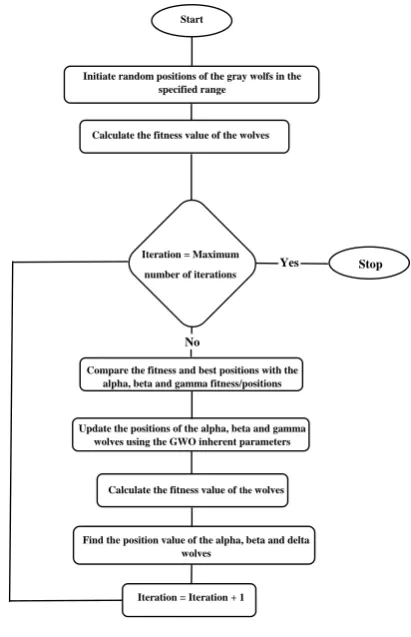
Three major steps almost always occur in every group hunting of the gray wolfs which is converted to mathematical model stated as chasing and approaching the prey, encircling the prey and finally the attacking phase. The structure of the GWO method of the Stirling heat engine is represented in Figure 3.
The GWO algorithm requires several input parameters analogous to the population based algorithms proposed to date. Accordingly, the population size, the numbers of iteration plus the inherent GWO parameters A and D, which are declared at the Table 2.
The parameters r1 and r2 are random vectors in the ranges of [0, 1].
TABLE 1. The parameters employed with their corresponding ranges
Individuals Range Range Individuals
pm (MPa) [.69,6.89] [0.06,0.1] S (m)
TL (K) [288,360] [1200,3000] nr (Rpm)
ΔTL (K) [5,25] [800,1300] TH (K)
Dc (m) [0.05,0.14] [64.2,237.6 ] ΔTH (K)
DR (m) [0.02,0.06] [0.006,0.0073 ] L
NR [250,400]
Figure 3. The Structure of the GWO algorithm
TABLE 2. Values of GWO parameters
Population size 50
Numbers of iteration 2000
A 2a.r1
D 2r2
It is worth noting that the improper selection of the population size and numbers of iteration would result the non-scientific values of the fitness function because of trapping the final values in the local answers not the global one. Thus, the trial and error process is conducted to achieve the best selection of the population size and iteration number comparing with the results of Ahmadi et al. [13]. The position updating of the gray wolf packs mentioned above is illustrated in Figure 4. The prey position or simply the global answer of the problem is estimated by the positions of the three groups of alpha, beta and delta of the gray wolfs.
In order to find the maximum values of power and efficiency and minimum values of the pressure loss simultaneously, linear programmable decision-making technique is applied and the resulting value is compared with the multi-objective function employed by other authors.
Start
Calculate the fitness value of the wolves Initiate random positions of the gray wolfs in the
specified range
Iteration = Maximum
number of iterations Stop
Update the positions of the alpha, beta and gamma wolves using the GWO inherent parameters
Calculate the fitness value of the wolves
Find the position value of the alpha, beta and delta wolves
Iteration = Iteration + 1 Compare the fitness and best positions with the
alpha, beta and gamma fitness/positions
No
Figure 4. The Gray Wolf Optimizer Position updating scheme [17]
To do this, several weight vectors are chosen in a way that their sum equals to 1. Choosing the values of weight vectors strongly depend on the designer’s idea about which of the objective functions are in a great matter. For convenience, identical importance of the cost functions are assumed, resulting 𝑤1= 𝑤2= 𝑤3= 1/3.
The extreme and minima values of X1,max, X2,max and
X3,min are the maximum values of power, Stirling engine
efficiency and the minimum value of pressure loss, respectively in which they are obtained individually. One can compute the resulting parameters of the three objective functions by solving them simultaneously as below:
𝑋 = 𝑤1× 𝑋1
𝑋1,𝑚𝑎𝑥+ 𝑤2× 𝑋2
𝑋2,𝑚𝑎𝑥− 𝑤3× 𝑋3 𝑋3,𝑚𝑖𝑛
(23)
3. RESULTS
As stated earlier, the parameters utilized in this paper are based on the extracted values from Ahmadi et al. [13]. Besides, the ranges of parameters defined in the previous section and several constant values are also defined that can be observed in Table 3 [13].
Three different popular decision making procedure including the Bellman-Zadeh, TOPSIS and LINMAP were employed by Ahmadi et al. [13], in order to obtain the best solution from three dependent objective functions using NSGA-II algorithm. It is worth noting that the first procedure mentioned above executes the fuzzy non-dimensionalization while the other two
procedures implement the Euclidian
non-dimensionalization. The GWO algorithm is now implemented acquiring the best solution of the three objective functions naming the output power, Stirling engine efficiency and the power loss.
TABLE 3. Constant variables utilized in reference [13]
Parameter Value Parameter Value
𝑁 8 𝐶𝑝𝑔 5193 (𝐽𝑘𝑔−1𝐾−1)
𝐶𝑣 3115.6 (𝐽𝑘𝑔−1𝐾−1) 𝑏 6.88 × 10⁻⁵
𝜌𝑠𝑡 8030 (𝑘𝑔𝑚−3) 𝛾 1.667
𝜆 1.2 𝑚𝑔 0.001135 (𝑘𝑔)
𝑑 4 × 10⁻⁵ (𝑚) 𝐶
𝑅 502.48 (𝐽𝑘𝑔−1𝐾−1)
𝑣 3.249 ×
10−5 (𝑚2/𝑠) 𝑓 0.556
𝑃𝑟 0.71
All of the aforementioned equations plus the defined parameters have been coded into the MATLAB software. The individually obtained extreme and minima values of power, Stirling engine efficiency and the minimum value of pressure loss are reported in Table 4. In order to have a better understanding of solving the three objective functions simultaneously, their corresponding results are also presented in the same table.
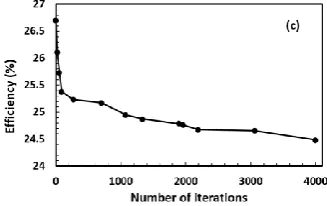
The convergence curve of the individual and multi-objective functions are illustrated in the Figures 5 and 6, respectively. It is obvious that the output results converge to the value reported in Table 4 when the iteration number reaches 4000.
More details about the 11 individual parameters discussed earlier are presented in Table 5 comparing the results from this paper with the outcomes of the three techniques naming TOPSIS, LINMAP and the Bellman-Zadeh.
It is worth noting that the results gathered from GWO approach was obtained from computing the mean values of the 10 times repetition of the problem. It is evident from Table 5 that although the terminal results from the multi-objective functions are very close, but the individual values of the parameters differs as will be discussed shortly. The values of the mean effective pressure, stoke, regenerator’s length and temperature of the heat sink are quite the same.
TABLE 4. Optimum results obtained by the use of GWO technique
Cost Function
Individually calculated cost
function
Optimum value of the cost function attempted
simultaneously
Minimization of
pressure loss 11.57 kPa 17.5 kPa
Maximization of Stirling engine efficiency
24.55 % 14.2 %
Maximization of
901 A. R. Tavakolpour-Saleh et al. / IJE TRANSACTIONS C: Aspects Vol. 30, No. 6, (June 2017) 895-903
Figure. 5. The convergence curve for the analysis of the three objective functions individually using the GWO algorithm. a) Power output b) Pressure loss c) Efficiency
Figure. 6. The convergence curve of the multi-objective function versus the number of iterations
TABLE 5. Comparison of the optimization results from various methods including GWO [13]
𝒑𝒎
(kPa) 𝑻𝑳
(K)
𝜟𝑻𝑳
(K) 𝑫𝒄
(mm)
𝑫𝑹
(mm) 𝑵𝑹
𝒔 (mm)
𝒏𝒓
(rpm)
𝑻𝑯
(K)
𝜟𝑻𝑯
(K) 𝑳 (mm)
Power (kW)
η (%)
Ploss
(kPa)
LINMAP 2550.3 298.4 11.8 101.6 59.5 339 60.5 2120 989.6 74.4 70 6.076 14.56 19.69
TOPSIS 2550.3 298.4 11.8 101.6 59.5 339 60.5 2120 989.6 74.4 70 6.076 14.56 19.69
Bellman-Zadeh 2437 299.5 12.1 106.1 58.9 338 60.5 2056 989.3 76.4 76.4 5.84 14.51 18.82
GWO 2514.19 298.4 14.04 99.12 29.39 317.28 60.0 1200 1070.2 220.73 67.6 6.06 14.2 17.5
The value of the heat sink’s temperature, temperature difference between heat source and working fluid and temperature difference between heat sink and working fluid are estimated higher than those reported by other authors while the remaining parameters are evaluated lower values than the ones referenced.
4. CONCLUSION
Due to the compulsion of the need of humanity to energy, numerous engines have been invented producing power. Stirling engines are a reciprocating, external combustion engines that convert heat into mechanical energy by means of the expansion and contraction of a contained working fluid, usually a gas.
The development of the three output power, engines
efficiency and pressure loss functions are discussed in this paper. In order to capture the optimized values of the three aforementioned objective functions individually, the new meta-heuristic algorithm inspired by the nature of gray wolf’s living is utilized naming as the Gray Wolf Optimizer (GWO) technique. This simple algorithm is a population based algorithm requiring few initial parameters for use.
5. REFERENCES
1. Walker, G., "Stirling engines", (1980).
2. Tavakolpour, A.R., Zomorodian, A. and Golneshan, A.A., "Simulation, construction and testing of a two-cylinder solar stirling engine powered by a flat-plate solar collector without regenerator", Renewable Energy, Vol. 33, No. 1, (2008), 77-87. 3. Ahmadi, M.H., Ahmadi, M.-A. and Pourfayaz, F., "Thermal models for analysis of performance of stirling engine: A review", Renewable and Sustainable Energy Reviews, Vol. 68, (2017), 168-184.
4. Ross, M.A., "Balanced crankshaft mechanism for the two piston stirling engine". (1979), Google Patents.
5. Thombare, D. and Verma, S., "Technological development in the stirling cycle engines", Renewable and Sustainable Energy Reviews, Vol. 12, No. 1, (2008), 1-38.
6. Tavakolpour-Saleh, A., Zare, S. and Omidvar, A., "Applying perturbation technique to analysis of a free piston stirling engine possessing nonlinear springs", Applied Energy, Vol. 183, (2016), 526-541.
7. Zare, S., Tavakolpour-Saleha, A. and Aghajanzadehb, O., "An investigation on the effects of gas pressure drop in heat exchangers on dynamics of a free piston stirling engine",
International Journal of Engineering-Transactions B: Applications, Vol. 30, No. 2, (2017), 294-305.
8. Zare, S. and Tavakolpour-Saleh, A., "Frequency-based design of a free piston stirling engine using genetic algorithm", Energy, Vol. 109, (2016), 466-480.
9. Kato, Y., Saitoh, S., Ishimatsu, K. and Iwamoto, M., "Effect of geometry and speed on the temperatures estimated by cfd for an isothermal model of a gamma configuration low temperature differential stirling engine with flat-shaped heat exchangers",
Applied Thermal Engineering, Vol. 115, (2017), 111-122. 10. Alfarawi, S., AL-Dadah, R. and Mahmoud, S., "Enhanced
thermodynamic modelling of a gamma-type stirling engine",
Applied Thermal Engineering, Vol. 106, (2016), 1380-1390. 11. Alfarawi, S., Al-Dadah, R. and Mahmoud, S., "Influence of
phase angle and dead volume on gamma-type stirling engine power using cfd simulation", Energy Conversion and Management, Vol. 124, (2016), 130-140.
12. Kraitong, K. and Mahkamov, K., "Optimisation of low temperature difference solar stirling engines using genetic algorithm", in World Renewable Energy Congress-Sweden; 8-13 May; Linkoping; Sweden, Linkoping University Electronic Press., (2011), 3945-3952.
13. Ahmadi, M.H., Hosseinzade, H., Sayyaadi, H., Mohammadi, A.H. and Kimiaghalam, F., "Application of the multi-objective optimization method for designing a powered stirling heat engine: Design with maximized power, thermal efficiency and
minimized pressure loss", Renewable Energy, Vol. 60, (2013), 313-322.
14. Ahmadi, M.H., Mohammadi, A.H. and Dehghani, S., "Evaluation of the maximized power of a regenerative endoreversible stirling cycle using the thermodynamic analysis",
Energy Conversion and Management, Vol. 76, (2013), 561-570.
15. Ahmadi, M.H., Sayyaadi, H., Mohammadi, A.H. and Barranco-Jimenez, M.A., "Thermo-economic multi-objective optimization of solar dish-stirling engine by implementing evolutionary algorithm", Energy Conversion and Management, Vol. 73, (2013), 370-380.
16. Ahmadi, M.H., Mohammadi, A.H., Dehghani, S. and Barranco-Jimenez, M.A., "Multi-objective thermodynamic-based optimization of output power of solar dish-stirling engine by implementing an evolutionary algorithm", Energy Conversion and Management, Vol. 75, (2013), 438-445.
17. Mirjalili, S., Mirjalili, S.M. and Lewis, A., "Grey wolf optimizer", Advances in Engineering Software, Vol. 69, (2014), 46-61.
18. Stirling, R., "Method and apparatus for controlling and pumping oil-wells". (1918), Google Patents.
19. Jafarian, A., Saidi, M. and Kazemzadeh Hannani, S., "Second law based analysis of fluid flow in the regenerator of pulse tube refrigerator", International Journal of Engineering Transactions A: Basics, Vol. 21, No. 2, (2008), 181-194. 20. Moosavi, B., Alemrajabi, A., Jafarian, A. and Arablu, M., "CFD
simulation of a multi-mesh pulse tube regenerator (research note)", International Journal of Engineering-Transactions A: Basics, Vol. 28, No. 1, (2014), 121-129.
21. Naddaf, N., "Stirling engine cycle efficiency", (2012). 22. Costea, M. and Feidt, M., "The effect of the overall heat transfer
coefficient variation on the optimal distribution of the heat transfer surface conductance or area in a stirling engine", Energy Conversion and Management, Vol. 39, No. 16, (1998), 1753-1761.
23. Costea, M., Petrescu, S. and Harman, C., "The effect of irreversibilities on solar stirling engine cycle performance",
Energy Conversion and Management, Vol. 40, No. 15, (1999), 1723-1731.
24. Petrescu, S., Costea, M., Harman, C. and Florea, T., "Application of the direct method to irreversible stirling cycles with finite speed", International Journal of Energy Research, Vol. 26, No. 7, (2002), 589-609.
903 A. R. Tavakolpour-Saleh et al. / IJE TRANSACTIONS C: Aspects Vol. 30, No. 6, (June 2017) 895-903
Multi-objective Optimization of Stirling Heat Engine Using Gray Wolf
Optimization Algorithm
TECHNICAL NOTE
A. R. Tavakolpour-Saleh, SH. Zare, H. Badjian
Department of Mechanical and Aerospace Engineering, Shiraz University of Technology, Shiraz, Iran
P A P E R I N F O
Paper history:
Received 11 February 2017
Received in revised form 16 March 2017 Accepted 21 April 2017
Keywords: Stirling Engine Power Output Pressure Loss Thermal Efficiency Gray Wolf Optimizion Multi-objective Optimization
ديكچ ه
شور زا هدافتسا هنیهب یاه
ارف یزاس یارب یرظن قیقحت کی هلاقم نیا رد .تسا هدش ریگارف رایسب هتشذگ ههد ود رد یراکتبا
زا هدافتسا اب ،گنیلرتسا یترارح یاهروتوم هنیهب یحارط یاهرتماراپ ندرک ادیپ یگزات هب هک تعیبط زا هتفرگ ماهلا یشور
هنیهب ینعی ،تسا هدش هئارا ( یرتسکاخ گرگ یزاس
GWO
ندناسر رثکادح هب یارب متیروگلا نیا .تسا هتفرگ تروص ،)
هلاقم نیا رد .تسا هدش هدافتسا راشف تفا ندناسر لقادح هب نینچمه و یترارح هدزاب ،یجورخ تردق ،
یطخ کینکت
لیلحت یارب یزاس رگید ترابع هب .تسا هدش هتفرگ راک هب هفدهدنچ هلاسم
، و هناگادج تروص هب فده عبات هس کمک هب
یطخ کینکت کمک هب مه تروص هب فده عبات هس یواح هلاسم ،یزاس
یم ناشن جیاتن . تسا هدش لح نامز هک دهد
گرگ متیروگلا ل زا یلوبق لباق یجورخ ،هلاقم نیا رد هدش هدافتسا یرتسکاخ یاه
شور ریاس هب هسیاقم رد تیفیک ظاح یاه
نوچمه حرطم
TOPSIS
و
Bellman-Zadeh
.دراد
![TABLE 3. Constant variables utilized in reference [13]](https://thumb-us.123doks.com/thumbv2/123dok_us/208409.2015190/6.595.60.280.99.269/table-constant-variables-utilized-reference.webp)