doi: 10.5681/rdme.2012.012 http://journals.tbzmed.ac.ir/rdme
Introduction
*Corresponding authors: Vahid Zamanzadeh, Email: [email protected]
Developing and Evaluating Clinical Written Assignment in Clinical
Teaching for the Senior B.S. Nursing Students: An action research
The value of an ideal clinical teaching in individual and professional development, also nursing clinical skills is undeniable.1
Clinical teaching, on the other hand, is the highest cost part of each nursing curriculum. And Practicum andinternship play an important role in forming basic skills and professional competencies of nursing students.2 Therefore, much time must be spend on the functions for which the students are responsible after graduation.2 Clinical teaching must reflect the nature of the work and professional practice. In this way, nursing students must get ready for critical thought, problem solving, clinical decision, Psychomotor skills, technological skills and professional value system. These skills can meet the changing social and scientific needs and expectations.2 Infant believes that the useful time that the nursing students must spend in clinical places is replaced by
discussing the issues of the instructors and those who are in charge of nursing. The time spent in clinical activities does not guarantee the quality. The quality of the activity and the time spent are two important factors.2
A study on the duration of clinical teaching for nursing students in Rafsanjan Medical School by Taleghani and Rafiee showed that the average of clinical teaching was 150 minutes which was almost the half of allocated time for training. Considering the waste of time, a revision must be done on the time of training activities program to let the students be desirably benefited from the program.3 In a study titled “Pathology of Clinical Teaching of Nursing Students in ICU Ward” much wasted time was reported by the participants.4 In another study done by Khadije Dehgani et al. most of the instructors and nursing students (more than 50%) evaluated the efficiency of the clinical courses for achieving holistic and community- based approaches in nursing, getting skills in doing nursing processes and the patients education relatively Leila Valizadeh, Vahid Zamanzadeh*, Faza Virani
Department of Nursing, Faculty of Nursing and Midwifery, Tabriz University of Medical Sciences, Tabriz, Iran
A RT I C L E I N F O A B S T R A C T
Article Type:
Research Article
Article History: Received: 12 Sep. 2012 Revised: 20 Oct. 2012 Accepted: 30 Oct. 2012 ePublished: 25 Dec. 2012 Keywords:
Clinical teaching Nursing student
Clinical written assignment
poor.5 The results of the study by Zamanzadeh et al6 whose participants were the graduate nurses, done on the first half of the year, showed that lack of enough skill in clinical decision among the graduate nurses reported by 51.5% participants was one the stressful factors in the first six months of the work as nurse. Similar results were achieved in the studies by Charnel and Oermann and Garvin.7,8 It is said that the current clinical teaching is not student-based and the clinical instructors almost always provide the clients with their need instead of adjusting teaching objectives to meet the students’ needs.9 So a change seems necessary in teaching trends that are benefited from clinical learning as much as possible.10 Selecting and applying methods or certain strategies in the clinical teaching must be based on the course objectives and expected results, the learning principles and the students’ needs, the level of student’s skill, the complexity of clinical setting, the severity of patients’ disease, the number of the students, the availability of the patients and sources.11
Written or oral plans of nursing care, the notes during training course , professor- student lecture and providing individual and group projects by the students with an emphasis on comprehensive understanding of clinical decision could be applied.12 Patient care assignment, self -directed learning activities, the clinical simulation, the actual clinical teaching or game-based (computer game), case method, case study, grand rounds and the clinical conference and discussion are clinical teaching/learning strategies in nursing. The common strategies in clinical teaching are patient care assignment, clinical conferences, nursing rounds and written assignments.11
Written assignment is useful for easy creation and development of critical thought, organizing thought and promoting the understanding of content.
Generally, the written assignment is complementary of the clinical experiences and includes short paper, nursing care programs, log or clinical reports, journal and concept map.11 In recent years, clinical teaching specially effective clinical teaching was the center of attention.13-14
Clinical instructor, clinical setting, the personal characteristics of the students, clinical teaching planning and evaluation could be considered as the important factors of clinical effectiveness.15 Improving and promoting the quality of clinical teaching needs to examine the existing condition, identify the strengths and improve the weaknesses.16,17 In Iran, some studies have already been done on clinical teaching of nursing students, which recommended some of the mentioned factors for an ideal condition. The descriptive studies on different aspects of it still continue.18-27 Finally, there is a need for further Studies on examining the effective interventions in these fields. In this study, the clinical written assignment for teaching the students was prepared and evaluated, considering the claims of the students that they could not access the necessary competencies in clinical teaching regarding
the important role of clinical instructors, regarding the objectives of undergraduate studies the expected results and also recommendations on applying various strategies the clinical teaching in nursing based on the level of the students. The results of the present research can be advantageous for the senior nursing students in promoting their clinical teaching experiences and their easier transition from clerkship to internship.
Since clinical teaching process and evaluation is the product of human’s complex relationships, the discovery of the actual relationship needs a deep exploring of the experiences and attitudes of the involved. Therefore, a qualitative method and action research was used in this study.
One of the hypotheses of an action research is that if the owners of the process and the stakeholders examine the problems by themselves, they will learn more and try more to solve them. The other hypothesis of action research is that if in a research the participants are at same rank/position they can exchange their experiences and information which can affect the function of the group.28
Methods
The participants in this action research were the senior bachelor nursing students whose instructors were in internal ward, children surgery, ICU of surgery and adult CCU. The sample size was 64 nursing students and three instructors holding MS in nursing.
the main data and modifying.28,32
Distinguishing the Problem and Planning
The procedures of this phase of the study were: 1. Examining the clinical teaching of nursing students in faculty members and instructors’ group discussion, 2. Examining the texts and the internet searching, 3. Providing clinical written assignments for teaching with the use of which the instructors would agree and 4. Change in the clinical teaching method after negotiating with the nursing students (senior) for their approval.
Thus, to review the quality of the clinical teaching for nursing students in a group discussion, a meeting including faculty members and instructors was held who were asked to talk about their experiences on the students’ clinical training. It helped us to distinguish some problems in the clinical teaching that influenced the teaching objectives. The problems were: carelessness of the students to paraclinical tests and their results, lack of diagnosing the client’s potential and probable problem and providing care, lack of the client’s complete care, lack of correct reporting and the students’ confusion when starting the patients care assignment who needed the recurrent supervision of the instructor were checked in, that led to the waste of much time and spending much energy and sometimes to incomplete work or lack of knowledge on the patient’s condition.
So after debating and reviewing the instructors’ ideas, examining the texts and the internet search were carried out and the clinical written assignment for teaching and enabling the students in the mentioned areas was provided and used. The forms included the health condition of the client sheet, tables for recording the information on the used medicines and related precaution ,clinical and paraclinical tests and their results, distinguishing the current and probable problems and designing the nursing care plan and carrying it out, and finally, writing nursing report through SOAPIE method.
Changes were done on teaching method after negotiating with the nursing students (senior), of course with their approval. The explained reasons were carrying out more coherent clinical teaching method and systematic and better use of presence in the clinical setting.
Therefore, in addition to examining the patients’ health condition, reviewing all prescribed medicine and clinical and paraclinical tests which have already been done and the required ones and also distinguishing the present and probable problems, planning for patient care and giving care on the base of related written nursing process by the students and report writing on the base of SOAPIE were applied.
Carrying out the Program and Removing the Problem The routine teaching method used to be as follows: that the instructors explained about the ward and hospitalized cases, prescribed medicine, common procedures and the equipments of the ward in the first day of course. Presence in the morning reports and bed side procedures whenever needed, drug administration and, midday injection, controlling vital signs were done every day. Also conferences related to the common hospitalized cases were held during the course.
However, after changing the method, in addition to familiarity of the students with ward, some information was given about the designed forms on the first day. On the second day, they start their work on the basis of clinical written assignment. Each student was given a case then she/he could make a comprehensive assessment using the forms. After that she/he completed the nursing process sheet and acted accordingly. Giving medicine, injection, checking vital signs and doing procedures of the ward were done as the previous method. Introducing the patient and the nursing process of the disease along with completed forms were presented and discussed in a conference by the student.
Evaluation
The information related to the applied changes in the clinical teaching was achieved in two ways: 1. Determining the students’ experiences at the beginning and end of the course. 2. Determining clinical instructors’ experiences at the beginning and end of the clinical teaching and through note taken during semester. SPSS was used for the analysis of the data to the students (before and after clinical course). The clinical instructors’ viewpoints were analyzed by content analysis method and the categorization of the information.
Results
The participants of the study were the nursing students of sixth semester 26.6%, the seventh 32.8% and the eighth 40.6% and three instructors with clinical teaching experience ranging from 3 to 11. Two of the students did not return the perceived care competency questionnaire. Results are showed tables 1-3.
Feedback Criticism
The nursing clinical instructors, in other universities, also found it a useful method. After applying the form in their teaching method, we got promising feedbacks from two state universities and one from Azad University. The
method has been carried out since 2003. The results of the study were presented in the seventh national student congress in Shahid Beheshti Medical School in 2005 and in Clinical teaching congress in Ardabil in 2008 and was chosen as the top paper. The project was assessed, scored (in 2011) and appreciated as one of the best educational scholarships (in 2012) in Tabriz University of Medical Sciences.
Semester Time
Undesired care competency
Number
Desired care Competency
Number
Total
Number test
6 Before 6 11 17 P=0.0022
After 2 13
7 Before 17 4 21 P=0.06
After 2 19
8 Before 19 7 26 P=0.016
After 0 26
Total 64
Table 1. Examining the effect of the nursing students’ clinical written assignment care competency, based on their terms, before and after the use of clinical written assignment, Tabriz, 2002.
Time competency Number Undesired care (%)
Desired care competency Number
(%)
Total
Number (%) test
Before 42(91.3) 22(27.5) 64
P<0.001
After (Miss=2) 4(8.7) 58(72.5) 62
Total 126
Table 2. Examining the effect of clinical written assignment in clinical teaching of children’s wards, CCU and ICU for nursing students before and after the use of clinical written assignment, Tabriz, 2003.
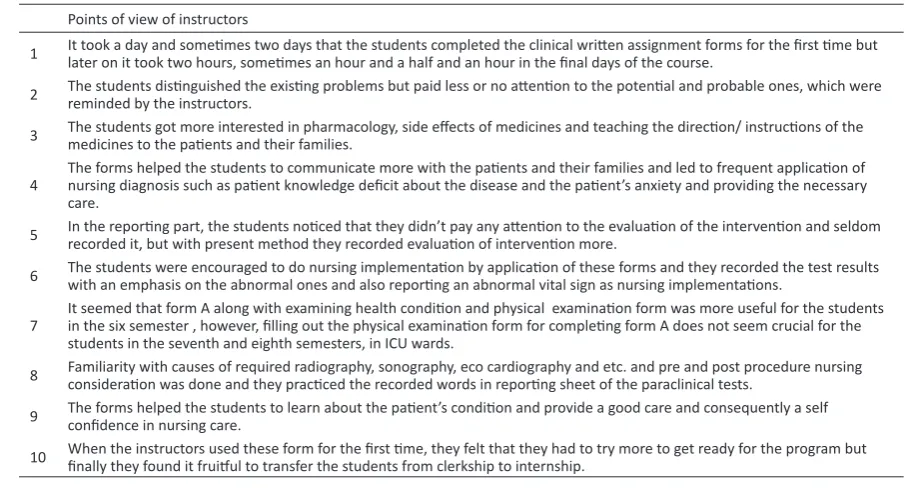
Points of view of instructors
1 It took a day and sometimes two days that the students completed the clinical written assignment forms for the first time but later on it took two hours, sometimes an hour and a half and an hour in the final days of the course.
2 The students distinguished the existing problems but paid less or no attention to the potential and probable ones, which were reminded by the instructors.
3 The students got more interested in pharmacology, side effects of medicines and teaching the direction/ instructions of the medicines to the patients and their families.
4 The forms helped the students to communicate more with the patients and their families and led to frequent application of nursing diagnosis such as patient knowledge deficit about the disease and the patient’s anxiety and providing the necessary care.
5 In the reporting part, the students noticed that they didn’t pay any attention to the evaluation of the intervention and seldom recorded it, but with present method they recorded evaluation of intervention more.
6 The students were encouraged to do nursing implementation by application of these forms and they recorded the test results with an emphasis on the abnormal ones and also reporting an abnormal vital sign as nursing implementations.
7 It seemed that form A along with examining health condition and physical examination form was more useful for the students in the six semester , however, filling out the physical examination form for completing form A does not seem crucial for the students in the seventh and eighth semesters, in ICU wards.
8 Familiarity with causes of required radiography, sonography, eco cardiography and etc. and pre and post procedure nursing consideration was done and they practiced the recorded words in reporting sheet of the paraclinical tests.
9 The forms helped the students to learn about the patient’s condition and provide a good care and consequently a self confidence in nursing care.
10 When the instructors used these form for the first time, they felt that they had to try more to get ready for the program but finally they found it fruitful to transfer the students from clerkship to internship.
Discussion
Carrying out clinical written assignment in clinical teaching among the nursing students in the sixth, seventh and eighth semesters, their care competency was statistically significant compared to the beginning of the course. The instructors also found it useful and believed that it could be advantageous for the students in the seventh and eighth semesters, who passed needed courses for completing and using the forms. Also they found it effective in transition of the students form clerkship to internship. The clinical instructor and colleagues in other universities evaluated it as a useful process as well.
The patients’ care planning based on the nursing process and considering its results is one of the duties of graduate nurses. Teaching health care to the individual, her/his family and society and designing the patient education are the duties of the graduate nurses on bachelor program.33 On the other hand, the changing and developing condition of the society and health system require the critical thinking competencies, the complete information assessment and independent clinical decision for nursing care. The aim of training competent nurses is that the patients get higher level of care. So, the clinical roles of the nurses could have various aspects suitable for different settings and patients.34 In a study titled” A Survey of Active Clinical Teaching Duration among Nursing Students of Rafsanjan Medical School in 2001” conducted by Taleghani and Rafee, the spent time on doing the different activities during clinical courses related to medical surgical I to IV and ICU were calculated. The measuring was one day in a week. The survey covered only four months. The mean theory activity from the first to the fourth week of clerkship was 34, 35, 50, 63 minutes respectively, and practical activity 5, 88, 79, 63, 60 minutes respectively. The mean activity of the patients’ health assessment was 31, 27, 28, 27 minutes respectively. The mean practical activity time decreased in the first four weeks, whereas the mean theoretical activity time increased. In intensive care units, the students’ mean practical activity time was more than other units. Totally, the mean clinical teaching time was 150 minutes 50% of which was only allocated to clerkship. Considering the wasted time, which seems to be 2.5 hours, a revision must be done in time of clerkship activities to fill the students’ time desirably.3
A study titled “Pathology of Clinical Teaching among the Nursing Students of ICU “by Khademhossieni et al. reported a lower level of students, satisfaction and wasted time in the clinical teaching.4
The study of Zamanzadeh et al. on the stressful experiences of the graduate in the first six months of their work showed that the lack of enough skill in the clinical decisions 51.5%, poor skill in prioritizing the nursing care activities 41%, lack of skill in the patient education 38.4% , lack of the needed information for the patient education
36%, poor skill in effective communication with patients and their families 24% were the stressful factors.6 The application of the assignment for the nursing students in the sixth semester and over was assessed as a useful. In determining the suitable strategies for clinical teaching, teaching objectives must be based on the learners’ experiences and the level of their knowledge in order to achieve the effective results.2
Conclusion
The researchers recommend the application of the clinical written assignment forms along with other strategies in clinical teaching for nursing students in the six semester and over in undergraduate level. The forms were compiled and used for clinical teaching for nursing students for the first time in the country. Training a competent and efficient nurse is one of the objectives of nurse training, thus, there is a need for a change in the nursing clinical teaching to achieve the expected results.
Acknowledgment
We would like to render our thanks to all the students who participated in this study. Our next thanks goes to all nursing clinical instructors in other universities, especially Ms. Akbarbeglou, Ms. Alee and Ms. Sadegnezhad for their critical feedbacks.
References
1. Zamanzadeh V, Parsa Yekta Z, Fathi Azar S,
Valizadeh L. The clinical teaching role of nursing
teachers. Iranian Journal of Medical Education 2002;2:27-33.[ Persian]
2. Gaberson KB, Oermann MH. Clinical teaching strategies in nursing, third edition. New York: Springer Publishing; 2010.
3. Taleghani F, Rafiei GHR. Surveying active time of
clinical education of nursing student in university of medical sciences, Rafsanjan. Iranian Journal of Medical Education 2002; 2:55-55.
4. Khademalhosseini SM, Alhani F, Anoosheh M. Pathology of "clinical education" in nursing students of intensive care unit: a qualitative study. Iranian Journal of Critical Care Nursing 2009;2:81-86. [Persian]
5. Dehghani KH, Dehghani H, Fallahzadeh H. The
educational problems of clinical field training based
on nursing teachers and last year nursing students view points. Iranian Journal of Medical Education 2005; 5:24-33.[Persian]
6. Zamanzadeh V, Namadie Vosogi M ,Seyyedfatemi
N. The new graduate nurses’ stressful experiencese
during transition period in teaching centers and
affiliated hospitals of Tabriz medical sciences
7. Charnley E. Occupational stress in the newly
qualified staff nurse. Nurs Stand 1999;13:33-36.
8. Oermann MH, Garvin MF. Stresses and challenges for new graduates in hospitals. Nurse Educ Today 2002;22:225-30.
9. Zerwekh JG, Claborn JC. Nursing today: transition and trends. 3 rd edition. Philadelphia: W. B. Saunders; 2000.
10. Hall JM. Dispelling desperation in nursing education. Nurs Outlook 2004;52:147–54.
11. Billings DM, Halstead JA.teaching in nursing: a
guide for faculty. 3rd edition. St. Louis: Saunders/
Elsevier; 2009.
12. Montana State University, College of Letters
& Science. Psychology undergraduate program overview [Internet]. USA: Montana State University; 2011[cited 2012 Apr]. Available from: http://www.montana.edu/wwwpy/undergrad.htm 13. Beitz J, Wieland D. Analyzing the teaching
effectiveness of clinical nursing faculty of full- and
part-time generic BSN, LPN-BSN, and RN-BSN
nursing students. J Prof Nurs 2005;21:32–45. 14. Schönwetter DJ, Lavigne S, Mazurat R, Nazarko
O. Students' perceptions of effective classroom and clinical teaching in dental and dental hygiene education. J Dent Educ 2006;70:624-35.
15. Hassan Zahraei R, Atash Sokhan G, Salehi S, Ehsanpour S, Hassanzadeh A. Comparing the factors related to the effective clinical teaching from faculty members' and students' points of view. Iranian Journal of Medical Education 2008;7: 249-56.[Persian]
16. Hosseiny N, Karimi Z, Malek zade J. The situation of clinical education based on nursing students’ opinion in Yasuj nursing and midwifery school. Iranian Journal of Medical Education 2005; 5:171-5.[Persian]
17. Hadizadeh F, Firoozi M, Shammaeyan Razavi N. Nursing and midwifery student’s perspective on clinical education in Gonabad University of Medical Sciences. Iranian Journal of Medical Education 2005; 5:70-8.[Persian]
18. Cheraghi F, Shamsaee F. Surveillance of nursing students of Hamedan University of Medical Sciences to clinical education. Res Med Sci 1998;1:156.[Persian]
19. Shahbazi L, Salimi T. Clinical education from the
viewpoints of nursing and midwifery students. Journal of Shaheed Sadoughi University of Medical Sciences and Health Services 1999;8:97-103. [Persian]
20. Khorsandi M, Khosravi SH. Clinical education from the viewpoints of nursing and midwifery school students of Arak. Rahavard Danesh 2001;5:29-32. [Persian]
21. Khadivzadeh T, Farokhi F. Investigation of clinical education weakness and strength from the viewpoints of nursing students in mashhad university of medical sciences. Iranian Journal of Medical Education 2003;3:67-68. [Persian]
22. Karimi Z, Hosseaini N. Evaluation of clinical
education from the viewpoints of nursing students. Iranian Journal of Medical Education 2003;3: 82.[Persian]
23. Salehi S, Hassan Zahrayi R, Ghazavi Z, Amini P, Ziaei S. The characteristics of effective clinical teachers as perceived by nursing faculty and students. Iranian Journal of Medical Education 2004;4:37-44. [Persian]
24. Fasihi Harandi T, Soltani Arabshahi K, Tahami SA, Mohammad Alizadeh Charandabi S. Viewpoints of medical students about the quality of clinical education. The Journal of Qazvin University of Medical Sciences 2004;8:4-9 [Persian]
25. Zaighami R, Faseleh M, Jahanmiri SH, Ghodsbin F. Nursing student's viewpoints about the problems of clinical teaching. The Journal of Qazvin University of Medical Sciences 2004;8: 51-5.[Persian]
26. Delaram M. Clinical education from the viewpoints of nursing and midwifery students in Shahrekord University of Medical Sciences. Iranian Journal of Medical Education 2006;6:129-35.[Persian]
27. Brazpardanjani Sh, Fridoni Moghaddam M, lorizadeh M. Clinical education from the viewpoints of students in nursing and midwifery school, Tehran University of Medical Sciences. Strides in Development of Medical Education 1998;5:102-11. [Persian]
28. Sarmad Z, Bazargan A, Hejazi E. Research methods in behavioral sciences. 5ed Edition. Tehran: Agahe Publications; 2001.[Persian]
29. Hampshire AJ .What is action research and can it promote change in primary care? J Eval Clin Pract 2000;6: 337-43.
30. Cooper J, Hewison A. Implementing audit in palliative care: an action research approach. J Adv Nurs 2002:39: 360-9.
31. Streubert HJ, Speziale HS, Carpenter DR. Qualitative research in nursing: advancing the humanistic
imperative. Philadelphia: Lippincott Williams &
Wilkins; 2006.
32. Hyrkäs K .Can action research be applied in developing clinical teaching? J Adv Nurs 1997:25:801-8.
33. The Curriculum of Bachelor in Nursing. 28th session
of educational planning high commission [Internet]. Tabriz University of Medical Sciences: Faculty of Nursing and Midwifery; 2005[Cited 2012 Feb 2]. Available from: http://nursing.tbzmed.ac.ir/
uploads/12/CMS/user/file/29/Edare_Amoozesh/ Maghate_Tahsili/Karshenasi_Parastari.pdf