Role of Cloud computing in education system: a study in Special
reference for Technical Education
Dr. Mukund kale
1, Prof. Anagha Vivek Dudgikar
21PhD, IIT Mumbai
Research Guide, HNIMR, Pune
2Research Scholar,
HNIMR, Pune, India
Introduction:
Cloud computing is a model for enabling convenient, ―on-demand" access to a shared pool of configurable computing resources, which can be rapidly provisioned and released with minimal management effort or service provider interaction.(Mell and Grance, et al 2009 NIST).The first major milestone of cloud computing got achieved in year 2000 for enterprise edition. Companies started delivering enterprise-level applications such as automated billing system, payment processing, call center and customer support etc. to any customer via Internetaccess using cloud computing. Also companies were able to purchase the service on a cost-effective on-demand basis.Cloud computing has experienced considerable growth from 2006 (Daniel Castro et al 2013).
Cloud computing has been a very popular area of research. Its extensive research has been reported in areas like Banking, Insurance, Manufacturing, Library, Healthcare, Education etc. Gartner (2012) mentioned that cloud computing is active mainly in Banking (25%), Insurance (15%) and Healthcare (15%).
Cloud computing is being adopted by education sector as a medium to share the knowledge by using technology.(Shimba et al 2010).The main reason of moving towards cloud computing is the effective utilization of computing resources. Apart from this, exchanging educational resources, experimentations on high end softwares etc have helped further to get cloud computing adopted in education sector (G.M. Murithi J.E. Kotzé et al 2012 ,Chen-Feng Wu et al 2013,BogdanMarinelaMarian et al 2011).
Following section provides a brief idea about how cloud computing is being leveraged in various sectors.
Adoption of cloud computing in different sectors:
Cloud computing is gaining popularity across variety of industries for basic business support functions. The research shows that cloud computing is being used for more than just IT functions. In fact, many industries are now viewing cloud computing in the context of how it can help them succeed in an evolving market place (Sahil, Sumesh, Prateek et al 2014).Cloud computing helps financial institutions, such as bank, insurance sectors, to improve their performance in number of ways, as discussed below.
Cloud Computing in Banking Sector: Banking & Financial Service (BFS) institutions are possibly the most advanced in terms of technology adoption and use cloud computing capabilities as a key differentiator. Now all the BFS Institutions across the world have become automated and are increasingly availing cloud computing services to reduce their cost of ownership.
Abstract:
Cloud computing is an emerging technology in IT sector. It has received increasing interest from many industries to improve their agility to fulfill dynamic business needs.Education sector too is not an exception as cloud computing provides promising benefits in terms of technology, scalable computing resources, sustainability etc. Cloud computing is also capable of providing cost effective solution in education sector.
This paper presents a critical review of published research literature on cloud computing, that covers the current key issues of cloud computing adoption in education sector, technical education in particular. It surveys scenarios of cloud computing deployments in foreign and Indian education institutes. Towards the end, the paper also provides cloud service providers perspective about deployment issues in Education sector. The paper concludes by highlighting key areas for research in cloud computing in education.
The white paper published by IBM et al 2010 has discussed about the benefits that cloud computing provides across various areas of banking sector are depicted below:
Area Sample benefit
Analytics Integrating customer data across banking platforms to enable near real-time Insights.
Business services Extending and incorporating third-party services to extend the banking ecosystem to support customer’s everyday buying and paying needs
Collaboration Enabling employees across distributed branches to access trading and banking systems through a security-rich cloud infrastructure
Desktop devices Deploying a private cloud to centralize management of desktops allows for greater remote flexibility without sacrificing control, while enabling banking employees to access the applications and data they need
Industry applications Enabling payment providers to standardize and modernize transaction processing
Infrastructure storage Providing scalable storage solutions to ensure that the real-time demands of today's trading and analytics processes are maintainable
Managed backup Backing up a bank’s critical business data to ensure that in the event of a disaster a bank can bounce back rapidly and easily
Security Enforcing active security and endpoint management to ensure corporate governance and banking IT policies are maintained
Table 1. The benefits that cloud computing can offer across various banking IT service areas By seeking all benefits provided by cloud computing, banks are continuously getting ways to improve their agility and adjust to market demands. The unique nature of cloud computing allows BFS institutions to pick and choose the services required on a pay-as-you-go basis(Sahil, Sumesh, Prateek et al 2014).Cloud computing help banks to enhance their ability to grow in new sectors or regions. Physical presence is no more a barrier which is helping banks to reduce time and cost burdens. It helps to create new markets and services to differentiate from competition. Banks are having better ability to provide consistent service to customers across branches, geographies ( Parag Arora et al 2013).
Cloud Computing in Insurance:
Cloud computing in the insurance industry is increasingly showing signs of being a necessity. It provides flexibility of sharing/storing their data fast, efficiently and securely that insurer wants (Jeff Tumpowsky et al 2014). One of the greatest benefits that cloud computing provides insurers are the ability to create a virtual server easily and deploy business-user-configurable cloud software solutions quickly. Virtualization allows that software or hardware to run more than one application at a time, so as a result, insurers can launch new products and services faster than ever before. (Kevin Mason et al 2013). Cloud Computing for Insurance offers opportunities and choice to help small insurance businesses grow and succeed. Smaller insurance companies can now access technology on a subscription basis that only larger insurance entities have been able to afford in the past. Cloud computing helps to drive new business and engage customers more effectively through new distribution models. It reduces time to market and drive new business opportunities. It helps to maximize insurance renewals by customers (Jordi Figueras et al 2010).
Through cloud computing, computing applications, platforms and infrastructure are delivered as a bundle of services to users within a private business (Jeff Tumpowsky et al 2014).
Though cloud computing benefits are primarily in BFS and insurance sectors as discussed above, many other sectors such as healthcare, library, manufacturing, education etc are also not far behind.
Alastair Brown (2014) has explained that mainly huge data storage of customers/patients, cost cut on infrastructure investments; provide customized services, access of system from anywhere anytime, are some of the distinct reasons for wide adoption of cloud computing in those areas.
Adoption of cloud computing in Education/Higher education
Educational organizations have demands for computationally heavy resources. They have to cope up with changing needs of students as well as expectations of the industries where students get placed. It increases the budget pressure on educational organizations. One of the important solutions for above issues is adoption of cloud computing. Many researchers have contributed for leveraging cloud computing in education sector. Few of them are mentioned below.
Behrend (2011) stated that cloud computing is highly cost effective in education sector. He also mentioned that it eliminates time constraints for students during usage of computing resources to improve their productivity. Workday’s whitepaper (2011) affirms that educational institutions using cloud technologyare able to take advantage of the newest innovations, fast implementations, and immediateupdates with the newest functionality.
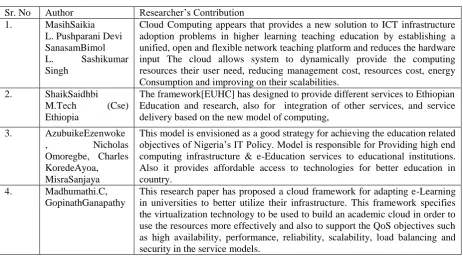
Table given below summarizes important research contribution reported by various researchers and it’s usage in education field.
Sr. No Author Researcher’s Contribution 1. MasihSaikia
L. Pushparani Devi SanasamBimol L. Sashikumar Singh
Cloud Computing appears that provides a new solution to ICT infrastructure adoption problems in higher learning teaching education by establishing a unified, open and flexible network teaching platform and reduces the hardware input The cloud allows system to dynamically provide the computing resources their user need, reducing management cost, resources cost, energy Consumption and improving on their scalabilities.
2. ShaikSaidhbi M.Tech (Cse) Ethiopia
The framework[EUHC] has designed to provide different services to Ethiopian Education and research, also for integration of other services, and service delivery based on the new model of computing,
3. AzubuikeEzenwoke , Nicholas Omoregbe, Charles KoredeAyoa, MisraSanjaya
This model is envisioned as a good strategy for achieving the education related objectives of Nigeria’s IT Policy. Model is responsible for Providing high end computing infrastructure & e-Education services to educational institutions. Also it provides affordable access to technologies for better education in country.
4. Madhumathi.C, GopinathGanapathy
This research paper has proposed a cloud framework for adapting e-Learning in universities to better utilize their infrastructure. This framework specifies the virtualization technology to be used to build an academic cloud in order to use the resources more effectively and also to support the QoS objectives such as high availability, performance, reliability, scalability, load balancing and security in the service models.
Table 2: Literature review of cloud computing in education field
As mentioned above, cloud computing adoption in education field in is remarkable and has tremendously benefitted.
Cloud computing is adopted in developed countries very fast in education field. Foreign universities have adopted this technology and benefitted.
Cloud Computing deployments in foreign Universities
Pandian(2011) mentioned that due to rapid growth of technology there is a need to redesign the educational system to meet industrial needs better.Advancement in technology is evolving at a very fast pace that is difficult to match. This puts universities around the world and those in developed countries in particular under pressure to meet up with latest IT trends (Judith Hurwitz, Robin, Marcia, Fern et al 2014). So the adoption rate of cloud computing in foreign universities is remarkable.The United States has been a leader in providing cloud computing services domestically and worldwide. Almost 78% universities in United States have leveraged cloud computing for engineering education in their campuses already.(Paul Korzeniowskiet al 2009).
expectations of the industry to place the students are compelling institutes to go for advanced technologies such as cloud computing.
For the technical institutes in the world, cloud computing is a powerful tooling that offers flexibility for students, staff, faculties, administrators, and other campus users. They can access file storage, databases, and other university applications anywhere anytime (Judith Hurwitz, Robin Bloor, Marcia Kaufman, and Fern et al 2012). In Cloud Forum 2012 mentioned that Universities, especially in developed and advanced countries, have adopted this technology for many reasons ranging from reduced cost of hardware acquisition and maintenance to greater access of web applications for teachers and learners and ultimately better academic outputs.
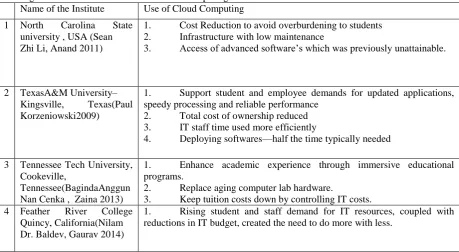
Table given below mentions the use of cloud computing in Technical Institutes in USA. Name of the Institute Use of Cloud Computing
1 North Carolina State university , USA (Sean Zhi Li, Anand 2011)
1. Cost Reduction to avoid overburdening to students 2. Infrastructure with low maintenance
3. Access of advanced software’s which was previously unattainable.
2 TexasA&M University– Kingsville, Texas(Paul Korzeniowski2009)
1. Support student and employee demands for updated applications, speedy processing and reliable performance
2. Total cost of ownership reduced 3. IT staff time used more efficiently
4. Deploying softwares—half the time typically needed
3 Tennessee Tech University, Cookeville,
Tennessee(BagindaAnggun Nan Cenka , Zaina 2013)
1. Enhance academic experience through immersive educational programs.
2. Replace aging computer lab hardware.
3. Keep tuition costs down by controlling IT costs. 4 Feather River College
Quincy, California(Nilam Dr. Baldev, Gaurav 2014)
1. Rising student and staff demand for IT resources, coupled with reductions in IT budget, created the need to do more with less.
Table 3: Advantages leveraged by Foreign Universities using Cloud Computing
Thus it is seen that due to adoption of Cloud computing by above mentioned universities, they are trying to fulfill students & industry demands as per market requirements.
Despite of Cloud computing adoption in developed countries is remarkable; in developing countries adoption rate is very low.
State of art of cloud computing adoption in Indian Technical institutes
A tremendous rise in the field of higher education in India has led the demand for the automation of education sector at all the levels. Technology has only reached class room of urban schools, wherein it is again limited to computer labs and audio-visual rooms. Eighty percent of the teaching in India is still imparted without the use of technological tools. This is mainly due to cost constraints. Demand has been rising for cost-effective, robust software applications to deliver services for learning and administration. Existing legacy systems are not scalable and require huge capital expenditure and IT staff to maintain the system. The Cloud Computing paradigm has emerged as the optimal solution to meet the requirements of cost effective, scalable and secure systems. Although above mentioned promising benefits are provided by cloud computing, the adoption rate in Indian education sector is not significant. (Vijayalakshmi Ravi et al 2012).
technologies in industries develops a broad gap, increasing demands from student’s community to provide high end technological facilities.
Technical education is typically resource intensive in terms of Simulation Facility, Computing, Modeling Facility& infrastructure. It requires huge capital investment. It is possible to meet those needs by efficient & effective use of cloud computing. (Pandian,Kasiviswanathanet al 2011)
AICTE report (2013) has mentioned Primary reasons for lesser adoption are: Reluctance to change traditional teaching methods -Education policies, controlling factors limit the acceptance to new change, Migration of Legacy systems on to new cloud services, Lack of tried & tested cloud based education models, Cost effectiveness of cloud in education is not well recognized.
To avoid such problems in technical institutes, AICTE has made some effort for the adoption of cloud computing as mentioned in the AICTE Report (2013). So technical institutes have started taking advantages such as free Google cloud for webmail services, use of online applications such as Google Documents or Adobe Photoshop Express, to store computer files online, to back up hard drive on to an online site. Though these are some of the examples of cloud computing usage in technical institutes in India, but the adoption is still at a very nascent stage. Having said that, some of the technical institutes in India have extensively used cloud computing technology to meet the industry needs. Number of such institutes is still very less, we can even count on finger!
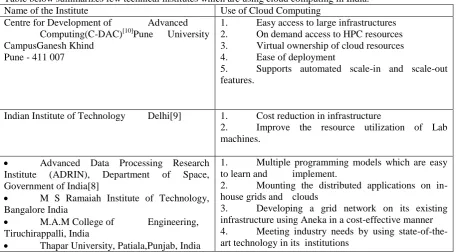
Table below summarizes few technical institutes which are using cloud computing in India. Name of the Institute Use of Cloud Computing
Centre for Development of Advanced Computing(C-DAC)[10]Pune University CampusGanesh Khind
Pune - 411 007
1. Easy access to large infrastructures 2. On demand access to HPC resources 3. Virtual ownership of cloud resources 4. Ease of deployment
5. Supports automated scale-in and scale-out features.
Indian Institute of Technology Delhi[9] 1. Cost reduction in infrastructure
2. Improve the resource utilization of Lab machines.
Advanced Data Processing Research Institute (ADRIN), Department of Space, Government of India[8]
M S Ramaiah Institute of Technology, Bangalore India
M.A.M College of Engineering, Tiruchirappalli, India
Thapar University, Patiala,Punjab, India
1. Multiple programming models which are easy to learn and implement.
2. Mounting the distributed applications on in-house grids and clouds
3. Developing a grid network on its existing infrastructure using Aneka in a cost-effective manner 4. Meeting industry needs by using state-of-the-art technology in its institutions
Table 4: Indian Technical institutes using cloud computing
The examples mentioned above indicate the usage of cloud computing in Indian Technical Institutes. Raj Mruthyunjayappa (2011) has mentioned in his interview that ―There is a greater need for automation & process management in Indian technical institutes‖. Technical institutes have started using paperless admission route, where the entire process of application handling is managed through the web including the counseling and fee payments for courses\classes. Few of the technology implementations like Smart Card readers across the institutions, dynamic university websites & portals, student admission portals, faculty portals, student information systems for student life cycle, career/placement management, learning management system (LMS), document management systems etc. has already been implemented. But the number of such institutes are very fewer in number which indicates that the adoption of cloud computing is very less in India. Some of the challenges which are being faced by institutes for adopting cloud computing are as below:
Migration of Legacy systems on to new cloud services e.g. SOA Applications Lack of tried & tested cloud based education models for engineering institutes Cost effectiveness of cloud in engineering education is not worked out.
As mentioned above one of the challenges is migration of legacy systems. The cloud service providers are facing certain issues during deployment of cloud computing. The following section briefly gives us idea about the issues & challenges faced by cloud service providers during deployment.
Service providers’ perspective
Cloud service provider focuses on key processes to ensure quality delivery of services. The report published by BMC software (2012) mentions the typical issues faced by Cloud service providers during deployment are: Platform neutrality, secure multi-tenancy, Self-service portal, fully automated multi-tier cloud service provisioning.
Sean Marston,Zhi Li, Subha jyoti , Anand Ghalsasi (2011) have discussed about issues involved during the deployment of cloud computing. The cloud service providers need to understand which applications are best positioned for migrating to cloud from legacy systems and challenges around this migration in the least disruptive manner.
Vimal Don Bosco, Dr. N Prabakara (2014) have focused on deployment challenges of cloud computing. There are many issues involved in web-Deployment in cloud computing. Some of the issues are mentioned below,
1. Performance 2. Security and privacy
3. Services Delivery and Billing 4. Interoperability and portability 5. Reliability and Availability 6. Performance and Bandwidth cost
Conclusion
Cloud computing is widely adopted worldwide in various sectors. The research on cloud computing has been reported to be focusing primarily on banking and finance, healthcare, education etc. The literature review indicates that cloud computing adoption in education field especially for technical education has tremendously benefitted in terms of cost and speed.Particularly foreign technical institutes are reported be ahead in this regard. However, from the perspective of its adoption in technical education in India, it appears that it is at a very nascent stage. The primary reasons for such low level of its adoption seem to be unawareness of cost effectiveness, lack of tried and tested models/frameworks etc.Very few technical institutes in India have embraced cloud computing and they are still maturing. These adoptions primarily work on ad-hoc basis and lack established systematic deployment and management systems. Thus the literature review indicates that there is a great potential for Indian technical institutes to take leap forward by adopting cloud computing.
References:
[1]. Chen-Feng Wu Learning Attitude and Its Effect on Applying Cloud Computing Service to IT Education International Journal of u- and e- Service, Science and Technology Vol. 6, No. 1, February, 2013
[2]. .Implementation of Cloud-based Virtual Labs for Educational Purposes
[3]. H. A. Ali and Haitham A. El-Ghareeb IJCSNS International Journal of Computer Science and Network Security, VOL.14 No.7, July 2014
[4]. R. Soundhara Raja Pandian , K.S. Kasiviswanathan Effective use of Cloud Computing concepts in Engineering colleges 2011 IEEE International Conference on Technology for Education
[5]. Bogdan GHILIC-MICU, Marinela MIRCEA, Marian STOICA Main Aspects of the Adoption of Cloud Solutions in Managing Service-Oriented Organizations – the Case of Higher Education Economy Informatics, vol. 11, no. 1/2011
[7]. Nilam Choudhary Dr. Baldev Singh GauravBagaria Vital Role of Cloud computing technology in Indian education system: a study in Specialreference for Technical Education IJSRD - International Journal for Scientific Research & Development| Vol. 2, Issue 04, 2014 | ISSN (online): 2321-0613 [8]. Bv Pranay Kumar, SumithaKommareddy, N.Uma Rani Effective Ways Cloud Computing Can
Contribute To Education Success Advanced Computing: An International Journal (ACIJ ), Vol.4, No.4, July 2013
[9]. Madhuri BHAVSAR1, ArchanaBHAVSARNCloud - Experimenting with Architecting and Facilitating Utility Services for Establishing Educational CloudJournal of Mobile,Embedded and Distributed Systems, vol. V, no. 2, 2013
[10]. Chaker El Amrani, HichamGibetTani, Lamiae Eloutouate Towards Setting up IBM Cloud Computing VCL at AbdelmalekEssaadi University
[11]. SafiyaOkai, MueenUddin, AmadArshad, RaedAlsaqour,andAsadullahShahCloud Computing Adoption Model forUniversities to Increase ICT Proficiency SAGE Open 2014 4:DOI: 10.1177/2158244014546461
[12]. G.M. MuriithiJ.E. KotzéCloud computing in higher education: implications for South African public universities and FET collegesProceedings of the 14th Annual Conference on World Wide Web Applications Durban, 7-9 November 2012ISBN: 978-0-620-55590-6
[13]. ShaikSaidhbi Cloud Computing Framework for Ethiopian Higher EducationInstitutions
[14]. .IOSR Journal of Computer Engineering (IOSRJCE). ISSN: 2278-0661, ISBN: 2278-8727Volume 6, Issue 6 (Nov. - Dec. 2012), PP 01-09.
[15]. www.iosrjournals.org
[16]. ShaikSaidhbi A Cloud Computing Framework for Ethiopian Higher Education Institutions Ethiopia [17]. Cloud computing in higher education: implications for South African public universitiesand FET
colleges
[18]. Olukunle A. Iyanda Application of contingency theory to cloud computing: a strategy for enhancing research and learning in the Nigerian universities
[19]. https://en.wikipedia.org/wiki/Cloud_management
[20]. Paul Korzeniowski Overcoming complex multi-cloud management challengesTechTarget
[21]. Judith Hurwitz, Robin Bloor, Marcia Kaufman,and Fern Halper Managing Cloud Computing Resources fromCloud Computing For Dummies
[22]. www.bmcsoftware.in/it-solutions/cloud-computing-software.html
[23]. How to Manage Foundational Issues with Cloud Computing Virtualization
[24]. Judith Hurwitz, Robin Bloor, Marcia Kaufman, and Fern Halper from Cloud Computing For Dummies
[25]. Sean Marston,Zhi Li, Subhajyoti, Anand Ghalsasi Cloud Computing – The Business Perspective Proceedings of the 44th Hawaii International Conference on System Sciences –2011.
[26]. www.bmcsoftware.in/it-solutions/cloud-computing-software.html
[27]. Ioan Petri a,c,∗, Omer F. Ranaa, GheorgheCosminSilaghi c, YacineRezgui Risk assessment in service provider communities ELSEVIER Future Generation Computer Systems 41 (2014) 32–43 HaralambosMouratidisa,∗, ShareefulIslama, Christos Kalloniatisb,
[28]. StefanosGritzalis A framework to support selection of cloud providers based on security and privacy requirements ELSEVIERThe Journal of Systems and Software 86 (2013) 2276– 2293
[29]. S. Vimal Don Bosco, Dr. N Prabakaran Challenges and issues of deployment on cloud International Journal of Innovative Research in Computer and Communication Engineering (An ISO 3297: 2007 Certified Organization) Vol. 2, Issue 2, February 2014
[30]. 30.Safiya Okai, Mueen Uddin, Amad Arshad, Raed Alsaqour, Asadullah Shah Cloud Computing Adoption Model for Universities to Increase ICT Proficiency DOI: 10.1177/2158244014546461Published 7 August 2014
[31]. USA Cloud Adoption & Trends 2012© Cloud Forum IP Ltd 2012
[32]. Nabil Sultan,‖ Cloud computing for education: A new dawn?‖ International Journal of Information Management.
[33]. .http://www.microsoft.com/education/enus/solutions/Pages/cloud_computing.asp
[35]. Sahil Patani , Sumesh Kadam , Prateek V. Jain Cloud Computing in the Banking sector : A survey Sahil Information Technology Department, VIIT, University of Pune, Pune,IndiaInternational Journal of Advanced Research in Computer and Communication Engineering Vol. 3, Issue 2, February 2014 [36]. M. Miller, Cloud Computing: Web-Based Applications That Change the Way You Work and
Collaborate Online, QUE Publisher, 2008.
[37]. G. Reese, Cloud Application Architectures: Building Applications and Infrastructure in the Cloud, O'Reilly Publisher, 2009.
[38]. Daniel Castro How Much Will PRISM Cost the U.S. Cloud Computing Industry? | August 2013 [39]. http://www.capgemini.com/resource-file- access/resource/pdf/Cloud_Computing_in_Banking.pdf [40]. www.manjrasoft.com/.../Manjrasoft%20Case%20Study%20-%20Solution
[41]. AhmedJameel Mansour Dong, B., Zheng, Q., Qiao, M., Shu, J., Yang, J.: Bluesky The Adoption of Cloud Computing Technology in Higher Education Institutions: Concerns and Challenges (Case Study on Islamic University of Gaza "IUG" )
[42]. N: Jaatun, M.G., ZHAO, G., RONG,C. Cloud Framework: An Elearning Framework Embracing Cloud Computing. (EDS.) Cloud Computing. lNCS, VOL. 5931, PP. 577–582. Springer, Heidelberg (2009).