The Thirty-Third AAAI Conference on Artificial Intelligence (AAAI-19)
Cross-Relation Cross-Bag Attention for Distantly-Supervised Relation Extraction
Yujin Yuan,
1Liyuan Liu,
2Siliang Tang,
1∗Zhongfei Zhang,
1Yueting Zhuang,
1Shiliang Pu,
3Fei Wu,
1Xiang Ren
41Zhejiang University2University of Illinois at Urbana Champaign3Hikvision Research Institute 4University of Southern California
{yujin, siliang, zhongfei, yzhuang, wufei}@zju.edu.cn, [email protected], [email protected], [email protected]
Abstract
Distant supervision leverages knowledge bases to automat-ically label instances, thus allowing us to train relation ex-tractor without human annotations. However, the generated training data typically contain massive noise, and may result in poor performances with the vanilla supervised learning. In this paper, we propose to conduct multi-instance learn-ing with a novel Cross-relation Cross-bag Selective Atten-tion (C2SA), which leads to noise-robust training for dis-tant supervised relation extractor. Specifically, we employ the sentence-level selective attention to reduce the effect of noisy or mismatched sentences, while the correlation among relations were captured to improve the quality of attention weights. Moreover, instead of treating all entity-pairs equally, we try to pay more attention to entity-pairs with a higher qual-ity. Similarly, we adopt the selective attention mechanism to achieve this goal. Experiments with two types of relation ex-tractor demonstrate the superiority of the proposed approach over the state-of-the-art, while further ablation studies verify our intuitions and demonstrate the effectiveness of our pro-posed two techniques.
Introduction
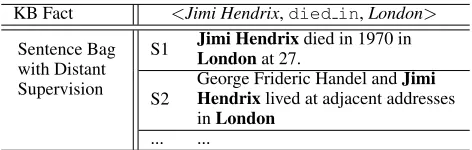
Aiming to detect and classify the relation between an en-tity pair in the given sentences, Relation Extraction (RE) plays a vital role in natural language understanding (Etzioni et al. 2004; Mintz et al. 2009; Liu et al. 2017a). The typ-ical methods follow the supervised learning paradigm and require extensive human annotations, which are costly and time-consuming. To alleviate such reliance, attempts have been made to build relation extractor with distant supervi-sion, i.e., automatically generating training data by knowl-edge base (KB). For example, with the KB fact<Jimi Hen-drix, died in, London> in Table 1, distant supervision would annotate all sentences containingJimi Hendrix and
Londonas the relation typedied in.
Despite its efficiency in cost and time, distant supervi-sion is context-agnostic thus containing massive noise for sentence-level RE. Accordingly, it may lead to an unsatisfy-ing performance before noise-robust trainunsatisfy-ing paradigms are developed (Lin et al. 2016). Multi-instance learning (MIL)
∗
Corresponding author.
Copyright c2019, Association for the Advancement of Artificial Intelligence (www.aaai.org). All rights reserved.
KB Fact <Jimi Hendrix,died in,London>
Sentence Bag with Distant Supervision
S1 Jimi Hendrixdied in 1970 in Londonat 27.
S2
George Frideric Handel andJimi Hendrixlived at adjacent addresses inLondon
... ...
Table 1: Distant Supervision and Sentence Bag.
has been employed to reduce the noise and bring such ro-bustness. As shown in Table 1, it treats sentence bag as the basic training instance, instead of individual sentence. Each bag would contain a group of sentences labeled by the same KB fact. By selecting from such bags, it allows a model to focus more on sentences of a higher quality and reduces the effect of noisy ones. Specifically, some methods (Riedel, Yao, and McCallum 2010; Hoffmann et al. 2011; Surdeanu et al. 2012) try to pick only one sentence from one bag, while more improvements (Lin et al. 2016; Liu et al. 2017b) have been observed by replacing the hard selection with Sentence-level Selective attention (ATT). ATT tries to assign attention weights to sentences and combines all sentences in the bag for the training.
However, ATT generates the attention weight for each re-lation type independently and overlooked their correre-lation. For example, in Table 1, by identifying S2 as a high-quality sentence forlive in, we are also able to recognize it as a low-quality sentence fordie in. Based on this intuition, we propose a novel attention mechanism, Cross-relation At-tention, which generates the attention weight after examin-ing their relatednesses to all relation types.
Moreover, we go beyond ATT and construct training in-stances at a higher level. We relax the constraint that one training instance only contains one entity pair. Specifically, we propose the Cross-bag Attention to combine different sentence bags, refer the combined structure as superbag, and set superbag as the training instance instead of sentence bag. This allows us to focus more on sentence bags of a higher quality, and reduce the noise brought by KB Facts which are outdated or unexpressed in the corpus.
we observe consistent improvements over the vanilla ATT. Extensive ablation studies are further conducted to verify both our intuitions and the effectiveness of both components.
Related work
Relation extraction is one of the most important tasks in NLP. Over the years, many efforts have been invested in relation extraction, especially in supervised relation ex-traction (Mooney and Bunescu 2006; Zelenko, Aone, and Richardella 2003; Rink and Harabagiu 2010). However, most of them are based on extra NLP systems to derive lex-ical features.
Recently, deep neural networks can learn underlying fea-tures automatically and have been used in the literature. (Socher et al. 2012) uses a recursive neural network in rela-tion extracrela-tion. (Zeng et al. 2014; Santos, Xiang, and Zhou 2015; Zeng et al. 2015) adopts an end-to-end convolutional neural network for relation extraction. (Zhou et al. 2016; Li et al. 2017; Zhang et al. 2017) uses the attention-based LSTM network to mitigate the weakness of the CNN net-work in processing long-span information. Based on CNN or RNN, there are still many efforts (Xu et al. 2015a; 2015b; Vu et al. 2016; Wang et al. 2016; Jiang et al. 2016; Huang and Wang 2017) to improve the network structures for more suitable for RE tasks. (Zeng et al. 2018) trains a relation extractor using Reinforcement learning.
Although reasonably good performances are reported in the above models, training these models requires a large amount of annotation data, which are difficult and expen-sive to obtain. To address this issue, distant supervision (DS) was proposed (Mintz et al. 2009) by assuming that all the sentences that mention two entities of a fact triple de-scribe the relation in the triple. In order to suppress the large amount of noise introduced by DS, many studies formulate the problem of relation classification as a multiple instance learning (MIL) problem (Riedel, Yao, and McCallum 2010; Hoffmann et al. 2011; Surdeanu et al. 2012; Zeng et al. 2015). All sentences containing the same entity pair are taken as a bag in MIL. (Lin et al. 2016) proposes the se-lective attention to select high quality sentence features in the bag as the bag feature and train the model by the bag feature. (Luo et al. 2017) proposes a transition matrix based method to dynamically characterize the noise. (Feng et al. 2018) uses reinforcement learning to select a more reliable subset on the DS dataset and uses it to train the classifier. In order to solve the bag level noisy label problem, (Liu et al. 2017b) uses a posterior probability constraint to correct potentially incorrect bag labels.
The selective attention method proposed by (Lin et al. 2016) is widely used in many recent efforts (Liu et al. 2017b; Li et al. 2017; Ji et al. 2017). The main differences be-tween our approach and that selective attention are: 1. Our approach takes into account the interplay between multiple relations. 2. Our approach assesses the quality of the bag fea-ture and reduces the impact of bag-level noisy label problem while the existing selective attention in the literature fails when processing a completely incorrect bag.
Methodology
Here, we develop a novel selective attention to reduce the noise of distant supervision for training relation ex-tractors. We present the Cross-relation Cross-bag Selective Attention(C2SA). It improves the sentence-level attention by considering the correlation among relations, and conducts the selection at the bag level with another attention layer.
Knowledge Base
Sentence Feature Neural Feature
Extractor
Bag Feature Superbag Feature
C2SA
Cross-relation Selective Attention
Cross-bag Selective Attention Output Later
DS Training Data
Unlabeled corpus
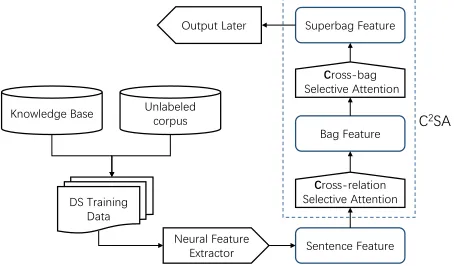
Figure 1: Distant Training with C2SA
As in Figure 1, the relation extractor has two components i.e., a neural feature extractor and an output layer. As for the neural feature extractor, it extracts useful features for rela-tion classificarela-tion and can be embodied by any popular neu-ral structures including CNNs and RNNs. Based on the ex-tracted features, the output layer makes the prediction on the relation type.
At the same time, the distant training pipeline with C2SA has four steps. The neural feature extractor is first employed to construct representations for each sentence. Then, the cross-relation selective attention combines the sentence rep-resentations and generate the representation for a sentence bag. Similarly, the cross-bag selective attention combines representations for the sentence bags and generates the rep-resentation for the superbag. At the end, the loss is calcu-lated based on the superbag feature that guides the learning of the relation extractor.
We now proceed by introducing these components in fur-ther details.
Relation Extractor
Typically, the neural feature extractor can be considered as a neural sentence encoder, which encodes sentences into low-dimensional, fixed-length vectors. It can be employed as any neural encoder, such as RNNs (e.g., LSTMs, GRUs) or CNNs. Since the CNNs-based models achieve the best results in our experiments, we take them as the defaults.
Input Representation To encode the sufficient sentence information in an entity-aware manner, we formulate the in-put for neural networks as follows: for a word at the position
iin a sentence, we first transform it into a pre-trained word vectorvi (Mikolov et al. 2013). Then we calculate its
...
,
Barack Obama was born
1n us
and
...
Word embedding
Word vector
convolution Position embedding
filters Sentence feature
Piecewise max pooling
Figure 2: P-CNN based Neural Relation Extractor
pd2 by looking up a position embedding table (Zeng et al.
2014). The position embedding table is randomly initialized and is updated during the model training. After that, we con-catenateviwithpd1andpd2as the word representationwi.
By repeating these steps, we transform each sentence into a fixed-sized matrix C = [w1,w2,· · · ,wm]T, wherewi
is a fixed-length vector andmis the maximum length of a sentence in the whole data corpus. For shorter sentences, we pad them with zeros.
Neural Feature Extractor As in Figure 2, we adopt piecewise-CNN (P-CNN) as the neural feature extractor. It is composed of a Convolution layer and a Piecewise Max-pooling layer.
In the Convolution layer, the outputcis calculated as:
ci,j =Pi◦Cj,j+l−1.
where Pi is the i-th convolutional kernel (filter), l is the
width of the kernel, and Ci,j is a sliding window on
sen-tenceC that starts from wi and ends at wj, i.e.,Ci,j = {wi,wi+1,· · ·,wj}.
The Piecewise Max-pooling (Zeng et al. 2015) is a vari-ant of the traditional max-pooling layer by considering the specific situation in relation extraction. For a sentence that contains an entity pair, the corresponding c is divided by such pair into three pieces. After that, the max-pooling op-eration is applied to each piece respectively, yielding three different output features. We then concatenate them into one feature vectorxi, wherexi ∈R3·n andnis the number of
filters. Finally, we apply hyperbolic tangent function at the output vectorxi.
Output Layer To compute the confidence of each rela-tion, we employ the linear projection and softmax function to calculate the conditional probability:
o=W·f (1)
P(r|f) = e or
Pnr
k=1eok
wherefis the extracted feature andWare the weights of the transformation.
In the experiments, we adopt the dropout strategy (Hin-ton et al. 2012) on the output layer to prevent overfitting.
Relation
embedding bag
𝑥𝑥1 𝑥𝑥2 𝑥𝑥3 𝑥𝑥4
Bag feature for 𝑟𝑟1
Bag feature for 𝑟𝑟3
𝑟𝑟1
𝑟𝑟2
𝑟𝑟3
Correlation Matrix
Similarity Matrix
Attention for 𝑟𝑟1
Attention for 𝑟𝑟3
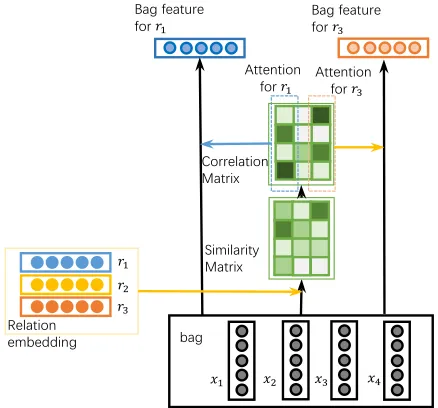
Figure 3: Structure of Sentence-level Cross-relation Selec-tive Attention
Dropout prevents co-adaptation of hidden units by randomly setting them to zero for a proportion p. Thus, we revise Equation 1 to Equation 2:
o=W·(fh) (2)
wherehis a vector of Bernoulli random variables with prob-abilitypof being1.
Cross-relation Cross-bag Selective Attention
Now we describe the proposed Cross-relation Cross-bag Se-lective Attention for relation extractor training. As intro-duced before, we follow the standard MIL and construct the sentence bags, i.e.,Bi={xi,1, xi,2,· · · , xi,nb}, wherexi,∗ contains the same entity pair andnb is the number of
sen-tences in the bag. With the distant supervision, each sentence bag is annotated by relations existing between the entity pair. With the sentence bag, we first leverage the cross-relation attention to combine sentences in the same bag (as shown in Figure 3); we then employ the cross-bag attention to inte-grate different bags into the superbag (as shown in Figure 5). The first attention attempts to reduce the effect of noisy or mismatched sentences, and the second aims to focus more attention on the high quality sentence bags.
Cross-relation Selective Attention For sentence bagBi,
we refer the extracted feature representation forxi,j as to
xi,j. Then we calculate the selective attention based on the
similarity between the sentence and the relation:
Si,j,k=
xi,j·rk kxi,jk krkk
(3)
whererkis the attention parameter corresponding to thek-th
𝑥𝑥1
𝑥𝑥2
𝑥𝑥3
𝑥𝑥4
𝑟𝑟1 𝑟𝑟2 𝑟𝑟3 𝑟𝑟1 𝑟𝑟3
Similarity matrix Correlation matrix Attention for
𝑟𝑟
1,
𝑟𝑟
3𝑟𝑟1 𝑟𝑟2 𝑟𝑟3
𝑥𝑥1
𝑥𝑥2
𝑥𝑥3
𝑥𝑥4
𝑥𝑥1
𝑥𝑥2
𝑥𝑥3
𝑥𝑥4
Figure 4: Similarity matrix and Correlation matrix
In order to capture the correlation among relations, we calculate the expected attention weight by the Bayes’ rule:
P(jthsentence|kthrelation)
=PnP(kthrelation|jthsentence)P(jthsentence) b
˜
j=1P(kthrelation|˜jthsentence)P(˜jthsentence)
(4)
Specifically, we assumeP(jthsentence)to be the uniform distribution, and calculateP(kthrelation|jthsentence)with
the softmax function:
P(kthrelation|jthsentence) =
eSi,j,k
Pnr ˜
k=1e
Si,j,k˜
(5)
To simplify the notion, we refer the calculated value of P(kthrelation|jthsentence) as to αj,k, and the value
ofP(jthsentence|kthrelation)as toβj,k. Then we rewrite
Equation 4 as
βj,k=
αj,k
Pnb ˜
j=1α˜j,k
(6)
Accordingly, the bag feature forBi for the k-th relation
can be calculated as
bi,k= nb
X
˜j=1
β˜j,kxi,˜j (7)
As shown in Figure 4, the cross-relation selective atten-tion depends on the similarities from the sentence to not only the target relation, but also the other relations. For example, in Figure 4,x2 andx4 have similar similarities tor1, but sincex4is more inclined to expressingr3, the model tends to use features ofx2to generate the bag feature and use this feature to predictr1.
Cross-bag Selective Attention The sentence level atten-tion assumes that at least one sentence in a bag expresses the relation between entity pairs. However, due to the noisy nature of distant supervision, there may still exist noise in the sentence bag level. For example, there are a large num-ber of entity pairs that cannot find any expression about their relations in the given corpus. Such entity pairs would result in the mismatched and noisy training instances for the sen-tence level relation extraction.
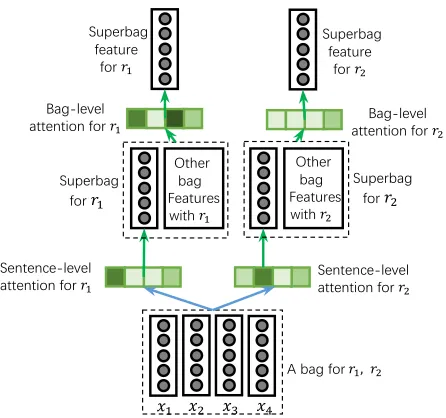
As shown in Figure 5, we go beyond the existing set-ting and propose to establish an additional selective atten-tion layer, i.e., Cross-bag Selective Attenatten-tion. Specifically,
𝑥𝑥1 𝑥𝑥2 𝑥𝑥3 𝑥𝑥4 Sentence-level
attention for𝑟𝑟1
Sentence-level attention for𝑟𝑟2
Superbag for 𝑟𝑟1
Other bag Features with 𝑟𝑟1
Bag-level attention for𝑟𝑟2
Bag-level attention for𝑟𝑟1
Superbag feature
for 𝑟𝑟1
Superbag feature
for 𝑟𝑟2
A bag for𝑟𝑟1,𝑟𝑟2
Other bag Features with 𝑟𝑟2
Superbag for 𝑟𝑟2
Figure 5: Cross-bag Selective Attention
we intend to combine several sentence bags of the same relation type and put more attention to the higher qual-ity ones. We refer the higher-level structure that contains a group of sentence bags as to superbag, and denote it as
B={B1, B2, ..., Bns}, wherensis the size of the superbag and allBiare labelled with thek-th relation type.
Based on the Cross-relation Selective Attention, we con-struct the representation for each sentence bag while cap-turing the correlation among sentences. Here, we combine these representations with an attention layer. Specifically, we obtain the superbag featuref forBas:
f =
ns
X
i=1
γi·bi,k
γi=
eS(rk,bi,k)
Pns
j=1eS(rk,bj,k)
(8)
wherebi,k is the bag representation w.r.t. Bi for the k-th
relation andrk is the attention parameter corresponding to
thej-th relation. Specifically, we tie up therkin Equation 8
with the ones in Equation 3. Also, similar to the Equation 3, we calculateS(rk,bi,k)with the cosine similarity.
Model Training
We employ the objective function as the negative log likeli-hood at the superbag level as follows:
L=−
nsb
X
i=1
logp(li|Bi) (9)
wherensbindicates the number of the superbags in the
train-ing set andliindicates the label of a superbag.
Experiments
Parameter Name Value Candidate Set sentence embedding
100 {100, 150, 200}
dimension
batch size 100 {100, 150, 200}
superbag size 2 {2, 3, 4, 5}
sliding window size 3
reused from previous
work word vector dimension 50
position embedding 5 dimension
dropout probability 0.5
Table 2: Hyper-parameter Settings.
these baselines are BLSTMs-based, while others are P-CNNs-based. Since C2SA is model-agnostic and only used in the learning phrase, we conduct the experiments with both types of neural relation extractors. Moreover, we employ two evaluation settings for an extensive comparison. Specif-ically, we first follow the popular setting and evaluate the model performances on the corpus-level relation extraction task. Besides, we also conduct experiments on the sentence-level relation extraction task with a human annotated test corpus. We observe that, in all settings, our proposed C2SA consistently outperforms the state-of-the-art.
For a better understanding, we further report a case study and ablation experiments, which further verifies our intuition and demonstrates the effectiveness of both cross-sentence and cross-bag selective attention mechanisms.
Model Training
As discussed before, we leverage C2SA to train two types of relation extractors, i.e., P-CNNs-based and BLSTMs-based. We refer these two variants as PCNN+C2SA and BLSTM+C2SA.
Dataset Following the existing literature (Riedel, Yao, and McCallum 2010; Lin et al. 2016; Li et al. 2017; Feng et al. 2018; Liu et al. 2017b), we use the New York Times (NYT) dataset as the training set (Mintz et al. 2009). It uses Free-base (Bollacker et al. 2008) to provide distant supervision on the NYT corpus. Specifically, it collects sentences from 2005 to 2006 and supports 53 different relations (including NA which means no relations for an entity pair). For training set statistics, this dataset contains 522611 sentences, 281270 entity pairs and 18252 KB facts.
Model Setting In all the experiments, we use 50 dimen-sional word vectors that are pre-trained by the Skip-gram algorithm1 on the NYT corpus. For hyper-parameters, we reuse part of them from the previous study (Zeng et al. 2015; Li et al. 2017), and tune the rest part by grid-search with the three-fold cross-validation (on the training set). The final hyper-parameter setting used in our experiments are summa-rized in Table 2.
1
https://code.google.com/p/word2vec/
0.4 0.5 0.6 0.7 0.8 0.9 1
0 0.05 0.1 0.15 0.2 0.25 0.3 0.35 0.4
pr
ec
isio
n
recall
PCNN+ATT BLSTM+2ATT PCNN+ATT+RL PCNN+ATT+softlabel BLSTM+C2SA PCNN+C2SA
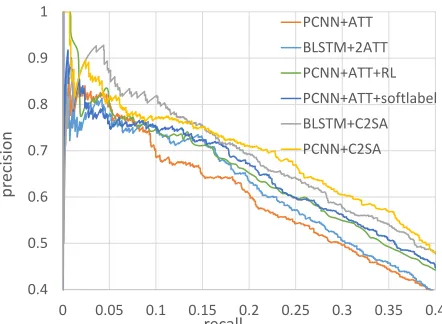
Figure 6: Performance comparison on the corpus-level rela-tion extracrela-tion.
Comparison on the Corpus-level Task
Here, we evaluate the performances of our method on the corpus-level relation extraction. For an entity pair, the task is to identify their relation type with regard to all the sentences that mention this entity pair. Specifically, we first feed all the sentence representations to the output layers for prediction. After that, the probability of a relation for an entity pair is the maximum probability of this relation in all the sentences mentioning this entity pair.
Test Set We use the test set of NYT for the corpus-level evaluation (Mintz et al. 2009). The test set is constructed with sentences from NYT of 2007 annotated with Free-base (Bollacker et al. 2008). Specifically, it contains 172448 sentences, 96678 entity pairs and 1950 KB facts.
Competing Methods We choose four recent methods as baselines:
• PCNN+ATT (Lin et al. 2016) uses the vanilla sentence-level selective attention to combine sentence features for each bag. Based on this attention, the representation for each bag is obtained and is trained under the PCNN model.
• BLSTM+2ATT (Li et al. 2017) also employs the vanilla sentence-level selective attention. Different from PCNN+ATT, it is a BLSTM-based model which has an additional word-level attention module.
• PCNN+ATT+RL (Feng et al. 2018) further incorporates reinforcement learning to improve PCNN+ATT. It trains the PCNN+ATT model with a subset of the training set, which is selected by the learned policy.
• PCNN+ATT+softlabel (Liu et al. 2017b) enhances the PCNN+ATT model by using the posterior probability constraint to correct potentially incorrect bag labels.
eval-uate C2SA in the held-out setting and report the model per-formances with the Precision-Recall curve.
We summarize the performances of BLSTM+C2SA, PCNN+C2SA, and all the baselines in Figure 6. We ob-serve that models trained with C2SA, no matter whether they are PCNNs-based or BLSTMs-based, consistently out-perform the other models. In addition, there is no clear difference between PCNN-based methods and BLSTM-based methods. For example, the PCNNs-BLSTM-based baseline (PCNN+ATT) performs worse than the BLSTMs-based baseline (BLSTM+2ATT). However, with our proposed C2SA, the PCNNs-based method (PCNN+C2SA) outper-forms the BLSTMs-based method (BLSTM+C2SA). We re-port the ablation studies later.
At the same time, we observe that the choice of the train-ing setttrain-ing has a large impact on the performances. That is, with the model trained more robustly to noise, there are clear improvements in performances. These observa-tions have further verified our intuition for improving the distantly-supervised relation extraction with a more robust training.
Comparison on the Sentence-level Task
For an extensive comparison, we further evaluate the perfor-mances of our method on the sentence-level relation extrac-tion. Different from the corpus-level task, this task aims to identify the relation type for an entity pair with regard to a specific sentence. More precisely, we feed the sentence rep-resentation to the output layer and observe the prediction.
Test Set For the sentence-level evaluation, we adopt the dataset used in the existing literature (Hoffmann et al. 2011). It contains 395 sentences with human annotations. Compared with the test set for the corpus-level task, this set is small in size. However, considering the fact that this dataset is manually annotated, it makes sense to report this comparison study.
Competing Methods We compare C2SA with two ma-jor baselines, i.e., PCNN+ATT and BLSTM+2ATT. Be-sides, we also make comparison with two variants of C2SA, i.e., CRSA and C2SA-dot. CRSA only performs the cross-relation selective attention and trains the model at the sen-tence bag level. C2SA-dot, on the other hand, changes the scoring function in Equation 3 and Equation 5 from the co-sine similarity to the dot product.
Performance Comparison As reported in Table 3, we ob-serve that C2SA outperforms both baselines and the variants. Besides, we observe that CRSA outperforms ATT and C2SA outperforms CRSA. This observation verifies the effective-ness of the two proposed techniques. In addition, we observe that after replacing the cosine similarity with dot product in C2SA, the performance drops significantly. This shows that when serving as the scoring function for the selective atten-tion, cosine similarity is more effective than the dot product.
Ablation Study
To further demonstrate the effectiveness of the two proposed selective attention mechanisms, we now report the ablation
PCNNs-based F1 BLSTMs-based F1
PCNN+ATT 0.377 BLSTM+2ATT 0.382
PCNN+CRSA 0.411 BLSTM+CRSA 0.409
PCNN+C2SA 0.421 BLSTM+C2SA 0.448
PCNN
+C2SA-dot 0.400
BLSTM
+C2SA-dot 0.401
Table 3: Performance comparison on the sentence-level re-lation extraction.
studies.
To examine the effectiveness of the cross-relation tive attention, we compare CRSA with the vanilla selec-tive attention (ATT). Specifically, CRSA only performs the cross-relation selective attention; both CRSA and ATT con-duct the training at the sentence bag level. As to the cross-bag selective attention, it is based on the sentence cross-bag repre-sentation. In other words, only the sentence-level attention is required. Accordingly, we demonstrate the effectiveness of the cross-bag selective attention by comparing CRSA with the full C2SA.
For a fair comparison, we compare the two types of re-lation extractions separately as we did before. As shown in Figure 7, all the models are trained with the same training set introduced before and are evaluated on the corpus-level task. We employ the Precision-Recall curve for the compar-ison studies with the summarized performances of PCNNs-based relation extractions in Figure 7(a) and the summarized performances of BLSTMs-based ones in Figure 7(b).
We observe that C2SA achieves the best performance in both cases. Also, we note that the PCNNs-based model achieves a better improvement than the BLSTMs-based model. For example, there is an obvious margin between the PCNN+CRSA and PCNN+ATT. We believe that this obser-vation is due to the difference between the characteristics of the different neural feature extractors. The CNNs-type mod-els are good at extracting local information (such as trigger words) of a sentence reflected in the dimensions of their fea-ture vectors, leading to the observation that cosine similarity based attention mechanism delivers a better performance.
On the other hand, it is observed that the gap between C2SA and CRSA verifies the fact that some sentence bags are of a higher quality than others. This observation demon-strates that the proposed cross-bag selective attention allows the model training at the superbag level with a more robust performance. We report the case studies below to support this observation.
Case Study
sen-0.4 0.5 0.6 0.7 0.8 0.9 1
0 0.05 0.1 0.15 0.2 0.25 0.3 0.35 0.4
pr
ec
isio
n
recall
PCNN+ATT
PCNN+CRSA
PCNN+C2SA
(a)
0.4 0.5 0.6 0.7 0.8 0.9 1
0 0.05 0.1 0.15 0.2 0.25 0.3 0.35 0.4
pr
ec
isio
n
recall
BLSTM+2ATT
BLSTM+CRSA
BLSTM+C2SA
(b)
Figure 7: (a) Aggregate precision/recall curves of PCNN+ATT, PCNN+CRSA, PCNN+C2SA (b) Aggregate precision/recall curves of BLSTM+2ATT, BLSTM+CRSA, BLSTM+C2SA
Total count of sentence bags 100
Contain at least one sentence 69
All annotations are incorrect 31
Table 4: Manually checked qualities for the sampled sen-tence bags with distant supervision
tence bags contain 483 sentences and their qualities are sum-marized in Table 4.
We observe that, even after aggregating sentences to con-struct sentence bag, the distant supervision is still noisy. Ac-tually, about 31% of all the sentence bags do not even con-tain one sentence that is correctly annotated. Therefore, it is fair to conclude that the superbag-level training is necessary to handle the noise of distant supervision.
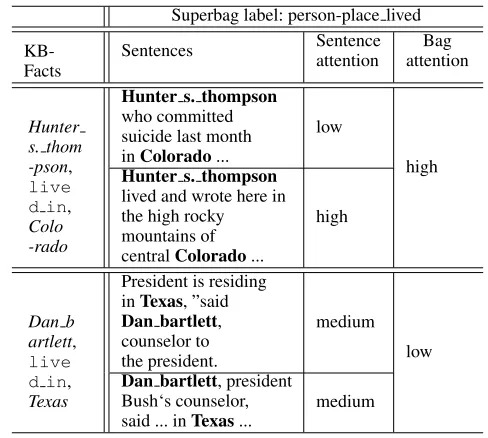
Effectiveness of Cross-bag Selective Attention We fur-ther examine whefur-ther the proposed cross-bag selective at-tention is capable of properly handling the noise from distant supervision. Table 5 shows a superbag for the relation type
lived in. It contains two sentence bags. One is for the KB fact<Hunter s,lived in,Colorado>, and the other is for the KB fact<Dan bartlett,lived in,Texas>. We observe that there is only one sentence that is correctly an-notated in the first sentence bag, and that all the sentences in the second bag are unmatched with the relation type of the KB fact. Clearly, the sentence-level selective attention would fail to handle the second bag. On the other hand, the proposed cross-bag selective attention allows the model to focus more on the sentence bag with a higher quality. For example, in Table 5, such selective attention reduces the ef-fect of the distant supervision noise by assigning a smaller attention weight to the second sentence bag.
Superbag label: person-place lived
KB-Facts
Sentences Sentence
attention
Bag attention
Hunter s. thom -pson,
live d in, Colo -rado
Hunter s. thompson who committed suicide last month inColorado...
low
high Hunter s. thompson
lived and wrote here in the high rocky mountains of centralColorado...
high
Dan b artlett,
live d in, Texas
President is residing inTexas, ”said Dan bartlett, counselor to the president.
medium
low
Dan bartlett, president Bush‘s counselor, said ... inTexas...
medium
Table 5: A case study for two sentence bags and their corre-sponding superbag
Conclusion and Future Work
Acknowledgments
This work has been supported in part by NSFC (No. 61751209, U1611461), 973 program (No. 2015CB352302), Hikvision-Zhejiang University Joint Research Center, Chi-nese Knowledge Center of Engineering Science and Tech-nology (CKCEST), Engineering Research Center of Dig-ital Library, Ministry of Education. Xiang Ren’s research has been supported in part by National Science Foundation SMA 18-29268.
References
Bollacker, K.; Evans, C.; Paritosh, P.; Sturge, T.; and Taylor, J. 2008. Freebase: a collaboratively created graph database for structuring human knowledge. InProceedings of SIGMOD, 1247–1250. AcM.
Etzioni, O.; Cafarella, M.; Downey, D.; Kok, S.; Popescu, A.-M.; Shaked, T.; Soderland, S.; Weld, D. S.; and Yates, A. 2004. Web-scale information extraction in knowitall:(preliminary re-sults). InProceedings of WWW, 100–110. ACM.
Feng, J.; Huang, M.; Zhao, L.; Yang, Y.; and Zhu, X. 2018. Re-inforcement learning for relation classification from noisy data. InProceedings of AAAI.
Hinton, G. E.; Srivastava, N.; Krizhevsky, A.; Sutskever, I.; and Salakhutdinov, R. R. 2012. Improving neural networks by preventing co-adaptation of feature detectors. arXiv preprint arXiv:1207.0580.
Hoffmann, R.; Zhang, C.; Ling, X.; Zettlemoyer, L.; and Weld, D. S. 2011. Knowledge-based weak supervision for informa-tion extracinforma-tion of overlapping relainforma-tions. InProceedings of ACL-HLT, 541–550. ACL.
Huang, Y., and Wang, W. Y. 2017. Deep residual learning for weakly-supervised relation extraction. InProceedings of EMNLP, 1803–1807.
Ji, G.; Liu, K.; He, S.; and Zhao, J. 2017. Distant supervision for relation extraction with sentence-level attention and entity descriptions. InAAAI.
Jiang, X.; Wang, Q.; Li, P.; and Wang, B. 2016. Relation extrac-tion with multi-instance multi-label convoluextrac-tional neural net-works. InProceedings of COLING.
Li, L.; Nie, Y.; Han, W.; and Huang, J. 2017. A multi-attention-based bidirectional long short-term memory network for rela-tion extracrela-tion. InInternational Conference on Neural Infor-mation Processing, 216–227. Springer.
Lin, Y.; Shen, S.; Liu, Z.; Luan, H.; and Sun, M. 2016. Neural relation extraction with selective attention over instances. In
ACL (1).
Liu, L.; Ren, X.; Zhu, Q.; Zhi, S.; Gui, H.; Ji, H.; and Han, J. 2017a. Heterogeneous supervision for relation ex-traction: A representation learning approach. arXiv preprint arXiv:1707.00166.
Liu, T.; Wang, K.; Chang, B.; and Sui, Z. 2017b. A soft-label method for noise-tolerant distantly supervised relation extrac-tion. InProceedings of EMNLP, 1790–1795.
Luo, B.; Feng, Y.; Wang, Z.; Zhu, Z.; Huang, S.; Yan, R.; and Zhao, D. 2017. Learning with noise: Enhance distantly super-vised relation extraction with dynamic transition matrix. Trans-formation.
Mikolov, T.; Chen, K.; Corrado, G.; and Dean, J. 2013. Effi-cient estimation of word representations in vector space.arXiv preprint arXiv:1301.3781.
Mintz, M.; Bills, S.; Snow, R.; and Jurafsky, D. 2009. Dis-tant supervision for relation extraction without labeled data. In
ACL-ICJNLP, 1003–1011. ACL.
Mooney, R. J., and Bunescu, R. C. 2006. Subsequence kernels for relation extraction. InNIPS.
Riedel, S.; Yao, L.; and McCallum, A. 2010. Modeling rela-tions and their menrela-tions without labeled text. MLKDD148– 163.
Rink, B., and Harabagiu, S. 2010. Utd: Classifying semantic relations by combining lexical and semantic resources. In Pro-ceedings of the 5th International Workshop on Semantic Eval-uation, 256–259. ACL.
Santos, C. N. d.; Xiang, B.; and Zhou, B. 2015. Classifying relations by ranking with convolutional neural networks.arXiv preprint arXiv:1504.06580.
Socher, R.; Huval, B.; Manning, C. D.; and Ng, A. Y. 2012. Semantic compositionality through recursive matrix-vector spaces. InProceedings of EMNLP-CoNLL, 1201–1211. ACL.
Surdeanu, M.; Tibshirani, J.; Nallapati, R.; and Manning, C. D. 2012. Multi-instance multi-label learning for relation extrac-tion. InEMNLP-CoNLL. ACL.
Vu, N. T.; Adel, H.; Gupta, P.; and Sch¨utze, H. 2016. Com-bining recurrent and convolutional neural networks for relation classification.arXiv preprint arXiv:1605.07333.
Wang, L.; Cao, Z.; de Melo, G.; and Liu, Z. 2016. Relation classification via multi-level attention cnns. InACL, volume 1, 1298–1307.
Xu, K.; Feng, Y.; Huang, S.; and Zhao, D. 2015a. Semantic relation classification via convolutional neural networks with simple negative sampling.arXiv preprint arXiv:1506.07650. Xu, Y.; Mou, L.; Li, G.; Chen, Y.; Peng, H.; and Jin, Z. 2015b. Classifying relations via long short term memory networks along shortest dependency paths. InProceedings of EMNLP, 1785–1794.
Zelenko, D.; Aone, C.; and Richardella, A. 2003. Kernel meth-ods for relation extraction. JMLR3(Feb):1083–1106.
Zeng, D.; Liu, K.; Lai, S.; Zhou, G.; Zhao, J.; et al. 2014. Re-lation classification via convolutional deep neural network. In
COLING, 2335–2344.
Zeng, D.; Liu, K.; Chen, Y.; and Zhao, J. 2015. Distant supervi-sion for relation extraction via piecewise convolutional neural networks. InEMNLP.
Zeng, X.; He, S.; Liu, K.; and Zhao, J. 2018. Large scaled relation extraction with reinforcement learning.Relation2:3. Zhang, Y.; Zhong, V.; Chen, D.; Angeli, G.; and Manning, C. D. 2017. Position-aware attention and supervised data improve slot filling. InProceedings of EMNLP, 35–45.