University of Mazandaran, Iran
http://cjms.journals.umz.ac.ir
ISSN: 1735-0611 CJMS.3(1)(2014),123-130
A modification of Chebyshev-Halley method free from second derivatives for nonlinear equations
H. Esmaeili1 and M. Rostami 2
1,2Department of Mathematics, Bu-Ali Sina University, Hamedan, Iran
Abstract.In this paper, we present a new modification of
Chebyshev-Halley method, free from second derivatives, to solve nonlinear equations. The convergence analysis shows that our modification is third-order convergent. Every iteration of this method requires one function and two first derivative evaluations. So, its efficiency index is 31/3 = 1.442 that is better than that of Newton method. Several numerical examples are given to illustrate the performance of the presented method.
Keywords: Chebyshev-Halley method; Newton method; Nonlin-ear equations; Third-order convergence.
2000 Mathematics subject classification: 65H05, 49M15, 34A34.
1. INTRODUCTION
Solving nonlinear equations is one of the most important problems in numerical analysis. In this paper, we consider iterative methods to find a simple rootα of a nonlinear equation f(x) = 0, where f :I 7→ R, for an open intervalI, is a scalar function. Newton method is undoubtedly the most famous iterative method to findα by using the scheme
xn+1 =xn− f(xn) f′(xn)
(1.1)
1E-mail: [email protected]
2Corresponding author. E-mail: [email protected]
Received: 15 April 2013 Revised: 6 November 2013 Accepted: 15 November 2013
that converges quadratically in some neighborhood ofα [1].
The classical Chebyshev-Halley method [2] which improves Newton method is given by
xn+1=xn−
(
1 +1 2
Lf(xn) 1−βLf(xn)
)
f(xn)
f′(xn), (1.2)
in which
Lf(xn) =
f(xn)f′′(xn) f′2(x
n)
, (1.3)
and β is a parameter. This family is known to converge cubically, and includes, as particular cases, the classical Chebyshev method (β = 0), Halley method (β = 1/2) and Supper-Halley method (β = 1). It is observed that the methods depend on the second derivatives in comput-ing process, makcomput-ing its practical utility rigorously restricted, so that the Newton method is frequently used as an alternative in solving nonlinear equations.
To remove the second derivative from (1.3), recently, some variants of Chebyshev-Halley method have been obtained [3,4,5,6].
Chun [3] considers approximating the equation f(x) = 0 around the point (xn, f(xn)) by the quadratic equation in x and y in the form x2+ay2+bx+cy+d= 0 and imposes the tangency conditionsy(xn) = f(xn), y′(xn) = f′(xn), y(wn) = f(wn), where wn = xn− ff′((xnxn)), to
obtain
f′′(xn)≈y
′′
(xn) = 2
(
1 +af′2(xn)
) f(wn)f′2(xn)
f2(x
n) +af′2(xn)[f(wn)−f(xn)]2 .
Therefore, he gets the approximation of
Lf(xn)≈
2f(xn)f(wn)(1 +af′2(xn))
f2(xn) +af′2(xn)[f(wn)−f(xn)]2 , (1.4)
in which ais a parameter.
Xiaojian [4], to remove thef′′(xn) in (1.3), approximated the equation f(x) = 0 around the point (xn, f(xn)) by the hyperbola form axy+ y+bx+c = 0 and imposed the tangency conditions y(xn) = f(xn), y′(xn) = f′(xn) and y(wn) = f(wn), where wn = xn− ff′((xnxn)). So, he
gets the approximation of
f′′(xn)≈y′′(xn) = 2f
′2(xn)f(wn)
f2(xn)−f(xn)f(wn),
that results in
Lf(xn)≈
2f(wn) f(xn)−f(wn)
Chun [5], to derive an approximation of f′′(xn) in (1.3), considers the approximationf(x)≈g(x) :=ax3+bx2+cx+d, satisfying the conditions f′(xn) = g′(xn) and f′(wn) = g′(wn), in which wn = xn− ff′((xnxn)). He
then derived the approximation of
f′′(xn)≈g′′(xn) = f
′(wn)−f′(xn)
wn−xn −
λ(wn−xn), λ= 3a
that results in
Lf(xn)≈1−
f′(wn) f′(xn)
+λf
2(x
n) f′3(x
n)
. (1.6)
Jisheng, Yitian and Xiuhua [6] used Taylor expansion of f(yn) about xn, in whichyn = xn−θff′((xnxn)) and θ is a nonzero real parameter, and
get the following approximation of
Lf(xn)≈
f(yn) + (θ−1)f(xn)
θ2f(xn) . (1.7)
It is proved that all of the above approximations of Lf(xn) applied to the Chebyshev-Halley method (1.2) lead to a cubically convergent method.
In this paper, using a new observation, we will approximate Lf(xn) by a finite difference between first derivatives. So, a new modification of Chebyshev-Halley method, free from second derivatives, is obtained. It is proved that our new modification has third-order convergence. Some examples are given to show the efficiency and superiority of the new method.
2. A NEW APPROXIMATION OF Lf(xn)
To obtain a new modification for Chebyshev-Halley method, free from second derivatives, we will approximate Lf(xn) using first derivatives. To this end, notice that
f′′(x) f′2(x) =−
(
1 f′(x)
)′
.
Using the well-known finite difference approximationF′(xn)≈[F(xn+ δn)−F(xn)]/δn, in which F(x) = 1/f′(x) and δn=γf(xn), we have
(
1 f′(x)
)′
≈ 1
γf(xn)
[
1
f′(xn+γf(xn))− 1 f′(xn)
]
.
So, we get the following approximation:
f′′(xn) f′2(xn) ≈
1 γf(xn)
[
1 f′(xn) −
1
f′(xn+γf(xn))
]
where γ ̸= 0 is a parameter. Considering the above approximation, we will have
Lf(xn)≈L˜f(xn) := 1 γ
[
1 f′(xn) −
1
f′(xn+γf(xn))
]
, (2.1)
that results in the following modification of the Chebyshev-Halley method, free from second derivatives:
xn+1 =xn−
(
1 +1 2
˜ Lf(xn) 1−βL˜f(xn)
)
f(xn)
f′(xn). (2.2)
In the sequel, we prove that the modified Chebyshev-Halley method (2.2) is cubically convergent for any choices of the constant parameters γ andβ. To do so, we need the following facts.
Definition 2.1. [4]Let f(x) be a real function with a simple rootα and {xn}n≥0 be a sequence of real numbers, converging towardsα. Then, we
say that the order of convergence of the sequence is p, if there exists a constant real number C ̸= 0, called the asymptotic error constant, such that
lim n→∞
|xn+1−α|
|xn−α|p =C.
For p =1, 2, 3 the sequence is said to have linear convergence, qua-dratic convergence or cubic convergence, respectively.
Definition 2.2. [4] Let en=xn−α be the error in the n-th iteration.
We call the relation
en+1 =Cepn+O(epn+1),
as the error equation.
If we can obtain the error equation for any iterative method, then the value ofp is its order of convergence andC is the asymptotic error constant.
Definition 2.3. [4] Let r be the number of new pieces of information required by a method. A ”piece of information” is typically any evalua-tion of a funcevalua-tion or one of its derivatives. The efficiency of the method is measured by the concept of efficiency index and is defined by
ρ=p1/r,
where p is the order of the method.
The following theorem is the main result of the manuscript.
If x0 is sufficiently close to α, then for any choices of the parameters
γ ̸= 0andβ, the modified Chebyshev-Halley method (2.2) has third-order convergence, satisfying the error equation
en+1=
(
2(1−β+γf′(α))c22−(1 + 1.5γf′(α))c3
)
e3n+O(e4n), (2.3)
where en=xn−α andck=
f(k)(α) k!f′(α).
Proof. Using Taylor expansion and taking into account f(α) = 0, we have
f(xn) = f′(α)(en+c2e2n+c3e3n+O(e4n)
)
, (2.4)
f′(xn) = f′(α)
(
1 + 2c2en+ 3c3e2n+ 4c4e3n+O(e4n)
)
. (2.5)
Dividing (2.4) by (2.5) gives
f(xn) f′(xn)
=en−c2e2n+ 2(c22−c3)e3n+O(e4n). (2.6)
Using the relation (2.5), we have also
1 f′(xn) =
1 f′(α)
[
1−2c2en+ (4c22−3c3)e2n+ (12c2c3−8c32−4c4)e3n+O(e4n)
]
.
(2.7) Takezn=xn+γf(xn). Then,
zn−α= (1 +γf′(α))en+γf′(α)
(
c2e2n+c3e3n+O(e4n)
)
and the Taylor expansion off′(zn) about α can be read as
f′(zn) = f′(α)(1 + 2c2(zn−α) + 3c3(zn−α)2+ 4c4(zn−α)3+O(e4n)
)
= f′(α)(1 + 2c2(1 +γf′(α))en+ke2n+me3n+O(e4n)
)
,
in which
k = 2c22γf′(α) + 3c3(1 +γf′(α))2,
m = 2c2c3γf′(α)(4 + 3γf′(α)) + 4c4(1 +γf′(α))3.
Hence,
1 f′(zn) =
1 f′(α)
[
1−2c2(1 +γf′(α))en
+(4c22(1 +γf′(α)2−k)e2n+N e3n+O(e4n)], (2.8)
where
Using relations (2.7) and (2.8), we obtain the following Taylor expansion of ˜Lf(xn) about α:
˜
Lf(xn) = 1 γf′(α)
[
2c2γf′(α)en+Se2n+M e3n+O(e4n)
]
, (2.9)
in which
S = 4c22−3c3−4c22(1 +γf′(α))2+k,
M = 12c2c3−8c32−4c4−N.
Thus,
1−βL˜f(xn) = 1 γf′(α)
[
γf′(α)−2c2γβf′(α)en−βSe2n−βM e3n+O(e4n)
]
.
(2.10) Dividing (2.9) by (2.10) gives
˜ Lf(xn) 1−βL˜f(xn)
= 2c2en + 1 γf′(α)
(
4c22γβf′(α) +S)e2n
+ 1 γf′(α)
(
4c2βS+ 8c32β2γf′(α) +M
)
e3n+O(e4n).
(2.11) Therefore, using (2.6) and (2.11), we have
en+1 =
(
2c3−c22−2c22β−
1 2γf′(α)S
)
e3n+O(e4n).
By substitution the value ofS in this relation and application of some simplifications, we obtain
en+1=
(
2(1−β+γf′(α))c22−(1 + 1.5γf′(α))c3
)
e3n+O(e4n),
which indicates that the method defined by (2.2) is cubically convergent. □
It is obvious that each iteration of the modified Chebyshev-Halley method (2.2) requires one evaluation of the function and two of its first derivative. So, according to the Definition 2.3, this method has the effi-ciency index equal to √3
3≈1.442, which is better than that of Newton method√2≈1.414. Thus, the new method is preferable if the compu-tational cost of the first derivative is not more than that of the function itself.
3. NUMERICAL EXAMPLES
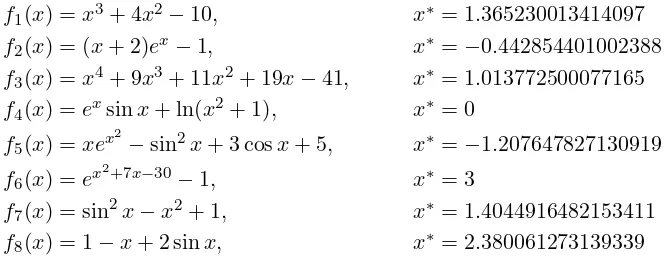
etc. (1.7) with θ=−1 (JYX), modified Halley (2.2) with β = 0.5 and γ = 0.2 (MH) obtained in this paper to solve some nonlinear equations. All computations were done using MATLAB 6.5 with the format of long floating point arithmetics. We accept an approximate solution rather than the exact root, depending on the precision (ε) of the com-puter. We use the following stopping criterion for computer programs:
|xn+1 −xn| < ε or the maximum number of iterations is maxiter. So, when the stopping criterion is satisfied, x∗ := xn+1 is taken as the
ex-actly computed root α. For numerical illustrations in this section, we used the fixed stopping criterion ε = 10−15 and maxiter = 250. The following test functions displayed the approximate zerosx∗ round up to 16th decimal places.
f1(x) =x3+ 4x2−10, x∗= 1.365230013414097
f2(x) = (x+ 2)ex−1, x∗=−0.442854401002388
f3(x) =x4+ 9x3+ 11x2+ 19x−41, x∗= 1.013772500077165
f4(x) =exsinx+ ln(x2+ 1), x∗= 0
f5(x) =xex
2
−sin2x+ 3 cosx+ 5, x∗=−1.207647827130919 f6(x) =ex
2+7x−30
−1, x∗= 3
f7(x) = sin2x−x2+ 1, x∗= 1.4044916482153411
f8(x) = 1−x+ 2 sinx, x∗= 2.380061273139339
Numerical results are shown in Table 1. The quantities therein denote the number of iterations, and the asterisk means that the number of iterations is more than maxiter. By taking Table 1 into consideration, we note that the number of iterations of our method (2.2) is comparable with that of obtained by using the other procedures.
Table 1. Comparison of various cubically convergent methods and the Newton method
N H X C JYX MH
f1, x0 =−0.1 80 73 29 * 20 25
f2, x0 =−1.2 8 5 4 6 6 5
f3, x0 = 0 8 4 4 4 4 4
f4, x0 = 1 7 5 4 5 5 4
f5, x0 = 2 220 6 31 22 * 14
f6, x0 = 3.3 9 5 4 5 4 4
f7, x0 = 0.1 16 9 9 * 28 6
4. CONCLUSIONS
In this work, we presented a new modification for Chebyshev-Halley method, free from second derivatives, to solve nonlinear equations. Ev-ery iteration of the new method requires one function and two first derivative evaluations. Hence, its efficiency index is 31/3 = 1.442 that is better than that of Newton method. Order of convergence of this method is three. Numerical experiments show that our method is com-parable with other third-order methods.
Acknowledgement. The authors thanks to the referee for his
im-portant suggestions which essentially improved the first version of the paper.
References
[1] A.M. Ostrowski, Solution of equations in Euclidean and Banach space, Academic Press, New York, 1973.
[2] J.M. Guti´errez, M.A. Hern´andez, A family of Chebyshev-Halley type methods in Banach spaces, Bull. Austr. Math. Soc. 55(1997), 113-130.
[3] C. Chun, Some second-derivative-free variants of Chebyshev-Halley methods, Appl. Math. Comput. 191(2007), 410-414.
[4] Zh. Xiaojian, Modified Chebyshev-Halley methods free from second derivative, Appl. Math. Comput. 203(2008), 824-827.
[5] C. Chun, Some variants of Chebyshev-Halley methods free from second derivative, Appl. Math. Comput. 191(2007), 193-198.