I J H S
Original Article
International Journal of Health Studies
The Effectiveness of Psycho-educational Program Based Parental Reflective Functioning
on the Improvement of Children with Separation Anxiety Disorder: A Single Subject
Study
Toktam Kazemeini1, Zohre Sepehri Shamloo1*, Ali Mashhadi1, Morteza Moddares Gharravi2
1 Faculty of Educational Science and Psychology, Ferdowsi University of Mashhad, Mashhad, Iran. 2 Psychiatry and Behavioral Sciences Research Center, Mashhad University of Medical Science, Mashhad, Iran.
Received: 6 December 2019 Accepted: 17 December 2019
Abstract
Background: Diagnosis of separation anxiety disorder (SAD) in childhood is a critical risk factor of mental health in adulthood. Etiology studies have indicated the significant role of parental psychological factors in children with SAD phenomena. The aim of study was to investigate the effectiveness psycho-educational program based parental reflective functioning (PRF) on the improvement of children's SAD.
Methods: A single-case experimental design with multiple baselines has been utilized to conduct the present study. Subjects of the study included 4 parents (two mothers and two fathers) with children suffering from SAD who referred to the psychiatric counseling center and clinic of child and adolescent psychiatrist in Mashhad during May and June of 2019. These parents were selected through convenience purposeful sampling method based on inclusion and exclusion criteria and participated in 12 sessions (two sessions per week) of a psycho-educational program based PRF. The participants completed the parent-separation anxiety questionnaire in three stages of baseline, during the implementation of the program (in sessions 5, 9 and 12), as well as one month after follow-up. The obtained data were analyzed using indicators of percentage recovery / PR, effect size and reliable change index (RCI). Results: At the end of the psycho-educational program, the results indicated a significant clinical decrease in the severity of separation anxiety in all four children of participants. The total score of recovery percentage for the first, second, third and fourth subjects was equal to 70.86, 71.30, 72.21 and 70.96, respectively. The RCI indicator of subjects was -9.93, -10.97, -11.59 and -11.26, respectively. Also, the effect size for the first, second, third and fourth subjects was equal to 7.43, 8.21, 8.67 and 8.43, respectively. Moreover, the overall improvement of all four subjects in subscales of fear of being left alone, fear of abandonment, fear of physical illness and fear of dangerous events was 66.75%, 71.10%, 70.39% and 71.73%, respectively which the values were significant clinically. This improvement process continued throughout the follow-up period.
Conclusion: According to research findings, the Psycho-educational program based parental reflective functioning has a positive effect on improving the symptoms of SAD in children. Therefore, it is recommended to utilize this program in treatment interventions for SAD.
Keywords: Separation anxiety disorder, Psycho-educational program, Parental reflective functioning.
*Corresponding to: Z Sepehri Shamloo, Email: [email protected]
Please cite this paper as: Kazemeini T, Sepehri Shamloo Z, Mashhadi A, Moddares Gharravi M. The effectiveness of parental reflective functioning-based psycho-educational program on the improvement of children with separation anxiety disorder: a single subject study. Int J Health Stud 2019;5(4):30-37
I
ntroduction
Separation anxiety disorder (SAD) is the most common disorder in childhood so that half of all children referring to the
treatment of anxiety disorders suffer from this disorder.1 In the
diagnostic and statistical manual of mental disorders (DSM-V), SAD has been defined as severe fear or anxiety of a person about separation from his/her attached people, which is disproportionate to the person's development level.2 In Iran, the
epidemiological studies of this disorder indicate a relatively high prevalence of it among primary school children up to 13.9%.3 SAD can have serious consequences on a child's life,
for example, it has a negative effect on several areas of the child's functioning including academic duties, social adjustment, and peer relationships.4,5
The etiological studies of SAD in children indicate the key role of parental psychological factors in the formation of this disorder.6-8 Bowlby's (1958) attachment theory is one of the
most important and prominent explanations in this field. According to this theory, SAD is considered as an attachment disorder and a consequence of inaccessibility and inadequate caregiver responses.9-11 A child with SAD suffers from an
insecure attachment because the caregiver has not been able to meet his or her needs consistently and develop a sense of predictability.9-11 Attachment theory has some limitations
despite its evolving base and high clinical applicability. For example, one can refer to its mere emphasis on parental sensitivity in the formation of a secure attachment;12,13 whereas
studies have shown that this factor has relatively weak power to explain the relationship between parent's internal working models and child attachment. This weakness of attachment theory in explaining the transmission of attachment style from parents to children has been addressed as a “transmission gap”.12-14 In recent decades, the concept of “reflective
functioning” has been introduced by Fonagy in the context of object relations approach with the emphasis of attachment researchers on filling the transmission gap.15-17 Reflective
functioning is a capacity that form in the context of primary relationships and influenced by attachment styles with primary caregivers and their mentalization ability.18 Fonagy has adopted
a developmental approach to re-interpret Bowlby's explanation about the role of maternal sensitivity as a real factor in determining the quality of subjective relationships and mental development. According to Fonagy, the transfer of attachment styles is dependent on the internalization of the mental dynamics of the caregiver by the child and this transition can be explained through the concept of parental reflective functioning (PRF).19 PRF is a fundamental capacity that
provides parents with flexible and coherent access to the emotions and memories of their primary attachment experiences.20 Fonagy and Target believe that this capacity
physical environment as well as a secure base for her child. On the other hand, the primary symbols are created through the interaction between mother and child and the child begins to the mental representation of herself/himself as a result of the mother’s ability to make meaningful the depth and scope of her child’s experience.21 In other words, PRF helps processes that
enable a person to safely separate himself/herself from his/her parents. This issue has important implications for good enough parenting. In fact, it seems that the successful separation of parents from their own parents is necessary and helpful for providing a healthy child separation through an appropriate developmental style.21 Moreover, parents who have access to
their childhood memories and can think about them are better able to understand, acknowledge and tolerate their child's personal emotional expressions.14
Research shows that there is a significant positive relationship between PRF and child attachment15,22,23 and
secure attachment styles in children are effectively promoted through PRF capacity.24,25 Mothers with the high level of PRF,
have the more flexible emotional relationships and parental sensitivity.26 In parents without reflection on mental states of
themselves and their child, primary defense mechanisms such as projection, projective identification, and denial destroy the capacity of parents for considering the child as an individual with separate autonomous, thinkable and emotional entity.27,28
Such parents deprive the child of the ability to form a sense of self29 and without this sense, the child would not be able to
make social interactions and determine boundaries in his/her relationships.
In addition, researches significantly support the assumption that PRF can be trained. In this regard, proper psycho-educational programs can improve parent’s ability to mentalization and reflection about mental states of themselves and their child.25,28 Abroad Iran, a number of PRF interventions
and psycho-educational programs have been designed. Among them, it can be referred as first parents,29 minding the baby30
and the family minds.31 Although the research literature
suggests that paying attention to the concept of PRF is growing in the theoretical and clinical viewpoints, there is a significant shortage in the field of empirically proven treatments based PRF. According to the review of the author of current research and considering the possible errors, no research has ever been conducted in Iran to investigate the effect of Psycho-educational program based PRF on the population of parents with children suffering from SAD. However, early Psycho-educational programs in this field can prevent the child from entering risky developmental ways and decrease the negative consequences associated with SAD. Therefore, the purpose of the present study was to investigate the effect of Psycho-educational program based PRF on the improvement of children with SAD.
Materials and Methods
A single-case experimental design with multiple baselines has been utilized to conduct the present study. The statistical population of the present study included parents of 6 to 9-year-old children suffering from SAD who referred to the psychiatric counseling center and clinic of child and adolescent psychiatrist in Mashhad during May and June of 2019. Among
them, the parents of 3 children (3 mothers and 3 fathers) were selected through a convenience purposeful sampling method based on inclusion and exclusion criteria. Four of these parents participated in all psycho-educational program sessions and 2 (one mother and one father) did not complete the intervention then their information was excluded from the study. The sample size was determined based on the minimum sample size needed to confirm or reject the research hypotheses in single-subject experimental studies.36 Inclusion criteria of present
study were as follow: (1) having a child between 6 and 9 years of age with the diagnosis of SAD according to psychiatric examination and semi-structured diagnostic interview of Kiddie schedule for affective disorders and schizophrenia - present and lifetime version, (2) no history of psychiatric comorbidity disorder including agoraphobia and generalized anxiety disorder, and (3) not receiving any psychological intervention (for child and parent) for at least three months before inclusion to the study. The exclusion criteria of the present study were as follows: (1) the history of severe psychopathology in parents, (2) the history of developmental disorders in child and (3) the absence of parent in the psycho-educational program for more than 3 sessions.
The data gathering tools included the demographic questionnaire and the separation anxiety assessment scale -parent version (SAAS-P) designed by Hahn, Hajinlian, Eisen, Winder, Pincus.37 The SAAS-P scale is a tool with 34 items
that measures the specific dimensions of childhood separation anxiety based on DSM-4 diagnostic criteria. The four main dimensions of this tool are fear of being left alone, fear of abandonment, fear of physical illness and fear of dangerous events. Preliminary data of prior researches support the reliability, validity and clinical application of this scale.37-39
Respondents graded the frequency of separation anxiety symptoms on each item of these scales on a 4-point scale from 1 (never) to 4 (always). The reliability and validity of a SAAS-P scale have been investigated in a validation study conducted by Talaienejad, Ghanbari, Mazaheri and Asghari.40 The results
obtained from exploratory factor analysis and confirmatory factor analysis confirmed the four-factor structure of this scale. Also, the internal consistency value (Cranach’s alpha coefficient) was 0.87. The value for sub-scales of fear of being left alone, fear of abandonment, fear of physical illness and fear of dangerous events was 0.74, 0.73, 0.68, and 0.62, respectively. Also, the concurrent validity of the scale was confirmed based on its correlation with Spence pre-school children anxiety scale (SCAS).40 The present study has been
approved by the ethics council of Ferdowsi university of Mashhad with the ethics code of IR.UM.REC.1398.091. The authors of the present study were obligated to anonymity and confidentiality criteria for information of participants. Subjects' consent to participate in the sessions of the psycho-educational program was obtained in the form of written informed consent. participants pay no money for attending the program.
referred from one of the Counseling Services Center of Mashhad ministry of education. K-SADS-PL interview was used to confirm the initial diagnosis of SAD in children of these parents. Then, the researcher explained research purposes to each subject in a session. In the same session, the SAAS-P questionnaire was completed by participants and gathered as the first baseline data. After completing baseline information, each client entered to psycho-educational program step by step. During two months, clients in twelve 45-minute sessions of psycho-educational program two days a week. Data on the psycho-educational program were gathered during three stages of its implementation (at the end of sessions 5, 9, 12). Follow-up data were also gathered one month after the last session of the psycho-educational program. The content of the parental Psycho-educational Program Based PRF has been designed and developed by the authors of the present study. For this purpose, the results of a qualitative phenomenological study on the reflective functioning of parents with children suffering from SAD41 were combined with general principles of parental
reflective functioning programs42 and the main components of
several evidence-based psycho-educational programs including First parents,29 Minding the Baby,30 Family Minds31 and
mindful parenting and reflective parenting groups.43 The
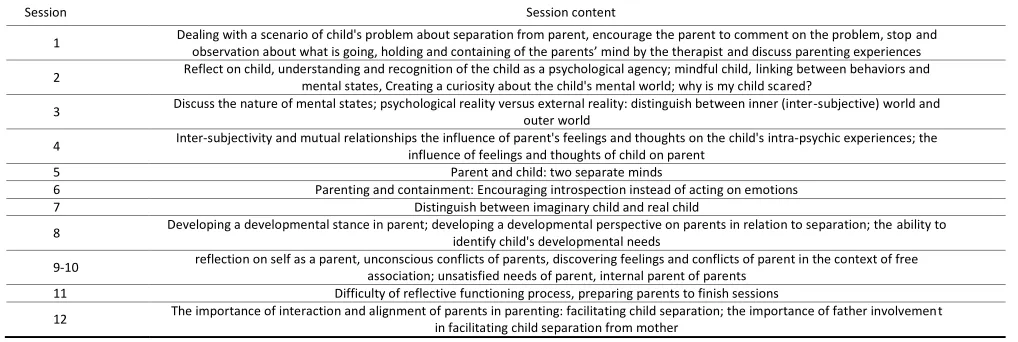
content validity of this program has been evaluated and validated by five child psychologists through the Delphi method. It should be noted that the order of sessions was not quite the same for all subjects and the content of sessions was variable according to the PRF level and the issues raised by them. The place of holding psycho-educational sessions was one of the psychotherapy rooms of a private psychological office. A summary of psycho-educational program sessions has been presented in table 1.
The participants of the present study were two mothers and two fathers, which a brief description for each of them has been presented below:
Participant 1: the first parent was a 27-year-old mother, housewife, and bachelor of literature who was referred to the researcher by a specialist child and adolescent psychiatrist. She
had a 6-year-old son with significant symptoms of fear of separation from parents; especially the mother appeared since about six months ago. The child would wake up at night with frightening nightmares with the content of being stolen, causing the mother to accompany him and his sleeping in the parents' bedroom.
Participant 2: the second subject was a 35-year-old mother with a 10-year-old son and an 8-year-old daughter. She was educated in nursing and has two/three years of part-time experience in the clinic but had quit her job because of taking care of her children and high stress of her job. The mother was permanently involved in the affairs of her children and was experiencing the fear and anxiety about illness and losing her children, which made her constantly checking on their physical health. This subject was referred by one of the education counseling centers. Although the main reason for her referring was the daughter’s dependency and her avoidance of going to school alone, both children suffered from symptoms of dependency and anxiety of separation from parents.
Participant 3: the third subject was a 40-year-old father, employee, chief accounting officer and the couple of the second subjects who referred due to treatment of his 8-year-old daughter's dependency and anxiety. Symptoms of her daughter's separation anxiety disorder had started since the first year of her primary school. Parents' most prominent solution in this regard was to accompany their daughter to school.
Participant 4: the fourth subject was a 34-year-old father, teacher and a PhD student in mathematics. He had a 7-year-old daughter and a six-month-old daughter. Firstly, this subject and his wife were referred by a child and adolescent psychiatrist. The reason for their referring was their 7-year-old daughter's over-dependency and fear of being alone so that she was never ready to be alone at home and even in her father's car when shopping. She was very afraid of sleeping alone in her room at night and insisted on either sleeping in her parents' room or her parents being in her room. She experienced a great fear of new places and people so that she went to school only with her mother in the first two months of the school year.
Table 1. Summary of PRF-based psycho-educational program for parents of children with SAD
Session Session content
1 Dealing with a scenario of child's problem about separation from parent, encourage the parent to comment on the problem, stop and
observation about what is going, holding and containing of the parents’ mind by the therapist and discuss parenting experiences
2 Reflect on child, understanding and recognition of the child as a psychological agency; mindful child, linking between behaviors and
mental states, Creating a curiosity about the child's mental world; why is my child scared?
3 Discuss the nature of mental states; psychological reality versus external reality: distinguish between inner (inter-subjective) world and
outer world
4 Inter-subjectivity and mutual relationships the influence of parent's feelings and thoughts on the child's intra-psychic experiences; the
influence of feelings and thoughts of child on parent
5 Parent and child: two separate minds
6 Parenting and containment: Encouraging introspection instead of acting on emotions
7 Distinguish between imaginary child and real child
8 Developing a developmental stance in parent; developing a developmental perspective on parents in relation to separation; the ability to
identify child's developmental needs
9-10 reflection on self as a parent, unconscious conflicts of parents, discovering feelings and conflicts of parent in the context of free
association; unsatisfied needs of parent, internal parent of parents
11 Difficulty of reflective functioning process, preparing parents to finish sessions
12 The importance of interaction and alignment of parents in parenting: facilitating child separation; the importance of father involvement
Results
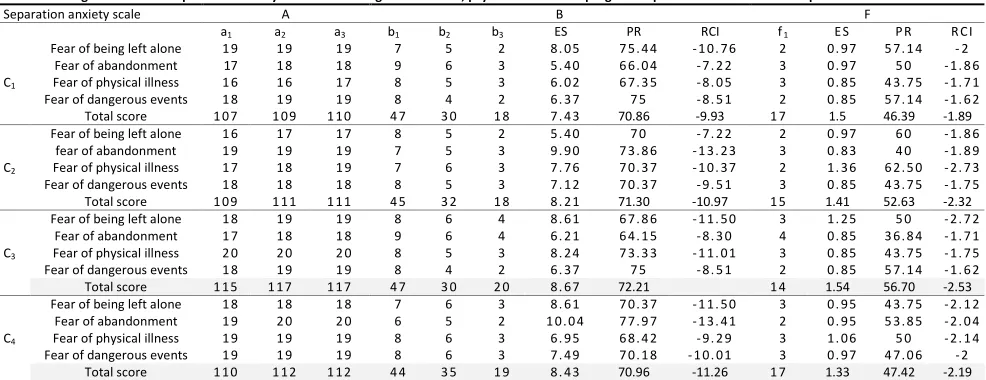
In the present study, the age range of parents was 27-40 years old. Two of parents had a bachelor's degrees, 1 master's degree and, 1 PhD degree. Three parents were employed and 1 housewife. The first parent had a 6-year-old child, the second and third parent (a couple) had a 10-year-old child and an 8-year-old child and the fourth parent had a 7-8-year-old child. Two parents were men and two were women. The research questions were investigated using the indicators of percentage recovery (PR), Cohen's effect size (EF) and the reliable change index (RCI). The scores of participants on separation anxiety scale and its subscales were separately evaluated at baseline stages, psycho-educational program sessions, and follow-up. The changes in subjects' scores, PR, RCI and ES indicators as well as visual analysis have been represented in table 2.
Table 2 shows the scores of a SAD and its subscales during baseline, psycho-educational program implementation, and follow-up stages. As can be seen from table 2, there is a significant decrease in scores between the stages of baseline sessions of psycho-educational program and follow-up. Scores were aligned or with a negligible decrease at the baseline stage but decreased more during program sessions and at the end. This downward proceeding continued during the follow-up period. According to the table, improvement of first, second, third and fourth parents in the total score of child's separation anxiety was 70.86, 71.30, 72.21 and 70.96, respectively at the end of the psycho-educational program and this trend was also continued during the follow-up period. The first, second, third and fourth participants have maintained 46.32%, 52.63%, 56.70%, and 47.42% of this improvement, respectively. Therefore, it can be concluded that psycho-educational program based PRF has an effect on decreasing separation
anxiety. On the other hand, the effect sizes of 7.43, 8.21, 8.67 and 8.43 for separation anxiety of the parents' child were in the medium to large range, which confirms the significance of this effect. Also, the value of RCI after psycho-educational sessions for all four parents was -9.93, -10.97, -11.59 and -11.26, respectively which is higher than 1.96 indicating the non-randomness of the results caused by measurement error and, then credibility of the results.
There was also a significant decrease in the scores of SAD subscales during baseline, psycho-educational program sessions and follow-up stages so that at the end of treatment, overall improvement for all four subscales of fear of being alone, fear of abandonment, fear of physical illness and fear of dangerous events was 71.04, 71.10, 70.39, and 73.71, respectively. At one-month of follow-up, the value was 52%, 56.51%, 93.46%, and 66.48%, respectively. Therefore, the effect of psycho-educational program based PRF on decreasing the subscales of SAD was confirmed.
Figure 1 represents the visual analysis. The comparison of columns scores of baseline, sessions 5, 9 and 12 and follow-up indicates the effect of psycho-educational program based PRF on decreasing total separation anxiety scores.
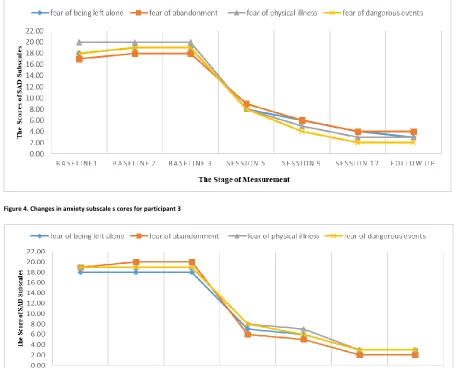
As figures 2 to 5 show, the score of separation anxiety subscales has been changed at baseline stages and after implementing the psycho-educational program. In the post stage, the scores of all four participants have been gradually decreased and this proceeding continued in the follow-up stage. This downswing in separation anxiety scores indicates the effectiveness of psycho-educational program based PRF on decreasing the separation anxiety subscales in all of 4 children of participants.
Table 2. Changes of children separation anxiety scores at the stages of baseline, psycho-educational program implementation and follow-up
Separation anxiety scale A B F
a1 a2 a3 b1 b2 b3 ES PR RCI f1 ES P R R C I
C1
Fear of being left alone 1 9 1 9 1 9 7 5 2 8. 05 7 5. 4 4 - 1 0. 76 2 0. 97 5 7. 1 4 -2
Fear of abandonment 17 1 8 1 8 9 6 3 5. 40 6 6. 0 4 - 7. 2 2 3 0. 97 5 0 - 1. 8 6
Fear of physical illness 1 6 1 6 1 7 8 5 3 6. 02 6 7. 3 5 - 8. 0 5 3 0. 85 4 3. 7 5 - 1. 7 1
Fear of dangerous events 1 8 1 9 1 9 8 4 2 6. 37 7 5 - 8. 5 1 2 0. 85 5 7. 1 4 - 1. 6 2
Total score 1 07 1 09 1 10 4 7 3 0 1 8 7. 43 70.86 -9.93 1 7 1.5 46.39 -1.89
C2
Fear of being left alone 1 6 1 7 1 7 8 5 2 5. 40 7 0 - 7. 2 2 2 0. 97 6 0 - 1. 8 6
fear of abandonment 1 9 1 9 1 9 7 5 3 9. 90 7 3. 8 6 - 1 3. 23 3 0. 83 4 0 - 1. 8 9
Fear of physical illness 1 7 1 8 1 9 7 6 3 7. 76 7 0. 3 7 - 1 0. 37 2 1. 36 6 2. 5 0 - 2. 7 3
Fear of dangerous events 1 8 1 8 1 8 8 5 3 7. 12 7 0. 3 7 - 9. 5 1 3 0. 85 4 3. 7 5 - 1. 7 5
Total score 1 09 1 11 1 11 4 5 3 2 1 8 8. 21 71.30 -10.97 1 5 1.41 52.63 -2.32
C3
Fear of being left alone 1 8 1 9 1 9 8 6 4 8. 61 6 7. 8 6 - 1 1. 50 3 1. 25 5 0 - 2. 7 2
Fear of abandonment 1 7 1 8 1 8 9 6 4 6. 21 6 4. 1 5 - 8. 3 0 4 0. 85 3 6. 8 4 - 1. 7 1
Fear of physical illness 2 0 2 0 2 0 8 5 3 8. 24 7 3. 3 3 - 1 1. 01 3 0. 85 4 3. 7 5 - 1. 7 5
Fear of dangerous events 1 8 1 9 1 9 8 4 2 6. 37 7 5 - 8. 5 1 2 0. 85 5 7. 1 4 - 1. 6 2
Total score 1 15 1 17 1 17 4 7 3 0 2 0 8. 67 72.21 1 4 1.54 56.70 -2.53
C4
Fear of being left alone 1 8 1 8 1 8 7 6 3 8. 61 7 0. 3 7 - 1 1. 50 3 0. 95 4 3. 7 5 - 2. 1 2
Fear of abandonment 1 9 2 0 2 0 6 5 2 1 0. 0 4 7 7. 9 7 - 1 3. 41 2 0. 95 5 3. 8 5 - 2. 0 4
Fear of physical illness 1 9 1 9 1 9 8 6 3 6. 95 6 8. 4 2 - 9. 2 9 3 1. 06 5 0 - 2. 1 4
Fear of dangerous events 1 9 1 9 1 9 8 6 3 7. 49 7 0. 1 8 - 1 0. 01 3 0. 97 4 7. 0 6 - 2
Total score 1 10 1 12 1 12 4 4 3 5 1 9 8. 43 70.96 -11.26 1 7 1.33 47.42 -2.19
Figure 1. The diagram of pretest-posttest and follow up scores
Figure2. Changes in anxiety subscale scores for participant 1
Figure 4. Changes in anxiety subscale s cores for participant 3
Figure 5. Changes in anxiety subscale scores for participant 4
Discussion
The purpose of the present study was to investigate the effect of psycho-educational program based PRF on the improvement of children with a SAD. The results showed that improvement of first, second, third and fourth subjects in the total score of separation anxiety was 70.86, 71.30, 72.21 and 70.96, respectively at the end of the psycho-educational program and. At one-month of follow-up, the first, second, third and fourth subjects have retained 46.32%, 52.63%, 56.70%, and 47.42% of this improvement, respectively. the overall improvement of all four subjects at the end of program and follow-up period in subscales of fear of being left alone, fear of abandonment, fear of physical illness and fear of dangerous events was 71.04 (52%), 71.10 (51.56%), 70.39 (46.93%) and 71.73 (48.66%), respectively. Therefore, the improvement significantly remained until one month after the end of the psycho-educational program.
No study has ever been directly conducted to investigate the effectiveness of the psycho-educational program based PRF on the improvement of children with a SAD. However, the results of the present study are consistent with the results of studies conducted by Talaie-Nejad, Mazaheri, Ghanbari,44
Moradi, Keshavarzi Arshadi,45 Abbasi, Amiri, Talebi46 and
Mayer-Brien, Turgeon and Lanovaz.47 The studies have shown
psycho-educational program based PRF stands on the basis of this assumption that reflective functioning is a mediating structure between subjective representations and parent-child interactive behaviors. This structure can be a precursor to sensitive parental behavior.48 Fonagy’s reflective functioning theory16
re-interprets the role of maternal sensitivity as the main factor in psychological transformation. According to this theory, “good enough” parent responsiveness is more important than parental sensitivity when interacting with the child. Such responsiveness occurs when the parents are capable of mentalization their child and able to understand and predict his or her mental states including thoughts, feelings, desires, and so on.49
Therefore, it can be argued in explanation the effectiveness of the present study that interventions and educations used in psycho-educational program based PRF have led to a change in parent's representations of their child their child as well as themselves as a parent, the component which has been also addressed by Slade.33 In other words, parents with participating
in the psycho-educational program based PRF could better understand their child as an individual with independence mind compared to the past and learned more about their early inter-subjective (inner) world and experiences in relation to their parents. Studies have shown that the mother’s representation from her child is significantly influenced by unresolved conflicts of the mother in her history and working on these conflicts can disengage the child from maternal projection.50
Parents without the ability to reflection on their own mental state and their child’s mental state cannot distinguish between their fears and worries from the child's psychological reality and attribute their own anxieties to separation to the child through basic defense mechanisms such as projection. In fact, their ability for considering the child as an individual with separate autonomous, thinkable and emotional entities is weak.28-42
Oppenheim and Koren-Karie51 have shown that lack of
maternal insight into the child's inner world is associated with non-respondent maternal behaviors and child insecure attachment. Improving the reflective stance of parents makes them have an open and non-defensive mindset about the mental state of themselves and their child and this can lead to appropriate emotional responsiveness and emotionally regulated caring behaviors. The result of such parental responsiveness is the ability to organize an effective emotion regulation in child.52 This ability can help the child to tolerate
separation from the parent and possess necessary mental tools for managing himself/herself in separation situations of the parent. In general, the results indicated the primary effectiveness of psycho-educational program based PRF in the improvement of children with a SAD.
It should be noted that despite the emphasis of literature on the importance of father’s role in facilitating child separation from mother, previous studies in the field of child's SAD have mainly focused on mothers.53 In current study, however, fathers
were also involved in the intervention. The study has also some limitations. It has been conducted in the form of a single-subject study then, due to the limited number of participants and its purposeful sampling method, results should be generalized with caution. Moreover, repeated measurement participants can lead them to learn and consequently decrease
parent’s scores in the questionnaires. It is recommended to investigate the efficacy and effectiveness of psycho-educational program based PRF used in current study through further controlled experimental studies. Also, comprising the effectiveness of this program with other parenting interventions and examining its effects on parental psychological dimensions of children with separation anxiety disorder can provide useful applied results.
Acknowledgement
Present article has been extracted from PhD dissertation approved by Ferdowsi university of Mashhad, No. 690. The authors would like to thank and appreciate the parents who participated in this study. The authors also appreciate Dr. Azam Sadat Heydari and Dr. Fatemeh Mohareri, child and adolescent psychiatrist and admission unit personnel of education department in District 1 of Mashhad for their cooperation in conducting the study.
Conflict of Interest
The authors declare that they have no conflict of interest.
References
1. American Psychiatric Association. Diagnostic and statistical manual of mental disorders (DSM-V): American Psychiatric Pub; 2013.
2. Cartwright-Hatton S, McNicol K, Doubleday E. Anxiety in a neglected population: Prevalence of anxiety disorders in pre-adolescent children. Clin Psychol Rev 2006;26:817-33.doi:10.1016/j.cpr.2005.12.002
3. Abdekhodaie MS, Sadeghi Ardobadi A. Prevalence of separation anxiety in children and effect of cognitive behavioral play therapy on reducing it. Clin psychol J 2012;3:51-58.
4. Irmak MY. What is separation anxiety disorder? Bull Clin Psychopharmacology 2016;26:31.
5. Fischer D, Himle J, Thyer B. Separation anxiety disorder. Handbook of prescriptive treatments for children and adolescents: Boston: Allyn and Bacon; 1999, p. 141151
6.Herren C, In-Albon T, Schneider S. Beliefs regarding child anxiety and parenting competence in parents of children with separation anxiety disorder. Journal of Behavior Therapy and Experimental Psychiatry 2013;44:53-60.
doi:10.1016/j.jbtep.2012.07.005
7. Stone LL, Otten R, Soenens B, Engels RC, Janssens JM. Relations between parental and child separation anxiety: the role of dependency-oriented psychological control. J child fam stud 2015;24:3192-9. doi:10.1007/s10826-015-0122-x
8. Rapee RM, Spence SH. The etiology of social phobia: Empirical evidence and an initial model. Clin Psychol Rev 2004;24:737-67. doi:10.1016/j.cpr.2004.06.004
9. Bowlby J. Attachment and loss: separation: anxiety and anger. England: Vintage;1980.
10. Slade A, Aber JL. Attachments, drives, and development: Conflicts and convergences in theory. In J. W. Barron, M. N. Eagle, & D. L. Wolitzky (Eds.), Interface of psychoanalysis and psychology: Washington, DC, US: American Psychological Association, 1992. p. 154-85
11. Schore AN. Effects of a secure attachment relationship on right brain development, affect regulation, and infant mental health. Infant Ment Health 2001;22:7-66.doi:10.1002/1097-0355(200101/04)22:1<7::AID-IMHJ2>3.0.CO;2-N
12. De Wolff MS, Van Ijzendoorn MH. Sensitivity and attachment: A meta‐analysis on parental antecedents of infant attachment. Child dev 1997;68:571-91. doi:10.1111/j.1467-8624.1997.tb04218.x
13. Rothstein ABE. Reflective functioning capacity in mothers of boys with ADHD, learning disorders and associated behavior problems [PhD thesis]. New York:City University of New York; 2012.
14. Pine F. Mahler's concepts of “symbiosis” and separation-individuation: revisited, reevaluated, refined. J Am Psychoanal Assoc 2004;52:511-33.
15. Slade A, Grienenberger J, Bernbach E, Levy D, Locker A. Maternal reflective functioning, attachment, and the transmission gap: a preliminary study. Attachment Hum Dev 2005;7:283-98. doi:10.1080/14616730500245880
16. Fonagy P, Steele M, Steele H, Leigh T, Kennedy R, Mattoon G, et al. Attachment, the reflective self, and borderline states: the predictive specificity of the adult attachment interview and pathological emotional development. Hillsdale, NJ: Analytic press; 1995, p. 223-79.
17. Fonagy P, Campbell, C. Attachment theory and mentalization. In A. Elliott & J. Prager (Eds.), The Routledge handbook of psychoanalysis in the social sciences and humanities. New York, NY, US: Routledge/Taylor & Francis Group; 2013, p. 115-31
18. Fonagy P, Bateman AW, Luyten P. Introduction and overview. Handbook of metalizing in mental health practice. Arlington, VA: American Psychiatric; 2012, p. 3-42.
19. Fonagy P. Attachment and borderline personality disorder. J Am Psychoanal Assoc 2000;48:1129-46.doi:10.1177/00030651000480040701
20. Fonagy P, Gergley G, Jurist E, Target M. Affect regulation, mentallization, and the development of the self. New York, NY: other Press; 2002.
21. Fonagy P, Target M. Bridging the transmission gap: An end to an important mystery of attachment research? Attachment Hum Dev 2005;7:333-43.
doi:10.1080/14616730500269278
22. Slade A. The development and organization of attachment: Implications for psychoanalysis. J Am Psychoanal Assoc 2000;48:1147-74.
doi:10.1177/00030651000480042301
23. Fonagy P. Thinking about thinking: Some clinical and theoretical considerations in the treatment of a borderline patient. Int J Psychoanal 1991;72:639-56.
24. Fonagy P, Steele M, Steele H, Moran GS, Higgitt AC. The capacity for understanding mental states: The reflective self in parent and child and its significance for security of attachment. Infant Ment Health J 1991;12:201-18.
doi:10.1002/1097-0355(199123)12:3<201::AID-IMHJ2280120307>3.0.CO;2-7 25. Sadler LS, Slade A, Close N, Webb DL, Simpson T, Fennie K, et al. Minding
the baby: enhancing reflectiveness to improve early health and relationship outcomes in an interdisciplinary home‐visiting program. Infant Ment Health J 2013;34:391-405. doi:10.1002/imhj.21406
26. Kelly K, Slade A, Grienenberger JF. Maternal reflective functioning, mother– infant affective communication, and infant attachment: Exploring the link between mental states and observed caregiving behavior in the intergenerational transmission of attachment. Attach Hum Dev 2005;7:299-311. doi:10.1080/14616730500245963
27.Slade A. Reflective parenting programs: theory and development. Psychoanal Inq 2007;26:640-657. doi:10.1080/07351690701310698
28.Ganjavi A, Mazaheri MA, Sadeghi MS. Mind-mindedness: development of mother-infant and examining its efficacy. Dev psychol (J Iranian psychologists) 2013;10:17-27.
29. Goyette-Ewing M, Slade A, Knoebber K, Gilliam W, Truman S, Mayes L. Parents first: a developmental parenting program. Yale Child Study Center. Unpublished Manuscript 2003.
30. Sadler LS, Slade A, Mayes LC. Minding the Baby: A mentalisation based parenting program. Chichester: John Wiley & Sons; 2006, p. 271-88.
31. Bammens AS, Adkins T, Badger J. Psycho-educational intervention increases reflective functioning in foster and adoptive parents. Adopt Fostering 2015;39:38-50. doi:10.1177/0308575914565069
32. Luyten P, Nijssens L, Fonagy P, Mayes LC. Parental reflective functioning: Theory, research, and clinical applications. Psychoanal Stud Child 2017;70:174-99. doi:10.1080/00797308.2016.1277901
33. Slade A. Parental reflective functioning: An introduction. Attachment Hum Dev 2005;7:269-81. doi:10.1080/14616730500245906
34. Rutherford HJV, Booth CR, Luyten P, Bridgett DJ, Mayes LC. Investigating the association between parental reflective functioning and distress tolerance in motherhood. Infant Behav Dev 2015;40:54-63. doi:10.1016/j.infbeh.2015.04.005
35. Cooke D, Priddis L, Luyten P, Kendall G, Cavanagh R. Paternal and maternal reflective functioning in the Western Australian Peel child health study. Infant Ment Health J 2017;38:561-74. doi:10.1002/imhj.21664
36. Lane JD, Gast DL. Visual analysis in single case experimental design studies: Brief review and guidelines. Neuropsychological Rehabilitation 2014;24:445-63.
37. Hahn L, Hajinlian J, Eisen A, Winder B, Pincus D. Measuring the dimensions of separation anxiety and early panic in children and adolescents: the separation anxiety assessment scale. In Symposium Conducted at the Meeting of the Association for Advancement of Behavior Therapy: Boston; 2003.
38. Hajinlian J, Hahn L, Eisen A. The phenomenon of separation anxiety across DSM-IV internalizing and externalizing disorders. In meeting of the Association for Advancement of Behavior Therapy: Boston; 2003.
39. Hajinlian J, Mesnik J, Eisen A. Separation anxiety symptom dimensions and DSM-IV Anxiety disorders: correlates, comorbidity, and clinical utility. In Poster presented at the 39th annual convention of the Association for behavioral and cognitive therapies: Washington, DC; 2005.
40. Talaienejad N, Ghanbari S, Mazaheri MA, Asghari A. Primary properties of separation anxiety scale (parent version). J Dev psychol 2016;12:225-35.
41. Kazemeini T, Sepehri Shamloo Z, Mashhadi A, Moddares Gharravi M. Reflective functioning factors in parents of children with separation anxiety disorder: a qualitative research. J child Ment Health 2018;5:181-92.
42. Slade A. Reflective parenting programs: theory and development. Psychoanal Inq 2007;26:640-57. doi:10.1080/07351690701310698
43. Fearon P, Target M, Sargent J, Williams LL, McGregor J,Bleiberg E, et al. Short-term mentalization and relational therapy (SMART): an integrative family therapy for children and adolescents. Handbook of mentalization-based treatment 2006;201-22.doi:10.1002/9780470712986.ch10
44. Talaie-Nejad N, Mazaheri M, Ghanbari S. The effectiveness of group training of attachment-based intervention of mothers in reducing symptoms of separation anxiety of preschoolers. Thoughts and Behavior in Clinical Psychology 2015;10:37-46.
45. Moradi M, Keshavarzi Arshadi F. Effectiveness of teaching parenting and behavior modification methods to mothers on the signs of separation anxiety in elementary-school children. The Soc Sci 2016;11:1209-13.
46. Abbasi Z, Amiri S, Talebi H. Efficacy of child-parent relationship training (cprt) on reduction separation anxiety symptoms in children aged 6-7 years. Inter J of Phillo & Soc-Psychol Sci 2016;2:21-33.
47. Mayer-Brien S, Turgeon L, Lanovaz MJ. Effects of a parent training programme for the treatment of young children with separation anxiety disorder. Cogn behav Ther 2017;10:e12. doi:10.1017/S1754470X17000198
48. Ganjavi A, Mazaheri MA, Sadeghi MS. Mind-mindedness: development of mother-infant package and examining its efficacy. J Dev psychol 2013;10:17-27.
49. Fonagy P, Luyten P. A developmental, metallization-based approach to the understanding and treatment of borderline personality disorder. Dev Psychopath 2009;21:1355-81. doi:10.1017/S0954579409990198
50. Fraiberg S, Adelson E, Shapiro V. Ghosts in the nursery: A psychoanalytic approach to the problems of impaired infant-mother relationships. J Am Acad Child Psychiatry 1975;14:387-421.doi:10.1016/s0002-7138(09)61442-4
51. Oppenheim D, Koren-Karie N, Sagi A. Mother’s empathic understanding of their preschoolers’ internal experience: Relations with early attachment. Int J Behav Dev 2001;25:16-26.
52. Fonagy P, Steele M, Steele H, Leigh T, Kennedy R, Mattoon G, et al. Attachment, the reflective self and borderline states: the predictive specificity of the adult attachment interview and pathological emotional development.. Attachment theory: Social, developmental and clinical perspectives; Hillsdale, NJ: Analytic Press; 1995.