Geschke Center
Master's Theses Theses, Dissertations, Capstones and Projects
Fall 12-18-2015
Dislocation and Adjustment of International
Student-Athletes
Thiago Brito Lopes
Follow this and additional works at:https://repository.usfca.edu/thes
Part of theAnthropology Commons,International and Area Studies Commons,Religion Commons,Sociology Commons, and theSports Studies Commons
This Thesis is brought to you for free and open access by the Theses, Dissertations, Capstones and Projects at USF Scholarship: a digital repository @ Gleeson Library | Geschke Center. It has been accepted for inclusion in Master's Theses by an authorized administrator of USF Scholarship: a digital repository @ Gleeson Library | Geschke Center. For more information, please [email protected].
Recommended Citation
In partial fulfillment of the Requirements for the Degree
MASTER OF ARTS in
INTERNATIONAL STUDIES
by
THIAGO BRITO LOPES
December 1, 2015
UNIVERSITY OF SAN FRANCISCO
Under the guidance and approval of the committee, and approval by all the members, this thesis project has been accepted in partial fulfillment of the requirements for the degree. APPROVED:
Advisor Date
Academic Advisor Date
Dean of Arts and Sciences Date
Table of contents:
Abstract ... iii
1. Introduction ... 4
2. Literature review ... 7
3. Research methods ... 15
4. Behind the mask: The Dons case ... 19
4.1 International dislocation among young students ... 24
4.1.1. Collegiate vs. professional sports ... 36
4.2. Acculturation and integration on campus ... 40
4.3. Academic challenges ... 54
4.4. Cultural shock ... 57
4.5. Plans after graduation ... 61
5. Conclusion ... 64
6. References ... 71
Abstract
One reason that attracts international student-athletes to American universities could be the interest in earning high quality education with the possibility of playing high performance sports. However, when compared to other international students, differences are seen: Other foreign students who look for a degree in the US desire not only an international education, but also potentially staying in the country. The University of San Francisco, where a cosmopolitan city meets education, fits it best. At USF, 82 countries are represented, reaching a number of 1708 students. Approximately ¼ of the whole student population is international. The ratio with student-athletes is not different, from which 49 of them are foreigners, coming from 20 countries, representing almost a third of the whole athletics department. This study analyzes how sports contribute within their adjustment in comparison with general students, and how sports ease this process, after arriving from their home countries. Aspects such as food, weather, language barriers, campus life and academic challenges have been observed to make that comparison. Also, we will understand if living in San Francisco, a city compromised with diversity and non-discrimination, makes a positive difference within the acclimatization to life abroad. With that said, it will be possible to analyze major advantages of international student-athletes over non-athletes. Being welcomed by the athletic community (teammates, coaches and athletes from other sports) creates a feeling of belonging. This environment, however, has disadvantages. For instance, athletes are isolated from the rest of campus activities, missing a connection between the athletics department and the rest of the school. Because of their busy routines, they have no time to get involved with other activities on campus. For that, at the end of this study it is recommended the creation of an office within the athletics department that would work to include athletes (Americans and foreigners) in other campus activities, such as University Ministry, for example.
1. Introduction
This article aims to analyze the reasons for the phenomenon of international movement of young athletes looking to study and practice high performance sports at an American university, where athletics seek to promote an integral formation of the student, adding professional learning of a particular degree with the practice of sports at highly competitive levels, and what characterizes and distinguishes them from other international students on campus.
The differences between international student-athletes and international students (non-athletes) will be compared, in order to look for the differences in their routines, schedule and groups to which they belong.
The research has been conducted with the study of a Jesuit Catholic university (University of San Francisco) and taking into account the nature of the institution. This paper will also seek to associate researchers on the topic, with the benefits of sports as a social agent, combined with the Jesuit ideals such as respect, solidarity, non-discrimination and diversity. These principles are represented by USF’s ideology, through the emblematic expression: "Change the World from Here", motivated by the awareness work through social actions developed from the University Ministry.
Motivations for this work
This initial proposal was inspired by previous experiences that enabled me to observe and live with a large movement of young people from every continent. This temporary dislocation occurred on World Youth Day Rio 2013, with the strong performance at the International Department in the Archdiocese of Rio de Janeiro (Brazil), working for the Local Organizing Committee. At that time, it allowed me to detect many young people from different nations and cultures that strove to migrate temporarily, encouraged by an ideal, in that case, by faith and their religious values.
Looking forward on this path with young people, joining USF’s University Ministry, allowed me to connect with young students from all over the world. In addition to that, the chance to work with the women’s volleyball team, whose roster had six international players, permitted me to approach the sports field, going back to a scenario from years ago, as a former volleyball athlete.
That multitasking position at USF (University Ministry and women’s volleyball team) provided a chance to reach out a variety of students from different regions of the U.S. and continents, mixing cultures and having the University's role to integrate them within an intercultural and interfaith environment, seeking an integral humanistic education.
Being a former athlete and, at the same time working with different religious backgrounds, this work allowed me to identify some common values between these two cultural events. Also, graduating in International Relations before coming to USF, and living a personal experience as a young migrant, strengthened the option for this research to be presented here.
This question became the main object of the research project, focusing on the motivation for the dislocation of athletes from other continents to practice a sport and study in San Francisco and what could set them apart from other foreign students within the adjustment process and integration in a new culture and country.
How the work is divided
Initially, some other authors’ thoughts on the topic will be addressed, combined with the reasons for displacement and dislocation, as well as cases of international students who opted to pursue their degree in the U.S. and at USF. Interviews with students and staff members will be presented to report their experiences on campus. Thereafter, current cases of international student-athletes and non-athletes will be analyzed to understand what brought them to this country and what challenges, doubts, or even conflicts, both groups may face. In the final section, their plans for after graduation will be discussed, if they consider staying in the U.S., if they want to play professionally (question only for athletes) or want to go back home.
2. Literature review
Much has been discussed about sports values and what sport can do to change people’s lives. What many authors confirm is that sport is definitely a social agent, being able to make a change in someone’s life, whether one is a high performance athlete, amateur or just a child who has just started practicing a specific activity. It is publicly known that major agents in the international community recognize sports as a life changer. The only place where everyone is treated equally is a court or field where anyone can play.
For instance, socialization through sports brings the concepts proposed by authors such as Coakley (1998) and Gmelch (2015). The power of sports as a tool in understanding children’s socialization into cultural practices (Collen, 2008) and their own development as human beings is also known. The idea of sports as social agent is widely defended by other authors, such as Nucci & Young-Shim (2005), when it comes to explaining how sports integrate people while teaching them how to win and lose without losing sportsmanship.
Another great example is the Catholic Church. The Holy See has released important facts about the responsibility of sports as a social agent in people’s lives. Blessed John Paul II was known as a former athlete and used to advocate for sports as a tool to connect and unite people from many cultures.
The Church recognizes the role that sport can play in perfecting the human person with its potential to moderate human instinct and its capacity to gather people together towards a common goal, promoting fellowship, solidarity, and peace through its universal appeal and ability to draw people from different cultures and backgrounds together in friendly
be immediately noted here that the Church’s “way of thinking” regarding sport, which began in an initial form and gradually developed with greater intensity and clarity, has come about by the wise intuition and the acute sensibility of the Supreme pontiffs, independently of their personal involvement in sports or their predisposition for sporting activity. Indeed, the pontiffs throughout the 20th century have shown a special interest in sport. These discourses manifest an enlightened perception of the evident value that sport plays within a modern culture that has been shaped by rapid change in the wake of the industrial revolution and the subsequent changes in the customs and lifestyles of the masses, as well as the frantic quest by man to affirm his own subjectivity and individual freedom. They have noted the physical, psychological, and spiritual benefits that come from the practice of sport, while, at the same time, they have underlined the risks and related dangers that derive from serious distortions of fundamental ethical norms. In sport, the human body is the “instrument”; but the body is not an end in itself. Pius XII clarifies this in a noted discourse on the four purposes of sport, where he states: “sport and
gymnastics have, as their immediate purposes, that of the education, development, and strengthening the body in its constitution and power of movement. (John Paul II Foundation for Sport, 2011)1.
In addition to the John Paul II Foundation for Sport, another good example of how sports can connect people is the Olympic Games. With the proposal of an “Olympic Truce”, the International Olympic Committee (IOC) and the United Nations (UN) recognize sports
1The John Paul 2 Foundation 4 Sport (JP2F4S) was launched by Pope Benedict XVI during his visit to
Britain in 2010. The charity is inspired by St. John Paul II’s vision for sport, which has as its primary focus the
building of spiritual character through excellence in sporting skills and fitness. The Foundation aims to enable
an ever increasing number of people – in particular the young initially – to achieve inner peace through sport
guided by the principles identified by St. John Paul II and set out in his declarations and writing. Website:
values and how they can integrate people among all over the world, no matter what religion they have, nationality, ethnicity or sexual orientation.
Recalling the recognition of the valuable contribution of sport in promoting education, development, peace, cooperation, solidarity, fairness, social inclusion and health at the local, regional and international levels, and noting that, as declared in the 2005 World Summit Outcome, sport can contribute to an atmosphere of tolerance and understanding among peoples and nations. (United States General Assembly Resolution on the Olympic Truce, 2013).
In the past decades, there has been an increase of international students attending American universities. Still, according to Fischer (2014), this growth causes implications for how universities recruit their international students and what they are looking for.
Zhao, Kuh and Carini (2005) came up with another common reason to host international students on American campuses: the mere fact that they contribute within the development of student body as a whole. The intercultural exchange promoted by universities enriches life experience for both groups (international and domestic students) and might be later evaluated by future employers. That being said, this international disposition proposed by universities, as shown by Andrade & Norman (2009) tends to turn campuses into the world’s corner, where different cultures meet and future leaders (no matter in what area) can be shaped.
Still under these reasons, as Eder, Smith & Pitts (2010) illustrated, the decision making process is related to factors such as campus location, weather, and reputation of the institution. Also, family or friends can serve as future references, when it comes to deciding about a place or even geographic proximity and environmental issues, such as a sunny climate.
series, which may increase the interest of international students in coming to the U.S. The export of the “American way of life” boosts people’s interest in having that as part of their lives.
American campuses have never been more international, enrolling a record of 886,052 students. The 2013-14 academic year has reached an increase of 8% in comparison to the previous year (Fischer, 2014).
With the globalization of studies, as mentioned by Biles and Lindley (2009), students go abroad with the possibility of earning an international degree and making a difference when
they return to their home countries. That being said, studying abroad is not just a form of
education, but indoctrination as well.
Attending a university in the U.S. brings many changes in the minds of students. As Gebhard (2010) proposed, it must be understood how international students think and feel whenever they arrive on campus, being away from home and friends and faced with constraints concerning food and weather.
Students going to school away from home tend to face challenges they never faced before. Most of them are at the age of 17 or 18 years old, being considered young adults. That combination of distance from home and immaturity brings an extra dose of challenges into their lives (Wintre, Kandasamy, Chavoshi & Wright, 2014).
With that being said, it is important to understand why international students come to the U.S. to enroll in American universities on athletics programs, what their expectations are, and what kind of student-athletes they are.
At first, most of them are looking for the possibility to combine sports and education, both at high levels (Love & Kim, 2011). They realize that both school and sports facilities can help them improve their capabilities, and they figure out how to take advantage of that.
In many countries it is not possible to practice high performance sports without quitting school; therefore, coming to the U.S. with the possibility of combining both activities seems attractive to most athletes. The possibility of earning a high quality degree practicing a sport tends to attract them (Lopes, 2010). Other countries do not offer the privilege of a dual career path, and student-athletes are professionals for at least the four years of their collegiate careers.
Consequently, as becoming a professional athlete is quite difficult, the possibility of having another professional outcome is something to take into account. Despite NCAA’s high level of competitiveness, the probability of getting a lucrative contract in sports is low (Tyrance, Harris & Post, 2013).
however they manifested that feeling after four years attending a university in the U.S., therefore being considered settlers. The settler is not different from any other international students who are not in an athletic program.
For student-athletes, a variety of factors pushing them into looking for a degree in the U.S. can be identified. Some of these factors are, for instance, access to high-level education with an athletic scholarship (not common in their home countries), the high competitiveness in U.S. collegiate sports, and the chance to be trained by highly qualified coaches and enjoy top quality facilities (Love & Kim, 2011, p.92).
The cultural exchange with domestic students also adds to the factors mentioned above, as to how both groups interact and feel and what expectations they have towards one another (Flaherty & Stojakovic, 2008).
However if, on the one hand, sports are known for helping people’s socialization, on the other hand, there are authors such as Miller & Kissinger (2009) who proposed that the more involved a student-athlete is with a sport program, the lower the grades will be in comparison with other students. In addition to their lower GPA’s, athletes tend not to be engaged with the academic community as a whole (Miller & Kissinger, 2009, p.30).
Nevertheless, as opposed to what is stated above, recent data suggests how sports and education, if combined properly, bring student-athletes to success. According to the NCAA’s latest report on student-athletes GPA’s throughout the past years, their academic performance has reached the highest percentage ever in comparison to non-athletes (National Collegiate Athletic Association, 2015).
students. The lack of fluency in English makes them feel even more insecure during classes (Tseng & Newton, 2002).
According to Richards (2014), within that process, they face five specific categories:
• Physical Change: When individuals or groups relocate.
• Biological Change: Exposure to new environmental effects. • Cultural change: Occurs when social institutions start developing.
• Social relationships: Development of new relationships.
• Psychological change: When there is behavioral and mental status change.
It is widely discussed what universities do to help students increase their grades. For that reason, most schools have been investing in tutors, or academic coaches, that offer help in choosing classes or even how to organize their studies (Andrade & Norman, 2009).
Other authors, such as Glass, Wongtrirat & Buus (2014) suggested that another good way to engage students in classroom activities is asking them to participate in discussions. It is an advantage because professors evaluate it and it helps them improve their fluency in English.
However, even with all literature above, most scholars have done research only on international students, neither citing nor listening to athletes. Literature on acculturation of international student-athletes is still quite narrow and restricted, with a few exceptions, such as Richards (2014) and Love & Kim (2011), but still limited.
For instance, both Coakley (1998) and Lopes (2010) offer thoughts on how important sports are when someone wants to study abroad and how it helps within socialization. But, in order to understand the adjustment process of athletes, it is necessary to confront sports with acculturation and campus life, combined with the interviews, to better understand the scenario.
general student body (Gebhard, 2010). Consequently, there is a gap in studies concerning the adaptation of student-athletes in the United States and the reasons behind it.
3. Research methods
To develop this work, both quantitative and qualitative research have been conducted at the University of San Francisco, also seeking to unite theory and practice, interviewing general students and student-athletes who enrolled between the years of 2012 to 2015, as well as head coaches, faculty and staff. The first step has been conducted through quantitative research with the Admissions department, in order to find out where foreign students come from and how many countries are represented. Then, interviews were done with students to evaluate their expectations of studying in the US. With these numbers, it was possible to evaluate and differentiate athletes and non-athletes.
The qualitative research was associated with the reasons that bring foreign student-athletes to American universities and how different their adjustments are, when compared with the general student body. With fieldwork interviews, having a selection process that is explained later in this section, it is possible to understand their behaviors. Also, the research has been conducted to evaluate their expectations prior to the academic life in the U.S., as well as plans after graduation. Professor George Gmelch, with his vast experience of a former student-athlete, advised this work, guiding the theoretical contribution for the development of this project.
In order to raise a sample of both groups and contrast their experiences on campus and thoughts of going to school in the U.S., a sample of thirty students has been taken. This group was comprised of 15 (6 male and 9 female) student-athletes and 15 non-athletes (8 male and 7 female). Their age range was 18 to 22 years old.
for concepts about the phenomenon of migration and sports, seeking articles written by authors in the field of anthropology and sociology of sports.
In addition, some literature pertaining to the Catholic Church also offered insights on the benefits and values developed during sports practice, with thoughts on sports and their benefits to the human being.
An empirical survey of USF actors was then conducted through interviews with students. Questions about their motivations to opt for life away from their countries of origin, families and their own cultures were asked. Students were also asked about their integration process in the U.S. or in San Francisco, specifically at USF. Both groups answered questions such as: What brought you to the United States? What issues did you have with food, if any? Who do you hangout with? Do you think that athletes have an advantage over non-athletes in the adjustment process? What are your plans for after graduation?
Students who were interviewed were at different stages of their collegiate careers. Some were incoming freshmen that tend to be more excited with the new experience, and some were seniors, who are able to give a full description about their four years as student-athletes. The interviews were conducted after sport practices, during study hall hours, occasional meetings on campus and games by approaching the student-athletes.
Three head coaches (volleyball, soccer and tennis) and the Athletics Director have kindly agreed to participate in the interviewing process, sharing their thoughts on international recruiting and what they have seen in their careers regarding international student-athletes. All of them have been interviewed on campus, either at their offices or in the cafeteria.
international student-athletes more mature than Americans? Do they want to play professionally? If not, what would they like to do after graduation?
Professor Jose2, who is a frequent spectator of games on campus and a former athlete, has also participated in the interviewing process by answering the same questions coaches and the athletics director did. He coordinates a variety of projects for the students’ community and is constantly dealing with international students. Both Jose and the International Student and Scholar Services director were asked to describe differences among the students. They detailed how each ethnicity tends to behave in comparison to one another, answering questions such as: What are the main problems you see amid international students at USF? What do they usually complain about? Do you recall any issues with food? How does the school try to get international students engaged with activities and programs on campus?
In order to have both points of view (from those who are coming and those who are about to leave), the study conducted interviews mostly with freshman and senior students. A small portion of sophomores and juniors had been considered, but since this study was seeking to compare students in first and last year’s expectations, freshman and senior students were the main focus.
In the case of non-athlete students, the interviewing process has not been different; the only contrast was the absence of sport practices and study halls. In their cases, most have been asked to answer the questions during events on campus, in the residence halls, or places such as the campus cafeteria. From both groups’ samples, the gender ratio attempted to simulate the entire USF student population: 63% of female and 37% of male students.
All interviews took no longer than thirty minutes. Some students were more detailed; others provided shorter answers, either because of personality traits or because of their
2 Jose teaches at USF, is a frequent spectator of athletics competitions and deals a lot with international
fluency in English. In order to preserve the students’ identities and to give them more freedom in what to say, each of them has been given a fictitious name. During the conduction of this research, no student refused to participate.
One of the limitations was the fact that not so many athletes have been approved to take summer classes, which caused the absence of most of them over that period. The interviewing process was supposed to start in July and had to be postponed because of student absence on campus. Those who were on campus for the summer were mainly American students. Additionally, some interviews had to be rescheduled because of their intense schedules and academic and athletic duties.
At the same time, non-athletes who participated in the interviewing process were more flexible than athletes. Some conversations had to be rescheduled, but only for an hour later or next day. If, on the one hand, they do not have head coaches pushing them for better grades, on the other hand, they have a less stressful routine, allowing them to study at home, spend more time in the library and attend the classes frequently.
With regards to student-athletes, the goal is to attempt to reveal the motivations to migrate to another country, another culture, away from their families and living an innovative and challenging experience. In particular, understanding how much USF’s motto "change the world from here" has influenced their decision, alongside with other factors, as well as how they perceive life in a university dedicated to promoting human rights and the Jesuits values.
4. Behind the mask: The Dons case3
The University of San Francisco, whose student population was the focus of this research, hosted, in the Fall 2014, 1,666 incoming freshman students, being 1274 of them undergraduate and 392 graduate students from 82 countries4. Within the athletics department, USF counts with 49 international student-athletes from 20 different countries for the 2015-2016 academic year.
When it comes to choosing where to go to school, the location of the campus makes more difference for international student-athletes than for Americans, as explained by USF’s athletics director: “USF is number 8 in the country in best places for international students. It’s a very international city, it’s a place for internationals.”
Wiktoria, an 18-year old freshman female from Poland, confirms his words. She has just joined the cross-country team in the Fall 2015 semester: “I chose San Francisco because I love the weather, the city and also the team is very good! It’s a Division I team.”
In USF’s case, there are many reasons behind the recruiting process of international student-athletes. A very common reason is the presence of an athlete from a specific country that comes to the university, no matter to what sport, and, after a successful experience, this athlete becomes a reference for future prospects, as a head tennis coach says:
Men’s soccer team was very famous for bringing Norwegian players. There was, then, a Norwegian kid who came through people that they knew from soccer. He was from Oslo, Norway, and he helped recruiting a couple of friends. He brought another friend from there and they’ve got another friend from Louisville at that time who transferred here and
3Inspired USF’s mascot Don Francisco, who wears a mask, the “Behind the Mask” series shows what’s
behind of a USF athlete. Studies, family and all the effort they put to be a successful athlete.
4https://www.usfca.edu/sites/default/files/admission/pdf/intl/stu_population_14f_country_major_combined.p
they also brought another friend. So we had four guys from Norway in our team, 80% of the team was international. We have a few guys from Denmark and from Sweden in our team and the women’s team has also 3 Swedish players right now. Sweden has always been like the powerhouse of tennis and Norway is like the “brother”. They’re still very good in Tennis and because of that we’ve built that network. One of our head coaches went recently to the international championship in Austria this summer to do some recruiting, and this was the first time we ever did it. A lot of other college coaches were already out there, the ones on the top 64, they were all there.
That connection created by Norwegians was the turning point of international recruitment at USF. The Dons won six national championships, having Norwegian players in five of them. That success was replicated in other sports, as said by the athletics director:
If you look back in history, our grand success specifically in our men’s soccer program, one of the first programs out there to recruit internationally, with a tremendous success, being national championships with a high number of international student-athletes. So I think it’s been a long history at USF ant it has a lot to do with that.
Still speaking about these connections that attract athletes to a specific university, it can be either a friend who is attending that institution or even the head coach. Professor Jose emphasizes how important these connections are when it comes to bringing international student-athletes to a specific university, and that attracts them:
This guidance is also mentioned by Julia, a 22-year old female senior from Croatia, as one of the main reasons why she was attracted to San Francisco and USF alongside with the high level of competitiveness. She is a classic case of an athlete who looks to combine high quality education with high performance sports at a competitive level (Love & Kim, 2011, p. 92):
I had offers from the East Coast, St. John’s and DePaul, but I knew the level is not as high as here. I did not see myself there, my intuition was telling me I could not live in big cities like New York or even Chicago. I knew I wanted something on the West Coast, also because of the lifestyle, the weather and everything. Then I was looking at all the teams and I saw USF had a Croatian player there. So I contacted her and asked if she knew anyone looking for a setter, not necessarily in San Francisco. And then she responded to me like two days later saying that one of their setters just quit. It just happened at the right moment and she told the coach she knew a setter. I talked with him on Skype and he really liked my attitude, my personality and my video.
The recruiting process is not only focused on international prospects. However, the need for more resources and the different expectations seen by foreigners tend to make a difference, according to the head volleyball coach:
We recruit everyone (Americans and foreigners), but I think USF is a great school for international students specifically, because of the location. We have some success with them, both academically and athletically they’re doing well for us. People know New York, San Francisco, Chicago, Los Angeles, so coming from another country you want to be somewhere you can have that experience versus American kids some times look for. They look for bigger schools; they have different attractions.
18 forces most of these young athletes to mature faster than Americans, and this is certainly an advantage for them, as claimed by a few head coaches:
International athletes are more mature at the age of 18, they can acclimate faster, and it’s a different mentality. If I were 18 years old and came to a different culture, I would be shocked (head tennis coach).
The student-athlete that comes here did grow up in a different culture of what school is all about. In America you go to college, you usually go for the experience of being outside your parents house, and then, school. If you are an international student, you most likely want to go to school to play a sport. So they are more focused, in many cases, than other freshmen (head volleyball coach).
When it comes to the reasons behind the decision making process of what university to attend, the location is an important factor. The University of San Francisco, object of this study, is located in a quite popular city in the United States.
Recently, the website Business Insider5 published a list of the 25 colleges with the best location in the United States; USF was the second best. Other than that, San Francisco has been recently listed as one of the top 5 cities most visited by foreigners in the country6. Both publications reflect perfectly what the head of the International Students Scholar Services at USF states:
I think it depends on the student. For undergraduate students I definitely see students who want to come get an education in a Jesuit tradition where they see the values of the Jesuit community as a university and the classes here. They also think the city is a huge draw for students. It’s definitely an international city, it has international airports, it’s easy to get
5 http://www.businessinsider.com/the-25-colleges-with-the-best-location-2015-10
6
from other parts of the world here and back home again, and there is a lot of cultural resources within the city. So it’s not just the university community, but they usually have a community of their home culture outside of the university, which can sometimes be a big draw for students but also for their families. Sometimes parents like to see that too.
Additionally, there is no secret that the role international students play on campus has increased significantly within the past two decades. American universities came up with the conclusion that including an international component to their courses helps domestic students acquiring a higher level of cultural exchange. At USF it is not different, the motto “Change the world from here” aims at those students who will make a difference in the world’s future.
From that perspective, attracting international students would make American undergrads more prepared for the future, especially when dealing with different cultural backgrounds after they graduate and go into the business market (Zhao, Kuh, & Carini, 2005).
Therefore, international students contribute to universities and the society. Their success and progress is an issue with far-reaching consequences not only for themselves, but also institutions and nations (Andrade & Norman, 2009, p.25).
If, on the one hand, push factors are hard to be understood based on their numerous causes, on the other hand pull factors come into play because of the attractiveness of a certain destination, which is clearly noticed by the traveler/student, as identified by Mazzarol & Soutar (2002). As for USF, the quality and the availability of technology-based programs can be mentioned as pull factors. Chong, male freshman from Malaysia, majoring in Computer Science, describes why he opted for San Francisco:
However, other components must be considered pull factors, such as language, geographic distance of the host country, the quality level of the host institution, the number of programs offered and how aware faculty and staff are of international students and what opportunities they have.
An increasing demand for higher education, either to improve skills for the future or to simply earn a good degree, is always a push factor. As pull factors, they may include the reputation of the country or the institution, the recommendation from friends and family, geographic proximity, and environmental issues such as a sunny climate (Eder, Smith & Pitts, 2010, p.234).
4.1 International dislocation among young students
In order to understand displacement of international student-athletes, it is primarily necessary to understand dislocation of international students, its causes and consequences. Later on, it will be possible to compare the main differences between athletes and non-athletes.
There are multiple factors behind the decision and the reasons that make someone leave family and friends, staying away from home for a couple of semesters, or even years. In the past years, there had been an increasing number of universities in the United States admitting international students to enrich their environment, bringing new cultures to campus life.
American universities and colleges tend to receive a vast amount of international students every year, and the number of incoming international students increased 30% from 2007 to 2012 (Institute of International Education, 2013)7.
An important factor in displacement of international students is globalization and its causes. In the past thirty years, with the uprising of neoliberalism, the world slowly became “smaller”, where distances have been shortened and borders disappeared.
Also, the internationalization of neoliberalism plays another important role. During the period that the world was still facing the dualism between Capitalism/Neoliberalism and Socialism, it was extremely important that peripheral countries, such as those from the Global South, were included in the international context (Biles & Lindley, 2009, p. 152). It meant that, transferring knowledge to these countries would also result in indoctrination by Neoliberalism, avoiding the so-called “Communist Wave”.
The New Imperialism proposed by David Harvey (2003) also had its beliefs in culture. Although economic expansion was the main goal, culture was a means of disseminating Capitalism, Neo-Liberalism and free markets as well. What he calls Globalization through Americanization around the world meant the export not only of political and financial institutions but also a way of life, consumerism and cultural forms (Harvey, 2003, p.41). In other countries’ societies, Americanization meant the arrival of habits such as eating fast-food, drinking Coca-Cola, listening to American pop music, watching famous American TV series and wearing clothing made in the U.S.A. (e.g. Levi’s jeans).
The cultural diffusion had begun in the 1980’s and is still ongoing. American common habits as those mentioned above are becoming more and more common in such countries,
7 Source:
present in families living rooms as they tend to prefer watching American series or movies over their local TV shows or whatever their own culture promotes.
Words in English have also been adopted, for example, diet, cellular and fitness have become part of non-English dictionaries. Events such as Halloween and Black Friday are now celebrated. In a clear demonstration of soft power8, people are attracted by the famous American way of life, just like moths attracted by the light (Tota, 2009).
Thus, for international students, the familiarity brought by the export of American culture is a motivational component when it comes to establishing an initial connection between them and the United States. The first step in the decision making process is when the barriers are knocked down and the distances are shortened. Feeling comfortable with the culture from a specific country helps a lot in the adjustment process when it comes to migrating to that place. With that said, international students may believe that the “American Dream” will come true in their lives in the U.S. just like in the movies or TV series they watch, in a true fairytale created in their minds.
Among all the reasons previously mentioned, education plays an important role when, for example, a student from Pakistan summarizes his wish to go to the United States in one word: Education. Students say they can expand their chances to get a good job in the future after graduation because of their international experience (Gmelch, 2015).
For international students, the possibility of earning an international degree in the U.S. is the main purpose of coming to this country (Ying, 2005), as confirmed by Chong:
My major is Computer Science, and I felt the U.S. could give me more opportunities. I could get internships. They have a lot of events for computer science students. Back in my country there’s not much attention to computer science.
8 Capacity of co-opting and attract instead of applying coercion, using force or giving money as a way of
Maria, an 18-year old female freshman from Brazil majoring in Liberal Arts and Social Justice, also repeats his words. As a musician, she agrees that for her academic area the U.S. is the place to be:
In my area, California is the state for the music industry in the whole world. So I wanted to come to California because of that.
Marco, an 18-year old freshman from Italy, also shares his opinion:
I came to the U.S. because I was looking for a different life, a new adventure. I love Verona, my city, everything there, but after 20 years it becomes boring because it’s a small town, always the same life, same people. So I had the opportunity to leave. You cannot compare San Francisco to Verona! I chose San Francisco because I came here with my family years ago and I was fascinated by California. So, it’s mainly because I love California.
Over the years, institutions have been founded in order to facilitate the exchange between students and universities. A well-known example is Fulbright9, promoting international education exchange for both professors and students. Therefore, it is accurate to say that international students are an important and relevant part of the mix of students in today’s universities and colleges’ campuses, being a significant source of diversity and revenue (Eder, Smith & Pitts, 2010, p.233).
According to Mazzarol & Soutar (2002) the decision making process to study abroad contains three specific rounds:
1 - The student decides that he/she wants to study abroad.
9 Founded in 1946 by Senator J. William Fulbright. The Fulbright program reaches more than 140 countries
2 - The student chooses a specific country and institution. Later, he/she identifies factors that make him/her choose a preferred university and host country.
One important aspect not to be forgotten is the knowledge or awareness of current events in the host country. That is the moment when personal recommendations, either by family or friends, arise. Cost concerns may also be present due to a possible financial impact that studying abroad may have on the family or the student’s budget. Lastly, aspects such as the environment and the student’s life style, geographic proximity and social connections will determine the place he/she is most interested in.
Similarly to other decision making processes, as shown by Mazzarol & Soutar (2002), the choice to study in another country is extremely influenced by either push or pull factors10. On the one hand, people are motivated by circumstances that push them into a new place. On the other hand, pull factors bring them to a stage at which they feel attracted to a specific location, such as a city or a university, a scholarship offered, or even the presence of relatives in that place.
In the case of Mohammad, a 19 year-old male junior from Saudi Arabia, it was primarily caused by a scholarship, but he chose San Francisco because of family reasons:
There is a scholarship offered by my government and, while I was in high school, I applied and was accepted. I applied for universities in San Francisco because my sisters live here. I applied for San Francisco State University and the University of San Francisco, but SF State did not accept my application because I was still studying in high school, they wanted me to finish first, and then send my final transcripts. USF accepted me.
Although less than 25% of student-athletes are awarded with full scholarship (full tuition, room and board), just 1% of the student-athletes among all 305 Division I universities receive
10 The push factor involves a force which acts to drive people away from a place and the pull factor is what
full scholarships (Coakley, 1998, p.321). Coming to the U.S. to combine athletic and academic lives still sound interesting for international athletes.
For international students not involved with any athletic program, scholarships are even scarcer. As Maria said previously, the main reason for her to come to the U.S. was the possibility of being closer to music producers. She explains that her mother had prepared herself to be able to pay for her school tuition, but it would have been better if she had been awarded with financial aid:
No, I didn’t have financial aid. My mother was very smart with the way she prepared herself to pay my tuition. She worked in a way I wouldn’t have to worry about that. But, at the same time, I think I could have asked for a scholarship, because I think I had a chance to be awarded one and I didn’t do it because I was afraid not to get it. From now on I will certainly ask for it!
Among the reasons to become a student-athlete at an American university are other attractive factors such as involving students in school activities and increasing their interest in academics, building responsibility, achievement orientation, teamwork skills and giving students opportunities to develop and display skills in activities valued in the society (Coakley, 1998, p.438).
Collegiate sports also create a sort of school spirit, as bringing students to every game always sounds exciting to a prospect. Going to a collegiate game can become a basis for spirited social occasions (Coakley, 1998, p.457).
Meant to be members of a completely different classification of students, student-athletes actually run through the same process. From listening to friends advising him/her of where to go, to the moment of the arrival, the “academic process” is not different.
There has been an increase in the internationalization of collegiate sports. According to a NCAA study, the number of “nonresident aliens” reached the mark of 10,395 participants in Division I athletics in the 2008-09 academic year, achieving 6.2% of all athletes in the NCAA’s most important division. This figure represents nearly a threefold increase from 1999-2000, when a total of 3,589 international athletes constitute 2.4% of the NCAA Division I student-athlete population. In certain sports, the migrant athletes are particularly striking. For example, 36.8% of women’s tennis teams and 35.5% of men’s tennis squads were comprised of athletes from outside of the U.S.
Both the growing quantity of international moving athletes in U.S. collegiate athletics and their particularly high concentration in certain sports present interesting issues for sport studies scholars to explore.
What illustrates that welcoming process is when international recruits travel to the U.S. prior to their enrollment in that specific school. This process is called “official or unofficial visits”11.
• Official visits: Usually are paid by the university, which is interested in that
recruit and should take up to 48 hours. A staff member (e.g. head or assistant coach) may even pick up the prospect at the airport.
• Unofficial visits: Paid by the prospect, it is unlimited, however the recruit
should cover all his/her expenses.
Some of these trips to campuses in the U.S. are organized by the so-called “agencies”, a recent phenomenon in the athletes recruitment field. The recruiting agencies are companies
(sometimes founded by former student-athletes) that take care of helping the prospect finding a university in the U.S. They help the student-athlete in the decision making process, giving advice and taking care of all paperwork, such as scheduling proficiency exams, helping them with the application process, and translating their transcripts and any other documents into English.
However, this work is not for free. Prospects pay a fee of approximately US$2,000.00 to cover the expenses with translation, proficiency tests, application processes and, of course, the services done by them. Agencies offer sports programs as a unique opportunity, as promoted on one of their websites:
Have you thought about playing and studying at a college in the U.S.? Our sports program is a custom program that assists athletes interested in studying and playing at American universities. In this program, most athletes can receive partial or full scholarships, covering tuition fees, housing, food and sports equipment. The program is valid only for athletes that will make the U.S. undergraduate courses. The program's goal is to give the athlete the best options of universities, according to their profile, technical skills, travel interests, location and other factors. During the preparation process, our team is
responsible for all actions, so that athletes need to focus only on training and preparation for English exams (Daquiprafora, 2015, para.1).
That being said, the agent acts as an advisor. No student makes any decision of where to go without talking to the agent first. Sometimes that relationship causes constraints, such as universities giving up on some prospects offered by agents because they try to put pressure on head coaches to admit students. Additionally, athletes represented by agencies, those who are really sought after by certain coaches, tend to take longer to accept a scholarship offer because their agent may claim that there might be better opportunities or possibilities.
The promises are not only to help the student find a university and a sports program. In order to make both student and parents feel more comfortable, agents promise to follow up with the student-athlete on a regular basis for the four years of the program, by either giving them advice or helping with the relationship between athlete and coach. Some of these agencies take prospects also on international trips to show them campuses in the U.S. and to create a relationship with coaches:
So nowadays recruiting has changed a little bit, where players now have a lot of these agencies. We get each week emails from agencies, from a guy in Belgium, from a guy in Brazil. We met a guy and he brought the kids over one summer to show them the
university, things like that. We did kind of a workout with them, they were like 14 guys touring to see how it looked like, going to an American university (head tennis coach). These agencies are managed primarily by former international-student-athletes. After graduation, they go back to their home countries. Then, they realize they can make money guiding future students through the same journey they went years before.
They are not always looking for the best future for the kids. The agent comes and watches us and says “oh you guys are very good”. Before, they thought it would be just another program. And they want to make money, so they want just to place their kids. They don’t care where they go.
Lucas, 19-year old male golf athlete from Brazil, confirms his thoughts. He says he did pay an agent to get him a good school, however the work was not as he expected:
I didn’t pay an enormous amount of money, but yes, I did pay some. Honestly, I think it didn’t change anything at all because they only refer students to Division II universities and I didn’t want to go to a DII school. Sometimes they even refer students to Junior Colleges, whose level is even lower. And Americans want Division I, everyone wants to play at the DI level. The agencies’ main concern is to make money and place you at any university.
Lucas words converge to what Thiago, male senior also from Brazil, illustrates about the relationship between future student-athletes and agencies:
I did have an agent. They advised me a lot but I think it could have been much better. I arrived here knowing nothing, zero! They helped me with the tests, some contacts with coaches, but the majority of contacts were made by me, also talking to friends. They helped me organize the paperwork and that’s all. I paid around US$2,000.00 for their service.
On the website Star Athletes Online12, former High School Basketball Coach Brian Hefferan describes the relationship between agents and college coaches. In his words, coaches hardly pay attention to athletes recommended by agents:
If you think about it; recruiting services have dozens to thousands of clients that they are trying to help get recruited. They package you up with a profile, maybe do your highlight
video and then ‘SPAM’ college coaches. These services do not know the coaches player personnel needs or if your child meets the school’s academic requirements. College coaches want to develop relationships with the student-athletes that they are recruiting (Star Athletes Online, 2012, para.7)!
As previously mentioned, visits are important for recruits because they serve as a first test for them to have an idea of how the school looks like. They visit the campus; meet coaches, other athletes and professors. After that, they may confirm their wishes to go to that university, as said by Nina, a 17-year old incoming Slovenian female volleyball player. She has not come yet, but she is very excited and cannot wait until she arrives in San Francisco in the Fall 2016 Semester:
I am so excited to be here, my family and friends are so jealous that I am here in the United States. I loved everything and everyone! The city is great, I am sure I will enjoy life here. I wish I could stay here right now, but I am looking forward to be here next academic year.
Although student-athletes experience the same decision making process on what to do and where to go, they have skills that “normal students” do not have. They are athletes; they have the capacity to pay for their studies by practicing a specific sport and competing for the university.
As Selbe (2013) states, being a student-athlete at a National Collegiate Athletic Association (NCAA) Division I13 school is an attractive idea. Some student-athletes are seen as celebrities on campus.
Another big advantage for student-athletes over non-athletes is seen after they graduate, even if they are not becoming professional athletes. After being part of an athletic program
for four years they tend to receive equal or greater remuneration in comparison to general students (Lopes, 2010).
Still according to Selbe (2013), if, on the one hand, being identified as a successful athlete on campus may sound exciting, on the other hand, it brings multiple challenges to international student-athletes as well. The hardest part is the language barrier. Although most of them have to take the “Test of English as Foreign Language” (TOEFL) to prove their English proficiency, they are still affected by their non-native fluency in the language.
As explained by Lucas, the reasons that made him come to the United States to play golf and pursue a degree are:
I came here because the universities give me conditions to be the number one in my sport. This is what I’m looking for; I want to be number one. And here I have all the conditions and facilities that can make me improve. If you’re a high performance athlete and you want to be great, you should go to school in the United States.
Lucas’s words fit in the students’ thoughts as well. Most of the interviewed student-athletes think that the possibility of combining high quality education and high performance sport is the main reason that motivates them to come to the US:
I came to the U.S. because in Brazil there is not much opportunity to play soccer in a competitive level and attend a university at the same time. You have to choose between soccer and studies. I came to the U.S. to attend high school on a scholarship and decided to stay (Daniel, junior male athlete from Brazil).
I wanted to do something exciting, something new after graduating from high school and I heard about opportunities to play volleyball in college, which means I could combine my studies and my sport, which is not as easy to do in Germany because back there
college seemed to be the perfect way for me to play at a higher volleyball level and get a degree (Susan, 22 years old, senior female athlete from Germany).
The reason I came to America in general is because in Europe it is really hard to maintain both academics and athletics at the same time, and this was just a great opportunity to pursue my undergrad degree and also to play at one of the highest levels in America (Julia, female senior athlete from Croatia).
Because of athletics, I’ve got an offer from USF’s cross-country head coach… he invited me. I just love running and in Poland I could not study and run at the same time (Wiktoria, Polish female freshman athlete from track & field/cross-country).
Moreover, for both groups (athletes and non-athletes), the decision of coming to the U.S. to study comes from different origins. Athletes expect to be awarded with a scholarship to practice high performance sports and earn a degree while non-athletes focus mostly on good education with the possibility of better opportunities in their careers in the future.
For Susan, Daniel and Julia, studying is not enough; they realized they could compete in the sport they love and receive a scholarship in return, differently from non-athletes, who would come to the U.S. just looking for an international degree and to increase their employment chances.
4.1.1. Collegiate vs. professional sports
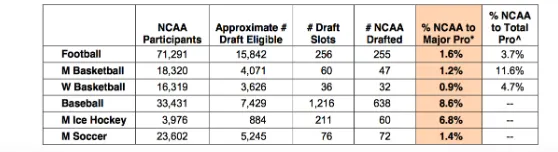
On a regular basis, NCAA publishes researches on the probability of a student-athlete becoming a professional athlete. For sports such as basketball, for example, a recent study by NCAA14 illustrates how difficult it is to become a professional athlete, giving the estimated probability of competing in professional athletics.
Table 1:
It also reflects what coaches say:
I think, on our team, I’d say 99.9% of the boys want to be a professional. Those who make it could be anywhere between 0% and 5%, maybe even less than 5%. If you want to say, just being a professional, signing a piece of paper, OK, maybe a few. If you want to talk about being a professional for longer than three years, that number is going to drop drastically (USF’s assistant men’s soccer coach).
His thoughts fit perfectly with Tyrance, Harris & Post’s (2013) words when it comes to explaining that they really want to be professionals, and some of them are actually drafted by teams in the major leagues, but it does not mean that they will sign a lucrative contract and they may remain for a long period in the franchise’s roster.
With that said, it is most likely that these athletes that do not make it to a professional league will end up doing other activities. They will use their college career and experience to formulate their life outside sports (Tyrance, Harris & Post, 2013, p.23).
A very recent case of a quite successful student-athlete who gave up on turning into a professional is Stanford’s junior male soccer athlete Jordan Morris. Morris, member of one the best soccer programs in the country, has been called to represent the U.S. National team in some friendly matches. Is not common to see college players being called to the national team, which evidences why he is treated as a jewel.
After succeeding in matches against Brazil and Mexico, Morris received offers to play both in MLS and in Europe, but he decided to stay at Stanford and pursue his degree. Why? When interviewed by the website Grantland in October 201515, Stanford’s Head Coach Jeremy Gunn shared his thoughts on Morris decision, supporting his ideas:
You’re going to school, but just barely. So you have this system, and it produces some really fantastic players. But what does it do for most of the other players? It just spits them back out. They’d dedicated their lives to soccer, but they’re still not good enough to play professionally. Now what? They don’t have many options. If you’re the club, then that’s great — all you need to do is develop a few really good players. But for society, for developing human beings, is that really something we want? I think we have something really special here in the United States. There’s always talk about how we should be copying these other countries, and in some ways that might be true. But in other ways, they should be copying us (Grantland, 2015, para.30).
Coach Gunn’s words meet what many athletes have previously said, as well as the NCAA reports on how many student-athletes actually turn professionals. Even if they reach the professional level, they know they will not be athletes forever. Thus, having a degree and being able to do something apart from sports in the future is key to a good career.
15 Blog created by ESPN to debate actual sports journalism,
As USF’s soccer assistant coach stated, there is no doubt student-athletes would love to play professionally, but when they realize that the road has more obstacles than expected, they gradually move on to other projects in their lives. Education in the US is built in that way, to give them multiple alternatives in their future.
In Brazil, country where some of the student-athletes that were interviewed come from, the high school dropout rates among athletes, especially in soccer, are astonishing. The few opportunities for social mobility, combined with the precariousness of the Brazilian academic system and the labor market for the new generations, make professional soccer become a life saving project for those who have talent.
At the end of the training process in soccer, if the young athlete cannot find a spot in the sports market, he tends to enter the formal labor market with low schooling, depending on the compatibility between strength and conditioning training and school. Thus, when they are unsuccessful in a soccer career, players trained under this system face more difficulties in settling in other occupations away from this sport (Rocha, Bartholo, Melo & Soares, 2011).
As some of the student-athletes have mentioned above, the American academic system offers them a unique opportunity to combine high quality education and high performance sports. It is true that most of them would consider playing professionally, but they want to have a second choice if anything goes wrong, either by not having any good contract or an injury that forces them to retire earlier. That model stands out for its excellence in comprehensive education that promotes training for both their professional and sport lives, allowing for the inclusion of the athlete in society (Lopes, 2010).
student-athletes rose one point to 67%, the highest rate ever. The student body federal graduation rate remained flat at 65% (National Collegiate Athletic Association, 2015)16.
4.2. Acculturation and integration on campus
There is no doubt about the importance of attracting international students to the United States colleges and universities. However, incorporating them into the cultural and academic system must be even more important. In order to grant them full integration and adjustment, there must be many sorts of cultural exchange and acceptance of diversity. Interactions through campus activities, extra curricular events between American and international students can be a key to integrate these populations with one another. International students who socially interact with American students tend to adjust to the social and cultural differences through their daily experiences (Gebhard, 2010, p.14).
Still according to the author mentioned above, every single part of the process is connected to their feelings and affects their lives when they arrive in the U.S.
Establishing an intercultural exchange is a key point to remove the gap between international and American students, resulting in the integration between them and creating a successful campus life for both groups (Flaherty & Stojakovic, 2008). Chong, a male freshman from Malaysia is a good example, as he celebrates the fact that he has an American roommate:
I have a roommate, he is American and he is at ROTC17, a very nice guy, good roommate, responsible. I am involved with the University Ministry and the choir. Initially, I was involved with the Taekwondo club, but the timing wasn’t right, it was immediately after classes and I was a bit tired, so I felt University Ministry was the best choice. Usually on
16 http://www.ncaa.org/about/resources/media-center/news/graduation-success-rate-continues-climb 17 Reserve Officers Training Corps. Program offered by the US Army at over 1,100 American Universities,