www.ijper.org
Hydroxypropyl-
β
-Cyclodextrin (HBC) Multicomponent
Complexation and pH independent controlled release
delivery system to Improved Dissolution and oral
Bioavailability of Ondansetron HCI
Adimulapu Anilkumar1*, Talasila Eswara Gopala Krishna Murthy2, Avula Prameela Rani3
1Vikas College of Pharmacy, Vissanapeta, Krishna Dist., A.P., INDIA. 2Bapatla College of Pharmacy, Bapatla, Guntur Dist., A.P., INDIA.
3University College of Pharmaceutical Sciences, ANU, Guntur Dist., A.P., INDIA.
ABSTRACT
The objective of this study was to develop pH independent controlled release matrix tablets of Ondansetron HCl by using Multi component Complexation technique, Methocel K100M as release retarding materials and HP β-cyclodextrin was selected as release modulators. Ondansetron is weakly basic drug and their salts shows pH-dependent solubility that may show drug release problems at higher pH of small intestine. Incorporation of weakly basic drugs, exhibiting pH dependent solubility, into oral controlled release delivery systems shows pH dependent release profiles. In the present investigation, an attempt was made to pH-solubility dependence of drug and dissolution enhancement was attained by inclusion complex of Ondansetron with HP- β-cyclodextrin at 1:1 (drug: β-CD) molar ratio and then prepared complex hydroxyl propyl methyl cellulose controlled released matrix tablets. The in vitro drug release studies were carried out in pH1.2 buffer for 2 hrs and then in pH6.8 phosphate buffer up to 24 hrs. The formulated matrix tablet F4 (without complexation) was very slow and drug is not released completely from matrix tablets in 6.8 pH phosphate buffer. The matrix tablets prepared using HP β- cyclodextrin with PVP (F8) showed a superior dissolution rate and good dissolution profile that was comparable to without complexation of Ondansetron HCl. Dissolution results showed pH independent controlled and almost complete release behavior of Ondansetron HCl up to 24 hrs time period. The drug release mechanism of the HPMC matrix tablets was found to be quasi Fickian mechanism. These results suggested that the oral bioavailability of Ondansetron HCl was significantly improved by Multi component Complexation strategies.
Key word: Ondansetron HCl, pH independent controlled drug delivery, Hydroxypropyl-β
-cyclodextrin, Multi component complexes.
DOI: 10.5530/ijper.50.4.19
Correspondence: A. Anil Kumar, Department of Pharma-ceutics, Vikas College of Pharmacy, Vissannapeta, Krishna District, A.P., India. PIN: 521 215,
Phone: 91-9866529250 E-Mail: anilkumar.adi@ gmail.com
INTRODUCTION
In the antiemetic category, across a broad range of therapeutic indications,. Ondansetron hydrochloride is a serotonin sub type-3 (5-hydroxytryptamine-3) receptor antagonist. It is a widely used drug for the treatment of several therapeutic purposes like anti-emetic especially it is used in the prevention of post operative nausea and vomiting and chemotherapy or radiation induced nausea and vomiting. The pharmacokinetic outline
Submission Date : 05-08-2016
Revision Date : 20-09-2016
Accepted Date : 23-09-2016
are faced with extended or recurrenttreatment during which they are at risk of CINV andPONV.1,2
The recommended oral dose regimen of Ondansetron hydrochloride is 8 mg, three times a day. The dose of Ondansetron HCl should be varying to 8-32 mg a day. The selection of dose regimen should be determined by the severity of the treatment. Ondansetron solubility exhibits high solubility in stomach at low pH (pH 1.2) and at higher pH (6.8 pH phosphate buffer), it exhibits poor solubility. Ondansetron HCl is weakly basic pH dependent soluble drug. The drug precipitation was found upon entry into the small intestine that may also affect the amount of drug obtainable for uptake throughout the intestinal mucosa.3,4
The availability of existing literature indicates that some of the techniques were developed in previous works, we have reported for pH-independent drug release. Out of that, one is gastro retentive drug delivery system in which the drug will float constantly for long period of time which is a question mark and also in-vitro/ in-vivo correlation is very poor. And another technique was developed pH modulating agents; this technique was somewhat better but the formulator was observed some manufacturing defects and prolonged drug release is very difficult. Then, in an effort to reach, the present investigation is aimed to develop a pH-independent control drug release dosage form of Ondansetron HCl for better pH independent dissolution properties as well as controlled release rate of Ondansetron. Hence, OND-HP-CD complexes have prepared and an optimal formulation was consequently designed by the combi-nation of these complexes into HPMC-based hydro-philic Matrix tablet once daily dosage form.5-7
One potential method of optimizing the efficacy of drug activity is through the use of rationally designed carrier materials such as Hydroxypropyl beta cyclodextrin (HPßCD) encapsulation technology. A chemically modified HP--CD, became a more interesting option than ß-CD to achieve Complexation because of better physicochemical properties and enhanced inclusion behavior. Studies had proven that this CD derivative is able to increase drug oral bioavailability With HP-ßCD, an aqueous drug complex preparation is very simple, of all the CD derivatives accessible, HP-ßCD is the safest, as it does not permeate the membranes, enhance the dissolution, of poorly water-soluble pH dependent soluble drugs. A recent publication from Gould and Scott concludes that HP-ßCD is well tolerate in most species, particularly if dosed orally, and shows limited toxicity.8-10 Hence’ the present study was undertaken to evaluate, by means of Multi component complexes in association with high molecular weight Methocelk100M
matrix tablets as strategies to improve Ondansetron HCl oral bioavailability and also to obtain a delayed thera-peutic effect of the drug as compared with a conven-tional formulation. The use of HP-cyclodextrin (CD) Multi component complexation has been attempted to overcome such pH dependent solubility and dissolution drawbacks.11
MATERIALS AND METHODS
Ondansetron was received as a gift sample from Pranami Drugs Pvt. Ltd., Gujarath . HP-bete-cyclodextrin and Methjocel k100M was purchased from Yarrow chem. Product Mumbai, Micro crystalline cellulose (Avicel PH 101), Sodium hydroxide, Magnesium Stearate, and Talc were purchased from ( S.D. Fine Chem Ltd., India),
respectively.
Analytical Method
Calibration curve of Ondansetron HCl was determined in 0.1 N HCl and 6.8 phosphate buffer at 249 nm using a UV-Visible spectrophotometer (Elico SL 210 UV-VIS Spectrometry Analytical Instruments Pvt Ltd, India). This calibration curve was used for estimation of drug release and drug content determination.
Solubility of Ondansetron HCl
The solubility of Ondansetron HCl was determined by using simulated gastric fluid without enzymes (SGF pH 1.2), pH 6.8 phosphate buffer and in pH 7.4 phosphate buffer. The solubility of the API was determined by the equilibrium solubility method. Which employs up to the saturation of a solution to obtain by stirring an exces-sive of API need to add in the medium until equilibrium is achieved. After equilibrating the solution was kept in shaker water bath (37 ± 10C) up to 24 h for
maxi-mum solubility of the drug. After that the samples were removed from shaker bath and filtered with 0.22 µm nylon non-pyrogenic disposable syringe filter. Finally the filtered solution was diluted and estimated by using UV-Visible Spectrophotometer (ELICO SL-210).
Excipient Compatibility Studies
In order to evaluate the reliability and compatibility of the drug with polymers in polymer-drug matrix, FTIR spectra of drug-polymer (1:1) powder mixture were recorded by the Potassium Bromide pellet method at the resolution rate of 4cm-1. The FTIR-Spectrum was
integrated in transmittance mode at the wave number range 400-4000 cm. (Jasco FTIR 6100 type-A, Japan)
and the comparative spectra were demonstrated.
MULTICOMPONENT COMPLEXES
Physical mixture
Perfectly weighed quantities of drug and polymer carrier were weighed taken in a china dish were mixed system-atically The resultant mixture was passed through sieve number 100 # and was stored in desiccators for the complete removal of moisture and was tested for the content uniformity. Drug: polymer molar ratios of 1:1 were prepared.12
Kneading Method
In this method the drug and carriers are used in diffe-rent molar ratios (1:1). Both drug and carrier was trit-urated by using a small volume of Ethanol and water (1:1) to form a thick paste, which was kneaded up to 60 minutes and then kept for air dry. Then the dried mass was dented and crushed and sifted through 100# and stored in desiccators for further studies.13
Solvent evaporation method
The necessary quantities of drug and cyclodextrin were dissolved in sufficient quantity of water-ethanol solvent mixture (1:1,) and evaporated on a water bath at 50°C with stirring. Each solid product was sieved through #80 and stored in desiccators.14,15
Calculation of Once Daily Dose for Ondansetron HCl
The total dose of ondansetron HCl for once-daily con-trolled release formulation was calculated by using avail-able pharmacokinetic data using fallowing equation
Dt = Dose [ 1+ (0.693*t)/t ½)] Where,
Dt indicates total dose of drug for controlled release, Dose is the immediate release part (4 mg), t indicates time during which controlled release is desired i.e. 24 h, and t1/2 = half life of the drug (3 h to 5 h).
Preparation of HPMC Matrix Tablets
Tablets containing 25 mg of Ondansetron hydrochlo-ride were prepared by direct compression method. The various formulations used in the preliminary study and Complexation technique are shown in the (Table 1,2) The respective powders Ondansetron HCl-HP-beta-cyclodetrin complexes equaling to 25 mg of Ondan-setron, HPMC K100 M CR, Avicel pH101,and were passed through sieve blended thoroughly with a mortar and a pestle. Magnesium stearate and talc were added to the blend and blended for further 5 min. Tablets were prepared using 8 mm die punch with Rotary tablet -punch tablet press (CADMACH, PRESS, INDIA. All
tablet formulations contained 25 mg of Ondansetron or its equivalent. The Hardness for all the formulations was adjusted to 5-6 kg/cm2 (Monsanto hardness tester-Macro Scientific Works, Delhi, India).
Estimation of ondansetron:
An ultraviolet (UV) Spectrophotometric method, based on the measurement of absorbance, at 249 nm, was developed and used for the estimation of Ondansetron HCl pure drug and formulation with excipients. The method Followed Beer’s law in the concentration range of 2 to10 μg/ml, with good correlation coefficient (0.9991). When a standard drug solution was assayed repeatedly (n = 5), the relative error (accuracy) and relative standard deviation (precision) were found to be 0.69 and 1.2%, respectively. No interference from the excipients used was observed.
Tablets containing complex of drug: β-CD
Complex prepared by different method were subjected for evaluation of drug content in the Drug:cycodextrin (1:1) complex and the data obtained is shown in table 3. It was observed that the practical yield was 71 to 95%. The maximum drug content was found to be 90.26% in the solvent evaporation method.16
Estimation of drug content in the matrix tablets
Five tablets were accurately weighed and powdered. Tablet powder equivalent to 25 mg of Ondansetron HCl was taken into a 100 ml volumetric flask. Initially 50 ml of ethanol was added into the volumetric flask and allowed to stand for 6 hrs with Sonication for the complete solubility of drug. Make up volume up to 100 ml with methanol, centrifuge the mixture and 1ml the supernatant liquid was filtered, the solution was sub -sequently diluted with purified water and analyzed for Ondansetron content by measuring absorbance at 249 nm.17
In vitro release studies
The in vitro dissolution studies were passed out using US Pharmacopeia (USP) apparatus type 2 (VEEGO, Instruments Corporation, Mumbai, India) at 50 rpm. The dissolution medium consisted of 0.1 N hydrochloric acid pH 1.2 for the first 2 hr and the phosphate buffer pH 6.8 from 3 to 24 hr (900 ml), maintained at 37°C ± 0.5°C. The drug release at different time intervals was measured by a (ELICO SL-210 UV-visible spectropho-tometer) at 249 nm. The release studies were conducted in triplicate, and the mean values of the percentage of drug released were plotted versus time.
Before to compression, the prepared granules were eval-uated for their characteristic parameters, such as bulk density, tapped density, Carr’s index, angle of repose, Hauser’s ratio. Carr’s compress ability index was deter-mined from the bulk and tapped densities using a digital tapped density apparatus (Electro lab Ltd, India).18
RESULTS AND DISCUSSION
pH-dependent solubility of weakly basic drug:
The solubility of Ondansetron was high under acidic pH conditions but decreased sharply when pH increased. Indeed, the estimated solubility values for each pH solu-tion studied were 23.3 mg/ml at pH 1.2, and 0.037mg/ml
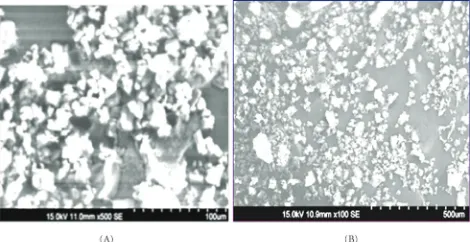
at pH 6.8, the drug was immediately precipitated and it formed large crystals. SEM analysis was shown in (Figure 1) The solubility studies reported clearly
illustrate the impact of pH on Ondansetron HCl solubility and dissolution. From the solubility values obtained, it is predictable that the extent of OND dissolution in the gastric environment will be high. Oppositely, under the pH values generally found in the upper regions of the gastrointestinal tract, the solubility and dissolution of pure OND will not be sufficient for complete dissolu -tion of the doses .The solubility studies was revealed OND HCl is a absolutely pH dependent soluble drug. Hence in this investigation an attempt was made to develop a suitable pH independent controlled released matrix tablets. Drug solubility was shown in is shown Table 4.
Scanning electron microscopy
The SEM micrographs performed on the Ondansetron API powder and precipitated powder in phosphate buffer pH 6.8.The pure Ondansetron particle size is
Table 3: Evaluation of drug: cycodextrin (1:1) complexation
S.NO Complexation method HP-ßCD ß-CD
% Practical yield % Drug content % Practical yield % Drug content
1 Physical mixture 95 29 ± 2.12 93 25 ± 2.12
2 Kneading 91 46 ± 2.3 90 36 ± 2.3
3 Solvent evaporation technique 88 79 ± 1.16 85 61 ± 1.16
Value shown in tables is mean of three determinations
Table 1: Beginning trail for selection of Methocel K100M polymer concen-tration without complexation
INGREDIENTS FORMULATION
F1 F2 F3 F4
Ondansetron HCl 25 25 25 25
Methocel K100M 25 50 75 100
PVP 5 5 5 5
AVICEL Ph 101 190 165 140 115
Talc 2.5 2.5 2.5 2.5
Mg stearate 2.5 2.5 2.5 2.5
Total weight 250 250 250 250
Table 2: Composition of Ondansetron HCl Tablet Formulations with Multicomponent complexation
Formulation Complexation equivalent to 25mg
of OND
HPMC
K100M pH 101Avicel PVP ß-CD ß-CDHP- Mgnesium stearate Talc Total tablet weight
F5- 105 100 84 5 1:1 - 3 3 300
F6- 105 100 89 - 1:1 - 3 3 300
F7- 128 100 66 - - 1:1 3 3 300
F8 128 100 61 5 1:1 3 3 300
small diameter than precipitated powder .the images was conformed that the drug particle size was increased in precipitated form of the powder than pure Ondanse-tron HCl powder form.SEM micrographs were shown in Figure 1.
FTIR Studies
The FT-IR of ondansetron HCl and polymer mixtures and optimized matrix tablets dosage form studied by KBR pellet technique. The Ondansetron HCl exhibited characteristic peaks at 3,394 and 1,633 cm, attributed to O-H stretching and C=O stretching vibrations. The physical spectrum showed significant shift in peaks of Ondansetron HCl change the intensity peaks were found. The formulation of Methocel K100M with-HP-beta-cyclodetrin formulation was studied the band at 3,499 cm for O-H stretching and 1,699 cm for C=O Stretching was found. Pure OND displays a peak char-acteristic of the N-H bending vibration at 1633 cm–1 and a band with main strong peak at 1280.62 cm–1 and 760.1 cm–1 indicative of C-N stretching and ortho-sub-stitution phenyl C-H bending respectively. It is evident that peaks of different functional groups of OND in various solid dispersions were some deviated from peaks of pure drug. Therefore it indicates that formation of inclusion complex OND with CDS (Figure 2, 3). The following characteristic peaks were observed in IR spectra (Figure 2 and 3) of Ondansetron and its
Complex prepared with HP-β CD.
Functional Groups Stretching/
Deformation Ondansetron HCl Aromatic C-H Streching 3080 – 3010
C=O (acid) Stretching 1635 – 1612 C-H (alkane) Stretching 2720 – 2662 Aromatic mono
substitution Stretching 750 – 772 Aliphatic C-H Stretching 1450 -- 1400
DSC STUDIES
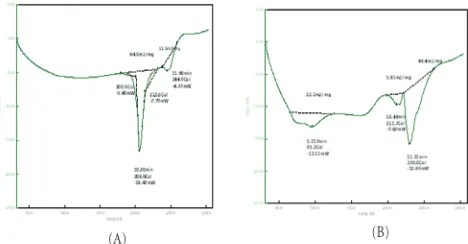
Differential scanning calorimetric Thermo grams perfor-med in Figure 4 (a) is pure drug and (b) is precipitated powder in 6.8 phosphate powder respectively, reveals that the melting point of OND HCl is 206.11
0
C and thatof OND HCl in the precipitated powder is 236.17
0
C. While there is a few differences in the melting points, it indicates that the drug stabilility will be modifying in precipitate form it will effect in drug release in 6.8 pH. Thermo grams has shown in Figure 4.XRD STUDIES
X-ray diffraction studies were then performed, in order to obtain more information to support DSC and TG results. The studied drug has a crystalline structure. The
2θ angle values of the more intense peaks for Ondan
-setron HCl are 2θ=15.74, 23.97 and 35.77. In Figures 5
and 6, the X-ray diffractograms of Ondansetron HCl precipitated powder are shown. According to my knowledge, XRPD methods showed the diffraction
Table: 4 pH solubility data of Ondansetron hydro-chloric acid at 370C.
pH solubility (mg/ml)
1.2 23
4.5 10.9
6.8 0.036
Figure 1: SEM micrographs ( a) precipitated form of drug in pH 6.8 phosphate buffer ( b ) pure ondensetron HCl.
Figure 2: FT-IR spectra of ondansetron HCl.
peaks of Ondansetron pure API and precipitated pow-der peaks are altered within the precipitated powpow-der of Ondansetron HCl in 6.8pH medium. Spectrums are shown in Figure 5.
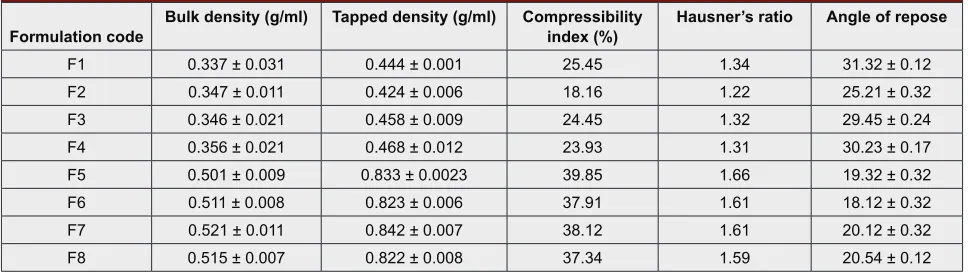
Evaluation of flow properties of powder blend
Prior to compression, all the formulations were
evalu-ated for their flow property .The powder blends of the formulations were evaluate for the flow properties. The results were showed in better flow properties with specified values. These results indicated that the powder
blends of all formulations were suitable to compress
tablets by direct compression method. However, flow
properties of formulation powder have Avicel PH 101 were superior when compared to Lactose. The results obtained point to that the powder flow properties were within the pharmacopoeias limits. (Table 5).
Evaluation of post-compression parameters of Ondansetron HCl matrix tablets
The compressed Ondansetron HCl matrix tablets were evaluated for properties like weight variation, friability and hardness drug content, of prepared matrix tablets was within 98 ± 3% of labeled claim. A good degree of uniformity in weight of tablets was achieved for all
batches of tablet formulations prepared. The percentage deviation was within ± 4, which indicates excellent uniformity in weight of all formulations of tablet formulations. The friability values of all batches of tablet formulations prepared were less than 1% variation. The hardness of all batches of tablet formulations compressed ranged between 5.5 To 6kg/cm 2. Preliminary studies were conducted for selecting the diluents to be used and Avicel PH 101 was selected as the diluents, as it gave good cohesiveness when compressed with controlled release polymers. The investigated tablet results sum-marized in the following tables (Table 6).
Polymer Optimization of Controlled Released Tablets
The matrix forming tablets were studied in different pH mediums, from the results, F1- F3 formulations was not capable to control the drug release in 0.1N HCl. A remarkable difference in the drug release was observed in pH 1.2 SGF and pH 6.8 phosphate buffers. The drug release from the matrix tablet in pH 1.2 was relatively faster from all the formulations. The result was found low concentration of Methocel K100M polymer burst release was observed in SGF pH 1.2, consequently pre-cipitation was observed in pH 6.8 phosphate buffer. F4 formulation (containing Methocel K100M 1:4 ratio), showed that with optimized concentration of approx-imately 26.24% in pH 1.2 after 2h and 65% of drug release in 6.8 phosphate buffer after 24h respectively, It was found pH dependent and incompletely drug release was found from matrix tablet.. The matrix tablets of Ondansetron HCl were prepared optimized constant polymer concentration of HPMC mentioned in the preliminary trails (1:4), (table 1). . The release profiles of Ondansetron HCl from hydrophilic HPMC-based matrix formulations (F1-F4) are presented in Figure 6. Based on preliminary trail studies, The basic nature of ondansetron HCl, the release of the drug from All formulations was<40% in the first 2 hour of the dis -solution testing (pH 1.2) the drug release predictable on Ondansetron HCl dissolution at pH6.8 is very less. the drug release need to controlled in pH 1.2 because Ondansetron solubility was found it is highly soluble in pH 1.2, where as another object drug release need to enhance in pH 6.8 phosphate due to pH dependent solubility.19-21 Therefore, Multi component
complex-ation was attempted to improve the dissolution perfor-mance of the drug over a pH range .Hence, hydrophilic HPMC-based matrix formulations, containing the drug in the form of HP β-cyclodextrin – multi component complexes, were designed to overcome the Ondansetron solubility drawback at higher pH values and to extend
Figure 4: (a) DSC thermo gram of pure ondansetron HCl (b) . DSC thermo gram of precipitated powder ondansetron HCl
in 6.8 Phosphate buffer.
Figure 5: (a) X-ray diffraction spectra of pure Ondansetron HCl (b) X-ray diffraction spectra of precipitated powder
drug release for a longer period of time without the risk of precipitation. However, drug release was nearly com-plete in the end of the dissolution experiment, almost indeed because of higher solubility and dissolution rate of multicomponent complexation matrix tablts. Therefore, there is a clear difference in the in vitro drug release characteristics of with HP β-cyclodextrin based matrix tablets as compared with. hydrophilic HPMC based matrix Ondansetron HCl formulations . Prelimi-nary studies were conducted for selecting the diluent to be used and Avicel PH 102 was selected as the diluent as it gave good cohesiveness when compressed with con-trolled release polymers.18
Effect of Multi Component Technique on Ondansetron HCl
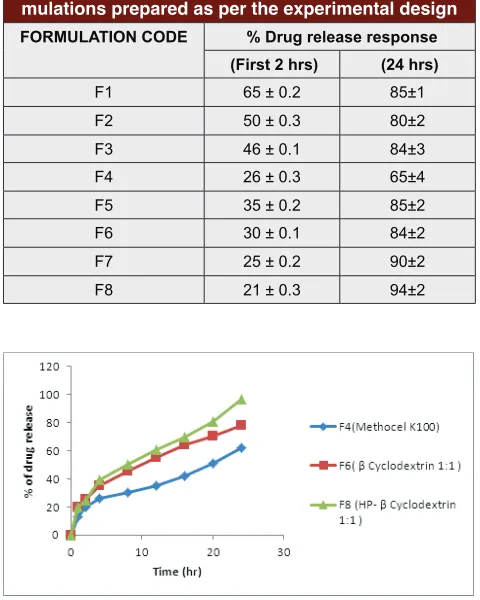
The Solid Multi-component complexes, OND- β CD and OND- HP β-CD-, with and without PVP, were prepared by solid dispersion method as described in briefly, equimolar amounts of CDs and OND were dis -solved in water and Ethanol solution, respectively. The preliminary drug release study of optimized controlled released polymer concentration formulation F4(made-up of 30% MethocelK100),The drug release 25% was released in first 2h in 0.1N HCl further drug release gradually decreased in pH 6.8 phosphate buffer only
65% of drug was released up to 24h. In case of formu-lation F5-F7 (containing OND- β CD) the drug release was 85% in 24 hours the drug release was enhanced through complex with - β CD. Moreover the above formulation with OND- β CD were not satisfied the limited drug release was found in 6.8 pH phosphate buffer. But complete drug release was not found in formulation .the formulation with OND- HP β-CD (F8) drug release was 94% of drug release extended up to 24 hours, Hence the complete drug release from dosage form up to the maximum time period (24 h) was found in pH 6.8 phosphate buffer with HP β-CD. The grade and concentration of the controlled release polymer and the effect of cyclodextrin. As once daily dosage form Ondansetron tablets are not available in the Indian market, theoretical pH independent released oral dosage form is needed for Ondansetron HCl, for once-a-day (24 hours) administration, was calculated, based on its pharmacokinetics as suggested by Wagner. The selection criteria of drug release study was on the basis of <20% drug release during first two hour in 0.1N HCl of the study to control dose dumping., in case 6.8 phosphate buffer >90% drug release up to 24 h. Among all the formulations, F8, HP-β-Cyclodextrin with PVP gave greater release, when compared to β-Cyclodextrin, this Multi component complexation technique was found
Table 5: Pre-compression parameters of the powder mixture
Formulation code Bulk density (g/ml) Tapped density (g/ml) Compressibility index (%) Hausner’s ratio Angle of repose
F1 0.337 ± 0.031 0.444 ± 0.001 25.45 1.34 31.32 ± 0.12
F2 0.347 ± 0.011 0.424 ± 0.006 18.16 1.22 25.21 ± 0.32
F3 0.346 ± 0.021 0.458 ± 0.009 24.45 1.32 29.45 ± 0.24
F4 0.356 ± 0.021 0.468 ± 0.012 23.93 1.31 30.23 ± 0.17
F5 0.501 ± 0.009 0.833 ± 0.0023 39.85 1.66 19.32 ± 0.32
F6 0.511 ± 0.008 0.823 ± 0.006 37.91 1.61 18.12 ± 0.32
F7 0.521 ± 0.011 0.842 ± 0.007 38.12 1.61 20.12 ± 0.32
F8 0.515 ± 0.007 0.822 ± 0.008 37.34 1.59 20.54 ± 0.12
Table 6: Evaluation Parameters of the Compressed Tablets
Tablets Average weight,(mg) Thickness,(mm) Hardness Friability Drug content%
F1 301 ± 2 4.85 (0.008) 6.23 ± 0.26 0.97 (0.51) 98.56 (1.12)
F2 298 ± 1 4.86 (0.006) 6.41 ± 0.24 0.56 (0.11) 97.12 ( 1.23)
F3 301 ± 3 4.85 (0.005) 5.98 ± 0.22 0.65(0.21) 95.12 (3.12)
F4 302 ± 2 4.86 (0.009) 5.91 ± 0.41 0.64 (0.52) 98.10 (2.2)
F5 299 ± 1 4.85 (0.004) 6.32 ± 0.54 0.86 (0.20) 98.12 (1.2)
F6 304 ± 1 4.84 (0.009) 6.45 ± 0.34 0.85 (0.08) 98.12 (3.3)
F7 302 ± 3 4.83 (0.008) 6.08 ± 0.34 0.87 (0.22) 97.23 (1.8)
suitable for pH independent controlled drug release of Ondansetron HCl over 24 hrs.19-20. The optimized formulation comparative released profile was shown in (Figure 7 and Table 7)
Mechanism of drug release from matrix tablet
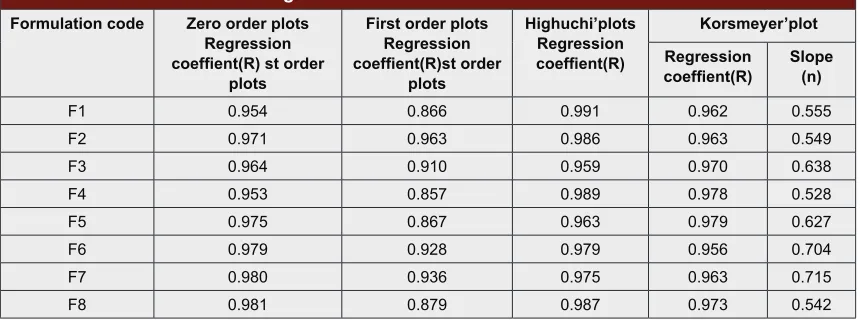
To identify the mechanism of drug release from these formulations, the data were treated according to first-order (log cumulative percentage of drug remaining versus time), Higuchi’s21 (cumulative percentage of
drug released versus square root of time), and Kors-meyer’s22 (log cumulative percentage of drug released versus log time) equations, along with zero order (cumu-lative amount of drug released versus time) pattern. The release rate kinetic data (correlation coefficients) can be seen in Table 8. When the data were plotted according to the zero-order equation, the formulations showed linearity with correlation coefficient values between 0.9538 and 0.9809. When the data were plotted according to the first order equation, the formulations show a just linearity, with significantly higher correlation coef -ficient values than the zero order plots, (0.962-0.9731) (t = 5.8 P < 0.001). First-order release rate constants for the tablets prepared with β CD The same observation was found with HP β CD also., matrix tablets prepared with HP β CD showed significant release (F = 22764,
P < 0.05). The effect of β CD/HP β CD on the drug release from the matrix tablets was attributed to the solubility enhancement effect of pH of the dissolution medium.23-24
Stability Studies
After three month time interval, outcome of acceler-ated stability studies of optimized formulation indicate it is stable at 400C / 75%. When the optimized batch Ondansetron HCl (F8) was subjected for organoleptic properties, appearance, friability, remains unaffected. The drug content and drug release were found to be (6.32 ± 0.05 kg/cm
2
, 92.72 ± 0.68 and 97.32 ± 1.4%, ) respectively.CONCLUSION
The present study was demonstrated to Enhance dis-solution of pH dependent soluble Ondansetron HCl using two different types of formulations (solid dis-persions and Matrix tablets) by using Multicomponent complexation was attempt to progress the dissolution performance of the drug over a pH range. From the result, it was clear and evident that even the solid disper-sion (SD) technique with HP-β-cyclodextrin and matrix tablets technique had improved the dissolution rate of drug to a huge extent. The percentage of the dissolution rate was higher in solid dispersion HP-β-cyclodextrin formulation than β-cyclodextrin formulation. Finally, it could be concluded that with future the Multicom-ponent complexation technique tremendous potential in the area of controlled release dosage form continue to enable novel applications in drug delivery and solve problems linked with the delivery of poorly pH depen-dent soluble drugs.
Figure 6: pH dependent release of Ondansetron HCl from HPMC matrix device.
Figure: 7 Comparative release profile of optimized Ondan-setron HCl for oral pH independent CR tablets formulation
compared with HPMC matrix tablet (F4).
Table 7: Dissolution data of various matrix tablet for-mulations prepared as per the experimental design
FORMULATION CODE % Drug release response (First 2 hrs) (24 hrs)
F1 65 ± 0.2 85±1
F2 50 ± 0.3 80±2
F3 46 ± 0.1 84±3
F4 26 ± 0.3 65±4
F5 35 ± 0.2 85±2
F6 30 ± 0.1 84±2
F7 25 ± 0.2 90±2
CONFLICTS OF INTEREST None
REFERENCES
1. Antonarakis es. et al. Nausea and vomiting associated with cancer chemotherapy: drug management in theory and in practice. BMJ. 2013;21:45-61. 2. Hesketh PJ, M.D. Drug Therapy in Chemotherapy-Induced Nausea
and Vomiting, Eng Med 2008;358:2482-94 http://dx.doi.org/10.1056/ NEJMra0706547 ; PMid:18525044.
3. Chie YW. Novel Drug Delivery Systems. 2nd Ed. New York, NY: Marcel
Dekker; Fundamentals of rate-controlled drug delivery; 1992;43-137. 4. Zawar LR, Bhandari GS. Formulation and Evaluation of Sustained Release
Ondansetron Poloxamer Based Solid Suppositories. Journal of Applied Pharmaceutical Science, 2012;2(7):186-190.
5. Jayanthi et al. pH – Independent controlled release swellable matrix tablets. IJRAP. 2011;2(2):577-80.
6. Dharmik M Mehta et al. Investigation of the drug release modulating effect of
acidifiers in modified release oral formulation of Cinnarizine. Asian Journal of
Pharmaceutical Sciences 2012;7(3):193-201.
7. Taniguchiab C, Inouea R, Kawabata Y et.al. Novel formulations of
Dipyridamole with microenvironmental pH-modifiers for improved
dis-solution and bioavailability under hypochlorhydria. International Journal of Pharmaceutics, 2012;434(1):148-54. http://dx.doi.org/10.1016/j.ijpharm. 2012.05.040; PMid:22643223.
8. Loftsson T, Masson M, Sirgurjo’nsdo’ttir JF. Methods to enhance the
complexation efficiency ofcyclodextrins. STP Pharma Sci. 1999;9:237-42.
9. Laura SS. Ribeiro, Ami´lcar c. Falca Cyclodextrin Multicomponent
Complexation and Controlled Release Delivery Strategies to Optimize the
Oral Bioavailability of Vinpocetin. Journal of Pharmaceutical Sciences, 2007;96(8):2018-28.
10. Brown NO, Butler DL, Chiang PK. Stabilization of thymopentin and
preservation of its pharmacological properties by 2-hydroxypropyl-beta-cyclodextrin. J Pharm Pharmacol 1993;45(7):666-7. http://dx.doi. org/10.1111/j.2042-7158.1993.tb05675.x ; PMid:8105066.
11. Buschman HJ. In Proceedings of the eighth Int. symposium on cyclodextrins.
Eds. Szejtli, J., Szente, L. Kluwer academic.1996;547.
12. Clternesi U, Sciacchutaro M. Cosmet, Toileteries. Manuf Worldwide. 1996;96:37.
13. Banchero M, Manna L. Investigation of the
piroxicam/hydroxypropyl-β-cyclodextrin inclusion complexation by means of a supercritical solvent in the presence of auxiliary agents. The Journal of Supercritical Fluids.
2011;57(3):259-66. http://dx.doi.org/10.1016/j.supflu.2011.04.006 .
14. Vandelli M, Salvioli G, Mucci A, Panini R, Malmusi L.
2-Hydroxypropyl-β-cyclodextrin complexation with sodeoxycholic acid. International Journal of Pharmaceutics. 1995;118(1):77-83. http://dx.doi.org/10.1016/0378-5173(94)00342-3 .
15. Koo C, Yun C. Inclusion complexation of hydrocortisone butyrate with
cyclodextrins and dimethyl-β-cyclodextrin in aqueous solution and in solid
state. International Journal of Pharmaceutics. 1993;96(1-3):91-103. http:// dx.doi.org/10.1016/0378-5173(93)90216-3 .
16. Lachman L, Lieberman AH, Joseph KL. The theory and practice of industrial pharmacy, Varghese publishing house, third edition; 293-345.
17. Remington. The Science and Practice of Pharmacy, 19th edition; 1669-70. 18. Masih D, Gupta R. Formulation and Evaluation of Mouth Dissolving Tablets of
Tolperisone. UK Journal of Pharmaceutical and Biosciences. 2013;1(1):1-6. http://dx.doi.org/10.20510/ukjpb/1/i1/91107: http://dx.doi.org/10.20510/ukjpb/1/ i1/91100 .
19. Gilles D, Pascal L, Francois C, Roger L. Inclusion complexation of
amide-typed local anaesthetics with β-cyclodextrin and its derivatives. ii. Evaluation of affinity constants and in vitro transfer rate constants. International Journal
of Pharmaceutics. 1996;136(1-2):165-74. http://dx.doi.org/10.1016/0378-5173(96)04512-7 .
20. Veiga F, Teixeira D, Kedzierewicz F, Sousa A, Maincent P. Inclusion complexation of tolbutamide with β-cyclodextrin and
hydroxypropyl-β-cyclodextrin. International Journal of Pharmaceutics. 1996;129(1-2):63-71. http://dx.doi.org/10.1016/0378-5173(95)04243-1 .
21. Rudnic, EM, Kottke MK. Tablet Dosage Forms. In: Modern Pharmaceutics. Banker GS, Rhodes CT, editors. 3rd ed. New York: Marcel Dekker,
Inc;1995;333-94.
22. Higuchi T. Mechanism of sustained action medication: Theoreticalanalysis of rate of release of solid drugs dispersed in solid matrices. J Pharm Sci 1963;52(12):1145-9. http://dx.doi.org/10.1002/jps.2600521210; PMid:14088963. 23. Korsmeyer RW, Gurny R, Doelker E, Buri P, Peppas NA. Mechanism of solute release from porous hydrophilic polymers. Int J Pharma. 1983;15(1):25-35. http://dx.doi.org/10.1016/0378-5173(83)90064-9 .
24. Shrikant P, Dhanyakumar D, Rohit R. Effect of method of preparation of
pioglitazone HCl-β-Cyclodextrin inclusion complexes. Asian J Pharm.
2010;4(2):168-72. http://dx.doi.org/10.4103/0973-8398.68470 .
Table 8: Drug release kinetics of formulated matrix tablets
Formulation code Zero order plots Regression
coeffient(R) st order
plots
First order plots Regression
coeffient(R)st order
plots
Highuchi’plots Regression
coeffient(R)
Korsmeyer’plot Regression
coeffient(R) Slope(n)
F1 0.954 0.866 0.991 0.962 0.555
F2 0.971 0.963 0.986 0.963 0.549
F3 0.964 0.910 0.959 0.970 0.638
F4 0.953 0.857 0.989 0.978 0.528
F5 0.975 0.867 0.963 0.979 0.627
F6 0.979 0.928 0.979 0.956 0.704
F7 0.980 0.936 0.975 0.963 0.715
SUMMARY GRAPHICAL ABSTRACT
• The pH independent controlled drug delivery system tablet concept for weakly basic pH dependent soluble drugs has been designed to release the drug at any pH of the Medium. • The higher viscosity polymer (HPMCK100M) had
been seen to inhibit the initial burst release of Ondansetron HCl, due to the drug nature the solubility is 23mg/ml in pH 1.2 and 0.339mg/ml in 6.8 pH phosphate buffer medium.
• It is a challenging to prepare a pH dependent soluble drug for pH independent drug release in a single unit dosage form we achieved in a simple technique.
• The hydroxypropyl-β-cyclodextrin (HBC) polymer in HPMC matrix tablet had been seen to enhance the drug release in 6.8 pH phosphate buffer and controlled drug precipitation when compared to
β-cyclodextrin.
• We successfully developed the pH independent controlled released dosage form of the poorly soluble Ondansetron HCL by using simple Multi-component complexation technique .
• We prepared the once daily dosage form of Ondansetron HCl of matrix tablets by direct compression technique for the treatment of post-operative nausea and vomiting (PONV), as well as chemotherapy- or radiation-induced nausea and vomiting (CINV and RINV) respectively
• The effervescent pH independent controlled released of OND HCl tablets was prepared by Multicomponent complexation technique.
• Formulations were evaluated for pre-compression, post-compression, in vitro buoyancy, and Short term accelerated stability studies for Optimized formulation.
• Evaluation parameters were within the accept-able limits for all formulations.
• in vitro dissolution studies, showed the formula-tion F4 having the combinaformula-tion of
hydroxypropyl-β-cyclodextrin and PVP is exhibiting better controlled release up to 24 h,pH independent drug release in both pH 1.2 and 6.8 pH phosphate buffer
Anil kumar is an Associate Professor at the Department of Pharmaceutics, Vikas college of pharmacy, VISSANNAPETA. He is having 8.5 yrs of teaching experience. His research interest is in the area of oral pH independent controlled drug delivery system- Floating, Mucoadhesive and herbal formulations. Currently perusing part time Ph.D. from JNTU, kakikinada, under the guidance of Dr.M., T.E. Gopala Krishna Murthy Professor & principal, Bapatla college of pharmacy,Bapatla and Dr. PRAMEELA RANI AVULA, Principal & Professor University College of Pharmaceutical Sciences Acharya Nagarjuna University Nagarjuna Nagar, Guntur on topic: Oral pH independent controlled drug delivery system.
About Authors
(A) Ondansetron HCl is precipitated in 6.8 pH
Dr. T.E. Gopala Krishna Murthy: M. Pharm., Ph. D. Principal, Professor , Bapatla College of Pharmacy served as an academic supervisor to more than 60 Master Degree dissertations and 9 PhD Degree dissertations for the award of M.Pharm and PhD Degrees. He has published many research articles in reputed national and international Journals. He received fellowship from Association of Pharmacy and Biotechnology and is a recipient of meritorious teacher award from JNTUK, Kakinada. He is acting as Editorial Board Member for various journals, authored 4 text books and filed for 5 Patents. He acted as Convener for two AICTE Sponsored National Seminars and two Staff Development Programmes. He was granted generous funds from AICTE under RPS and MODROBS Schemes during his academic service till now.