ISSN 1392 – 2785 Inzinerine Ekonomika-Engineering Economics(3).2009 WORK HUMANISM
The Concepts of Quality of Life and Happiness – Correlation and Differences
Dalia Susniene, Algirdas Jurkauskas
Kaunas University of Technology, Panevezys Institute
Klaipedos str. 1, LT-35209 Panevezys, [email protected], [email protected]
Concern about the quality of life is to a great extent learned and rational. It arises from what humans learn about life, death, incapacitation, suffering, health, and success and from the realization that they need to know more about the quality of life to make decisions. And although during the decision-making process they may be prompted by instinctive impulses, in the main, quality of life decisions are arrived at through deliberating alternatives, predicting the consequences of following. Happiness, life satisfaction and subjective well-being are mutually interrelated – and indeed they are all closely connected with the notion of quality of life – but they are also highly contested constructs.
‘Happiness’ is perhaps the most contested; indeed, the disagreement about happiness is at an absolutely basic level. One of the leading figures in the study of quality of life and a Nobel Laureate, Daniel Kahneman does not trust people’s own statements and beliefs on this topic. Indeed, he goes further than this and claims: ‘they do not generally know how happy they are, and they must construct an answer to that question whenever it is raised’ (Kahneman, 1999). He claims that the starting point should not be people’s subjective views about how happy they are but instead objective measures of those sensations that are associated with the real-time feeling of happiness – in other words, objective happiness.
Perhaps the greatest strength of any approach to subjective well-being is that it pays serious attention to people’s happiness and life satisfaction. Happiness may not be enough as a measure of quality of life as can be seen from the case of the ‘happy poor’. But even though it cannot be a sufficient criterion of quality of life, any measure of quality of life that took no account at all of whether a person was miserable or dissatisfied would surely be lacking an important dimension. It is clear, though, that there is more to quality of life than just subjective attributes such as happiness or satisfaction. There are objective qualities too, and some of these, such as sufficient nutrition, a non-hazardous environment, and a long and healthy life are universally, or virtually universally uncontroversial as components of quality of life.
Keywords: quality of life, happiness, assessment, objective and subjective criteria.
Introduction
Lately the concepts quality of life, happiness experience great attention from public as well as from academic sphere.
Quality of life, which has gained prominence in social research study since 1970s, is a broad concept concerned with overall well-being within society. This is not an episodic case as the world is becoming more alike therefore necessity occurs to compare the life in our own country with the life in other countries or walks of life.
Though the quality of life is intensively under research over the last four decades but “good life” concept can be found in Plato or his student Aristotle works (McLeish, 1999; Taylor, 2001). Plato’s superior value of life was thinking based on logics that excel human feelings. Aristotle had different point of view and claimed that life without feelings, even if it can bring risk, is worthless. However, on the concept of happiness and quality of life they had similar viewpoints. Plato’s considerations correspond more to modern quality of life criteria and Aristotle’s – to happiness, which not necessarily depend on economic or social living conditions. In the last century, quality of life was understood as material well-being and money. Later, after the shift in understanding of meaning of life and values, there was a shift in the concept of quality of life and its constituencies, one of which is happiness (Juozulynas et. al., 2006).
Research problem: to identify how different are the concepts quality of life and happiness and how they are influenced by each other.
Research goal: to analyze Lithuanians’ understands and preferences describing quality of life and one of its indicators – happiness.
Research objectives:to analyze the concepts of quality of life and happiness, their understanding as well as the role of happiness in quality of life; to identify the most important factors for Lithuanians in understanding quality of life.
Research methods:comparative analysis of academic literature, review of published researches, empirical research, formulation of conclusions.
The concept of quality of life
There is no universally accepted definition of quality of life. Usually it is referred to the definition of World health organization introduced in 1995 – [Quality of life] is an individual’s perception of their position in life in the context of the culture and value systems in which they live and in relation to their goals, expectations, values and concerns incorporating physical health, psychological state, level of independence, social relations, personal beliefs and their relationship to salient features of the environment quality of life refers to a subjective evaluation which is embedded in a cultural, social and environmental context. (World Health Organization Quality of Life (WHOQOL Group, 1995).
Many factors influence quality of life, i.e. physical, spiritual and health state, independence level, social relationship with the environment and others (Ruzevicius, 2006; Shin, 1979; Bagdoniene, 2000). To put it in other words quality of life can be defined as satisfaction of a person with t current life dimensions in comparison with the pursued or ideal quality of life. Also the assessment of quality of life depends on person‘s value system as well as cultural environment to which he/she belongs to (Gilgeous, 1998; Suber, 1996; Fitzpatrick, 1996), when describing the quality of life concept, claims that it depend on external circumstances. Life conditions can determine high life value though after even a slight change of the latter a shift in understanding and assessment of quality of life occurs too. Quality of life is determined by a lot of factors and conditions: dwelling, employment, income and material well-being, moral attitudes, personal and family life, social
support, stress and crisis, condition of health, prospects of health care, relationship with the environment, ecologic factors, etc. (Juozulynas and Čemerych, 2005; Rugiene, 2005; Phillips, 2006).
The assessment of quality of life
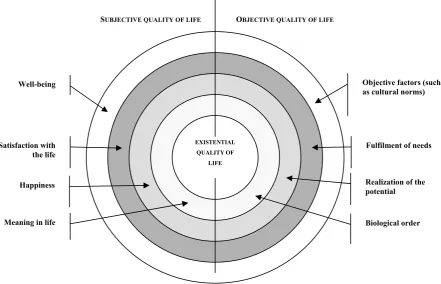
Quality of life is assessed with the help of both objective and subjective indicators. In quality of life research, one often distinguishes between the subjective and objective quality of life. Subjective quality of life is about feeling good and being satisfied with things in general. Objective quality of life is about fulfilling the societal and cultural demands for material wealth, social status and physical well-being (Quality-of-Life Research Center, 2005). Accordingly, objective indicators exist in the society and they can be monitored and assessed by their amount and frequency rate. Whereas subjective indicators exist in the consciousness of an individual and they can be identified only from the person’s answers to important subjects to her/him. Comprehensive quality of life survey must include both types of indicators (Juniper et. al., 2005; European Foundation for the Improvement of Living and Working Conditions, 2007; Eurofound. Quality of life, 2008).
This spectrum, from the subjective to the objective quality of life via the quality of life in the existential depths, incorporates a number of existing quality-of-life theories. Therefore this spectrum is called the integrative quality-of-life (IQOL) theory (Ventegodt et.al., 2003).
EXISTENTIAL QUALITYOF
LIFE
SUBJECTIVE QUALITY OF LIFE OBJECTIVE QUALITY OF LIFE
Fulfilment of needs
Biological order Realization of the potential Satisfaction with
the life
Happiness
Meaning in life
Well-being Objective factors (such
as cultural norms)
Quality of life is often assessed by the following spillover theory, which maintains that person’s satisfaction in one sphere of quality of life influences the level of satisfaction in other spheres. There is a certain hierarchy of life spheres in human consciousness: the highest is generally perceived as quality of life then depending on person itself follow other parts of quality of life (family, work, health, leisure, etc.) (Sirgy, et al, 2003). Greater satisfaction in one life sphere increases satisfaction level ranked higher in other sphere, e.g. high quality of work life increases the satisfaction with the whole quality of life (spillover rises from bottom to top). However being unsatisfied with one sphere of life can be not of great influence to satisfaction, if ever, in other spheres or can influence only one particular sphere. For example, if a person is unsatisfied with his/her job, he/she can compensate it with greater attention to the family and experience, greater satisfaction with the quality of family life (Furmonavicius, 2003).
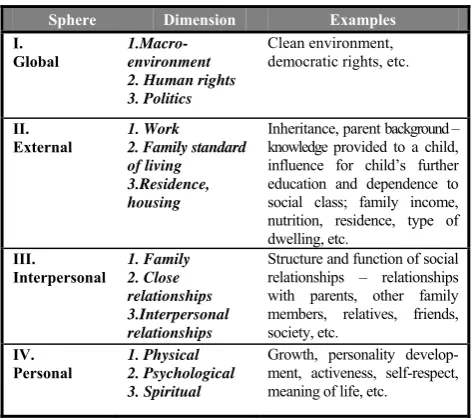
In 1993 Lindstrom introduced universal quality of life model (Table 1). It is recommended to it apply to a separate individual, group of people or to the whole population in the research of quality of life covering both objective conditions and subjective evaluation.
Table 1
Universal quality of life model(Bagdoniene, 2000)
Sphere Dimension Examples
I.
Global 1.Macro-environment 2. Human rights 3. Politics
Clean environment, democratic rights, etc.
II. External
1. Work 2. Family standard of living 3.Residence, housing
Inheritance, parent background – knowledge provided to a child, influence for child’s further education and dependence to social class; family income, nutrition, residence, type of dwelling, etc.
III.
Interpersonal 1. Family 2. Close relationships 3.Interpersonal relationships
Structure and function of social relationships – relationships with parents, other family members, relatives, friends, society, etc.
IV.
Personal 1. Physical 2. Psychological 3. Spiritual
Growth, personality develop-ment, activeness, self-respect, meaning of life, etc.
We can find a lot of useful information in EurLIFE which is an interactive database on quality of life in Europe, offering data drawn from the Foundation's own surveys and from other published sources. The data provided deals with the objective living conditions and subjective well-being of European citizens. Eurofound database covers the results from 27 EU Member States and the candidate countries Croatia and Turkey. The assessment is carried out according to the following criteria: health, employment, income deprivation, education, family, social participation, housing, environment, transport, safety, leisure, life satisfaction. These criteria included a number of indicators. In 2005 the first place in Europe got Vienna (Austria), the second – Copenhagen (Denmark), and the third – Amsterdam (Netherlands). Vilnius was in the 19th place followed by Warsaw (20),
Tallinn (21) and Riga (23).
Organization’s role in quality of life. Organizations play an important role in society, impacting on communities and regions as well as individual employees. When speaking about quality of life, it is necessary to take into account that it is closely related to economics, organizational management because some of quality of life criteria according to EurLIFE (an interactive database on quality of life in Europe), especially such as employment and quality of work, influence employee competence. Consequently, a higher quality of products could be achieved which results in economic benefit for companies. Work has a great impact on quality of life and happiness. Speaking about quality of working life there are four main factors at workplace that should be discussed too: physiological stress factor, psychological stress factor, physical and chemical factors. The main physiological stress-factor is a poorly designed workplace. Other physiological hazards include lifting loads, physical exertion, fatigue, working long in the same posture, standing; poor support from colleagues and from the hierarchy. They all may affect the functional status of the nervous system. The list of psychological stress-factors is large: job content (lack of variety or short work cycles, meaningless work, under use of skills, high uncertainty), work overload or under load, work pace (high levels of time pressure, machine pacing), work schedule (shift working, night shifts, unpredictable hours), control of work (low participation in decision making, lack of control over workload), inadequate equipment availability, organizational problems (poor communication, low levels of support of problem solving), interpersonal relationships, job insecurity, home-work interface (low support at home, conflicting demands of work and home) etc, but they can be derived also from physical or chemical factors such as inconvenient microclimate, excessive noise, insufficient lighting, dangerous chemicals (Reinhold et al, 2008).
A better quality of working life, together with the promotion of employment and entrepreneurship, are central to the European Union's employment strategy and social policy agenda (EUROFOND, 2008). Organizations and their performance are closely related to four key dimensions of quality of work and employment: ensuring career and employment security; maintaining the health and well-being of workers; developing skills and competencies; reconciling work-life balance. The results of evaluation of quality of working life factors could be a possibility for social programs establishment, for implementation and development in organizations, at national or international level (Akranaviciute, Ruzevicius, 2007). It is now generally believed that human resources and their management serve as a strategic asset to the organization. It leads to the development and sustainability of competitive advantage in the organization (Kazlauskaite, Buciuniene, 2008). Moreover, it is apparent that human resource management and quality of working life are interrelated. Thus, investing in human resource management programs can be mutual benefit to the individual and to the organization.
reasoning has grounds and more or less can reflect real life situation.
Happiness
Happiness is the meaning and the purpose of life, the whole aim and end of human existence (Aristotle).
But what is happiness except the simple harmony between a man and the life he leads (Albert Camus).
Despite the significance of happiness, psychology throughout its history has more often focused on negative emotions. Since 1887, Psychological Abstracts (a guide to psychology's literature) has included, as of this writing, 10,735 articles mentioning anger, 70,845 mentioning anxiety, and 86,767 mentioning depression. For every 13 articles on these topics, only one dealt with the positive emotions of joy (1161), life satisfaction (7949), or happiness (3938). There is, of course, good reason to focus on negative emotions; they can make our lives miserable and drive us to seek help. Nevertheless, researchers are becoming increasingly interested in subjective well-being, assessed either as feelings of happiness (sometimes defined as a high ratio of positive to negative feelings) or as a sense of satisfaction with life. The feeling of happiness is very subjective and depends not only on external factors. The quality of life lies in the conformity between the actual life lived and the formula for being a person that lies deep within the organism. As our consciousness and life experiences are also biologically conditioned, the experience that life has or does not have meaning can also be seen as conditioned by the state of the biological information system. If communication between the cells of the organism is not optimal, states of experience and of conscious life cannot be optimal either (Ventegodt, Merrick, and Anderson, 2003). Even if it is so, happiness as an indicator is very important assessing quality of life. Most people use the word happiness with caution, because it has special significance. They use it with respect. Being happy is not just being cheerful and content. It is a special feeling that is precious and very desirable, but hard to attain. Happiness is something deep in the individual that involves a special balance or symmetry. Happiness is closely associated with the body, but is not limited to it. It comprises an individual’s whole existence and is signified by a certain intensity of an experience, which is also the case with unhappiness. The intensity of the experience is a dimension that does not separate happiness from more superficial aspects of the quality of life such as being satisfied with life and well-being. Typically, happiness is associated with nonrational dimensions, such as love, close ties with nature, etc., but not with money, state of health, and other objective factors. Happiness is found in classical philosophy and religious concepts, and it has inspired humanity broadly (Bentham, 1997).
So what is happiness? In 1962, Abraham Maslow published his book “Towards a Psychology of Being”, and established a theory of quality of life, which is still considered a consistent theory of quality of life. Maslow based his theory for development towards happiness and true being on the concept of human needs. He described his approach as an existentialistic psychology of self-actualization, based on personal growth. Maslow tried to
solve this difficult problem by giving a universal roadmap of personal development, applying a progressive series of needs, where the next need is revealed as you realize the previous. In this way, Maslow established a form of staircase, which obtained its popular interpretation in the pyramid or his hierarchy of needs.
Maslow described the ideal life as a long journey through the eight needs, which takes its departure from the concrete and down to earth to the abstract and divine — transcendent in his own word. In order to fulfill them one by one, we must develop our beings to be more spontaneous, independent, active, and responsible.
In the bottom of the hierarchy, we find the four most basic needs of the human being:
• The physiological needs, like food, clothes, and sleep; • The need for peace of mind, like a safe residence; • The need for love as, for instance, to belong to someone;
• The need for respect or to be acknowledged.
In the middle of the hierarchy we find two more advanced needs:
• The need for knowledge and understanding — to know ourselves and to understand our world;
• The need for creativity and aesthetics — to use our knowledge and talents to create.
In the top of the hierarchy we find our two most abstract needs:
• The need for self-actualization — to realize our personal meaning of life;
• The need for transcendence — to become an integrated and valuable part of the world.
Maslow’s hierarchy of needs has met severe criticism from researchers arguing that it is not in accordance with facts (Ventegodt, 2003). We are often fighting and keeping our direction in spite of not getting our needs fulfilled. Just think of soldiers, creative in spite of lack of security, financially pure artists, and socially isolated scientists. Hungry children are still playing, so needs cannot be ordered in such a hierarchy, argues the Danish psychiatrist, Anton Aggernæs (1989). Human adaptation is such that life expectations are usually adjusted so as to lie within the realm of what the individual perceives to be possible. This enables people who have difficult life circumstances to maintain a reasonable quality of life.
Because there are so many conceptions of human needs, and because these conceptions are culturally bound, it is rather difficult to determine what needs a person actually has. Thus, the concept of needs has been criticized by many scholars for being diffuse, unsuitable for research, and as material for personal development. The realization of our profound potentials, which we also call self-realization, appears to us as a more precise and useful concept.
is long multi-stage process. There are different factors for happiness we can discuss them and try to determine the most important ones.
The key to happiness may lie in your genes. Psychologists at the University of Edinburgh and the Queensland Institute for Medical Research in Australia have found that happiness is partly determined by personality traits that are largely hereditary, along with your situation in life. Although happiness is subject to a wide range of external influences, it has been found that there is a heritable component of happiness which can be entirely explained by genetic architecture of personality (Davidson, 2001, Weiss, 2007).
While these genes will not guarantee happiness, the personality mix they result in could act as a trigger when bad things happen, allowing people to have an "affective reserve" of happiness that can be called upon in stressful times (Weiss, 2007). However, propensity to bad mood, pessimism is partly biologically determined but it does not mean that we should not try to pursue happiness.
Other research confirms that there is much more to well-being than being well-off. Many people (including most German citizens, and most new American collegians, as Figure 2 suggests) believe they would be happier if they had more money (Csikszentmihalyi, 2006).
Figure 2. The changing materialism of entering college students. From 1970 through most of the 1980s, annual surveys of more than 200,000 entering U.S. college students revealed an increasing desire for wealth.
(Source HERI, 1966 to 2002.)
Yet in the long run, increased affluence hardly affects happiness. Even in Calcutta slums, people "are more satisfied than one might expect" (Diener, 2009; Davidson, 2001). Wealth is like health: Its utter absence can breed misery, yet having it is no guarantee of happiness.
As Figure 3 shows, the average American, though certainly richer, is not a bit happier. In 1957, some 35 percent said they were "very happy," as did slightly fewer—30 percent—in 2002.
According to the carried survey in Europe (based on the following dimensions: health, employment, income deprivation, education, family, social participation, housing, environment, transport, safety, leisure, life satisfaction) the happiest people are Danes and Netherlanders. Lithuanians are fifth from the bottom out of 27 countries. For many people in Asia, Africa or South America a handful of rice and some clothes are enough to feel happy. For Lithuanians and other economically wealthier countries such understanding of happiness is difficult to accept.
Figure 3. Does money buy happiness? Though buying power has more than doubled since the 1950s, the average American's reported happiness has remained almost unchanged.
Lithuania is in 63rd place in Europe according to the
quality of life index, i.e. significantly higher in comparison to happiness indicator. Taking into account this fact, it would be worth to analyze Lithuanians’ understanding and preferences describing quality of life and one of its indicator – happiness.
77%
15%
7%
1%
0% 20% 40% 60% 80% 100%
very good good satisfa
ctory unsa
tisfac tory
Results of the Research
At this point it was not our intent to get overall results for quality of life research. That was only a pilot survey in preparation for more comprehensive research. Analyzing the concept Quality of life we confined to this definition: the degree to which a person enjoys the important possibilities of his/her life. Possibilities result from the opportunities and limitations each person has in his/her life and reflect the interaction of personal and environmental factors. Enjoyment has two components: the experience of satisfaction and the possession or achievement of some characteristic, as illustrated by the expression: "She enjoys good health." Recognizing the subjectivity of quality of life is a key to understanding this construct. Quality of life reflects the difference, the gap between the hopes and expectations of a person and his present experience.
Firstly, the respondents were asked to rank the Quality of life dimensions taken from above mentioned EurLIFE database. It appeared that the most important Quality of life dimensions are safety and income deprivation. In our further research, as we were interested in person’s understanding of concept “happiness”, we added this indicator. Happiness is one of the indicators from the dimension “Life satisfaction”. Next step was to analyze the answers of respondents from Panevezys community concerning these three factors. The results were as follows:
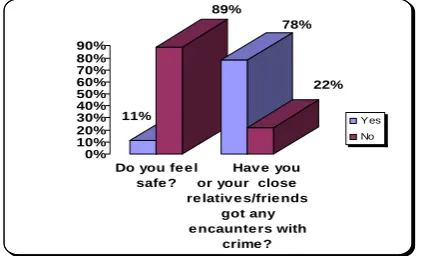
Safety. From the respondents’ replies we can see that majority of them do not feel safe (see Figure 4).
18
61
21
0 10 20 30 40 50 60 70
improved hasn't changed worsened
This worrying fact is a problem and can cause negative impact on economic and social spheres. Another question from safety was about encounter with crime.
11%
89%
78%
22%
0% 10% 20% 30% 40% 50% 60% 70% 80% 90%
Do you fe e l safe ?
Hav e you or your close re lativ e s/frie nds
got any e ncaunte rs with
crime ?
Yes No
Figure 4. Data from the respondents’ replies about feeling safe and encounter with crime
Again quite a lot of respondents or their close relatives or friends during last two years became victims of crime (see Figure 4). This result explains why the respondents do not feel safe.
Consequently, the respondents were asked to evaluate the work of institutions that secure safety in the society (see Figure 5).
Figure 5. Evaluation of work of institutions that must secure inhabitants safety
It is apparent that when people feel insecure they cannot evaluate the work of institutions positively. This correlation is obvious from the results of the survey. People do not feel safe and blame relevant institutions for that.
Income deprivation. Very important aspect describing quality of life is person’s financial situation. Therefore, the respondents from Panevezys were asked if they are satisfied with their financial situation. According to the gathered data, it can be summarized that only 7 % of respondents are satisfied with their financial situation, 36 % - partly satisfied, 31 % - unsatisfied, and 26 % are completely unsatisfied. These results are not surprising and can be explained by general situation in Lithuania in comparison with average earnings in Europe.
One more very important fact when analyzing quality of life is positive or negative trend of respondents’ financial situation. Therefore the respondents had to evaluate the shift of their financial situation to positive or negative direction. The results are shown in Figure 6:
Figure 6. ring last
two years (2007- beginning of 2008)
ituation, 38 % were not sure
Evaluation of the financial situation du
Lastly, the respondents were asked to evaluate their future prospects concerning their financial situation. The tendency of negative evaluation prevailed: only 18 % were optimistic about future financial s
, and 44 % were pessimistic.
worrying and could be influenced by changeable economic and social situation and inability of people to adapt to severe conditions of market economy. Furthermore, the research was performed in 2007 and at the beginning of 2008 when inflation was low and the country experienced economic growth. The situation of the end of the year 2008 and beginning of 2009 drastically changed. It is very economically unstable and we can assume that pessimism and unsatisfactory evaluation of quality of life and its se
ether can help developing a meaningful life philosophy.
parate dimensions will increase.
People’s preference to being well off financially or developing a meaningful life philosophy. In order to identify respondents’ preference to being well off financially or developing a meaningful life philosophythey were asked to rank them. 55 % of respondents ranked being well off higher, and 45 % - meaningful life philosophy. Respondents’ preference to being well off has evidently close relationship with dissatisfaction with their financial situation. This kind of preference is not welcomed therefore respondents had to indicate institutions that should foster a meaningful life philosophy. After the result analysis (see Figure 7) it is obvious that only all institutions tog
7% 5% 3% 9%
76%
0% 10% 20% 30% 40% 50% 60% 70% 80%
family church school community all these institutions
7. The institutions that should have infl
Figure uence in
developing meaningful life philosophy
piritual harm
ithuania and the world the results would be even worse.
•
•
•
ou
ind; onal financial situation;
•
trary, happiness rienced being very poor.
2.
3.
4.
6.
7.
8.
ropa.eu/publications/bysubject /listqualityoflife2008.htm
Happiness
Finally, after such dimensions as safety, income deprivation and the indicator of people’s preference to being well off financially or developing a meaningful life philosophy, respondents were asked if they feel happy. Happiness is one important indicator in identifying people’s life satisfaction. Respondents’ replies were as follows: 18 % feel happy, 49 % - fairly happy and 33 % - unhappy. To question “What do you lack to feel happy” respondents named safety 6%, money 20 %, s
ony 18 %, and all the named things – 56 %.
After the analysis of the survey results, it can be concluded that quality of life according to safety, income deprivation and life satisfaction dimensions is unsatisfactory for majority of respondents, which is influenced by feeling unsafe, dissatisfaction with financial situation and lack of spiritual harmony. We dare to claim that in the year 2009 after the drastic change of economic situation in L
Conclusions
The purpose of the quality of life index is to provide a tool for community development which can be used to monitor key indicators that encompass the social, health, environmental and economic dimensions of the quality of life in the community. The quality of life index can be used to comment frequently on key issues that affect people and contribute to the public debate about how to improve the quality of life in the community. It is intended to monitor conditions, which affect the living and working conditions of people and focus community action on ways to improve mental and physical health. The analysis of research and pilot survey results revealed that:
• concept of quality of life is multidimensional and should undergo qualitative and quantitative assessment;
quality of life should be unity of objective criteria covering standard level of state, city or members of social community;
quality of life, especially quality of working life is closely interrelated with organizational management and economics. The higher quality of life and quality of working life indexes, the more skillful and competent employees, better quality of products;
ha inpp ess is a subjective factor depending on person’s tlook that depends on:
fe philosophy and balance of m
¾ meaningful li
¾ importance of pers
¾ background;
¾ religiousness;
¾ understanding of one’s own place in a society. Quality of life concept and happiness concept correlates but are not the same. Person whose quality of life index is high can feel unhappy and on the con
can be expe
References
1. Aggernæs, A. (1989). Quality of Life. FADL’s Publ. Copenhagen.
Akranaviciute, D. & Ruzevicius, J. (2007).Quality of Life and its Components’ Measurement. Inzinerine Ekonomika-Engineering Economics(2), 45-50.
Bagdonienė, D. (2000). Gyvenimo kokybės ir gyventojų
kokybės sąvokų apibrėžimas. Ekonomika ir vadyba-2000: aktualijos ir metodologija: tarptautinės konferencijos pranešimų medžiaga, 46-48.
Bentham, J. (1997) An Introduction to the Principles of Morals and Legislation. Clarendon Press, Oxford, [reprint of 1823 edition].
5. Csikszentmihalyi, M. (2006). Flow: The Psychology of Optimal Experience. Academic Internet Publishers. Davidson, R. J. (2001). Toward a biology of personality and emotion. Annals of the New York Academy of Sciences (935), 191-207.
Diener, E. & Biswas-Diener, R. (2008). Rethinking happiness: The science of psychological wealth.
Malden, MA: Blackwell Publishing.
9. European Foundation for the Improvement of Living and Working Conditions, 2007 First European Quality of Life Survey: Key findings from a policy perspective.
Available from Internet: www.eurofound.europa.eu 10. Fitzpatrick, R. (1996). Quality of Life and Health:
Concepts, Methods and Applications. Health Policy,
37(1), 53-72.
11. Furmonavicius, T. (2003). Fiziologinių veiksniųįtaka vyresnio amžiaus vyrų kai kuriems gyvenimo kokybės aspektams. MEDICINA, 39(9), 896-901.
12. Gilgeous, V. (1998). Manufacturing managers: their quality of working life. Integrated Manufacturing Systems(9), 173-181.
13. Hergenhahn, B. R. (2005). An introduction to the history of psychology. Belmont, CA, USA: Thomson Wadsworth, 475.
14. Juniper, E. F., Svensson, K., Mörk, A.C. & Ståhl, E. (2005). Modification of the Asthma Quality of Life Questionnaire (standardised) in patients 12 years and older. Health and Quality of Life Outcomes, 3-58.
15. Juozulynas A. & Čeremnych E. (2005). Gyvenimo kokybė ir sveikata. Sveikatos mokslai(1), 71-74. 16. Juozulynas, A. Marcijonas A., Jurgenėnas A. &
Kaminskas K. (2002). Dirbančiųjų ekologijos ir ergonomikos bei gyveni-mo kokybės tyrimai.
Sveikatos mokslai(6), 58-61.
17. Juozulynas, A., Reklaitienė, R., Jurgelėnas, A., Zabulytė, D., Valeikienė, V. & Narkauskaitė, L. (2006). Gyvenimo kokybės ir visuomenės sveikatos sąsajos. Sveikatos mokslai 2 (16), 166-170.
18. Kahneman, D., Diener, E. & Schwarz, N. (1999).
Well-being: The foundations of hedonic psychology. New York: Russell Sage Foundation.
19. Kazlauskaite, R. & Buciuniene, I. (2008). The Role of Human Resources and Their Management in the Establishment of Sustainable Competitive Advantage.
Inzinerine Ekonomika-Engineering Economics(5), 78-85.
20. Maslow, A. (1962). Toward a Psychology of Being.
Van Nostrand, New York.
21. McLeish, Kenneth (1999). Aristotle: The Great Philosophers. Routledge. p. 5. Myers, D. G. (2004). Excerpted from Psychology, 7th edition, New York: Worth Publishers.
23. Myers, D. G. & Diener, E. (1997). The new scientific pursuit of happiness. Harvard Mental Health Letter, 4 (2), 4-7. 24. National Opinion Research Center surveys (NORC)
(2002). Available from Internet: http://www.norc. uchicago.edu /homepage.htm
25. Phillips, D. (2006). Quality of life and sustainability.
International Journal of Environmental, Cultural, Economic and Social Sustainability, 2(2), 103-112. 26. Reinhold, K., Tint, P., Tuulik, V & Saarik, S. (2008).
Innovations at Workplace: Improvement of Ergonomics.
Inzinerine Ekonomika-Engineering Economics(5), 85-95. 27. Rugienė, R., Dadonienė, J. & Venalis, A. (2005).
Gyvenimo kokybės klausimyno adaptavimas, jo tinkamumo kontrolinei grupei ir reumatoidiniu artritu
sergantiems ligoniams įvertinimas. Medicina, 41(3), 232-239.
28. Ruževičius, J. (2006). Kokybės vadybos modeliai ir jų taikymas organizacijų veiklos tobulinimui. Vilnius, Vilniaus universiteto leidykla.
29. Shin, D. (1979). The concept of quality of life and the evaluation of development effort. Comparative politics, 299-304.
30. Sirgy M. J., Rahtz, D. & Coskun Samli, A. Advances in Quality-of-Life Theory and Research. Kluwer Academic Publishers.
31. Suber, P. (1996). Against the Sanctity of Life.
Available from Internet: http://www.earlham.edu/~ peters/writing/ sanctity.htm
32. Taylor, A. E. (2001). Plato: The Man and his Work. Courier Dover Publications.
33. The Quality of Life Research Center 2005. Available from Internet: http://www.livskvalitet.org/cms.ashx/ English
34. The Higher Education Research Institute (HERI). The American Freshman surveys, UCLA, 1966-2002.
Available from Internet: http://www.heri.ucla.edu/ 35. US Census Bureau. Historical Statistics of the United
States and Economic Indicators. Available from Internet: http://www.census.gov/compendia/statab/hist _stats.html. 36. Ventegodt, S., Merrick, J. & Andersen, N.J. (2003).
Quality of life theory III. Maslow revisited. Scientific World Journal (3), 1050-7.
37. Ventegodt, S., Anderson, N.J. & Merrick, J. (2003). Quality of life philosophy I. Quality of life, happiness, and meaning in life. The Scientific World JOURNAL
(3), 1164-1175.
38. Ventegodt, S., Merrick, J., & Anderson, N. J. (2003). Quality of life theory I. The IQOL theory: an integrative theory of the global quality of life concept.
The Scientific World Journal (3), 1030-1040.
39. Weiss, A., Bates T. C. & Luciano, M. (2008). Happiness is a personal (ity) thing: The genetics of personality and subjective well-being in a representative sample.
Psychological Science (19), 205-210.
40. WHOQOL Group (1995). The World Health Organisation Quality of Life Assessment.
41. WHOQOL: position paper from the World Health Organisation, Social Science and Medicine(41), 1403-9.
Dalia Susnienė, Algirdas Jurkauskas
Gyvenimo kokybės ir laimės sąvokų sąsajos ir skirtumai
Santrauka
Pastaruoju metu gyvenimo kokybės ir laimės būsenai skiriamas didelis dėmesys. Gyvenimo kokybė yra plati sąvoka ir glaudžiai susijusi su bendra visuomenės gerove. Ja buvo susidomėta ir pradėta nuodugniau tyrinėti nuo 1970 m. Tai nėra atsitiktinis dalykas, nes pasaulis vienodėja ir atsiranda būtinybė lyginti gyvenimą savo šalyje, savo siauresnėje aplinkoje su gyvenimu kitose šalyse, kitose visuomenės grupėse. Nors gyvenimo kokybės klausimais labiau susidomėta ne taip jau seniai, tačiau „gero gyvenimo“ sampratų randame Platono ir jo mokinio Aristotelio veikaluose. Platonas aukščiausia gyvenimo vertybe laikė logika pagrįstą
nuo ekonominių ir socialinių gyvenimo sąlygų. Praėjusio amžiaus pradžioje gyvenimo kokybė buvo suvokiama kaip materialinė gerovė ir pinigai. Vėliau, keičiantis gyvenimo prasmės suvokimo ir vertybių
turiniui, keitėsi ir gyvenimo kokybės samprata bei jos sudedamosios dalys (Juozulynas ir Jurgelėnas, 2005).
Žmogaus sąmonėje gyvenimo sritys išsidėsčiusios tam tikra hierarchija: aukščiausiai yra bendrai suvokiama visa gyvenimo kokybė, po to individualiai išsidėsto kitos gyvenimo kokybės dalys (šeima, darbas, sveikata, laisvalaikis ir pan.) (Sirgy, et al, 2001).
Didesnis pasitenkinimo lygis vienoje gyvenimo srityje didina pasitenkinimo lygį pagal svarbumą aukščiau esančioje srityje, pavyzdžiui, aukšta gyvenimo darbe kokybė didina pasitenkinimą viso gyvenimo kokybe (perteklius kyla iš apačios į viršų). Tačiau jaučiamas nepasitenkinimas viena gyvenimo sritimi gali beveik neveikti kitų sričių
pasitenkinimo lygio arba didinti pasitenkinimo lygį vienoje srityje. Antai, jeigu žmogus jaučia nepasitenkinimą darbu, jis gali tai kompensuoti didesniu dėmesiu šeimai ir didesniu pasitenkinimu šeimyninio gyvenimo kokybe (Furmonavičius, 2001).
Tyrimo problema: nustatyti gyvenimo kokybės ir laimės sąvokų
skirtumus, taip pat aptarti, kokį šios sąvokos daro poveikį viena kitai. Tyrimo tikslas: išnagrinėti, kaip respondentai Lietuvoje supranta gyvenimo kokybę, kokios dimensijos ar indikatoriai, apibūdinantys gyvenimo kokybę, yra svarbiausi, ir kaip supranta laimę – vieną iš indikatorių. Tyrimo uždaviniai: išanalizuoti gyvenimo kokybės ir laimės sąvokas bei jų supratimą; aptarti laimės pojūčio įtaką gyvenimo kokybei; nustatyti svarbiausius respondentams Lietuvoje faktorius, apibūdinančius gyvenimo kokybę. Tyrimo metodai: lyginamoji mokslinės literatūros analizė, mokslinių tyrimų apžvalga, empirinis tyrimas ir išvadų
formulavimas.
Vienas iš gyvenimo kokybės indikatorių – laimė – yra labai subjektyvus ir priklauso ne tik nuo įvairių išorinių veiksnių. Ji priklauso nuo paties žmogaus, jo prigimties (genų), vertybių, polinkių, charakterio ir kitų savybių. Psichologo Davido Mayerso teigimu, laimė – tai pilnaverčio, prasmingo ir malonaus gyvenimo ilgalaikis jutimas. Anot Z. Froido, tai, ką žmogus vadina laime, kyla iš susikaupusių prigimties poreikių patenkinimo. Tačiau šiuolaikinė psichologija laimės nesieja išimtinai su seksualiniais ar kitais malonumais. Laimė – tai ilgas, daugiapakopis procesas.
Gyvenimo kokybės klausimai nagrinėjami įvairiose mokslo srityse. Sociologijoje – tai subjektyvus gerovės supratimas, įvertinantis individo poreikius ir sampratą; ekonomikoje – tai materialinėmis vertybėmis ir pinigine išraiška įvertinamas gyvenimo lygis, tradiciškai išreiškiamas bendruoju nacionaliniu produktu, tenkančiu vienam gyventojui ir 1970 m. Pasaulio banko sukurtu fiziniu gyvenimo kokybės indeksu, apimančiu socialinius , ekonominius ir su sveikata susijusius kintamuosius. Medicinoje gyvenimo kokybės samprata susijusi su sveikatos ir ligos santykiu, įterpiant veiksnius, darančius poveikį sveikai gyvensenai. Tačiau visuotinai pripažinto gyvenimo kokybės apibrėžimo nėra. Literatūroje plačiai remiamasi Pasaulio sveikatos organizacijos (WHO) 1995 m. pateiktu gyvenimo kokybės apibrėžimu – gyvenimo kokybė yra individo savo vietos gyvenime suvokimas, remiantis savo gyvenamos aplinkos kultūros ir vertybių sistema ir siejant šį suvokimą su asmeniniais tikslais, lūkesčiais, vertybėmis ir dalykais, susijusiais su fizine sveikata, psichologine būsena, savarankiškumo lygiu, visuomeniniais ryšiais, tikėjimu ir santykiu su aplinka.
Neakcentuojant laimės ar gyvenimo kokybės apibendrinto supratimo, žvalgomuoju tyrimu buvo pabandyta nustatyti, kaip Panevėžio miesto gyventojai vertina kai kuriuos kriterijus, aktualius šiuolaikinei Lietuvos visuomenei. Išanalizavus respondentų atsakymus ir apibendrinant tyrimo rezultatus galima teigti, kad gyvenimo kokybe, įvertinus saugumo, materialinės gerovės ir dvasinio pasitenkinimo kokybę, nepasitenkina didelė dalis tyrime dalyvavusių respondentų. Tai sąlygota individų
nesaugumo jausmo, nepasitenkinimo materialine padėtimi ir dvasinės harmonijos trūkumo.
Tyrimas buvo atliekamas 2007 m. pabaigoje ir 2008 m. pradžioje, tad galime daryti prielaidą, kad Lietuvą ir pasaulį apėmus ekonominei krizei, rezultatai dabar būtų dar pesimistiškesni.
Gyvenimo kokybei turi įtakos daug faktorių: tai ir asmens fizinė, dvasinė taip pat sveikatos būklė, nepriklausomumo lygis, socialinis ryšys su aplinka ir kiti veiksniai (Ruževičius, 2006; Shin, 1979). Paprasčiau gyvenimo kokybę galima apibūdinti kaip žmogaus pasitenkinimą esamo gyvenimo dimensijomis, lyginant su jo siekiamu ar idealiu gyvenimo lygiu. Jos vertinimas priklauso ir nuo žmogaus vertybių sistemos bei kultūrinės aplinkos, kuriai jis priklauso (Gilgeous, 1998). Suber P. (1996), apibūdindamas gyvenimo kokybės koncepciją, teigia, kad ji priklauso nuo išorinių aplinkybių. Gyvenimo aplinkybės ar sąlygos gali lemti aukštą
gyvenimo vertę, tačiau nors kiek pakitus aplinkybėms keičiasi ir asmens gyvenimo kokybės suvokimas ir vertinimas. Taigi gyvenimo kokybę
lemia daugybė veiksnių ir aplinkybių: būstas, užimtumas, pajamos ir materialinis gerbūvis, moralinės nuostatos, asmeninis ir šeimyninis gyvenimas, socialinė parama, stresas ir krizės, sveikatos kokybė, sveikatos priežiūros galimybės, santykiai su aplinka, ekologiniai veiksniai ir kt. (Juozulynas ir Čemerych, 2005; Rugienė, 2005).
Atlikus mokslinės literatūros analizę ir įvertinus Panevėžio gyventojų gyvenimo kokybę saugumo, materialinių ir dvasinių vertybių
aspektu, galima daryti šias išvadas:
• Gyvenimo kokybės termino samprata yra daugialypė, reika-laujanti tiek kokybinio, tiek kiekybinio įvertinimo, literatūroje ji pateikiama ir apibrėžiama pakankamai įvairiai ir plačiai.
• Gyvenimo kokybė turėtų būti objektyvi valstybės, miesto ar kokios socialinės bendrijos narių gyvenimo lygio kriterijų visuma, lygintina su kitos panašios grupės narių gyvenimu.
• Gyvenimo kokybės kriterijai gali ir turi keistis atsižvelgiant į
bendrą pasaulio gyvenimo raidą ekonominiu, politiniu, socialiniu ir kitais požiūriais.
• Gyvenimo kokybė, o ypač gyvenimo darbe kokybė, yra neatsiejama nuo organizacijų vadybos ir ekonomikos. Kuo aukštesni gyvenimo ir gyvenimo darbe kokybės indeksai, tuo kvalifikuotesni darbuotojai, geresnė prekių kokybė.
Gyvenimo kokybė vertinama tiek objektyviais, tiek ir subjektyviais rodikliais. Subjektyvi gyvenimo kokybė nusako pasitenkinimą gyvenimu bendrai, objektyvi gyvenimo kokybė atspindi socialinius ir kultūrinius poreikius materialinei gerovei, socialiniams statusui ir fizinei gerovei.
• Laimė yra subjektyvus individo požiūris į gyvenimą, priklausantis nuo:
o dvasinės būsenos;
Taigi objektyvūs rodikliai visuomenėje egzistuoja, jie gali būti stebimi ir matuojamas jų kiekis ar pasikartojimo dažnumas. Subjektyvūs bruožai egzistuoja individo sąmonėje ir jie identifikuojami tik iš individo atsakymų rūpimomis temomis. Išsamus gyvenimo kokybės tyrimas turi apimti abiejų rūšių rodiklius (Juniper, 2002).
o gyvenimo vertybių supratimo; o materialinių poreikių reikšmės; o išsilavinimo;
o religingumo;
o savo vietos visuomenėje supratimo ir kitų faktorių.
Gyvenimo kokybė dažniausiai vertinama laikantis pertekliaus teorijos (angl. spillover theory), kuri teigia, kad žmogaus pasitenkinimas vienoje gyvenimo kokybės srityje daro poveikį pasitenkinimo lygiui kitose srityse.
• Gyvenimo kokybės ir laimės sampratų negalima tapatinti. Individas, besinaudojantis aukščiausiu gyvenimo kokybės indeksu, gali būti labai nelaimingas ir atvirkščiai, laimingas gali jaustis ir visiškas vargšas.
• Remiantis žvalgomojo tyrimo rezultatais galima teigti, kad eilinis lietuvis nėra laimingas ir jo nuotaikos gana pesimistinės vertinant savo gyvenimo kokybę.
Raktažodžiai: gyvenimo kokybė, laimė, įvertinimas, objektyvūs ir subjektyvūs
kriterijai.