Volume 2009, Article ID 612719,13pages doi:10.1155/2009/612719
Research Article
Power Allocation Strategies for Distributed Space-Time Codes in
Amplify-and-Forward Mode
Behrouz Maham
1, 2and Are Hjørungnes
11UNIK-University Graduate Center, University of Oslo, 2027 Kjeller, Norway 2Department of Electrical Engineering, Stanford University, Stanford, CA 94305, USA
Correspondence should be addressed to Behrouz Maham,[email protected]
Received 22 February 2009; Revised 28 May 2009; Accepted 23 July 2009
Recommended by Jacques Palicot
We consider a wireless relay network with Rayleigh fading channels and apply distributed space-time coding (DSTC) in amplify-and-forward (AF) mode. It is assumed that the relays have statistical channel state information (CSI) of the local source-relay channels, while the destination has full instantaneous CSI of the channels. It turns out that, combined with the minimum SNR based power allocation in the relays, AF DSTC results in a new opportunistic relaying scheme, in which the best relay is selected to retransmit the source’s signal. Furthermore, we have derived the optimum power allocation between two cooperative transmission phases by maximizing the average received SNR at the destination. Next, assumingM-PSK andM-QAM modulations, we analyze the performance of cooperative diversity wireless networks using AF opportunistic relaying. We also derive an approximate formula for the symbol error rate (SER) of AF DSTC. Assuming the use of full-diversity space-time codes, we derive two power allocation strategies minimizing the approximate SER expressions, for constrained transmit power. Our analytical results have been confirmed by simulation results, using full-rate, full-diversity distributed space-time codes.
Copyright © 2009 B. Maham and A. Hjørungnes. This is an open access article distributed under the Creative Commons Attribution License, which permits unrestricted use, distribution, and reproduction in any medium, provided the original work is properly cited.
1. Introduction
Space-time coding (STC) has received a lot of attention in the last years as a way to increase the data rate and/or reduce the transmitted power necessary to achieve a target bit error rate (BER) using multiple antenna transceivers. In ad hoc network applications or in distributed large-scale wireless networks, the nodes are often constrained in the complexity and size. This makes multiple-antenna systems impractical for certain network applications [1]. In an effort to overcome this limitation, cooperative diversity schemes have been introduced [1–4]. Cooperative diversity allows a collection of radios to relay signals for each other and effectively create a virtual antenna array for combating multipath fading in wireless channels. The attractive feature of these techniques is that each node is equipped with onlyoneantenna, creating a virtual antenna array. This property makes them outstanding for deployment in cellular mobile devices as well as in ad hoc mobile networks, which have problem with exploiting multiple antenna due to the size limitation of the mobile terminals.
Among the most widely used cooperative strategies are amplify and forward (AF) [4,5] and decode and forward (DF) [1,2,4]. The authors in [6] applied Hurwitz-Radon space-time codes in wireless relay networks and conjecture a diversity factor aroundR/2 for largeRfrom their simula-tions, whereRis the number of relays.
the relays, it requires full channel information at the receiver of both the channel from the transmitter to relays and the channel from relays to the receiver. Therefore, training symbols have to be sent from both the transmitter and relays. Distributed space-time coding was generalized to networks with multiple-antenna nodes in [8], and the design of practical DSTCs that lead to reliable communication in wireless relay networks has also been recently considered [9–
11].
Power efficiency is a critical design consideration for wireless networks such as ad hoc and sensor networks, due to the limited transmission power of the nodes. To that end, choosing the appropriate relays to forward the source data as well as the transmit power levels of all the nodes become important design issues. Several power allocation strategies for relay networks were studied based on different cooperation strategies and network topologies in [12]. In [13], we proposed power allocation strategies for repetition-based cooperation that take both the statistical CSI and the residual energy information into account to prolong the network lifetime while meeting the BER QoS requirement of the destination. Distributed power allocation strategies for decode-and-forward cooperative systems are investigated in [14]. Power allocation in three-node models is discussed in [15,16], while multihop relay networks are studied in [17–
19]. Recent works also discuss relay selection algorithms for networks with multiple relays, which result in power efficient transmission strategies. Recently proposed practical relay selection strategies include preselect one relay [20], best-select relay [20], blind-selection algorithm [21], informed-selection algorithm [21], and cooperative relay selection [22]. In [23], an opportunistic relaying scheme is introduced. According to opportunistic relaying, a single relay among a set of Rrelay nodes is selected, depending on which relay provides the best end-to-end path between source and destination. Bletsas et al. [23] proposed two heuristic methods for selecting the best relay based on the end-to-end instantaneous wireless channel conditions. Performance and outage analysis of these heuristic relay selection schemes are studied in [24,25]. In this paper, we propose a decision metric for opportunistic relaying based on maximizing the received instantaneous SNR at the destination in amplify-and-forward (AF) mode, when statistical CSI of the source-relay channel is available at the source-relay. Furthermore, similar to [7], knowledge of whole CSI is required for decoding at the destination. In this paper, we use a simple feedback from the destination toward the relays to select the best relay.
In [9, 10], a network with symmetric channels is assumed, in which all source-to-relay and relay-to-des-tination links have i.i.d. distributions. In [7], using the pairwise error probability (PEP) analysis in high SNR scenario, it is shown that uniform power allocation along relays is optimum. However, this assumption is hardly met in practice and the path lengths among nodes could vary. Therefore, power control among the relays is required for such a cooperation. In [10], a closed-form expression for the moment generating function (MGF) of AF space-time cooperation is derived as a function of Whittaker function. However, this function is not well behaved and
cannot be used for finding an analytical solution for power allocation.
Our main contributions can be summarized as follows. (i) We show that the DSTC based on [7] in which relays
transmit the linear combinations of the scaled version of their received signals leads to a new opportunistic relaying, when maximum instantaneous SNR-based power allocation is used.
(ii) The optimum power allocation between two phases is derived by maximizing the average SNR at the destination.
(iii) We derive the average symbol error rate (SER) of AF opportunistic relaying system withM-PSK orM -QAM modulations over Rayleigh-fading channels. Furthermore, the probability density function (PDF) and moment generating function (MGF) of the received SNR at the destination are obtained. (iv) We analyze the diversity order of AF opportunistic
relaying based on the asymptotic behavior of average SER. Based on the proposed approximated SER expression, it is shown that the proposed scheme achieves the diversity order ofR.
(v) The average SER of AF DSTC system for Rayleigh fading channels is derived, using two new methods based on MGF.
(vi) We propose two power allocation schemes for AF DSTC based on minimizing the target SER, given the knowledge of statistical CSI of source-relay links at the relays. An outstanding feature of the proposed schemes is that they are independent of the instantaneous channel variations, and thus, power control coefficients are varying slowly with time. The rest of this paper is organized as follows. InSection 2, the system model is given. Power allocation schemes for AF DSTC based on minimizing the received SNR at the destination are presented in Section 3. In Section 4, the average SER of AF opportunistic relaying and AF DSTC with relays with partial statistical CSI is derived. Two power allocation schemes minimizing the SER are proposed in
Section 5. In Section 6, the overall performance of the system is presented for different number of relays through simulations. Finally,Section 7summarized the conclusions.
Throughout the paper, the following notation is applied. The superscriptst andH stand for transposition and con-jugate transpose, respectively.E{·}denotes the expectation operation. Cov(xT) is the covariance of theT×1 vectorxT. All logarithms are the natural logarithm.
2. System Model
. . . f1
f2
s d
r1
g1
r2 g2
rR
fR gR
Figure 1: Wireless relay network consisting of a source s, a destinationd, andRrelays.
respectively. Suppose each link has a flat Rayleigh fading, and channels are independent of each others. Therefore,frandgr are i.i.d. complex Gaussian random variables with zero-mean and variances σ2
fr and σ 2
gr, respectively. Similar to [7], our scheme requires two phases of transmission. During the first phase, the source node transmits a scaled version of the signal
s=[s1,. . .,sT]t, consisting ofT symbols toallrelays, where it is assumed thatE{ssH} = (1/T)I
T. Thus, from time 1 to
T, the signalsP1Ts1,. . .,
P1TsTare sent to all relays by the source. The average total transmitted energy inT intervals will beP1T. Assuming fris not varying duringTsuccessive intervals, the received T×1 signal at the rth relay can be written as
rr=
P1T frs+vr, (1)
wherevris aT×1 complex zero-mean white Gaussian noise vector with variance N1. Using amplify and forward, each relay scales its received signal, that is,
yr=ρrrr, (2)
whereρr is the scaling factor at Relay r. When there is no instantaneous CSI available at the relays, but statistical CSI is known, a useful constraint is to ensure that a given average transmitted power is maintained. That is,
ρ2 r =
P2,r
σ2 frP1+N1
, (3)
whereP2,r is the average transmitted power at Relayr. The total power used in the whole network for one symbol transmission is thereforeP=P1+
R r=1P2,r.
DSTC, proposed in [7], uses the idea of linear disper-sion space-time codes of multiple-antenna systems. In this system, theT×1 received signal at the destination can be written as
y=
R
r=1
grAryr+w, (4)
whereyris given by (2),wis aT×1 complex zero-mean white Gaussian noise vector with the component-wise variance of N2, and theT×Tdimensional matrixAr is corresponding to therth column of a properT×Tspace-time code. The
DSTCs designed in [9,10] are such thatAr,r =1,. . .,R, are unitary. Combining (1)–(4), thetotalnoise vectorwTis given by
wT=
R
r=1
Ar
P2,r
σ2 frP1+N1
grvr+w. (5)
Since, gi, vi, and w are independent complex Gaussian random variables, which are jointly independent, the con-ditional auto covariance matrix ofwTcan be shown to be
CovwT | fr
R r=1, gr
R r=1
=
⎛ ⎝R
r=1
P2,rgr2N1 σ2
frP1+N1 +N2
⎞ ⎠IT,
(6)
whereITis theT×Tidentity matrix. Thus,wTis white.
3. Opportunistic Relaying through AF DSTC
In this section, we propose power allocation schemes for the AF distributed space-time codes introduced in [7], based on maximizing the received SNR at the destinationd. First, the optimum power transmitted in the two phases, that is, P1 and P2 =R
r=1P2,r, will be obtained by maximizing the average received SNR at the destination. Then, we will find the optimum distribution of transmitted powers among relays, that is,P2,r, based on instantaneous SNR.
3.1. Power Control between Two Phases. In the following
proposition, we derive the optimal value for the transmitted power in the two phases when backward and forward channels have different variances by maximizing the average SNR at the destination.
Proposition 1. Assume α portion of the total power is
transmitted in the first phase and the remaining power is
transmitted by relays at the second phase, where0< α <1, that
is,P1=αPandP2=(1−α)P, wherePis the total transmitted
power during two phases. Assumingσ2
fr = σ 2
f andσg2r = σ 2 g,
the optimum value ofαby maximizing the average SNR at the
destination is
α= N1σ
2
gP+N1N2
N2σ2f −N1σg2
P
⎛ ⎜ ⎜ ⎝ 1 +
N2σ2f−N1σg2
P N1σg2P+N1N2 −
1
⎞ ⎟ ⎟ ⎠. (7)
Proof. The average SNR at the destination can be obtained by
dividing the average received signal power by the variance of the noise at the destination (approximation ofE{SNR}using Jensen’s inequality). Using (1)–(6), the average SNR can be written as
SNR= α(1−α)P
2σ2 fσg2
αN2σ2f−N1σg2
P+N1σg2P+N1N2
, (8)
where we have assumed σ2fr = σ 2
f and σg2r = σ 2
which maximizes (8), subject to the constraint 0< α <1, is obtained as
α=
1 +β−1
β , (9)
where
β=
N2σ2f −N1σg2
P N1σg2P+N1N2 .
(10)
Similarly, whenN2σ2f < N1σg2, the optimum value ofα, which maximizes SNR in (8), subject to constraint 0< α <1, is also (9) and (10). Therefore, observing (9) and (10), the desired result in (7) is achieved.
For the special case ofN2σ2f = N1σg2, the optimumαis equal to 1/2, which is in compliance with the result obtained in [7], where assumedN1=N2andσ2f =σg2. In this case, we have
α= lim β→0+
1 β
1 +β−1
= lim β→0+
1 β
β 2+o(1)
=1
2.
(11)
3.2. Power Control among Relays with Source-Relay link CSI at
Relay. Now, we are going to find the optimum distribution
of the transmitted powers among relays during the second phase, in a sense of maximizing the instantaneous SNR at the destination.
The conditional variance of the equivalent received noise is obtained in (6). Thus, using (1), (2), and (4), the instantaneous received SNR at the destination can be written as
SNRins=
R
r=1P1fr2gr2
P2,r/
σ2 frP1+N1
R
r=1gr2
P2,r/
σ2 frP1+N1
N1+N2 . (12)
For notational simplicity, we represent SNRins in (12) in a matrix format as
SNRins= ptUp
ptVp+N 2
, (13)
wherep=[P2,1,P2,2,. . .,P2,R]tand the positive definite diagonal matricesUandVare defined as
U=diag
⎡
⎣P1f12g12 σ2f1P1+N1
,P1f2 2
g22 σ2f2P1+N1
,. . .,P1fR 2
gR2
σ2 fRP1+N1
⎤ ⎦,
V=diag
⎡
⎣ g12N1 σ2
f1P1+N1 , g2
2 N1 σ2
f2P1+N1
,. . ., gR 2
N1 σ2
fRP1+N1
⎤ ⎦.
(14)
Then, the optimization problem is formulated as
p∗=arg max
p SNRins, subject top
tp=P2, (15)
where theR×1 vector p∗ denotes the optimum values of power control coefficients. Moreover, sinceptp=P
2=(1− α)P, we can rewrite (13) as
SNRins= ptUp
ptWp, (16)
where diagonal matrixWis defined asW =V+ (N2/P2)IR. Since W is a positive semidefinite matrix, we define q W1/2p, whereW=(W1/2)tW1/2. Then, (16) can be rewritten as
SNRins=q tZq
qtq , (17)
where diagonal matrixZisZ=UW−1. Now, using Rayleigh-Ritz theorem [26], we have
qtZq
qtq ≤λmax, (18)
where λmax is the largest eigenvalue of Z, which is corre-sponding to the largest diagonal element ofZ, that is,
λmax= max r∈{1,...,R}λr
= max r∈{1,...,R}
P1P2fr2gr2
P2gr2N1+N2
σ2 frP1+N1
.
(19)
The equality in (18) holds if q is proportional to the eigenvector ofZcorresponding toλmax. SinceZis a diagonal matrix with real elements, the eigenvectors ofZare given by the orthonormal bases er, defineder,l = δr,l,l = 1,. . .,R. Hence, the optimumqmaxcan be chosen to be proportional to ermax. On the other hand, since p = W−1/2q, and W is a diagonal matrix, the optimump∗ is also proportional to
ermax. Using the power constraint of the transmitted power in the second phase, that is,ptp=P
2, we havep∗ =
P2ermax. This means that for each realization of the network channels, the best relay should transmit all the available powerP2and all other relays should stay silent. Hence, the optimum power allocation based on maximizing the instantaneous received SNR at the destination is to select the relay with the highest instantaneous value ofP1P2|fr|2|gr|2/(P2|gr|2N1+N2(σ2frP1+ N1)).
3.3. Relay Selection Strategy. In the previous subsection,
be aware of all channels for coherent decoding. Thus, the same channel information could be exploited for the purpose of relay selection. However, if we assume a distributed relay selection algorithm, in which relays independently decide to select the best relay among them, such as work done in [23], the knowledge of local channels fr and gr is required for the rth relay. The estimation of fr andgr can be done by transmitting a ready-to-send (RTS) packet and a clear-to-send (CTS) packet in MAC protocols.
4. Performance Analysis
4.1. Performance Analysis of the Selected Relaying Scheme
4.1.1. SER Expression. In the previous section, we have
shown that the optimum transmitted power of AF DSTC system based on maximizing the instantaneous received SNR at the destination led to opportunistic relaying. In this section, we will derive the SER formulas of best relay selection strategy under the amplify-and-forward mode. For this reason, we should first derive the received SNR at the destination due to therth relay, when other relays are silent, that is,
γr=
P1P2fr2gr2
P2gr2N1+N2
σ2 frP1+N1
. (20)
In the following, we will derive the PDF ofγr in (20), which is required for calculating the average SER.
Proposition 2. For the γr in (20), the probability density
functionpr(γr)can be written as
pr
γr
=2Are−BrγrK0
2Arγr
+ 2Br
Arγre−BrγrK1
2Arγr
,
(21)
whereArandBrare defined as
Ar=
N2
σ2frP1+N1
P1P2σ2frσ 2 gr
, Br= N1
P1σ2fr
, (22)
andKν(x)is the modified Bessel function of the second kind of
orderν[27].
Proof. The proof is given inAppendix A.
Defineγmax max{γ1,γ2,. . .,γR}. The conditional SER of the best relay selection system under AF mode with R
relays can be written as
Pe
R| fr
R r=1, gr
R r=1
=c Qg γmax
, (23)
whereQ(x)=1/√2π∞xe−u
2/2
du, and the parameterscand gare represented as
cQAM=4
√
M√−1
M , cPSK=2,
gQAM= 3
M−1, gPSK=2sin 2π
M
.
(24)
For calculating the average SER, we need to find the PDF of γmax. Thus, in the following proposition, we derive the PDF of the maximum ofR random variables expressed in (20).
Proposition 3. For the γr in (20), the probability density
function of the maximum of theRrandom variables,γr, can
be written as
pmax
γ=
R
r=1 pr
γ
R
i=1 i /=r
1−2e−Biγ
AiγK1
2Aiγ
!
, (25)
wherepr(γ)is derived in(21).
Proof. The proof is given inAppendix B.
Now, we are deriving the SER expression for the selection relaying scheme discussed in Section 3. Averaging over conditional SER in (23), we have the exact SER expression as
Pe(R)=
"∞
0Pe
R| fr
R r=1, gr
R r=1
pmax
γdγ
=
"∞
0c Q
g γpmax
γdγ.
(26)
Using the moment generating function approach, we can expressPe(R) given in (26) as
Pe(R)=
"∞
0 c π
"π/2
0 e
−g γ/(2sin2φ)
pmax
γdφdγ
= c
π
"π/2
0 Mmax
− g
2sin2φ
dφ,
(27)
where Mmax(−s) = Eγ(e−sγ) is the moment generating function ofγmax. In the following theorem, we state a closed-form expression forMmax(−s) in (27).
Theorem 1. For theRindependent random variablesγr, which
is stated in (20), the MGF of γmax = max{γ1,γ2,. . .,γR}is
given by
Mmax(−s)≈
⎛ ⎝R
r=1 Br
⎞ ⎠R
r=1
(R−1)! (s+Br)R
eAr/(2(s+Br))
×
#
Ar(s+Br)
Br
(R−1)!·W−R+(1/2),0
×
Ar
s+Br
+R!W−R,(1/2)
Ar
s+Br
$
, (28)
whereWa,b(x)is Whittaker function of orders a and b (see, e.g.,
[27] and [28, equation 9.224]).
2
1 4
3
0
K0 (x)
−log (x)
0.2 0.4 0.6 0.8
0 1
x
(a)
K1 (x)
1/x 40
20 80 100
60
0
0.2 0.4 0.6 0.8
0 1
x
(b)
Figure2: Diagrams ofK0(x) and log(1/x) in (a) andK1(x) and 1/x
in (b), which have the same asymptotic behavior whenx → 0.
4.1.2. Diversity Analysis. From [27, equation (9.6.8)], and
[27, equation (9.6.9)], the following properties can be obtained
K0(x)≈ −log(x), K1(x)≈ 1
x. (29)
Specially, for small values of x, which corresponds to the small value of AandB in (22), or equivalently, high SNR scenario, the approximations in (29) are more accurate. In
Figure 2, we have shown thatK0(x) and log(1/x), and also K1(x) and 1/xhave the same asymptotic behavior whenx →
0+. Therefore, we can approximatep
r(γ) in (21) as
pr
γ≈Br−Arlog(4Ar)
e−Brγ−A
re−Brγlog
γ, (30)
and hence,pmax(γ) in (25) is approximated as
pmax
γ≈
R
r=1
Br−Arlog(4Ar)
e−Brγ−A
re−Brγlog
γ!
×
R
i=1 i /=r
1−e−Brγ
.
(31)
Using (31), we can approximate the moment generating function ofγmax, that is,Mmax(−s)=Eγ(e−sγ), in high SNRs as
Mmax(−s)=
"∞
0e
−s γp max
γdγ
≈
R
r=1
⎛ ⎜ ⎜ ⎝
R
i=1 i /=r
Bi
⎞ ⎟ ⎟ ⎠
"∞
0e
−(s+Br)γ
×%Br−Arlog(4Ar)−Arlog
γ&γR−1dγ, (32)
where we have approximated (1−e−Brγ) withB
rγ, due to the high SNR assumption we made. Simplifying (32), we have
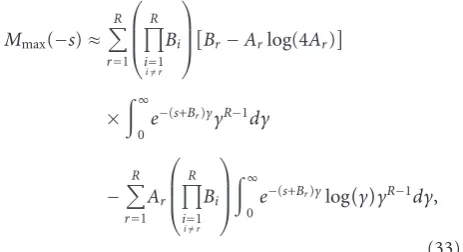
Mmax(−s)≈
R
r=1
⎛ ⎜ ⎜ ⎝
R
i=1 i /=r
Bi
⎞ ⎟ ⎟
⎠%Br−Arlog(4Ar)
&
×
"∞
0e
−(s+Br)γγR−1dγ
−
R
r=1 Ar
⎛ ⎜ ⎜ ⎝
R
i=1 i /=r Bi
⎞ ⎟ ⎟ ⎠
"∞
0e
−(s+Br)γlogγγR−1dγ,
(33)
where the first integral can be calculated as
∞
0e−(s+Br)γγR−1dγ = (R − 1)!(s+Br)−R. With the help of [28, equation (4.352)] , the second integral in (33) can be computed as
"∞
0e
−(s+Br)γlogγγR−1dγ
=(R−1)! (s+Br)−R
ξ(R)−log(s),
(34)
whereξ(R)=1 + 1/2 + 1/3 +· · ·+ 1/(R−1)−κ, andκis the Euler’s constant, that is,κ ≈ 0.5772156. Therefore, the closed-form approximation for the MGF function ofγmaxis given by
Mmax(−s)≈(R−1)! R
r=1
⎛ ⎜ ⎜ ⎝
R
i=1 i /=r
Bi
⎞ ⎟ ⎟
⎠(s+Br)−R
×%Br−Arlog(4Ar) +Ar
log(s)−ξ(R)&. (35)
To have more insight into the MGF derived in (35), we representArandBras functions of the transmit SNR, that is,
μ=P/N1, assuming the destination and relays have the same value of noise, that is,N1=N2. Thus,ArandBrin (22) can be represented in high SNRs as
Ar= 1 (1−α)μσ2
gr
, Br= 1 αμσ2
fr
and then,Mmax(−s) in (35) can be rewritten as
Mmax(−s)≈
⎛ ⎝R
i=1 1 σ2fi
⎞ ⎠R
r=1
(R−1)!
%
(s+Br)μα
&R
×
⎡ ⎣1 +ασ2
fr
logsμ(1−α)σ2 gr/4
−ξ(R) (1−α)σ2
gr
⎤ ⎦.
(37)
Now, we are using the moment generating function method to derive an approximate SER expression for the opportunistic relaying scheme discussed inSection 3. Using the moment generating function approach, we can express Pe(R) given in (26) as
Pe(R)=
"∞
0 c π
"π/2
0 e
−(gγ/2 sin2φ) pmaxγdφdγ
= c
π
"π/2
0 Mmax
− g
2 sin2φ
dφ
≈
⎛ ⎝R
i=1 1 σ2fi
⎞
⎠c2R(R−1)!
πgμαR
R
r=1
"π/2
0 sin 2R
φ
×
⎡ ⎣1 +ασ2
fr
loggμ(1−α)σ2 gr/8 sin
2φ−ξ(R) (1−α)σ2
gr
⎤ ⎦dφ,
(38)
where by using (22),g/2 sin2φ+Bris accurately approximated withg/2sin2φfor all values ofφin high SNR conditions. For deriving the closed-form solution for the integral in (38), we decompose it into
Pe(R) ≈Ω
μ,R
'
C1
μ,R"
π/2
0 sin
2Rφ dφ−C2(R)
×
"π/2
0 sin 2Rφ
logsinφdφ
(
,
(39)
whereΩ(μ,R),C1(μ,R), andC2(R) are defined as
Ωμ,R= c2R(R−1)!
πgμαR
R
i=1 1 σ2 fi
, (40)
C1
μ,R=
R
r=1
⎡ ⎣1 +ασ2
fr
loggμ(1−α)σ2 gr/8
−ξ(R) (1−α)σ2
gr
⎤ ⎦,
(41)
C2(R)= R
r=1 ασ2fr (1−α)σ2
gr
. (42)
Using [28, equation (4.387)] for solving the second integral in (39), the closed-form SER approximation is obtained as
Pe(R)≈ (2R)! ((2RR)!)2
π 2Ω
μ,R
×
⎧ ⎨ ⎩C1
μ,R−C2(R)
⎛ ⎝R
k=1 (−1)k+1
k −log(2)
⎞ ⎠ ⎫ ⎬ ⎭.
(43)
In the following theorem, we will study the achievable diversity gains in an opportunistic relaying network contain-ingRrelays, based on the SER expression.
Theorem 2. The AF opportunistic relaying with the scaling
factor presented in(3), in which relays have no CSI, provides
full diversity.
Proof. The proof is given inAppendix D.
4.2. SER Expression for AF DSTC. In this subsection, we
derive approximate SER expressions for the AF space-time coded cooperation using moment generating function method.
The conditional SER of the protocol described in
Section 2, with R relays, can be written as [29, equation (9.17)]
Pe
R| fr
R r=1 gr
R r=1
=cQ
⎛ ⎜ ⎝ g
R
r=1
μrfrgr2
⎞ ⎟ ⎠, (44)
where by using (2)–(6),μrcan be written as
μr=
P1P2,r/
σ2 frP1+N1
R
k=1
P2,k/
σ2fkP1+N1
σ2
gkN1+N2
. (45)
It is important to note that in (45) we approximate the conditional variance of the noise vector wT in (6) as its expected value. The received SNR at the receiver side is denoted
γ=
R
r=1
γr, (46)
where
γr=μrfrgr2. (47) We can calculate the average SER as
Pe(R)=
"∞
0Pe
R| γr
R r=1
pγdγ
=
"∞
0c Q
g γpγdγ.
(48)
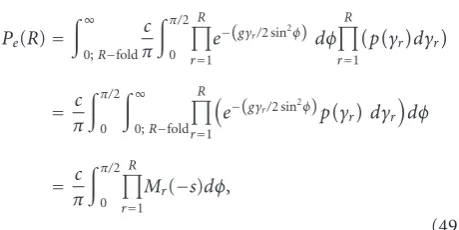
separation of the relay nodes in the network. Hence, the average SER in (48) can be rewritten as
Pe(R)=
"∞
0;R−fold c π
"π/2
0 R
r=1
e−(gγr/2 sin2φ)dφ
R
r=1
pγr
dγr
= c
π
"π/2
0
"∞
0;R−fold R
r=1
e−(gγr/2 sin2φ)pγ
r
dγr
dφ
= c
π
"π/2
0 R
r=1
Mr(−s)dφ,
(49)
where Mr(−s) is the MGF of the random variableγr, and
s=g/2 sin2φ.
It can be shown that for larger values of average SNR,γ, the behavior ofγ/γbecomes increasingly irrelevant because theQterm in (48) goes to zero so fast that almost throughout the whole integration range the integrand is almost zero. However, recalling thatQ(0)=1/2, regardless of the value of γ, the behavior ofp(γ) around zero never loses importance. On the other hand, it is shown in [10, equation (19)] that the PDF of the random variables γr is proportional to the modified bessel function of second kind of zeroth order, that is,
pγr
= 2
μrσ2frσ 2 gr
K0
⎛
⎝2/ γr
μrσ2frσ 2 gr
⎞
⎠. (50)
This PDF has a very large value around zero. Thus, the behavior of the integrand in (48) around zero becomes very crucial, and we can approximate p(γr) in (50) with a logarithmic function, which is easier to handling. In
Figure 2(a), we have shown that K0(x) and log(1/x) have the same asymptotic behavior when x → 0+, that is, limx→0+K0(x) → −log(x). Hence, we can approximate
Mr(−s) as
Mr(−s)≈
"∞
0e
−s γr −1 μrσ2frσ
2 gr
log
⎛ ⎝ 4γr
μrσ2frσ 2 gr
⎞ ⎠dγr
= 1
sμrσ2frσ 2 gr
⎡ ⎣log
⎛ ⎝s μrσ2frσ
2 gr 4
⎞ ⎠−κ
⎤ ⎦.
(51)
Furthermore, for the case of R = 1, the closed-form solution for the approximate SER is obtained as
Pe(R=1)≈ c
π
"π/2
0 M(−s)dφ
= 2c
πgμrσ2frσ 2 gr
"π/2
0 sin 2φ
⎡ ⎣log
⎛ ⎝g μrσ2frσ
2 gr
8 sin2φ
⎞ ⎠−κ
⎤ ⎦dφ
= c
2μrσ2frσ 2 gr
⎡ ⎣log
⎛ ⎝μrσ2frσ
2 gr 2
⎞
⎠−(κ+ 1)
⎤ ⎦.
(52)
5. Power Control in AF DSTC without
Instantaneous CSI at Relays
In this section, we propose two power allocation schemes for the AF distributed space-time codes introduced in [7]. We use the approximate value of the MGF, which was derived in
Section 3, for the power control among relays. Furthermore, we present another closed-form solution for the MGF, as a function of the incomplete gamma function, which can be used for a more accurate power control strategy.
The MGF of the random variable γ, M(−s), which is the integrand of the integral in (49), is given by the product of MGF of the random variablesγr. SinceMr(−s) is independent of the otherμi,i /=r, we can write
∂M(−s) ∂μr =
∂Mr(−s)
∂μr R
i=1 i /=r
Mi(−s), (53)
which will be used in the next two subsections to find the power control coefficients.
5.1. Power Allocation Based on Exact MGF. The closed-form
solution for MGF of random variableγrcan be found using [28, equation (8.353)] as
Mr(−s)= 2
s μrσ2frσ 2 gr
Γ
×
⎛ ⎝0, 1
s μrσ2frσ 2 gr
⎞
⎠e1/sμrσ2frσ2gr,
(54)
whereΓ(α,x) is the incomplete gamma function of orderα [27, equation (6.5)] . Moreover, from [28, (8.356)], we have
−dΓ(α,x) dx =x
α−1e−x. (55)
Since the MGFs in (51) and (54) are functions ofxr
μrσ2frσ 2
grs, we can express (53) in terms of xr. Hence, using (55), the partial derivative ofMr(−s) with respect toxrcan be expressed as
∂Mr(−s)
∂xr =
∂ ∂xr
0
2 xrΓ
0, 1 xr
e1/xr
1
= 1
x2 r
0
1−Γ0, 1 xr
1 + 1 xr
e1/xr
1
.
(56)
Furthermore, the power constraint in the the second phase, that is,Rr=1P2,r=P1, can be expressed as a function ofxr. Thus, using (45) and the definition ofxr, under the high SNR assumption, we have the following constraint:
R
r=1 xr
σ2 grs
≤ P1
Given the objective function as an integrand of (49) and the power constraint in (57), the classical Karush-Kuhn-Tucker (KKT) conditions for optimality [30] can be shown as
R
i=1 i /=r
0
2 xiΓ
0, 1 xi
e1/xi
1
1 x2 r
×
0
1−Γ0, 1 xr
1 + 1 xr
e1/xr
1
+ λ σ2 grs
=0
forr=1,. . .,R.
(58)
By solving (57) and (58), the optimum values of xr, that is, x∗r, r = 1,. . .,R can be obtained. Now, we can have the following procedure to find the power control coefficients,P2,r. First, thex∗r coefficients can be solved by the above optimization problem. Then, recalling the relationship between xr and μr, that is, xr = μrσ2frσ
2
grs, and by taking average μr over different values ofφ, since s is a function of sin2φ, the optimum value ofμr is obtained. However, for computational simplicity in the simulation results, we have assumed s = 1, which corresponds to φ = π/2. Since the maximum amount of Mr(−s) occurs in s = 1, this approximation achieves a good performance as will be confirmed in the simulation results. Finally, using (45), we can find the power control coefficients,P2,r. If we assume that relays operate in the high SNR region, P2,r would be approximately proportional toμr.
5.2. Power Allocation Based on Approximate MGF. The
power allocation proposed inSection 4.1needs to solve the set of nonlinear equations presented in (58), which are function of incomplete gamma functions. Thus, we present an alternative scheme in this subsection. For gaining insight into the power allocation based on minimizing the SER, we are going to minimize the approximate MGF of the random variable γ, obtained in (51). Using (51) and (57), we can formulate the following problem:
min
{x1,x2,...xR}
R
r=1 1 xr
log
xr 4
−κ
,
subject to R
r=1 xr
σ2 grs
≤ P1 N2
, xr≥0, forr=1,. . .,R. (59)
The objective function in (59), that is,F(x1,x2,. . .,xR) =
2R
r=1(1/xr)(log(xr/4)−κ), isnota convex function in general. However, it can be shown that forxr>4e1.5+κ, the Hessian of
F(x1,x2,. . .,xR), is positive, which corresponds to high SNR conditions, this function is convex. Therefore, the problem stated in (59) is a convex problem for high SNR values and has a global optimum point. Now, we are going to derive a solution for a problem expressed in (59).
The Lagrangian of the problem stated in (59) is
L(x1,x2,. . .,xR)= R
r=1
log(xr)−κ
xr
+λ
⎛ ⎝R
r=1 xr
σ2 grs
− P1 N2
⎞ ⎠,
(60)
whereλ >0 is the Lagrange multiplier, andκ=log(4) +κ. For nodesr =1,. . .,Rwith nonzero transmitter powers, the KKT conditions are
−log(xr)
x2 r
+1 +κ
x2 r
R
i=1 i /=r
log(xi)−κ
xi
+ λ σ2 grs
=0. (61)
Using (51) and some manipulations, one can rewrite (61) as
1 xr −
1 xr
log(xr)−κ
M(s)= λ
σ2 grs
. (62)
Since the strong duality condition [30, equation (5.48)] holds for convex optimization problems, we have λ(Rr=1(xr/σg2rs)−(P1/N2)) = 0 for the optimum point. If we assume the Lagrange multiplier has a positive value, we haveRr=1(xr/σg2rs) = P1/N2. Therefore, by multiplying the two sides of (62) withxr, and applying the summation over
r=1,. . .,R, we have
⎡ ⎣R−R
i=1 1 log(xi)−κ
⎤
⎦M(s)=λP1 N2.
(63)
Dividing both sides of equalities in (62) and (63), we have
1 xr
1− 1
log(xr)−κ
= N2 P1σg2rs
⎡ ⎣R−R
i=1 1 log(xi)−κ
⎤ ⎦
(64)
forr = 1,. . .,R. The optimal values of xr in the problem stated in (59) can be easily obtained with initializing some positive values for xr, r = 1,. . .,R, and using (64) in an iterative manner. Then, we apply the same procedure stated inSection 4.1to find the power control coefficients,P2,r.
6. Simulation Results
In this section, the performance of the AF distributed space-time codes with power allocation is studied through simulations. We utilized distributed version of GABBA codes [10], as practical full-diversity distributed space-time codes, using BPSK modulation. We compare the transmit SNR (P/N1) versus BER performance. We use the block fading model, in which channel coefficients changed randomly in time to isolate the benefits of spatial diversity. Assume that the relays and the destination have the same noise power, that is,N1=N2.
10−6 10−5 10−4 10−3 10−2
10−1 100
AF DSTC; R = 3 [3]
AF DSTC with R = 4 [3]
Prop. AF opportunistic relaying; R = 3; simulation
Prop. AF opportunistic relaying; R = 4; simulation Prop. AF opportunistic relaying; R = 3; analytic
Prop. AF opportunistic relaying; R = 4; analytic
BER
0 5 10 15 20 25
SNR (dB)
Figure 3: The average BER curves of relay networks employing DSTC and opportunistic relaying with partial statistical CSI at relays, BPSK signals andσ2
fi=σ
2 gi=1.
in Section 3, when the number of available relays is 3 and 4. For AF DSTC, equal power allocation is used among the relays. All links are supposed to have unit-variance Rayleigh flat fading. One can observe fromFigure 3that the AF opportunistic scheme gains around 2 and 3 dB in SNR at BER 10−3, when 3 and 4 relays are used, respectively. Furthermore, Figure 3 confirms that the analytical results attained inSection 4 for finding SER for AF opportunistic relaying coincide with the simulation results. Since the curves corresponding toR relays are parallel to each other in the high SNR region, the AF opportunistic relaying has the same diversity gain as AF DSTC. In low SNR scenarios, due to the noise adding property of AF systems, even opportunistic relaying withR=3 outperforms AF DSTC withR=4.
Figure 4 compares the performance of the two AF schemes introduced inSection 3, when the proposed power allocation in two phases is employed. That is, we compare the equal power allocation in two phases [7] with the optimum value ofα, which is derived in (7). The number of relays is supposed to beR = 4. Assuming dg =
√
2df = 2, where
df anddg are source-to-relays and relays-to-destination distances, respectively,σ2
fi =1/d 4
f =1 andσ2gi =1/d 4 g =1/4. This is due to the fact that path loss can be represented by 1/dn, where 2 < n < 5, and we assume n = 4.
Figure 4demonstrates that by using the optimum value of α in (7), around 1 dB gain is achieved for both AF DSTC and AF opportunistic relaying schemes for BER of less than 10−3. Therefore, the amount of performance gain obtainable using the optimal power allocation between two phases is negligible compared to the equal power allocation, that is, α=1/2.
SNR (dB)
AF DSTC with α = 0.5 AF DSTC with optimum α
AF opportunistic relaying with α = 0.5 AF opportunistic relaying with optimum α 10−6
10−5
10−4 10−3
10−2
10−1 100
BER
0 5 10 15 20 25 30
Figure 4: The average BER curves of relay networks employing DSTC and opportunistic relaying in AF mode, when equal power between two phases is compared with αin (7), and with BPSK signals,σ2
fi=4σ
2
gi=1, andR=4.
SNR (dB)
4 × 1 GABBA DSTC
4 × 2 GABBA DSTC
Analytical result (R = 1) 4 × 3 GABBA DSTC Analytical result (R = 2)
Analytical result (R = 3) 10−6
10−5 10−4
10−3
10−2
10−1 100
BER
10 15 20 25 30
Figure5: The average BER curves versus SNR of relay networks employing distributed space-time codes with BPSK signals.
Uniform power [7]
Exact MGF-based power control Approximate MGF-based power control
10 15 20 25 30
R = 2
R = 3
SNR (dB) 10−6
10−5 10−4
10−3
10−2
10−1
BER
Figure 6: Performance comparison of AF DSTC with different power allocation strategies in a network with two and three relays and using BPSK signals.
in Section 3 for finding the BER approximate well the performance of the practical full-diversity distributed space-time codes for high SNR values.
Figure 6 presents the BER performance of the AF distributed space-time codes using different power alloca-tion schemes. For transmission power among nodes, we employed the two power control schemes introduced in
Section 4, and also uniform power transmission among relays, that is, P1 = P/2 and P2,r = P/2R [7]. Since the proposed power allocation strategies are designed for high SNR scenarios, we study the system performance in the high SNR regime. Furthermore, since we supposed that the relays are operating in low noise conditions, here, we assumeN2= 2N1. Slow Rayleigh flat fading channels are considered, with variance of σ2
fr(r) = σ 2 gr(r) =
1
2r−1,r = 1, 2,. . .,R. For the power control scheme expressed in Section 4.1 (based on the exact MGF), we have used MATLAB optimization toolbox command “fmincon” designed to find the minimum of the given constrained nonlinear multivariable function.
Figure 6demonstrates that using the power control schemes ofSection 5, about 1 and 2 dB gain will be obtained forR=2 andR=3 cases, respectively, comparing to uniform power allocation. The power control strategy given in Section 5.1
(exact MGF-based power control) has a slightly better performance than the power control strategy presented in
Section 5.2(Approximate MGF-based power control), at the expense of higher computational complexity.
7. Conclusion
In this paper, we have shown that using maximum instanta-neous SNR power allocation at the relays, subject to the fixed
transmit power during the second phase, distributed space-time codes under amplify and forward led to opportunistic relaying. Therefore, the whole transmission power during the second phase is transmitted by the relay with the best channel conditions. We analyzed the SER performance of the AF opportunistic relaying system with M-PSK and M -QAM signals. Simulations are in accordance with the analytic expressions. We also derived approximate BER formulas of AF DSTC using the moment generating function method, when M-PSK and M-QAM modulations are employed. Simulation results confirmed that the theoretical expressions have a similar performance to the Monte Carlo simulations at high SNR values. Furthermore, we proposed two power allocation methods based on minimizing the BER, which are independent of the knowledge of instantaneous CSI. Simulations showed that up to 2 dB is achieved in the high SNR region compared to an equal power transmission, when using three relays.
Appendices
A. Proof of
Proposition 2
Suppose X = |fr|2 andY = |gr|2, where X and Y have exponential distribution with mean of X = σ2
fr andY = σ2
gr, respectively. Therefore, the cumulative density function (CDF) ofZ=XY/(aY+b), wherea=N1andb=N2(σ2frP1+ N1)/P2, can be presented to be
Pr{Z < z} =Pr{XY/(aY+b)< z}
=
"∞
0Pr
#
X < z
ay+b y
3
pY
yd y
= 1
Y
"∞
0
1−e−z(ay+b)/X ye−y/Yd y
=1− 1
X
"∞
0e
−az/Xe−(bz/X y+y/Y)d y
=1−2e−az/X
/
bz XYK1
⎛ ⎝2
/
bz XY
⎞ ⎠,
(A.1)
where we have used [28, equation (3.324)] for the last equality. The PDF ofZcan be written as
pZ(z)= d
dzPr{Z < z} = f1(z) +f2(z), (A.2)
where f1(z) andf2(z) are defined as
f1(z)= 2b XYe
−az/XK 0
⎛ ⎝2
/
bz XY
⎞
⎠, (A.3)
f2(z)=2a
X
/
bz XYe
−az/XK 1
⎛ ⎝2
/
bz XY
⎞
where for the derivative of (d/dz)Pr{Z < z}we have used the following equality [27]
x d
dxKν(x)= −xKν−1(x)−νKν(x). (A.5) Now, using (A.2)–(A.4), and the fact that the PDF of the random variableγr =P1Zis (1/P1)pZ(γr/P1), we obtain the result in (21).
B. Proof of
Proposition 3
For deriving the PDF ofγmax we should first find its CDF, which can be written as
Pr γmax< γ
=Pr γ1≤γ,γ2≤γ,. . .,γR≤γ
=
R
r=1
Pr γr≤γ
.
(B.1)
The second equality comes from the fact that we assumed that all channel coefficients are independent of each others. Then the PDF ofγmaxcan be written as
pmax
γ= d
dγPr γmax< γ
=
R
r=1 pr
γ
R
i=1 i /=r
Pr γi≤γ
.
(B.2)
Replacing pr(γ) and Pr{γi ≤ γ} from (21) and (A.1), respectively, in (B.2), the result given in (25) is obtained.
C. Proof of
Theorem 1
Consideringpmax(γ) stated in (25), we can expressMmax(−s) as
Mmax(−s)=
"∞
0e
−sγp max
γdγ
≈
R
r=1
"∞
0e
−sγp r
γ
R
i=1 i /=r
1−e−Biγ
dγ
≈2 R
r=1
"∞
0e
−(s+Br)γ
× ArK0
2Arγ
+Br
ArγK1
2Arγ
!
×
⎛ ⎜ ⎜ ⎝
R
i=1 i /=r
Bi
⎞ ⎟ ⎟ ⎠γR−1dγ,
(C.1)
where in the second equality we have approximatedK1(x)≈
1/x(see, e.g., [27, equation (9.6.8)]), and in the third equality (1−e−Biγ) is approximated byB
iγ. These approximations are accurate for all values ofBi, since the fact thate−x,K0(x), and
K1(x) are decreasing functions ofxin the integrand in (C.1), and thus, the value ofBiγaroundγ=0 is critical. Simplifying (C.1), we get
Mmax(−s)≈2 R
r=1 Ar
⎛ ⎜ ⎜ ⎝
R
i=1 i /=r
Bi
⎞ ⎟ ⎟ ⎠
×
"∞
0e
−(s+Br)γK 0
2Arγ
γR−1dγ
+ 2 R
r=1
Ar
⎛ ⎝R
r=1 Br
⎞ ⎠
×
"∞
0e
−(s+Br)γK 1
2Arγ
γR−(1/2)dγ.
(C.2)
The integrals in (C.2) denotedI1andI2, respectively, can be evaluated with the help of [28, equation (6.631)], which with some extra manipulations leads to
I1=Γ
2(R)(s+B
r)−R+(1/2) 2Ar
eAr/2(s+Br)W
−R+(1/2),0
Ar
s+Br
, (C.3)
I2=Γ
(R+ 1)Γ(R)(s+Br)−R 2Ar
eAr/2(s+Br)W
−R,1/2
Ar
s+Br
, (C.4)
whereΓ(n) is the gamma function of order n. Combining (C.2), (C.3), and (C.4), the desired result given in (28) is achieved.
D. Proof of
Theorem 2
From (41)–(43), and by using a tractable definition of the diversity gain in [31, equation (1.19)], we have
Gd= −lim μ→ ∞
log(Pe(R)) logμ
= −lim μ→ ∞
logΩμ,R+ logC1
μ,R logμ
= −lim μ→ ∞
logμ−R logμ −μlim→ ∞
loglogμ logμ =R,
(D.1)
where in the second, third, and fourth equations, we have used the l’H ˆopital’s rule. Hence, it is proven that AF opportunistic relaying scheme derived inSection 3provides full diversity of orderRin a network consisting ofRrelays.
Acknowledgment
References
[1] A. Sendonaris, E. Erkip, and B. Aazhang, “User cooperation diversity—part I: system description,”IEEE Transactions on Communications, vol. 51, no. 11, pp. 1927–1938, 2003. [2] A. Sendonaris, E. Erkip, and B. Aazhang, “User cooperation
diversity—part II: implementation aspects and performance analysis,”IEEE Transactions on Communications, vol. 51, no. 11, pp. 1939–1948, 2003.
[3] J. N. Laneman and G. W. Wornell, “Energy-efficient antenna sharing and relaying for wireless networks,” inProceedings of IEEE Wireless Communications and Networking Conference, pp. 7–12, Chicago, Ill, USA, September 2000.
[4] J. N. Laneman and G. Wornell, “Distributed space-time coded protocols for exploiting cooperative diversity in wireless networks,” inProceedings of the IEEE Global Telecommunica-tions Conference (GLOBECOM ’02), vol. 1, pp. 77–81, Taipei, Taiwan, November 2002.
[5] R. U. Nabar, H. B¨olcskei, and F. W. Kneubuhler, “Fading relay channels: performance limits and space-time signal design,” IEEE Journal on Selected Areas in Communications, vol. 22, no. 6, pp. 1099–1109, 2004.
[6] Y. Hua, Y. Mei, and Y. Chang, “Wireless antennas-making wireless communications perform like wireline communi-cations,” in Proceedings of IEEE AP-S Topical Conference on Wireless Communication Technology, Honolulu, Hawaii, USA, October 2003.
[7] Y. Jing and B. Hassibi, “Distributed space-time coding in wireless relay networks,”IEEE Transactions on Wireless Com-munications, vol. 5, no. 12, pp. 3524–3536, 2006.
[8] Y. Jing and B. Hassibi, “Cooperative diversity in wireless relay networks with multiple-antenna nodes,” inProceedings of International Symposium on Information Theory (ISIT ’05), pp. 815–819, Adelaide, Australia, September 2005.
[9] Y. Jing and H. Jafarkhani, “Using orthogonal and quasi-orthogonal designs in wireless relay networks,”IEEE Transac-tions on Information Theory, vol. 53, no. 11, pp. 4106–4118, 2007.
[10] B. Maham, A. Hjørungnes, and G. Abreu, “Distributed GABBA space-time codes in amplify-and-forward relay net-works,”IEEE Transactions on Wireless Communications, vol. 8, no. 4, pp. 2036–2045, 2009.
[11] G. S. Rajan and B. S. Rajan, “Distributed space-time codes for cooperative networks with partial CSI,” inProceedings of IEEE Wireless Communications and Networking Conference (WCNC ’07), pp. 903–907, Hong Kong, March 2007.
[12] Y.-W. Hong, W.-J. Huang, F.-H. Chiu, and C.-C. J. Kuo, “Cooperative communications in resource-constrained wire-less networks,”IEEE Signal Processing Magazine, vol. 24, no. 3, pp. 47–57, 2007.
[13] B. Maham and A. Hjørungnes, “Minimum power allocation in SER constrained amplify-and-forward cooperation,” in Proceedings of the 67th IEEE Vehicular Technology Conference (VTC ’08), pp. 2431–2435, Singapore, May 2008.
[14] M. Chen, S. Serbetli, and A. Yener, “Distributed power alloca-tion strategies for parallel relay networks,”IEEE Transactions on Wireless Communications, vol. 7, no. 2, pp. 552–561, 2008. [15] A. Host-Madsen and J. Zhang, “Capacity bounds and power
allocation for wireless relay channels,”IEEE Transactions on Information Theory, vol. 51, no. 6, pp. 2020–2040, 2005. [16] D. R. Brown, “Energy conserving routing in wireless adhoc
networks,” inProceedings of the 38th Asilomar Conference on Signals, Systems and Computers (ACSSC ’04), Monterey, Calif, USA, November 2004.
[17] A. Reznik, S. R. Kulkarni, and S. Verd ´u, “Degraded Gaussian multirelay channel: capacity and optimal power allocation,” IEEE Transactions on Information Theory, vol. 50, no. 12, pp. 3037–3046, 2004.
[18] M. O. Hasna and M.-S. Alouini, “Optimal power allocation for relayed transmissions over Rayleigh-fading channels,”IEEE Transactions on Wireless Communications, vol. 3, no. 6, pp. 1999–2004, 2004.
[19] M. Dohler, A. Gkelias, and H. Aghvami, “Resource allocation for FDMA-based regenerative multihop links,”IEEE Transac-tions on Wireless CommunicaTransac-tions, vol. 3, no. 6, pp. 1989–1993, 2004.
[20] J. Luo, R. S. Blum, L. J. Cimini, L. J. Greenstein, and A. M. Haimovich, “Link-failure probabilities for practical cooperative Relay networks,” inProceedings of the 61th IEEE Vehicular Technology Conference (VTC ’05), pp. 1489–1493, Stockholm, Sweden, May 2005.
[21] Z. Lin and E. Erkip, “Relay search algorithms for coded cooperative systems,” inProceedings of IEEE Global Telecom-munications Conference (GLOBECOM ’05), vol. 3, pp. 1314– 1319, St. Louis, Mo, USA, November-December 2005. [22] H. Zheng, Y. Zhu, C. Shen, and X. Wang, “On the eff
ec-tiveness of cooperative diversity in ad hoc networks: a MAC layer study,” inProceedings IEEE International Conference on Acoustics, Speech, and Signal Processing (ICASSP ’05), vol. 3, pp. 509–512, Philadelphia, Pa, USA, March 2005.
[23] A. Bletsas, A. Khisti, D. P. Reed, and A. Lippman, “A simple cooperative diversity method based on network path selection,”IEEE Journal on Selected Areas in Communications, vol. 24, no. 3, pp. 659–672, 2006.
[24] A. Bletsas, H. Shin, and M. Z. Win, “Outage optimality of opportunistic amplify-and-forward relaying,”IEEE Commu-nications Letters, vol. 11, no. 3, pp. 261–263, 2007.
[25] Y. Zhao, R. Adve, and T. J. Lim, “Symbol error rate of selection amplify-and-forward relay systems,” IEEE Communications Letters, vol. 10, no. 11, pp. 757–759, 2006.
[26] R. Horn and C. Johnson, Matrix Analysis, Cambridge Aca-demic Press, Cambridge, UK, 1985.
[27] M. Abramowitz and I. A. Stegun,Handbook of Mathematical Functions, Dover, New York, NY, USA, 1972.
[28] I. S. Gradshteyn and I. M. Ryzhik,Table of Integrals, Series, and Products, Academic, San Diego, Calif, USA, 1996.
[29] M. K. Simon and M.-S. Alouini,Digital Communication over Fading Channels: A Unified Approach to Performance Analysis, John Wiley & Sons, New York, NY, USA, 2000.
[30] S. Boyd and L. Vandenberghe, Convex Optimization, Cam-bridge University Press, CamCam-bridge, UK, 2004.