Energy Efficient ACO and Compressive Sensing Based GSTEB Routing Protocol
Shweta Saini, Vishal Arora
Shaheed Bhagat Singh State Technical Campus, Ferozepur, India 152004
ACKNOWLEDGEMENT
The experts could be glad to the Director and head of the Computer Science Department of Shaheed Bhagat Singh State Technical Campus for help.
Abstract
WSN has become important section of research in computational theory because wide section of applications. But due to limited battery the ability consumption has become important limits of WSNs protocols. Nevertheless several methods has been proposed so far to enhance the power effectiveness further but still much advancement can be done. To be able to overcome the constraints of the earlier work a brand new increased technique is proposed in that paper. The proposed technique has the capacity to overcome the limits of the GSTEB routing protocol by using the compressive sensing and ant colony based optimization based tree construction.
A. Wireless Sensor Network
Any Wireless Sensor Network (WSN) functions massive amount small sensor nodes having limited calculation potential, small recollection, limited electrical energy, and constrained variety interacting device. Sensor nodes are firmly structured in your community of interest. Every product has feeling and instant interaction features which make it to feeling and obtain information from environmentally friendly environments and then transfer the data to various nodes in the sensor network. Early in the day in your day situations, it's been obtained excellent interest from equally academic teams and company area.
Fig.1 Wireless Sensor Network
geographic region to watch organic or even the environmental situations, like heat range, look, demand, etc. WSN has appeared seeing that a crucial region pertaining to study and development. They could be now by having a faster deployment point, applying significant possibility of several applications. It will not be fair to talk about that they are predicted protect a huge position in the world in the coming decade [5].
B. Types Of Wireless Sensor Network
In relation to the environmental surroundings, the forms of areas determined in order these could be began could be terrestrial, underground and so on. Various kinds of WSNs contain:
Terrestrial WSNs Underground WSNs Underwater WSNs Multimedia WSNs Mobile WSNs
Terrestrial WSN: Terrestrial WSNs can handle speaking base stations properly, and include hundreds to hundreds and 1000s of wireless alarm nodes used sometimes in unstructured (ad hoc) or prepared (Pre-planned) manner. Inside an unstructured function, the sensor nodes are arbitrarily distributed within the goal area that's slipped from the restored plane.
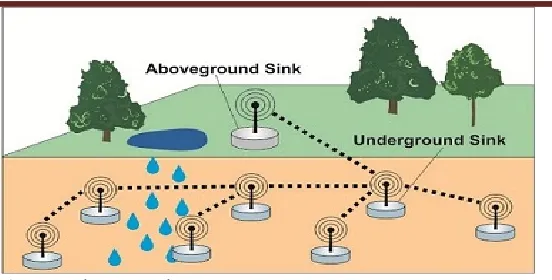
Underground WSNs: The underground wireless sensor networks are more expensive are far more costly in comparison to terrestrial WSNs as it pertains to deployment, maintenance, and equipment charge factors and careful planning. The WSNs networks include numerous warning nodes which may be concealed in the underside to check underground WSNs conditions. To change data from the sensor nodes to the base station, additional sink nodes are found above the bottom.
Multimedia WSNs: Multimedia wireless sensor networks communities have been planned allow monitoring and monitoring of functions in the shape of multimedia, such as for example imaging, movie, and audio. These communities consist of low-cost sensor nodes built with microphones and cameras.
Mobile WSNs: These techniques include an accumulation of sensor nodes that might be transferred independently and may be interacted with the bodily environment. The lightweight nodes have the capacity to compute sensation and communicate.
Fig. 2 Underground WSN
C. Methodology
General Self Organized tree based energy balance routing protocols for WSN
General Self-Organized Tree-Based Energy-Balance routing protocols (GSTEB) [2] constructs a routing tree with a means wherever, just about any rounded, Base station (BS) decides some sort of origin node plus send that alternative to each node. In that case, almost every node decides parent node through using into account simply themselves in addition to community friend's information. This can make GSTEB some sort of strong and energetic protocol. Target involving GSTEB is to enhance system time of various purposes [12]. Generally there are two meanings regarding system life span and two excessive circumstance of data fusion are seen in paper beneath issue to think about that will be called follows: Network lifetime is explained in two ways:
(a) Enough time from the start of function right till first node dies.
(b) Enough time right away of function appropriate till last node or all nodes are now useless.
The cases in data fusion are:
Case (1): The data amongst sensor nodes can be totally fused. Each node directs the exact same information regardless of quantity it receives. Case (2): The info is not fused. Every exchange node directs data which can be an item of that simple sensed data plus data obtained from their child nodes.
Operations of GSTEB: The essential procedures of GSTEB are: A. Initial Phase:
In that stage, parameters i.e. parameters usually are initialized. Initial stage may be split into some measures.
Step 1: When that stage starts, BS deliver a packet to each and every of the nodes to share with these individuals of start time, your amount of time place plus simply how much of nodes N. Viewing that the nodes get field, they could examine their particular certain energy-level (EL) [11].
Step 3: Each node hits it's packet in a radius along with a particular distance all through their time position following Stage 1. For example, in I time place, node where ID may be I’ll deliver away its packet. These packet features a launch plus the important points as an example coordinates plus EL of node I .Every additional node within this time around place often see the route, in the case many of them are buddies of node I, they'll get that packet plus history the important points of node I within storage. [12].
B. Tree Constructing Phase:
Following the routing tree is unquestionably produced, every sensor node gathers data to develop a DATA_PKT that expectations to often be passed to BS.
Step 1: BS assigns any node as root plus produce root ID plus their coordinates to every signal nodes.
Step 2: Each of them node efforts to select a parent or guardian running around in its other individuals who live regional utilizing EL.
Step 3: Considering all nodes prefers the parent by their other individuals who keep regional and each node papers friend's information every one node may only understand each of these other individuals who keep regional parent nodes by computing, and it may also identify each of these kid nodes. If node doesn't have any kid node it define itself as a leaf node, by which knowledge signal begins [14].
C. Self-Organized Data Collecting and Transmitting Phase:
Following the routing tree is obviously created; every sensor node collects information to make a DATA_PKT those expectations to frequently be found in BS [13].
D. Information Exchanging Phase:
Regarding Case1, as a result of reality every node hopes to generate along with deliver DATA_PKT generally in most circular, it'll exhaust their power and expire. That vanishing of any sensor node could simply impudence a topography .Therefore the nodes that may certainly transfer involve to tell others.
Regarding Case2 BS can certainly gather the first EL along with coordinate’s knowledge of every one sensor nodes in original Phase. For every single and every round, BS created the routing pine and need to in the machine utilizing the EL along with coordinate’s information. The moment the routing tree is made, the energy expenditure of every and every sign node through that round could possibly be used in the form of BS, therefore the info needed for processing a topology for the following round could possibly be discovered beforehand [6].
Steps Involved for Proposed work
The present research energy is planned to be achieved in many levels that need to be preceded in the manner, as explained under.
1. Literature evaluation
2. Make algorithm in MATLAB 7.10.0 (R2010a) programming.
Proposed Algorithm
For obtaining successful results, proposed a better GSTEB redirecting by using Ant Colony optimization approach:
Swarm Intelligence (SI) is the area relationship of various simple agents to achieve a global goal. SI is created on social insect metaphor for resolving several types of problems. Insects like insects, bees and termites are now living in colonies. Each insect in a cultural insect colony seemingly have their agenda. The integration of specific actions does not have any supervisor. In a cultural insect colony, a staff frequently does not accomplish all jobs, but instead specializes in a few tasks.
FANT (Forward Ants) BANT (Backward Ants)
The various steps how these brokers are driving routing data to one another are the following:
Each system node starts FANT to all or any locations at typical time intervals. Ants identify a way to area randomly predicated on new routing tables.
The FANT generates a collection, pressing in journey instances forever node as that node has reached.
When area is achieved, the BANT inherit the stack.
The BANT place the selection things and employs the trail in reverse.
When ants are along the way to find food, they begin from their home and go toward the food. When an ant reaches a junction, it's to decide which part to take next. While strolling, ants deposit pheromone, which marks the course taken. The attention of pheromone on a particular course is an indication of its usage. As time passes, the interest of pheromone decreases due to diffusion effects.
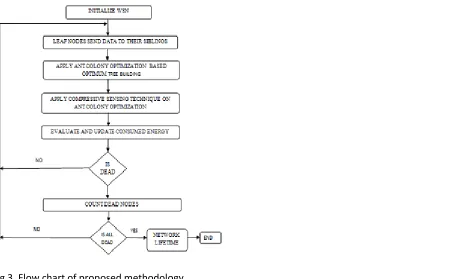
Step 1: Initialize network
Step 2: Leaf nodes send data to their siblings.
Step 3: Apply Ant colony optimization Based optimum number of trees building for GSTEB Protocol for WSNs
Step 4: Apply Compressive Sensing on Ant Apply Ant colony optimization Based optimum number of trees building for GSTEB Protocol for WSNs.
Step 5: Examine and upgrade the consumed energy.
Step 6: Always check whether all nodes become dead, if sure then display network lifetime and otherwise continue to step 3.
D. Experimental Result
On applying recommended compressive sensing based reactive GSTEB routing protocol for Ant Colony Optimization, the below success shall be achieved.
Result in Tabular and graphs
First node dead time (Stable Period Evaluation) Table1. FIRST NODE DEAD (in sec)
Node Existing With ACO With ACO& Comp.
100 1848 2027 3002
150 1879 2107 3196
200 1867 2132 3242
250 1848 2040 3251
300 1864 2127 3237
350 1833 2144 3294
400 1839 2235 3346
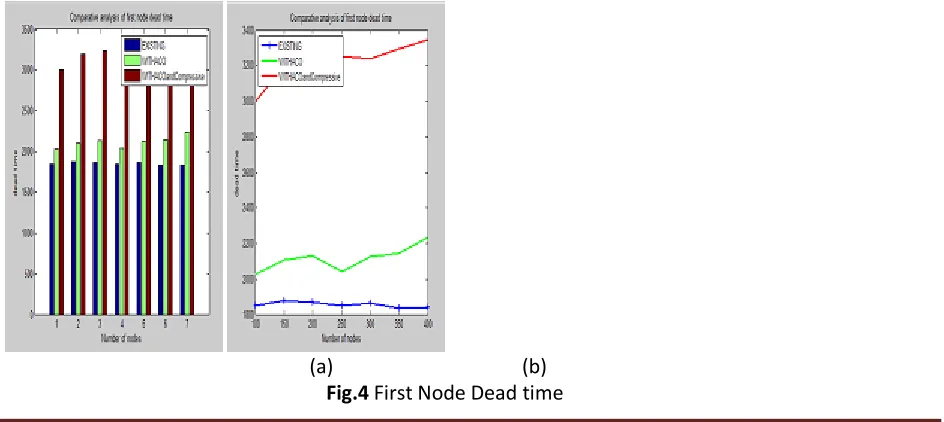
Table 1 shows the comparison among Existing GSTEB, Proposed Ant colony optimization technique to build optimum no. of trees on existing GSTEB and then apply compressive sensing on Ant colony optimization with respect to first node dead time. It clearly shows that in case of proposed GSTEB the number of rounds for first node dead is more than the existing GSTEB.
Fig 4 shows the comparison among Existing GSTEB, Proposed Ant colony optimization technique to build optimum no. of trees on existing GSTEB and then apply compressive sensing on Ant colony optimization with respect to first node dead time. Bar graph and Line graph clearly shows that the number of rounds for first node dead in the case of the proposed are more than the existing GSTEB. It is confirmed that the proposed algorithm is comparatively better than the existing techniques.
Half node dead time
Table 2 illustrates the comparison among Existing GSTEB, Proposed Ant colony optimization technique to build optimum no. Of trees on existing GSTEB and then apply compressive sensing on Ant colony optimization with respect to half node dead time. It definitely shows that the amount of rounds for half node dead in case of the planned are more compared to Existing GSTEB.
Table2. HALF NODE DEAD (in sec)
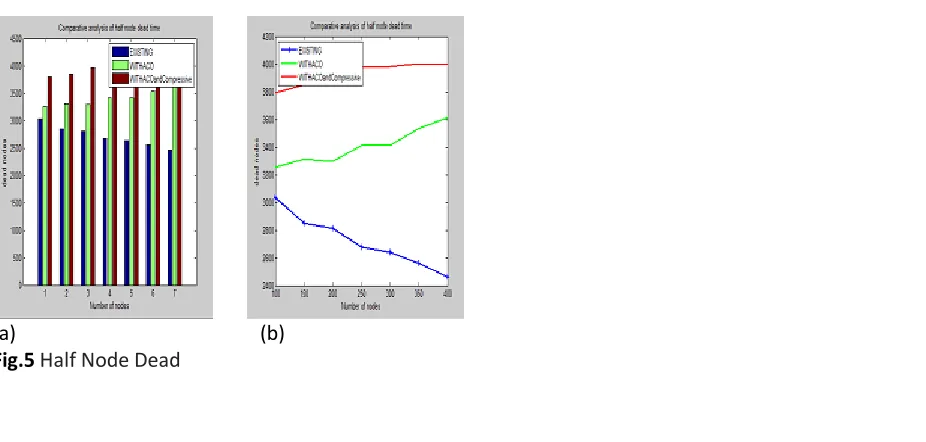
Fig 5 displays the comparison among Existing GSTEB, and Proposed Ant colony optimization technique to build optimum no. Of trees on existing GSTEB and then apply compressive sensing on Ant colony optimization with respect to half node dead time. Bar graph and Line graph clearly shows that the number of rounds for half node dead in case of the proposed are more than the Existing GSTEB. It is confirmed that the proposed algorithm is comparatively better than the existing techniques.
(a) (b) Fig.5 Half Node Dead
Node Existing With
ACO
With ACO & Comp.
100 3033 3254 3793
150 2848 3311 3851
200 2811 3297 3961
250 2677 3412 3975
300 2639 3415 3982
350 2559 3532 4001
Last node dead time i.e. Network lifetime
Table 3 shows the comparison among Existing GSTEB Proposed Ant colony optimization technique to build optimum no. Of trees on existing GSTEB and then apply compressive sensing on Ant colony optimization with respect to last node dead time. It clearly shows that the numbers of rounds for last node dead in case of the proposed are more than the Existing GSTEB.
Table3. ALL NODES DEAD (in sec)
Node Existing With
ACO
With ACO& Comp.
100 3121 3263 3958
150 3011 3675 4010
200 2935 3738 4107
250 2873 3807 4123
300 2819 3832 4141
350 2825 3740 4144
400 2807 3839 4151
Fig 10 shows the comparison among Existing GSTEB, Proposed compressive sensing based reactive GSTEB routing protocol and Proposed Ant colony optimization technique to build optimum no. Of trees on existing GSTEB and then apply compressive sensing on Ant colony optimization first node dead time with respect to last node dead time. Bar graph and Line graph clearly displays that the number of rounds for last node dead in case of the proposed are more than the Existing GSTEB. It is confirmed that the proposed algorithm is comparatively better than the existing techniques.
(a) (b)
Fig .6 Last Node Dead
Residual Energy i.e. Remaining Energy
Table 4 shows the comparison among Existing GSTEB, Proposed Ant colony optimization technique to build optimum no. of trees on existing GSTEB and then apply compressive sensing on Ant colony optimization with respect to residual Energy. It shows that in case of proposed GSTEB the number of rounds for residual energy is more than the existing GSTEB.
Fig.11 shows the comparison among Existing GSTEB, Proposed compressive sensing based reactive GSTEB routing protocol and Proposed Ant colony optimization technique to build optimum no. Of trees on existing GSTEB and then apply compressive sensing on Ant colony optimization first node dead time with respect to residual energy. Bar graph and Line graph clearly displays that the number of rounds for residual energy in the case of the proposed tend to be more compared to existing GSTEB. It's confirmed that the proposed algorithm is comparatively better than the present techniques.
(a) (b) Fig. 7 Residual Energy
Packets Sent to Base Station i.e. Throughput
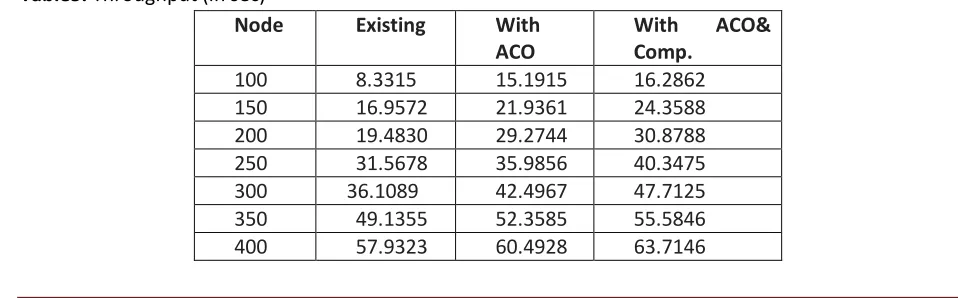
Table 5 shows the comparison among Existing GSTEB, Proposed Ant colony optimization technique to build optimum no. of trees on existing GSTEB and then apply compressive sensing on Ant colony optimization with respect to Throughput. It shows that in case of proposed GSTEB the number of rounds for throughput is more than the existing GSTEB.
Table5. Throughput (in sec)
Node Existing With
ACO
With ACO& Comp.
100 0.2549 0.3762 0.3094
200 0.2674 0.3746 0.3010
250 0.2667 0.3985 0.2998
300 0.2712 0.3826 0.3016
350 0.2661 0.2876 0.2979
400 0.2643 0.2861 0.2932
Node Existing With
ACO
With ACO& Comp.
100 8.3315 15.1915 16.2862
150 16.9572 21.9361 24.3588
200 19.4830 29.2744 30.8788
250 31.5678 35.9856 40.3475
300 36.1089 42.4967 47.7125
350 49.1355 52.3585 55.5846
Fig 12 shows the contrast among Existing GSTEB, Proposed compressive sensing based reactive GSTEB routing protocol and Proposed Ant colony optimization technique to build optimum no. Of trees on existing GSTEB and then apply compressive sensing on Ant colony optimization first node dead time with respect to throughput. Bar graph and Line graph clearly displays that the number of rounds for packets sent to Base Station in case there is the proposed are more compared to existing GSTEB. It's proved that the proposed algorithm is relatively much better than the present techniques.
(a) (b) Fig.12 Throughput
E. Conclusion
The proposed technique was made and applied in the MATLAB tool. In that report, the ant colony optimization for perfect quantity of trees developing is applied also the aftereffect of the compressive detecting has been revealed by the GSTEB routing protocol. The different metrics will also be used to evaluate the development of the proposed technique around GSTEB.
References
[1] Dilip Kumar; 2014; Performance analysis of energy efficient clustering protocols for maximizing
lifetime of wireless sensor networks; Wireless Sensor Systems IET; 4; 9-16.
[2] Dutta, Raju, Gupta Shishir, and K.Das Mukul; 2002; Power consumption and maximizing network
lifetime during communication of sensor node in WSN; Procedia Technology; 4; 158-162.
[3] Faiza Nawaz and Ahmed Bazaz Shafat; 2010; Lifetime optimization of Wireless Sensor Network
through energy efficient clustering for robust data routing; 2nd IEEE International Conference on
Computer Technology and Development (ICCTD); 235-239.
[4] Guo, Jianghong, Zhang Haifeng, and Chen Weijun; 2012; Location-based Inner-Cluster Data
Aggregation for Wireless Sensor Networks; AASRI Procedia 3; 523-527.
[5] Li, Nan, Li Shangru and Fang Xiaozhou;2010; Adaptive data aggregation mechanism based on
leach protocol; International Conference on Advanced Intelligence and Awareness Internet; pp.
131-134.
[6] Lindsey, Stephanie, and S. Raghavendra Cauligi; 2003; PEGASIS: Power-efficient gathering in
sensor information systems; Aerospace conference proceedings IEEE; Vol-3.
[7] Lu, Yao, Chen Jianping, Cosma Ioan , kuonen Pierre and Hirsbrunner Beat; 2014; Construction of Data Aggregation Tree for Multi-objectives in Wireless Sensor Networks through Jump Particle
[8] Mathapati, S. Basavaraj, Patil Siddarama, and Mytri V.D; 2012; A cluster based Energy Efficient
Reliable Routing Protocol for Wireless Sensor Networks; 1st IEEE International Conference on
Emerging Technology Trends in Electronics, Communication and Networking; pp. 1-6.
[9] Peng Ji, Li Yupeng, Jiang Jingqi, and Wang Tianbao; 2012; A Clustering Protocol for Data
Aggregation in Wireless Sensor Network; Proceedings of the IEEE International Conference on
Control Engineering and Communication Technology; 649-652.
[10] Sangolgi, B. Nagaveni, and Khaja Ahmeduddin Zakir Syed; Energy Aware Data Aggregation
Technique in WSN; International Journal of Scientific and Research Publications: 376.
[11] Seeniselvi T. Mrs and Shanmugapriya I.; 2014; Artificial Bee Colony Algorithm Based Delay
Energy Efficient Sleep Scheduling in WSN; International Journal; 3; 2.
[12] Tan, Ozgur Huseyin, and Korpeoglu Ibrahim; Power efficient data gathering and aggregation in wireless sensor networks; ACM Sigmod Record 32.4; 66-71.
[13] Younis, Ossama, Krunz Marwan, and Ramasubramanian Srinivasan; 2006; Node clustering in
wireless sensor networks recent developments and deployment challenges Network; IEEE No. 3;