STUDY OF INTOLERABLE AIR POLLENS AND HYPERSENSITIVITY
FROM SELECTED AREAS IN DELHI NCR
Ms. Shaheen Parveen Khan
1*, Dr. Yogender Singh
21. Research Scholar, Department of Pharmacy, Sunrise University, Alwar (Raj.) INDIA
2. Research Supervisor, Department of Pharmacy, Sunrise University, Alwar (Raj.) INDIA
Abstract:
People routinely exposed to the heavy traffic suffer from respiratory diseases like asthma, acute
bronchitis due to presence of bacteria, fungi, and organic dusts in the air. Life at these areas
studied became a health hazard. A survey of aerospora conducted in five selected areas of Delhi
NCR showed that bacteria and fungi were present in the order of 3x10³ and 2x10³ respectively.
21 fungal species and 7 bacterial species were present in the present study. Many filamentous
fungi known to be aeroallergens were present, Aspergillus being the predominant species.
Pathogenic bacteria like Pseudomonas, Staphylococcus were present in many areas of study. The
threshold limit value (TLV) and Biological exposure indices values should be liaised for every
area in the city which will serve as guide to control health hazards.
Keywords:
Microflora, Delhi NCR, Fusarium and Helminthosporium.Introduction:
Increase of population and developmental programmes in the world have resulted in extensive
urbanization regardless of environment considerations, leading to air pollution and climate
changes. These consequences are purely anthropogenic causing unpleasant effects on biotic
communities, the effects often extending to large air pockets even at a distance.
Pollutants include particulate and gaseous matter. Particulate matter of biological origin can be a
major cause of respiratory ailments to humans, causing allergies and pathogenic infections of the
respiratory tract. In this investigation we term these pollutants as bioallergens. Allergic
sensitization of the intrathorasic airways (asthma) or lung parenchyma (hypersensitive
pneumonitic) may be a major health problem and this is of concern in the long term for exposure
to inhaled bioallergens.
Extrinsic allergic alveolitis is a serious hypersensitive response usually associated with repeated
exposure to spores of thermophilic actinomycetes. Aspergillosis and Histoplasmosis are serious
fungal infections of humans, initiated by spores deposited in the alveoli, they can be life
threatening diseases in immune compromised people, when the fungi disseminate from the lungs
to major organs of the body.
Air sampling is used routinely in developed countries to monitor the population of air
particulates, and to inform the public through broadcasting. It is used by the major hospitals to
monitor the population of specific allergenic particles like fungal spores so that the causes of
patient’s allergies can be determined.
The recognition of existing and potential dust or allergen hazards is the first step towards
improving health and safety of people exposed. Health hazard evaluation requires the collection
of quantitative and qualitative data on the bioallergens present in the environment. Delhi NCR is
fast developing urban area which has seen steady growth of industries resulting in pollutants of
all kinds. Heavy traffic and air pollution has increased several folds adversely affecting the
health of people living in and around Delhi. A study has therefore been undertaken to 1)
Quantify the microbial population in the air in some selected areas of the city and 2) identify the
potent bioallergens which cause various types of allergies.
International Journal of
Research
e-ISSN: 2348-6848 p-ISSN: 2348-795X Volume 6Issue06
May 2019
Air quality in the capital region will deteriorate sharply in the next two days because of a significant rise in emissions from field fires from Punjab, low surface wind and atmospheric conditions that trap pollutants, the official pollution monitoring agency of the government has warned.
Farmers in Punjab have stepped up burning of crop reside after the harvest to prepare their fields for the next round of planting. This has a direct bearing on the air quality particularly when surface.
According to the 2011 census of India, the population of NCT of Delhi is 16,753,235. The
corresponding population density was 11,297 persons per km2 with a sex ratio of 866 women per
1000 men, and a literacy rate of 86.34%. In 2004, the birth rate, death rate and infant mortality
rate per 1000 population were 20.03, 5.59 and 13.08, respectively. In 2001, the population of
Delhi increased by 285,000 as a result of migration and by 215,000 as a result of natural
population growth, which made Delhi one of the fastest growing cities in the world. Dwarka Sub
City, Asia's largest planned residential area, is located within the National Capital Territory of
Delhi. Urban expansion has resulted in Delhi's urban area now being considered as extending
beyond the NCT boundaries to incorporate the towns and cities of neighbouring states including
Gurgaon and Faridabad of Haryana, and Ghaziabad and Noida of Uttar Pradesh, the total
population of which is estimated by the United Nations at over 26 million. According to the UN
this makes Delhi urban area the world's second-largest, after Tokyo, although Demographia
declares the Jakarta urban area to be the second-largest. The 2011 census provided two figures
for urban area population: 16,314,838 within the NCT boundary and 21,753,486 for the
Extended Urban Area.The 2021 regional plan released by the Government of India renamed the
Extended Urban Area from Delhi Metropolitan Area (DMA) as defined by the 2001 plan to
Central National Capital Region (CNCR)
Experimental
International Journal of
Research
e-ISSN: 2348-6848 p-ISSN: 2348-795X Volume 6Issue06
May 2019
Sample sites
Five randomly selected areas in Delhi NCR representing different environmental conditions were
chosen in the present study.
1. ITDC Bus station. 2. Cannaught Place 3. Rajiv Chowk 4. Old Delhi Railway Station 5.
Gurgaon-Delhi NH
Isolation and identification of Micr oflora:
For isolating fungi present in the air, Petri dishes containing Rose Bengal Agar with
chloramphenicol were exposed for a period of 30 minutes. The exposed plates were incubated
for 5 days in an incubator at 26° . The fungi developed after seven days were observed under a
compound microscope after staining with cotton blue. The cultural and morphological
characteristics of fungi were identified by the use of pictorial atlas of soil and seed fungi.
For isolating bacteria nutrient agar plates were exposed to air for 30 minutes and incubated at
37° . Bacterial isolates were identified based on the morphological characters like colony
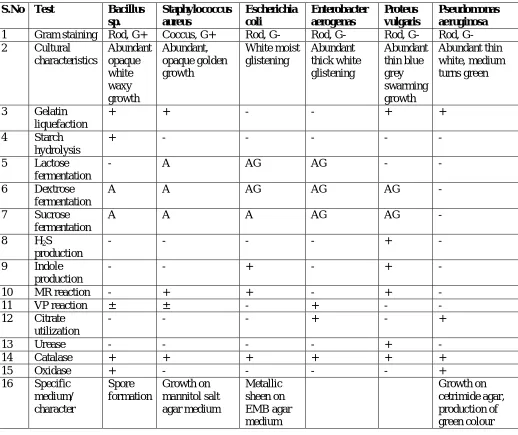
colour, texture, followed by biochemical tests performed according to standard protocols (Table
1).
Results and Discus sion:
Occurrence of Microflora
Various test sites showed the presence of bacterial and fungal contaminants as given in the table
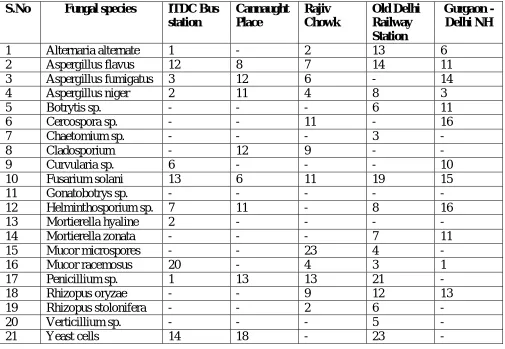
2 and 3. A total of 21 fungal and 7 bacterial species were isolated from the sampling stations.
The air borne particulate matter collected from all the 5 areas in the present study viz. 1. ITDC
Bus station. 2. Cannaught Place 3. Rajiv Chowk 4. Old Delhi Railway Station 5. Gurgaon-Delhi
NH showed abundant bacterial and fungal propagates. Bacterial population was more in the air
in all the samples compared to the fungal population. While the bacterial population ranged from
2x10³ to 3x10³ cfu, fungal population ranged from 3x10² to 1x10³ cfu (Table 4).
Respiratory diseases were noticed in the workers of factories exposed to pseudomonas and
Bacillus subtilis. In the present study these two genera are present in all the sampling sites posing
a potential risk of respiratory allergies (table3). Filamentous fungi represent a major hazard for
people exposed to organic dusts. The β-D glucans, the basic polyglucose constituents of fungal
cell wall occurring in the air in the concentration of 10-2 to 102 ng/m3 can cause chronic lung
inflammation and evoke disease. In the present study many fungal species were observed in the
air which exerts adverse effects on the respiratory tract of exposed people. Among them the most
important are Aspergillus flavus, Mucor recemosus dominant in ITDC area. As this species is
known to be potential aeroallergen it could well be a health hazard of all people travelling
regularly from this bus station (Table 2), Bacillus subtilis, in the Cannaught Place and
Escherichia coli in the Rajiv Chowk area. (Table 3) also causes severe health hazard to the
people residing around.
According to Lacey and Dutkiewiez Rhizopus is known to cause organic dust toxic syndrome
(ODTS). In the present study spores of Rhizopus are abundantly found market and old Delhi
Railway station areas. (Table 3).
Bacillus subtilis and Proteus was predominant microflora in the Delhi Gurugram NH. The
presence of pathogenic bacteria like Staphylococcus, Streptococcus and Pseudomonas is
dangerous and preventive hygiene and safety measures for eradication of these bacterial strains
should be the first priority.
The bacterial population was highest in the air samples collected from ISBT area. This can be
explained by the presence in the vicinity of sampling area a slum improper sanitary conditions
and garages for the mechanical workshops. Further the presence of waste oil and dusty roads are
conducive for bacterial growth. E.Coli was predominant in this area. (Table 3). The presence of
E.Coli warrants the need to take safety measures. In this context hygiene living conditions like
cleaning of drains and spraying of antibacterial chemicals have to be implemented.
The fungal population in this area comprises plant pathogens like Fusarium and
Helminthosporium.
International Journal of
Research
e-ISSN: 2348-6848 p-ISSN: 2348-795X Volume 6Issue06
May 2019
Rajiv chowk and Cannuaght place are the two important areas of Delhi NCR with a dense
vehicular traffic releasing noxious gases like CO, CO2, SO2 and NO2 into the air. Such vehicular
traffic conditions, the bacterial and fungal spores seem to range around 102 to 103 cpu/m3 as
compared to 106-109 cpu/m3 in the farming atmosphere. This range is not an alarming figure and
hence not a serious health hazard. However, the present project covered only duration of 3
months (December to March). Studies throughout the year covering different seasons may
indicate significant differences in the levels of aerospora in different areas of Delhi NCR. Results
of this investigation were compared with the allowed standards of developed countries.
Establishing of occupational exposure limit:
The American conference of government industrial hygienists (ACGIH) publishes a book
containing TLV (Threshold limit value) and BEI (Biological exposure indices). These values
listed are used by hygienists as guidelines to assists in the control of work place hazards.
The knowledge about health risks due to mold exposure is not widespread and health authorities
in developing countries may not be aware of the potentially serious reactions that the exposure
can evoke.
To the best of our knowledge so far the occupational exposure limit (OEL) or threshold limit
values (TLV) for aerospora have not been elaborated and introduced as legislations anywhere in
our country. The necessity of such values is unquestionable.
Conclusions:
1. The recognition of potential bioallergen hazard is the first step towards protecting against
dust exposure.
2. Health hazard evaluation requires the collection of qualitative and quantitative data.
3. Time studies across different seasons of the year would indicate the levels of dust people
are being exposed to in different parts of the city.
4. The threshold limit value (TLV) and biological exposure indices (BEI) values should be
liaised for every area in Delhi NCR which could be used as guide line to control health
hazards.
5. Occupational exposure limit (OEL), levels of particulate matter should be determined and
proper legislation made to ameliorate the hazards of dust pollution.
Table 1: Identification of bacteria S.No Test Bacillus
sp. Staphylococcus aureus Escherichia coli Enterobacter aerogenas Proteus vulgaris Pseudomonas aeruginosa
1 Gram staining Rod, G+ Coccus, G+ Rod, G- Rod, G- Rod, G- Rod, G-
2 Cultural
characteristics Abundant opaque white waxy growth Abundant, opaque golden growth White moist glistening Abundant thick white glistening Abundant thin blue grey swarming growth Abundant thin white, medium turns green
3 Gelatin
liquefaction
+ + - - + +
4 Starch
hydrolysis
+ - - - - -
5 Lactose
fermentation
- A AG AG - -
6 Dextrose
fermentation
A A AG AG AG -
7 Sucrose
fermentation
A A A AG AG -
8 H2S
production
- - - - + -
9 Indole
production
- - + - + -
10 MR reaction - + + - + -
11 VP reaction ± ± - + - -
12 Citrate
utilization
- - - + - +
13 Urease - - - - + -
14 Catalase + + + + + +
15 Oxidase + - - - - +
16 Specific
medium/ character Spore formation Growth on mannitol salt agar medium Metallic sheen on EMB agar medium Growth on cetrimide agar, production of green colour
International Journal of
Research
e-ISSN: 2348-6848 p-ISSN: 2348-795X Volume 6Issue06
May 2019
Table 2: Percentage of different fungal species at sampling stations:
S.No Fungal species ITDC Bus station Cannaught Place Rajiv Chowk Old Delhi Railway Station Gurgaon -Delhi NH
1 Alternaria alternate 1 - 2 13 6
2 Aspergillus flavus 12 8 7 14 11
3 Aspergillus fumigatus 3 12 6 - 14
4 Aspergillus niger 2 11 4 8 3
5 Botrytis sp. - - - 6 11
6 Cercospora sp. - - 11 - 16
7 Chaetomium sp. - - - 3 -
8 Cladosporium - 12 9 - -
9 Curvularia sp. 6 - - - 10
10 Fusarium solani 13 6 11 19 15
11 Gonatobotrys sp. - - - - -
12 Helminthosporium sp. 7 11 - 8 16
13 Mortierella hyaline 2 - - - -
14 Mortierella zonata - - - 7 11
15 Mucor microspores - - 23 4 -
16 Mucor racemosus 20 - 4 3 1
17 Penicillium sp. 1 13 13 21 -
18 Rhizopus oryzae - - 9 12 13
19 Rhizopus stolonifera - - 2 6 -
20 Verticillium sp. - - - 5 -
21 Yeast cells 14 18 - 23 -
Table 3: Percentage of different bacterial species at sampling stations:
S.No Bacterial species ITDC Bus station Cannaught Place Rajiv Chowk Old Delhi Railway Station Gurgaon -Delhi NH
1 Bacillus subtilis 18 16 21 46 22
2 Escherichia coli 13 11 09 11 40
3 Proteus vulgaris - 16 14 19 10
4 Pseudomonas sp. 29 21 13 13 10
5 Staphylococcus
aureus
5 12 10 15 11
6 Enterobacter
aerogenes
- 16 11 18 7
7 Enterobacter
aerogenes
2 - - 2 -
Table 4: Bacterial and Fungal Colony Forming Units (CFU) in the air of Delhi NCR
S.No. Sampling area Bacterial Fungi
1 ITDC Bus station 2.1x10³ 1.1x10³
2 Cannaught Place 2.4x10³ 1.2x10³
3 Rajiv Chowk 2x10³ 1.4x10³
4 Old Delhi Railway Station 2x10³ 2.5x10²
5 Gurgaon-Delhi NH 3x10³ 3.4x10²
References:
1. J. Dutkiewicz, Bacteria and Fungi in organic dust as potential health hazard, Ann. Agric.
Environ. Med, 4, 11-16, (1997).
2. J. Lacey and J. Dutkiewicz., Bioaerosols and occupational lung disease, J. Aerosol
Science 25, 1371-1404, (1994).
3. Pictorial Atlas of soil and seed fungi. Morphologies of cultured Fungi and key to species,
edited by Watnabe, T., 2nd edition, CRC Press, London (2012).
4. Bergey’s Manual of Determinative bacteriology, edited by J.G. Holt, 9th Edition,
Williams & Wilkins, Baltimore. (2004).
5. R. Rylandre, K. Pearson, H. Goto, K. Yuasa, and S. Tanaka, Air born beta- 1,3- glucan
may be related to symptoms in sick buildings, Indoor Environ, 1, 263-267. (1999).
6. W.G. Sorenson, Health impact of mycotoxins in the home and the work place: An
overview, cited in Biodeterioration Research, edited by C E O Rear and G C Ilewellyn,
Plenum Press, New York, pp: 201-205 (1998).
7. A. Sheela Veronica, Bioallergenes in the air of selected areas of India Environmental
Studies, GITAM (2011).
8. B. Crook and J. Lacey, Enumeration of air borne microorganisms in work environments,
cited in Indoor and ambient air quality, edited by R. Perry and P W Kirk, Selper Ltd.,
London, pp: 447-452, (2008).
International Journal of
Research
e-ISSN: 2348-6848 p-ISSN: 2348-795X Volume 6Issue06
May 2019