Comparative Study on Secure Multipath Routing
Vin it Patel1 Saumya Lahe ra2, Dwij Bhatt3, Jigar Patel4
B.E.Student, Dept. of Co mputer Engineering, M CT’s RGIT, Mu mba i,India 1
B.E.Student, Dept. of Co mputer Engineering,SAKEC, Mu mbai,India 2, 3, 4
ABSTRACT: Multipath routing is a technique that allows for computer network communications to be sent over mu ltip le alternate paths. This is in contrast to a single routing protocol, where a data stream is directed along a single path from a source to a destination. With multip le paths, the source and destination pair can use any number of alternate routes to achieve performance enhancements, connection stability, and potential security improve ments. Multipath routing is a promising technique to increase the Internet ’s reliability and to give users greater control over the service they receive. There a re three e le ments to a mu ltipath routing name ly -path discovery, traffic distribution, and path ma intenance. Path discovery means finding different availab le paths from source to destination using pre-defined criteria. In Tra ffic distribution a multipath protocol may decide to forward data using only the path with is the best and keep other discovered paths as backups. Or the paths may be used concurrently. Path maintenan ce specifies when and how new paths are acquired if the states of currently available paths change. The main goal is to discover multip le source to destination paths with a lo w routing overhead during a route discovery. It is typically proposed in order t o increase the reliab ility of data transmission.
KEYWORDS: Path Discovery , Traffic Distribution , Path Maintenance.
I. INTRODUCTION
Multipath routing, sometimes called traffic d ispersion , has been one of the most important current directions in the area of routing. The current routing is based on the single path routing - between a source and a destination, the single minimu m-cost path tends to be selected although different cost metrics may yie ld different paths. However, in a reasonably well-connected network, there may e xist several paths between a source -destination pair. The concept of mu ltipath routing is to give the source node a choice at any given time of mu ltip le paths to a partic ular destination by taking advantage of the connectivity redundancy of the underlying network. The mu ltip le paths may be used alternately, name ly, traffic taking one path at a time , or they may be used concurrently, namely, traffic flowing through mu ltip le paths simultaneously.
Multipath routing was first proposed by Maxe mchuk to spread the traffic fro m a source in space rather than in time as a means for load balancing and fault handling in packet switching networks. The method was shown to equalize load and increase overall network utilization; with redundancy, it imp roves the delay and packet loss properties at the e xpense of sending more data through the network. Since then, the multipath routing technique has been applied to various types of networks, s uch as the communicat ion networks, B-ISDN, ATM networks, etc.,
II. EL EMENTS OF A MULTIPATH ROUTING PROTOCOL
Three ele ments of mult ipath routing include path discovery, traffic distribution, and path ma intenance which are e xpla ined below.
2.1. Path Discovery:
Since data transmission in wire less sensor networks is commonly perfo rmed through mult i-hop data forwa rding techniques, the main task of the route discovery process is to determine a set of intermediate nodes that should be selected to construct several paths from the source nodes towards the sink node . If the node has already received the request it drops the packet. If the node itself the target node then the route discovery is over and the node returns the path to the sender. If not then the node appends its own address to the list of traversed nodes and broadcast this updated request.
A. Disjoint Multipath Routing
In sensor-disjoint path routing, the primary path is availab le whereas the alternate paths are less desirable as they have longer latency. The disjoint makes those alternate paths independent of the prima ry path. Thus, if a fa ilu re occurs on the primary path, it re ma ins local and does not affect any of those alternate paths .
B. Braided Multipath Routing
To construct the braided multipath, first the primary path is computed. Then, for each node on the prima ry path, the best path is computed while it does not include that node. Those best alternate paths are not necessarily disjoint fro m the prima ry path and are called idealized bra ided multi-paths.
2.2 Traffic Distribution:
In spite of path discovery of multip le paths issue, another important issue that is discussed here is traffic distribution Multipath routing algorithms that optima lly split traffic into a given set of paths investigated in the context of flow control .It is worth noting that the selection of the routing paths is another majo r design consideration that has a drastic effect on the resulting performance .
A. Number of Paths
A protocol can use a single path and keep the rest as backups, or it can utilize mult iple paths in a round-robin fashion, with only one path sending at a time . A protocol can choose to use a single path and keep the rest as backups, or it can utilise mu ltip le paths in a round-robin fashion, with only one path sending at a time. If multip le paths are used concurrently to carry traffic, the protocol needs to decide how traffic is split over the paths and how to handle out-of-order packets at the destination.
B. Allocation Granularity
The traffic a llocation strategy that is used deals with ho w the data is distributed amongst the paths. The choice of allocation granularity, which is important in traffic a llocation, specifies the smallest unit of informat ion allocated to each path . Some possible choices of traffic granula rity include, in order of increased control overhead, per source-destination pair, per flow, per packet, per segment.With a fine granula rity, load balancing can be more e fficient.
2.3 Path Maintenance:
before new routes are available . It should be noted that initiating the process of route discovery can ma ke high overheads whenever one of the routes fails. When the route maintenance indicates that the source route is broken ,source can attempt to use any other route it happens to know to the destination ,or can invoke route discovery again to find the new route,
III B ENEFITS OF MULTIPATH ROUTING
3.1 Fault tolerance:
In the a fault tolerance system the system continue to operate properly in the event of the failure of some of its components.The original idea behind using multipath routing approach in WSN was to provide path and reliab le data transmission from source to destination.
3.2 Load Balancing:
As traffic d istribution is not equal in a ll links in the network, spreading the traffic a long mu ltip le routes can
allev iate congestion in some lin ks and bottlenecks .When a lin k beco mes over-utilised and causes congestion, multipath routing protocols can choose to divert traffic through alternate paths to ease the burden of the congested link.
3.3 QoS Improvement:
QoS support in terms of network throughput, end -to-end latency and data delivery ratio is an important objective in designing multipath routing protocols for different types of network.
3.4 Reduced Delay:
The delay is min imized in mu lt ipath routing because backup routes are identified during route discovery.For wireless networks employing single path on-demand routing protocols, a route failure means that a new path discovery process needs to be initiated to find a new route.
This results in a route discovery delay. The delay is min imised in mu ltipath routing because backup routes are identified during route discovery.
3.5 Bandwidth aggregation:
By splitting data to the same destination into multip le streams, each routed through a different path, the effective bandwidth can be aggregated. This strategy is particular beneficia l when a node has multip le low bandwidth lin ks but requires a bandwidth greater than an individual link can provide. End -to-end delay may a lso be reduced as a direct result of larger bandwidth.
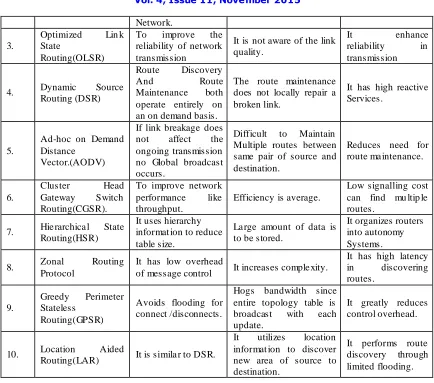
IV COMPARATIVE S TUDY
SR
NO. ALGORITHM ADVANTA GES DISA DVA NTA GES CONCLUSION
1.
Destination
Sequence Distance Vector(DSDV)
The Protocol
converge quickly via triggered updates.
Most Routing
Information is not Used.
With the use of sequence number it is loop free a ll the time
2. Fisheye State
Routing.(FSR)
To Reduce routing updates in Ad hoc
Route Table size Still Grows linearly.
TABLE (4. 1) COM PARISON OF DIFFERENT A LGORITMS
V.CONCLUS ION
DSDV, OSR and FSR type of protocol finds a route on demand by flooding the network with Route Request packets. The main disadvantage of these algorithms is that it has a high latency time in route finding and Excessive flooding can lead to network clogging.
DSR and AODV type of protocol co mbines the advantages of proactive and reactive routing. The routing is initia lly established with some proactively prospected routes and then serves the demand from additionally activated nodes through reactive flooding. The choice o f one or the other method requires predetermination for typical cases. The ma in d isadvantages of such algorith ms it depends on number of other nodes activated .Reaction to traffic de mand depends on gradient of traffic volu me. In AOA V Significant reduction in control overhead as compared to DSDV.
Hie rarchica l type wh ich includes CGSR HSR and ZRP type of protocol the choice of proactive and of reactive routing depends on the hierarchic level in which a node resides. The routing is initially established with some proactively prospected routes and then serves the demand fro m additionally activated nodes through reactive flooding on the lower levels. The choice for one or the other method requires proper attribution for respective levels .The ma in disadvantages of such algorithms are that it depends on depth of nesting and addressing scheme. Reaction to traffic
Network.
3.
Optimized Lin k
State
Routing(OLSR)
To improve the
reliability of network transmission
It is not aware of the link quality.
It enhance
reliability in
transmission
4. Dynamic Source
Routing (DSR)
Route Discovery
And Route
Maintenance both
operate entirely on an on demand basis.
The route maintenance does not locally repair a broken link.
It has high reactive Services.
5.
Ad-hoc on Demand Distance
Vector.(AODV)
If link breakage does
not affect the
ongoing transmission no Global broadcast occurs.
Difficult to Maintain
Multiple routes between same pair of source and destination.
Reduces need for route ma intenance.
6.
Cluster Head
Gateway Switch
Routing(CGSR).
To improve network
performance like
throughput.
Efficiency is average.
Low signalling cost can find mu ltip le routes.
7. Hie rarchica l State
Routing(HSR)
It uses hierarchy informat ion to reduce table size.
La rge amount of data is to be stored.
It organizes routers into autonomy Systems.
8. Zonal Routing
Protocol
It has low overhead
of message control It increases comple xity.
It has high latency
in discovering
routes.
9.
Greedy Perimeter
Stateless Routing(GPSR)
Avoids flooding for connect /disconnects.
Hogs bandwidth since entire topology table is
broadcast with each
update.
It greatly reduces control overhead.
10. Location Aided
Routing(LAR) It is simila r to DSR.
It utilizes location
informat ion to discover new area of source to destination.
It performs route
discovery through
demand depends on meshing parameters.ZRP performs better than any single proactive or reactive protocol. No clear consensus on which of the two produces better clustering.
REFERENCES
[1] X. Lin and N. B. Shro_, \The Multi-path Utility Maximization Problem," in 41st AnnualAllerton Conference on Communication, Control, and
Computing, Monticello, IL, October 2003.
[2] F. P. Kelly, A. Maulloo, and D. Tan, \Rate Control in Communication Networks: ShadowPrices, Proportional Fairness and Stability," Journal of the Operational Research Society, vol. 49, pp. 237{252, 1998.
[3] K. Kar, S. Sarkar, and L. T assiulas, \Optimization Based Rate Control for Multipath Sessions," T echnical Report No. 2001 -1, Institute for Systems Research, University of Maryland, 2001.
[4] W.H. Wang, M. Palaniswami, and S. H. Low, \Optimal Flow Control and Routing in Multi-Path Networks," Performance Evaluation, vol. 52, no. 2-3, pp. 119{132, April 2003.
[5] H. Han, S. Shakkottai, C.V. Hollot, R. Srikant, and D. Towsley, \Overlay T CP for Multi- Path Routing and Congestion Control," Presented at the ENS-INRIA ARC-TCP Workshop,
Paris, France, Nov. 2003 and at the IMA Workshop on Measurements and Modeling of the Internet, January 2004, avilalable at http://tesla.csl.uiuc.edu/_srikant/pub.html.
[6] G. Apostolopoulos, R. Guerin, S. Kamat, and S. K. T ripathi, \Quality of Service BasedRouting: A Performance Perspective," in Proceedings of ACM SIGCOMM, Vancouver,Canada, September 1998, pp. 17{28.
[7] Q. Ma and P. Steenkiste, \On Path Selection for Tra_c with Bandwidth Guarantees," in IEEE ICNP, 1997.
[8] A. Shaikh, J. Rexford, and K. Shin, \Evaluating the Impact of Stale Link State on Qualityof-Service Routing," IEEE/ACM Transactions on Networking, vol. 9, no. 2, pp. 162{176,April 2001.
[9] P. B. Key, \Optimal Control and Trunk Reservation in Loss Networks," Probability in theEngineering and Informational Sciences, vol. 4, pp. 203{242, 1990).
[10] X. Lin and N. B. Shro_, \An Optimization Based Approach for Quality of Service Routing in High-Bandwidth Networks," in Proceedings of