University of South Carolina
Scholar Commons
Theses and Dissertations
2015
An Investigation of a Culturally Responsive
Approach to Science Education in a Summer
Program for Marginalized Youth
Brittany A. Garvin
University of South Carolina - Columbia
Follow this and additional works at:https://scholarcommons.sc.edu/etd Part of theScholarship of Teaching and Learning Commons
This Open Access Dissertation is brought to you by Scholar Commons. It has been accepted for inclusion in Theses and Dissertations by an authorized administrator of Scholar Commons. For more information, please [email protected].
Recommended Citation
A
NI
NVESTIGATION OF AC
ULTURALLYR
ESPONSIVEA
PPROACH TOS
CIENCEE
DUCATION IN AS
UMMERP
ROGRAM FORM
ARGINALIZEDY
OUTHby
Brittany A. Garvin
Bachelor of Science
University of South Carolina, 2007
Submitted in Partial Fulfillment of the Requirements
For the Degree of Doctor of Philosophy in
Teaching and Learning
College of Education
University of South Carolina
2015
Accepted by:
Tambra O. Jackson, Major Professor
Stephen Thompson, Major Professor
Christine Lotter, Committee Member
Bryan Brown, Committee Member
D
EDICATIONTo my Grandmother, Heddie, my Mother, Betty and my Sister, Lenora.
A
CKNOWLEDGEMENTSMy Grandmother often reminds me to hold to God’s unchanging hand. I give all glory,
honor, and praise to God, my Heavenly Father who began a good work in me and was
faithful to carry it on to completion.
Many wonderful people and experiences have made this dissertation possible. To my
advisor, Dr. Tambra Jackson, thank you for your guidance, support, and tough love
during this process; but most importantly, thank you for your unwavering faith in me.
Many thanks to my committee members – Dr. Stephen Thompson, Dr. Christine Lotter,
and Dr. Bryan Brown for their patience with my growth as a scholar and researcher; but
most importantly for challenging me to think about my research in new and complex
ways.
To my TRIO Family, thank you for embracing me and showing me the way. You all
have taught me so much about the classroom as you welcomed me back summer after
summer to teach science and constantly reminded me that every child deserves access to
and opportunities in STEM education. To my Upward Bound students, thank you for
teaching me how to be a better science teacher and for your passion, questions, and
eagerness to learn and discover – keep moving (and at times, pushing) forward!
To my family and friends who have always been an inspiration for me to excel beyond
what I could ever imagine, I am forever grateful for your love, faith and hope in me.
A
BSTRACTThe demographics of today’s schools are becoming more and more ethnically and
linguistically diverse, as culturally diverse students comprise approximately one third of
school populations (Ladson-Billings, 2005). However, the educational experiences of
students of Color demonstrate a history of marginalization and inequity (Williamson et
al., 2007) as far too many students of Color have maintained poor educational
achievement outcomes. The effects of such disproportionally high levels of low
academic achievement are extensive and can be witnessed across subject content areas,
particularly in math, science, and literacy. To improve the academic performance of
students who are culturally, racially, ethnically, and linguistically diverse, improved
methods of instruction and pedagogy that better facilitate learning among diverse student
populations must be instituted (Ladson-Billings, 2005). Thus the need to provide
summer science enrichment programs where students engage in scientific
experimentation, investigation, and critical thinking are vital to helping students who
have been traditionally marginalized achieve success in school science and enter the
science career pipeline.
This mixed methods study examined the impact of a culturally responsive
approach on student attitudes, interests in science education and STEM careers, and basic
science content knowledge before and after participation in a science course within the
responsive approach to teach science in an informal learning space significantly increases
student achievement. Students receiving culturally responsive science instruction
exhibited statistically significant increases in their posttest science scores compared to
pretest science scores. Likewise, students receiving culturally responsive science
instruction had a significantly higher interest in science and STEM careers.
The qualitative data obtained in this study sought to gain a more in-depth
understanding of the impact of a culturally responsive approach on students’ attitudes,
interests in science, and STEM careers. Findings suggest providing students the
opportunity to “do” and learn science utilizing a culturally responsive approach was
much more beneficial to their overall science knowledge, as it allowed students to
experience, understand, and connect to and through their science learning. Likewise,
culturally responsive science instruction helped students to foster a more positive interest
in science and STEM careers as it provided students the opportunity to do science in a
meaningful and relevant way. Moreover, results revealed students receiving culturally
responsive science instruction were able to see themselves represented in the curriculum
and recognized their own strengths; as a result they were more validated and affirmed in
T
ABLE OFC
ONTENTSDEDICATION ... iii
ACKNOWLEDGEMENTS ... iv
ABSTRACT ...v
LIST OF TABLES ...x
LIST OF FIGURES ... xii
CHAPTER 1: INTRODUCTION ...1
PROBLEM STATEMENT ...5
PURPOSE OF THE STUDY ...16
SIGNIFICANCE...18
OPERATIONAL DEFINITIONS ...19
CONCLUSION ...21
CHAPTER 2: REVIEW OF RELATED LITERATURE ...22
THEORETICAL FRAMEWORK ...42
CONCLUSION ...64
CHAPTER 3: METHODOLOGY ...65
METHODOLOGICAL APPROACH ...65
PILOT STUDY ...68
RESEARCH CONTEXT AND PARTICIPANTS ...72
RESEARCHER ROLE ...86
ASSUMPTIONS OF THE STUDY ...88
STUDY LIMITATIONS ...89
CHAPTER 4: CURRICULUM ...90
A HISTORY OF THE FEDERAL TRIO PROGRAMS...91
LOCAL SITE SIGNIFICANCE ...93
CULTURALLY RESPONSIVE SCIENCE CURRICULUM...94
CHAPTER 5: RESULTS ...106
RESEARCH QUESTION 1 ...106
RESEARCH QUESTION 2 ...119
RESEARCH QUESTION 3 ...128
OTHER RELEVANT FINDINGS ...130
CHAPTER 6: DISCUSSION OF RESULTS AND IMPLICATIONS ...138
IMPLICATIONS OF A CULTURALLY RESPONSIVE APPROACH ON STUDENT ATTITUDES ...138
IMPLICATIONS OF A CULTURALLY RESPONSIVE APPROACH ON STUDENT INTERESTS ...143
IMPLICATIONS OF A CULTURALLY RESPONSIVE APPROACH ON STUDENT CONTENT KNOWLEDGE ...147
OTHER RELEVANT FINDINGS ...148
IMPLICATIONS FOR PRACTICE AND RESEARCH ...152
FUTURE RESEARCH ...154
CONCLUSION ...155
APPENDIX A– INVITATION TO PARTICIPATE AND ASSENT FORM ...174
APPENDIX B–CULTURALLY RESPONSIVE SCIENCE ASSESSMENT ...177
APPENDIX C– SCIENCE CONTENT ASSESSMENT ...181
APPENDIX D– FOCUS GROUP INTERVIEW PROTOCOLS ...186
L
IST OFT
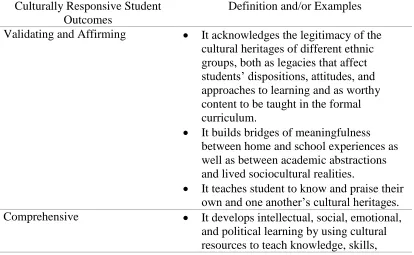
ABLESTable 2.1 Culturally Responsive Teaching Student Outcomes and Definitions ...53
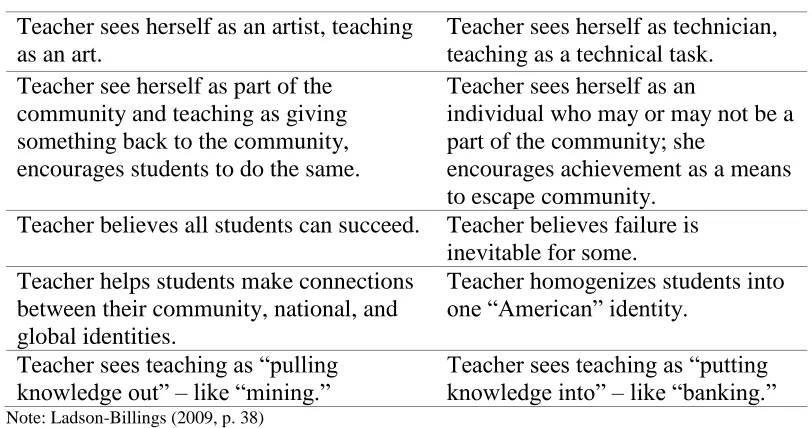
Table 2.2 Conceptions of Self and Others ...58
Table 2.3 Social Relations ...59
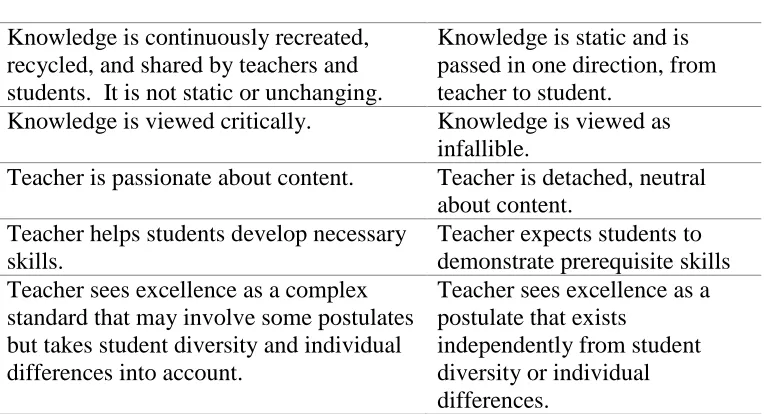
Table 2.4 Conceptions of Knowledge ...60
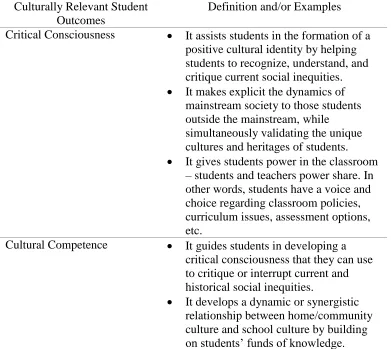
Table 2.5 Culturally Relevant Teaching Student Outcomes and Definitions ...62
Table 3.1 Participant Demographics for Experimental and Comparison Group ...75
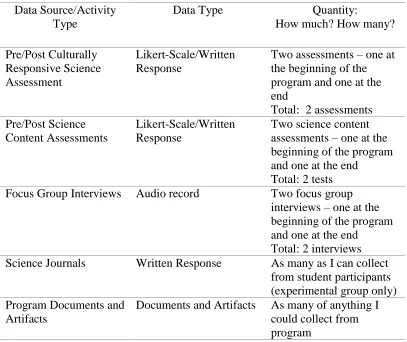
Table 3.2 Summary of Data Set ...82
Table 3.3 Grouped Culturally Responsive/Relevant Student Outcome Measures ...85
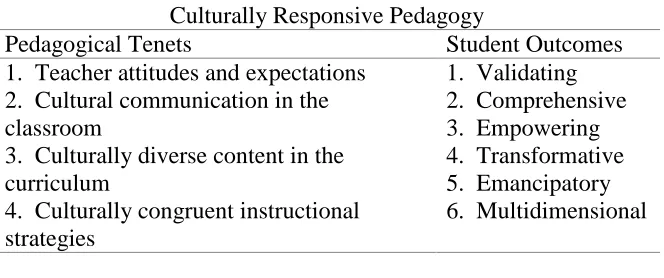
Table 4.1 Culturally Responsive and Culturally Relevant Pedagogical Tenets and Student Outcomes ...95
Table 4.2 Characteristics and Outcomes of Culturally Responsive Science in the Summer Curriculum...103
Table 5.1 Descriptive Statistics for Experimental and Comparison Groups: Attitude toward Science ...107
Table 5.2 Meaningful Summer Science Learning Experiences ...110
Table 5.3 Descriptive Statistics for Experimental and Comparison Groups: Interest in Science ...120
Table 5.4 Descriptive Statistics for Experimental and Comparison Groups: Interest in STEM careers ...120
Table 5.5 Descriptive Statistics for Pre-test and Posttest: Science Content Knowledge .129
Table 5.7 One-Way Repeated Measures ANOVA (Wilks’ Lambda) Results for
L
IST OFF
IGURESFigure 3.1 AAAS Assessment Items by Science Discipline and Science Topic(s) ...79
Figure 3.2 Triangulation of Data Sources ...83
Figure 4.1 Curricular Components of the Culturally Responsive Science Curriculum ..102
CHAPTER
1
I
NTRODUCTIONWhether or not you reach your goals in life depends entirely on how well you prepare for them and how badly you want them. You’re eagles! Stretch your wings and fly to the sky.
(Dr. Ronald McNair)
I am a product of opportunity and did not get this far without the prayers, help,
love, support, encouragement, inspiration, and sacrifice of others. Individuals from all
walks of life, in church, institutions and education, have provided me numerous
opportunities to demonstrate my abilities. Essentially it was up to me to embrace, prepare
for, and maximize those opportunities, but first, others had to give me a chance to
succeed. As a African American female growing up in the deep rural south of South
Carolina, where Chitlin Struts and dirt roads are just as common as morning traffic jams
and city skylines, I can vividly recall my schooling experiences and how they altered my
life and inspire the work I do today.
As I reflect on my K-12 learning experiences, I am reminded of leaky ceilings,
moldy windows and the smell of mildewed floors, wore, tattered, and spineless
textbooks, and above all the teachers who demonstrated tough love – Mrs. Bethea, Mrs.
Thompson, and Mr. Wintrode. The rural elementary, middle, and high school I attended,
resources during my K-12 experience echoes in my mind, one thing that resonates louder
are those teachers who pushed, challenged, and encouraged me.
During my elementary tenure, I was an outgoing and at times, talkative little girl.
I oftentimes found casualty to talk in class and would have to surrender to a nearby
corner or silent lunch. However, there was my third grade math teacher, Mrs. Bethea, a
petite African American woman with a jheri curl, who “didn’t take no stuff.” There was
no talking, laughing, playing, or chewing gum in Mrs. Bethea’s math class. I struggled in
math, for it was not a subject that came easy for me and I had to work and practice each
day to get better. There were countless worksheets done, math drills performed, and
flashcards made to help me get better; but no matter how hard I tried and how long I
worked, I kept making “careless errors.” It seemed “careless errors” was Mrs. Bethea’s
favorite two words, for on every math quiz, math test, and homework assignment, she
would write those infamous two words, “careless errors.” One day I finally made 100
percent on a math quiz. I remember feeling so excited because I felt I finally got it,
however to my surprise, though smaller in size, Mrs. Bethea wrote, “beware of careless
errors.” This was a major breakthrough for me. You see all the time I was so caught up
with and even frustrated by those two words that I missed the message and meaning of
what Mrs. Bethea was trying to teach me. Those infamous words were more than mere
words, they represented the importance of the struggle and why it is important to work
hard and persevere. And even when you make it or think that you have, to always
remember and beware of what you made it through to get to where you are.
I recall middle school madness just like it was yesterday. For me, the pressure to
success was tremendous. I wanted to be cool and hang out with the popular kids.
However, it was not cool to get to class early, sit on the front row, do your homework, or
make good grades. When I started seventh grade, I found myself at a cross-road, I could
be down with the cool kids and not do well academically, or I could achieve academically
and be an outcast with the cool kids. Thankfully with the discipline of my mother and the
“talkin to” from Mrs. Thompson, I chose wisely. Mrs. Thompson was an eighth grade
science teacher. She and my mom went “way back” and we were all members of the
same church. Mrs. Thompson was a big and tall African American woman with a voice
comparable to Barry White. She seemed to possess somewhat magical powers because
she always knew what I made on every test and quiz, when I got into trouble for talking
in class, and where I was – there was no escaping her. One day she asked me what I
wanted to be when I grew up. And though I do not recall exactly what I said, I hear her
words resounding over and over in my mind, “you can be anything and do anything you
put your mind to.” You see until that moment, all of my focus was on doing well and
getting good grades and I had not really given much time or thought to what I wanted to
do after I graduated high school. Mrs. Thompson’s words and mystic behavior was
exactly the push I needed. Although at times a little strange, Mrs. Thompson had a
unique way of moving me forward in the right direction. The fact that she always
seemed to know how I did on tests and quizzes and if I was behaving or not, was her way
of checking on me and sometimes telling on me. I look back on the middle school
madness and I am thankfully for Mrs. Thompson’s motherly spirit, tough love and
Thompson helped me to understand the importance of choice, how not to dissect a frog,
and to believe in myself and the value of my abilities.
I clearly recall my high school experiences and all the disappointment, hurt, and
frustration felt during that time. My two favorite subjects in high school and even today,
are math and science. Unlike science, math was not something that came easy, but I was
willing, able, and ready to master the challenge. My favorite science class during my
high school tenure was biology. I loved the dissections, hands-on learning elements of
the class, the teacher, and above all, the ability to connect what I was learning to me.
However, the science curriculum did not reflect elements of culture, symbols of diversity,
or relatable examples for someone like me – I felt disconnected and sometimes confused
by the curriculum. To make matters worse, my favorite math teacher, Mr. Wintrode, said
to me, “your math light bulb is not bright enough to take my Calculus class.” As one
would imagine, I was devastated and speechless. I stood in disbelief with a look of
confusion and great sadness on my face, for he was my favorite teacher and I had grown
to admire and respect him over my high school tenure. But then I remembered the
teachings of Mrs. Bethea and the words of Mrs. Thompson, “you can be anything and do
anything you put your mind to.” Choosing wisely, I set out to prove him wrong, and I
did! In May 2003 I graduated valedictorian, earning a B+ in my calculus class and a
three on the AP calculus exam.
I began the introduction by sharing that I am a product of opportunity. For it has
taken a village of individuals to support, nurture, and provide the opportunities I am
privileged to today. However, what about those students who are equally talented and
more than just mere academic success, but also access to systems and processes that can
promote limitless aspirations. As an African American woman from a low-resourced
K-12 schooling system, a first-generation college graduate from the rural South, and a
female scientist, I advocate on behalf of those students who want better, deserve better,
and need better. I embrace and carry with me all of these experiences, for these are the
moments that have helped to shape, mold, and refine my interests and ignite the fire
within to teach for, work with, and inspire science discovery among marginalized youth.
The work I am inspired to do, stems from my own personal battles with oppression,
marginalization, and inequity as well as amazing instances of opportunity. As a learner,
scholar, and activist I seek to engage students who have been underrepresented and
underserved in science through new discoveries and curiosity. I want students to know
and understand that science can be an avenue for solutions to the inequitable
circumstances in their lives and communities.
I draw upon these particular educational experiences as these are the moments
that have shaped and inspired the work I do today. I want all students, especially students
of Color and poor students, to understand that they are eagles and should stretch their
wings and fly.
Problem Statement
In 2003, the National Center for Education Statistics reported that the average
eighth grade student of Color performs at the same level of academic proficiency as the
average fourth grade White student; and that there existed a four-year reading gap
Fast-forward to 2011, the National Center for Education Statistics reported that at grade 8, the
average science scores for Black and Hispanic students were significantly lower than the
score for White students. Likewise at grade 12, the average science scores for Black and
Hispanic students compared to White students are again significantly lower.
Trends in International Mathematics and Science Study (2012) (TIMSS) an
international assessment of mathematics and science at the fourth and eighth grades
documents the current low performance of U.S. students on standardized math and
science assessments; where East Asian countries such as Korea and Singapore are among
the top-performers in science on TIMSS 2012 at grade four and Singapore had the
highest average achievement at the eighth grade (Martin, Mullis, Foy, & Stanco, 2012).
This level of performance of U.S. students appears to be consistent overtime. Studies
such as the National Assessment of Educational Progress (NAEP) reveal the average
performance of U.S. 17-year-olds on the 2008 reading and mathematics assessments was
not measurably different from their performance in the early 1970s (USDOE, 2013). In
addition to the overall low academic achievement trends for the U.S., students of Color
and low-income students fare much worse than their middle class, White counterparts. In
school year 2009-10 approximately 78 percent of public high school students graduated
on time with a regular diploma. Among all public high school students, Asian/Pacific
Islander had the highest graduation rate (93.5 percent), followed by Whites (83.0
percent), Hispanics (71.4 percent), American Indians/Alaska Natives (69.1 percent), and
African Americans (66.1 percent) (USDOE, 2013). Moreover, students of Color,
overrepresented in special education programs (Artiles & Trent, 1994; Ford & Harris,
1999; Gregory & Mosely, 2004).
Despite efforts to close the academic achievement gap for disadvantaged youth
over the past forty years, considerable discrepancies remain. In 2009, the National
Assessment of Educational Progress (NAEP) showed 49 percent of low-income
fourth-grade students scored “below basic” levels in reading (the lowest proficiency level)
compared to 20 percent of higher-income students. Similarly, such achievement gaps
exist for mathematics, 30 percent of low-income students performed at the lowest
proficiency level compared to only 9 percent of their higher-income peers. Due to the
inequitable proportion of low-income minority students, similarly sized achievement gaps
exist between White and Black students in the United States, White and Hispanic
students, as well as among native speakers and English language learners (McCombs et
al., 2011). These achievement gaps are especially disturbing as they support subsequent
inequities in educational attainment, whereby students from the bottom quartile of the
income distribution are more than twice as likely to drop out of high school as students
from the top quartile of the distribution (National Center for Education Statistics, 2011).
These low high school completion rates have significant consequences for both the
student and society, as formal schooling is an important gateway to gainful means of
employment (Belfield & Levin, 2007).
Considering the growing population of culturally and linguistically diverse
students in U.S. schools, it is critically important that education policies, pedagogies, and
initiatives effectively promote racial and ethnic minority students’ educational
Maramba, & Gasman, 2013). Academic achievement gaps among ethnically diverse
students persist in science achievement and can also be observed in science course
enrollments leading to careers in STEM fields (Chipman & Thomas, 1987; National
Science Foundation, 2002). One outcome of these gaps is that women and people of
Color are underrepresented in the science and engineering workforce. For example,
White males (51%) dominated science and engineering occupations while Black men
(3%) and Black women (2%) comprised only a small fraction of the science and
engineering workforce (National Science Foundation, 2013). The 2013 National Science
Foundation Women, Minorities, and Persons with Disabilities in Science and Engineering
Report reveals persistent underrepresentation of these groups in science and engineering
education as well as employment in the United States, as minority women constitute only
1 in 10 employed scientists and engineers. Although gains have been made over the past
few decades in narrowing occupational gaps, women and minority scientists are often
underutilized in the workforce than are their White, male counterparts (Oakes, 1990).
South Carolina Trends
Children of Color constitute a new diverse majority of those enrolled in the
South’s public schools and most of these students are also low income (Southern
Education Foundation, 2010). Presently the South is home to 40 percent of the nation’s
low income students and has some of the lowest educational achievement and attainment
levels in the country (Southern Education Foundation, 2010). There have been numerous
calls and efforts made to provide states, school districts, and communities needed
financial support to increase and enhance access to and opportunities in Science,
populations (Caldwell & Siwatu, 2003; Tyson, Lee, Borman, & Hanson, 2007). As the
challenge to better educate students of Color and poor students intensifies, the need to
provide equitable science learning experiences for all students aimed at scientific literacy
and STEM participation also becomes crucial. Research has shown that providing such
experiences for Black and Hispanic students can have a positive impact. For example,
Black and Hispanic students who took high level math and science courses were as likely
as White students to pursue STEM degrees (Tyson et al., 2007). Such findings suggest
that one factor impacting the racial disparities described here occur because fewer Black
and Hispanic students are prepared for STEM in high school.
Several barriers related to STEM education exist for marginalized youth in South
Carolina. First, academic achievement in science and subsequent matriculation into
STEM career fields has been limited for students of Color and low-income youth. In
2011, the National Center for Education Statistics reported that 39% of South Carolina’s
eighth-grade students are below basic proficiency in science and 30% are below basic
proficiency in math. Second, rates of participation in advanced placement courses exhibit
significant White/Black disparities: of advanced placement test takers in Biology, 10.2%
were Black and 82.1% were White; and in Calculus, 12.9% were Black and 81.3% were
White (Southern Education Foundation, Inc., 2002). The underrepresentation of students
of Color in advanced placement courses denies African American students the positive
benefits of long-term outcomes for those who participate in advanced placement courses.
Becker (as cited in Flowers, 2008) stated, “Education…has been viewed as the most
significant investment an individual can make to accumulate higher levels of human
considered the gifted program at the high school level, enhance this investment. Without
quality science education and equitable access to high-level science courses, students of
Color will be less likely to pursue STEM-related jobs.
Summer Learning Loss
Although it is known by many names, “brain drain,” “summer slide,” summer
learning loss is a real phenomenon that affects children nation-wide as research suggest
low-income children and youth experience greater summer learning loss than their
higher-income peers (Alexander, Olson, & Entwisle, 2007; Heyns, 1978; McCombs et
al., 2011). Even more disturbing is that “summer learning loss is cumulative; overtime,
the difference between the summer learning rates of low-income and higher-income
students contributes substantially to the achievement gap” (McCombs et al., 2011, p.
xiii). Commenting on the summer brain drain issue in a May 2012 interview with CNN,
Ron Fairchild, President and CEO of Maryland-based Smarter Learning Group states,
“summer after summer, low income kids lose roughly two months’ worth of learned
skills which account for a huge and significant learning gap over the course of the
elementary school years” (Schewe, 2006).
A recent study by Alexander et al. (2007) indicates that summer learning loss can
be tied to economic status. This work reveals that during the school year lower income
children’s academic skills in kindergarten through 4th grade improve at close to the same
rate as those of their more advantaged peers; however over the summer,
middle-and-upper income children’s skills continue to improve while lower income children’s do not.
Emphasizing the importance and overall concern of summer learning loss, Karweit,
lose some literacy and academic abilities during the summer months. Some students lose
as much as three to four months of academic progress while children in high-income
areas gain at least a month of progress during the summer.” Likewise, Heyns in her 1978
book Summer Learning and the Effects of Schooling established that achievement gaps by
family socioeconomic status and race/ethnicity widen more during the summer months
than during the school year. Simply, summer learning loss disproportionately affects
low-income students. Additional research by Hayes and Grether (1969) suggest that 80
percent of the difference between the performance scores of White and Black students
can be explained by differential summer learning loss. Even President Obama in 2010
noted, “Students are losing a lot of what they learn during the school year during the
summer” (McCombs et al., 2011). Therefore it is critically important that low-income
and marginalized youth engage and participate in summer learning programs, as
participation could mitigate learning loss and produce achievement gains (McCombs et
al., 2011). I argue that summer learning programs deserve a front row seat in the
educational reform arena, as it can be used as a conduit to alleviate summer learning loss
and support success for underachieving populations.
Summer Learning Programs
For a long time, summer learning programs have taken a back seat to mainstream
education reform efforts, as policymakers have devoted a great deal of time and money to
improve the traditional school day and year. However, in many formal education
settings, students of Color are experiencing inequitable opportunities to (high) quality
science learning (Atwater, 2000). Research indicates that summer learning loss can be
programs, which are too few in low-income neighborhoods (Cable News Network, 2012).
More than half of the achievement gap between lower-and higher-income youth can be
explained by unequal access to summer learning opportunities (National Summer
Learning Association, 2009). Access to and opportunities in summer learning programs
have the potential to prevent learning loss and propel students toward higher academic
achievement (McCombs et al., 2011). According to McCombs et al. (2011) summer
learning programs can effectively improve academic outcomes for students. Findings
also suggest that extended learning opportunities, programs that extend learning into the
out-of-school time hours, may be more advantageous for low-come, low-performing,
ethnic minority or otherwise disadvantaged students.
A 2011 report from the Harvard Family Research Project suggests that year-round
learning (including afterschool and summer learning programs) can help promote school
success and reduce summer learning loss, especially for economically and otherwise
disadvantaged youth. The report suggests that such programming initiatives can help
close gaps in access to services and learning opportunities, provide developmentally
appropriate activities and challenges, and strengthen student-centered learning.
Furthermore, findings suggest that summer programming can also help deepen students’
engagement and fill gaps in students’ school-year learning.
The types of summer learning programs vary widely as each integrates and
implements different curriculums and seeks to engage diverse student populations. In
South Carolina alone there are a variety of summer programs (i.e. University of South
Carolina, Carolina Master Scholars Adventure Series; Summer Inquiry Institute Camp;
recruitment on low-income, first-generation college students and individuals with
disabilities like those that fall under Federal TRIO Programs (e.g. Upward Bound,
Upward Bound Math & Science, Educational Talent Search, and Gear-Up). TRIO
Programs are federal outreach programs designed to identify and provide services for
individuals to progress through the academic pipeline from middle school to
postbaccalaureate (U.S. Department of Education, 2013). All Upward Bound Programs
must provide instruction in math, laboratory science, composition, literature, and foreign
language. Upward Bound Math & Science is designed specifically for students who have
a strong interest in pursuing a career in a science, math, or technology related field (U.S.
Department of Education, 2013). It is important to note that programs such as TRIO
Upward Bound, Educational Talent Search, and Gear Up not only provide summer
learning opportunities, but also include year round academic learning components and
provide services such as academic, financial, and personal counseling, exposure to
academic programs and cultural events, tutorial services, mentoring programs, in addition
to much more. Students participating in the programs previously mentioned have an
opportunity to obtain access to services and opportunities that they may not otherwise
receive.
In sum, summer learning programs have the potential to help children and youth
improve their academic and other outcomes, as this is especially true for children from
low-income families who may not have access to educational resources through the
summer months as well as for low-achieving students who need additional time to master
academic content (McCombs et al., 2011). Summer learning programs provide students
Culturally Responsive Science Pedagogy & Curriculum
Pedagogical approaches that have both relevance and meaning to the lives of their
students have been shown to mitigate the underachievement of students of Color (Delpit,
1995; Garcia, 2001; Howard, 2001; Irvine, 1990; Ladson-Billings, 2009). Over three
decades of literature suggests that culturally relevant teaching has the potential to reverse
achievement trends of ethnically diverse students (Gay, 2010; Ladson-Billings, 2009; Lee
& Fradd, 1998; Lee & Luykx, 2006; Moll & Gonzalez, 2004).
Gay (2000) shares:
Although called by many different names, including culturally relevant, sensitive,
centered, congruent, reflective, mediated, contextualized, synchronized, and
responsive, the idea about why it is important to make classroom instruction more
consistent with the cultural orientations of ethnically diverse students, and how
this can be done, are virtually identical. (p. 29)
Gay (2010) defines culturally responsive teaching as “using the cultural
knowledge, prior experiences, frames of reference, and performance styles of ethnically
diverse students to make learning encounters more relevant and effective” (p. 31).
Culturally responsive teaching is more than just a notion or a display of knowledge,
instead it is embodiment of belief and recognition of racial, social, and cultural diversity
in learning. Ladson-Billings (1992) explains that culturally responsive teachers develop
social, emotional, intellectual, and political learning by utilizing students’ cultural capital
to impart knowledge, skills, attitudes, and values. Simply, “they teach the whole child”
not equate to deficits and that creating learning communities that value and embrace all
students is not simply culturally responsive, but socially just.
Boutte, Kelly-Jackson, and Johnson, (2010) raised the question, “how does
culturally relevant teaching look in an actual [science] classroom?” (p. 2). Boutte et al.
(2010) posed the question because few explicit classroom examples on culturally relevant
science pedagogy exist, as culturally relevant pedagogy is predominant in the literacy and
language arts literature (Au & Jordan, 1981; Bell & Clark, 1998; Feger, 2006; Henry,
1996; Jimenez, 1997; Ladson-Billings, 1992).
Often embedded within the discourse of equity in science education is the
assumption that science is objective, value- and culture-free, and rests on a universal
knowledge base. However as Tan, Calabrese-Barton, Turner, and Gutierrez (2012) posit,
“without consideration of the sociocultural and systemic factors that shape science and
math education, all students are viewed as homogenous, promoting a reform agenda best
described as one science [or math] fits all” (p. 8). Simply, sociocultural and critical
perspectives highlight the economic and social realities that students deal with on a daily
basis; as this requires an integrated view of how the daily contexts in which students live
and learn matter, and critically inform opportunities for all students to learn science.
Issues of equity, diversity, and social justice are critically important and there is an
emerging body of literature that seeks to engage the science education community on
such issues (Calabrese Barton, 2003; Basu, 2010; Johnson, 2011; Santos, 2008).
With an increasing number of ethnically, linguistically, and culturally diverse
students in today’s schools, it is imperative that science classrooms meet their
students of Color requires “integrating disciplinary knowledge with knowledge of student
diversity” (Lee & Luykx, 2006, p. 3). In the words of Justice Frankfurter in Dennis v.
United States, 339 US 184 in 1949 – “there is no greater inequality than the equal
treatment of unequals” (p. 3). It is important that science educators and researchers
examine how culturally responsive pedagogy can play a role in increasing academic
outcomes in science for culturally and linguistically diverse populations.
Purpose of the Study
Today’s schools are becoming more and more ethnically and linguistically
diverse, as culturally diverse students comprise approximately one third of school
populations (Ladson-Billings, 2005). The enrollment number among these students has
increased from 22 to 43 percent since 1972 (USDOE, 2006). Students of Color represent
at least half of schools’ population in the nation’s largest 25 cities. African Americans,
Asian Americans, and Hispanic students are projected to constitute nearly 57% of all US
schools by 2050 (US Department of Commerce, 1996). However, the educational
experiences of students of Color demonstrate a history of marginalization and inequity
(Williamson et al., 2007) as far too many students of Color have maintained poor
educational achievement outcomes. The effects of such disproportionally high levels of
low academic achievement are extensive and can be witnessed across subject content
areas, particularly in math, science, and literacy. To improve the academic performance
of students who are culturally, racially, ethnically, and linguistically diverse, improved
methods of instruction and pedagogy that better facilitate learning among diverse student
responsive pedagogy utilize students’ cultural funds of knowledge, experiences, and
perspectives as a conduit to improve academic achievement among ethnically diverse
students. Culturally responsive pedagogy is an inclusive, comprehensive, and
transformative approach where prior experience, cultural background, and ethnic identity
of both the teacher and student are mutually realized, valued, and shared (Gay, 2010).
More than forty years ago, Abrahams and Troike (1972) argued that if racially diverse
students are to be taught effectively, teachers “must learn wherein their cultural
differences lie and…capitalize upon them as a resource, rather than…disregarding the
differences… [and] thereby denigrating…the students” (p. 5).
Marginalized youth, particularly African American students are faced with
inequitable opportunities to experience quality science in the nation’s public schools
(Atwater, 2000). Therefore the need to provide summer science enrichment programs
where students spend time outside of the traditional classroom engaged in scientific
experimentation, investigation, and critical thinking are vital to helping students who
have been traditionally marginalized achieve success in formal science spaces and enter
the science career pipeline. There have been numerous studies done to evaluate the
effectiveness of summer science enrichment programs. Results reveal that summer
science enrichment programs can improve students’ social comfort and self-efficacy in
science (Colyn, DeGraaf, & Certan, 2008; Fields, 2009; Gilmour & McDermott, 2008;
Thurber, Scanlin, Scheuler, & Henderson, 2007). It is important to note that the summer
science enrichment programs are not seen as substitutes for the regular schools, teachers,
and counselors. Rather such programs are viewed more as opportunities for participants
relevant way. The literature is clear in that culturally responsive teaching helps students
of diverse backgrounds achieve academic success (Au & Kawakami, 1994; Foster, 1995;
Gay 2010; Ladson-Billings, 2009) however, it is not so clear how informal opportunities
to learn science in a culturally responsive way impact marginalized youth. Thus there
exists a gap in the literature that examines culturally responsive summer science
enrichment programs and their impact on marginalized youth.
The purpose of this study was to understand the impact of a culturally responsive
approach on student attitudes, interests, and overall science learning during a summer
learning program. Specifically, this study sought to evaluate the impact of a culturally
responsive approach on student attitudes, interests in science education and STEM career
fields, and basic science content knowledge before and after their participation in a
science course within the TRIO Upward Bound Summer Program. The following
research questions guide this investigation:
R1: What is the impact of a culturally responsive approach in a summer science
program on student attitudes towards science education?
R2: What is the impact of a culturally responsive approach in a summer science
program on student interests in science education and STEM career fields?
R3: What is the impact of a culturally responsive approach in a summer science
program on student understandings of basic science content knowledge?
Significance
Limited understandings about the intersections of summer learning and culturally
understandings on pedagogical and curricular possibilities in these spaces. Given, the
federal support of this particular summer learning program and the diverse student
population it serves, obtaining a clearer understanding of the ways in which the science
curriculum in this space impacts students is warranted. This work is also significant in
the science education field for several reasons. First, summer science activities provide
children and youth time to develop an interest in science which is critical to getting
students into STEM careers (National Summer Learning Association, 2009); however
little is known about the specific impact of science education curriculum in summer
programs on students’ basic science content knowledge. Second, research advocates for
more culturally responsive curriculum to improve academic achievement amongst
ethnically diverse populations (Esposito & Swain, 2009; Gay, 2000; Nieto, 1996);
however there is limited research on the impact of substantive science learning activities
using a culturally responsive framework (Berry, 2011; Boutte et al., 2010). This project’s
results have the potential to provide significant insight into the kinds of science education
curriculum needed to increase academic outcomes for ethnically diverse populations.
Operational Definitions
Attitude, as defined by Brandwein, Watson, & Blackwood (1958) represents the
emotional orientation of an individual toward the topic at hand.
Culture, as defined by Howard (2010) is a complex collection of values, norms,
customs, ways of existing, ways of understanding and experiencing traditions that
serve as context for interpreting reality. To be clear, culture is not being used to
refer or denote race and ethnicity, nor is it defined or used as a social construct.
Culturally relevant/responsive teaching in this study is used interchangeable
and refers to theoretical and pedagogical approaches to addressing student
achievement through critical lenses that challenge school inequities
(Ladson-Billings, 2009). “Culturally responsive pedagogy is situated in a framework that
recognizes the rich and varied cultural wealth, knowledge, and skills that students
from diverse groups bring to schools, and seeks to develop dynamic teaching
practices, multicultural content, multiple means of assessment, and a
philosophical view of teaching that is dedicated to nurturing student academic,
social, emotional, cultural, psychological, and physiological well-being”
(Howard, 2010, p. 67-68).
Extended learning programs also referred to as extended learning opportunities
(ELOs) include a broad range of programs that provide children with academic
enrichment and/or supervised activities beyond the traditional school day and in
some cases beyond the traditional school year. ELOs can include before-and
after-school programs, Saturday academies, summer after-school, extended after-school year, and
other innovative programs that enhance student learning.
Interest refers to the state or desire of wanting to know and/or learn (more) about
something or someone.
Marginalized describes groups that have been excluded, or pushed outside of
what has been defined as “mainstream,” as such groups have not been allowed
Color and low-income youth who have historically experienced discrimination
and institutionalized inequity within U.S. public schools. For the purpose of this
study, “youth” refers to people in high school between the ages of 14 and 18 years
old.
STEM (Science, Technology, Engineering, and Mathematics) education in
this study refers to an approach to education which integrates science, technology,
engineering, and mathematics through an instructional method which utilizes
project-based problem-solving, discovery, and exploratory learning as it requires
students to actively engage a situation to obtain a solution to a given problem
(Fioriello, 2010).
Conclusion
In sum, if we are to effectively address science inequities and achievement gaps,
we must employ new teaching strategies that allow students to bridge home knowledge
with school knowledge. Culturally relevant pedagogy is an effective approach to help
students of diverse backgrounds achieve academic success as it connects students’ home
knowledge with school scholarship (Ladson-Billings, 1995). Consequently, this study
seeks to add to existing literature and fill a scholarly void offering insight on the impact
of a culturally responsive approach to instruction on student attitudes, interests in science
education and STEM career fields, and understandings of basic science content
knowledge before and after their participation in a science course within a summer
CHAPTER 2
R
EVIEW OFR
ELATEDL
ITERATUREThe purpose of this study was to understand the impact of a culturally responsive
instructional approach and to examine the ways in which student attitudes, interests in
science education and STEM careers, and understandings of basic science content
knowledge is informed during participation in a summer learning experience.
Consequently, this review of the literature: a) provides an overview of science education
reform and approaches (or the lack thereof) to meeting the needs of diverse student
populations; b) examines the literature on informal science education and the
effectiveness of extended learning (summer) programs; c) reviews the research on
culturally relevant pedagogy, including culturally relevant science curriculum and
teaching; and d) examines the theoretical framework guiding this study.
Science Education Reform and its Impact on Diverse Student Populations
One of the most notable phrases associated with science education reform has
been “science for all.” Pivotal to several national reform documents and projects in the
United States [American Association for the Advancement of Science (AAAS), 1989,
1993; National Research Council (NRC), 1996] this phrase emphasizes and promotes the
K-demographic groups, the idea of “science for all” has yet to become reality. Simply, the
science education community has fallen short of providing equitable science learning
opportunities to all students – particularly marginalized youth of Color and poor students.
Science education reform efforts have employed numerous approaches and teaching
strategies (i.e. the learning cycle and inquiry-based instruction) to address the continued
inequities and gaps in science achievement between students of Color and their White
counterparts (Lee & Luykx, 2005; Moje, Collazo, Carillo, & Marx, 2001); however the
persisting low performance of students of Color cause many to doubt and criticize such
reform effectiveness. And while reform documents emphasize “science for all” as the
essence of equity and excellence, regrettably measures do not provide a clear and
coherent understanding of equity or strategies for accomplishing it (Lynch, 2000;
Rodriguez, 1997). Thus, Lee & Luykx (2006) support a vision of reform aimed at the
academic achievement of all students which necessitates integrating disciplinary
knowledge with knowledge of students’ race/ethnicity, culture, language, and social
class.
Science Education Reform
Science education reform has notably called for “science literacy for all,” “equity
and excellence,” and “standards based reform” but what exactly do these phrases mean
and require of us? It requires and acknowledges that those who work with diverse
populations of K-12 students move beyond business as usual and catchy slogans, and
work diligently to genuinely transform teaching and successfully engage all students.
Conversely, although each of these phrases (“science literacy for all,” etc.) are widely
(DeBoer, 2000), and without clear and coherent understanding, such reform becomes a
vague and daunting notion. The literature documents several reasons for the difficult
transition between theory and practice of educational reform, as they include but are not
limited to the following: insufficient school and classroom resources (Oakes, 1990),
inadequate knowledge base of teachers (Anderson, 1991), and narrowly defined visions
of science implementation in schools (Stanley & Brickhouse, 1995).
The past few decades have sought to institute change with the introduction and
implementation of two important national policy efforts, as both have lead the way in
science education reform – Project 2061: Science for all Americans (Rutherford &
Ahlgren, 1990) and the National Science Education Standards (NSES) (National
Research Council, 1996). Both the National Research Council’s National Science
Education Standards and the American Association for the Advancement of Science
(AAAS, 1993) Benchmarks for Science Literacy address common areas (i.e. cooperative
learning, equity, assessment and evaluation, constructivism, and learning styles) and
overlap extensively in their recommendations (Biological Sciences Curriculum Study,
1994), however there are also distinct differences. The development of the National
Science Education Standards (NRC, 1996) was guided by four principles: 1) science is
for all students; 2) learning science is an active process; 3) school science reflects the
intellectual and cultural traditions that characterize the practice of contemporary science,
and; 4) improving science education is part of systemic education reform. Science is for
all students is a statement of both equity and excellence as NSES maintains that all
students regardless of sex, age, cultural or ethnic background, and ability level should
Standards maintain a strong position to meeting the needs of students, stating “learning
science is something students do, not something that is done to them” (NRC, 1996, p.
20). Furthermore the Standards challenge science teachers of all grade levels to display
theoretical and practical knowledge and ability in science, learning, and science teaching.
In other words, what students learn is greatly influenced by how they are taught, therefore
science teachers should implement various instructional strategies and teaching practices
to address all (diverse) student learning needs.
Unlike the National Science Education Standards, Project 2061: Science for all
Americans is a long-term initiative focused on improving science education, facilitating
all Americans becoming scientifically, mathematically, and technologically literate.
Project 2061 articulates a coherent set of K-12 learning objectives that serve as a
foundation for both state and national science education frameworks (AAAS, 2013).
Science for all Americans defines scientific literacy, establishes and outlines benchmarks
for science education, and develops a framework for teacher education. This project also
seeks to encourage science teachers to actively engage students during the learning
process, reduce use of rote memorization, and include cooperative learning opportunities
and activities (Rutherford & Ahlgren, 1990). While the goal of both science reform
initiatives were to provide a true standard for equity in science education, research
reveals that educational reforms in diversity have disregarded difficult and challenging
issues – ignoring the economic, cultural, and social background of students intended to
support (Yerrick & Johnson, 2011).
More recently in July 2011, the National Research Council (NRC) released A
Ideas, which identifies key scientific concepts and practices all students should learn by
the end of high school. This Framework serves as the foundation for the new K-12
science education standards that will soon replace the National Science Education
Standards and Benchmarks for Science Literacy. Over a two year process, led by
twenty-six states the development of the new science standards – the Next Generation Science
Standards (NGSS) is complete with implementation expected fall 2014. The Next
Generation Science Standards seek to provide an important opportunity to improve not
only science education but also student achievement. The Framework on which NGSS
rests, reflects a new vision for science education with six guiding principles about the
nature of learning science at its core: 1) children are born investigators, 2) focusing on
core ideas and practices, 3) understanding develops overtime, 4) science and engineering
require both knowledge and practice, 5) connecting to students’ interests and experiences,
and 6) promoting equity. The goal of NGSS is to create a context for learning, where
students comprehend core knowledge and ideas and engage in scientific and engineering
practices, therefore contributing to broader student understanding and deeper level
scientific and engineering investigation in high school, college, and career (NGSS, 2014).
It is also important to note that the Next Generation Science Standards are internationally
benchmarked against countries (i.e. Singapore, China, South Korea, Japan, etc.) whose
students have historically performed better than U.S. students in mathematics and
science. With the debut of the Next Generation Science Standards tentatively slated for
fall 2014, the science education community and those whose work center around equity
opportunities to learn science and engage in science and engineering practices to all
students – particularly marginalized youth of Color and poor students.
Science education reformers often regard science as objective and culture-free
while other education scholars have repeatedly argued it is not (Rodriguez, 2004).
Aikenhead (1996) argued school “science curriculum, more often than not, provides
students with a stereotype image of science: socially sterile, authoritarian,
non-humanistic, positivistic, and absolute truth” (p. 10). Thus suggestively from this
stereotype, the myth of culture-free science in school has its premise. Research suggests
that devaluing student perspectives and culture of marginalized groups in science leads to
withdrawal and continuous underrepresentation of such students in science (Brown,
2004). Recognition, acknowledgement, and inclusion of culture and diversity in science
reform efforts is critically important to the academic success of marginalized students; for
without inclusion, students of Color will continue to experience inequitable learning
opportunities in science classrooms (Atwater, 2000) and the academic achievement gap
among demographic groups will continue to plague our nation’s schools .
Inquiry-based science instruction
Science education reform initiatives have called for a pedagogical shift from a
teacher-centered, textbook-based instructional paradigm to a student-centered,
inquiry-based model (NRC, 1996). In fact the National Science EducationStandards (NSES)
strongly promote inquiry, defining it as central to science learning (NRC, 1996, p.2). The
NSES further suggest that inquiry-based instruction will be a powerful vehicle for
students to learn and engage in scientific content. While NSES provide examples of
inquiry learning; however it does not provide specifications and recommendations for
how to conduct inquiry in the classroom, so that teachers can create modes of inquiry
individually designed to meet the needs of their unique school settings. Moreover, there
is no clear definition of inquiry as the term is used to describe both the teaching and
doing of science (Colburn, 2000). The National Science Education Standards detail this
dichotomy:
…Scientific inquiry refers to the diverse ways in which scientists study the natural
world and propose explanations based on the evidence derived from their work.
Inquiry also refers to the activities of students in which they develop knowledge
and understanding of scientific ideas, as well as an understanding of how
scientists study the natural world.
Likewise, Anderson (2002) states “the reader is left to create his or her own
images of what constitutes this form of teaching” (p. 3); similarly, Crawford (2007)
reveals researchers, teachers, and teacher educators have widely different views of what
constitutes inquiry in science. Colburn (2000) identifies three forms of inquiry-based
instruction: structured inquiry, open inquiry, and guided inquiry. Structured inquiry
provide students step-by-step procedures, including the questions to be investigated and
the methods to collect data without disclosure of expected outcomes. Open inquiry
places students in control of their decisions for each aspect of their inquiry – the problem
to investigate, procedures, and interpretation; while guided inquiry is viewed as a
semi-structured approach because students may or may not have control of the methods used to
pursue answers and interpret results (Colburn, 2000). With variously different definitions
defined, it is no wonder that teachers struggle to effectively implement inquiry-based
learning models in science for all students, especially with linguistically and ethnically
diverse students. Regardless of definition, researchers continue to investigate the impact
of inquiry-based models in science with students from diverse backgrounds.
The studies described in this section, though relatively few in number, vary
widely in terms of research questions, methodology, and student outcomes. Guided by
the National Science Education Standard’s approach to inquiry-oriented instruction, Von
Secker (2002) used hierarchical linear models to estimate the extent to which five
inquiry-based teacher practices (eliciting student interest and engagement, using
appropriate laboratory techniques, problem solving, conducting further study, and
scientific writing) promote achievement of all students and reduce gaps in achievement
among students with different demographic profiles (gender, race – ethnicity, and
socioeconomic status). Findings suggest teacher practices that improve overall academic
excellence simultaneously are as likely to contribute to greater inequities among more
and less advantaged students as they are to close academic achievement gaps. Simply,
instructional choices that teachers make do not affect all students equally. Even in the
same class, teacher practices coupled with science achievement may be influenced by
student demographic profiles.
In a quantitative investigation conducted by Cuevas, Lee, Hart, and Deaktor
(2005), the authors examined the impact of an inquiry-based intervention on the ability to
conduct inquiry by third and fourth graders from diverse backgrounds over the course of
(SES), home language, and English proficiency. Furthermore, achieving and
low-SES students made considerable gains from the pre- to post-elicitation compared to their
high-achieving and middle-SES counterparts. Likewise, students who exited from
English for Speakers of Other Languages (ESOL) programs also exhibited considerable
gains compared to non-ESOL students.
Research by Amaral, Garrison, and Klentschy (2002) examined the impact of a
four-year intervention with elementary ELL students in a rural school district. Data
collected measured student achievement in four content areas: science, writing, reading,
and mathematics. Students in the district participated in kit- and inquiry-based science
instruction that included the use of science notebooks. Results indicated that the
achievement of English learners increased in relation to the number of years students
participated in the project. Simply, the longer students were in the program, the higher
their scores were in science, writing, reading, and mathematics.
Although incredibly few studies exist that examine diverse student achievement
and inquiry-based science instruction, Kanter and Konstantopoulos (2010) investigated
the impact of an inquiry-based science curriculum on minority student achievement,
attitudes, and careers. Results suggest that students’ science achievement improved with
the project-based curriculum, however student attitudes toward science and plans to
pursue science careers did not. Furthermore, findings indicate that the frequency of
teachers’ use of inquiry activities was not predicative of minority student science
achievement. The authors state that “the social constructivism (and related conceptual
to help students from diverse backgrounds cross from their real-life worlds into the
worlds of the science classroom and science in general” (p. 26).
It has been widely debated whether an inquiry-based teaching approach is the best
method for helping students acquire knowledge due to the disadvantages with this
approach – students arriving at incorrect solutions, use of inefficient strategies to find
information, or students never discovering what it is they are trying to find out or why
(Santrock, 2001). While, others argue and research data corroborates, that inquiry-based
instruction without culturally relevant pedagogy may not be sufficient to support
ethnically diverse students in learning science (Kanter & Konstantopoulos, 2010; Lee &
Luykx, 2005; Meyer & Crawford, 2011; Moje et al., 2001; Patchen & Cox-Petersen,
2008). Although inquiry-based instruction has proven successful and promotes academic
achievement, it lacks consideration of culture. It is important that teachers incorporate
linguistic and cultural funds of knowledge students of diverse backgrounds bring to the
classroom (Moll, 1992). Scholars argue that without this inclusion, students from
ethnically and socially diverse backgrounds will continue to experience inequitable
opportunities to quality science education (Atwater, 2000; Lee & Fradd, 1998; Warren,
Ballenger, Ogonowski, Rosebery, & Hudicourt-Barnes, 2001).
The studies examined here offer insights on the effectiveness of reform based
measures such as inquiry-based models on diverse student populations. This work helps
us better understand the challenges contemporary reform efforts have in meeting the
academic needs of linguistically and culturally diverse students in learning science.
intersect with scientific practices is in need of further understanding. Consequently, this
study seeks to add to existing scholarship and fill such a gap.
Informal Science Education and the Effectiveness of Extended Learning Programs
Informal learning opportunities may provide ways for youth to increase and
maintain their interest with science (Gibson & Chase, 2002). Informal science education
is often an understudied area of science learning, as science educators are typically bound
by traditional, content-focused science curricula, aimed to prepare students for the
science “pipeline” (Aikenhead, 2006). There is no single definition of informal learning
nor is there a standard list of domains where it can take place (McComas, 2006).
Generally informal learning refers to “science learning that occurs outside the traditional,
formal schooling realm…” (Dierking, Falk, Rennie, Anderson, & Ellenbogen, 2003, p.
108). Typically, school field trips have been the primary way to support, engage, and
connect abstract classroom learning with real-world science (Prather, 1989;
Ramey-Gassert & Prather, 1994). Research supports that the most effective science instruction
occurs when students and teachers have access to resources. Resources can include field
trips but should also extend much farther. Likewise, the National Science Education
Standards (NSES) support and encourage learning beyond the classroom stating that
schools are part of the broader community “that contains organizations that influence
science education, including colleges and universities, nature centers, parks and
museums, businesses, laboratories, community organizations, and various media” (NRC,
classroom is a limited environment. The school science program must extend beyond the
walls of the school to the resources of the community” (NRC, 1996, p. 45).
Despite the small number of studies on out-of-school, summer science learning
for K-12 marginalized youth, this section of the literature review seeks to provide
evidential support of what has been done and its impact on student achievement. In her
review of the literature on science learning beyond the classroom, Ramey-Gassert (1997)
examined the importance of informal science learning experiences in the context of a
variety of out-of-school science environments for (diverse) children as well as in-service
and preservice teachers. She found that informal science education environments provide
students unique and engaging science learning opportunities. Likewise, research suggests
that informal settings have the potential to extend classroom (science) learning by
providing students with a range of rich, motivating experiences (Harvard Family
Research Project, 2011; McCombs et al., 2011; Ramey-Gassert, 1997).
While the nation’s classrooms are increasingly diverse, science is not generally
presented in such a way that is accessible or meaningful to all students, as most science
instruction does not result in equitable achievement (Ferguson & Mehta, 2002; Kober,
2001). Despite efforts to close the academic achievement gap between disadvantaged and
advantaged youth over the past forty years, considerable discrepancies (i.e. dropout rate,
standardized test scores, etc.) remain.
Out-of-school, summer science programs
The academic persistence of students of Color has continuously been marked by
dismal indicators of educational achievement such as high dropout rates and low