AUDIT CONTROLS AND PERFORMANCE OF CONSTITUENCY DEVELOPMENT FUND PROJECTS IN EMBAKASI EAST CONSTITUENCY, KENYA
MARGARET W. MURIITHI D53/CTY/PT/24706/2013
A RESEARCH PROJECT SUBMITTED TO THE SCHOOL OF BUSINESS IN PARTIAL FULFILMENT FOR THE AWARD OF DEGREE MASTER OF BUSINESS
DECLARATION
This research project is my original work and it has not been presented in any academic
institution for award of a degree.
……….. ………
SIGNATURE DATE
MARGARET MURI ITHI
D53/CTY/24706/2013
I ascertain that this work is being done by this candidate under my supervision
……….. ………
SIGNATURE DATE DR. JOHN N. MUNGAI
DEDICATION
I wish to bestow this work to my family members, friends and colleagues for support and
ACKNOWLEDGEMENT
I wish to acknowledge my Supervisor Dr. John N. Mungai for the support and guidance he has
accorded during the entire period of this research project. I wish also to appreciate my classmates
who offered me assistance in time of need. Special thanks to my family who tirelessly supported
me morally and financially, not forgetting my employer for according me the time to do this
TABLE OF CONTENT
DEDICATION ... iii
ACKNOWLEDGEMENT ... iv
TABLE OF CONTENT ... v
LIST OF TABLES ... vii
LIST OF FIGURES ...iix
OPERATIONAL DEFINITION OF TERMS ... x
ABBREVIATION and ACRONYMS ... xi
ABSTRACT ... xi
CHAPTER ONE INTRODUCTION ... 1
1.1 Background of the Study ... 1
1.2 Statement of Problem ... 7
1.3 Objectives of the Study ... 8
1.4 Research Questions ... 8
1.5 Significance of the Study ... 9
1.6 Scope of the Study... 9
1.7 Limitations of the Study ... 10
1.8 Organization of the study ………10
CHAPTER TWOLITERATURE REVIEW... 11
2.1 Introduction ... 11
2.2 Theoretical Literature ... 11
2.3 Empirical Literature ... 14
2.4 Summary of Literature Review and Gap... 25
2.5 Conceptual Framework ………...31
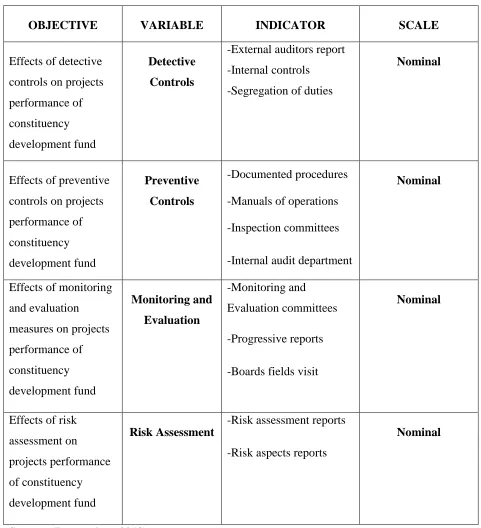
2.6 Operationalization of variables………...32
2.7 Ethical Considerations……….………..33
CHAPTER THREERESEARCH METHODOLOGY ... 34
3.1 Introduction ... 34
3.2 Research Design ... 34
3.3 Target Population ... 34
3.4 Sampling Procedure and Sample Frame ... 35
3.6 Data Collection Procedure ... 36
3.7 Validity and Reliability of Data Collection Instruments ... 36
3.8 Data Analysis Techniques and Presentation ... 37
CHAPTER FOURDATA ANALYSIS, INTERPRETATIONS AND PRESENTATION .. 39
4.1 Introduction ... 39
4.2 Response Rate ... 39
4.3 Demographic Results ... 40
4.4 Detective Controls ... 43
4.5 Preventive Controls ... 51
4.6 Monitoring and Evaluation... 60
4.7 Risk Assessment ... 65
4.8 Project Performance ... 68
4.9 Correlation ... 70
4.10 Regression Analysis ... 72
CHAPTER FIVE SUMMARY, CONCLUSIONS AND RECOMMENDATIONS ... 755 5.1 Introduction ... 755
5.2 Summary of the Key Findings ... 755
5.3 Conclusion of the Study ... 77
5.4 Recommendations of the Study ... 778
5.5 Areas for Further Studies ... 778
REFERENCES ... 79
APPENDICES ... 86
APPENDIX I: GRADUATE SCHOOL APPROVAL LETTER ... 86
APPENDIX II: RESEARCH AUTHORISATION LETTER ... 87
APPENDIX III: LETTER OF INTRODUCTION TO RESPONDENTS ... 89
LIST OF TABLES
Table 2.1: Summary of Literature Review Matrix... 25
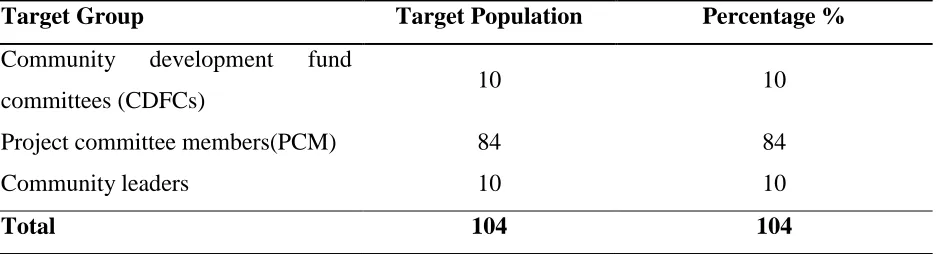
Table 3.2: List of Target Population of the study ... 34
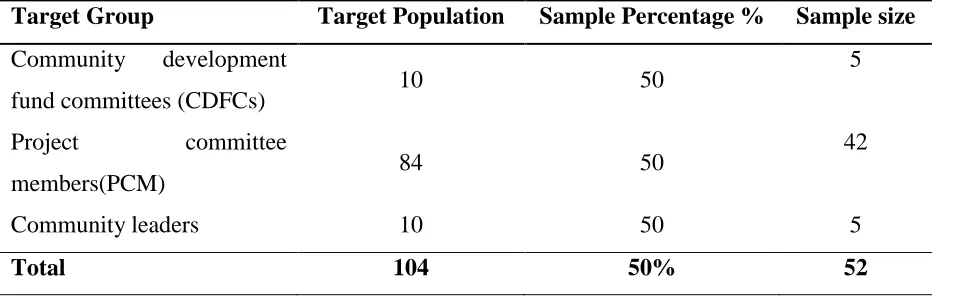
Table 3.3 List of Sample Size ... 35
Table 4.4: Response Rate ... 39
Table 4.5: Reliability Coefficients ... 39
Table 4.6: Respondents Gender ... 40
Table 4.7: Age in Years ... 41
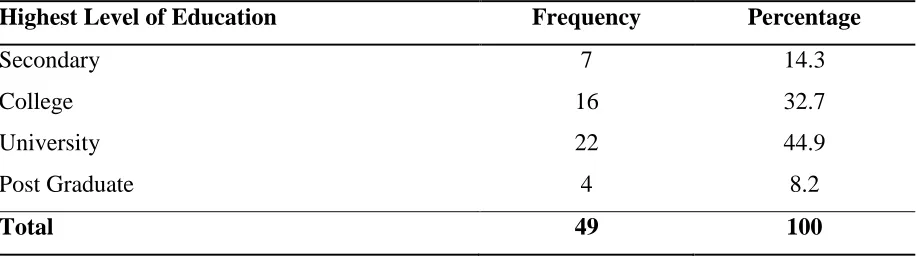
Table 4.8: Highest Level of Education ... 41
Table 4.9: Positioned in Constituency ... 42
Table 4.10: Period in Being Part Of Constituency CDF office ... 42
Table 4.11: Effectiveness of the Detective Control ... 44
Table 4.12: Internal Controls Adopted by the CDF office ... 44
Table 4.13: Controls in Detecting Frauds and Enhancing Performance ... 45
Table 4.14: Top Management on Areas Pointed by the External Auditor’s Report ... 46
Table 4.15: Help in Detecting Frauds ... 46
Table 4.16: Reason Behind The lack of Enhancement In Areas Pointed ... 47
Table 4.17: Major Issues Addressed ... 48
Table 4.18: Segregation of Duties in Minimizing Frauds and Errors ... 48
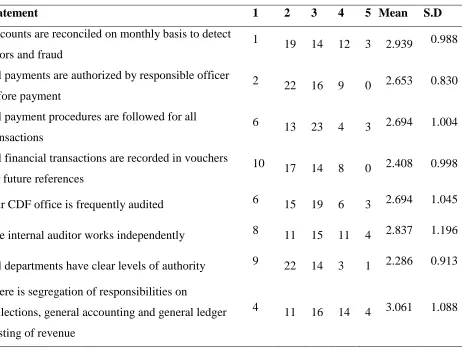
Table 4.19: Extent of Agreement on Statement Relating to Detective Controls ... 49
Table 4.20: Areas that Need Changes to Enhance Detection of Errors and Frauds ... 50
Table 4.21: Major Preventive Control in Place to Detect and Prevent Frauds ... 51
Table 4.22: Effective of the Systems ... 52
Table 4.23: Manuals of Operations In The Department ... 52
Table 4.24: Manuals in Terms of User Friendliness ... 53
Table 4.25: Guide in the Operations ... 53
Table 4.27: Frequency of Inspection ... 55
Table 4.28: Inspection Committee Reporting ... 55
Table 4.29: Internal Audit Department Effectiveness in Minimizing Frauds and Errors ... 56
Table 4.30: Rating of Internal Audit Department ... 56
Table 4.31: Reason for Ineffectiveness ... 57
Table 4.32: Statement Relating To Preventive Control ... 57
Table 4.33: Best Preventive Which Ease Fraud Detection Prevention ... 59
Table 4.34: Monitoring and Evaluation Committees ... 60
Table 4.35: Rating Effectiveness of Audit Control Roles ... 60
Table 4.36: The Role of Monitoring and Evaluation ... 61
Table 4.37: How often the Committee Give Progressive Reports ... 61
Table 4.38: Reports plus board’s fields’ visit helps on improving performance ... 62
Table 4.39: Statement Relating to Monitoring and Evaluation ... 63
Table 4.40: How often the Risks Assessment Reports are Produced ... 65
Table 4.41: Reports Plus Risk aspects on Improving Performance ... 65
Table 4.42: Statements Relating To Risk Assessment... 66
Table 4.43: The Risk Assessment Methods Which can Ease Fraud ... 67
Table 4.44: Rating Project Implemented by CDF Fund ... 68
Table 4.45: Improving the Utilization of The Fund ... 69
Table 4.46: Measures for CDF offices performance ... 69
Table 4.47: General Performance of the CDF Fund ... 70
Table 4.48: Correlations... 71
Table 4.49: Model Summary ... 72
Table 4.50: Summary of One-Way ANOVA results ... 73
LIST OF FIGURES
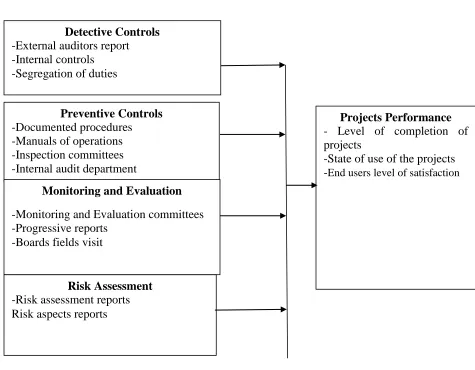
Figure 1.1: Conceptual Framework ... 31
OPERATIONAL DEFINITION OF TERMS
Audit controls Audit control, is a process for assuring achievement of an organization's objectives in operational effectiveness and efficiency, reliable financial
reporting, and compliance with laws, regulations and policies.
Audit This comes from a Latin word “audire” meaning to hear in other words it means official examination of account and records.
Control Is an exercise performed in the present to achieve a plan drawn up for the future.
Frauds A fraud is deliberate deception to secure unfair or unlawful gain. Fraud is both a civil wrong and a criminal wrong
Internal Control It has been defined by the Auditing planning committee (APC) in UK as the whole system of control financial and otherwise established by
management in order to carry out the business of the enterprise in an
orderly and efficient manner to safeguard the assets and secure as far as
possible, the competence and accuracy of records, the prevention and
detection of errors and fraud in accordance with the final preparation of
financial statement.
Management It is defined as the process of planning, organizing coordinating and controlling the activities of an organization. It is seen as a group of people
who monitor and control the organization activities towards the
achievement of the organization objectives.
Performance Refers to how well an organization is doing to reach its vision, mission, and goals. In this proposal performance is equated in terms number of
completed projects and how sustainable are the projects in the near future.
Constituency development fund is a fund established in 2003 through an Act of Parliament, the CDF Act 2003. The Act was later reviewed by the CDF (Amendment)
Act 2007, and repealed by CDF Act, 2013 which was subsequently
succeeded by the current NG-CDF (Amendment) Act 2016.
`
ABBREVIATION and ACRONYMS AfDB African Development Bank Group
CDF Constituency Development Fund
CDFC Constituency Development Fund Committee
COSO Committee of Sponsoring Organizations of the Tread Way Commission
IBP International Budgetary Partnership
IIA Institute of Internal Auditors M and E Monitoring and evaluation
NGOs Non-Governmental Organizations NSSF National Social Security Fund RMCs Regional Member Countries
SPSS Statistical Package for Social Science TISA the Institute for Social Accountability
ABSTRACT
CHAPTER ONE INTRODUCTION 1.1 Background of the Study
Audit control is contended to be a complex handle with regard to both the open and
private division (Ellsworth, 2014). The reason of the audit control is said to be that it supports an
organization in complying with the critical laws and controls; get together its bookkeeping
or enumerating commitments; the achievement of its intended goals, security of the resources of
the substance from incidents, dishonorable utilization and hurts. Concurring with the
Organization for Budgetary Co-operation and Progression (OECD, 2011),
the public sector needs to preserve insightfulness, straightforwardness and duty.
Globally, developed countries like the USA, China and Russia have resorted to decentralization
of resources which allude to the trade of political control, choice making capacity and resources
from central to sub-national levels of government (Walker, 2012). USA have a congressional
task for the most portion called “pork barrel,” “earmarks” or “member items” in national and
state-level course of action making which is comparative to the voting open progression back in
most of the making countries. This has driven to restoration of ancient teachings that showed up
to offer openings for decentralization. Since1990s decentralization has been associated to
collective fortifying and larger part run the show government due to dissatisfaction of
marketizing changes to through and through lessen incomparable poverty (Dixit, 2013).
In the developing countries, parliamentary incorporation in grassroots and in communities’
headway has been developing in a diverse set of countries, e. g. Kenya, Pakistan, India, Uganda,
Bhutan, Jamaica and Papua Cutting edge Guinea (Brinkerhoff, 2013). One approach gadget for
this incorporation is Community (Barrett, 2010). In Philippines, the utilization of the nation
assets by lawmakers to influence in their voting demographics dates back to 1930 by imitating
‘pork barrel’ legislative issues in Joined Together States of America, which got to be the
establishment of the plan of a Constituencies Development Fund (CDF) commenced in the
nation in 1989 (Brinkerhoff, 2013). Papua Modern Guinea started a CDF in 1984 and at last,
and Africa. In sub-Saharan Africa, CDFs have prospered over the last two decades basically after
picking up prominence taking after Kenya’s opening a CDF in 2003 (Vian, 2012).
In Solomon Islands, CDFs has experienced number of issues which incorporates: issues
around straightforwardness, responsibility, corruption and squander, viability,the appropriate
role of Members of Parliament (MPs) , and the degree to which CDFs impact politic al behavior
(Baily, 2015). In rating the execution of Solomon Islands’ CDF World Bank (2014) report found
the key degree on which it performed well was the speed at which finance. In Ghana, after
several years of implementing the community development fund, significant progress has been
made (Anderson, 2012). However, challenges include severe financial constraints; institutional,
operational and technical capacity constraints; fragmented and uncoordinated information and
embezzlement of the community funds. CDF was introduced in Uganda in 2005 and 2008 in
Tanzania, (Achuora and Ochriri, 2011).
In Kenya, CDF concept was created in 2003 immediately after the National Rainbow Coalition
(Narc) Government of President Mwai Kibaki romped into power (Joshi, 2011). CDF, alongside
free primary education, were just among the many progressive programmes which the Narc
government rolled out with enthusiasm at the time. The kitty was set up by the CDF Act of 2003,
with the essential objective of tending to poverty at grassroots level by committing at slightest
2.55 of the government’s conventional income to grassroots improvement. In January 2013, the
CDF Act 2003 (as corrected in 2007) was revoked and supplanted with CDF Act 2013 that is
adjusted to the structure of Kenya 2010. Sanctioning of the previous mention was implied to
adjust the law administering CDF with the devolution concept as captured in the modern
Structure (Mamiro, 2014). The Kenyan CDF was presented at 2.5 percent of the national
government’s income and, subsequently, develops with the in general measure of the
government budget. It has been contended that CDFs can enable parliaments by permitting them
to designate and spend cash freely of the official. MPs too claim that CDFs permit them to reply
specifically to concrete requests from their constituents, something that they may not be effective
Audit controls are measures that organizations established with the point of guaranteeing that the goals, objectives, and mission of the organization are met (Rezaee, 2012). They allude to set
of organizational approaches and strategies that guarantee any exchange is prepared in the fitting
way to dodge squander, burglary and abuse of organization assets. Through audit controls,
organizations accomplish execution and organizational objectives, avoid misfortune of assets,
empower generation of solid reports and guarantee compliance with laws and controls. In this
way review control is built up by the organizational administration to guarantee that the
commerce of venture is carried out in an efficient and productive way. This assist guarantees
adherence to administration approaches defend the resources and secure the completeness and
precision of the records.
The public sector all over the globe is always and broadly working to progress its review controls
so as to increase its income influx, survive in the quickly changing financial and competitive
situations, and adjust to the moving requests and needs (Kantzos and Chondraki, 2013). Audit
control comprises of five interrelated components which are determined from the way
administration runs an association, and coordinates the administration activities: control
environment; chance appraisal; control exercises; data and communication; and observing
(Carmichael, 2013). Agreeing to Liu (2012) and Rittenberg (2014), beneath the current
operations of organizations in common, the significance of review control can be partitioned into
six major categories; recognizing mistake and fraudulence, diminishing unlawful conduct,
progressing the competence of the trade substance, progressing the quality of information,
making a difference to make the commerce foundation, and diminishing auditors expense.
1.1.1 Detective Controls
Audit controls has a number of elements, these are; preventive, detective, and corrective
(Singleton, 2013). The detective controls are utilized to distinguish and report the event of an
exclusion, a blunder or a pernicious act. Millichap (2013) expressed that isolation of obligations
as one of the most compelling criminologist control in any association. One of the prime reason
of control is the segregation of those obligations which would in case pooled together would
empower one person to record and prepare a full transaction single-handedly. This one increases
the chance of deliberate control of accounts and advances the component of checking. This
diverse representatives. Detective remedial controls offer assistance in guaranteeing that the
effect of a danger is minimized, distinguish the cause of an issue as well as the rectify mistakes
emerging from the issue. Detective controls rectify issues found by analyst controls and adjust
the preparing framework to play down future event of the issue (Joshi, 2011). In the CDF
projects detective controls are ensured for instance by external auditors from the office of the
auditor general conducts audits in the constituencies every two years , an internal audit
department ensures that
1.1.2 Preventive Controls
Preventive controls anticipate potential issues that could happen any time in recent transactions,
make alterations, and avoid a blunder, exclusion or malevolent act from happening (Ishumgisa,
2011). De Paula (2013) as well populated that preventive controls require that exchange assets
like plant and device, equipment, motor vehicle, stock and cash should to be kept safely and
should to be confined to authorized staff as it were. The techniques arranged and security
measures taken to secure assets are known as Physical Controls. The sort of physical controls
common to most companies consolidate trade of watches, alert system, solid energized fence,
strong room, safes and security lights. Batra (2012) revealed that control of reports incorporates
control of organization sensitive files for outline receipts, cheques, adjacent purchase orders,
charge and credit notes. These files must be managed with by a reliable officer and should to be
pre-numbered to ensure control and minimize mishandle. They require safe keep and control
from a vocal range e.g. central station or else control regions (Lawrence, 2010).
1.1.3 Monitoring and Evaluation
This is the handle of surveying the superiority of the inner control assembly as time goes by
(Mueller‐ Hirth, 2012). Since inside controls are forms, it is as a rule acknowledged that they are
required to be in enough observed in arrange to evaluate the quality and the viability of the
frameworks execution over time. Hazard appraisal envelops a set of assets, behaviors, methods
and activities that is adjusted to the characteristics of each organization and that empowers
directors to keep dangers at a worthy level for the company. As a result, chance administration is
day dangers and at that point optimizing those dangers in arrange to realize esteem (Saarens and
de Beelde, 2014).
1.1.4 Risk Assessment
Risk evaluation is too the prepare of recognizing and analyzing administration significant
dangers to the arrangement of money related articulations that would be displayed decently in
similarity with common acknowledged bookkeeping rule, data and communication frameworks
Inside controls necessitate that entirely connected data be distinguished, apprehended and
transferred in a shape and time outline that empower individuals to convey out their budgetary
reporting duties (Ntongo, 2012).
In Kenya, within the judicial systems there are a handful of cases yet to be concluded and some
have been concluded putting the members of parliament (patrons) of defense to explain whether
there exists mismanagement of the fund (Kimenyi, 2014). According to this study there is lack of
integrity which usually results to criminal activities, and in the same spirit, this implies that the
fund operates in an environment where prudence is not observed thereby accountability is
lacking, this leads to the risk of sub-optimism and the achievement of personal interest not the
public common goal.
In the financial year 2014-2015, the report by the Office of the Auditor-General revealed waste
of large amounts of money through infringement to procurement rules, single-sourcing, diversion
of funds and untenable project (Gathogo and Wanyoike, 2015). The report showed
massive irregularities in the use of funds under CDF with at least 270 out of the 290
constituencies being unable to provide documents to support the expenditure of over Sh 3.85
billion. In some constituencies, the auditor noted that CDF committees were not keeping books
of accounts. Other constituencies were cited for failure to comply with acquirement laws and
investing millions on unlawful ventures. A few of the exceptional disclosures included
Kapenguria voting public where, Sh5.2 million was granted to a temporary worker and paid in
full the same day the contract was marked. In Taita Taveta, the allotment of Sh 37 million from
the CDF account to finance the development of a Sh 345 million restorative college was cited.
the fact that the parent service had not endorsed it. In Tigania West, an allotment of Sh1M
bursary to train boda boda operators (Gathogo and Wanyoike, 2015).
Despite the government of Kenya’s endeavor to devolve funds to the grassroots, still the
economic welfare of the people is still low (Nyaguthii and Oyugi, 2013). Additionally, the report
by the Auditor General have affirmed the massive misappropriation of Constituency
Development Funds in Constituencies. This study will therefore seek to analyse how audit
controls can help to improve performance of CDF at Embakasi East constituency.
1.1.5 Embakasi East Constituency.
Embakasi East Constituency is an electoral constituency in Kenya. It is one of the constituencies
in Nairobi County. Embakasi East Constituency comes from Embakasi Constituency which was
a former electoral constituency in Kenya. It was one of eight constituencies of Nairobi Province.
The constituency has since been split into Embakasi South Constituency, Embakasi North
Constituency, Embakasi Central Constituency, Embakasi East Constituency, and Embakasi West
Constituency. At Embakasi East constituency CDF is helping provide services to communities
that for many years did not benefit substantially from government services (Okungu, 2013).
In particular, basic services like health care, good roads and schooling are now being made
available through CDF. In this regard, if the CDF initiative is properly implemented, it can play a
significant role in the achievement of the Vision 2030 objectives, which are overly geared
towards enhancing economic growth and poverty reduction. Given the importance of this Fund
in local development, it is critical to strengthen its institutional, design and implementation
aspects. This will be instrumental in enhancing the efficiency in the utilization of funds and
reinforcing CDF implementation by promoting citizen’s participation in CDF processes and
activities (Ngare, 2013). However a review of the projects implemented indicated so many
numerous projects some of which are in private property in the constituency, others have since
stalled and still others have high value according to audit reports. Public participation was
1.2 Statement of Problem.
The government earmarks considerable assets through the CDF for arrangement of
administrations. In later times, there has been much discussion approximately the administration
of the stores with respect to destitute responsibility; dishonorable acquirement and offering;
over-invoicing; inefficient use; and need of openness in the budget preparation (Nyaguthii and
Oyugi, 2013). The previous contributes to misappropriation of reserves at the cost of effectively
completing the planning ventures. Okungu (2013) charges that almost 70 per cent of the voting
public detailed fumble, robbery, extortion and misappropriation of the CDF reserves. A report by
the Kenya Tax Payers Association for 2015/2016 indicated that 40 percent of the CDF could not
be accounted for, 20 percent of the projects had not been successfully completed and only 5
percent had been completed successfully, and over 35 percent had been well utilized. Economic
survey (2016) indicates that NG-CDF project performance in Kenya averages on 42 percent
locally.
It is assist stated by Nyaguthii and Oyugi (2013) that CDF officers and lawmakers are cleared
out to recognize ventures and oversee stores which leads to misappropriations. Unsuccessfully
completed ventures deny constituents the aiming benefits which incorporate among others social
conveniences and framework. The victims of abuse of these funds are, hence, the neighborhood
individuals at voting public level and nationwide.
Locally Wambugu (2011) carried out a study in Dagoretti Constituency which revealed that there
is political interference on the implementation of CDF projects which leads to underperforming
of CDF projects in the period of study. Mutunga (2010), reported that public funds are
squandered since Constituency Development Fund projects stall and yet the government keeps
pumping more money into the kitty. It further reported that in some areas within the country,
most of the projects have either stalled or failed to kick off; in others, shoddy performance by
merchants had been noted.
A substantial number of studies have been undertaken on performance of CDF funds but very
few have focused audit controls in place. This study therefore sought to analyse the audit
controls and stature of CDF, a case study of Embakasi East Constituency. This study sought to
order to enhance projects performance of the CDF at Embakasi East and the whole country at
large so as to achieve the Kenya’s Vision 2030.
1.3 Objectives of the Study
1.3.1 General Objective of the Study
To investigate the effects of audit controls to the performance of constituency development fund
projects in Embakasi East Constituency.
1.3.2 Specific Objectives
The Study was guided by the following Specific Objectives
i. To establish the effects of detective controls on projects performance of constituency
development fund in Embakasi Constituency.
ii. To determine the effects of preventive controls on projects performance of constituency
development fund in Embakasi East constituency.
iii. To establish the effects of monitoring and evaluation measures on projects performance
of constituency development fund in Embakasi East Constituency.
iv. To determine the effects of risk assessment on projects performance of constituency
development fund in Embakasi East Constituency.
1.4 Research Questions
i. To what level do detective controls affect projects performance of constituency
development fund in Embakasi East Constituency?
ii. To what extent do preventive controls affect projects performance of constituency
development fund in Embakasi East Constituency?
iii. How do monitoring and evaluation measures affect projects performance of constituency
development fund in Embakasi East Constituency?
iv. To what level does risk assessment affect projects performance of constituency
1.5 Significance of the Study.
This study will be of use to these stakeholders; Management which gives proper account of
funds entrusted to them is likely to lead to reduction of administrative and implementation costs
on CDF programmes and projects. This will enable the Government to implement more projects
for the citizens. Potential investors who are interested in investing or partnering in CDF owned
projects may use the findings of this study and turn around the CDF projects into efficient and
effective projects.
Policy makers require information to enable them put in place sound policies that will enhance
management and financial discipline aimed at having CDF programmes operate on commercial
principles. This study will provide such relevant information for policy formulation in CDF
sector. The study in this area on accountability of funds may in turn be used to trigger subsequent
studies in other related areas of funding like the Local Authority Transfer Fund (LATF). The
findings will give regulators information that will facilitate their ability to put in place
appropriate audit controls for CDF programmes to enable them operate efficiently. With the
implementation of the findings of this study, funds given to the CDF will be properly utilized
and this will benefit the citizens being the beneficiaries of the programmes.
This investigative work will go a long way in helping organizations to find the effect of review
controls and propose measures in rectifying them. It will moreover uncover the issues caused by
destitute review controls and might be valuable to understudies, researchers, teachers and other
third parties as it should open unused zone of advance investigate work and at same time
progress challenges to up-coming analysts.
1.6 Scope of the Study
This study was restricted to investigate audit controls and stature of CDF in Embakasi east
constituency. The study was guided by four specific objectives which included; preventive audit,
detective controls, monitoring and evaluation and risk assessment. The research targeted
population ten CDF fund committee members, 84 project committee members and ten
community leaders totaling to 104 respondents. The study area was chosen based on the Social
Audit Report (2015) where by Embakasi East constituency was among the constituency listed
several audit queries regarding their spending. This helped in collecting reliable and accurate
data for the study.
1.7 Limitations of the Study
The researcher encountered a number of restrictions hindering access to information sought by
the study. The main limitation of study was its inability to include more constituencies around
the Country. Some of the respondents targeted were hesitant in giving data dreading that the data
looked for would be utilized to threaten them or print a negative picture almost their voting
public. The analyst handled the issue by carrying a presentation letter from Kenyatta University
and guaranteed them that the data they delivered would be treated with most extreme secretly
and it would be utilized simply for scholastic purposes.
1.8 Organization of the Study
The proposition was organized into five chapters. Chapter one comprised of the foundation of
the study, explanation of the issue, targets of the study, inquire about questions, and importance
of study, scope and restrictions of the study. Chapter Two covered the introduction and the body
of the study where specific variables were discussed, theoretical framework, related empirical
literature as well as the conceptual framework. Chapter Three contained the following: research
design, target population, sampling procedure, research instruments, validity and reliability of
the instruments and data analysis. Chapter Four contained data analysis and presentation while
Chapter Five contained summary of the findings, conclusion, recommendations and
CHAPTER TWO LITERATURE REVIEW 2.1 Introduction
This section analysed past literature on effects of audit controls and projects performance of
constituency development fund. The chapter also reviewed theories of audit controls, empirical
review and the research gap has also been established.
2.2 Theoretical Literature
This is a collection of interrelated thoughts based on hypotheses. It is a contemplated set of
thoughts which are inferred from and upheld by information or prove. This study was guided by
the taking after hypotheses:
2.2.1 The Agency Theory
Jenses and Meckling (1976) were the main researchers to explicitly model the theory of agency.
Concurring to the organization hypothesis, a firm comprises of a nexus of contracts between the
proprietors of financial assets (the principals) and directors (the specialists) who are charged with
utilizing and controlling those assets (Jensen and Meckling, 1976). The hypothesis sets that
operators have more data than principals and that this data asymmetry antagonistically influences
the principal’s capacity to screen whether or not their interface are being legitimately served by
specialists. As such, the hypothesis depicts firms as vital structures to preserve contracts, and
through firms, it is conceivable to work out control which minimizes artful behavior of operators
(Jensen and Meckling, 1976). Concurring to the hypothesis, in arrange to harmonize the interests
of the specialist and the principal, a comprehensive contract is composed to address the intrigued
of both the operator and the principal.
The agent-principal relationship is fortified more by the central utilizing a master and
frameworks (reviewers and control frameworks) to screen the specialist (Jussi and Petri, 2014).
Advance the hypothesis recognizes that any deficient data around the relationship, interface or
work execution of the operator depicted could be unfavorable and an ethical danger. Ethical
danger and antagonistic choice effect on the yield of the operator in two ways; not having the
is designated to do. The organization hypothesis subsequently works on the presumption that
principals and agents act normally and utilize contracting to maximize on their riches (Jensen
and Meckling, 1976).
This hypothesis is appropriate to this study basically since audit control is one of numerous
instruments utilized in the public segment to address the organization issue by diminishing office
costs that influences the general execution of the relationship as well as the benefits of the
principal (Abdel Khalik, 2013). Review control improves the arrangement of extra data to the
central (government) almost the behavior of the operator (administration) decreases data
asymmetry and brings down on risks. In the case of Constituency funds, the auditor general plays
principal on behalf of the government in ensuring that the agent, (CDFC’s) who is the committee
mandated to implementing the project execution, carry’s out his duty in the best interest of the
citizens. Auditor general detects any errors and frauds that may be perpetrated in an attempt to
deviate funds from the original intended use. The agent on the other hand ensures that the funds
are channeled to the right use to benefit the citizens whom he acts on behalf.
2.2.2 Reliability and Accounting Theory.
The reliability and accounting theory was brought about by Lawrence Sawyer (1911-2002), and
from time to time was known as father of contemporary internal auditing. Reliability theory
simply describe the likelihood of system completion as an expected function during an interval
of time (Gavrilov and Gavrilova, 2011). Initially, was helpful in nineteenth century maritime
insurance and life insurance companies in computing profitable rates to charge their customers.
According to the reliability theory, an audit control comprises of components that are interrelated
and each for component, there needs to be a defined measure of success. As such, the state of a
component is determined by whether the component is successful or not successful. The
reliability of a component is defined as the probability of the component being found in the
success state. In addition, the reliability of the entire internal control system is a binary
combination with two possible values, success and failure. This study considers the part of the
The two potential clients of the unwavering quality hypothesis are the external auditor and
organization administration. Kinney (2010) states that; amid the external review, evidence is
assembled to bolster a proficient conclusion. Review control have an essential reason of
appraisal and control of dangers; that a fabric blunder was not be anticipated or identified on an
opportune premise by the framework clearing out to misfortunes. Frail review control result in
more substantive work and consequently more prominent fetched. Stratton (2013) moreover
includes that the handle of assessment of the review control by both administration and outside
reviewers is judgmental in nature. Be that as it may, the few endeavors at modeling review
control have not been actualized by the open division due to the need of authenticity, trouble of
modeling behavioral frameworks, need of fetched viability, and need of understanding by
professionals.
The internal audit department conducts audits every month in the constituencies , this ensures the
preventative controls put in place are strictly followed, segregation of duties , record keeping
among others are some of the preventative controls applied, Internal auditor evaluates whether
the preventative controls are reliable in ensuring accountability and transparency hence
safeguarding funds from misuse and other abuses .Reliable preventative controls therefore
ensures that citizens derive utility from the projects financed by these funds. Frequent
monitoring of the projects implementation is ensures that the funds so disbursed are being
implemented according to plan, in so doing the stalled projects can be marked, overpricing
detected, misuse and alarming activities not authorized.
2.2.3 The Fraud Triangle Theory.
This theory has been proposed by Albrecht (2013) who expresses that extortion is made out of
three components, specifically an apparent weight, an apparent open door and legitimization of
the demonstration of misrepresentation; these three components are known as the
misrepresentation triangle. Each demonstration of misrepresentation, independent of whether it is
done against a substance or in the interest of an element, is constantly made out of the three
components (Albrecht, 2013). The three components in the extortion triangle are intelligent, for
example the more prominent the apparent open door or the more extreme the weight, the less
Skousen, 2012). Notwithstanding, extortion is a mind boggling matter and is an element of a mix
of components (Rae and Subramanian, 2013).
For example, now and again, albeit interior controls were poor, there were no frequency of
extortion, while in different cases despite the fact that great inward controls existed
representatives still figured out how to evade the inner controls to confer misrepresentation (Rae
and Subramaniam, 2013). A comprehension of how openings, weights and legitimizations add to
extortion in associations can help administration to effortlessly perceive the regions of
defenselessness to misrepresentation and fortify these regions (Albrecht, 2013).
Misrepresentation culprits must have some approach to support their activities as worthy
(Albrecht, 2013). Defense of fake conduct is for the most part because of a fraudster's absence of
individual honesty or other good thinking (Rae and Subramaniam, 2013).
People don't confer misrepresentation unless they can legitimize it as being predictable with their
very own code of morals, as individual trustworthiness might be the key restricting variable in
shielding a man from abusing resources (Hillison, 2013). Legitimization by fraudsters exudes
from their inclination that the casualties owe them and that they merit more than they are getting
(Mutua, 2011).
A few people have a demeanor, character or set of moral esteems that enable them to purposely
and purposefully submit an untrustworthy demonstration (Cohen, 2011). A solid good code can
keep people from utilizing justifications to legitimize illegal conduct; inner inspectors however
ought to accept that anybody is equipped for supporting the commission of extortion (Hillison,
2013). The Fraud Triangle Theory supports the risk assessment in the CDF projects
implementation, any risky transactions are evaluated and measures taken to avert before the
funds are lost.
2.3 Empirical Literature.
This section analyzed scholarly literature published starting from global level to regional level
2.3.1 Detective Controls and Projects Performance.
Detective control is the establishment on which a compelling review framework is built
and worked inanorganizationthat endeavors to accomplish its vital goals give dependable money
related detailing to inside and outside partners, and work its trade productively and viably
(Ishmgisa, 2011). Control actions, if automatic or manual, have numerous aims as well as
functional at numerous administrative and practical levels (COSO, 2011).
Being a subject of interest, various researchers have investigated the relationship between
detective controls and performance. In Ukraine, Hooks and Ponemon, (2014) investigated the
relationship between detective control and fraud prevention among the commercial banks. The
study used descriptive survey method to investigate the matter. The study used purposive
sampling methods to select 68 commercial banks operating Ukraine. The study showed a strong
positive correlation detective control and fraud prevention. (Correlation value = 0.874,
significant value, 0.001).
The study concluded that a commercial bank should have a strong detective control environment
that includes awareness, prevention, and detection sub programs. This study failed to give a
preview of what is happening in the public sector. It only concentrated on commercial banks
which might not give the clear picture of the detective controls in the public sector.
In Africa, Losses from fraud present significant threat under devolved governments system. In
Nigeria, Subramaniam, (2010) assesses the relationship between organisation detective control
and performance of the health sector. The study used descriptive survey design to investigate
this matter. The research employed stratified sampling method to select 147 respondents
working with the health sector. Results obtained showed that the countries’ health sector had a
weak detective control environment, characterized with poor internal auditing procedure, poor
internal control measures, poorly paid and motivated staff, lack of an ethical organizational
culture, weak governance, lack of support from senior management and limited human
resources.
The health sector finances are usually meant for the hospital management. This study failed to
give a picture of what might happen in the event finances are channeled to the hospital and it’s
According to Ewa and Udoayang (2012) who carried an empirical review to assess the effect of
analyst control plan on commercial banks’ capacity to explore employee’s extortion and staff life
fashion and extortion location in Ghana. Information was compiled in 13 Ghanaian commercial
banks utilizing a scale of Likert in nature and analyzed utilizing rates and proportions.
The research revealed that detective control plan impacts employee’s demeanor in the direction
of extortion in that a solid inner control instrument is discouragement to employee’s extortion
while a frail one uncovered the framework to extortion and makes occasion for employees to
obligate extortion. In expansion, most Ghanaian banks do not pay genuine consideration to the
life fashion of their staff individuals and that most staff individuals are of the see that successful
and productive inner control plan could identify representative extortion plans in the managing
an account segment.
The study concluded that successful and effective analyst control framework is fundamental to
stem the clutter in the managing an account segment. Study subsequently suggested that banks in
Ghana ought to update their criminologist frameworks and pay genuine consideration to the life
fashion of their staff individuals as this could be a ruddy hail to recognizing frauds. This study
also failed to address the control designs in the public sector. Most of the Ghanaian are owned by
the private sector and this study might fail to give a glimpse of what the researcher needs in this
study.
In South Africa, Murdock (2013), assessed the relationship between detective control and fraud
prevention. Secondary data was used to investigate the matter. The study used a linier prediction
model to predict the outcome. The regression Results obtained showed than any positive change
on detective control environment would positively enhance the fraud prevention within the
industry. The recommended for strong detective Control activities that enable managers to
address risk timely, effectively and efficiently. The study failed to collect data from the
immediate individuals bestowed with the responsibility of running their organisations. Use of
secondary data limited establishing the most effective detective controls for the respective
organisations.
In Kenya, various scholars have also investigated the importance of the detective controls and
performance, Cecilia, (2015) investigated the challenges within the control environment that
descriptive study design. Purposive sampling procedure was employed in picking key
Government officials. Stratified sampling procedure was used to select 278 responders
comprising of top, middle and lower management levels. The study noted that lack of
appropriate regulations, resources low status and lack of independence hinder the effective
performance Government ministries in Kenya. The study concluded that risk needs to be
assessed and anti-fraud programs generated as key to an effective detective control culture within
the Government ministries in Kenya. This study failed to address the role of external auditors
comprehensively. The study only concentrated on the internal control systems.
In a study on internal control function of the Kenya Polytechnic University College, Wainaina
(2011) shows that as a substitute of its presence on the scene of operations, management must
rely on detective control techniques to implement its decisions and to regulate the activities for
which she would ultimately be responsible for. Use of effective detective Control Systems is
deemed crucial in the management of business resources.
As a result, the management of any organization designs control procedures to allocate, control
and ensure efficient utilization of resources, in order to achieve the overall organisation goals. It
was found that detective controls play a vital part in avoiding and recognizing extortion and
securing the organization's assets, both physical and intangible. This is achieved through proper
authorization controls and documentation. This study failed to show the role of middle level and
low-level management in frauds detection. Much emphases were only given to the top
management cadre.
2.3.2 Preventive Controls and Projects Performance
Utilizing the analytical approach and centering on preventive review exercises, Barra in the year
(2010) examined impact of punishments and other inside controls on employee’s penchant to be
false. Information was gathered from both administrative and non-administrative workers. The
results indicated that the nearness of the preventive control exercises, Segregation of duties,
increments had taken a toll of committing extortion. Hence, the advantage gained from
preventing extortion has to exceed those efforts applied in a setting up structures of segregating
duties and responsibilities for a worker to obligate extortion. Additionally, it was set up that
segregation of duties is a least-cost extortion obstacle for non-administrative workers, but for
This outcome proposes the viability of preventive controls such as isolation of obligations is
subordinate on detective controls. This study only concentrated on the punitive measures in
enhancing preventive controls. This study failed to capture the non-punitive measures that
organisations should adopt to in fraud reduction in their organisations.
Amudo and Inanga (2012) carried out an assessment of preventive controls on the Territorial Part
Nations (RMCs) of the African Advancement Bank Bunch (AfDB) centering on Uganda in East
Africa. The study built up that a few . They considered prescribed advancement of the existing
preventive control systems in the projects. The study findings failed to give a comprehensive
analysis of the preventive controls of Kenya and Uganda against those of developed countries.
Kakucha (2013) assessed the level of adequacy of preventive controls working in the capital city
of Nairobi Kenya. This was quantitative study carried out between the month of September year
2007 and the month of June years 2009 utilizing a test of 30 little dealings as recorded in the
National Social Security Support (NSSF) Enroll of Kenya. Essential information was gathered
from directors of the little trade utilizing interviews guides and further examination of records
relating to inside controls.
The think about set up that there was lacks in the frameworks of preventive controls, with the
notch of lacks changing from one venture to another. The mechanisms of inside control that were
lost in a majority of small businesses overviewed were: firstly, hazard examination, and
furthermore need of legitimate stream of data. In expansion, the think about built up that the test
populace had constrained mindfulness of what constituted a successful preventive framework of
inner regulator. The scholarly work further alluded a negative association amid the phase of an
undertaking and the adequacy of its preventive framework of inside control while a negative
relationship amid the assets held by a venture and its inner control framework shortcomings
happens.
The suggestion needed to illuminate the administrators of little trade of what constitutes an
effective and successful framework of preventive control through gatherings and workshops.
This study concentrated on small businesses which were owned by individually. In most of these
enterprises, the audit controls are quite weak as compared to other institutions that have
Michina (2011) carried out an overview of the effect of preventive control on operational
productivity of non-governmental organizations (NGOs) in Nairobi utilizing a test of fifty (50)
NGOs. Information was collected utilizing a survey comprising both open and closed finished
questions. The study set up that that preventive controls in the NGOs based in Nairobi were
decided to a great extent by the organization structure such that it is the beat administration that
chooses on how the assets gotten from givers and other lenders are to be apportioned and
conveyed to the recipients. Encourage, cash administration was positioned moment inner control
calculate influencing NGOs operational productivity.
As such, NGOs with great cash administration were found to be in a position to draw in
numerous sources of stores for their operations and as such, this called for legitimate utilize of
assets at their disposal. Moreover, NGOs with structured organizational structures had
well-structured approaches and strategies on how exercises were run. The discoveries too appeared
that much higher operational productivity was enlisted in enormous well-known NGOs which
lead to controlled preventive controls by the subsidizing accomplices. The study concluded that
preventive control impacts operational effectiveness. This study only looked at the operational
efficiency failing to give its findings in terms of performance which is a key thing for
organization growth and sustainability.
2.3.3 Monitoring and Evaluation Measures and Projects Performance
M and E is a process that makes a difference move forward execution and accomplish comes
about. Its objective is to make strides current and future administration of yields, results and
impact. Being an area of interest, local and international researchers have investigated the
relationship between, monitoring and evaluation process frauds control. In India, Khanna,
(2014). Investigated role of monitoring and evaluation process on quality governance. The
research plan was a case study of National Agrarian Division. Study utilized essential
information which was collected utilizing a meet direct. The discoveries of the think about were
that observing and assessment handle is done quarterly has made a difference the organization to
track down execution against goals/ targets which guarantee responsibility and also allowing for
early signals to detect negative factors that may lead to poor performance like frauds (Ingle,
dependent variable. The study failed to give a clear picture of the role monitoring and evaluation
on performance on the National Agricultural Sector.
In Turkey, Yttri, (2012) investigated role of monitoring and evaluation process on accountability
in the implementation of government funded projects. This study adopted a descriptive research
design Quantitative and qualitative methods of collecting data were applied. The findings
established that lack of monitoring and evaluation process in the execution to government funded
projects led to massive corruption in the implementation of projects. The study recommended
that its government should look for ways of supporting the monitoring and evaluation process as
well setting up a monitoring and evaluation department for efficiency and accountability. This
study failed to give other roles of monitoring and evaluation rather preventing corruption during
the project process.
A study by Adepoju (2014) sought to establish the response strategies to fraud by local NGO in
Nigeria. Among the variables investigated included monitoring and evaluation, this study
adopted a descriptive survey design because it aimed at giving an accurate description on the
response strategies to fraud by local NGO in Nigeria. The targeted population for this research
was 146-registered local NGO in majorly operating Lagos.
The study collected both primary and secondary data using a semi-structured questionnaire while
secondary data was obtained from review of reports from the internal Fraud and Investigations
Department and review of periodic reports filed by the NGO. The study found that lack of strong
monitoring and evaluation policies compromised the fight against fraud. The study
recommended for implementation periodic monitoring, evaluation process and whistle blowing
policy. This study concentrated only one sector of the economy failing to give an exploratory
analysis in the entire economy.
In Uganda Kusek, (2014) investigated the role of monitoring and evaluation on resource
utilization. Main objective of the research was to look into the process of systematizing the
monitoring and evaluation of rural development projects and programs in Uganda. The study
applied descriptive survey design where a census of the target population was done using
questionnaires as the instruments of data collection. Descriptive statistics was used as the method
other parties of interest with regular feedback on the project progress, resource utilization and
improve on the milestones in the achievement of the laid out outcome. The study concluded that
monitoring and evaluation practice facilitates timely adjustments of loopholes challenging rural
development. This study only concentrated on the rural projects, thus failing to include the urban
projects are capital intensive in nature and might attract individuals whom the sole aim is to
swindle public funds.
In Zimbabwe. Gaventa, (2012) examined the Influence of monitoring and evaluation on citizen
empowerment outcomes. The findings of the study revealed a strong positive association
between monitoring and evaluation by an organization and prevention and citizen empowerment
(r=0.785, P< 0.050). Findings also showed that each component of monitoring and evaluation
process as proposed by COSO positively impacted on fraud prevention and detection.
Monitoring and evaluation positively prevent fraudulent practices (ß1=0.4784, P<0.001). This
study failed to include other aspects of audit control. It only concentrated on monitoring and
evaluation.
In Ethiopia Mueller and Hirth (2012) assessing the role of Monitoring and evaluation process on
frauds control on agricultural sector, the target population included the 108-top management in
agricultural sector, the study found a strong positive correlation between M and E process frauds
control at Ethiopia’s’ agricultural sector. Both the quantitative and qualitative outcome support
the notion that there is a positive linear relationship between PM and E and frauds control. The
study failed to note that evaluation that monitoring activities would serve as a precursor in
preventing fraudulent practices.
Akelola (2012), investigated the effect of monitoring and evaluation on fraud discovery and
prevention among parastatals in Kenya. The fundamental issue was that there is expanded level
of extortion and misappropriation of stores in Kenyan parastatals caused by destitute checking
and assessment measures. The study embraced an illustrative investigate plan. The populace of
the study was all the 28 parastatals in Kenyan. The study conducted a census on all the 28 in
parastatals Kenyan. The he study adopted an explanatory research design. A conventional
straight relapse show was utilized. The relapse comes about demonstrated that there was a
negative and noteworthy relationship between compromise control and level of fraud avoidance
monetary administration control and level of fraud anticipation and discovery while the
relationship between announcing and budget control and level of extortion avoidance and
discovery was positive and critical. Taking after study discoveries, the study suggested that
Kenyan parastatals ought to put in put more grounded money related administration control
measures through more visits and gatherings among the individuals of the risk administration
committee and equally look into finance and investment committees. This study did not have as
much gaps as compared to the current study.
Gathogo, and Wanyoike, (2015) examined the influence played by monitoring and evaluation (M
and E) factors on performance of road project performance in Nyandarua County. The study
examined how M and E factors, influence project performance deliverables, such completion
within the set time and budget cost as well as achieving the right quality. This study was guided
by the following objectives. The study targeted the employees of the Nyandarua county who are
directly or indirectly involved in monitoring and evaluation of road projects. The study found
that the employees in the county lacked proper monitoring and evaluation of their projects.
The study noted that lack of strong monitoring and evaluation policies created a leeway for over
estimation of project cost thus lowering. This study concentrated on roads projects only and
failed to address other projects implemented in the region which has unique challenges as
compared to roads projects.
2.3.4 Risk Assessment and Projects Performance
Risk assessment alludes to the cautious evaluation of components that influence the plausibility
of targets of the organization not being accomplished. It alludes to the recognizable proof and
examination of important dangers related with accomplishing the targets of the organization
(Karagiorgos, 2013). They include that risk evaluation is the process of recognizing and
analysing administration important dangers to the planning of money related explanations that
would be displayed reasonably in similarity with common acknowledged bookkeeping guideline.
In organizations, administration must decide the level of chance carefully to be acknowledged,
and attempt to preserve such chance inside decided levels. It is in this manner the administrations
obligation to plan inner controls to guarantee effectiveness and viability, unwavering quality of
occasional execution audit and assessment of the roundness and viability of the controls designed
by the internal auditor department.
Risk assessment is considered to be the identification as well as examination of applicable
hazards which can damage the accomplishment of purposes, creating a base for determining how
the hazards must be managed. Risks are evaluated to determine the probability of an occasion
happening, the effect, as well as hazard patience (IIA, 2011). To determine if hazard
administration is operational, pertinent hazard information must be taken and conversed in
efficiently across the organization, permitting management to do their tasks (IIA, 2011).
In UK, Spekle, (2012), investigated the impact of risk assessment practice on detection frauds by
private sector. The study embraced a graphic overview plan. The target populace comprised of
the 443 fabricating companies while stratified irregular testing was utilized to decide the test
from which information was collected. The study found that fabricating companies that were
applying a few hazard appraisal hone and anticipation strategies to control existing extortion
dangers.
It was found that genuine time gross settlement related fraud hazard was happening with an
exceptionally tall degree. The regression investigation found that the extortion discovery
methods and anticipation strategies driven to a negative alter in extortion sorts and bad habit
vice. The fabricating companies in UK ought to approach the issue of extortion chance as a
segment and not as person. The study failed to conduct a comparative analysis with car
manufacturing companies in developing economies. This would give the most effective risk
assessment controls for the industry.
In Ghana, Adeleye, (2014) investigated the risk assessment practice on detection frauds by in
government. The target populations for the study were the senior officers in the risk management
departments. The initial sample was gathered by structured questionnaire. The questionnaire was
self-administered through drop and pick later. A total of 154 respondents were engaged in the
study. The results of the study indicated that there exists a positive relationship between fraud
assessment practice and performance government ministries in Ghana. It also found out that
preventive and detective fraud risk management practices had a very strong positive (Pearson
service delivery to citizens. The study only concentrated on the senior officers alone. Frauds
execution in most organisations starts from the junior staff. Information from the junior staff
would help in coming up with effective conclusions and recommendations.
Risk management is a complex task for any organization and increasingly important in a world
where economic events are linked. In Tanzania Tufano, (2016), investigated the impact of risk
assessment practice on detection frauds by Tanzanians water board, the research study targeted
eleven (11) Heads of water board. Questionnaires were administered to solicit information from
respondents. The study revealed a strong relational association in the risk assessment practice
instituted by an organization and prevention and detection of fraud. The study concludes that risk
assessment particularly fraud risk assessment would positively prevent fraud related practices.
This study focused on risk assessment practices alone and failed to bring out other audit controls
aspects in this study.
In Kenya Ngare, (2013) assesses the effect of risk assessment practice on detection of detection
of frauds by commercial banks in Kenya. This study embraced a clear investigate plan and the
target populace of this think about was all commercial banks in Kenya. The study utilized
essential information and auxiliary information sources. The information collected was coded
and analyzed utilizing the Microsoft Exceed expectations and SPSS. Inferential investigation was
done utilizing inferential measurements.
The study was tried by a relapse demonstrate to look at the impacts of chance evaluation
methodologies on location of fakes by commercial banks in Kenya. The result appears that there
is a positive and noteworthy impact of risk appraisal techniques on discovery of fakes by
commercial banks in Kenya. The discoveries embroil that commercial banks extortion discovery
and avoidance units ought to embrace extortion administration methodologies to diminish money
related extortion misfortunes to upgrade development in money related execution so as to
maximize the bank esteem. A number of studies have been done in Kenya on risk assessment
strategies and practices. However, none of the studies focused on the relationship between risk