ISSN(Online): 2319-8753
ISSN (Print): 2347-6710
I
nternational
J
ournal of
I
nnovative
R
esearch in
S
cience,
E
ngineering and
T
echnology
(An ISO 3297: 2007 Certified Organization)
Vol. 6, Special Issue 9, May 2017
Structural Optimization Methods: A General
Review
Prashant Kumar Srivastava
1*, Simant
2, Sanjay Shukla
31
Asst. Prof., Ambalika Institute of Management & Technology, Lucknow India
2Professor, Sagar Institute of Technology & Management, Barabanki India
3Senior Research Engineer (Designs), Government of India, Ministry of Railways, Research Designs and Standards
Organisation, Lucknow India
ABSTRACT : In present era of technological enhancement, every manufacturing organization is striving to focus to lower production costs and to reduce weight of component while meeting the required performance characteristics. Saving of material and energy can be achieved through optimizing the shape and topology of the structure on choosing a more efficient structural configuration. Design engineers are looking for rigorous methods to solve optimization model. Efficiency and economy are critical parameters for selecting innovative methods to improve the performance of the existing systems. The present review will develop an understanding of shape and topology optimization is, and the theory behind, how it can be used to improve the design process.
KEYWORDS: Optimization, Topology, Material Saving, Design, Efficiency, Innovative Methods.
I. INTRODUCTION
Optimization techniques [20] [21] have become more important as the prospect of simulating complex mechanical structures has become a reality. A common approach in the layout design of structural parts is the topology optimization, which find an optimum material distribution [6] within a selected geometrical design space to best meet loading conditions and constraints. Another important approach for optimizing the structure is shape optimisation, which optimises weight(mass) in given parametric geometric constraints. In the case of complex shaped parts, like automobile body structures, shape optimisation is still hard to do; mainly due to the difficulty in translating shape design parameters into meaningful analysis models. Sizing, shape and Topology optimization address different aspects of structural design problems.
II. STRUCTURAL OPTIMIZATION
Structural optimization a class of optimization problem, can easily be traced back to 1904 when Michell [1] derived formulae for structures with minimum weight given stress constraints on various design domains. Save and Prager1985 [2] proved that the resulting structures (Populurazied as Michell structures) had the minimum compliance for corresponding volume structures and hence were global optimum of minimization of compliance subject to volume problems.
In engineering, the optimization of an objective function is basically the maximization or minimization [22] of a problems subjected to given constraints. In Structural optimization , the purpose is to find the optimal material distribution according to some given demands of a structure. Some common functions to minimize are the mass, displacement or the compliance (strain energy). This problem is most often subject to some constraints i.e. mass or the size of the component.
This optimization is traditionally done manually using an iterative intuitive process that roughly consists of the following steps
ISSN(Online): 2319-8753
ISSN (Print): 2347-6710
I
nternational
J
ournal of
I
nnovative
R
esearch in
S
cience,
E
ngineering and
T
echnology
(An ISO 3297: 2007 Certified Organization)
Vol. 6, Special Issue 9, May 2017
2. The evaluation of design requirements, for example by a Finite Element Analysis (FEA) 3. Insure that requirements are fulfilled or not. If some lacking than repeat process 2 & 3
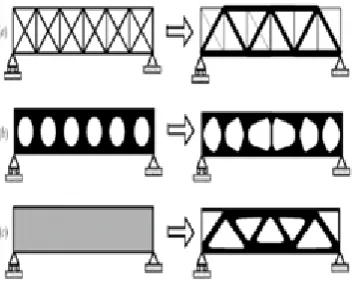
The result depends heavily on the designer’s experience, knowledge, and perception regarding understanding of the problem. Changes to the design are can be made in trial and an error. This process can be very time consuming and may result in a suboptimal design. The problem of structural optimization can basically be categorized into three types, Sizing (mass), Shape and Topology (layout). Refer Fig 1.
Fig. 1. a. Sizing b. Shape c. Topology Optimization (Courtesy: Ref. 6.)
III. STATEMENT OF OPTIMIZATION PROBLEM
Majority of engineering problems often involve constrained minimization. An example of such constrained minimization problem is finding the minimum weight design of a structure subject to constraints on stress and deflection. Constrained problems may be expressed in the following general nonlinear programming form:
minimize
subject to
(1.1)
and ,
(1.2)
where
= objective or cost function,
are inequality constraints, and are equality constraints.
The inequality constraints in Eq. (1.1) include explicit lower and upper bounds on the design variables may also express Eq. (1.2) in the form: minimize f(x). Focusing on reduction of weight may be obtained by focusing on optimization and description of size, shape and topology optimization have been considered in the present work .
IV. METHODS OF STRUCTURAL OPTIMIZATION
ISSN(Online): 2319-8753
ISSN (Print): 2347-6710
I
nternational
J
ournal of
I
nnovative
R
esearch in
S
cience,
E
ngineering and
T
echnology
(An ISO 3297: 2007 Certified Organization)
Vol. 6, Special Issue 9, May 2017
structure’s shape and size as the design variables are the coordinates of the boundary (shape optimization) or the physical dimensions (size optimization), but more exercise is needed to control the topology of the structure. Various method of structural optimization are discussed and reviewed as:
4.1 Sizing optimization
Sizing optimization is the simplest form of structural optimization. The shape of the structure is known and the objective is to optimize the structure by adjusting sizes of the components. Here the design variables are the sizes of the structural elements, for example the diameter of a rod or the thickness of a beam or a sheet metal .As in size optimization where the diameter of the rods are the design variables In a sizing optimization problem, the design variables are usually geometrical parameters such as length, width or thickness of the part being optimized.
4.2 Shape optimization
Shape optimization is performed similarly as the topology optimization. The main difference is in how the design variables are defined. Design variables are the coordinates of the boundary. The process of shape optimization consists of three modules [19]: geometrical representation, structural analysis, and optimization algorithms. To select a geometrical representation is the first step in the shape optimization process , The nodal coordinates are chosen as design variable because it is very simple by using ANSYS. Considering the architectural or structural requirements , the initial design model is constructed. The design model is converted into an analysis model. So the past researches focus on the objective function i.e. lowest cost or minimum weight .As mature analysis software, ANSYS [13] & [15] can be analyzed almost all the structures, and has been used in many practical engineering.
Yunliang Ding [3] develop a numerical model for analysis of shape optimization of various structures. Described the several steps in the shape optimization process. According to him , the steps of shape optimization are model description, selection of the objective function and shape variables, representation of boundary shape, finite element mesh generation & refinement , sensitivity analysis and solution methods. These steps are reviewed in detail in their work. X. Duan et.al. [8]. discussed the procedure of shape optimization on V-shaped anvil using Finite Element(FE) analysis interface. A FEA software MARC is used for this type of parametric optimization procedure
4.3 Topology optimization
Topology optimization is the most general structural optimization technique and it is mainly considered in a conceptual design stage. The Greek word topos, meaning landscape or place, is the origin of the word topology optimization. Topology optimization is perhaps the most difficult of all three types of structural optimization. The optimization is performed by determining the optimal topology of the structure. Optimization therefore occurs through the determination of design variable values which correspond to the component topology providing optimal structural behaviour [4] & [5].
In topology optimization a fixed finite element mesh is used and one design variable is connected to each element. The design variable determines if the corresponding element will represent structural material or a hole. The connectivity of the structure, while connecting the applied loads to the given boundary conditions, is thus changed such that the objective function is minimized subjected to the specified constraint Applying topology optimization to structural design typically involves considering quantities such as weight, stresses, stiffness, displacements, buckling loads and resonant frequencies, with some measure of these defining the objective function and others constraining the system. Topology optimization rapidly expanding a new research field, which has interesting theoretical implications in the field of mathematics, mechanics, multi-physics and computer science, but also important practical applications in product development (particularaly car and aerospace) industries, and is likely to have a significant role in micro and nanotechnologies. A century ago, the first paper on topology optimization is published by the Australian inventor
Michell (1904)[1], who derived optimality criteria for the least weight layout of trusses. After seven decades, authors
ISSN(Online): 2319-8753
ISSN (Print): 2347-6710
I
nternational
J
ournal of
I
nnovative
R
esearch in
S
cience,
E
ngineering and
T
echnology
(An ISO 3297: 2007 Certified Organization)
Vol. 6, Special Issue 9, May 2017
exact solutions of popular benchmark problems (Lewinski and Rozvany 2007-08) [12]. The development of topological optimization can be attributed to Bendsoe and Kikuchi (1988) [5] & [6].They presented a homogenization based optimization approach of topology optimization. They assumed that the structure is formed by a set of non-homogenous elements which are composed of solid and void regions and obtained optimal design under volume constraint through optimization process. In their method, the regions with dense cells are defined as structural shape, and those with void cells are areas of unnecessary material .At the World Congress, Seoul(2007) many papers were discussed on application and approaches of topology optimization In the Hyper works Technology Conference (HTC), Varun Ahuja et al. (2012) presented paper and discussed about Optimization Techniques in Reducing the Weight of Engine Mounting Bracket[14] and concluded 15 % weight saving of the bracket using Opti-Struct Software tool. In this conference some other papers on topology optimization is discussed. M.V.Aditya Nag(2012) in HTC Conference showed the result how the weight of engine mounting bracket is reduced up to 60% without compromising the strength of the bracket[16]. Dheeraj Gunwant et.al Misra (2012) compared The results of ANSYS based Optimality Criterion [18]which was a gradient based method, were compared with those obtained by Element Exchange Method which was a non-gradient based method
V. CONCLUSION
Size optimization required to find the optimal values of the various dimensions. Shape optimization is the further extension of size optimization; it allows extra freedoms in the configuration of the structure such as the location of connections between members. Modified designs are restricted to a fixed topology and thus can be written using a limited number of optimization variables. Topology optimization advances the size and shape optimization and gives no restrictions to the optimized structure. It simply tries to find the optimal domain of the governing equations contained within some design field. It provides minimum distribution of material in selected design space. Compared to size and shape optimization, topology optimization allows more freedom as no initial structure is required. Only the design space, the loads and the boundary conditions are required in order to find an optimized structure which satisfies the given restriction.
REFERENCES
1. A.G.M. Michell. LVIII. The limits of economy of material in frame structures. The London, Edinburgh, and Dublin Philosophical Magazine and Journal of Science, , 1904.
2. Save, M. and Prager, W., editors Structural Optimization, Volume 1: Optimality Criteria. Plenum Press, New York, NY 1985.
3. Yunliang Ding ,Shape optimization of structures: a literature survey, Department of Aeronautical, Structures and Materials, computers & Structures Vol. 24. No. 6. pp. 985-1004. 1986.
4. M.P. Bendsøe and N. Kikuchi. Generating optimal topologies in structural design using a homogenization method. Computer methods in applied mechanics and engineering, 71(2):197–224, 1988.
5. M.P. Bendsoe, and N. Kikuchi.Generating optimal topologies in structural design using a homogenization method by Comput. Meth. Appl. Mech. Eng. Vol: 71: 197-224.,1988.
6. M.P. Bendsøe. Optimal shape design as a material distribution problem. Structural optimization, 1(4):193–202, 1989.
7. M.P. Bendsøe, A. Ben-Tal, and J. Zowe. Optimization methods for truss geometry and topology design. Structural and Multidisciplinary Optimization, 7(3):141–159, 1994.
8. X-duan, T Sheppard, Shape optimization using FEA software-A v-shaped anvil as an example, Journals of material processing technology vol no 120 pp 426-431, 2002.
9. Martin Philip Bendsøe and Ole Sigmund. Topology Optimization - Theory, Methods, and Applications. Springer Verlag, Berlin, second edition edition, 2003.
10. Gong Shuguang , “ANSYS engineering application and its analysis”(Book style) Beijing China Machine Press,.4 pp. 35–85,2003.
11. M. Zhou, N. Pagaldipti, H.L. Thomas, Y.K. Shyy, "An integrated approach to topology, sizing, and shape optimization", Structural and Multidisciplinary Optimization, vol. 26, no. 5, pp. 308-317, 2004
12. G. I. N. Rozvany.A critical review of established methods of structural topology optimization” by , Springer-Verlag ,2008.
13. Prashant Kumar Srivastava “Volume Reduction of A Mechanical Component using ANSYS” in M.Tech Dissertation ,HBTI ,Kanpur,INDIA(2011).
14. Varun Ahuja Sandip Hazra Application of Optimization Techniques in Reducing the Weight of Engine Mounting Bracket” by, HTC (Hyper Works Technology Conference) Conference, India 2012.
ISSN(Online): 2319-8753
ISSN (Print): 2347-6710
I
nternational
J
ournal of
I
nnovative
R
esearch in
S
cience,
E
ngineering and
T
echnology
(An ISO 3297: 2007 Certified Organization)
Vol. 6, Special Issue 9, May 2017
16. M.V.Aditya Nag .Topology optimization of a Engine Mounting Bracket”, , HTC (Hyper Works Technology Conference) Conference, India 2012
17. Prashant Kumar Srivastava, Rajive Gupta & Simant. Structural Weight optimization of A Bracket using ANSYS, International Journal of Research Engg & Technology, Vol 3, Spl Issue 10, 2014
18. Kishan Anand , Anadi Misra. Topology Optimization and Structural Analysis of Continuous Linear Elastic Structures using Optimality Criterion Approach in ANSYS.International Journal of Innovative Research in Science, Engineering and Technology Vol. 4, Issue 6, June 2015.
19. Guoyong Cuia, Changyu Cuia,b,Shape Optimization Based on ANSYS, Journal of Information & Computational Science–4297 July 20, 2015. 20. S S Rao, Optimization Theory & Applications, ,Wiley Eastern limited, INDIA