Pandian Saraswathi Yadav Engineering College, Arasanoor, Sivagangai, Tamilnadu, India
Improving Energy Efficiency in WSN Using
Tree Based Energy Balancing Routing
Protocol
G.Karthika
1, A.Rajeswari
2PG Scholar, Department of CSE, P.S.R.Rengasamy College of Engineering for Women, Tamilnadu, India1
Assistant Professor, Department of CSE, P.S.R.Rengasamy College of Engineering for Women, Tamilnadu, India2
ABSTRACT: Wireless sensor networks (WSNs) have become a hot research topic in recent year. Applications include military, liberate, environment monitoring, and smart homes. The use of WSN has foreseen big changes in data gathering, processing, routing of information and dissemination for different environments and applications. A WSN is composed of hundreds or even thousands of small, inexpensive sensor nodes which communicate with one another wirelessly. Sensor nodes naturally do not have very much computational authority, limiting the kinds of networking protocols and security mechanisms they can employ. Scientists have proposed numerous conventions, for example, LEACH, HEED, PEGASIS, TBC and PEDAP. The energy efficient routing protocol of General Self Organized Tree Based Energy Balance Routing protocol (GSTEB) used to improve the energy efficiency and to reduce the energy consumption, balance the network lifetime. Simulation results show that GSTEB a fitter performance than other protocols in balancing energy spending, thus prolonging the lifetime of WSN. This protocol to improve the energy efficiency compared to other protocol like LEACH. Simulation results show that GSTEB a better performance than other protocols in balancing energy utilization, thus prolonging the lifetime of WSN.
KEYWORDS: Energy-balance, network lifetime, routing protocol, wireless sensor network.
I. INTRODUCTION
A Wireless Sensor Network (WSN) of spatially distributed autonomous sensors to monitor physical or environmental conditions such as warmth, echo, anxiety, etc. and to cooperatively pass their data through the network to a main location. In Wireless Sensor Network the group of nodes form a network. It have a source and destination node. The source node want to send the information to the destination node. First it selects the path by interconnecting the rely nodes and pass the information to the destination via the gateway. A WSN have deployed for various purposes like military application, surveillance in volcanic or remote regions, etc. Wireless Networks collect and disseminate from the fields where ordinary networks are unreachable for various environmental and strategic reasons. The energy consumption rate for sensors in a wireless sensor network varies greatly based on the protocols the sensors use for communications. A critical constraint on sensors networks is that sensor nodes employ batteries. A second constraint is that sensors will be deployed unattended and in large numbers, so that it will be difficult to change or recharge batteries in the sensors. Therefore, all systems, processes and communication protocols for sensors and sensor networks must minimize power consumption. There are lot of energy efficient routing protocol in wireless sensor network. Because battery replacement is not possible in WSN. Therefore they introduce energy efficient routing protocol for improving energy efficient and to reduce the energy consumption.
Pandian Saraswathi Yadav Engineering College, Arasanoor, Sivagangai, Tamilnadu, India
efficiency. Section IV describes the implementation of protocol and compared the parameters to the existing protocol. In Section V presents and analyze the obtained results. Finally, Section VI concludes the paper.
II. BACKGROUND AND RELATED WORK
In the networking literature, there are several works that proposed either to improve the energy efficiency using various method. The following section deals with most representative work related to proposed work.
A. Energy Efficient Routing Protocol
There are various energy efficient routing protocol used over the battery replacement in WSN. A main task of WSN is to periodically collect information of the interested area and transmit the information to BS. A simple approach to fulfilling this task is that each sensor node transmits data directly to BS. However, when BS is located far away from the target area, the sensor nodes will die quickly due to much energy consumption. On the other hand, since the distances between each node and BS are different, direct transmission leads to unbalanced energy consumption. To solve these problems, many protocols have been proposed. Of the protocols proposed, hierarchical protocols such as LEACH, HEED, PEGASIS, HEERP, TAEERP, TBC and PEDAP can achieve satisfactory solutions. The following literature review deals with the literature works related to this project.
Energy-Efficient Communication Protocol For Wireless Sensor Networks[1].In LEACH, for the entire network, Wireless distributed micro sensor systems will enable the reliable monitoring of a variety of environments for both civil and martial application. We look at announcement protocols, which can have considerable bang on the overall energy dissipation of these networks. Based on our findings that the conservative protocols of direct communication, minimum-broadcast-energy, multi hop steering, and static clustering may not be finest for sensor networks, we propose LEACH (Low-Energy Adaptive Clustering Hierarchy), a clustering-based protocol that utilize randomized rotation of local cluster base stations (cluster-heads) to evenly distribute the energy load among the sensors in the network. This position is self-elected at different time intervals. The decision to become a cluster-head depends on the amount of energy left at the node. In this way, nodes with more energy remaining will perform the energy-intensive functions of the network. Each node makes its conclusion about whether to be a cluster-head independently of the other nodes . In addition, we discuss a conventional clustering approach to routing and the drawbacks of using such an approach when the nodes are all energy-constrain. Using a direct communication protocol, each sensor sends its data straightforwardly to the base station.
HEED: A Hybrid, Energy-Efficient, Distributed Clustering approach for Ad-hoc sensor Networks[2].In the authors proposed a HEED to periodically selects cluster heads according to a hybrid of the node residual energy and asecondary parameter, such as node proximity to its neighbors or node degree. HEED terminates in iterations, incurs low message overhead, and achieves fairly uniform cluster head distribution across the network. We prove that, with appropriate bounds on node density and intracluster and intercluster transmission ranges, HEED can asymptotically almost surely guarantee connectivity of clustered networks. Simulation results demonstrate that our proposed approach is effective in prolonging the network lifetime and supporting scalable data aggregation.
Pandian Saraswathi Yadav Engineering College, Arasanoor, Sivagangai, Tamilnadu, India
A Chain Oriented Sensor Network For Efficient Data Collection[4].In COSEN, the general for most of the applications in wireless communication we focus on bandwidth efficiency and higher throughput. Energy efficiency comes as secondary concern because devices are connected to the mains or come with a sufficiently capable or/and rechargeable power source. But they have a tiny irreplaceable power unit or rechargeable source. These tiny sensors gain popularity with the advances of MEMS (Micro- Electro-Mechanical Systems) based sensor technology, low-power electronics, and low-low-power radio design. The energy restriction of battery operated sensor nodes certainly makes this task difficult and complicated because once deployed in the target field, it is not feasible to change the battery periodically. The applications in wireless communication we focus on bandwidth efficiency and higher throughput. Most of the protocols can be classified as either data-centric or hierarchical or location-based. Data-centric routing protocols mainly utilize attribute-based query and involve naming of desired data.It consider about the delay of the network. Our protocol shows better performance than both LEACH and PEGASIS in terms of energy consumption and network delay. Moreover, we find in the simulation that our protocol takes higher number of rounds than that of PEGASIS before the first sensor dies. Furthermore, COSEN is simple and easy to implement. Here for the sake of simplicity we describe a two-layer hierarchical chain based protocol.
A Balanced-Clustering, Energy-Efficient Hierarchical Routing Protocol in WSN[5].In BCEE, Wireless Sensor Networks together hundreds or thousands of sensor nodes to accurately monitor a distant environment. Considering harsh resources constraint, it requires forceful wireless communication protocols that are energy efficient and can provide longer life span, in particular for routing protocol.
It requires robust wireless communication protocols that are energy efficient and can provide longer lifetime, especially for routing protocol. A number of routing protocols have been proposed to reduce energy consumption, especially hierarchical routing algorithm. A balanced clustering, energy efficient hierarchical routing protocol is proposed, called BCEE, aiming at equilibrate energy consumption highly to whole network and prolong network lifetime effectively. The results show that our protocol offers significant reductions of energy consumption and prolongs network lifetime hugely. Also the produced clusters exhibit several appealing characteristics. This approach can be applied to the design of several types of sensor network protocols that require scalability, prolonged network lifetime, fault acceptance, and load balancing.
TBC for Energy Efficient Wireless Sensor Networks[6].
In
TBC, Wireless sensor networks are widely used for gathering data in an independent fashion. Since sensors are power forced devices, it is quite important for them to reduce the energy utilization. In this paper we propose a new tree-based clustering (TBC) approach for energy efficient wireless sensor networks. Here the nodes in a cluster form a hierarchy with the root as the cluster-head, while the tallness of the tree is decided based on the distance of the member nodes to the cluster head. Computer simulation shows that the anticipated scheme effectively reduces and balances the energy consumption among the nodes, and thus appreciably extends the network lifetime compared to the existing schemes such since LEACH, PEGASIS, and TREEPSI. It low-cost and low-power wireless micro sensor nodes have become popular. Wireless sensor network (WSN) consists of tiny sensor nodes forming an ad hoc distributed data sensing and propagation network which collects the information on the surrounding environment. The limited energy at each node affects the lifetime of the full network, and as a result energy efficiency has been a critical design issue for the protocols and algorithms developed for WSN. Among various approaches proposed for energy efficient WSNs, the clustering approach in which data are gathered by one representative sensor of each group of sensors allows good scalability for the sensor network consisting of hundreds or thousands of nodes.Pandian Saraswathi Yadav Engineering College, Arasanoor, Sivagangai, Tamilnadu, India
network manager (or base station) when abnormal events occur. It is desirable to make these nodes as energy-efficient as possible and to rely on their large numbers in order to obtain high quality results.
III. SYSTEM DESIGN
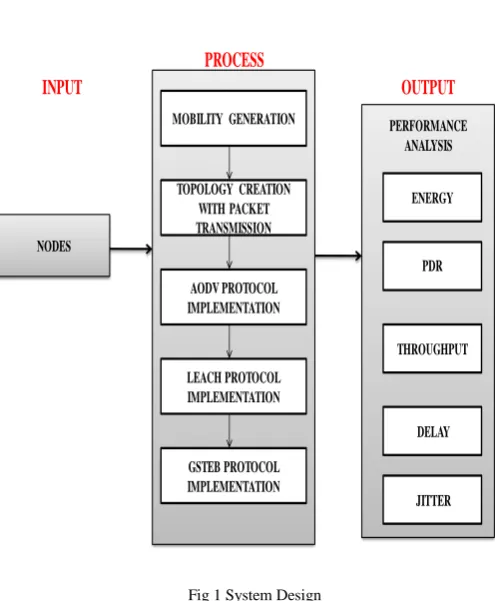
Wireless Sensor Network are deployed the large amount of nodes in the environment. To collect the information from number of nodes to send the data to the Base Station (BS). In the data transmission are having two kinds, there are the Single hop Communication and Multi hop Communication. Major requirements of Wireless Sensor Network are the energy consumption, network lifetime, scalability and robustness. Many energy efficient protocols are introduced to improve the energy efficiency and balanced the network lifetime. Researchers are introducing the many kind of protocol for energy consumption. In the Wireless Sensor Network the energy consumption is the emerging technique in the research field. It provide the various network parameter like throughput, delay, jitter, lifetime.
NODES
MOBILITY GENERATION
TOPOLOGY CREATION WITH PACKET TRANSMISSION
AODV PROTOCOL IMPLEMENTATION
LEACH PROTOCOL IMPLEMENTATION
ENERGY
PDR
THROUGHPUT
DELAY
INPUT
PROCESS
PERFORMANCE ANALYSIS
OUTPUT
GSTEB PROTOCOL IMPLEMENTATION
JITTER
Fig 1 System Design
Pandian Saraswathi Yadav Engineering College, Arasanoor, Sivagangai, Tamilnadu, India
chosen on the cluster head, after that communication the cluster head emitted some energy, so remaining energy of the other nodes are concentrated and the cluster head elected by the remaining energy of the nodes.
Therefore, those nodes with less remaining energy may be chosen as the cluster head which will result that these nodes may die first. The cluster heads communicate with the base station in single-hop mode which makes LEACH (LOW ENERGY ADAPTIVE CLUSTERING HIERARCHY) cannot be used in large-scale wireless sensor networks for the limit effective communication range of the sensor nodes. The proposed General Self Organized Tree Based Energy Balanced Routing Protocol (GSTEB) is used to improve the energy efficiency and balancing the network lifetime. The network collects information periodically from a terrain where each node continually senses the environment and sends the data packet to the base station. Normally the network lifetime has two definitions. First one is the time from the start of the network operation to the death of the first node in the network. Second one is the time from the start of the network operation to the death of the last node in the network. Here the access points are used in the proposed protocol to reduce the energy consumption and compared to the existing protocol to prove the better performance of the protocol. To improving the act of network, there are different metrics are, namely, Energy, Throughput, Packet delivery ratio, End to end delay, Jitter, Packet drop failure.
IV. IMPLEMENTATION OF GSTEB
This module evaluates the network lifetime and it has two kinds of step to implement this protocol. The two steps are following:
I.Tree construction
II.Data transmission
Tree construction
The BS can transmits all the information to all other nodes in the network environment, which results in much less energy consumption. In order to equilibrium the network load node with the largest residual energy is chosen as cluster head.
The cluster head collects all the data of all sensors and transmits the aggregated data to BS over longer distance. By using the control of BS, the energy waste can be reduced and thus the process may be much simpler. And we provide better network life time.
Data transmission
Each sensor node in the network it collects the information to generate a DATA_PKTs which needs to be transmitted to BS (base station). In a time slot, only the member nodes are trying to send their DATA_PKTS. For which cluster head is available in that time, then the nodes are send the data to that node after that the node aggregated all the nodes finally transmitted to the base station so it can be reduce the energy consumption and balance the network lifetime.
V. SIMULATION AND PERFORMANCE EVALUATION
In this section, an NS-2 simulator is used to investigate the performances of GSTEB protocol and compare it to Adaptive protocols.
A. Network models and Parameters
The parameters and the values are the energy, throughput, delay, packet delivery ratio, jitter for the performance analysis of GSTEB protocol. The mobility of the node in the network are achieved by using the NS2 tool.
B. Simulation Environment Topology Formation Using Network Simulator
Pandian Saraswathi Yadav Engineering College, Arasanoor, Sivagangai, Tamilnadu, India
Fig 2 Nodes Creation Using Ns2
C. GSTEB IMPLEMENTATION
The neighbor node selection based on the residual energy. After the nodes selection, the other nodes are transmit the packet to the access point and finally the access point transmits to the base station. After the neighbor node selection.
The access point act as the root node, the root node collects all the information from the cluster head, the cluster head collects all the information from the neighbor nodes and finally the access point transmits the information to the BS (base station). So this kind of way we can reduce the energy consumption compared to the LEACH protocol.
Fig 3 Implementation Of Gsteb Using Ns2
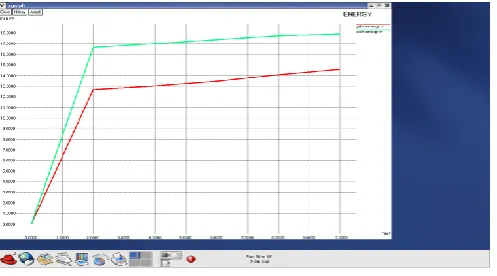
1 . Energy Used
The metric is measured as the percent of energy consumed by a node with respect to its initial energy. The initial energy and the final energy left in the node, at the end of the simulation run are measured. The percent energy consumed by a node is calculated as the energy consumed to the initial energy. And finally the percent energy consumed by all the nodes in a scenario is calculated as the average of their individual energy consumption of the nodes.
Energy used by the vehicles are calculated as follows:
𝑬𝒄 =
𝒊𝒆 − 𝒇𝒆
𝒊𝒆
− − − − − − − − − − − −(𝟏)
𝐴𝐸𝐶 = 𝐸𝑐/𝑁
𝑖𝑘
𝑖
− − − − − − − − − − − − − (2)
Where
Pandian Saraswathi Yadav Engineering College, Arasanoor, Sivagangai, Tamilnadu, India
ie – Initial energy fe – final energy
AEC – Average Energy Consumed by the WSNs Ni – Number of nodes
Fig 4 Comparison Graph for ENERGY
2. Throughput
It is a measure of the amount of data transmitted from the source to the destination in a unit period of time (second). The throughput is measured in total bits received per second. Also to be noted is that this metric only measures the total data throughput, ignoring all other overhead, over the network. The throughput of a node is measured by first counting the total number of data packets successfully received at the node, and computing the number of bits received, which is finally divided by the total simulation runtime. The throughput of the network is finally defined as the average of the throughput of all nodes involved in data transmission.
𝑇ℎ𝑟𝑜𝑢𝑔ℎ𝑝𝑢𝑡 =
𝑡 𝑛𝑜𝑑𝑒𝑠𝑁
− − − − − (3)
Where
t(nodes) – throughput of nodes involved in data transmission N- Number of nodes
C . Packet Delivery Ratio
PDR can be derived from the ratio of the number of received packets by the number of transmitted packets to be received and sent from/to the server respectively. And the PDR is calculated as follows:
𝑝𝑑𝑟 =
𝑛 𝑟𝑝
𝑛 𝑡𝑝
− − − − − − − − − −(4)
Where
Pdr- packet delivery ratio
Pandian Saraswathi Yadav Engineering College, Arasanoor, Sivagangai, Tamilnadu, India
Fig 5 Comparison Graph for THROUGHPUT 3 . Delay
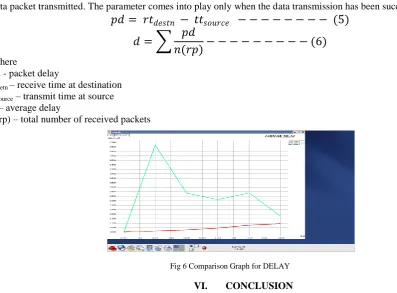
The end-to-end delay is the time taken for a data packet to reach the destination node. The delay for a packet is the time taken for it to reach the destination. And the average delay is calculated by taking the average of delays for every data packet transmitted. The parameter comes into play only when the data transmission has been successful.
𝑝𝑑 = 𝑟𝑡
𝑑𝑒𝑠𝑡𝑛− 𝑡𝑡
𝑠𝑜𝑢𝑟𝑐𝑒− − − − − − − − (5)
𝑑 =
𝑝𝑑
𝑛(𝑟𝑝)
− − − − − − − − − (6)
Where
pd - packet delay
rtdetn – receive time at destination
ttsource – transmit time at source
d – average delay
n(rp) – total number of received packets
Fig 6 Comparison Graph for DELAY
VI. CONCLUSION
Pandian Saraswathi Yadav Engineering College, Arasanoor, Sivagangai, Tamilnadu, India
ACKNOWLEDGEMENT
The authors acknowledge the contributions of the students, faculty of P.S.R.Rengasamy college of Engineering for Women for helping in the design of test circuitry, and for tool support. The authors also thank the anonymous reviewers for their thoughtful comments that helped to improve this paper. The authors would like to thank the anonymous reviewers for their constructive critique from which this paper greatly benefited.
REFERENCES
[1] I. F. Akyildiz, Y. Sankarasubramaniam, E. Cayirci, “WSNs: A Survey” , Computer Networks, Dec. 2001.
[2] K.Akkaya and M.Younis,”A survey of routing protocols in wireless sensor networks,” Elsevier Ad Hoc Network j., vol.3/3,pp.325-349, 2005. [3] W.B. Heinzelman, A.Chandrakasan, and H. Balakrishanan, “An application- specific protocol architecture for wireless sensor networks,” IEEE
Trans wireless Commun, vol. 1, No. 4,pp.660-670, oct.
[4] Wendi Rabiner Heinzelman, Anantha Chandrakasan and Hari Balakrishnan, “Energy- Efficient Communication Protocol for Wireless Micro Sensor Networks”, Proc. International Conf. System Sciences, 2000.
[5] O.Younis, S.Fahmy, “HEED: A Hybrid, Energy-Efficient, Distributed Clustering Approach for ad hoc sensor networks” , IEEE Trans. On Mobile Computing Vol.3, No. 4, Oct-Dec 2004.
[6] Nitin Goel, Goodloo Aujl, ”Hierarchical Energy Efficient Routing Protocol For WSNs”, Proc. Int’l Conf. Communication and Signal processing, April 3-5, 2013.
[7] Nahdia Tabassum, Ouaziehsanul Kabir Mamun, Yoshiyori Urano,” COSEN: A Chain Oriented Sensor Networks For Efficient Data Collection”, IEEE Trans. Computer Security,2006.
[8] Xiaovan Cui, Zhao Liu,” BCEE: A Balanced-Clustering, Energy-Efficient Hierarchical Routing Protocol in WSN”, Proceedings of IC-NIDC, 2009.
[9] kyung tae kim, chang hoon lyu, sung soo moon,” TBC for energy efficient WSN”, Proc. Int’l Con. Advanced Information Networking and Application Workshop,2010.
[10] G.mankar and S.T.bodkhe, ”Traffic Aware Energy Efficient Routing Protocol”, IEEE Trans, 2011.
BIOGRAPHY
G.Karthika has received B.E degree in Computer Science and Engineering from University College of Engineering-Ariyalur 2013. She is currently pursuing Master of Engineering in Computer Science in P.S.R.Rengasamy College of Engineering for Women under Anna University, Chennai. Her areas of interest in research are Wireless Sensor Networks.