321
Shortest Path Using Ant Colony Optimization in VANET
K. Sivakumar1, Dr. C. Chandrasekar2 Department1,2 Computer Science
Email: [email protected], [email protected]
Abstract: VANET is a form of mobile ad-hoc networks (MANET) to provide connections between near vehicles and near fixed equipment. Today VANET used largely function for the public safety, the calm, Travelers Information, Traffic Management, Traffic co-ordination and Assistance etc. The traffic congestion can happen anytime anywhere in the traffic. Its condition where the traffic controls fail and may occur accidents, road maintenance, and rule breaking, etc. therefore, to avoid the traffic congestion. Vehicle traffic congestion leads to air pollution, driver irritation, and costs billions of dollars annually in fuel consumption. Finding a proper solution to vehicle congestion is a great challenge due to the dynamic and unpredictable nature of the network topology of vehicular environments, especially in urban areas. Ant algorithms simulate the cooperative behavior of real ants one of the good way of traffic congestion. Its combines the average travel speed prediction of traffic on roads with map segmentation to reduce congestion as much as possible by finding the least congested shortest paths into order on the road to avoid congestion instead of recovering from it. ACO collects real-time traffic data from vehicles and road side units to predict the average travel speed of roads traffic. It utilizes this information to execute an ant-based algorithm on a segmented map resulting in avoidance of congestion. The outcome shows that when the road is congestion, path algorithm for active traffic network can be more appropriate for traveler to find the path. The simulation result analysis is NS2 and this analysis is providing in terms of performance metrics, such as a packet delivery ratio, the average end-to-end delay, and throughput. Simulation result shows that the ant colony optimization finding the best path to a nest into food in the model area.
KEYWORDS: VANET, ACO, NS2, vehicle traffic congestion, SUMO.
1. INTRODUCTION
For the past 10 years, numbers of Vehicular is increase day by day all over the world, which also increasing more traffics. This large number of vehicles leads to heavy traffic congestion, air pollution, high fuel consumption and following economic issues (Narzt et al. (2010)). New building, high-capacity streets and highways can ease some of the aforementioned problems. However, this solution is very costly, time consuming and in most cases, impossible because of space limitations. On the other hand, optimal usage of the existing roads and streets capacity can lessen the congestion problem in large cities at a lower cost [1].
Intelligent Transportation System (ITS) is a newly emerged system which collects real-time data for congestion monitoring using road side units (e.g. video cameras, radio-frequency identification (RFID) readers and induction loops) and vehicles as mobile sensors (i.e. in-vehicle technologies or smart phones). These data are used by car navigation systems (CNS) to find the shortest path or optimal path from a source to a destination. Other key factors include congestion,
number of traffic lights, number of route lines, accident risk and travel time [2].
This traffic information was provided by existing infrastructures (e.g. Road Side Units) in order to propose a traffic-aware shortest path for users and drivers. Therefore, this information is not only based on the current traffic information but is also based on other metrics such as weather and historical traffic information. It is value noting that their system is reactive and avoids vehicle congestion implicitly, which is still not enough, due to non-recurring congestion. These types of congestion include more than 50% of all vehicle congestion (Coifman mallika (2007)). Moreover, the same path is suggested to users by this system and similar to static algorithms, congestion will be switched from one route to another if a significant number of drivers utilize this system [3].
322 to produce fast, multi-criteria, low cost and robust
solutions for various problems such as routing, scheduling and assignment (Merkle and Blum (2008); Panigrahi et al (2011)). Among these heuristic algorithms, the use of ant colony optimization algorithms has been reported as promising and is one of the best approaches for congestion control and traffic management. Their behavior for survival is the best way of finding shortest path. The goal of Ant Traffic Control System algorithm is to dynamically control the traffic network balance such that traffic flow in the network is optimized. In case one route is blocked or delayed, car drivers should be informed about alternative routes. This paper has proposed the algorithm for the shortest path selecting in dynamic traffic network, based ant algorithm. This measure can help travelers find the route and save time in the countryside of congestion [4-8].
2. VEHICLE AD-HOC NETWORK
VANET (Vehicular Ad Hoc Network) is a subgroup of MANET (Mobile Ad Hoc Network) in this type of communication networks each vehicle represents a node of the network and the communication can occur in two ways [9]:
1. V2V (vehicle-to-vehicle), when the communication is between two or more vehicles,
2. V2I (vehicle-to-infrastructure) when the communication is between a vehicle and a device in the highway.
In this type of network, vehicles may be a router or a simple node. Figure 1 shows a diagram with the main VANET network elements, and the features of VANET networks are shown below [10]:
Dynamic topology: the nodes (vehicles) can reach high speeds, however, unlike MANET networks, these movements are accomplished towards well-defined directions, following paths limited by streets and highways; Network without infrastructure: vehicular communication is based on Ad Hoc architecture, that is, without a main access point;
Discontinuous network: as a consequence of the dynamic topology of the network, a node can easily disconnect from the network;
Unlimited battery: knowing that the vehicle battery is recharged when it is running, the energy of a node can be considered unlimited.
This type of network enables the development of several applications. Vehicular communication is considered the key for increasing traffic safety and a booster in the development of the transportation sector. The VANETs networks applications can be divided into three main groups [9]:
Safety:
The preventing collision and accident reporting.
Information:
Notification of traffic congestion.
Entertainment:
Video streaming and internet access.
Fig.1. Main VANET elements.
323 In a real VANET network, it is possible to
have obstacles between two or more vehicles. These obstacles fade the signal transmitted and delay the communication. Therefore, it is required to find alternative routes of communication for the vehicles in these conditions. This paper proposed Ant Colony Optimization (ACO), a nature-inspired algorithm with fast response time, low computational effort, and that is particularly useful for routing problems and find the good path [9].
2.1 Characteristics of VANET
VANET is an application of MANET but it has its own distinct characteristics which can be summarized as [11]:
2.1.1 High Mobility:
The nodes in VANETs usually are moving at high speed. This makes harder to predict a node’s position and making protection of node privacy [12].
2.1.2 Network topology:
Due to high node mobility and random speed of vehicles, the position of node changes frequently.
2.1.3 Unbounded network size:
VANET can be implemented for one city, several cities or for countries.
2.1.4 Frequent exchange of information:
The ad hoc nature of VANET motivates the nodes to gather information from the other vehicles and road side units.
2.1.5 Wireless Communication:
VANET is designed for the wireless environment. Nodes are connected and exchange their information via wireless.
2.1.6 Sufficient Energy:
The VANET nodes have no issue of energy and computation resources. This allows VANET usage of demanding techniques such as RSA, ECDSA implementation and also provides unlimited transmission power.
2.1.7 Protection:
The VANET nodes are physically better protected. Thus, VANET nodes are more difficult to compromise physically and reduce the effect of infrastructure attack.
3. ANT COLONY OPTIMIZATION
Ant Colony Optimization, it is a Swarm based optimization algorithm and was proposed by Marco Dorigo in 1992. It is basically dependent on how the ants search the food source even though they are blind and carry the food to their nest. The deposition of the chemical substance called as pheromone by the ants on the path they travel and the evaporation of this pheromone over certain duration of time, these are the two most essential terms in Ant colony optimization. With the help of pheromone, ants decide which path to follow; this process is the stigmergic communication [14]. As shown in figure 2, initially all ants move in an unplanned manner to discover the food. When they find food, they carry the food and come to the colony in reverse path by depositing the pheromone along the traveled path [13].
Fig.2. Ants’ deposition of pheromone from the food source to the nest
Now the nest ants which are coming out from the nest will first check for the amount of
324 concentration is highest. As the time passes more ants
will travel on the particular path, which is the shortest path having highest amount of pheromone deposited [13].
3.1 ACO in Traffic Application
Due to its widespread occurrence, traffic congestion is a popular topic of study for the application of Artificial Intelligence. Some of the methods proposed to address the dynamic behavior of traffic congestion using the ACO algorithm. ACO application in traffic network replaces the pheromone with the congestion factor to determine the optimum path. Its application in traffic management involves the determination of the optimum path for a driver to get from one location to another [15].
The advantage of using ACO algorithm in determining the path is that it gives the agents the ability to predict and avoid traffic congestion. After, traffic congestion will be reduced once new traffic
entering the network is discouraged from entering a congested route [16]. Each driver, equipped with a device that is connected to the Global Positioning System (GPS) network, will update their locations consistently to the database where the congestion factor of the road will be calculated based on the number of cars occupying the road and the road capacity.
Fig. 3 shows the current traffic system which transmits traffic information through television or radio which is usually not available in real time to the drivers on the road. The same figure suggests the usage of cell phones built in with GPS to create another layer of connection between traffic system updates and the current, ongoing traffic. The database will store all the values of the road’s congestion factors, the current location and destination of each agent, and ultimately ad hoc situations such as road closures, accidents, and vehicle breakdowns that can cause unusual traffic interference [15].
Fig.3. Different layers of communication within a traffic system
3.2 Algorithm
An algorithm based on the ACO has been designed and modeled in the network simulator. A virtual traffic network has been created and modeled which runs in real time for visual observation. The method used in determining the optimum path is shown in Fig.
325 Fig.4. Flowchart for determining the optimum path using the ACO algorithm
4. SIMULATION RESULT AND WORK
We have used Network simulator 2, having version NS-2.35 to evaluate the different data forwarding protocols. In 1995 network simulator in its Version 1 and in 1996 version 2 network simulators was introduced. To run the simulation in NS-2, Tcl script is required to feed. During the simulation, all the information related to the data packets is stored in the trace files. After the completion of the simulation, the AWK program is used in order analysis the text based trace file and NAM program is to use to analysis the information in terms of animation [13].
4.1 SIMULATION WORK:
In this paper calculate the traffic using No. of vehicle near in the coverage area. More than vehicle present in road capacity, and then assume the place will be traffic accord. Then we will choose an alternate path to the destination using ACO method. The ACO method has helped to identify the alternate path to
quickly reach the destination. Then road capacity calculates the following formula:
[image:5.595.152.456.103.280.2]
Table 1: Simulation Parameters
PARAMETER TYPE VALUE
Network Simulator NS-2.35 Routing Protocol AODV,DSDV,DSR
Simulation Time 499.00
Simulation Area 1000*1000m
Number of Nodes 100
DATA TYPE FTP
Packets Generation Rate 80 kb
Packet Size 160 bytes
MAC Protocol IEEE 802.11
Channel Type Wireless Channel
Antenna Type Omni Antenna
326 Fig.5. SUMO tool graphical view for road-side – 1
327 Fig.7. SUMO Zoom view for traffic signal using sumo tool-1
c
Fig.8. SUMO Zoom view for traffic signal using sumo tool-2
328 5. PERFORMANCE EVALUATION
The performances parameters that can be obtained through the NS2 Trace Analyzer are as follows, which are the main parameters are:
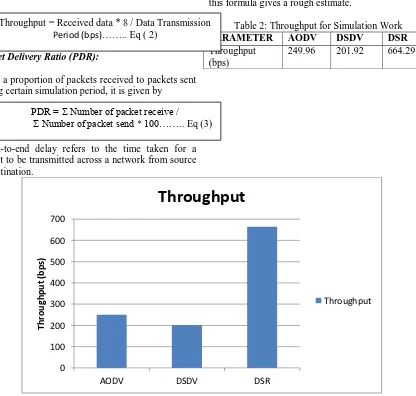
Throughput
Packet Delivery Ratio End to End Delay
Throughput:
Throughput is the rate at which a network sends receives data. It is a good channel capacity of net connections and rated in terms bits per second (bit/s).
Packet Delivery Ratio (PDR):
It is a proportion of packets received to packets sent during certain simulation period, it is given by
End-to-End Delay:
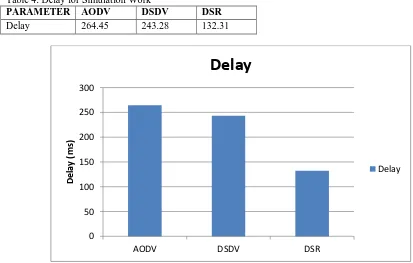
End-to-end delay refers to the time taken for a packet to be transmitted across a network from source to destination.
Where
Where
Dend-end=end-to-end delay, Dproc=procedure delay
Dtrans=transmission delay, Dprop=propagation delay
Dqueue=queue delay
N= number of links (Number of routers + 1)
Each router will have its own dtrans, dprop, dproc hence
[image:8.595.95.511.280.676.2]this formula gives a rough estimate.
Table 2: Throughput for Simulation Work
PARAMETER AODV DSDV DSR
Throughput (bps)
[image:8.595.116.477.454.671.2]249.96 201.92 664.29
Fig.10. Performance Analysis of Throughput
Table 3: Packet Delivery Ratio for Simulation Work
PARAMETER AODV DSDV DSR
PDR 99.33 99.32 99.38
0 100 200 300 400 500 600 700
AODV DSDV DSR
Th
rou
gh
p
u
t
(b
p
s)
Throughput
Throughput
Throughput = Received data * 8 / Data Transmission
Period (bps)…….. Eq ( 2)
PDR = Σ Number of packet receive / Σ Number of packet send * 100…….. Eq (3)
329 Fig.11. Performance Analysis of PDR
Table 4: Delay for Simulation Work
PARAMETER AODV DSDV DSR
Delay 264.45 243.28 132.31
Fig.12. Performance Analysis of Delay
Table 5: Performance value of AODV, DSDV and DSR
PROTOCOLS THROUGHPUT PDR DELAY
AODV 249.96 99.33 264.45
DSDV 201.92 99.32 243.28
DSR 664.29 99.38 132.31
99.29 99.3 99.31 99.32 99.33 99.34 99.35 99.36 99.37 99.38 99.39
AODV DSDV DSR
P
D
R
(
%
)
PDR
PDR
0 50 100 150 200 250 300
AODV DSDV DSR
D
e
la
y
(m
s)
Delay
330 Fig.13. Performance Analysis of AODV, DSDV, DSR protocols
6. CONCLUSION
The beginning simulation result shows that the ACO algorithm is capable of providing the shortest travelling time for an agent moving in a simulated traffic network. After, the algorithm has established to have the ability to create an optimal traffic distribution in a congested traffic network by suggesting the path which is less congested. The results also show that the algorithm performs better in a highly congested traffic situation system.
The results are achieved by analyzing the ability of the algorithm to avoid congested paths and at the same time reducing their total travelling time in the network. The final results show that the ACO algorithm is capable of reducing the travelling time between 21.13% and 38.99%. As a conclusion, the simulation model of the traffic network is optimized by the implementation of the ACO algorithm for path finding, and is best utilized in a highly congested traffic network.
In this paper we have proposed, two ACO based routing protocols AODV, DSDV and DSR. The result of the Ant colony optimize process shows that AODV, DSDV and DSR performs well for Vehicular Ad hoc Networks. This protocol shows good results of parameters such as Throughput, Packet Delivery Ratio, and End-to-End Delay.
REFERENCES
1. Mohammad Reza Jabbarpoura, Ali Jalooli et al “Ant-based Vehicle Congestion Avoidance System using Vehicular Networks”, Engineering Applications of Artificial Intelligence, Elsevier, Nov-2014, Vol-36, 303-319
2. Narzt, W., Wilingseder, U., Pomberger, G., Kolb, D., Hortner, H., “Self organizing congestion evasion strategies using ant-based phseromones”, ITS World Congress Journal Special Issue in IET Intelligent Transport Systems vol.4, Issue.1 93-102, 2010.
3. Pan, J., Khan, M.A., Sandu Popa, I., Zeitouni, K., Borcea, C., “Proactive vehicle re-routing strategies for congestion avoidance”, Distributed Computing in Sensor Systems (DCOSS), 2012 IEEE 8th International Conference on 16-18 May 2012, IEEE. pp. 265-272.
4. Coifman, B.A., Mallika, R., “Distributed surveillance on freeways emphasizing incident detection and verification”. Transportation research part A: policy and practice,Elsevier, Oct-2007, vol.41,P: 750-767.
5. Merkle, D., Blum, C., 2008. Swarm intelligence: Introduction and applications, Springer
6. Blum, C., “Ant colony optimization: Introduction and recent trends”. Physics of Life reviews, Elsevier, vol.2, Dec-2005, 353-373.
7. Yang, X.S., Cui, Z., Xiao, R., Gandomi, A.H., Karamanoglu, M., 2013. Swarm intelligence and bio-inspired computation: Theory and applications, first edition, Elsevier.
8. Panigrahi, B.K., Shi, Y., Lim, M.H., 2011. Handbook of Swarm Intelligence.Springer. 9. Rodrigo Silva et al, “A Heuristic Algorithm
Based on Ant Colony Optimization for Multi-objective Routing in Vehicle Ad Hoc Networks”, Computational intelligence and 11th Brazilian congress on computational intelligence, IEEE, 8-14 sept 2013.
10. R. Michoud, A. M. Orozco, and G. Llano, “Mobile ad-hoc routing protocols survey for the
0 100 200 300 400 500 600 700
THROUGHPUT PDR DELAY
AODV
DSDV
331 design of VANET applications,” in IEEE
Colombian Intelligent Transportation Systems Symposium, 2012, pp. 1-6.
11. Jyoti Jain, Nidhi Chahal “A REVIEW ON VANET, TYPES, CHARACTERISTICS AND VARIOUS APPROACHES” sept 2016.
12. Kalkundri Ravi “AODV Routing in VANET for Message Authentication Using ECDSA” IEEE
Conf. on Communications and Signal Processing (ICCSP), 2014, pp 1389 – 1393.
13. Snehal K. Gaikwad et al “An Ant Colony Optimization based Routing Techniques for VANET” April 2016.
14. V. A. Gajbhiye, R. W.Jasutkar,”Biologically Inspired Routing Protocol for Vehicular Ad hoc Network” 6 International Conference on Advanced Infocom Technology (ICAIT), 2013, IEEE Publications.
15. Shahrizul Anuar Abu Nahar and Fazida Hanim Hashim “Modelling and Analysis of an Efficient Traffic Network Using Ant Colony Optimization Algorithm” July 2011.