
Revisiting Key Schedule’s Diffusion In Relation
With Round Function’s Diffusion
Jialin Huang, Xuejia Lai
Department of Computer Science and Engineering Shanghai Jiaotong University, China
Abstract. We study the weakness of key schedules from an observa-tion: many existing attacks use the fact that the key schedules poorly distribute key bits in the diffusion path of round function. This reminds us of the importance of the diffusion’s relation between key schedule and round function. We present new cryptanalysis results by exploring such diffusion relation and propose a new criterion for necessary key schedule diffusion. We discuss potential attacks and summarize the causes for key schedules without satisfying this criterion. One major cause is that over-lapping between the diffusion of key schedule and round function leads to information leakage of key bits. Finally, a measure to estimate our criterion for recursive key schedules is presented.
Today designing key schedule still lacks practical and necessary princi-ples. For a practical key schedule with limited diffusion, our work adds more insight to its requirements and helps to maximize the security level.
1
Introduction
necessity. Early key schedules are very simple, including following kinds: simple permutation of master key, e.g. DES, IDEA; direct or recursive linear trans-formation from master key. As the development of cryptanalysis technique, the designer began to add non-linear operations, such as S-boxes, into key sched-ules for avoiding related-key (differential) type attacks. Most of non-linear key schedules are falling into three types. First type is similar to the SPN structure of block cipher, such as AES. A typical case of second type is Serpent, which goes through a number of S-boxes after linear transformation. The third type usually uses cipher primitives to generate prekeys–this ensures a certain degree of confusion and diffusion, then transform prekeys into subkeys linearly. These key schedules are invertible to eliminate equivalent keys, which may appear in a one-way situation [17].
Our Contribution.In this paper, we observe that most of the attacks exploit-ing key schedule weakness are based on the fact that the key bits are insufficiently distributed in the diffusion of round function, and give examples to illustrate this fact. From this observation, we point out that the relation between the diffu-sion of cipher function and the diffudiffu-sion of key schedule will affect the degree of encryption process’s dependency on key bits. We discuss this relation in terms of the definitions ofcalculation dependency path andactual key information. A criterion for key schedule is proposed which is ignored by most designers now. Potential attacks when our criterion is not satisfied are discussed and causes are summarized. Moreover, by examining our criterion on other ciphers, new crypt-analysis results are presented, including: meet-in-the-middle attacks on 40-round SHACAL-2 and 25-round XTEA; improving a meet-in-the-middle attack on Ser-pent with lower time complexity and on AES with lower memory complexity; minor improvements for Safer++ and MISTY1. Finally, we present a way to measure our criterion for recursive key schedules.
Since most practical key schedules need high efficiency, their linear diffusion are limited and cannot achieve ”completeness” as in most round functions. How to maximize the security level in this situation is meaningful. Our criterion con-centrates on the linear layer of key schedules, and it is a necessary requirement whatever the non-linear components are.
2
Previous Work and Our Motivation
This section introduces previous design rules for key schedules. We highlight the work relating with linear transformation, and discuss what they lack of.
key schedules with different permutations and potential attacks caused by key schedules without satisfying above principles are not mentioned.
In [2], the author pointed out that all subkeys should be equally good, and defined a so-called ”strong key schedule” with this property: it is ”hard” to find any remaining key bits from any known key bits. The author then proposed a simple ”strong key schedule” using encryption functions.
In [13], the author discovered that several practical attacks utilize the lin-ear relation between subkey bits in different rounds, which avoids considerable amount of work. So he suggested this relation be practically intractable, and proposed two necessary properties: equal effect for all input key bits and weakly one-way. For these properties the author constructed a key schedule with n-folding algorithm and DES(3 single DES and 1 triple-DES), which slows down key setup obviously.
In [3] the author recommended maximizing avalanche in the subkeys. If pos-sible every key bit should affect nearly every round in different ways. More specific principles are given in [4], including: hard to invert; no equivalent keys and collision-freedom–standard hash function properties; no dead spots; equally powerful effect of every key bit on the subkeys.
In [14], the author indicated that knowledge of one subkey provides no leakage of information about any other subkeys. Each subkey is generated by inputting all master key bits to a one-way function, ensuring the avalanche effect and the entropy.
In [11], the author adopted a invertible and recursive structure to design AES key schedule. He claimed that this structure must possess low implementation cost, sufficient diffusion and asymmetry.
In [12], the author stressed on one-wayness and minimal mutual information between all subkey bits and master key bits(using master key bits directly in subkeys leads to the worst case), which can be obtained by one-wayness. He measured one-wayness with Shannon’s bit confusion and bit diffusion with sta-tistical tests.
and this key schedule is proved to exist 2271 equivalent key pairs [17]. Second,
maximizing avalanche effect reminds us of the importance of the diffusion in a key schedule. The AES designer claimed that his key schedule can achieve suf-ficient diffusion by taking a recursive structure. However, this key schedule has caused many attacks due to its slow diffusion, which is not the original intention of the designer. The definition of ”sufficient” or ”slow” for diffusion is unclear and just intuitive. So what requirements should the diffusion of key schedules satisfy? We consider above two problems together by relating the key schedule’s diffusion with the cipher function’s diffusion to propose a more detailed leakage pattern. Through our specific requirements, a key schedule can be designed more targeted.
3
Our Definitions
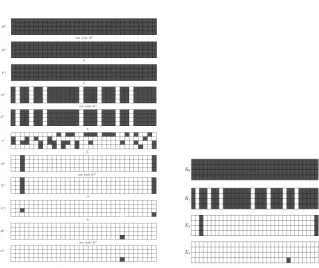
First, we improve a 6-round meet-in-the-middle attack [5] on Serpent [32] for explaining our definitions. The plaintext is B0 and the ciphertext is B6. Bi is the input of round i, Xi is the input of S-box layer in round i, and Yi is the input of linear layer in round i. The bit to meet isX3
3,7(at 3’th row, 7’th column
of X3). Fig. 1 shows the computation flow from the plaintext. The grey boxes
represent the internal bits needed to compute in each round, and it is easy to know which key bits are involved in this computation.
The amount of the involved key is 237 bits by Fig. 1. However, according to the linear transformation in the key schedule, the grey 8 bits in K2 can derive
from the gray bits in K0 and K1. So actually the information of involved key
is 229 bits, with a possible time complexity reduction. We check the decryption flow, and exchange the order of linear transform L in round i-1 and key XOR operation in round i. Instead of guessing K4, and K5, we guess K
0
4 and K
0
5,
Ki0 =L−1(K
i). We need to guess 4 bits in K
0
4, 48 bits in K
0
5 and 124 bits in
K6. The total is 176 bits. So the total complexity depends on the computation
from plaintext. The time complexity of original attack is 2247, while our time
complexity is 2233 with 25 data complexity. The improvement of our attack is
mainly based on two facts. First is the existence of equivalent key steming from the characteristics of key-alternating structure, and this has been used in many other attacks such as on AES and ARIA. We stress on the second fact that the combined action of the key schedule’s diffusion and the round function’s diffusion makes the actual involved key bits less than their expected number. The effect of round function diffusion on the key schedule is not neglectable. One measure for diffusion is the completeness property, which deals with the dependency of each output bit on the input bits. So for the ”incomplete” diffusion, we focus on the dependency of output bits on input bits and give the following definitions.
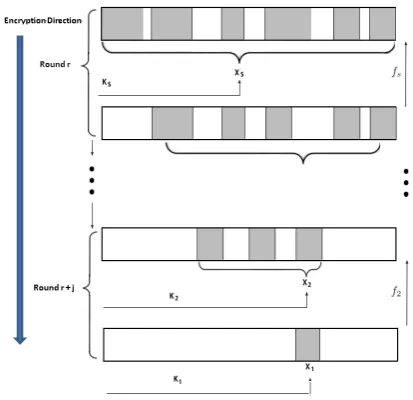
Definition 1. Calculation Dependency Path:X is a m-bit intermediate val-ue. According to the cipher round function, there is a calculation path forX0:
X0 = f1(X1, K1) = f1(f2(X2, K2), K1) = f1(f2(f3(X3, K3), K2), K1) = ...=
Fig. 2.A calculation dependency path. The grey parts areXi. Note that the direction is considered as ”backward”, opposite to the encryption direction. Similarly, a ”forward” calculation dependency path corresponding to decryption process is opposite to the decryption direction.
fi is a sub-function depending on the cipher structure, where i= 1, ..., s.Xi is
the set of input bits forfi andXi−1is the set of output bits, i.e. the calculation of Xi−1 is dependent on Xi and Ki. X →X1 → X2 → ... →Xs is called a
calculation dependency path.
Definition 2. Key Dependency Path:The subkey bits involved in a calcula-tion dependency path are denoted as a key dependency path. That is,K1, K2, ...., Ks.
Definition 3. Actual Key Information(AKI):According to a key schedule, the minimal amount of key bits which can easily derive all subkey bits in a key dependency path is called actual key information.
path depend on the diffusion of round function, and AKI is determined by the diffusion of key schedule. Ciphers with different structures have different forms of sub-functions. Take SPN structure as an example, the sub-functionfican be easily known from the entries of linear transformation matrix corresponding to Xi−1. Look at Fig. 1, the grey boxes in the left show a calculation dependency
path, and in the right show a key dependency path. X0 is X33,7, andXsis B0. The AKI is 229 bits of the linear map of master key.
In a combination of two or more paths, the definition of AKI still holds.
4
Existing Attacks Using Weakness of Key Schedules
One serious weakness of key schedules used by current attacks is the existence of calculation dependency paths missing some bits of master key(’s map). The following examples illustrate how this insufficient AKI plays an important role in an attack1.
4.1 IDEA
IDEA [26] is a 64-bit, 8.5-round block cipher with 128-bit keys. The input of roundiis denoted byXi= (Xi
1,X2i,X3i,X4i). The output of KA layer in round
i isYi = (Yi
1,Y2i,Y3i, Y4i). The subkey of roundiis Zi = (Z1i,Z2i,Z3i, Z4i, Z5i,
Zi
6).pi, qi,si,ti, ui are intermediate values of MA layer in roundi.
Recently, one of the most important cryptanalysis on IDEA is a meet-in-the-middle attack combining with the keyless Biryukov-Demirci relation [6]. The 6-round attack takes use of the following two calculation dependency paths. Backward: s4 → p4 → (Y4
1,Y34) → (X14, X34) → (Y13, t3, Y23, u3) → (Y13, Y23,
p3, q3) → (Y13, Y23, Y33, Y43) → (X13, X23, X33, X43) → (Y12, Y22, Y32, Y42). The key dependency path are: Z14, Z34, Z54, Z13, Z23, Z33, Z43, Z53, Z63, Z52, Z62, with 112-bit AKI(the 50-33 bits of the master key). Forward:s5→p5→(X16,X26)→
(Y16,Y26)→(X17,X27,X37,X47)→(X18,X28,X38,X48)→(Y18,Y28,Y38,Y48). The
involved subkeys are: Z5
5, Z16, Z26, Z56, Z66, Z17, Z27, Z37, Z47, Z57, Z67, Z18, Z28, Z38, Z48,
with 103-bit AKI(the 125-99 bits of the master key). Above AKI are both less than master key size(128-bit), which make a meet-in-the-middle attack possible. The leaked information between these two key dependency paths further reduces memory complexity[6].
Moreover, above 6-round attack is extended into 7.5-round with splice-and-cut technique, using another path [6]: (X2
1,X22, Y32, Y42)→(X11, X21,X31, X41).
The combined AKI of this path(0-95 bits of the master key) and above forward path is only 103 bits, so the top and bottom rounds can be connected to target more rounds. Above backward path is modified as s4 → (X2
1, X22, Y32, Y42),
without changing its corresponding AKI.
Finally, [6] proposed the distributive technique for speeding up exhaustive search, which save the searching complexity for the missing key bits in a calcu-lation dependency path. The path s3 → p3 → (Y13, Y33) → (X13, X33) → (X12, X22, X32, X42) →(X11, Y21, X31, X41) misses 16-24 bits of the master key, so the
attacker can perform operations in this path without guessing these 9 bits, and then perform the rest operations for all of the key guesses. This technique still needs to go over all the possible keys, but performs less than a full encryption for each key.
4.2 KASUMI
KASUMI [27] is a 64-bit, 8-round block cipher with 128-bit keys. The plaintext P = L0||R0. Let Li and Bi be the input and output of i+ 1 round function respectively. X[i1,...,i2] denotes the (i2 -i1 + 1)-bit data fromi1’th bit toi2’th
bit of X. Each round key is made up ofKLi,KOiandKIi. Here,KLi= (KLi,1,
KLi,2),KOi = (KOi,1, KOi,2, KOi,3) and KIi = (KIi,1,KIi,2,KIi,3), which
are linearly derived from the master keyK = (k1,k2,...,k8).
In [7], the author proposed a meet-in-the-middle attack using initial structure and partial matching. The construction of the initial structure is based on a for-ward calculation dependency path:R0[16, ...,31]→(L1[16, ...,31],B0[16, ...,31])
→(L0,B1). In addition, whenL0is 0x0000f f f f, the output of FL has nothing
to do with KL1. So the involved subkeys are:KO1, KI1, KL2, KI2,2,KO2,2,
KI2,3,KO2,3containing 7 16-bit words of master key exceptk3. Similarly, choose
L2 as 0x0000f f f f, the output of FL has nothing to do withKL3, so the
back-ward pathL3[16, ...,31]→(B2[16, ...,31],L1[16, ...,31])→(L2, B1) also exclude
k3. These two paths bring about a initial structure separatingk3 in the process
of searching the total key.
Moreover, using the distributive technique in [6] also can get a factor of almost 2 speedups for exhaustive search on KASUMI. Due to the absence ofk4
andk8in the top and bottom rounds of paths, the part of encryption performed
until the full key guess is thus slightly more than 4 rounds.
4.3 MISTY1
8-round MISTY1 [28] has a more complicate key schedule than KASUMI while other components and structure are similar. However, although this key schedule adds non-linear S-boxes, its diffusion still exists flaws. In [8] the author extended an integral attack to 6-round MISTY1 by applying a weakness of the key sched-ule. We show this weakness also comes from a calculation dependency path with insufficient AKI. This example illustrates more clearly about the concept of sub-function in Definition 1 due to the structure of MISTY1. F Oi denotes FO function in round i, and it includesF Ii,1, F Ii,2, F Ii,3, and two key XOR
FL functions. KLi,1 andKLi,2 are subkeys inF Li. The master key K = (K1,
K2,...,K8), and another 8 16-bit words areK
0
i =F IKi+1(Ki).
This attack starts before the F L3, F L4 layer and ends at the end of the
cipher. The plaintext isP(1..32)||P(33..64)The beginning valueX0 is the input
ofF I4,1.X(i1..i2)denotes the (i2 -i1+ 1)-bit data fromi1’th bit toi2’th bit of
X.D(1..32)is the output ofF L
3,D(33..64) is the output ofF L4.
X0=AKO4,1LIL4=AKO4,1LD(33..48)LOL3
=AKO4,1LD(33..48)LM L3LAKO3,4
D(33..48)=F L
KL4,1,KL4,2(P (33..64))
M L3=F IAKI3,1(AKO3,1
LIL
3)LIR3LF IAKI3,2(AKO3,2
LIR
3)
IL3=F LKL3,1,KL3,2(P (1..32))
IR3=F LKL3,1(P (1..32))
So the calculation dependency path is X0 → (D(33..48), M L3) → (D(33..48),
IL3,IR3)→(P(1..32),P(33..64)), with key dependency pathAKO4,1LAKO3,4,
AKI3,1,AKO3,1,AKI3,2,AKO3,2,KL3,1,KL3,2,KL4,1,KL4,2. Due to the bits
leakage of the key schedule, whenKL3,2 andKL4,1have been guessed,AKI3,1,
AKI3,2is also known. This diminished AKI makes the attack successful. Another
path used in [8] begins from the input ofF I4,2.
4.4 Camellia
In [18], the author gave a few observations on Camellia’s key schedule [29], which can also be summarized as key information leakage in the calculation dependency paths. Take Camellia-128 as an example, the AKI of the combination of (K8,
K9,2) and (K16,2, K17) is only 82 bits(Ki is the subkey of round function F in round i, Ki,j is the j’th byte of Ki), which makes a 4 rounds extension on a 6-round impossible differentials feasible. The same situation also occurs in Camellia-192 and Camellia-256.
5
New Attacks Using Weakness of Key Schedules
By checking calculation dependency paths, we find new meet-in-the-middle at-tacks for 40-round SHACAL-2 and 25-round XTEA. In addition to Serpent men-tioned in Section 3, we also improve previous attacks on AES and Safer++.
From now on, X[i1] denotes thei1’th bit of X, and X[i1,...,i2] denotes the (i2
-i1 + 1)-bit data fromi1’th bit toi2’th bit of X.
5.1 SHACAL-2
SHACAL-2 [21] is composed of 64 rounds using a variable key length up to 512 bits. A 256-bit plaintext is divided into eight 32-bit words A, B, C, D, E, F, G, H.Pi is the input of round i, andPi+1 is the output of round i.
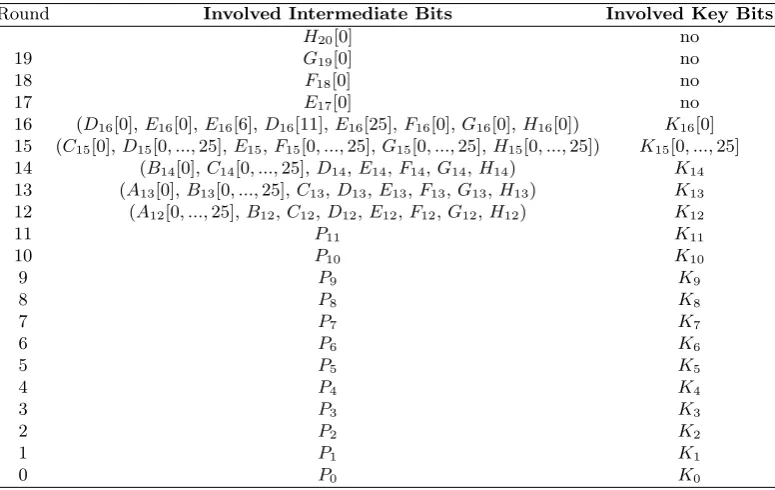
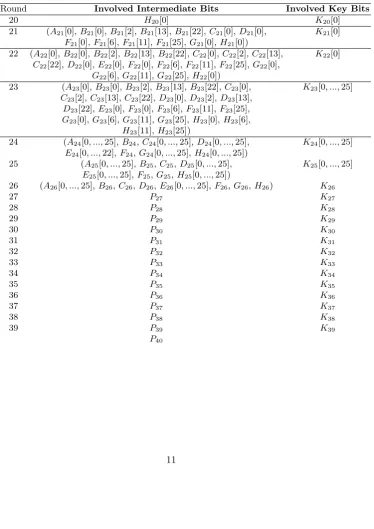
keys. The plaintext is P0, and the ciphertext is P40. We find a forward and a
backward calculation dependency paths with insufficient AKI both starting from H20[0]. See Table. 1 and Table. 2.
Table 1.The Backward Calculation Dependency Path and Its Key Dependency Path
Round Involved Intermediate Bits Involved Key Bits
H20[0] no
19 G19[0] no
18 F18[0] no
17 E17[0] no
16 (D16[0],E16[0],E16[6],D16[11],E16[25],F16[0],G16[0],H16[0]) K16[0] 15 (C15[0], D15[0, ...,25],E15,F15[0, ...,25],G15[0, ...,25],H15[0, ...,25]) K15[0, ...,25] 14 (B14[0],C14[0, ...,25],D14,E14,F14,G14,H14) K14 13 (A13[0],B13[0, ...,25],C13,D13,E13,F13,G13,H13) K13 12 (A12[0, ...,25],B12,C12,D12,E12,F12,G12,H12) K12
11 P11 K11
10 P10 K10
9 P9 K9
8 P8 K8
7 P7 K7
6 P6 K6
5 P5 K5
4 P4 K4
3 P3 K3
2 P2 K2
1 P1 K1
0 P0 K0
The AKI of the backward path is 507 bits. There are totally 529 bits in the forward path which should have cover all the 512 bits master key. However, the leakage reduce the AKI to only 508 bits. With the knowledge of K24[0, ...,25],
K25[0, ...,25], K26, ..., K39, once we guess K24[26, ...,31], according to the key
schedule K23[0, ...,25] andK22[0] can be derived.
With above two paths we can mount a basic meet-in-the-middle attack by checking ifH20[0] computed from plaintexts and ciphertexts match. We choose
4 plaintexts and their ciphertexts. The time complexity for meet-in-the-middle phase is 2508+ 2509, and for searching phase is 2508, totally 2510.
Table 2.The Forward Calculation Dependency Path and Its Key Dependency Path
Round Involved Intermediate Bits Involved Key Bits
20 H20[0] K20[0]
21 (A21[0],B21[0],B21[2],B21[13],B21[22],C21[0],D21[0], K21[0] F21[0],F21[6],F21[11],F21[25],G21[0],H21[0])
22 (A22[0],B22[0],B22[2],B22[13],B22[22],C22[0],C22[2],C22[13], K22[0] C22[22],D22[0],E22[0],F22[0], F22[6],F22[11],F22[25],G22[0],
G22[6],G22[11],G22[25],H22[0])
23 (A23[0],B23[0],B23[2], B23[13],B23[22],C23[0], K23[0, ...,25] C23[2],C23[13],C23[22],D23[0],D23[2],D23[13],
D23[22],E23[0],F23[0],F23[6],F23[11],F23[25], G23[0],G23[6],G23[11],G23[25],H23[0], H23[6],
H23[11],H23[25])
24 (A24[0, ...,25],B24,C24[0, ...,25],D24[0, ...,25], K24[0, ...,25] E24[0, ...,22],F24,G24[0, ...,25],H24[0, ...,25])
25 (A25[0, ...,25],B25,C25,D25[0, ...,25], K25[0, ...,25] E25[0, ...,25],F25,G25,H25[0, ...,25])
26 (A26[0, ...,25],B26,C26,D26,E26[0, ...,25],F26,G26,H26) K26
27 P27 K27
28 P28 K28
29 P29 K29
30 P30 K30
31 P31 K31
32 P32 K32
33 P33 K33
34 P34 K34
35 P35 K35
36 P36 K36
37 P37 K37
38 P38 K38
39 P39 K39
5.2 XTEA
XTEA [30] has 64-bit block size and 128-bit key size, which is extended from TEA [36]. The best 25-round result is a three-subset meet-in-the-middle with 9 known plaintexts and 2120.4 XTEA computations [37]. Other recent results
include [9, 22]. Our 25-round attack has similar complexity with [37] but is much simpler. The attacks in [9, 37] and ours all make use of calculation dependency paths without enough AKI.
Li||Ri andLi+1||Ri+1 is the input and output of round i. The master key is
made of four 32-bit wordsK0, K1,K2 andK3. Our attack is from round 23 to
round 47, with the plaintextL23||R23 and the ciphertextL48||R48. We compute
L36[0] from the plaintexts and the ciphertexts, and check if they match.
We trace those bits needed to know during the calculation for L36[0] from
plaintext. In order to compute L36[0], we need to compute R35[0]; In order
to compute R35[0], we need to compute L34[0], R34[0], R34[5], and so on. This
path is illustrated in Appendix 1. By examining the key schedule, we find that K3[21, ...,31] of master key are not used. Similarly, K0[21, ...,31] are not used
for computingL36[0] from ciphertext. The attack is as follows:
Algorithm 5.1: A meet-in-the-middle attack for 25-round XTEA(P)
for eachguess of K0[0, ..,20], K1, K2, K3[0, ..,20]
do
for eachguess of K0[21, ...,31]compute Li36[0]f rom pi, i= 0, ..,7,
store these Li
36[0]in a hash table
for eachguess of K3[21, ...,31]compute Li36[0]f rom ci, i= 0, ..,7,
check if there is a match in the table
if there is a match in the table, choose as a candidate key. Exhaustively search the candidate keys.
The time complexity of the meet-in-the-middle phase needs 2106+11+3= 2120
encryption. There are 2128−8= 2120 candidate keys left, so the searching phase
needs 2120encryption. The total time complexity is 2121, and the data complexity is 8.
5.3 AES
AES has 128-bit block size and supports three key sizes: 128, 192, and 256 bits. It is byte-oriented, and the state is organized as a 4 × 4 table with one-byte entries.K(r) andC(r)denote the subkey and the ciphertext of r’th round.Kˆ(r)
=M ixColumns−1(K(r)).X
i,j denotes the byte of X at row i, column j. Two calculation dependency paths both starting from C1(5),1 are used. The
forward is:C1(5),1 →(C1(6),1,C2(6),1,C3(6),1,C4(6),1)→C(7) →C(8), with key dependency path denoted as A: Kˆ1(6),1, Kˆ1(7),1, Kˆ2(7),4, Kˆ3(7),3, Cˆ4(7),2, K(8). The backward is: C1(5),1
→ (C1(4),1, C2(4),2, C3(4),3, C4(4),4) → (M1(4),1, M2(4),2, M3(4),3, M4(4),4)(M is the value after MixColumn), with key dependency path denoted as B:K1(4),1,K2(4),2, K3(4),3, K4(4),4,
K1(5),1. Another key path denoted as C is:K1(0),1,K2(0),2,K3(0),3,K4(0),4,K1(1),1.
In [23], the author described a meet-in-the-middle attack on 8-round AES-256 with two parts. First is precomputing all possible mappings of C1(1),1 → C1(5),1. Then search key bytes in A and C to choose and encrypt a suitable plaintext set, and do a partial decryption on the ciphertext set.
Algorithm 5.2: A meet-in-the-middle attack for 8-round AES-256(P)
for eachguess of K3(4),3, K4(4),4, K1(5),1
do
for eachguess of c0, .., c21
do
(
precompute fc
0,..,c21,K3,3(4),K (4) 4,4,K
(5) 1,1
(x), x= 0, ...,255
Store the2176256 bytes sequence in a hash table
for eachguess of key bytes in path C
do
P artially encrypt the set of 232 plaintexts to get the intermediate values of C(1) Choose256 plaintexts that C1(1),1 takes every possible value and the other bytes f ixed Sort the256 plaintexts chosen above indexed by their values of C1(1),1
for eachguess of K1(4),3, K2(4),3, K2(4),4, K3(4),4, K4(4),3,
column2of K(6), column1of K(8),Kˆ1(6),1,Kˆ1(7),1,Kˆ2(7),4,Kˆ3(7),3,Kˆ4(7),2
do
Deduce K1(4),4 f rom K1(5),1, K1(4),3, andK1(1),1 Deduce column2, 3, 4of K(8)
P artially decrypt the ciphertexts corresponding to the256 plaintexts to get the sequence of the intermediate values of C1(5),1.
If this sequence matches one of the2176sequences in the hash table,
record the key as a candidate, otherwise, continue with another guess.
The precomputation needs to search subkeys in path B and other 20 param-eters, 25 bytes totally:c0,..,c21,K
(4) 3,3,K
(4) 4,4,K
(5) 1,1.
3, 4 of the subkeyK(6), columns 3, 4 of the subkeyK(4), column 4 ofK(2). So
K3(4),3,K4(4),4are leaked. Also,K1(3),1 can derive from the knowledge ofK1(1),1(belongs
to key path C) andK1(2),4, thenK1(5),1 is also leaked fromK1(3),1 andK1(4),4.
By above observation we can reduce the memory complexity by a factor of 224 with a similar method mentioned in [6]. We rearrange the key bytes in the
key search phase.
Choose a set of 232 plaintexts with bytes on the diagonal taking all possible values and the other 12 bytes fixed. Obtain the corresponding ciphertexts. The attack is Algorithm 5.2.
The memory complexity of this attack is 2176 × 256 = 2184 bytes, while the
original attack is at least 2208 bytes. With a time-memory tradeoff, the original
attack can reduce the memory complexity at the cost of increasing the time complexity. Our attack obtains a lower memory complexity without changing the time complexity–2208 encryptions. This is not the best result for 8-round
AES-256, but can remind us of examining the key schedule more carefully.
5.4 Safer++
The author in [25] proposed integral cryptanalysis on 4-round Safer++256[33].
We find that a slight modification for this attack can bring another one round extension. K2r−1 and K2r are subkeys in round r. K
(p)
i denotes the p’th byte of Ki. A forward key dependency path is as follows: K
(1) 7 , K
(1) 8 , K
(5) 9 , K
(6) 9 ,
K9(7),K9(8),K9(9),K9(12), K10(5), K10(6), K10(7),K10(8),K10(9),K10(12). Another key path is: K1(3), K1(4), K1(6), K1(7), K1(9), K1(10), K1(13), K1(16), K2(3), K2(4), K2(6), K2(7), K2(9),K2(10),K2(13),K2(16). Although the combination of these two paths relates to 30 bytes subkeys, its AKI is only 22 bytes. This makes the 5-round attack successful: 2-round integral property and 3 rounds external extension. Unlike the original attack, we only check whether one byte is balanced and this is enough to be a non-trivial attack.
6
Our Criterion and Further Discussion
Considering above attacks, we propose a criterion for the design of key schedule:
A key schedule should have no r-round key dependency path with AKI less than the size of master key.r is dependent on specific security standards for different block ciphers. For a high security level, r should be as small as possible. We discuss the unsafe consequences when our criterion is not satisfied:
– If a backward/forward calculation dependency path of length r with insuf-ficient AKI exists, then there is a r-round extension for an attack with a proper data complexity. e.g. the attacks in [24] and in Section 4.3.
– If a backward calculation dependency path of lengthr1and a forward
calcu-lation dependency path of lengthr2 with insufficient AKI and certain kind
reduced when there is leakage in their key dependency paths. e.g. the attack in Section 5.3. The simplest connection is that the outputs of these two paths are the same one, which results in a basic meet-in-the-middle attack. If the connection is ofr3 length, there is a (r1+r2+r3)-round attack.
– If the total AKI of the combination of paths at the top and bottom is insuf-ficient, a basic splice-and-cut technique is feasible. e.g. the attack in [6]. – If there are calculation dependency paths with insufficient AKI in successive
sub-functions, a construction for initial structure is feasible. e.g. the attack in Section 4.2.
– When a calculation dependency path has been used in an attack, the exis-tence of missing key bits in segments of this path will further reduce the time complexity. That is, we generalize ”The distributive technique” mentioned in [6] to other attack scenarios—the original technique is just as an opti-mization for exhaustive search. We divide a path into consecutive segments and for some segments the search computation for the missing key bits is saved. For example, we can reduce the time complexity of 6-round attack on MISTY1 in [8] at least by a factor of 2. We separateK40 and K6 from the
key guessing process, since they are only used inAKI3,2,KL4,1andKL4,2.
That is, when we computeD(33..48)from the plaintexts, we needn’t to guess
K2, K
0
8, K3, K5. The attacks for XTEA in [9] and Section 5.2 can also be
slightly improved by this technique. The longer the segment is and the less AKI the segment has, the more time complexity can be reduced. Although improvement brought by this technique is very minor, it still implies a po-tential defect for key schedules. Even it is uncertain whether there will be any kinds of disastrous attacks based on this defect, obviously many existing attacks are easier than what they were considered before.
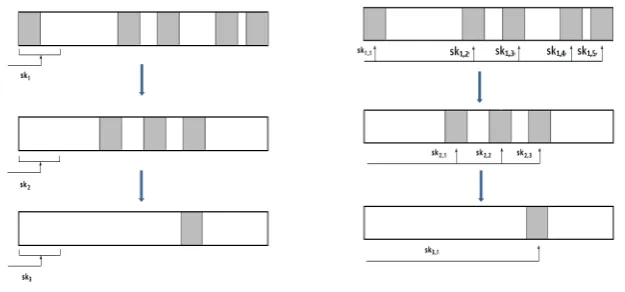
There are three major causes for existing key schedules without satisfying our criterion. In order to explain more clearly, we give 3-round examples which are simple but typical.
– The subkey bits are poorly used and distributed by the round function, especially when the subkey size is much smaller than the block size and master key size. For the 3-round path in the left of Fig. 3, it is obvious that only part ofsk1is involved, whilesk2andsk3 are not used and distributed.
– The subkeys do not increase the avalanche effect of the master key(e.g. simple permutation), so key dependency paths probably contain a small amount of key information. See the right of Fig. 3, in this situation the first cause is eliminated and each intermediate value is keyed. Suppose that the master key is (K1,K2,...,Kk),sk1,1=K2,sk1,2=K1,sk1,3=K5,sk1,4=K3,sk1,5
=K8,sk2,1 =K3,sk2,2 =K5,sk2,3 =K8,sk3,1 =K1. Although there are
9 sub-blocks of subkeys in this path, their AKI is only 5 sub-blocks. – The key information leakage decreases the AKI. In our context, the leakage
master key and have some avalanche effect. Suppose thatsk2,1 = sk1,1 ⊕
sk1,2 ⊕sk1,3, sk2,2 =sk1,2 ⊕sk1,4 ⊕ sk1,5,sk3,1 =sk1,5 ⊕sk2,1 ⊕sk2,3,
the AKI is 6 sub-blocks.
Fig. 3.Examples corresponding to different causes.skimeans the subkey in round i. ski,j means the j’th sub-block ofski which is involved in the calculation dependency path.
According to above causes, we suggest more detailed requirements for a key schedule. Every forward and backward key dependency path as well as their combinations should be carefully examined.
– The subkey size is no small than the block size and master key size, which makes sure every intermediate value in a path get keyed.
– More and more key bits should be involved with each transformation in the key schedule. A simple permutation, e.g. shift or rotation, is not preferred. Binary linear operations such as XOR and modulo addition are better. – The diffusion path in the key schedule should be totally inconsistent with the
diffusion in round function. That is, any subkey bits cannot be determined by the subkey bits that are in the same key dependency path.
7
Measure for Recursive Key Schedule
subkeys on-the-fly without precomputaion, which is especially requisite in hash mode application; increasing the avalanche effect of key bits round-by-round; security measure can be more normative and systematic. Recursive key schedules can help to control the speed and pattern of key bits diffusion by the iteration. We only need to investigate one round transformation and the results can extend to any rounds. If each subkey directly transforms from the master key without relations with its neighbour rounds, the measure is hard since we need to check key dependency paths from each round.
Consider the three causes we summarized in Section 6. The first cause is main-ly due to the structure of block cipher and has nothing to do with key schedule’s diffusion. Also, if the linear operations in recursive key schedules cannot involve more bits to increase the diffusion after each round (e.g, shift, rotation), we can analyze these simple key schedules directly and eliminate the second cause. Thus we only consider those recursive linear transformations with operations in-troducing more diffusion(e.g, XOR and modulo addition), and focus on avoiding the third cause: the diffusion of key schedule does not result in key information leakage in the diffusion path of round cipher. Note that this is only a necessary condition for a secure key schedule.
Usually linear transformations of both block cipher and key schedule can be represented as follows: LT → yj = Pai,jxi+bj, whereyj and xi are the output and input respectively, and bj ∈ GF(2) is the constant coefficient. All ai,j over GF(2) constitute the representing matrix, andai,j = 1 means output j is dependent on input i. So we can know the input bits that each output bit depends on from each column of the matrix. M1 represents the matrix of the
round function, and M2 represents the matrix of the key schedule. We discuss
the conditions M2 should satisfy when M1 is known.
Denote k as master key size and n as block size. We take k = 2n as an example, since this is common but typical when master key size larger than block size. For many block ciphers this situation is more vulnerable to attack than thatk=n, so it deserves more attention. We consider consecutive 4 rounds of cipher, corresponding to 2 rounds of key scheduling. We take two rounds of
cipher as one and the equivalent transformation matrixM10 is
M2 1 M1
M3 1 M12
, with
the identity matrix rewritten as I0 =
I 0 M1I
. Now M10, I0 and M2 have the
same size k×k. In our context, addition and multiplication are OR and AND respectively, and weight(·) means Hamming weight.
M2= (α1,α2,...,αk),αi is the column vector ofM2.
M10 = (γ1,γ2,...,γk),γi is the column vector ofM
0
1.
eiis ak-bit vector, wherei’th bit equal to ”1” and other bits are ”0”,i= 1, ..., n. For each i, i∈[1..n]:
Step.1 θ=I0 ·ei = (θ1,θ2,...,θk). Step.2 β =M10 ·θ=
Pk
Step.3 For eachj, j∈[1..k], if weight(θjαj+β)>weight(β), increase AKI by 1 bit, else makeθj equal to 0. Check if AKI = k. If AKI = k, go Step.4, otherwise,M2is unsafe.
Step.4 For any subset s with elements chosen fromθ1, θ2,...,θk, if weight(P
θj∈sθjαj
+β)-2 weight(β)<weigth(s),
AKI = AKI - weight(s) +3 weight(P
θj∈sθjαj+β) - weight(β).
If AKI< k,M2 is unsafe.
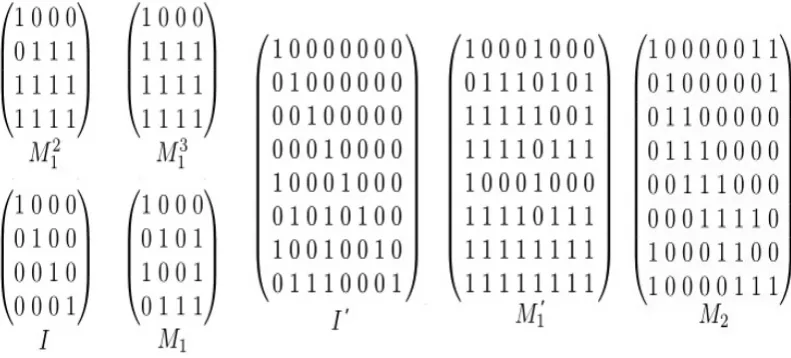
By inverse of LT we can examine the other direction of key dependency paths. We show an example to explain above procedure in Fig. 4. AssumeM1is
4×4 andM2 is 8×8, i.e.k= 8, and n= 4. They are as follows:
Fig. 4.Matrices of round function diffusion and key schedule diffusion.
Wheni= 1, θ= (1,0,0,0,1,0,1,0), β = (1,0,1,1,1,1,1,1), AKI = 7. Forj= 1, θ1α1= (1,0,0,0,0,0,1,1),θ1α1+β =β. For otherj, we can check thatθjαj+β= β. So there is nojsatisfying that weight(θjαj+β)>weight(β), AKI still equals to 7 bits. This shows that M2 is unsafe and we need not go Step.4.
8
Conclusion
This paper focuses on the diffusion of key schedules and proposes a criteri-on by the definiticriteri-on of AKI: every key dependency path correspcriteri-onding to the calculation dependency path should have enough AKI–the actual required key
2 Here is the decimal subtraction, similarly hereinafter. 3
information. We have shown several published attacks to explain our criterion, and presented new cryptanalysis results on SHACAL-2, XTEA, Serpent, AES and Safer++. We believe that this criterion can be used to improve attacks for other block ciphers by analyzing their key schedules. Many previous design rules of key schedules lack necessity or practicality, so it is hard to convince designers to follow. Our work gives a practical guidance for both the design and the crypt-analysis. Open problems include how to design efficient key schedules satisfying our criterion and how to develop new attacks based on weak key schedules with paths of insufficient AKI. Our work emphasizes that the interaction between the diffusion of cipher round function and the diffusion of key schedule should get more attention. An analysis for the linear transformation of recursive key schedules is given in our work, and more effective and generalized analysis tools can be further developed.
References
1. J. Kelsey, B. Schneiery, and D. Wagner, Key Schedule Weaknesses in SAFER+, Second AES Candidate Conference, 1999.
2. Lars R. Knudsen, Practically secure Feistel ciphers, FSE 1993, LNCS, Vol. 809, pages 211-221, Springer, 1994.
3. J. Kelsey, B. Schneier, and D. Wagner, Key-Schedule Cryptanalysis of IDEA,
G-DES, GOST, SAFER, and Triple-DES, Advances in Cryptology–CRYPTO’96,
pages 237-251, Springer, 1996.
4. J. Kelsey, B. Schneier, and D. Wagner, Related-Key Cryptanalysis of 3-WAY,
Biham-DES, CAST, DES-X, NewDES, RC2, and TEA, INFORMATION AND
COMMUNICATIONS SECURITY 1997, LNCS, Vol. 1334, pages 233-246.
5. T. Kohno, J. Kelsey, and B. Schneier,Preliminary Cryptanalysis of Reduced-Round
Serpent, Third AES Candidate Conference, pages 195-211, 2000.
6. E. Biham, O. Dunkelman, N. Keller, and A. Shamir,New Data-Efficient Attacks on
Reduced-Round IDEA, http://eprint.iacr.org/2011/417.
7. K. Jia, H. Yu, X. Wang, A Meet-in-the-Middle Attack on the Full KASUMI, http://eprint.iacr.org/2011/466.
8. X. Sun, X. Lai,Improved Integral Attacks on MISTY1, SAC 2009, LNCS, Vol. 5867, pages 266-280.
9. G. Sekar, N. Mouha, V. Velichkov, B. Preneel, Meet-in-the-Middle Attacks on
Reduced-Round XTEA, Topics in Cryptology - CT-RSA 2011, LNCS, Vol. 6558,
pages. 250-267. Springer 2011.
10. J. Kelsey, B. Schneier,Key-Schedule Cryptanalysis of DEAL, SAC ’99 Proceedings of the 6th Annual International Workshop on Selected Areas in Cryptography pages 118-134.
11. J. Daemen, V. Rijmen,The Design of Rijndael AES - The Advanced Encryption Standard, 2002.
12. L. May, M. Henricksen, W. Millan, G. Carter, and E. Dawson, Strengthening the
Key Schedule of the AES, INFORMATION SECURITY AND PRIVACY, LNCS,
2002, Vol, 2384, pages 117-134.
14. G. Carter, E. Dawson, L. Nielsen,Key Schedules of Iterative Block Ciphers, IN-FORMATION SECURITY AND PRIVACY LNCS, 1998, Vol. 1438, pages 80-89. 15. L. Brown, Key scheduling DES type cryptosystems, Auscrypt 1990 Advances in
Cryptography, pages 221-228, Springer 1990.
16. L. Brown,A Proposed Design for an Extended DES, Computer Security in the Age of Information, W. J. Caelli (editor), North-Holland, Amsterdam, 1989.
17. J. Choy, A. Zhang, K. Khoo, M. Henricksen, and A. Poschmann,AES Variants
Se-cure Against Related-Key Differential and Boomerang Attacks, WISTP 2011, LNCS,
Vol. 6633, pages 191-207, Springer, 2011.
18. J. Lu, Y. Wei, J. Kim, P.A. Fouque, Cryptanalysis of Reduced Versions of the
Camellia Block Cipher, SAC 2011.
19. Y. Shin, J. Kim, G. Kim, S. Hong and S. Lee, Differential-Linear Type Attacks
on Reduced Rounds of SHACAL-2, INFORMATION SECURITY AND PRIVACY,
LNCS, 2004, Vol. 3108, pages 110-122.
20. Y. Wei, Y. Hu, J. Chen, Differential-nonlinear attack on 33-round SHACAL-2
Journal of Xidian University 2010.
21. H. Handschuh, D. Naccache, SHACAL : A Family of Block Ciphers, Submission to the NESSIE project, 2002, http://www.cryptonessie.org.
22. A. Bogdanov, M. Wang,Zero Correlation Linear Cryptanalysis with Reduced Data
Complexity, FSE 2012.
23. H¨useyin Demirci, and Ali Aydin Sel¸cuk,A Meet-in-the-Middle Attack on 8-Round AES, proceedings of FSE 2008, LNCS, vol. 5086, pages 116-126, Springer, 2008. 24. N. Ferguson, J. Kelsey, S. Lucks, B. Schneier, M. Stay, D. Wagner, and D. Whiting,
Improved cryptanalysis of Rijndael, In B. Schneier, editor, FSE, LNCS, vol. 1978, pages 213-230, Springer, 2000.
25. G. Piret and J.J. Quisquater, Integral Cryptanalysis on reduced-round Safer++, IACR Cryptology ePrint Archive(2003)33-33.
26. X. Lai, J.L. Massey, and S. Murphy,Markov Ciphers and Differential Cryptanaly-sis, Advances in Cryptology, proceedings of EUROCRYPT 1991, LNCS 547, pages 17C38, Springer, 1992.
27. 3rd Generation Partnership Project, Technical Specification Group Services and System Aspects, 3G Security, Specification of the 3GPP Confidentiality and Integri-ty Algorithms; Document2: KASUMI Specification, V3.1.1 (2001).
28. M. Matsui,New Block Encryption Algorithm MISTY, FSE 1997, pages 54-68. 29. K. Aoki, T. Ichikawa, M. Kanda, M. Matsui, S. Moriai, J. Nakajima, T. Tokita,
Camellia: a 128-bit block cipher suitable for multiple platformsdesign and analysis, In: Stinson, D.R., Tavares, S.E. (eds.) SAC 2000. LNCS, Vol. 2012, pages 39-56. Springer, 2001.
30. R.M. Needham, D.J. Wheeler,Tea extensions, technical report, Computer Labora-tory, University of Cambridge, 1997, http://www.cix.co.uk/klockstone xtea.pdf. 31. C.H. Meyer, S.M. Matyas,Cryptography: A New Dimension in Data Security, John
Wiley , Sons, New York, 1982.
32. R. Anderson, E. Biham, Lars R. Knudsen,Serpent: A Proposal for the Advanced
Encryption Standard, NIST AES Proposal, 1998.
33. J.L. Massey, G.H. Khachatrian, and M.K. Kuregian,Nomination of SAFER++ as
Candidate Algorithm for NESSIE, http://www.cryptonessie.org.
34. Lars R. KnudsenA Detailed Analysis of SAFER K, JOURNAL OF CRYPTOL-OGY, Vol. 13, pages 417-436, 2000.
36. D.J. Wheeler, R.M. Needham,TEA, a Tiny Encryption Algorithm, FSE 1994, Vol. 1008, pages 363-366, Springer, 1994.
37. Y. Sasaki, L. Wang, Y. Sakai, K. Sakiyama, and K. Ohta, Three-Subset
Meet-in-the-Middle Attack on Reduced XTEA, AFRICACRYPT 2012, LNCS, Vol. 7374,
pages 138-154.
![Fig. 5. The backward calculation dependency path for L36[0].](https://thumb-us.123doks.com/thumbv2/123dok_us/7888031.1308875/21.595.147.542.240.515/fig-backward-calculation-dependency-path-l.webp)
