One-Key Compression Function Based MAC
with Security beyond Birthday Bound
Avijit Dutta, Mridul Nandi, Goutam Paul
Indian Statistical Institute, Kolkata 700 108, India. [email protected], [email protected],
Abstract. Gaˇzi et al. [CRYPTO 2014] analyzed the NI-MAC construc-tion proposed by An and Bellare [CRYPTO 1999] and gave a tight birthday-bound ofO(`q2/2n), as an improvement over the previous bound
ofO(`2q2/2n). In this paper, we design a simple extension of NI-MAC, called NI+-MAC, and prove that it has security bound beyond birthday (BBB) of order O(q2`2/22n) provided` ≤ 2n/4. Our construction not only lifts the security of NI-MAC beyond birthday, it also reduces the number of keys from 2 (NI uses 2 independent keys) to 1. Before this work, Yasuda had proposed [FSE 2008] a single fixed-keyed compression function based BBB-secure MAC with security boundO(`q2/22n) that
uses an extra mask, requires a storage space to store the mask. However, our proposed construction NI+ does not require any extra mask and thereby has reduced the state size compared to Yasuda’s proposal [FSE 2008] with providing the same order of security bound for light-weight applications
Keywords: Beyond Birthday, MAC, NI, Structure-Graph.
1
Introduction
problem becomes the main bottleneck.
NMAC and HMAC. NMAC and its variant HMAC [2] is the first re-keying compression function based MAC where a key is appended to a message and then the appended message is hashed using Merkle-Damg˚ard technique. It has been standardized in [23] and has become popular and widely used in many network protocols like SSH, IPSec, TLS etc. Bellare et al. in [2] proves that NMAC is a secure PRF based on the assumption (i) f is a secure PRF and (ii)Cascfis a WCR (weakly collision resistant). HMAC, when instantiated with MD4 or SHA-1, plays the role ofCascfand both have been found not to satisfy the WCR property [37, 38] and hence the security of HMAC [2] stands void. To restore the PRF security of NMAC, Bellare in [6] investigates the proof and drops assumption (ii). Koblitz and Menezes in [22] criticizes the way [6] discusses the practical implication of their result against uniform and non-uniform reductions used in the proof.
Dodis et al. in [12] investigates the indifferentiable property of HMAC from a keyed random oracle. In a recent line of researches, generic attack against iterated hash based MAC are being investigated [31, 32, 30, 25]. More recently, Gaˇzi et al. in [14] showed a tight bound on NMAC. There is also a recent result [15] on the generic security analysis of NMAC and HMAC with input whitening.
Yasuda in [40] had proposed a novel way of iterating a compression function dedicated for the use of MAC which is more efficient than standard HMAC to process data much faster. In [42] Yasuda has showed that classical sandwiched construction with Merkle-Damg˚ard iteration based hashing provides a secure MAC which is an alternative for HMAC, useful in situation where the message size is small and high performance is required. A new secret-prefix MAC based on hash functions is presented in [45] which is similar to HMAC but does not require the second key.
U. Maurer et al. in [27] has presented a MAC construction namely PDI, that transforms any Fixed-Input Length (FIL) MAC to Alternative Input Length (AIL) MAC and investigated the tradeoff between the efficiency of MAC and the tightness of its security reduction. In [28] construction of AIL MAC from a FIL MAC with a single key was presented which is better than NI [1].
Beyond Birthday Secure MAC.We discuss two types of MACs in this cat-egory - one is block cipher based and the other one is compression function based.
•Block Cipher Based Beyond Birthday Secure MAC.Recently, many MAC con-structions have been proposed with security beyond the birthday barrier without degrading the performance. The first attempt was made in ISO 9797-1 [3] with-out security proof. But Algorithm 4 of ISO 9797-1 was attacked by Joux et al. [20] that falsified the security bound. Algorithm 6 of ISO 9797-1 was proven to be secure againstO(22n/3) queries with restrictions on the message length [46].
construc-tion [47] with beyond birthday security. In 2012, Zhang et al. [50] proposed a 3key version of f9 MAC (3kf9) that achieves BBB security.
There is also another deterministic MAC mode provides security beyond the birthday bound. Given ann-bit to n-bit fixed-key block cipher with MAC securityagainstqqueries, Dodis et al. [13] have designed a variable-length MAC achievingO(qpoly(n)) MAC security. However, this design requires even longer keys and more block cipher invocations. By parity method, Bellare et al. present MACRX [3] with BBB security, conditioned on the input parameters are random and distinct. In [18], Jaulmes et al. proposed a randomized MAC that provides BBB security based on the ideal model (or possibly based on tweakable block cipher). Another BBB secure randomized construction called generic enhanced hash then MAC has been proposed in [29] by Minematsu. In [24], the authors propose a tweakable block-cipher based two-key rate-2 BBB-secure MAC with security margin ofO(q2`2/2n). Recently Datta et al. in [11] unify PMAC Plus
and 3kf9 in one key setting with beyond birthday security.
•Compression Function Based Beyond Birthday Secure MAC.Besides the block cipher based BBB MAC constructions, Yasuda in [41] proposed a compression function based MAC construction - Multi-lane HMAC, that achieves BBB se-curity. In [44] Yasuda presented a double pipe mode operation (Lucks Con-struction [26]) for constructing AIL MAC from a FIL MAC that achieves BBB security. This work is further extended to provide full security in [48]. In [43] Yasuda has proposed a fixed single keyed compression function based cascaded MAC in which, for a l blocks message, one needs to compute l many different masks where the masks are generated from a single mask ∆0 using the field
multiplication. The security of the scheme has been proved to be O(`q2/22n).
Further improvement on [43] is followed in [49].
Fixed-Key MAC. An et al.in [1] proposed a fixed-keyed compression func-tion based MAC called NI-MAC. The construcfunc-tion of NI-MAC is similar to that of NMAC [2], the only difference is that NI-MAC uses two independent keyed compression functions fK1, fK2. The motivation of designing NI was to avoid
constant re-keying on multi-block messages in NMAC and to allow for a security proof starting by the standard switch from a PRF to a random function, followed by information-theoretic analysis.
We mention here that the security proof technique for re-keying compression function based MAC is completely different from that of fixed-keyed compression function based MAC. The security of the former scheme is proved using reduc-tion argument, whereas that of the latter is proved by replacing the fixed-keyed compression function with a random function.
Gaˇzi et al.in [14] revisited the proof of NI-MAC and gave a tight birthday bound ofO(`q2n2), a better bound than earlierO(
`2q2
2n ).
(1) We propose a fixed key compression function based MAC NI+with rate1 b/(b+n), which is an extension of existing NI-MAC, that achieves beyond-birthday security of security bound O(q2`2/22n), where b is the block length
and n is the number of output bits. Our proposed construction not only lifts the security of NI beyond birthday (Sect. 4), but also reduces the number of required keys from two (NI uses two independent keys) to one.
(2) Yasuda in [43] proposed a rate-1, one pass mode BBB secure MAC with a beyond birthday security bound ofO(`q2/22n). The construction uses a
keyed-compression function fk fromb0 bits to nbits and ab0-bit mask∆0 where one
needs to store the mask value. Note that, the assumption in the construction [43] isb0≥2n. Now, for processing a message of lblocks, one needs to compute the masks ∆1, ∆2, . . . , ∆l which are computed from ∆0 using field multiplication.
The state size of the Yasuda’s proposed construction is 2(b0+n), as one needs to store theb0-bit masking value and theb0-bit checksum value along with two
n bits partial outputs2. In this regard, our construction NI+ is a rate-b/b+n
single-keyed compression function based MAC that uses a keyed-compression functionfk from (b+n)-bits to nbits, whereb > n. Our construction does not
use any mask and therefore the state size of NI+ is reduced to (b+ 2n) as one needs to storeb-bit checksum value along with twonbit partial outputs.
However, to compare the state-size of Yasuda’s construction with our design, one needs to consider the compression functions with the same input size in both the scheme, i.e., one needs to replace input size (b0) of the compression function used in the construction proposed in [43] by b+n, which gives the state size of Yasuda’s scheme to 2(b+n) + 2n= 2(b+ 2n), which is twice of our state size. Though reducing this state-size to 2nbits was placed as an open problem in [43, Section 7], our construction has slightly improved the state size, albeit with the cost of an extra factor of ` in the security bound. However, we note that this bound is comparable to that of [43] for light-weight applications in which ` is usually to be small.
In the following table we show different parameters and the security bound of known stateless and deterministic BBB secure MACs. We write BC to denote block cipher based MAC in which the underlying primitive is a block cipher and CFrk denotes re-keying compression function based MAC in which the
underly-ing primitive is a compression function (e.g. HMAC), CFf k denotes fixed-keyed
compression function based MAC (e.g. NI).
1
Rate, rsb, whereb-size of message block,s-total input size of the function without
the key part andris the total number of function calls to process a single message block.
2 In [43] author has mistakenly stated the state size for the construction is b0 + 2n
Construction Type # Keys Rate Security Bound State size (#bits) SUM-ECBC [46] BC 4 1/2 O(`3q3/22n) 2n
PMAC Plus [47] BC 3 1 O(`3q3/22n) 4n
3kf9 [50] BC 3 1 O(`3q3/22n) 2n
1kf9 [11] BC 1 1 O(q3`4/22n) 2n
1k PMAC+ [11] BC 1 1 O(q3`4/22n) 4n L-Lane (L= 2) HMAC [41] CFrk 3 1/2 O(`2q2/22n) 2n
1-pass mode [43] CFf k1 1 O(`q2/22n) (2b+ 4n)
NI+[This paper] CF
f k1 b/(b+n)O(`2q2/22n) (b+ 2n)
2
Preliminaries
In this section, we briefly discuss the notations and definitions used in this pa-per. We also state some existing basic results. We denote|S| as the cardinality
of set S. Let x ←−$ S denote that x is chosen uniformly at random from S. [n] denotes the set of integers {1,2, . . . , n}. (s)|n denotes the last n bit
sub-string of b bit string s. Let M be a binary string over {0,1}. Length of M in bits is denoted by |M|. When |M| modb 6= 0, we pad 10d to M to make|M|
modb= 0 whered=n−1− |M| modbandb denotes the block length ofM.
M1||M2||. . .||Ml denotes the partition of message M after M is being padded,
where eachMi ∈ {0,1}b andl denotes the number of blocks ofM.`denotes the
maximum number of blocks in a message. By aq-set or aq-tuplex:= (xi :i∈I)
for an index setI, we mean a set or a tuple of sizeq. When all elementsx0isare distinct we writex∈distq.
Random Functions.LetF unc(A, B) denote the set of all functions fromAto
B. A random function Fis a function which is chosen from F unc(A, B) fol-lowing some distribution, not necessarily uniform. In particular, a functionρn is
said to be a uniform random function, ifρn is chosen uniformly at random from
the set of all functions from a specified finite domain Dto{0,1}n. Throughout
the paper we fix a positive integer n. We will specify a uniform random func-tion by performing lazy sampling. In lazy sampling, initially the function ρ is undefined at every point of its domain. We maintain a set Dom(ρ) that grows dynamically to keep the record of already defined domain points of ρ. Dom(ρ)
is initialized to be empty. Ifx /∈ Dom(ρ) then we will choose y ←− {0$ ,1}n and
addxin Dom(ρ). In this regard,xis said to befresh. On the other hand, ifx∈ Dom(ρ) (i.ex=x0) theny←f(x0). In this regard xis said to becovered. Security Definitions.We consider that an adversaryAis an oracle algorithm with access to its oracle O(·) and outputs either 1 or 0. Accordingly, we write AO(·)= 1 or 0. The resource ofAis measured in terms of the time complexityt
which takes into account the time it takes to interacts with its oracleO(·) and the time for its internal computations, query complexity q takes into account the number of queries asked to the oracle by the adversary, data complexity `
Pseudo-Random Function.We definedistinguishing advantageof an or-acle algorithmAfor distinguishing two random functionsFfromGas
AdvA(F; G) :=Pr[AF= 1]−Pr[AG= 1].
We define PRF-advantage of Afor ann-bit constructionFby
AdvprfF (A) :=AdvA(F; ρn).
We call A a (q, `, t)-distinguisher if it makes at most q queries with at most
`-blocks in each query and runs in time at most t. We write AdvprfF (q, `, t) = maxAAdvprfF (A) where maximum is taken over all (q, `, t)-distinguisher A. In an information theoretic situation we also ignore the time parametert. We call a keyed constructionFis (q, `, )-prf ifAdvprfF (q, `)≤. Informally,Fis called a secure PRF, ifis negligible,
Collision-Free and Cover-Free.Now we define some other information-theoretic security advantages (in which there is no presence of an adversary). Let Hbe a random function which outputs twonbit blocks, denoted by (Σ, Θ)∈({0,1}n)2.
For a q-tuple of distinct messages M = (M1, . . . , Mq), we write H(Mi) =
(Σi, Θi). For aq-tuple of pairs (Σi, Θi)
i, we say that
1. A tuple (Σi, Θi)i iscollidedif∃i, j ∈[q] such thatΣi =Σj and Θi=Θj
for somej6=i. Otherwise the tuple is said to becollision-free.
2. A tuple (Σi, Θi)i is covered if ∃i, j ∈ [q] such that Σi = (Mαj)|n and Θi =Yj
α−1 whereα∈[li] orα∈[lj] andj could be equal toi, Mαj denotes
the αth block of jth message Mj and Yj
α−1 is a n bit binary string that
denotes the output of (α−1)th block corresponding to jth message Mj.
Otherwise the tuple is said to becover-free.
Definition 1. We define (q, `)-collision advantageand (q, `)-cover-free advan-tage as
AdvcollF (q, `) = max
M∈distq
Pr[(Σi, Θi)i is not collision-free].
AdvcfF(q, `) = max
M∈distq
Pr[(Σi, Θi)i is not cover-free].
2.1 Structure Graphs
In this section, we briefly revisit the structure graph analysis [5, 14].
Consider a cascaded construction with a function f, where f is a uniform random function, that works on a message M = M1||M2||. . .||Ml of length l
blocks as follows:
Y0=0, andYi=f(Yi−1, Mi) fori= 1, . . . , l,
whereMi is theithblock of messageM.
Informally, for a set of any two fixed distinct messagesM ={M1, M2} and a uniformly chosen random functionf, we construct the structure graph Gf(M)
with {0,1}n as the set of nodes as follows. We follow the computations for M1 followed by those of M2 by creating nodes labelled by the values y
i of the
intermediate chaining variablesYi with the edge (yi, yi+1) labelled by the block Mi+1. In this process, if we arrive at a vertex already labelled, while not following
an existing edge, we call this event an f-collision.3 The sequence of alternating
vertices and edges corresponding to the computations for a messageMjis called
anMj-walk or more generally a message walk, denoted byWj. A more formal
discussion on structure graph appears in Appendix A.
LetG(M) denote the set of all structure graphs corresponding to the set of messagesM(by varyingf over a function family). For a fixed graphG∈ G(M), letf Coll(G) denote the set of allf-collisions inG. We state the following results.
Proposition 1. [14, Lemma 2] For a fixed graph G, Prf[Gf(M) = G] ≤
2−n|f Coll(G)|.
Proposition 2. Pr[G ←− G$ (M) : |f Coll(G)| ≥ 3]≤ 27`6
22n, where ` is the total
number of blocks of the messages in M.
Proof of the Prosposition can be found in Appendix B.
It is to be noted that for CBC-MAC analysis [5],f(α, β) is taken asπ(α⊕β) and for the NI-MAC analysis [14], f(α, β) is taken asρ(α||β), where πis a random permutation over n bits andρ is a random function from b+n bits to n bits, wherebis the message block-length andnis the length of the chaining variable as well as the tag.
3
Proposed Construction of NI
+for Beyond-Birthday
Secure MAC
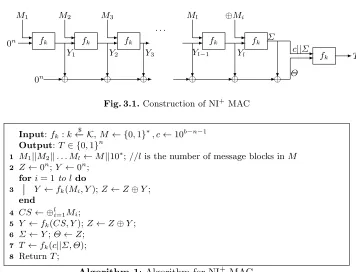
We present the schematic diagram of NI+ in Fig. 3.1 followed by the description in Algorithm 1. Letfk : {0,1}b+n → {0,1}n be a keyed function from b+n
bits tonbits where b > nwherebrefers to the block length of a message block and n refers to the output length in bits. Let M ∈ {0,1}bl. So we can write M = (M1, M2, . . . , Ml) where each Mi ∈ {0,1}b. We define a checksum block
3
fk fk fk fk fk
0n
Y1 Y2 Y3 Yl−1 Yl
⊕ ⊕ ⊕ ⊕ ⊕
0n
Σ
Θ c||Σ
⊕
fk T
M1 M2 M3 Ml ⊕Mi
. . .
Fig. 3.1.Construction of NI+ MAC
Input:fk:k←− K$ ,M← {0,1}∗, c←10b−n−1 Output:T ∈ {0,1}n
M1||M2||. . . Ml←M||10∗; //lis the number of message blocks inM 1
Z←0n;Y ←0n;
2
fori= 1 toldo
Y ←fk(Mi, Y);Z←Z⊕Y; 3
end
CS← ⊕l i=1Mi; 4
Y ←fk(CS, Y);Z ←Z⊕Y; 5
Σ←Y;Θ←Z; 6
T←fk(c||Σ, Θ); 7
ReturnT; 8
Algorithm 1: Algorithm for NI+ MAC
CS = ⊕l
i=1Mi. We denote Cascfk(M) := fk1(. . .(fk(fk(0, M1), M2), . . . , Ml).
Output of Cascfk(M) and the checksum blockCS is passed through the same
function fk and the output is denoted as Σ. We obtain Θ by xoring all the
intermediate chaining values (i.e⊕l
i=1Yi⊕Σ). We concatenate a fixedb−nbit
string c = 10b−n−1 with the 2n bit string Σ||Θ to match the input size of f k
and then the entire concatenatedb bit string (i.ec||Σ||Θ) is passed throughfk
and finally outputs the tagT. We sometimes denoteCS byMl+1.
Note that, NI+ is similar to that of NI up toCascfk(M) except the following
differences. Schematic diagram of NI is given in Appendix C.
(a) In NI construction,b-bit encoding of|M|and the last message block output
Y` is passed through a different keyed compression functionfk2. In NI
+
, we substitute theb-bit length encoding by the checksum block CS. Moreover,
CSandY` is passed through the same keyed compression function.
(b) NI is a two fixed-keyed compression function based MAC. NI+ is a single fixed-keyed compression function based MAC.
(c) NI provides only birthday bound (`q2/2n) security. NI+ provides beyond
birthday bound security (q2`2/22n) when`≤2n/4.
variables (i.e Θ = ⊕l
i=1Yi⊕Σ) as the birthday bound attack is followed from
Prennnel and Oorschot’s attack [33].
4
Security Analysis of NI
+-MAC
Gaˇzi et. al in [14] have shown that the advantage of NI-MAC is bounded above by
q2
2n
l+64l2n4
. In this section we analyze the advantage of our construction NI+
-MAC and show that the advantage of NI+-MAC achieves beyond birthday bound
security; better than that of NI-MAC. Thus we have the following theorem.
Theorem 1. Let f : {0,1}k× {0,1}b× {0,1}n → {0,1}n be a (, t, q) secure
PRF. Then NI+ be a0, t0, q, lsecure PRF, where
0 ≤+ q 2n +
2q2
22n +
2q2`2
22n +
2q2`4
23n +
54q2`6
23n ,
such that t=t0 + ˜O(lq). Moreover, if `≤2n/4 then,
0 ≤+ q 2n +
2q2`2
22n .
Proof. LetA be a adaptive PRF-adversary against NI+ running in time t and
asking at mostqqueries, each of length at most`blocks. NI+uses a single keyed
functionf. Now if we replace f by a uniformly distributed random function r
such thatr←−$ F unc({0,1}b×{0,1}n,{0,1}n) and call the resulting construction NI+
r, then using the standard reduction from information theoretic setting to
complexity theoretic setting we have,
Advprf
NI+≤+Adv
prf NI+
r
.
Therefore to prove Theorem 1, we only need to prove
Advprf NI+
r ≤ q
2n +
2q2
22n +
2q2`2
22n +
2q2`4
23n +
54q2`6
23n .
Consider the following Game as shown in Algorithm 2 where the adversary Aqueries to oracleOwith distinct messages Mi and obtains the responseTi.
Note that GameG0truly simulates a uniform random function andG1simulates
the actual construction NI+r. Therefore using the fundamental lemma of game-playing technique [7], we have the following:
Advprf NI+
r
=Pr[AG1 = 1]−Pr[AG0 = 1]
≤Pr[AG1 setsbadsigma∨ AG1 setsbad]
initialize: badsigma, bad←f alse; 1
On thejthqueryMj; 2
M1j||M
j
2||. . . M
j l ←M
j||
10∗←Partition(Mj),Y0= 0; 3
fori= 1 tol; 4
if ((Mij, Y j
i−1)∈Dom(f)) Y
j i ←f(M
j i, Y
j i−1); 5
Else Yij← {0,1} n
; 6
f(Mij, Yij−1)←Y
j i ;
7
Dom(f)←Dom(f)∪(Mij, Yij−1); 8
if ((⊕l i=1M
j i, Y
j
l)∈Dom(f)) Y j
l+1←f(⊕
l i=1M
j i, Y
j l);
9
Else Ylj+1← {0,1}n; 10
f(⊕l i=1M
j i, Y
j l)←Y
j l+1; 11
Dom(f)←Dom(f)∪(⊕l i=1M
j i, Y
j l);
12
Σj←Yj l+1,Θ
j← ⊕l+1
i=1Y
j i;
13
if (Σj= 0) badsigma←true; 14
Tj←− {$ 0,1}n
; 15
if ((Σj, Θj) = (Σi, Θi) for somei∈ {1,2, . . . , j−1}, or (c||Σj, Θj) = 16
(Ms∗, Y
∗
s−1) such that s∈[li+ 1] ors∈[lj+ 1],∗ ∈ {i, j}); if (¬bad);
17
Coll(i, j)←true, bad←true; 18
if ((Σj, Θj) = (Σi, Θi)) Tj←f(Σi, Θi) ;
19
Else Tj←f(Ms∗, Y
∗
s−1) ; 20
Return Tj; 21
Algorithm 2: Game G0 is without boxed statement and G1 is with
boxed statement.
Therefore, we evaluate now the probability Pr[AG1 setsbad]. To evaluate this,
let us define a double block functionHf(M) := (Σ, Θ) with respect to a uniform
random functionf. Recall that the tupleHf(Mi) := (Σi, Θi)i,∀i∈[q] is said to
be collision-free if∀i, eitherΣi6=Σj or Θi6=Θj or both∀j∈[i−1]. Similarly,
the tuple (Σi, Θi)
iis said to be cover-free if∀i, eitherΣi 6= (Mαj)|norΘi 6=Y j α−1
or both∀j∈[i]. Therefore, it is then easy to see that,
Pr[AG1 sets bad]≤Advcoll
H (q, `) +Adv
cf
H(q, `)
≤ q
2
2 (Adv
coll
H (2, `) +Adv
cf
H(2, `)). (2)
Now we state the following lemma, proof of which is deferred until next section. The first three cases of the lemma bound the collision-free advantage and the last three cases bound the cover-free advantage of functionHf(·).
Notation: Let Ecoll denotes the collision event (i.e. Σi =Σj∧Θi =Θj) and Ecf denotes the covered event (i.e.Σi =x∧Θi=Yts) for somenbit constantx. Wi denotes the walk graph corresponding to messageMi.Y denotes the vector
length in number of blocks ofMiandMj respectively. WhenMi is not a prefix
of Mj or Mj is not a prefix ofMi, pdenotes longest common prefix (LCP) of Mi andMj. That means Mi
p+1 6=M j
p+1 andMαi =Mαj where 1≤α≤p. Let
G(Mi,Mj) denotes the set of all structure graphs corresponding to two fixed
messagesMi andMj.Ga ⊂ G(Mi,Mj) be the set of all structure graphs with
accidenta where, in this paper, we considera = 0,1,2. Moreover, when a= 1 or 2 we denoteGa
nl⊂ Ga be the set of all structure graphs such that none of the
two message walksWi, Wj contains a loop. Ga
l denotes the set of all remaining
structure graphs. Moreover,Ga =Ga nlt G
a
l fora= 1,2.
Lemma 1. Let us consider G ←− G(M$ i,Mj), whereMi andMj are any two
distinct messages, each of length at most`blocks and a particularnbit constant x, we have the followings:
Case (A) :Pr[Ecoll∧ |f Coll(G)|= 0]≤ 212n.
Case (B) :Pr[Ecoll∧ |f Coll(G)|= 1]≤ `
2
22n.
Case (C) :Pr[Ecoll∧ |f Coll(G)|= 2]≤ `
4
23n.
Case (D) :Pr[Ecf∧ |f Coll(G)|= 0]≤ 212n.
Case (E) :Pr[Ecf∧ |f Coll(G)|= 1]≤ `
2
23n.
Case (F) :Pr[Ecf∧ |f Coll(G)|= 2]≤ `
4
23n.
Resume the proof of Theorem 1: Now we have all the materials to prove Theorem 1 which is given in the following.
It is easy to see the followings:
AdvcollH (2, `)≤
2 X
k=0
Pr[Ecoll∧ |f Coll(G)|=k] + Pr[|f Coll(G)| ≥3].
AdvcfH(2, `)≤
2 X
k=0
Pr[Ecf∧ |f Coll(G)|=k] + Pr[|f Coll(G)| ≥3].
Therefore, we have the following results,
AdvcollH (2, `)≤ 1 22n +
`2
22n + `4
23n +
27`6
23n . (3)
AdvcfH(2, `)≤ 1 22n +
`2
22n + `4
23n +
27`6
23n . (4)
Equation (3) follows from Case (A),(B) and (C) of Lemma 1. Similarly, Equa-tion (4) follows from Case (D),(E) and (F) of Lemma 1.
Substituting Equation (3) and (4) into Equation (2) we obtain
Pr[AG1 setsbad]≤ 2q
2
22n +
2q2`2
22n +
2q2`4
23n +
54q2`6
23n .
Moreover it is easy to see that Pr[AG1 setsbadsigma]≤ q
2n. Therefore, substi-tuting these two probability expressions back to Equation (1) will give
Advprf NI+
r ≤ q
2n+
2q2
22n+
2q2`2
22n +
2q2`4
23n +
54q2`6
4.1 Proof of Lemma 1
We prove all the following cases using structure graph analysis. After fixing two distinct messages we choose a structure graph uniformly at random from the set of all structure graphs. Then we analyze mainly two eventsEcollandEcf in view
of the number of collisions occurred in the randomly chosen structure graphG. Therefore, we have,
Pr[Ecoll∧ |f Coll(G)|=a] = X
H∈Ga
Pr[Ecoll∧G=H]
Pr[Ecf∧ |f Coll(G)|=a] = X
H∈Ga
Pr[Ecf∧G=H]
It is easy to see that |Ga| ≤`2a as structure graph is uniquely determined by
the number of accidents occurred in the graph when the two messages are fixed. Therefore, we only need to bound (i) Pr[Ecoll∧G=H] and (ii) Pr[Ecf∧G=H]
for some fixed structure graph H having accidentawhere we considera= 0,1 or 2.
Case (A) : Proof of Pr[Ecoll∧ |f Coll(G)|= 0]≤ 1
22n. We fix a structure graph H ∈ G0 and then analyze the probability of the event E
coll with respect
toH in a case-by-case basis.
Case (i) WhenMi or Mj is not a prefix of each other, we recall thatpbe the
LCP of Mi and Mj. Therefore, all Yi α and Y
j
β are distinct wherep+ 1≤α≤ li, p+ 1≤β≤lj. Moreover,Yαi6=Yαj,p+ 1≤α≤min{li, lj}as the number of
collisions inH is 0. Therefore, we have,
Pr[Ecoll∧G=H] = Pr[Θi=Θj∧G=H|Σi=Σj]·Pr[Σi=Σj]
It is obvious that Pr[Σi = Σj] ≤ 1
2n−2` and the event Θi = Θj ∧G = H conditioned on the eventΣi=Σjimplies a non trivial equation onY as we will
obtainYi
p+1 andY j
p+1 for which Θi⊕Θj = 0 would become non-trivial. Thus,
Pr[Θi=Θj∧G=H|Σi=Σj]≤ 1
2n−2`. Therefore,
Pr[Ecoll∧G=H]≤
1
22n, assuming`≤2 n−1.
Case (ii) Consider either of the two messages is a prefix of other (w.l.o.gMj
is a prefix of Mi). Since l
i > lj therefore,p=lj. Since the number of collision
in H is 0, Yp+1i , . . . Yli
i are all distinct with each other and with Y
i 1, . . . , Y
i lj. This implies thatYlii6=Ylj
j as depicted in Fig. 4.1. Therefore, the probability of
Θi=Θj∧G=H conditioned on the eventΣi=Σj will be O(1/2n) as we will
obtain two random variables Yli
i and Y
j
lj for which Θ
i⊕Θj = 0 would become
non-trivial. Moreover, Pr[Σi=Σj]≤ 1
2n. Therefore again,
Pr[Ecoll∧G=H]≤
1 22n.
Since,G0= 1, we have, Pr[E
Fig. 4.1.Structure graph with 0 accident
Case (B) : Proof of Pr[Ecoll ∧ |f Coll(G)| = 1] ≤ `
2
22n. Like the earlier case, we fix a structure graph H ∈ G1 and then analyze the probability of the
event Ecoll with respect to H in a case-by-case basis. Since G1 = Gnl1 t G 1 l, it
follows that H∈ G1
nl or H∈ Gl1. We analyze each case separately as follows:
Case (B.1) When H ∈ G1
nl. It essentially implies that H is the union of two
walk graphsWi, Wj such thatW
i andWj are path. Without loss of generality,
we considerli≥lj.
Case (B.2)WhenH ∈ G2
l. It implies that either of the walksW
iorWjcontains
a loop.
(B.1) Analysis of G1
nl. Let us considerH ∈ G 1
nl. First of all we would like to
note that ifMjis a proper prefix ofMithen|G1
nl|= 0, as in that case number of
accidents ofHwill be 0. So, without loss of generality, lets assume thatMj is not
a prefix ofMi andpbe theLCPofMiandMj. Therefore,Yi
α=Yαj, 1≤α≤p.
As number of collision is 1 therefore, let the colliding pair is (Yi βi, Y
j
βj), where
p+ 1≤βi≤li, p+ 1≤βj ≤lj.
Case (i) Let βi = βj = p+ 1 and li = lj and after the collision Yβi = Y j β,
for p+ 2≤β ≤li. In this case, it is clear that checksum block of ith message CSi and checksum block ofjth message CSj would not be equal and therefore
even if Yi li = Y
j
lj, the event Σ
i = Σj would not be trivial. So, even though
Pr[Θi = Θj|Σi = Σj ∧G = H] = 1, but the required randomness will be
obtained from the following two equations : (i)Yi p+1⊕Y
j
p+1= 0, (ii)Σi⊕Σj = 0
such that the rank of the system of equations is 2. Therefore,
Pr[Ecoll∧G=H]≤
1 22n.
Case (ii)Let βi =βj =p+ 1 and li =lj and after the collision Yβi6=Y j β, for p+ 2≤ β ≤li. Then we will always obtain Yki and Y
j
k0 such that Θi = Θj is
non-trivial for somek, k0. Therefore again in this case we have,
Pr[Ecoll∧G=H]≤
1 22n.
Case (iii)Letβi=βj =p+ 2 andli=ljandYβi=Y j
β, forp+ 3≤β≤li, then Θi=Θjwould implyYi
p+1=Y j
p+1; creates one more collision which violates the
condition that the structure graph has only one collision.
Therefore, in general, we assume that the colliding pair is (Yi βi, Y
j
βj), where
after the collision point eitherWi andWj follow the same path or they will get
bifurcated right from the collision point and will never meet again. IfWiandWj
follows the same path, then for Case (i) we have shown that we can ensure to get the probabilityO(1/22n). If not, then except Case (iii) whereβ
i=βj =p+ 2,
we will obtain two random variablesYi k andY
j
k0 such that equationΘi⊕Θj = 0
becomes non-trivial. IfWiandWj gets bifurcated right after the collision point,
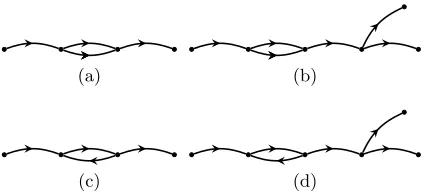
then the equality ofΘ becomes non-trivial for two random variablesYi p+1 and Yp+1j as depicted in (a) and (b) of Fig. 4.2. Note that it is easy to follow that we will always obtain two such random variables.
(a) (b)
(c) (d)
Fig. 4.2.Structure graphs with 1 accident. (a) and (b): no loop, (c) and (d): one loop.
Case (iv) Finally, if βi = li and βj = lj then one can easily find out two
random variables from the set {Yp+1i , . . . , Ylii−1} ∪ {Y
j
p+1, . . . , Y j
lj−1} such that the equation onΘbecomes non-trivial.
Therefore, in each of the above cases we have obtained
Pr[Ecoll∧G=H]≤
1 22n.
Since|G1 nl| ≤ |G
1| ≤`2, we have, Pr[E
coll∧ |f Coll(G)|= 1]≤ `
2
22n.
(B.2) Analysis of G1
l. Let us fix a structure graph H ∈ G 1
l. Without loss of
generality we assume thatWicontains a loop. That meansαis a smallest integer
such thatYαi=Yα+ci forc≥1. Herecdenotes the loop size. Note that, the loop actually creates a collision and therefore, neither (i) Wj or Wi makes another different loop, nor (ii) Wj collides with Wi as in both of the cases number of collisions will increase to 2. Thus, the only possibilities are either
(i) Wj completely lies onWi
(ii) Wj could followWibut after a pointWj andWigets bifurcated and never meets.
We will analyze the probability of the event Ecoll∧G=H separately for each
Case (i) : Wj completely lies on Wi.
Let us assume Wi = Yi
1||. . .||Yαi−1||(Yαi||. . .||Yα+ci −1)k||Yα+c+1i ||. . .||Ylii and
Wj = Y1j||. . .||Yαj−1||(Yαj||. . .||Y j α+c−1)
k0||Yj
α+c+1||. . .||Y j
lj where k
0 ≥ 0. Now
we have the following cases:
• As Wj lies onWi, it is easy to see that ifk0 = 0 thenWj be a subsequence of Yi
1||. . .||Yαi−1 and therefore one can ensures the non-triviality of equation Θi⊕Θj = 0 which holds with probability 1
2n. Moreover, Ylii 6= Y
j
lj and thus
Σi=Σj also holds with probability 21n and therefore Pr[Ecoll∧G=H]≤ 212n.
• If k0 ≥ 1, then it is obvious thatY1j||. . .||Yαj−1 = Yi
1||. . .||Yαi−1. Now, if we
assume that the length of the tail ofWi(i.eYi
α+c+1||. . .||Ylii) is same as that of
Wj then it must have been the case thatk6=k0 and without loss of generality
we can assume that k > k0. SinceYi li =Y
j
lj, depending on the equality ofCS
i
andCSj we have Pr[Σi =Σj| |f Coll(G)|= 1] = 1. Therefore,
Pr[Ecoll∧G=H] = Pr[Θi=Θj|Σi=Σj∧G=H]
· Pr[Σi=Σj| G=H]·Pr[G=H]
Ask > k0 therefore, it is obvious to see that there must be at least two random variablesYsiandYsi0 for whichΘi=Θj would become non-trivial as depicted in
(c) of Fig. 4.2.
Thus in the above equation, Pr[Θi = Θj|Σi = Σj ∧G = H] ≤ 1 2n and Pr[G=H]≤ 1
2n. Therefore, Pr[Ecoll∧G=H] ≤ 212n. Moreover, if we assume that the tail length of Wi andWj are not same (w.l.o.gtail(Wi)> tail(Wj))
then we have either k = k0 or k 6= k0. The case of k = k0 has already been taken care of. Ifk6=k0 thenYli
i6=Y
j
lj and therefore,Θ
i⊕Θj= 0 would become
non-trivial for the random variable Yli
i and Y
j
lj. Moreover, Pr[Σ
i =Σj] ≤ 1 2n. Thus,
Pr[Ecoll∧G=H]≤
1 22n.
Case (ii) : Wj follows Wi but after they get bifurcated and never
meets. In this case Wj bifurcates from Wi right after some point X. This
condition necessarily implies that Yi li 6= Y
j
lj. Now it is to be noted that ifW
j
completely lies onWi (as inhead(Wi) =head(Wj) andk=k0) and bifurcates
right from the pointX =Yi
li−1, thenΘ
i=Θj would implyYi li=Y
j
lj, introduces one more collision and hence the number of collision would increase. Therefore, even if head(Wi) = head(Wj) either k 6=k0 or Wj must get bifurcated from Wi from some earlier point ofYi
li−1. In both of these cases one should obtain at least two random variables (either from portion of loop or from portion of tail)
Yi
s andYsi0 for somesands0 that ensures the non-triviality of equation onΘ as
depicted in (d) of Fig. 4.2. Moreover asYi
li6=Y
j
lj this ensures that Pr[Σ
i=Σj]≤ 1
2n. Hence, Pr[Ecoll∧ G=H]≤ 1
Therefore, in all of the above cases we have obtained Pr[Ecoll∧G=H]≤ 212n.
Moreover,|G1 l| ≤ |G
1| ≤`2. So, Pr[E
coll∧ |f Coll(G)|= 1]≤ `
2
22n.
Case (C) : Proof of Pr[Ecoll∧|f Coll(G)|= 2]≤ 2x`3n4 Likewise the analysis of Case (B), we first fix a graphH ∈ G2and analyze the probability ofE
collwith
respect to H in a case-by-case basis. With the same argument, eitherH ∈ G2 nl
orH ∈ G2 l.
Case (C.1) Let us consider H ∈ G2
nl which implies that none of the message
walksWi orWj contains a loop.
Case (C.2) Let us consider H ∈ G2
l which implies that either of the message
walksWi orWj contains a loop.
(C.1) Analysis of G2
nl. Let pbe the LCP of M
i and Mj. Since number of
accident of H is 2, we denote the collision pairs are : (Yαii, Yαjj) and (Yβi
i, Y
j βj) wherep+ 1≤αi, βi≤liand p+ 1≤αj, βj≤lj.
Case (i) Letli =lj, αi =αj =p+ 1 andβi =βj =p+ 2 and after collision Yi
s =Ysj, forp+ 3≤s≤li. This case is boiled down to the analysis of subcase
(i) under Case (B.1). Therefore, even though Pr[Θi=Θj|Σi=Σj∧G=H] = 1,
we obtain the required randomness from the following three linearly independent equations : (i)Yi
p+1⊕Y j
p+1= 0, (ii)Yp+2i ⊕Y j
p+2= 0 and (iii)Σi⊕Σj= 0 such
that the rank of the system of equations become 3. Therefore, Pr[Ecoll∧G= H]≤ 1
23n.
Case (ii)This case is similar to Case (i) except that after the collisionYi s 6=Ysj.
Again this case is boiled down to the analysis of subcase (ii) under Case (B.1). Therefore it is easy to see that the obtained rank of the linear system of equations will be at least 3. Therefore in this case also, we obtain, Pr[Ecoll∧G=H]≤ 213n.
Case (iii)Letli=lj and two collision points are not consecutive like Case (i).
We can also assume that after the final collision point (i.e Yβi
i =Y
j βj) Y
i s =Ysj
for s ≤li. So, we can obtain a system of linear equations of rank 3 such that Θi⊕Θj = 0 along with two collisions give three linearly independent equations.
Therefore, in this case we obtain, Pr[Ecoll∧G=H]≤ 213n. In general, we assume that the colliding pair is (Yi
αi, Y
j
αj) and (Y
i βi, Y
j βj) , wherep+1≤αi, βi ≤li, p+1≤αj, βj ≤lj. Since the number of collision allowed
in H is 2, after the first collision point (Yi αi, Y
j αi), W
i and Wj must bifurcate
and then meets with each other to form the second collision point (Yi βi, Y
j βj) and then Wi, Wj follow the same path or they will get bifurcated from the
second collision point and will never meet again. IfWi andWj follows the same
path, then for Case (i) we have shown that we can ensure to get the probability
O(1/22n). If not, then we will obtain two random variablesYi k andY
j
k0 such that
equation Θi⊕Θj = 0 becomes non-trivial. IfWi andWj gets bifurcated after
(a) (b)
(c) (d)
(e) (f)
(g) (h)
(i) (j)
(k) (l)
(m) (n)
(o) (p)
(q) (r)
(s) (t)
random variablesYi k andY
j
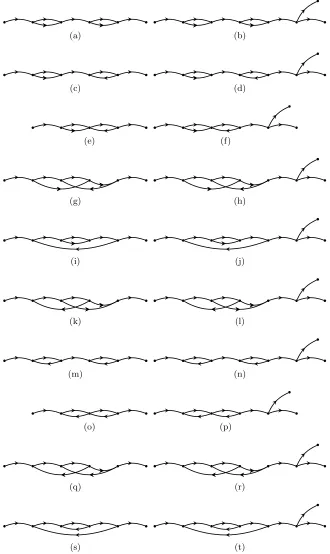
k0 as depicted in (a) and (b) of Fig. 4.3. Note that it is
easy to follow that we will always obtain two such random variables. Therefore, the obtained rank of the linear system of equations comprising of equations (i)
Σi⊕Σj = 0, Θi ⊕Θj = 0, Yi αi ⊕Y
j
αj = 0, Y
i βi = Y
j
βj = 0 will be at least 3. Therefore, Pr[Ecoll∧G=H]≤ 213n.
Case (iv)Finally,βi=liandβj =ljwhereαi< βi, αj < βj, then one can easily
find out two random variables from the set{Yi
p+1, . . . , Ylii−1} ∪ {Y
j
p+1, . . . , Y j lj−1} such that the equation onΘ becomes non-trivial.
Therefore, from the all of the above cases we have the following,
Pr[Ecoll∧G=H]≤
1 23n.
Moreover,|G2 nl| ≤ |G
2| ≤`4. Therefore, Pr[E
coll∧ |f Coll(G)|= 2]≤ `
4
23n.
(C.2) Analysis ofG2
l. We characterize the all possible graphs in following two ways :
(i) When both the accident comes from a single message walk. (ii) When two message walks are involved to yield two accidents.
(ii.i) When each message walk contributes a single accident. (ii.ii) When two message walk jointly contributes two accidents.
Letpbe theLCP ofMi andMj. Since number of accident of H is 2, here the
collision pairs will be one of the followings based on the three cases listed above: (a) (Yi
αi, Y
i
α0i) and (Y i βi, Y
i
β0i) (single message walk) whereαi< α 0
i< βi< β 0 i, (b)
(Yi αi, Y
i
α0i) and (Y j βj, Y
j
βj0) (each message walk contributes single accident) where αi < α
0
i and βi < β 0
i, (c) (Yαii, Y
j
αj) and (Y
i βi, Y
j
βj) (two message walks jointly contribute two accidents) wherep+ 1≤αi, βi ≤li andp+ 1≤αj, βj≤lj.
Case (i) : Both accidents come from a single message walk.To analyze this case, note that, only a single message walk (e.g Wi) yields two accidents;
that means, the accident pair is (Yi αi, Y
i
α0i) and (Y i βi, Y
i
βi0), thusW
i contains two
distinct loops, whereasWj does not contain any loop. In this regard, it is to be
noted thatWj either lies onWiorWj eventually bifurcates fromWi and never
meets again. Now we have two possibilities under this case. (a) When li =lj,
then it has to be the case that Wj must bifurcates from Wj from some fixed
certain point node X in H. Note that, it may also happen that X does not exist in someH and in that specific cases we will obtain two parallel walks. Now one can easily see that two distinct accidents yields two linearly independent equations. That is
Yαi
i⊕Y
i α0i = 0
Yβii⊕Yβi0
Moreover, the following two equationsΣi⊕Σj= 0 andΘi⊕Θj= 0 is not implied
from the previous two linearly independent equations coming from accidents as one can easily see that Yi
li 6= Y
j
lj and thus, Σ
i⊕Σj = 0 is not a trivial
equation. Thus one can ensure that the rank of this system of linear equations is at least 3. (b) Whenli 6=lj, then without loss of generality we assume that li> lj. Therefore, either Wj bifurcates from Wi orWj completely lies on Wi.
Former case has already been treated. So, whenWj completely lies onWiwhere
|Wj|<|Wi|4, then againYi li 6=Y
j
lj, making the equationΣ
i⊕Σj= 0 non-trivial.
Moreover, two accidents imply two linearly independent equations. Altogether, the rank of the system of equations become at least 3. Therefore, in this case, we obtain
P r[Ecoll∧G=H]≤
1
23n. (5)
Case (ii.i) : Each message walk contributes a single accident. When two message walkWi, WJ individually contributes a single accident, that is the
accident pair is (Yi αi, Y
i
α0i) and (Y j βj, Y
j
β0j). Note that the last collision point, say,
(Yβj
j, Y
j
β0j) must be after the LCPpoint. Therefore, each of W
i and Wj contains
a single loop and they never meet again, otherwise that will contribute to one more accident. Therefore, the structure of the graph is simple as depicted in (m) and (n) of Fig 4.3. It is very straight-forward to see that Yi
li 6=Y
j
lj. Moreover, two distinct accident gives two linearly independent equations and therefore, one can see that the rank becomes at least 3. Thus, Equation (5) holds in this case.
Case (ii.ii) : Two message walks jointly contribute two accidents. For-mer two cases were easy to handle as those cases contain simple structure graphs. This case is little involved to handle as it contains many kind of structure graphs as depicted in (c) to (t) of Fig, 4.3.
Letddenotes the gap of two colliding nodes5. Note that for (e), (f), (o) and (p) of Fig. 4.3, value ofdis 0. For the rest of the cases,d >0.
To keep our discussion simple, we give the details proof of (c) of Fig. 4.3 and then one can use the similar analysis for the proof of the rest of the cases.
Details analysis for Case (c) of Fig. 4.3. Let the fist collision point is (Yi
αi, Y
j
αj). This accident is contributed by two message walksW
i andWj. After
this first accident point, the second message walk may or may not take part in forming the second collision. (a) IfWj takes part in forming the second collision then after the first collision point Wi and Wj will move in unison and after forming the second collision Wj and Wi may bifurcates or again they move in unison depending on the message blocks of Mj. (b) On the other hand, if
Wj does not take part then either (i) Wj bifurcates from a node X where X ∈ {Yiα
i, Yαii+1, . . . , Y
i
αi+d} and never meets again or (ii)W
j completely lies
onWi and|Wj|< β
i. Note that in both of the cases (a) and (b), two collision
4 Length of a walkW is denoted as|W|. 5
give rises to two linearly independent equations
Yαii⊕Y
j αj = 0
Yβi
i⊕Y
j βj = 0.
(a)We considerWj takes part in forming the second collision. If l
i =lj, then
we will findYi
p+1for whichΘi⊕Θj = 0 becomes non-trivial and hence the rank
of the above two equations along with Θi⊕Θj = 0 becomes 3. If l
i 6=lj then
again one can ensure to obtainYlj
i such that the variable is fresh in the equation
Θi⊕Θj= 0 which makes the rank of the above three equations to 3.
(b)We considerwj does not take part in forming the second collision. Therefore
(i) WhenWjbifurcates fromWithen againYj
lj will be the fresh random variable in the equationΘi⊕Θj = 0; making the rank of the system of equations to at
least 3. (ii) If Wj completely lies onWi, which essentially impliesl
j < li, and
therefore, one can obtain Yi
li which will be fresh in the equationΘ
i⊕Θj = 0;
making the rank at least 3.
Therefore, in all of the above cases, we have observed that the rank of the following system of equations is at least 3.
Yαii⊕Yαjj = 0
Yβi
i⊕Y
j βj = 0
Σi⊕Σj= 0
Θi⊕Θj = 0.
Therefore, we have,
Pr[Ecoll∧G=H]≤
1 23n.
All of the remaining cases can be analyzed similarly and one can show the rank to be at least 3. Since,|G2
l| ≤ |G2| ≤`4. Therefore, Pr[Ecoll∧|f Coll(G)|= 2]≤ `
4
23n.
Case (D) : Proof of Pr[Ecf ∧ |f Coll(G)| = 0]≤ 1
22n. We fix a structure graphH ∈ G0 and then analyse the probability of the eventE
cf with respect to H in a case-by-case basis.
Case (i)Letpbe theLCPofMi andMj. Therefore,Yi
α=Yαj where 1≤α≤p
and Yi β 6=Y
j
β where p+ 1≤β ≤min{li, lj} as the number of accident in H is
0. Moreover, if li > lj then allYβi would have been distinct as |f Coll(G)|= 0
where lj+ 1 ≤β ≤li. Note that, it is also true that Ylii 6=Y
j
lj. Therefore, we have the following set of equations:
Ylii+1=x, (6)
wherescould be eitheriorjandt∈[li+1] ort∈[lj+1]. For each of these cases
one can easily check that the above system of equation has rank 2. Therefore, Pr[Ecf∧G=H]≤ 212n.
Case (ii).Without loss of generality let us consider thatMj is a prefix of Mi.
Sinceli> lj therefore,p=lj. Since, number of collisions in H is 0,Yp+1i , . . . Ylii
are all distinct with each other and withY1j, . . . , Ylj
j. This implies thatY
i li6=Y
j lj as depicted in Fig. 4.1. Therefore, the set of equations (Equation (6) and (7)) has the full rank. Therefore, again we have, Pr[Ecf∧G=H]≤212n.
Therefore from the above two cases, we have, Pr[Ecf ∧G=H] ≤ 212n for any non-zeronbit constantx. Moreover|G0| ≤1. So Pr[E
cf∧ |f Coll(G)|= 0]≤ 212n.
Case (E) : Proof of Pr[Ecf ∧ |f Coll(G)| = 1] ≤ 2l22n. Again, we fix a structure graphH ∈ G1 and then analyse the probability of the eventE
cf with
respect toH in a case-by-case basis. Therefore,H ∈ G1
nlorH ∈ G 1
l. We analyse
each case separately as follows.
Case (E.1) Let us consider H ∈ G1
nl which implies that none of the message
walksWi orWj contains a loop.
Case (E.2) Let us consider H ∈ G1
l which implies that either of the message
walksWi orWj contains a loop
(E.1) Analysis ofG1
nl.As beforeM
iorMjcould not be a prefix of each other.
Let pbe theLCP of Mi and Mj and let the colliding pair is (Yi βi, Y
j
βj), where
p+ 1≤βi≤li, p+ 1≤βj≤lj. In this case, it is easy to check that the following
system of equations will have rank 2.
Yli
i+1=x,
Y1i⊕Y2i⊕. . .⊕Ylii+1+Yts= 0.
Therefore, we have Pr[Ecf∧G=H]≤212n.
Note that,|G1
nl| ≤ |G1| ≤`2. Therefore Pr[Ecf∧ |f Coll(G) = 1|]≤ l
2
22n.
(E.2) Analysis ofG2
l.As before let us assume thatWicontains a loop of sizec
such thatYi
α=Yα+ci forc≥1. Since the loop creates a collision, neither (i)Wj
or Wi makes another different loop, nor (ii)Wj collides withWi as in both of
the cases the number of collisions will increase to 2. Thus we have the following two possibilities.
(1) Wj coincides withWi
(2) Wj could followWi but after a pointWi andWj departs and never meets again.
We analyze the probability of the event Ecf ∧G = H separately for each of
Case (i) : Wj coincides with Wi.
Letkdenotes the number of iterations in the loop ofWi andk0 be the number
of iterations in the loop of Wj. Now irrespective of the value of k and k0, the
system of equations (Equation (6) and (7)) will have rank 2 and therefore, we can upper bound the probability of our desired event to 221n.
Case (ii) : Wj could follow Wi but after a point Wi and Wj departs
and never meets again.
The analysis for this case would be similar to Case (i). Here Wi andWj
bifur-cates from a certain point sayX andli−X, lj−X 6= 0. Therefore, it is trivial
to see that the set of equations (i.e Equation (6) and (7)) will have full rank. Again, as we have shown in the previous case that Pr[Ecf∧G=H]≤212n.
Therefore, for the above two cases Pr[Ecf∧G=H]≤221n. Moreover,|Gl1| ≤
|G1| ≤`2. Therefore, Pr[E
cf∧ |f Coll(G)|= 1]≤ `
2
22n.
Case (F) : Proof of Pr[Ecf ∧ |f Coll(G)|= 2]≤ xl4
23n Proof of this bound is similar to Case (C) and thus we skip the proof of the bound.
5
Conclusion
In this paper, we have proposed a non-tweaked single fixed-key compression function based MAC NI+, a variant of NI-MAC that achieves BBB security and efficient than NI-MAC in terms of number of keys. Moreover, our construction is better than Yasuda’s proposed single-fixed key compression function based MAC construction that uses an extra mask ofbbits which needs a storage space. More-over, we have been able toslightly reduce the state size from 2(b+ 2n) bits to (b+ 2n) bits which was an open problem in [43] to reduce the state size to 2n
bits. Thus we are leaving the problem still open which does not require now a extra mask.
References
1. Jee Hea An and Mihir Bellare. Constructing vil-macsfrom fil-macs: Message au-thentication under weakened assumptions. In Wiener [39], pages 252–269. 2. Mihir Bellare, Ran Canetti, and Hugo Krawczyk. Keying hash functions for
mes-sage authentication. In Neal Koblitz, editor, CRYPTO ’96, volume 1109 ofLNCS, pages 1–15. Springer, 1996.
3. Mihir Bellare, Oded Goldreich, and Hugo Krawczyk. Stateless evaluation of pseu-dorandom functions: Security beyond the birthday barrier. In Wiener [39], pages 270–287.
5. Mihir Bellare, Krzysztof Pietrzak, and Phillip Rogaway. Improved security analyses for CBC macs. In Shoup [34], pages 527–545.
6. Mihir Bellare. New proofs for NMAC and HMAC: security without collision-resistance. In Cynthia Dwork, editor, CRYPTO 2006, volume 4117 of LNCS, pages 602–619. Springer, 2006.
7. Mihir Bellare and Phillip Rogaway. The security of triple encryption and a frame-work for code-based game-playing proofs. In Vaudenay [35], pages 409–426. 8. John Black, Shai Halevi, Hugo Krawczyk, Ted Krovetz, and Phillip Rogaway.
UMAC: fast and secure message authentication. In Wiener [39], pages 216–233. 9. John Black and Phillip Rogaway. A block-cipher mode of operation for
paralleliz-able message authentication. In Knudsen [21], pages 384–397.
10. Andrey Bogdanov, Lars R. Knudsen, Gregor Leander, Christof Paar, Axel Poschmann, Matthew J. B. Robshaw, Yannick Seurin, and C. Vikkelsoe. PRESENT: an ultra-lightweight block cipher. In Pascal Paillier and Ingrid Ver-bauwhede, editors, CHES 2007, volume 4727 of LNCS, pages 450–466. Springer, 2007.
11. Nilanjan Datta, Avijit Dutta, Mridul Nandi, Goutam Paul, and Liting Zhang. One-key double-sum mac with beyond-birthday security. Cryptology ePrint Archive, Report 2015/958, 2015. http://eprint.iacr.org/.
12. Yevgeniy Dodis, Thomas Ristenpart, John P. Steinberger, and Stefano Tessaro. To hash or not to hash again? (in)differentiability results for H 2 and HMAC. In Reihaneh Safavi-Naini and Ran Canetti, editors, CRYPTO 2012, volume 7417 of
LNCS, pages 348–366. Springer, 2012.
13. Yevgeniy Dodis and John P. Steinberger. Domain extension for macs beyond the birthday barrier. In Kenneth G. Paterson, editor, EUROCRYPT 2011, volume 6632 ofLNCS, pages 323–342. Springer, 2011.
14. Peter Gazi, Krzysztof Pietrzak, and Michal Ryb´ar. The exact prf-security of NMAC and HMAC. In Juan A. Garay and Rosario Gennaro, editors, CRYPTO 2014, volume 8616 ofLNCS, pages 113–130. Springer, 2014.
15. Peter Gaˇzi, Krzysztof Pietrzak, and Stefano Tessaro. Generic security of nmac and hmac with input whitening. Cryptology ePrint Archive, Report 2015/881, 2015. http://eprint.iacr.org/.
16. Deukjo Hong, Jaechul Sung, Seokhie Hong, Jongin Lim, Sangjin Lee, Bonseok Koo, Changhoon Lee, Donghoon Chang, Jaesang Lee, Kitae Jeong, Hyun Kim, Jongsung Kim, and Seongtaek Chee. HIGHT: A new block cipher suitable for low-resource device. In Louis Goubin and Mitsuru Matsui, editors, CHES 2006, volume 4249 of
LNCS, pages 46–59. Springer, 2006.
17. Tetsu Iwata and Kaoru Kurosawa. OMAC: one-key CBC MAC. In Johansson [19], pages 129–153.
18. ´Eliane Jaulmes, Antoine Joux, and Fr´ed´eric Valette. On the security of randomized CBC-MAC beyond the birthday paradox limit: A new construction. In FSE, 2002, volume 2365 ofLNCS, pages 237–251. Springer, 2002.
19. Thomas Johansson, editor. In FSE, 2003, volume 2887 ofLNCS. Springer, 2003. 20. Antoine Joux, Guillaume Poupard, and Jacques Stern. New attacks against
stan-dardized macs. In Johansson [19], pages 170–181.
21. Lars R. Knudsen, editor. EUROCRYPT 2002, volume 2332 of LNCS. Springer, 2002.
22. Neal Koblitz and Alfred Menezes. Another look at hmac. J. Mathematical Cryp-tology, 7(3):225–251, 2013.
24. Will Landecker, Thomas Shrimpton, and R. Seth Terashima. Tweakable block-ciphers with beyond birthday-bound security. In Reihaneh Safavi-Naini and Ran Canetti, editors, CRYPTO 2012, volume 7417 of LNCS, pages 14–30. Springer, 2012.
25. Ga¨etan Leurent, Thomas Peyrin, and Lei Wang. New generic attacks against hash-based macs. In Kazue Sako and Palash Sarkar, editors, ASIACRYPT 2013, volume 8270 ofLNCS, pages 1–20. Springer, 2013.
26. Stefan Lucks. A failure-friendly design principle for hash functions. In Bimal K. Roy, editor, ASIACRYPT 2005, volume 3788 of LNCS, pages 474–494. Springer, 2005.
27. Ueli M. Maurer and Johan Sj¨odin. Domain expansion of macs: Alternative uses of the FIL-MAC. In Nigel P. Smart, editor,Cryptography and Coding, 2005, volume 3796 ofLNCS, pages 168–185. Springer, 2005.
28. Ueli M. Maurer and Johan Sj¨odin. Single-key ail-macs from any FIL-MAC. In Lu´ıs Caires, Giuseppe F. Italiano, Lu´ıs Monteiro, Catuscia Palamidessi, and Moti Yung, editors, ICALP 2005, volume 3580 ofLNCS, pages 472–484. Springer, 2005. 29. Kazuhiko Minematsu. How to thwart birthday attacks against macs via small randomness. In Seokhie Hong and Tetsu Iwata, editors, FSE, 2010, volume 6147 ofLNCS, pages 230–249. Springer, 2010.
30. Yusuke Naito, Yu Sasaki, Lei Wang, and Kan Yasuda. Generic state-recovery and forgery attacks on chopmd-mac and on NMAC/HMAC. In Kazuo Sakiyama and Masayuki Terada, editors, IWSEC 2013, volume 8231 ofLNCS, pages 83–98. Springer, 2013.
31. Thomas Peyrin, Yu Sasaki, and Lei Wang. Generic related-key attacks for HMAC. In Wang and Sako [36], pages 580–597.
32. Thomas Peyrin and Lei Wang. Generic universal forgery attack on iterative hash-based macs. In Phong Q. Nguyen and Elisabeth Oswald, editors, EUROCRYPT 2014, volume 8441 ofLNCS, pages 147–164. Springer, 2014.
33. Bart Preneel and Paul C. van Oorschot. Mdx-mac and building fast macs from hash functions. In Don Coppersmith, editor, CRYPTO 1995, volume 963 ofLecture Notes in Computer Science, pages 1–14. Springer, 1995.
34. Victor Shoup, editor. CRYPTO 2005, volume 3621 ofLNCS. Springer, 2005. 35. Serge Vaudenay, editor. EUROCRYPT 2006, volume 4004 of LNCS. Springer,
2006.
36. Xiaoyun Wang and Kazue Sako, editors. ASIACRYPT 2012, volume 7658 ofLNCS. Springer, 2012.
37. Xiaoyun Wang, Yiqun Lisa Yin, and Hongbo Yu. Finding collisions in the full SHA-1. In Shoup [34], pages 17–36.
38. Xiaoyun Wang and Hongbo Yu. How to break MD5 and other hash functions. In Ronald Cramer, editor, EUROCRYPT 2005, volume 3494 ofLNCS, pages 19–35. Springer, 2005.
39. Michael J. Wiener, editor. CRYPTO ’99, volume 1666 ofLNCS. Springer, 1999. 40. Kan Yasuda. Boosting merkle-damg˚ard hashing for message authentication. In
Kaoru Kurosawa, editor, ASIACRYPT 2007, volume 4833 of LNCS, pages 216– 231. Springer, 2007.
41. Kan Yasuda. Multilane HMAC - security beyond the birthday limit. In K. Sri-nathan, C. Pandu Rangan, and Moti Yung, editors, INDOCRYPT 2007, volume 4859 ofLNCS, pages 18–32. Springer, 2007.
43. Kan Yasuda. A one-pass mode of operation for deterministic message authentication- security beyond the birthday barrier. In Kaisa Nyberg, editor, FSE, 2008, volume 5086 ofLNCS, pages 316–333. Springer, 2008.
44. Kan Yasuda. A double-piped mode of operation for macs, prfs and pros: Security beyond the birthday barrier. In Antoine Joux, editor, EUROCRYPT 2009, volume 5479 ofLNCS, pages 242–259. Springer, 2009.
45. Kan Yasuda. HMAC without the ”second” key. In Pierangela Samarati, Moti Yung, Fabio Martinelli, and Claudio Agostino Ardagna, editors, ISC 2009, volume 5735 ofLNCS, pages 443–458. Springer, 2009.
46. Kan Yasuda. The sum of CBC macs is a secure PRF. In Josef Pieprzyk, editor, CT-RSA 2010, volume 5985 ofLNCS, pages 366–381. Springer, 2010.
47. Kan Yasuda. A new variant of PMAC: beyond the birthday bound. In Phillip Rogaway, editor, CRYPTO 2011, volume 6841 ofLNCS, pages 596–609. Springer, 2011.
48. Kan Yasuda. On the full MAC security of a double-piped mode of operation.
IEICE Transactions, 94-A(1):84–91, 2011.
49. Kan Yasuda. A parallelizable prf-based MAC algorithm: Well beyond the birthday bound. IEICE Transactions, 96-A(1):237–241, 2013.
50. Liting Zhang, Wenling Wu, Han Sui, and Peng Wang. 3kf9: Enhancing 3gpp-mac beyond the birthday bound. In Wang and Sako [36], pages 296–312.
A
Formal Discussion on Structure Graph
Let for two distinct messagesM1andM2ofl1andl2blocks respectively, where M1=M11||M21||. . .||Ml11 andM
2=M2
1||M22||. . .||Ml22,
and the correspondingY-values be given by
y1
0, y11, y21, . . . , y1l1 andy
2
0, y21, y22, . . . , y2l2
respectively. Letτ =l1+l2. We use the notationMi where 1≤i≤τ to refer to
the block M1
i, wheni≤l1, otherwise refer to the blockMi2−l1. Similarly, letYi
to refer to0wheni= 0; Y1
i , when 1≤i≤l1; andYi2−l1, when l1+ 1≤i≤τ.
Now, we give a few definitions.
Definition 2. We define two mappings[[·]]and[[·]0 on{0, . . . , τ} as follows:
(1) [[i]],min{j:Yi=Yj}, and
(2) [[i0]],[[i]] fori6=l1 except that[[l1]]0= 0.
Definition 3. For any fixedf and any two distinct messagesM={M1, M2},
we define the structure graphGf(M)as follows:
Gf(M)
,(V, E, L), whereV ={[[i]] : 0≤i≤τ},E={([[i−1]]0,[[i]]) : 1≤i≤τ}, andL((u, v)) ={Mi : [[i−1]]0 =uand[[i]] =v} is an edge-labeling.
Definition 4. For the computation of M1, the sequence 0, ([[0]]0,[[1]]), [[1]],
([[1]]0,[[2]]),. . .,[[l1]]of alternating vertices and edges is called anM1-walk. (An M2-walk is defined analogously).
Let (Vi, Ei, Li) be the graph obtained after processing only the first i out of τ
blocks ofM. We define a collision event as follows.
Definition 5. (i,[[i]])is anf-collision if[[i]]< iandMi∈/ Li−1([[i−1]]0,[[i]]).
Note that the last condition onMiimplies that collision occurred due to parallel
B
Proof of Proposition 2
Propostion 2 Pr[G ←− G(M) :$ |f Coll(G)| ≥ 3] ≤ 27`6
23n, where ` is the total number of blocks of the messages inMwhere `≤2n/2.
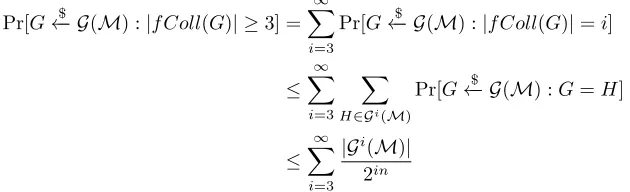
Pr[G←− G(M) :$ |f Coll(G)| ≥3] =
∞
X
i=3
Pr[G←− G(M) :$ |f Coll(G)|=i]
≤
∞
X
i=3 X
H∈Gi(M)
Pr[G←− G(M) :$ G=H]
≤
∞
X
i=3
|Gi(M)|
2in
Now, note that the a graphGis uniquely determined by its number of collisions. Therefore, |Gi(M)| ≤ (2`(2`+1)
2 )
i ≤ (3`2)i. Now let a denotes 3`2
2n. Assuming
`≤2n/2 we can write,
Pr[G←− G(M) :$ |f Coll(G)| ≥3]≤ a
3
(1−a)
≤ 27`
6
23n .
u t
C
Diagram of NI
fk1 fk1 fk1 fk1 fk2 T
0n
Y1 Y2 Y3 Yl−1 Yl
M1 M2 M3 Ml |M|
. . .