Design and Analysis of AODV Routing Protocol
in VANET Using NS-2
Valsangkar Farid1, Prof Shirgan S.S2
,
Kadganchi Harshad3NBNSCOE Solapur
Abstract: In last three decade ,tremendous improvement is made in research area of wireless adhoc network and now a days ,one of the most attractive research topic is inter vehicle communication i.e. realization of mobile adhoc network . AODV routing protocol is used to implement the Intelligent Transport Systems (ITS) concepts in VANET. A simulation is performed using AODV routing protocol in NS2 to study the hurdles involved in providing a secure and data transfer between the vehicular nodes. The data analysis is done based on the results collected from the simulation environment. The
data’s are traced out to find the absolute details of the network. Finally, the graphs are plotted for Throughput , E2EDelay and PDF.
Keywords: MANET, VANET, ITS ,AODV,NS2,etc.
I. INTRODUCTION
MANETs consist of mobile/semi mobile nodes with no
existing pre-established infrastructure. They connect
themselves in a decentralized, self-organizing manner and also establish multi hop routes. If the mobile nodes are vehicles then this type of network is called VANET(vehicular adhoc network). One important property that distinguishes MANET from VANET is that nodes move with higher avg. speed and number of nodes is assumed to be very large. Vehicular networks consist of vehicles and Road Side Units (RSU) equipped with radios. Plummeting cost of electronic components and permanent willingness of manufacturers to increase road safety and to differentiate themselves from their
competitors vehicles are becoming “Computer on Wheels” rather than “Computer N/W on Wheels”. Convergence of
forces from both the public and private sector implies that in not-too-distant future we are likely to see the total birth of vehicular n/w.
The wealth of information that could be obtained from vehicular networks is quite enormous, ranging from location and speed of emergency alerts and request for roadside assistance. In particular, many envisioned safety related
applications require that the vehicles continuously broadcast their current position and speed in so called heart beat messages. This messaging increases the awareness of vehicles
about their neighbors’ whereabouts and warns drivers off
dangerous situations.
Fig.1 VANET Scenario
II. UNIQUE CHARACTRISTIC OF VANET
2.1 Unique VANET characteristics
Though Vehicular network share common characteristics with conventional ad-hoc sensor network such as self organized and lack of central control. VANET have unique challenges that impact the design of communication system and its protocol security[2]. These challenges
include-1. Potentially high number of nodes.
Regarding VANETs as the technical basis for envisioned Intelligent Transportation System (ITS) we expect that a large portion of vehicles will be equipped with communication capabilities for vehicular communication. Taking additionally potential road-side units into account, VANET needs to be scalable with a very high number of nodes.
2. High mobility and frequent topology changes.
Nodes potentially move with high speed. Hence in certain scenarios such as when vehicle pass each other, the duration of time that remains for exchange of data packets is rather small. Also, intermediate nodes in a wireless multi-hop chain of forwarding nodes can move quickly.
3. High application requirement on data delivery.
Important VANET applications are for traffic safety to avoid road accidents; potentially including safety-of-life. These applications have high requirements with respect to real time and reliability. An end-to-end delay of seconds can render a safety information meaningless.
4. No confidentiality of safety information.
For safety application the information contained in a message is of interest for all road users and hence not confidential.
5. Privacy.
Communication capabilities in vehicles might reveal information about the driver/user, such as identifier, speed,
position and mobility pattern. Despite the need of message authentication and non-repudiation of safety messages, privacy of users and drivers should be respected in particular location privacy and anonymity.
III. ROUTING PROTOCOLS FOR VANET
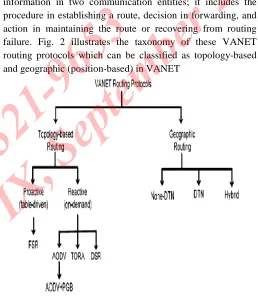
[image:3.612.309.567.221.517.2]A routing protocol governs the way of exchanging information in two communication entities; it includes the procedure in establishing a route, decision in forwarding, and action in maintaining the route or recovering from routing failure. Fig. 2 illustrates the taxonomy of these VANET routing protocols which can be classified as topology-based and geographic (position-based) in VANET
3.1 AODV
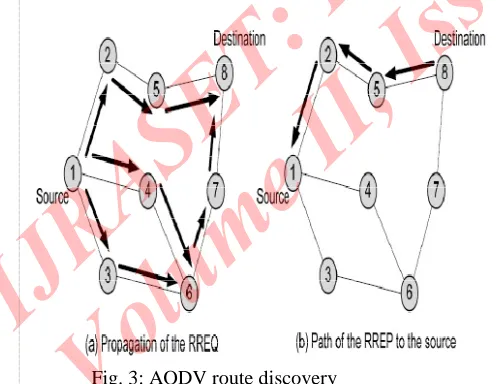
[image:4.612.31.279.483.675.2]As in VANET, nodes (vehicles) have high mobility and moves with high speed. Proactive based routing is not suitable for it. Proactive based routing protocols may fail in VANET due to consumption of more bandwidth and large table information. AODV is a reactive routing protocol, which operates on hop-by-hop pattern. The Ad hoc On-Demand Distance Vector (AODV) [3] algorithm enables dynamic, self-starting, multihop routing between participating mobile nodes wishing to establish and maintain an ad hoc network. AODV allows mobile nodes to obtain routes quickly for new destinations, and does not require nodes to maintain routes to destinations that are not in active communication. Route Requests (RREQs), Route Replies (RREPs), and Route Errors (RERRs) are the message types defined by AODV. In AODV routing, upon receipt of a broadcast query (RREQ), nodes record the address of the node sending the query in their routing table. This procedure of recording its previous hop is called backward learning. Upon arriving at the destination, a reply packet (RREP) is then sent through the complete path obtained from backward learning to the source . At each stop of the path, the node would record its previous hop, thus establishing the forward path from the source. The flooding of query and sending of reply establish a full duplex path. After the path has been established, it is maintained as long as the source uses it. A link failure will be reported recursively to the source and will in turn trigger another query-response procedure to find a new route.
Fig. 3: AODV route discovery 3.2. AODV Route Discovery
AODV [25] uses route discovery by broadcasting RREQ to all its neighboring nodes. The broadcasted RREQ contains addresses of source and destination, their sequence numbers, broadcast ID and a counter, which counts how many times RREQ has been generated from a specific node. When a source node broadcast a RREQ to its neighbors it acquires RREP either from its neighbors or that neighbor(s) rebroadcasts RREQ to their neighbors by increment in the hop counter. If node receives multiple route requests from same broadcast ID, it drops repeated route requests to make the communication loop free.
3. 3 AODV Route Table Management
Routing table management in AODV is needed to avoid those entries of nodes that do not exist in the route from source to destination. In AODV Managing routing table information handled with the destination sequence numbers.
3.4 AODV Route Maintenance
When nodes in the network detects that a route is not valid anymore for communication it delete all the related entries from the routing table for those invalid routes. And sends the RREP to current active neighboring nodes that route is not valid anymore for communication. AODV maintains only the loop free routes.
IV. SIMULATION ENVIRONMENT
4.1 Simulation Parameters
Various parameters used for performance evaluation are: 1) Throughput: It is the amount of data per time unit that is delivered from one node to another via a communication link. The throughput is measured in Packets per unit TIL or bits per TIL. TIL is Time Interval Length. More is the throughput of sending and receiving packets better is the performance. Lesser is the throughput of dropping packets better is the performance.
2) Average throughput: It is the average of total throughput. It is also measured in Packets per unit TIL or bits per TIL. 3) Packet Drop: It shows total number of data packets that could not reach destination successfully. The reason for packet drop may arise due to congestion, faulty hardware and queueoverflow etc. Lower packet drop rate shows higher protocol performance.
4) Packet size: Size of packets in bytes.
5) Average simulation End to End delay (End2End delay): This metric gives the overall delay, from packet transmission by the application agent at the source node till packet reception by the application agent at the destination node. Lower delay shows higher protocol performance. The following equation is used to calculate the average end-to-end delay, Average End to End Delay = (T_DataR – T_DataS), Where T_DataR = Time data packets received at destination node T_DataS = Time data packets sent from source node. The end to end delay is important metrics because VANET needs a small latency to deliver quick messages. It shows the suitability of the protocol for the VANET.
[image:5.612.316.577.98.430.2]6) Simulation time: Total time taken for simulation. It is measured in seconds.
Table 1. Data Analysis Based on simulation setup
V. RESULTS AND ANALYSIS
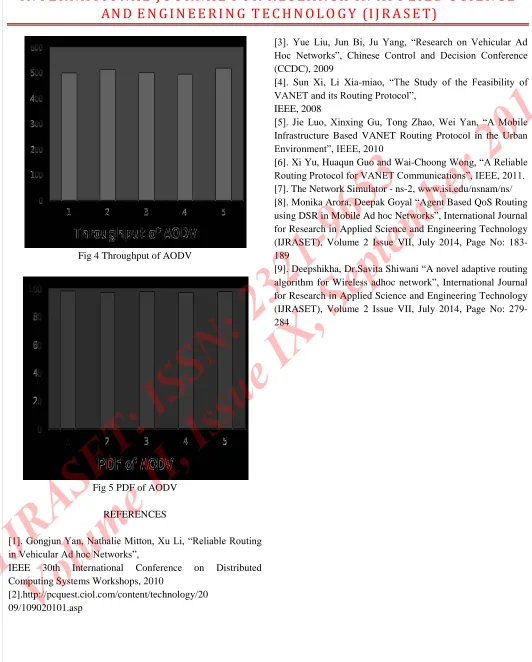
Fig 4 Throughput of AODV
Fig 5 PDF of AODV
REFERENCES
[1]. Gongjun Yan, Nathalie Mitton, Xu Li, “Reliable Routing in Vehicular Ad hoc Networks”,
IEEE 30th International Conference on Distributed
Computing Systems Workshops, 2010
[2].http://pcquest.ciol.com/content/technology/20 09/109020101.asp
[3]. Yue Liu, Jun Bi, Ju Yang, “Research on Vehicular Ad Hoc Networks”, Chinese Control and Decision Conference
(CCDC), 2009
[4]. Sun Xi, Li Xia-miao, “The Study of the Feasibility of
VANET and its Routing Protocol”,
IEEE, 2008
[5]. Jie Luo, Xinxing Gu, Tong Zhao, Wei Yan, “A Mobile
Infrastructure Based VANET Routing Protocol in the Urban
Environment”, IEEE, 2010
[6]. Xi Yu, Huaqun Guo and Wai-Choong Wong, “A Reliable
Routing Protocol for VANET Communications”, IEEE, 2011.
[7]. The Network Simulator - ns-2, www.isi.edu/nsnam/ns/
[8]. Monika Arora, Deepak Goyal“Agent Based QoS Routing
using DSR in Mobile Ad hoc Networks”, International Journal
for Research in Applied Science and Engineering Technology (IJRASET), Volume 2 Issue VII, July 2014, Page No: 183-189
[9]. Deepshikha, Dr.Savita Shiwani“A novel adaptive routing