
NUMERICAL SOLVER BASED ON THE FINITE
DIFFERENCE TIME DOMAIN (FDTD)
TECHNIQUE FOR RESEARCH AND TEACHING
PURPOSES
NURUL ‘ATIQAH BINTI AHMAD
i
ABSTRACT
A 1D-FDTD code was developed to support plane wave excitation in 3D-FDTD domain and the code was developed using C++ programming language. First-order Mur absorbing boundary condition (ABC) is applied to keep outgoing electric and magnetic fields from being reflected into the problem space. In this thesis, the performance of 1D-FDTD scheme is then evaluated on several medium including free space, lossless dielectric medium, lossy dielectric medium and good conductors. Sine-Gaussian technique is used to excite field signal in the 1D-FDTD simulation domain and the simulation have been carried out to analyze the performance of the scheme. From the results, the 1D-FDTD scheme shows good expected results on all applied conditions. The integration of 1D-FDTD scheme into the 3D-FDTD solver is realized through the implementation of Total Field Scattered Field (TFSF) technique. The technique is used to excite plane wave into the 3D-FDTD domain for future wave propagation studies. All simulation results presented in this work were
ABSTRAK
CHAPTER 1
INTRODUCTION
1.1 Project Background
Over the past years, a number of numerical and analytical approaches to Maxwell's time-dependent curl equations were broadly used with the increases in computer memory capacity and relentless advances in computational imitating efficiency. Consequently, the demand for efficient field modelling tools in electromagnetic scattering problems is ceaselessly expanding. In general, computational electromagnetic techniques have been applied to vast areas including the study of the radiation, scattering and penetration of electromagnetic wave with 3-D objects, in problems related to telecommunication, electromagnetic compatibility (EMC), microwave devices, waveguide structures, medical diagnosis and many others [4].
and can be bounded to permit accurate models for a very large variety of electromagnetic wave interaction problems [3].
Furthermore, the primary advantage of FDTD over other full-wave models is that, FDTD being a time domain method allows broadband analysis of the antenna by Gaussian pulse excitation. The antenna characteristics over a wide frequency range can be obtained by taking the Fourier transform of the FDTD simulation results obtained when a wideband Gaussian pulse is used as an excitation and most of widely used electromagnetic simulation software's use frequency domain methods like FEM [1].
1.2 Problem Statement
In many problems of electromagnetics the quantity of interest is the field scattered by a localized object in an otherwise uniform background, under harmonic plane wave illumination. Since FDTD is a near-field solver and only represents a finite portion of the space, it is impossible to create inside it a truly plane wave of infinite extent traveling in an arbitrary direction. Therefore, the development of the plane wave source condition allowed the earliest engineering applications of FDTD computational electromagnetics modeling. These applications were in the defense and bio electromagnetics areas, and involved the interaction of complex-shaped, inhomogeneous material structures with impinging pulsed or continuous-wave electromagnetic fields. Initially, many problems of these types located the material structure of interest far from the radiating antenna, where the incident illumination could be approximated by plane wave.
3
of optics, one can treat the waves as light rays which correspond locally to plane waves.
1.3 Project Objectives
The objectives of the project are:
(i) To develop a stand-alone 1D-FDTD scheme for electromagnetic wave study. (ii) To evaluate the performance of 1D-FDTD scheme on various materials and
medium.
(iii) To Implement TFSF decomposition into the existing 3D-FDTD scheme for plane wave excitation in 3D space.
1.4 Scope of Project
The scopes of the project are:
(i) The 1D-FDTD scheme and the 3D-TFSF decomposition codes were developed using C++ programming language.
(ii) Using OriginPro software for data post-processing purposes.
(iii) Mur absorbing boundary condition was applied to truncate the 1D-FDTD simulation space to infinity.
(iv) The performance of the 1D-FDTD scheme was evaluated on several medium and material conditions including free space, dielectric (lossy and lossless) and PEC.
(v) Using the sine-gaussian technique to excite field signal in the 1D-FDTD simulation domain.
(vi) The plane wave is only for normal incident propagation in 3D space.
1.5 Outlines of the Thesis
Chapter 2 unfolds the theoretical concept of FDTD principles including the derivation of the magnetic and electric field update equations, parameters that control the stability and accuracy. The advantages of using FDTD, excitation source, absorbing boundary condition (ABC) and total field scattered field (TFSF) were discuss in general.
Chapter 3 comprises the methodology or approaches in order to achieve the objectives of the project. It shows work flow used in completion of this project. The derivation of electric field and magnetic field for Total/Scattered Field formulation in 3D were shown.
Chapter 4 discuss the results and analysis data which are addressed through the simulation of the 1D-FDTD evaluation in a various medium and plane wave implementation to the currently available FDTD code. Graphs of simulation output and comparison of results in time steps are explained in this chapter.
CHAPTER 2
LITERATURE REVIEW
2.1 Introduction
Over the past few years, finite-difference time-domain (FDTD) method [1] have become increasingly prevalent in the computational electromagnetic problems due to its simplicity, efficiency, robustness and versatility scheme for highly complex configuration in the computational domain. Generally, FDTD technique is the most well-known numerical method for the solution of problems in electromagnetic simulation ranging from RF to optical frequencies. It is considered to be one of the most powerful numerical techniques for solving partial differential equations of any kind. In addition, it can be utilized to solve the spatial as well as the temporal distributions of electric and magnetic fields in various media.
2.2 Rise of FDTD Methods
The FDTD method, introduced by Yee in 1966 [1], was the first technique in this class, and has remained the subject of continuous development. Since 1990, when engineers in the general electromagnetics community became aware of the modeling capabilities afforded by FDTD and related techniques, the interest in this area has expanded well beyond defense technology.
There are seven primary reasons for the expansions of interest in FDTD and related computational solution approaches for Maxwell’s equations:
(i) FDTD uses no linear algebra:
Being a fully explicit computation, FDTD avoids the difficulties with linear algebra that limit the size of frequency-domain integral-equation and finite-element electromagnetics models to generally fewer than electromagnetic field unknowns. FDTD models with as many as field unknowns have been run; there is no intrinsic upper bound to this number [4]. (ii) FDTD is accurate and robust:
The sources of error in FDTD calculations are well understood, and can be bounded to permit accurate models for a very large variety of electromagnetic wave interaction problems [4].
(iii) FDTD treats impulsive behavior naturally:
Being a time-domain technique, FDTD directly calculates the impulse response of an electromagnetic system. Therefore, a single FDTD simulation can provide either ultra wideband temporal waveforms or the sinusoidal steady-state response at any frequency within the excitation spectrum [4]. (iv) FDTD treats nonlinear behavior naturally:
Being a time-domain technique, FDTD directly calculates the nonlinear response of an electromagnetic system.
(v) FDTD is a systematic approach:
7
of an integral equation. For example, FDTD requires no calculation of structure-dependent Green functions [4].
(vi) Computer memory capacities are increasing rapidly:
While this trend positively influences all numerical techniques, it is of particular advantage to FDTD methods, which are founded on discretizing space over a volume, and therefore inherently require a large random access memory.
(vii) Computer visualization capabilities are increasing rapidly:
While this trend positively influences all numerical techniques, it is of particular advantage to FDTD methods, which generate time-marched arrays of field quantities suitable for use in color videos to illustrate the field dynamics.
Generally, the algorithm used by Yee was described by the electric field component which was spatially and temporally offset from the magnetic field component to acquire the update equations. These equations were used in a leapfrog manner to propagate the electric and magnetic fields ahead in time. The equations provide the present fields in terms of the past fields all over the computational domain. After Yee’s publication, the approach was widely used with different endeavor [2-6].
The boundaries of the computational domain in FDTD need to be carefully treated when simulating problems in open regions. Spurious reflections will generally occur from the termination of the grid.
The problem can be solved by means of the well-known method called the absorbing boundary condition (ABC). It is generally meant to absorb any outgoing propagating waves without ideally producing spurious reflections. The ABCs was first proposed in 1971 by Merewether [7] to solve the open region difficulties. The development chronicle to magnify the practicability study of the technique was continued in the literature by [8-12] which were based of nonmaterial type. In contrast, Berenger presented a new idea in 1994 called the perfectly matched layer (PML) ABC which was based on material category [13]. The state of the art of Berenger’s PML contributes to notably better precision when compared to the other
The main handicap of FDTD lies in the truth that only consistent grids can be used. Accordingly, the geometry resemblance in FDTD is restricted to staircase-shaped boundaries which lead to a large number of computer memory requirements and the CPU time particularly when dealing with curvature geometries with fine features [16]. The total number of cells in the computational domain grows significantly due to a global fine mesh. Another FDTD weakness is the presence of error due to numerical dispersion [17-18].
2.3 Finite Difference Time Domain Method in 1D
The finite-difference time-domain (FDTD) method is arguably the simplest, both conceptually and in terms of implementation, of the full-wave techniques used to solve problems in electromagnetics. It can accurately tackle a wide range of problems. However, as with all numerical methods, it does have its share of artifacts and the accuracy is contingent upon the implementation. The FDTD method can solve complicated problems, but it is generally computationally expensive. Solutions may require a large amount of memory and computation time. The FDTD method loosely fits into the category of “resonance region” techniques, in example, ones in which the characteristic dimensions of the domain of interest are somewhere on the order of a wavelength in size. If an object is very small compared to a wavelength, quasi-static approximations generally provide more efficient solutions. Alternatively, if the wavelength is exceedingly small compared to the physical features of interest, ray-based methods or other techniques may provide a much more efficient way to solve the problem.
The FDTD method employs finite differences as approximations to both the spatial and temporal derivatives that appear in Maxwell’s equations (specifically Ampere’s and Faraday’s laws). Consider the Taylor series expansions of the function expanded about the point with an offset of
(2.1)
9
where the primes indicate differentiation. Subtracting the second equation from the first yields:
(2.3)
Dividing by produces:
(2.4)
Thus the term on the left is equal to the derivative of the function at the point plus
a term which depends on plus an infinite number of other terms which are not shown. For the terms which are not shown, the next would depend on and all subsequent terms would depend on even higher powers of . Rearranging slightly, this relationship is often stated as:
(2.5)
The “O” term represents all the terms that are not explicitly shown and the value in parentheses, in example., , indicates the lowest order of in these hidden terms. If is sufficiently small, a reasonable approximation to the derivative may be obtained
by simply neglecting all the terms represented by the “O” term. Thus, the central-difference approximation is given by:
(2.6)
Note that the central difference provides an approximation of the derivative of the function at , but the function is not actually sampled there. Instead, the function is sampled at the neighboring points and . Since the lowest power of being ignored is second order, the central difference is said to have second-order accuracy or second-order behavior. This implies that if is reduced by a factor of 10,
One can construct order central differences. In order to get higher-order behavior, more terms, in example, more sample points, must be used. The use of higher-order central differences in FDTD schemes is certainly possible, but there are some complications which arise because of the increased “stencil” of the
difference operator. For example, when a PEC is present, it is possible that the difference operator will extend into the PEC prematurely or it may extend to the other side of a PEC sheet. Because of these types of issues, it will only consider the use of second-order central difference.
2.3.1 Update Equations in 1D
Consider a one-dimensional space where there are only variations in the x direction. Assume that the electric field only has a z component. In this case Faraday’s law can be written:
(2.7)
Thus must be the only non-zero component of the magnetic field which is time
varying. (Since the right-hand side of this equation has only a component, the magnetic field may have non-zero components in the and directions, but they must be static. It will not be concerned with static fields here.) Knowing this, Ampere’s law can be written as:
(2.8)
The two scalar equations obtained from (2.7) and (2.8) are:
(2.9)
11
The first equation gives the temporal derivative of the magnetic field in terms of the spatial derivative of the electric field. Conversely, the second equation gives the temporal derivative of the electric field in terms of the spatial derivative of the magnetic field. As will be shown, the first equation will be used to advance the magnetic field in time while the second will be used to advance the electric field. A method in which one field is advanced and then the other, and then the process is repeated, is known as a leapfrog method.
The next step is to replace the derivatives in (2.9) and (2.10) with finite differences. To do this, space and time need to be discretized. The following notation will be used to indicate the location where the fields are sampled in space and time:
(2.11)
(2.12)
where is the spatial offset between sample points and is the temporal offset. The index corresponds to the spatial step, effectively the spatial location, while the
index corresponds to the temporal step. When written as a superscript still represents the temporal step and it is not an exponent. When implementing FDTD algorithms, it will see that the spatial indices are used as array indices while the temporal index, which is essentially a global parameter, is not explicitly specified for each field location. Hence, it is reasonable to keep the spatial indices as an explicit argument while indicating the temporal index separately.
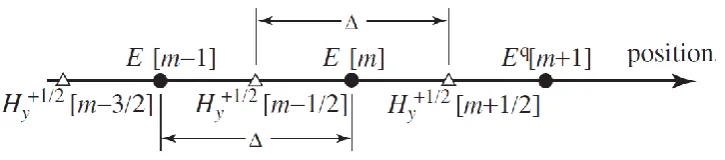
Figure 2.1 shows the arrangement of electric and magnetic field nodes in space and time. The electric field nodes are shown as circles and the magnetic-field nodes as triangles. The indicated point is where the difference equation is expanded to obtain an update equation for [3]. It is the answer to the question of how
and hence unknown. The FDTD algorithm provides a way to obtain the future fields from the past fields.
Figure 2.1: Arrangement of electric and magnetic field nodes in space and time [3].
As indicated in Figure 2.1, consider Faraday’s law at the space-time point :
(2.13)
The temporal derivative is replaced by a finite difference involving
and (in example, the magnetic field at a fixed location but two different times) while the spatial derivative is replaced by a finite difference involving and (in example, the electric field at two different locations but one time). This yields:
13
Solving this for yields:
(2.15)
This is known as an update equation, specifically the update equation for the
field. It is a generic equation which can be applied to any magnetic-field node. It shows that the future value of depends on only its previous value and the
[image:16.595.153.487.420.665.2]neighboring electric fields. Figure 2.2 shows the space-time after updating the magnetic field. The dividing line between future and past values has moved forward a half temporal step. The indicated point is where the difference equation is written to obtain an update equation for [3]. After applying (2.15) to all the magnetic-field nodes, the dividing line between future and past values has advanced a half time-step. The space-time grid thus appears as shown in Figure 2.2 which is identical to Figure 2.1 except for the advancement of the past or future dividing line.
Figure 2.2: Space-time after updating the magnetic field [3].
(2.16)
Replacing the temporal derivative on the left with a finite difference involving and z and replacing the spatial derivative on the right with a finite
difference involving and yields:
(2.17)
Solving for yields:
(2.18)
Equation (2.18) is the update equation for the field. The indices in this equation are generic so that the same equation holds for every node. Similar to the update equation for the magnetic field, here it will see that the future value of depends on
only its past value and the value of the neighboring magnetic fields.
After applying (2.18) to every electric-field node in the grid, the dividing line between what is known and what is unknown moves forward another one-half temporal step. One is essentially back to the situation depicted in Figure 2.1 where the future fields closest to the dividing line between the future and past are magnetics fields. They would be updated again, then the electric fields would be updated, and so on.
It is often convenient to represent the update coefficients and in terms of the ratio of how far energy can propagate in a single temporal step to the spatial step. The maximum speed electromagnetic energy can travel is the speed of light in
free space and hence the maximum distance energy can travel in one time step is (in all the remaining discussions the symbol will be reserved for the speed of light in free space). The ratio is often called the Courant number
15
simulation (hence the use of ) and will be considered further later. Letting and the coefficients in (2.18) and (2.15) can be written as:
(2.19)
(2.20)
where is the characteristic impedance of free space.
In FDTD simulations there are restrictions on how large a temporal step can be. If it is too large, the algorithm produces unstable results (in example, the numbers obtained are completely meaningless and generally tend quickly to infinity). At this stage it is not consider a rigorous analysis of stability. However, thinking about the way fields propagate in an FDTD grid, it seems logical that energy should not be able to propagate any further than one spatial step for each temporal step, .
This is because in the FDTD algorithm each node only affects its nearest neighbors. In one complete cycle of updating the fields, the furthest a disturbance could propagate is one spatial step. It turns out that the optimum ratio for the Courant number (in terms of minimizing numeric errors) is also the maximum ratio. Hence, for the one-dimensional simulations considered initially, it will use:
(2.21)
Figure 2.3: A one-dimensional FDTD space showing the spatial offset between the magnetic and electric fields [3].
2.4 Maxwell’s Equations in 3D
A pioneering way of describing the electromagnetic phenomena was introduced by James Clerk Maxwell in 1865 [4]. Later in 1873, he published an article called “Treatise on Electricity and Magnetism” in which the discoveries of Coulomb,
Oersted, Ampere and Faraday were united into four refined constructed mathematical equations known as Maxwell’s equations. The differential time domain Maxwell’s equations in a linear medium are given by:
(2.22)
(2.23)
In (2.22) and (2.23), the following symbols are defined: (i) is the magnetic flux density in webers/meter2. (ii) is the electric flux density in coulombs/meter2. (iii) is the electric field in volts/meter.
(iv) H is the magnetic field in amperes/meter.
(v) is the magnetic current density in volts/meter2 and is defined to relate any magnetic loss to the field.
(vi) is the electric current density in amperes/meter2 and is defined to relate any electric loss to the field.
17
(2.24)
(2.25)
Where *
is magnetic resistivity in Ω/m and σ is the electric conductivity in S/m. In materials with field-independent, direction-independent and frequency-independent electric and magnetic properties, the following proportions apply:
(2.26)
(2.27)
μ is the magnetic permeability in H/m and ε is the electric permittivity in F/m.
Inserting
(2.24) and (2.26) to (2.22) and dividing by μ gives:
(2.28)
is the magnetic losses which may exist inside the medium. Inserting (2.25) and (2.27) to (2.23) and dividing by ε gives:
(2.29)
Where is the electric losses which may exist inside the medium. In Cartesian coordinates, equations (2.28) and (2.29) yield the following six scalar equations:
The system of six coupled partial differential equations of (2.30-2.32) and (2.33-2.35) forms the basis of the FDTD numerical algorithm for electromagnetic wave interaction with general 3D objects. The FDTD algorithm need not explicitly enforce the Gauss law relations indicating zero free electric and magnetic charge. This is because these relations are theoretically a direct consequence of the curl equations. However, the FDTD space lattice must be structured so that the Gauss law relations are implicit in the positions of the electric and magnetic components, and in the numerical space derivative operations upon these components that model the action of the curl operator.
2.5 The Yee Algorithm
The FDTD algorithm as first proposed by Kane Yee in 1966 employs second-order central differences. The algorithm can be summarized as follows:
(i) Replace all the derivatives in Ampere’s and Faraday’s laws with finite differences. Discretize space and time so that the electric and magnetic fields are staggered in both space and time.
(ii) Solve the resulting difference equations to obtain “update equations” that express the (unknown) future fields in terms of (known) past fields.
(iii) Evaluate the magnetic fields one time-step into the future so they are now known (effectively they become past fields).
(iv) Evaluate the electric fields one time-step into the future so they are now known (effectively they become past fields).
(v) Repeat the previous two steps until the fields have been obtained over the desired duration.
19
A space point in a rectangular grid is defined from Yee's original notation [5] as:
(2.36)
Let F denote any function of discrete space and time given by:
(2.37)
Δx, Δy and Δz are the grid space increments in x, y and z directions respectively, and Δt is the time increment. Using a central finite-difference approximation, space and
time derivatives of F can be written as:
(2.38)
(2.39)
In equation (2.38), is the error term that represents all the remaining terms in
a Taylor series expansion. It is known as a central finite difference scheme in space with second-order accuracy. Similarly, (2.39) is second-order accurate in time. Applying Yee's finite-difference scheme to (2.30) gives:
(2.40)
The field component in (2.40) is evaluated at time step n. However, the value of at time step n is not available and hence the following interpolated approximation is used:
By substituting equation (2.41) in (2.40), leaving on the left hand side and passing the all remaining terms to the right, assuming cubical FDTD cells are used, the finite difference updating equation for the magnetic and electric field components can be derived as:
(2.42) (2.43) (2.44) (2.45) (2.46) (2.47)
It can be seen that the coefficients on the left hand side are referred to as Yee's updating coefficients. The electric field coefficients are given by:
(2.48) (2.49)
The magnetic updating coefficients can be written as:
(2.50) (2.51)
The subscript p can be x, y or z and is the cell size in the p-direction. Assuming
21
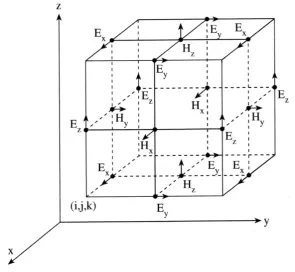
[image:24.595.171.467.339.611.2]dielectric or magnetic, electric and magnetic field updating coefficients can be easily calculated from equations (2.48) to (2.51) before the FDTD time stepping algorithm starts. The orientation of the fields in Figure 2.4 is known as the FDTD lattice or Yee cell. The magnetic and electric fields are located on the faces and the edges of the cube respectively. Each electric field vector component is surrounded by four circulating magnetic field vector components and vice versa. Both the electric and magnetic field vector components are located half a cell from each other. In addition, this arrangement permits easy implementations of the central finite difference approximations and the integral form of the Faraday's law and the Ampere's law. The system of difference equations is solved at the nodes. Figure 2.5 illustrates the typical relationship between field components within a quarter of a cell and on a plane distinctly helpful when handling boundary conditions of a closed region.
Figure 2.5: Relationship between field components: (a) within a quarter of a unit cell, (b) on a plane [6].
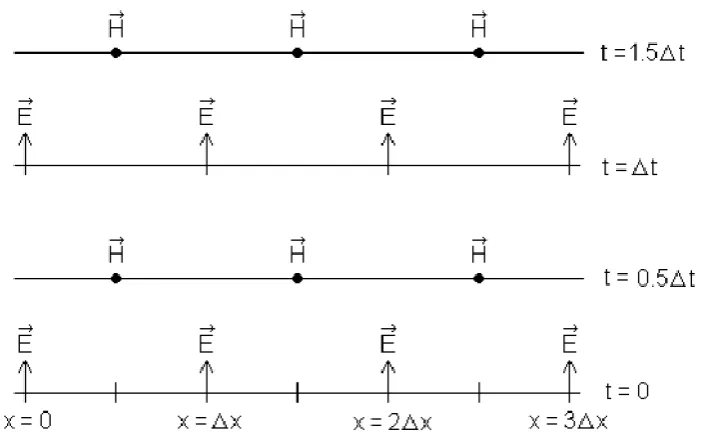
Figure 2.6: Space-time chart of the Yee algorithm in a leapfrog arrangement [1].
[image:25.595.144.495.337.557.2]23
[image:26.595.223.414.176.455.2]frequency. It can be seen that a leapfrog arrangement between the electric and magnetic field vector components is used to implement the time step of the FDTD algorithm. The grids of the electric and magnetic fields are displaced half a cell between them indicating that the computer must work through them in turn.
Figure 2.7: The flow chart of the time stepping FDTD algorithm [3].
2.6 Numerical Dispersion and Stability
The accuracy and stability of FDTD method is controlled by two significant parameters namely the space resolution and the time resolution . Waves
equal to λmin/10, where λmin is the shortest wavelength at the frequency of
[image:27.595.168.473.196.412.2]computation. The numerical grid produces a certain amount of numerical dispersion error, when the grid size and the angle of propagating wave are increased as illustrated in Figure 2.8. Numerical dispersion is observed to be approximately 1% when the cell size is exactly λ/10.
Figure 2.8: Variation of the numerical phase velocity with wave propagation angle in two-dimensional FDTD grid [1].
The time increment must satisfy the CFL criterion [1, 3] to ensure the stability of
the computation process, which sets the relation between the time and space resolution for three-dimensional FDTD given by:
(2.52)
is the maximum phase velocity of the propagating wave in any material in the
model. For the three-dimensional cubic cell space lattice with
in a d-dimensional spatially homogeneous FDTD grid, the time step is bounded by:
92
REFERENCES
1. Taflove, A. and Hagness, S. C., Computational Electrodynamics: The Finite – Difference Time – Domain method, 3rd Edition, Artech House, Inc., 2005.
2. Sullivan, D. M. (2013). Electromagnetic simulation using the FDTD method. John Wiley & Sons.
3. Schneider, J. B. (2010). Understanding the finite-difference time-domain method. Scholl of electrical engineering and computer science Washington
State University.–URL: http://www. eecs. wsu. edu/~ schneidj/ufdtd/(request
data: 29.11. 2012).
4. Yee, K. S., Numerical solution of initial boundary value problems involving Maxwell's equations in isotropic media. IEEE Transactions on Antennas and Propagation 14 (3): 302–307, 1996.
5. Taflove, A. Application of the finite-difference time-domain method to sinusoidal steady state electromagnetic penetration problems. IEEE Transactions on Electromagnetic Compatibility 22 (3): 191–202, 1980.
6. Bi, Z., Wu, K., Wu, C., and Litva, J., Accurate Characterization of Planar Printed Antennas using Finite – Difference Time – Domain method, IEEE Transactions on Antennas and Propagation, vol. 40, May 1992.
7. Loui, H. 1D-FDTD using MATLAB.
8. Xiao, Y., Maywar, D. N., and Agrawal, G. P. (2014). Reflection and transmission of electromagnetic waves at a temporal boundary. Optics letters,
39(3), 574-577.
9. Sandeep, S., Broadband analysis of microstrip patch antenna using 3D FDTD – UPML, University of Colorado at Boulder, USA, ECEN 5134 - Term paper, 2008.
10. Schneider, J. B. (2004). Plane waves in FDTD simulations and a nearly perfect total-field/scattered-field boundary. Antennas and Propagation, IEEE
11. Hu, F. Q. (2004). Absorbing boundary conditions. International Journal of Computational Fluid Dynamics, 18(6), 513-522.
12. Zweki, M., Abd-Alhameed, R. A., Mangoud, M. A., Excell, P. S., and Vaul, J. A., Broadband Analysis of Finite Microstrip Patch Antenna Structure using FDTD ”, 11th International Conference on Antennas and Propagation,
UMIST, Manchester, UK, April 2001.
13. Sheen, D. M., Ali, S. M., Abouzahra, M. D., and Kong, J. A., Application of the Three–Dimensional Finite–Difference Time–Domain Method to the Analysis of Planar Microstrip Circuits, Microwave Theory and Techniques, IEEE Transactions on, 38(7), 849-857, July 1990.
14. Taflove, A. and Brodwin, M. E., Numerical solution of steady-state electromagnetic scattering problems using the time-dependent Maxwell's equations. Microwave Theory and Techniques, IEEE Transactions on, 23(8), 623-630, 1975.
15. Taflove, A. and Brodwin, M. E. Computation of the electromagnetic fields and induced temperatures within a model of the microwave-irradiated human eye. IEEE Transactions on Microwave Theory and Techniques 23 (11): 888– 896, 1975.
16. Holland, P. R., Threde: A free-field EMP coupling and scattering code. IEEE Transactions on Nuclear Science 24 (6): 2416–2421, 1977.
17. Berenger, J. P., A perfectly matched layer for the absorption of electromagnetic waves. Journal of computational physics, 114(2), 185-200., Oct.1994.
18. Mur, G., Absorbing boundary conditions for the finite-difference approximation of the time-domain electromagnetic-field equations.
Electromagnetic Compatibility, IEEE Transactions on, (4), 377-382., Nov. 1981.
19. Fang, J. (1994). Absorbing boundary conditions applied to model wave propagation in microwave integrated-circuits. Microwave Theory and
Techniques, IEEE Transactions on, 42(8), 1506-1513.
94
21. Merewether, D. E., Fisher, R., and Smith, F. W. (1980). On implementing a numeric Huygen's source scheme in a finite difference program to illuminate
scattering bodies. Nuclear Science, IEEE Transactions on, 27(6), 1829-1833.
22. Umashankar, K. R., and Taflove, A., A novel method to analyze electromagnetic scattering of complex objects, IEEE Trans. Electromagnet. Compat., Vol. 24, 1982, pp. 397 – 405.
23. Ramli, K. N. (2011). Modeling and analysis of complex electromagnetic problems using FDTD subgridding in hybrid computational methods
(Doctoral dissertation, University of Bradford).
24. Dahlan, S. H. (2012). Contribution to the body of revolution finite-difference time domain (BoR-FDTD) method-implementations of hybrid and
multi-resolution approaches for fast simulation of electrically large
axis-symmetrical antenna structures (Doctoral dissertation, Universite De
Rennes).
25. Gedney, S. D. (2011). Introduction to the Finite-difference Time-domain (FDTD) Method for Electromagnetics. Synthesis Lectures on Computational
Electromagnetics, 6(1), 1-250.
26. Katz, D. S., Thiele, E. T., and Taflove, A. (1994). Validation and extension to three dimensions of the Berenger PML absorbing boundary condition for
FDTD meshes. Microwave and Guided Wave Letters, IEEE, 4(8), 268-270.
27. Ziolkowski, R. W., and Heyman, E. (2001). Wave propagation in media having negative permittivity and permeability. Physical review E, 64(5),
056625.
28. Kosmas, P. (2007, October). Review of an FDTD TF/SF Formulation Based on Auxiliary 1-D grids. In Computational Electromagnetics in Time-Domain,
2007. CEM-TD 2007. Workshop on (pp. 1-4). IEEE.
29. Barros, F. J. B., Santos, R. O., Araújo, J. S., and Sobrinho, C. L. S. S. (2003, October). FDTD code for determination of the radiation pattern of an aperture
antenna using the magnetic vector potential and parallel processing. In
Applied Electromagnetics and Communications, 2003. ICECom 2003. 17th
International Conference on (pp. 441-444). IEEE.
microstrip circuits. Microwave Theory and Techniques, IEEE Transactions
on, 44(9), 1535-1539.
31. Sun, W., Loeb, N. G., & Fu, Q. (2002). Finite-difference time-domain solution of light scattering and absorption by particles in an absorbing
medium. Applied optics, 41(27), 5728-5743.
32. Engquist, B., and Majda, A. (1977). Absorbing boundary conditions for numerical simulation of waves. Proceedings of the National Academy of
Sciences, 74(5), 1765-1766.
33. Mur, G. (1998). Total-field absorbing boundary conditions for the time-domain electromagnetic field equations. Electromagnetic Compatibility,
IEEE Transactions on, 40(2), 100-102.
34. Hui, W., Zhi-Xiang, H., Xian-Liang, W., and Lei, W. (2011, July). Perfect plane wave injection into 3D FDTD (2, 4) scheme. In Cross Strait
Quad-Regional Radio Science and Wireless Technology Conference (CSQRWC),
2011 (Vol. 1, pp. 40-43). IEEE.
35. Gurel, L. E. V. E. N. T., OGuz, U. G. U. R., and Arikan, O. R. H. A. N. (1997, July). Accurate plane-wave excitation in the FDTD method. In
Antennas and Propagation Society International Symposium, 1997. IEEE.,
1997 Digest (Vol. 4, pp. 2164-2167). IEEE.
36. Rappaport, T. S. (1996). Wireless communications: principles and practice
(Vol. 2). New Jersey: prentice hall PTR.
37. Free-Space, B. P. C. (2005). Michael Marcus and Bruno Pattan.
38. Andrews, L. C., and Phillips, R. L. (2005). Laser beam propagation through random media (Vol. 10, No. 3.626196). Bellingham: SPIE press.
39. Jackson, J. D., and Jackson, J. D. (1962). Classical electrodynamics (Vol. 3). New York etc.: Wiley.
40. Wang, W. C. (1986). Electromagnetic wave theory.
41. Ishimaru, A. (1991). Electromagnetic wave propagation, radiation, and scattering. Prentice-Hall.
42. Smith, D. R., & Schurig, D. (2003). Electromagnetic wave propagation in media with indefinite permittivity and permeability tensors. Physical Review
Letters, 90(7), 077405.
96
44. Ulaby, F. T. (2005). Electromagnetics for engineers. Pearson/Prentice Hall.
![Figure 2.1: Arrangement of electric and magnetic field nodes in space and time [3].](https://thumb-us.123doks.com/thumbv2/123dok_us/8762432.894646/15.595.169.472.136.353/figure-arrangement-electric-magnetic-field-nodes-space-time.webp)
![Figure 2.2: Space-time after updating the magnetic field [3].](https://thumb-us.123doks.com/thumbv2/123dok_us/8762432.894646/16.595.153.487.420.665/figure-space-time-updating-magnetic-field.webp)
![Figure 2.7: The flow chart of the time stepping FDTD algorithm [3].](https://thumb-us.123doks.com/thumbv2/123dok_us/8762432.894646/26.595.223.414.176.455/figure-flow-chart-time-stepping-fdtd-algorithm.webp)

