
DYNAMIC SPECTRUM ACCESS UTILIZING SOFTWARE DEFINED RADIO (SDR)
BAREQ KAWWAM AHMED
A project report submitted in partial
Fulfillment of the requirement for the award of the Degree of Master Electrical Engineering
Fakulti Kejuruteraan Elektrik dan Elektronik Universiti Tun Hussein Onn Malaysia
CHAPTER 1
INTRODUCTION
1.1 Overview
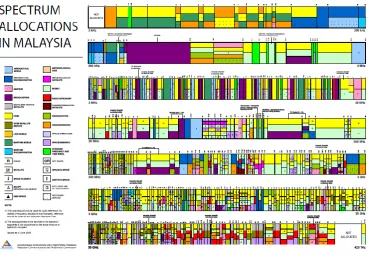
[image:2.595.128.498.465.720.2]Currently, spectrum is managed in divide and conquers fashion where a specific band in the spectrum is allocated to a specific service. This practice causes the spectrum to be fully assigned especially from 3 kHz until 420 THz. In Malaysia itself, most of the spectrum is already allocated to the specific applications as shown in Figure 1.1 [1].
However, most of this allocated spectrum is underutilize. Study by Shared Spectrum Company [2] shows that in New York City, only 13% of the spectrum
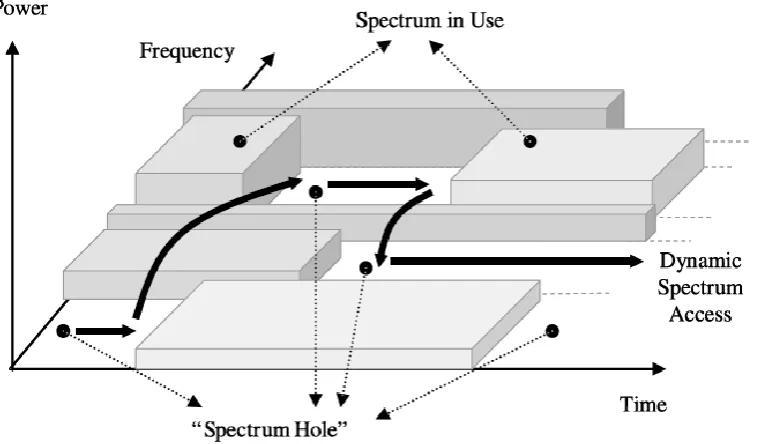
[image:3.595.123.487.283.539.2]between 30 MHz until 29 GHz is utilize (as shown in Figure 1.2) while Danijela Cabric [3] reported that there is very low utilization of the spectrum especially between 3 GHz to 6 GHz bands as shown in Figure 1.3. This underutilize spectrum has lead to the creation of vacant spectrum which is known as spectrum whitespaces or spectrum holes [12]. In order to overcome this underutilize spectrum and solve the spectrum scarcity problem, a new concept of accessing the spectrum is proposed; the Dynamic Spectrum Access (DSA) [4].
Figure 1.2 Bar Graph of the Spectrum Occupancy in Each Band in New York City and Chicago
Figure 1.3 Measurement of 0-6 GHz spectrum utilization at Berkley Wireless Research Centre
[image:4.595.120.499.404.626.2]1.2 Problem Statement
In order to achieve the goal of DSA, it is a fundamental requirement that the unlicensed user which wants to use the licence spectrum performs spectrum sensing to detect the presence of the licensed user signal before a spectrum is accessed as to avoid harmful interference. Hence, the detection of the licensed user signal and identification of unoccupied spectrum segments, the spectrum holes, has to be done as accurate and as robust as possible.
Besides, during the communication of the unlicensed user, it is needs by this user to jump from frequency hole to frequency hole whenever needed. Therefore, the continuity and the seamless of the communication are an issue. A good synchronization algorithm is needed in order to ensure all users which are communicating with one another are using the same physical parameter for instance the frequency used. The failure of the synchronization will cause the broken of the communication.
1.3 Research Objectives
The main objective of this research is to develop a DSA radio system which can utilize the unused spectrum to enable the communications of the unlicensed user even in the licensed spectrum. As a result, the objectives of the proposed research are:
To derive the suitable formula / mathematical expression for Dynamic
Spectrum Access (DSA) model .
To choose the most suitable SDR platform to be used in this research
and for the rest of the researchers in the research group which involved in SDR and cognitive radio (CR) research.
To develop the spectrum sensing module for the DSA radio using the
chosen SDR platform (Existing software radio platform prototype system built in Simulink/Matlab).
To design a basic spectrum access and synchronization module for the DSA radio using the chosen SDR platform.
1.4 Scope of Work
The scope of this research is to design the DSA radio system which consists of the spectrum sensing module and spectrum access and synchronization module using an SDR platform. In this research, the SDR platform used is designed by Matlab Simulation. Therefore, the design of DSA radio is limited by the capabilities of the chosen SDR platform.
The design of spectrum access and synchronization module is based on simplex operation. The complete DSA radio system is tested and the result will be
presented in this thesis.
1.5 Organization of the Thesis
This thesis consists of six chapters. Chapter 1 serves as an introduction to the thesis. It covers topics such as problem statement, objectives of the research and scope of the work.
The rest of the thesis is organized as follows: Chapter 2 provides the relevant background for understanding the DSA including the spectrum sensing and the SDR. The final part of chapter 2 discusses on the existing thesis related to the DSA.
The process of designing and implementing the DSA radio system. The design of the DSA architecture including the transmitter and the receiver is further explain in detail in Chapter 3. The final chapter concludes the outcomes of the research and proposes new ideas for future works. Chapter 4, 5, and 6 will be discussed about the Simulation result , Spectrum access , synchronization and the conclusion .
CHAPTER 2
LITERATUER REVIEW
2.1 Overview
The previous chapter discusses the current spectrum allocation scenario and problems related to it. It further highlights the requirement and importance of changing the spectrum policies from static spectrum allocation and access to dynamic fashion.
This chapter introduces the dynamic spectrum access (DSA) technique which is the best candidate to overcome this static spectrum allocation which causes the spectrum scarcity and spectrum underutilization problem. The most important component in DSA system is spectrum sensing is elaborates in this chapter with some example on the existing technique of spectrum sensing. The chapter further
presents the existing work regarding the implementation of DSA carried out by other researchers so far.
2.2 Literature of study
This chapter will provide an overview of the dynamic spectrum access
utilizing GNU and SDR. It will provide summarize some of the major developments
in dynamic spectrum access utilizing GNU and SDR in the past decades and will
reveal the impetus of the research.
In a many countries, the measurement of spectrum occupancy indicates
irregular and inadequately exploited radio spectrum because of the old-fashioned
unlicensed (cognitive) CU (user) to opportunistically transmit a licensed (primary)
PU (user) frequency band for a specific time if at any point it fails to detect any
operations that are on-going. In most cases, the DSA is recognized by the use of the
CR (cognitive radio) technology because of its unique features of being able to sense,
study and become accustomed to the surroundings (Rondeau and Bostian, 2009, p.
47) [44]. The suggested plan of the DSA that is based on the system of the CR
comprises of four purposeful blocks that are most important: the sensing of the
spectrum, the management of the spectrum, the decision of the spectrum and
transmitting of data. The implementation is normally done by making use of the
Universal Software Radio Peripheral (USRP), the Software Defined Radio (SDR)
and the GNU Radio platform. With this, a significant improvement will be shown in
the result in terms of PRR (packet Reception Rate) in CR systems that are DSA
based compared to the system that lacks the capabilities of the DSA.
The SDR was discovered in 1991, by Joseph Mitola as a development of
hardware-based tool into completely software-based tool (Khattab, Perkins and
Bayoumi, 2013, p. 74) [42] . It is possible to reconfigure and reprogram the SDR by
simply altering the programmable coding and not altering the circuitry. The
functionalities that are contained by the SDR are operated by software components
that are on Field Programmable Gate Rays (FPGA) and Digital Signal Processors
(DSP). For this reason, the coding of demodulation and modulation can be
reconfigured and modified. However, the SDR is only capable of operating on
demand without being able to reconfigure itself and adapt to the radio atmosphere.
For this reason, the CR is developed by integrations from the SDR for the purposes
of adapting, learning and self-configuration to the ratio of the environment. The
work for the purposes of transmitting data by using the CR. The discovery of GNU
was done by Eric Blossom in an open foundation that was on the basis of python and
C++ programming language architecture, which gives a free software toolkit used for
the purposes of learning, building and deploying software radio (Rondeau & Bostian
2009 p. 145) [44] .
Fette (2009, p. 139) [41] posits that he GNU radio is particularly suitable and
preferred to be used for systems that use the Linux system for operation. The GNU
Radio comprises a library of blocks that process signals like modulators, filters and
demodulators that are used in the construction of a radio. A two-tier structure is used
in the organizing of a GNU radio. All the signal processing blocks that are
responsible for showing the critical performance of a signal are usually implemented
in C++, at the same time as the higher-level’s connection, non-performing grave
support, gluing and organization are done by the use of Python (Fette, 2009, p. 139)
[41] . According to Khattab, Perkins and Bayoumi (2013 p. 80), the SWIG is
normally the tool that is used for gluing the C++ and Python. The incorporation of
the GNU Radio software in the cognitive radio allows for a system that is scalable
and highly flexible. The GNU Radio alone is not that helpful in view of the fact that
it requires some hardware to cross point to the entire world. Providentially, according
to Fette (2009, p. 138) [41] , the GNU Radio supports a number of dissimilar
hardware platforms, for instance, sound cards and a number of dissimilar RF
front-end for receiving dissimilar bands of RF spectrum. The sky-scraping demand for RF
(radio frequency) makes the preface of more spectrum well-organized technologies
and more competent and resourceful spectrum running regime essential (Fette 2009
p. 143) [41]. The Cognitive Radio (CR) is an innovative technology that shows
Most literatures hold that The CR schemes do not just have the potentiality of
making use of the spectrum more efficiently, but also puts forward more flexibility
and versatility with their greater ability than before adapting with their operations
that were based on peripheral factors. According to Li and Kokar (2013 p. 142) [43] ,
the CR systems are capable of playing an essential role in the accomplishing of the
Dynamic Spectrum Access (DSA), and a standard shift for management of the
spectrum from a replica that is based on static spectrum access to a replica that is
based on spectrum access that is of self-motivation. A quick progress is being
prepared in the study on cognitive radio expertise to make smooth the progress of
flexibility in the utilization of the spectrum and Dynamic Spectrum Access. On the
other hand, this will bring about possibilities in challenges to the authorities of
spectrum management. The current management guiding principles and set of laws
of the spectrum do not provide for this flexibility that was greater than before
(Rondeau & Bostian 2009 p. 149) [44] . The changes in the management spectrum
will be needed to gain benefits of the likelihoods for the DSA as a way for more
usage of spectrum efficiently. From an authoritarian point of view, there are two
dissimilar models that are well thought-out to improve the goodness of the
organization and flexibility, a representation based on property rights that are
tradable and a representation based on (commons) open access. These
representations require to be connected to the new-fangled technological
2.3 Dynamic Spectrum Access
With the explosion of the wireless technology and services in this decade, the thirst for spectrum usage is very demanding. The current static spectrum allocation policy cannot support the need of this demand and it needs to be revised. The spectrum policy needs to allow spectrum to be access dynamically. One of the promising methods to overcome this spectrum scarcity is the dynamic spectrum access (DSA).
DSA is a technology which allows overlay spectrum sharing between unlicensed users or usually called secondary users (SUs) and licensed users or known as primary users (PUs). In [7] IEEE1900.1 working group defined DSA as a technique which enable a radio to dynamically change its operating frequency in real-time based on the condition of the environment and the objectives of the system.
With DSA, SU can utilize spectrum band for a period of time whenever this band is underutilize by PU. SU uses a cognitive radio (CR) technique to identify the underutilize spectrum or spectrum hole and adobe their transmission scheme such that they will avoid any harmful interference to PU [4] [5]. The DSA cycle defined
by [6] is depicted in Figure 2.1. It consists of four key components; spectrum policy, neighbour discovery, frequency selection and channel maintenance.
Spectrum policy: specifies the policy that DSA radio has to follow, for instance it tells which channel is allowed to be accessed and the maximum transmit power allowable for the chosen channel and etc. Neighbour discovery: DSA radio utilizes the detector (spectrum
sensing module) to identify the free channel or spectrum hole. The information is updated in the database and will be used for DSA radio to access the channel.
choose the most appropriate frequency from the database based on the desired quality of service (QoS).
Channel maintenance: to keep the existing connection between DSA radios alive to ensure the continuity of communication.
Figure 2.1 Dynamic Spectrum Access Cycle
Neighbor discovery and frequency selection play a very important role in
2.4 Cognitive Radio
In [9], Cognitive Radio (CR) is defined as an intelligent wireless communication system that is aware and learns from its environment and adapts its operation by making corresponding changes in certain operating parameters i.e frequency used, transmission power, modulation and coding. The vital objective of the cognitive radio is to achieve the best accessible spectrum through cognitive capability and reconfigurability. In other words, CR also embodies awareness, intelligence, learning, adaptively, reliability and efficiency. Cognitive cycle consists of three major steps as follows [3]:
Sensing of RF stimuli which involves the detection of spectrum holes
to facilitate the estimation of channel state information and prediction of channel capacity for use by the transmitter.
Cognition/spectrum management which controls opportunistic
spectrum access and capturing the best available spectrum to meet user communication requirements. Cognitive radios should decide on the best spectrum band to meet the Quality of Service (QoS) requirements over all available spectrum bands by managing functions such as optimal transmission rate control, traffic shaping and routing.
Actions to be taken can be in terms of re-configurable communication
parameters such as frequency used, transmission power, modulation
These three tasks form a cognitive cycle as shown in Figure 2.2.
Figure 2.2 Basic cognitive cycle [1]
2.5 Software Defined Radio
The term Software Defined Radio (SDR) was introduced by Joseph Mitola from MITRE Corporation in 1991. His first paper on SDR was published in 1992 at IEEE National Telesystems Conference [16]. Though the concept was first proposed in 1991, SDR have their origins in the defense sector since the late 1970’s in both the U.S. and Europe. One of the first public software radio initiatives was a U.S. military thesis named SpeakEasy [17]. SPEAKeasy program is then evolved into the Joint Tactical Radio System (JTRS) in 1999 [16].
and processing works in radio communication are done in software instead of hardware. Therefore, in SDR, signal will be processed in digital domain instead in
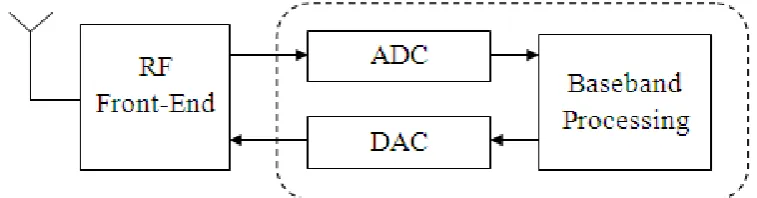
analog domain as in conventional radio. Signal digitization work is done by using the analog to digital converter (ADC). Figure.2.3 shows the concept of SDR. As depicted in this figure, the ADC process is taking place after the front end circuit. Front end is used to down convert the high frequency signal to a lower frequency called the intermediate frequency or if possible to base band frequency; this is needed due to the speed limitation of current commercial of the shelf (COTS) ADC chip. The ADC converts analog signal into digital signal and passes it to the baseband processor for further processing. The baseband processing include demodulation, filtering, channel coding, and etc. The baseband processing is carried out through software program in contra with the conventional radio which is software design.
[image:16.595.125.504.369.468.2]Figure 2.3 SDR Block Diagram
The basic idea of SDR is to bring the software as close as possible to the antenna. The ideal SDR is called the software radio (SR). Figure 2.4 shows the concept of SR. In SR, the analog to digital converter (ADC) process is directly done after the antenna.
Initially SDR was mean to support multiservice radio, but in the last decade, SDR research has shift to a new direction in which it is used as a platform for
cognitive radio (CR) in DSA.
2.6 Spectrum Sensing
In order for SUs to access the PUs spectrum, it has to comply with the policies and regulation defined by the regulator agencies i.e Federal Communication Commission (FCC), Malaysian Communications and Multimedia Commission
(MCMC) and etc. [4, 12]. The basic idea of this policies and regulation is to ensure that SU does not produce any harmful interference to PU when it accesses and utilize the PU spectrum. In order to full fill this requirement, it is a fundamental need for SU to have a very robust and accurate spectrum sensing module.
Spectrum sensing is one of the most important functionalities in CR method in order to enable the spectrum sharing with DSA [9][10][11]. Its function is to provide the information on the status of the spectrum to the CR engine. CR engine use this information to analyze all degree of freedom (time, frequency and geographical) in order to identify the spectrum usage [3] and tune the SU radio according to the objectives for instance, to accessing the unused spectrum or the
spectrum hole. The main challenges in spectrum sensing is to detect the week signal in low signal to noise ratio (SNR) condition with very low probability of miss detection [3]. In order to detect this signal, SUs has to have a very sensitive spectrum sensing hardware and a very robust spectrum sensing technique. Others challenges in spectrum sensing are as follows:
Hidden PUs problem due to multipath fading and shadowing.
Detecting spread spectrum by PUs including frequency hopping
spread-spectrum (FHSS) and direct-sequence spread spread-spectrum (DSSS) [3]. Sensing time required by the spectrum sensing has to be as fast as
possible to provide higher throughput to the system. Robustness of the spectrum sensing has to be high.
SUs have to be able to detect the present of PUs as soon as possible when
In OSI or TCP/IP model, spectrum sensing is done in the Physical (PHY) layer. Various approaches have been proposed for spectrum sensing such as matched filter, energy detection and cyclostationary feature detection method.
Match filter: The optimal way for detecting any signal is by using a matched
filter [3][11]. Match filter can allow SU to detect the signal in the spectrum
even in a very low SNR condition. Furthermore, due to its coherency, less
time and less sample is required to make a correct decision on the present
of the PU. However, match filter requires a prior knowledge on the
behaviour of the received signal at both PHY and MAC layer [3] for instance
it needs information of the modulation scheme, packet format, bitrate and
etc of the PU. Hence, detecting different signals requires implementing
several match filters.
Energy detector: The energy detector (ED) arises as a suboptimal choice for
non-coherent detection [13]. ED utilizes the measured radio frequency
energy or the received signal strength indicator (RSSI) to decide on the
vacant of the channel [15][11]. Even though ED requires no knowledge on
the transmitted signals in the channel, a small error in estimating the
hypothesis’s threshold may result in an unreliable detection of PUs. Thus,
the ED would completely fail in low SNR environments when the detected
energy is below a certain threshold. In this condition ED is not able to
differentiate between modulated signals and noise. Furthermore, by using
ED, DSA radio will not be able to differentiate between PUs and SUs
[3][11][15]
Cyclostationary feature detection: The cyclostationary feature detection
discriminates the modulated signals from the noise. Cyclostationary
feature detection implements a two-dimensional spectral correlation
function rather than the one-dimensional power spectral density of the
energy detector to reliably extract the spectral correlation due to the
periodicity feature of modulated signals from the noise that is of
wide-sense stationary with no correlation [3]. The main drawback of the feature
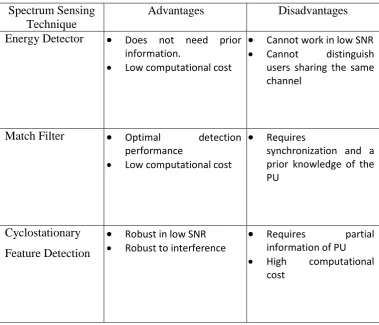
Table 2.1 summarizes the strengths and weaknesses of each spectrum sensing techniques mentioned above. In this research, only local sensing is used and energy detector is chosen due to the assumption that cognitive user (CU) has limited information on the primary signal (i.e. only the local noise power is known). In local sensing, each CU senses the spectrum within its geographical location and makes a decision on the presence of PUs based on its own local sensing measurements. Hence energy detector will give an optimal measured value. In addition, IEEE802.22 standard on cognitive radio has spectrum sensing via energy detection in its provision.
Table 2.1 Advantages and Disadvantages of Spectrum Sensing Techniques Spectrum Sensing
Technique
Advantages Disadvantages
Energy Detector Does not need prior information.
Low computational cost
Cannot work in low SNR Cannot distinguish
users sharing the same channel
Match Filter Optimal detection
performance
Low computational cost
Requires
synchronization and a prior knowledge of the PU
Cyclostationary Feature Detection
Robust in low SNR Robust to interference
Requires partial information of PU High computational
2.6.1 DSA using CR
The artificial depletion of the available spectrum and the underutilization of the allocated spectrum made the DSA method very important in the last one decade. DSA is a method which will allows the spectrum sharing between the licensed users and the unlicensed users (PUs and SUs). CR is the technology which will provide the intelligence to the radio which will bring DSA to reality. SDR is the platform which supports the CR technology and made it possible to be implemented. In this research, SDR platform used is the GNU Radio and the Simulate Modem in Matlab.
2.6.2 GNU Radio
GNU Radio [21] is an open source software toolkit which consists of a huge numbers of signals processing blocks library (i.e. modulators, filters, amplifiers and etc). This signal processing blocks can be linked and programmed to build and create the baseband part of a dedicated radio.
In GNU Radio, the entire signal processing block code is written in C++ and it is compiled with an optimized, modern, C++ compiler [23]. The list and documents on the available signal processing block can be found in [22]. Most of the required signal processing blocks to build a radio are available, however, a new signal processing block also can be created. A good tutorial in creating a new signal processing block can be found in [21].
In order to build a dedicated radio using GNU Radio, several signal processing blocks has to be tied and linked together. The most basic structure of the
Figure 2.5 Basic Structure of GNU Radio Flow Graph
In GNU Radio, python is used as the glue to tie the signal processing blocks together. Python is an interpreted language which does not require compiling the
written code. This will speed up the development process. Signal processing blocks which is connected together is called flow graph. Tutorial on how the flow graph can be found in [25]. Simplified wrapper and interface generator (SWIG) is used as the interface compiler which allows the integration between C++ and Python language.
GNU Radio has a huge number of users around the world. The GNU Radio package consists of several radio application including the FM radio reception and transmission which can decide on air FM radio signal and play it back on the computer sound card, analog TV decoder which can decode TV station signal and display in real time, spectrum analyzer which can be used to monitor the RF spectrum, oscilloscope which can used to analyze the signal in time domain and etc.
Besides the GNU Radio package, there are many other applications that have been developed on top of GNU Radio and SDR by the third party groups some of the thesiss are listed in [40].
• GPS based Projects: Gregory Heckler et. al. develop the GPS L1 C/A receiver on top of GNU Radio and USRP. This thesis is known as the GPS-SDR thesis which is hosted at [35]. A complete source code and forum based support can be found in the website. A complete GPS references for developer is available in GNU Radio website [32]
• IEEE802.11 based Projects: The BBN thesis [BBN] is one of the dominant GNU Radio and USRP IEEE802.11 thesis [34]. The developed radio is able to
Signal Source Signal
decode low rate on air IEEE802.11b packet from the network interface cards (NICs) reliably at 1Mbps and partially at 2Mbps. P. Fuxjäger et. al. [38] develops the
IEEE802.11p transmitter. This thesis is using MATLAB to derive the radio from the standard document and the individual MATLAB block is then ported to GNU Radio one by one.
• IEEE802.15.4 based Projects: Thomas Schmid et al [39] develop the GNU Radio O-QPSK modulation code based on the CMOS IEEE802.15.4 RF IC architecture [33]. This modulation is then used to support GNU Radio IEEE802.14.5 radio which can communicate with Berkeley TelosB and MicaZ mote. The source code of the thesis is available in [39]. Thomas Schmid code is then used as the base of IEEE802.15.4 SDR radio in this master thesis.
2.7 Review of DSA Research
One of the most important components in dynamic spectrum access (DSA) system is its spectrum sensing part. The first hardware implementation of spectrum sensing is done by Danijela Cabric [3][14]. Energy Detector (ED) spectrum sensing technique is used in this work. The experiment is done using Berkeley Emulation Engine two (BEE2). This work presents the experimental design to measure the
Figure 2.6 Spectrum Sensing Experimental Setup Using BEE2 [14]
2.8 Summary
Chapter 2 elaborates the importance of DSA and the technologies that allows spectrum sharing in DSA. CR and SDR are the key technologies that open up the possibilities of DSA. One of the most critical functions in CR is the sensing mechanism.
Three types of spectrum sensing mechanism are reviewed in this chapter; match filter; energy detector and cyclostationary features detector. The advantages and disadvantages of this technique are discussed. Energy detector is chosen as the optimal detector for this thesis due to its simplicity and its ability to be used as non-coherent detector.
The SDR platform chosen for this research is the GNU Radio and SDR. This platform is chosen due to the rich available libraries and large community who share their experience in utilizing this platform as their SDR platform. However, to install the GNU Radio and to begin using it is required in depth knowledge. The next chapter provides step-by-step to install GNU Radio software and how to run the GNU Radio for the first time.
CHAPTER 3
METHODOLOGY
3.1 Overview
The previous chapter introduced the concept of dynamic spectrum access (DSA). Four key component of DSA is discussed in the chapter. In this chapter, the design of the DSA for this research is presented. The implementation of the DSA is using GNU Radio as the SDR software platform. In this chapter, the step-by-step GNU Radio installation guide is presented to give a tight guide to the GNU Radio newbie to begin working with GNU Radio Software.
This chapter also elaborates the design of the secondary user (SU) transmitter and SU receiver algorithm. The packet structure used by SUs is presented which is in the MAC layer.
3.2 GNU Radio Installation
GNU Radio supports eight different operating systems (OS): Fedora, Debian, SuSE, Ubuntu, Madriva, Mac OS X, NetBSD and Windows. However, due to many dependency packages needed by GNU Radio, which makes the installation bothersome, the most suitable OS to be used is Linux Fedora and the latest and most stable version of Fedora during the starting of this research is Fedora 9.
References
[1] Spectrum Allocation in Malaysia, Suruhanjaya Komunikasi dan Multimedia
Malaysia (SKMM).
[2] Mark A. McHenry et al. “Spectrum Occupancy Measurements”. Shared Spectrum Company, under project NeTS-ProWIN: Wireless Interference: Characterization and Impact on Network Performance, December 20, 2005 [3] Danijela Cabric, Shridhar Mubaraq Mishra, Robert W. Brodersen.
“Implementation Issues in Spectrum Sensing for Cognitive Radios”.
Asilomar Conference on Signals, Systems, and Computers, 2004.
[4] Ian F. Akyildiz, Tommaso Melodia, Kaushik R. Chowdhury. A survey on wireless multimedia sensor networks. Computer Networks (ScienceDirect),
2007. 51(4): 921-960.
[5] Mohamed Hamid, “Dynamic Spectrum Access in Cognitive Radio Networks: Aspects of Mac Layer Sensing”. Master Thesis, December 2008.
[6] Salvador D'Itri and Mark McHenry. “Dynamic spectrum access moves to the
forefront”. Apr 2008 [online] available at
http://rfdesign.com/military_defense_
electronics/radio_dynamic_spectrum_access/index.html
[7] Joanna Guenin. “IEEE SCC41 Standards for Dynamic Spectrum Access Networks”. IEICE Software & Cognitive Radio Expo & Technical
Conference 1 August, 2008 Tokyo, Japan
[8] Przemysław Pawełczak, Gerard J. M. Janssen and R. Venkatesha Prasad. “Performance Measures of Dynamic Spectrum Access Networks”. IEEE
GLOBECOM 2006, San Francisco, CA, November 2006
[9] Kamran Arshad, Muhammad Ali Imran, KlausMoessner. “Collaborative SpectrumSensing Optimisation Algorithms for Cognitive Radio Networks”.
International Journal of Digital Multimedia Broadcasting Volume 2010. [10] Tuncer Can Aysal, Sithamparanathan Kandeepan and Radoslaw Piesiewicz.
“Cooperative Spectrum Sensing over Imperfect Channels”.
[11] ben latif. “nota a.arief”
[12] simon hykin. “cognitive radio: Brain-Empowered Wireless Communications”. IEEE Journal on Selected Areeas in Communications. Vol
23, No.2, February 2005.
[14] D. Cabric. S. M. Mishra. R. W. Brodersen, "Implementation Issues in Spectrum Sensing", In Asilomar Conference on Signal, Systems and
Computers, November 2004.
[15] Sai Shankar N, Carlos Cordeiro, Kiran Challapali. “Spectrum Agile Radios: Underutilization and Sensing Architectures”. 2005
[16] J. Mitola. “Software radios-survey, critical evaluation and future directions”. IEEE National Telesystems Conference, pages 13/15-13/23, 19-20 May 1992. [17] Minh Nguyen. “Software Radio (R) Evolution and Its Application to
Aeronautical Mobile Communications”, May 19-22, 2003.
[18] Peter G. Cook ,Wayne Bonser.” Architectural Overview of the SPEAKeasy System”. IEEE Journal On Selected Areas In Communications, Vol. 17, No.
4, April 1999.
[19] SDR Forum. “SDRF Cognitive Radio Definitions”. 8 November 2007 [Online] available at http://www.sdrforum.org/pages/documentLibrary/ documents/SDRF-06-R-0011-V1_0_0.pdf.
[20] Leech, M., “Gnuradio and USRP: Solderless breadboarding for the 21st Century”, 30, Proceedings, 25th
Anniversary Conference of the Society of Amateur Radio Astronomers.
[21] GNU Radio. [online] available at www.gnuradio.org.
[22] Eric Blossom. “GNU Radio: Tools for Exploring the RF Spectrum”.
November 2004 Linux Journal, Issue 122, June 2004, as.
[23] GNU Radio 3.2svn C++ API Documentation. May 2010 [online] available at http://gnuradio.org/doc/doxygen/index.html.
[24] Eric Blossom. “How to Write a Signal Processing Block”. Revision 0.3, July 2006. [online] available at http://www.gnu.org/software/gnuradio/doc/howto-write-a-block.html.
[25] Eric Blossom. “Tutorials Write Python Applications”. Febuary 2010 [online] available at http://www.gnuradio.org/redmine/wiki/gnuradio/Tutorials WritePython Applications
[26] GNU Radio Real World User. [online] available at http://gnuradio.org/redmine/wiki/gnuradio/OurUsers
[28] OpenBTS Desktop Testing. [online] http://gnuradio.org/redmine/wiki/1/ OpenBTSDesktop TestingKit
[29] The Global Software System for Mobile communications (GSSM). [online] available at http://thre.at/gsm/
[30] Steve, Joshua Lackey, David Hulton, “The A5 Cracking Project: Practical attacks on GSM using GNU Radio and FPGAs”, Chaos Communication
Camp 2007, August 2007, Berlin.
[31] Dominic Spill, “Implementation of the Bluetooth stack for software defined radio, with a view to sniffing and injecting packets” University College
London, May 2007.
[32] Dominic Spill, Andrea Bittau, “Bluesniff, Evemeets Alice and Bluetooth”, The first USENIX workshop on Offensive Technologies, Boston, MA, August 2007.
[32] Dominic Spill. “GNU Radio Stuff”. [online] available at http://gnuradio.wordpr ess.com/
[33] John Notor, Anthony Caviglia, Gary Levy. “CMOS RFIC Architectures for IEEE 802.15.4 Networks”. Cadence Design Systems, Inc, 2003.
[34] GNU Radio Global Positioning System. [online]
http://gnuradio.org/redmine/wiki/1/ GlobalPositioningSystem.
[35] Gregory W Heckler. “Exploring GPS with Software Defined Radio”. [online]
available at http://www.gps-sdr.com
[36] BBN IEEE802.11b. [online] available at https://cgran.org/wiki/BBN80211 [37] GNU Radio Real on Others Server. [online] available at
http://gnuradio.org/redmine/ wiki/gnuradio/OtherCode
[38] P. Fuxjäger, A. Costantini, D. Valerio, P. Castiglione, G. Zacheo, T. Zemen, F. Ricciato, IEEE 802.11p Transmission Using GNURadio, 6th Karlsruhe Workshop on Software Radios (WSR'10), March 2010
[39] Thomas Schmid, Oussama Sekkat, Mani B. Srivastava. “An Experimental Study of Network Performance Impact of Increased Latency in Software Defined Radios”.
[41] Fette, B. A., 2009. Cognitive radio technology. Amsterdam: Academic
Publishers.
[42] Khattab, A., Perkins, D., and Bayoumi, M. A., 2013. Cognitive radio networks
from theory to practice. New York: Springer.
[43] Li, S., and Kokar, M. 2013. Flexible adaptation in cognitive radios. New
York: Springer.
[44] Rondeau, T. W., and Bostian, C. W., 2009. Artificial intelligence in wireless
communications. Boston: Artech House.
[45] B. Oksendal. 1998. Stochastic Differential Equations - An Introduction With
Applications,Springer, Berlin.
[46] Charalambous, C. D and Menemenlis, N. 2001. “A state-space approach in
modeling multipathfading channels via stochastic differential equations,” in
Proc. IEEE International Conference on Communications (ICC), 7, p. 2251–
2255.
[47] Fang, F., Fields T. R & Haykin, S. 2007. “Stochastic differential equation
theory applied to wireless channels,” IEEE Transactions on Communications,
55, p. 1478–1489.
[48] T. R. Fields and Tough, R. J. A. 2003. “Stochastic dynamics of the scattering
amplitude generating K-distributed noise,” Journal of Mathematical Physics,
44,(11), p. 5212–5223.
[49] T. R. Fields and Tough, R. J. A. 2003a. “Diffusion processes in electromagnetic
scattering amplitude generating K-distributed noise,” Journal of Mathematical
[50] T. R. Fields and Tough, R. J. A. 2005b. “Dynamical models of weak
scattering,” Journal of mathematical Physics, 46, p. 13302–13320.

![Figure 2.2 Basic cognitive cycle [1]](https://thumb-us.123doks.com/thumbv2/123dok_us/8766901.896915/15.595.130.499.149.383/figure-basic-cognitive-cycle.webp)

![Figure 2.6 Spectrum Sensing Experimental Setup Using BEE2 [14]](https://thumb-us.123doks.com/thumbv2/123dok_us/8766901.896915/23.595.124.505.73.257/figure-spectrum-sensing-experimental-setup-using-bee.webp)
