International Journal of Emerging Technology and Advanced Engineering
Website: www.ijetae.com (ISSN 2250-2459,ISO 9001:2008 Certified Journal, Volume 4, Issue 5, May 2014)
A Survey on Chromosomes Abnormalities based on
Swarm Algorithms
S.Vanitha
1, Dr.T.Padma
2¹Research Scholar, ²Professor, Department of Master of Computer Applications, Sona College of Technology
Abstract-Many genetic abnormalities that may occur in future generations can be analyzed through the structure and morphological characteristics of chromosomes, which decides the respective gene that has disorders. A genetic disorder is an illness caused by abnormalities in genes or chromosomes. While some diseases are due to a genetic disorder, they can also be caused by environmental factors. As we unlock the secrets of the human genome, we are learning that nearly all diseases have a genetic component. Geneticists group genetic disorders into three categories: Single gene disorders are caused by a mutation in a single gene. The mutation may be present on one or both chromosomes (one chromosome inherited from each parent). Chromosome disorders are caused by an excess or deficiency of the genes that are located on chromosomes, or structural changes within chromosomes. Gene-gene interaction studies focus on the investigation of the association between the single nucleotide polymorphisms (SNPs) of genes for disease susceptibility. This paper surveys on chromosomes and their types and respective diseases associated with the chromosomes. It also surveys on updated review of reviews of swarm based Algorithms.
Keywords-- Chromosomes, Genes, Genetic Disorder, SNPs, Swarm Based Algorithms.
1.INTRODUCTION
A scientific basis for that observation was first provided with the development of the new science of genetics at the beginning of this century. More recently, the techniques of molecular biology have shown that information is passed from parent to offspring in the form of large molecules of deoxyribonucleic acid, or DNA. DNA contains four different kinds of subunits (known as nucleotides, or bases) arranged in a linear order.
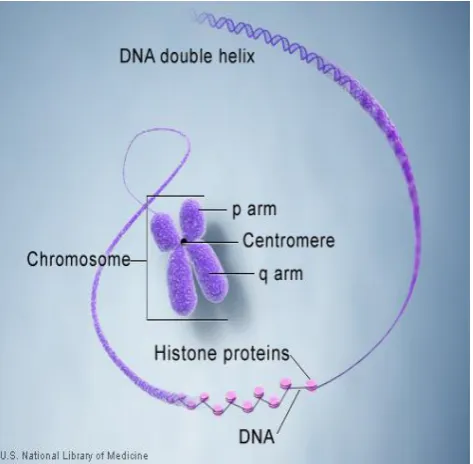
A chromosome is an organized structure of DNA and protein that found in nucleus of the cell. It is a single piece of coiled DNA containing many genes, regulatory elements and other nucleotide sequences
[image:1.595.317.554.220.452.2]The chromosomes contain in some kind of code–script the entire pattern of the individual’s future development and of its functioning in the mature state. That genes must act as some sort of encoded instruction set was recognized well before DNA was known to be the hereditary material.
Figure 1-DNA and histone proteins are packaged into structures called chromosomes.
Number of genes is an estimate as it is in part based on gene predictions. Substantial progress towards identifying the genes whose expression underlies human specific anatomy and behavior can be made by analyzing DNA from cultured primate cells already available in cell banks.
The individual bases are generally indicated by the first letters of their full chemical names adenine, thymine, cytosine, and guanine: A, T, C, or G. A molecule of DNA is actually two different, but complementary and fully redundant, linear sequences of nucleotides.
T–A–G–C–C–G–C–A–T–A
| | | | | | | | | |
A–T–C–G–G–C–G–T–A–T
International Journal of Emerging Technology and Advanced Engineering
Website: www.ijetae.com (ISSN 2250-2459,ISO 9001:2008 Certified Journal, Volume 4, Issue 5, May 2014)
II. VARIOUS TYPES OF CHROMOSOMES
Humans normally have 46 chromosomes in each cell, divided into 23 pairs. Two copies of chromosome 1, one copy inherited from each parent, form one of the pairs. Chromosomes are of four types based on the position of the centromeres. They are telocentric chromosomes (rod shaped), acrocentric chromosomes (rod shaped), sub-metacentric chromosomes (L shaped) and sub-metacentric chromosomes (V shaped). Based on their functions, they are either autosomes or sex chromosomes.
Autosomes are the chromosomes that are found in all the body cells and they decide the somatic characters of the organism. In humans, there are 46 chromosomes out of which 44 are autosomes and the remaining two are sex chromosomes.
[image:2.595.316.554.112.247.2]Sex chromosomes are involved in the determination of sex of the organism. In both animals and plants, these chromosomes are found different in both structure and functions. In human males there are two sex chromosomes as XY and in human female there are two sex chromosomes as XX.
Figure 2-Karyotype representation of Chromosomes.
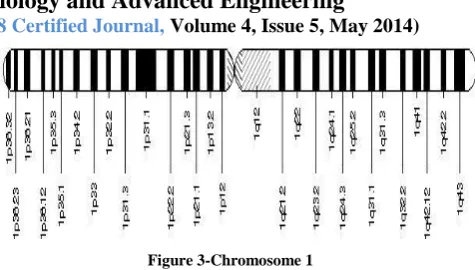
A. Chromosome 1
[image:2.595.47.280.387.641.2]Chromosome 1 is the largest human chromosome, spanning about 249 million DNA building blocks (base pairs) and representing approximately 8 percent of the total DNA in cells. It likely contains 2,000 to 2,100 genes that provide instructions for making proteins
.
Figure 3-Chromosome 1
Abnormalities: Structural abnormalities in several body systems, Physical abnormalities and neurological and psychiatric problems, delayed growth and development, distinctive facial features, birth defects, and other health problems.
B.Chromosome 2
Chromosome 2 is the second largest human chromosome, spanning about 243 million building blocks of DNA and representing almost 8 percent of the total DNA in cells. It likely contains 1,300 to 1,400 genes that provide instructions for making proteins.
Figure 4-Chromosome 2
Abnormalities: Individuals with this chromosome abnormality often have developmental delay, small head size (microcephaly), slow growth before and after birth, heart defects, and distinctive facial features.,effects on health and development, including intellectual disability, slow growth, characteristic facial features, weak muscle tone (hypotonia), and abnormalities of the fingers and toes.
C. Chromosome 3
Chromosome 3 spans about 198 million base pairs and represents approximately 6.5 percent of the total DNA in cells.
It likely contains 1,000 to 1,100 genes that provide instructions for making proteins.
[image:2.595.321.540.391.506.2]International Journal of Emerging Technology and Advanced Engineering
Website: www.ijetae.com (ISSN 2250-2459,ISO 9001:2008 Certified Journal, Volume 4, Issue 5, May 2014)
Figure 5-Chromosome 3
D. Chromosome 4
[image:3.595.60.273.298.461.2]Chromosome 4 spans about 191 million DNA building blocks and represents more than 6 percent of the total DNA in cells. It likely contains 1,000 to 1,100 genes that provide instructions for making proteins.
Figure 6-Chromosome 4
Abnormalities: Delayed growth and development, intellectual disability, distinctive facial features, heart defects, and other medical problems.
E. Chromosome 5
Chromosome 5 spans about 181 million DNA building blocks and represents almost 6 percent of the total DNA in cells.
[image:3.595.320.546.338.435.2]It likely contains about 900 genes that provide instructions for making proteins.
Figure 7-Chromosome 5
Abnormalities: Disease delayed growth and development, distinctive facial features, birth defects, and other health problems.
F. Chromosome 6
Chromosome 6 spans about 171 million DNA building blocks and represents between 5.5 and 6 percent of the
Figure 8-Chromosome 6
Abnormalities: Delayed growth and development, intellectual disability, distinctive facial features, birth defects, and other health problems
G. Chromosome 7
Chromosome 7 spans about 159 million DNA building blocks and represents more than 5 percent of the total DNA in cells. It likely contains 900 to 1,000 genes that provide instructions for making proteins.
Figure 9-Chromosome 7
Abnormalities: Other changes in the number or structure of chromosome 7 can cause delayed growth and development, intellectual disability, distinctive facial features, skeletal abnormalities, delayed speech, and other medical problems
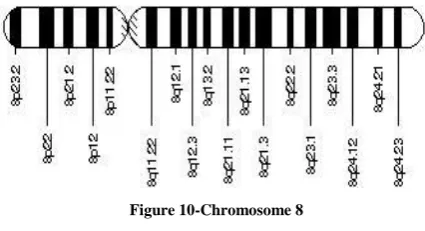
H. Chromosome 8
[image:3.595.323.536.571.686.2]Chromosome 8 spans more than 146 million DNA building blocks and represents between 4.5 and 5 percent of the total DNA in cells. It likely contains about 700 genes that provide instructions for making proteins
Figure 10-Chromosome 8
Abnormalities: Absent corpus callosum, weak muscle tone
I. Chromosome 9
[image:3.595.52.258.582.670.2]International Journal of Emerging Technology and Advanced Engineering
Website: www.ijetae.com (ISSN 2250-2459,ISO 9001:2008 Certified Journal, Volume 4, Issue 5, May 2014)
[image:4.595.55.271.197.342.2]Abnormalities: Other changes in the structure or number of copies of chromosome 9 can have a variety of effects. Intellectual disability, delayed development, distinctive facial features, and an unusual head shape are common features
Figure 11-Chromosome 9
J. Chromosome 10
Chromosome 10 spans more than 135 million DNA building blocks and represents between 4 and 4.5 percent of the total DNA in cells. It likely contains 700 to 800 genes that provide instructions for making proteins.
[image:4.595.322.543.322.455.2]Abnormalities: Intellectual disability, delayed growth and development, distinctive facial features, and heart defects are common features
Figure 12-Chromosome 10
K. Chromosomes 11
Chromosome 11 spans about 135 million DNA building blocks and represents between 4 and 4.5 percent of the total DNA in cells. It likely contains 1,300 to 1,400 genes that provide instructions for making proteins.
[image:4.595.63.259.446.583.2]Abnormalities: Intellectual disability, delayed development, slow growth, distinctive facial features, and weak muscle tone (hypotonia)
Figure 13-Chromosome 11
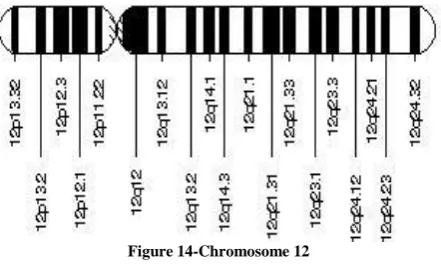
L. Chromosomes 12
Chromosome 12 spans almost 134 million DNA building blocks and represents between 4 and 4.5 percent of the total DNA in cells. It likely contains 1,100 to 1,200 genes that provide instructions for making Proteins.
Figure 14-Chromosome 12
Abnormalities:The number or structure of chromosome 12 can have a variety of effects on health and development. These effects include intellectual disability, slow growth, distinctive facial features, weak muscle tone (hypotonia), skeletal abnormalities, and heart defects.
M. Chromosomes 13
Chromosome 13 is made up of about 115 million DNA building blocks and represents between 3.5 and 4 percent of the total DNA in cells. It likely contains 300 to 400 genes that provide instructions for making proteins.
Abnormalities: Affected individuals may have developmental delay, intellectual disability, low birth weight, and other physical abnormalities.
[image:4.595.319.546.639.749.2]International Journal of Emerging Technology and Advanced Engineering
Website: www.ijetae.com (ISSN 2250-2459,ISO 9001:2008 Certified Journal, Volume 4, Issue 5, May 2014)
N. Chromosomes 14
[image:5.595.311.549.112.245.2]Chromosome 14 spans more than 107 million DNA building blocks and represents about 3.5 percent of the total DNA in cells. Chromosome 14 likely contains 800 to 900 genes that provide instructions for making proteins.
Figure 16-Chromosome 14
Abnormalities: some people with terminal deletion 14 syndrome have a loss or gain of genetic material from another chromosome. People with this condition may have weak muscle tone (hypotonia), a small head (microcephaly), frequent respiratory infections, developmental delay, and learning difficulties.
O. Chromosomes 15
Chromosome 15 spans more than 102 million DNA building blocks and represents more than 3 percent of the total DNA in cells. It likely contains 600 to 700 genes that provide instructions for making proteins.
Figure 17-Chromosome 15
Abnormalities: Intellectual disability, delayed growth and development, hypotonia, and characteristic facial features
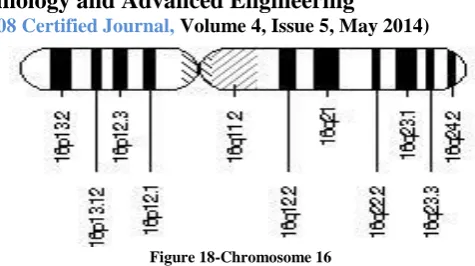
P. Chromosomes 16
[image:5.595.52.274.213.351.2]Chromosome 16 spans more than 90 million DNA building blocks and represents almost 3 percent of the total DNA in cells. It likely contains 800 to 900 genes that provide instructions for making proteins.
Figure 18-Chromosome 16
Abnormalities: Intellectual disability, delayed growth and development, distinctive facial features, weak muscle tone (hypotonia), heart defects, and other medical problems
Q. Chromosomes 17
[image:5.595.355.507.367.479.2]Chromosome 17 spans about 81 million DNA building blocks and represents between 2.5 and 3 percent of the total DNA in cells. It likely contains 1,200 to 1,300 genes that provide instructions for making proteins.
Figure 19-Chromosome 17
Abnormalities: The number or structure of chromosome 17 can have a variety of effects, including intellectual disability, delayed development, characteristic facial features, weak muscle tone (hypotonia), and short stature.
R. Chromosomes 18
Chromosome 18 spans about 78 million DNA building blocks and represents approximately 2.5 percent of the total DNA in cells. It likely contains 200 to 300 genes that provide instructions for making proteins.
[image:5.595.54.271.499.648.2] [image:5.595.318.546.615.726.2]International Journal of Emerging Technology and Advanced Engineering
Website: www.ijetae.com (ISSN 2250-2459,ISO 9001:2008 Certified Journal, Volume 4, Issue 5, May 2014)
Abnormalities:Intellectual disability, an unusually small head, widely spaced eyes, low-set ears, and speech problems.
S. Chromosomes 19
[image:6.595.317.547.162.300.2]Chromosome 19 spans about 59 million base pairs (the building blocks of DNA) and represents almost 2 percent of the total DNA in cells. It likely contains about 1,500 genes that provide instructions for making proteins.
Figure 21-Chromosome 19
Abnormalities: Dystrophia myotonica
T. Chromosomes 20
[image:6.595.56.268.241.373.2]Chromosome 20 spans about 63 million DNA building blocks and represents approximately 2 percent of the total DNA in cells. It likely contains 500 to 600 genes that provide instructions for making proteins.
Figure 22-Chromosome 20
Abnormalities: Intellectual disability, delayed development, distinctive facial features, skeletal abnormalities, and heart defects
U. Chromosomes 21
Chromosome 21 is the smallest human chromosome, spanning about 48 million base pairs (the building blocks of DNA) and representing 1.5 to 2 percent of the total DNA in cells.
In 2000, researchers working on the Human Genome Project announced that they had determined the sequence of base pairs that make up this chromosome. It was the second human chromosome to be fully sequenced.
[image:6.595.320.536.438.572.2]It likely contains 200 to 300 genes that provide instructions for making proteins.
Figure 23-Chromosome 21
Abnormalities: Effects on health and development. Chromosome 21 abnormalities can cause intellectual disability, delayed development, and characteristic facial features
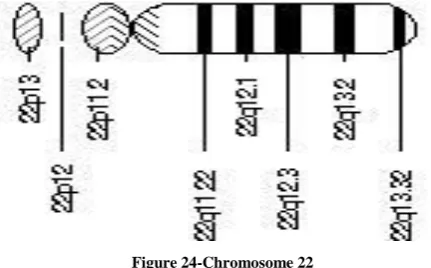
V. Chromosomes 22
Chromosome 22 is the second smallest human chromosome, spanning more than 51 million DNA building blocks and representing between 1.5 and 2 percent of the total DNA in cells It likely contains 500 to 600 genes that provide instructions for making proteins.
Figure 24-Chromosome 22
Abnormalities: 22q11.2 deletion syndrome- The deletion occurs near the middle of the chromosome at a location designated as q11.2. This region contains 30 to 40 genes, but many of these genes have not been well characterized. A small percentage of affected individuals have shorter deletions in the same region. Disease: Cancer
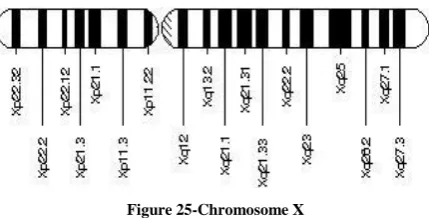
W. Chromosomes X
The X chromosome spans about 155 million DNA building blocks and represents approximately 5 percent of the total DNA in cells.
[image:6.595.48.276.461.615.2]International Journal of Emerging Technology and Advanced Engineering
Website: www.ijetae.com (ISSN 2250-2459,ISO 9001:2008 Certified Journal, Volume 4, Issue 5, May 2014)
Early in embryonic development in females, one of the two X chromosomes is randomly and permanently inactivated in cells other than egg cells. This phenomenon is called inactivation or Lyonization. X-inactivation ensures that females, like males, have one functional copy of the X chromosome in each body cell. Because X-inactivation is random, in normal females the X chromosome inherited from the mother is active in some cells, and the X chromosome inherited from the father is active in other cells.
Some genes on the X chromosome escape X-inactivation. Many of these genes are located at the ends of each arm of the X chromosome in areas known as the pseudoautosomal regions. Although many genes are unique to the X chromosome, genes in the pseudoautosomal regions are present on both sex chromosomes. As a result, men and women each have two functional copies of these genes. Many genes in the pseudoautosomal regions are essential for normal development.
[image:7.595.317.546.134.332.2]The X chromosome likely contains 800 to 900 genes that provide instructions for making proteins.
Figure 25-Chromosome X
Abnormalities: Chromosomal conditions involving the sex chromosomes often affect sex determination (whether a person has the sexual characteristics of a male or a female), sexual development, and the ability to have children (fertility)
X.Chromosomes Y
The Y chromosome spans more than 59 million building blocks of DNA and represents almost 2 percent of the total DNA in cells.
The Y chromosome is present in males, who have one X and one Y chromosome, while females have two X chromosomes.
The Y chromosome likely contains 50 to 60 genes that provide instructions for making proteins. Because only males have the Y chromosome, the genes on this chromosome tend to be involved in male sex determination and development. Sex is determined by the SRY gene, which is responsible for the development of a fetus into a male. Other genes on the Y chromosome are important for male fertility.
Many genes are unique to the Y chromosome, but
[image:7.595.56.271.391.500.2]As a result, men and women each have two functional copies of these genes. Many genes in the pseudoautosomal regions are essential for normal development.
Figure 26-Chromosome Y
Abnormalities: Chromosomal conditions involving the sex chromosomes often affect sex determination (whether a person has the sexual characteristics of a male or a female), sexual development, and the ability to have children (fertility). Rarely, males may have more than one extra copy of the Y chromosome in every cell (polysomy Y). For example, the presence of two extra Y chromosomes is written as 48,XYYY. The extra genetic material in these cases can lead to skeletal abnormalities, decreased IQ, and delayed development, but the features of these conditions are variable
III. ALGORITHMS
Swarm intelligence studies the collective behavior of systems composed of many individuals interacting locally with each other and with their environment. Researchers in computer science have developed swarm-based systems in response to the observed success and efficiency of swarms in nature to solve difficult problems. In such biological swarms, the individuals (ant, bee, termite, bird or fish) are by no means complete engineers, but instead are simple creatures with limited cognitive abilities and limited means to communicate.
International Journal of Emerging Technology and Advanced Engineering
Website: www.ijetae.com (ISSN 2250-2459,ISO 9001:2008 Certified Journal, Volume 4, Issue 5, May 2014)
IV. CONCLUSION
A number of conventional compliment deficiency with chromosome consequence has how been categorized. Here we have focused on chromosome abnormalities based on their deletion and mutation.
A few evolutionary algorithms have been used with multi-objective functions. Swarm optimization algorithms such as ant colony, particle swarm optimization, bee based algorithms and firefly algorithm have been used in wide variety of engineering problems. Other Swarm based algorithms are also used in mining, identification of genes and DNAs.
REFERENCES
[1] Ensembl Human Map View
[2] Ginalski K, Rychlewski L, Baker D, Grishin NV. Protein structure
prediction for the male-specific region of the human Y chromosome. Proc Natl Acad Sci U S A. 2004 Feb 24;101(8):2305-10.PubMed citation
[3] Krausz C, Quintana-Murci L, Forti G. Y chromosome
polymorphisms in medicine. Ann Med. 2004;36(8):573-83. Review. PubMed citation
[4] Li Z, Haines CJ, Han Y. "Micro-deletions" of the human Y chromosome and their relationship with male infertility. J Genet
Genomics. 2008 Apr;35(4):193-9. doi:
10.1016/S1673-8527(08)60027-2. Review.PubMed citation
[5] Map Viewer: Genes on Sequence
[6] Noordam MJ, Repping S. The human Y chromosome: a
masculine chromosome. Curr Opin Genet Dev. 2006
Jun;16(3):225-32. Epub 2006 May 2. Review. PubMed citation
[7] Rizvi AA. 46, XX man with SRY gene translocation: cytogenetic
characteristics, clinical features and management. Am J Med Sci.
2008 Apr;335(4):307-9. doi:
10.1097/MAJ.0b013e31811ec1b4.PubMed citation
[8] Russo P, Siani A, Miller MA, Karanam S, Esposito T,
Gianfrancesco F, Barba G, Lauria F, Strazzullo P, Cappuccio FP. Genetic variants of Y chromosome are associated with a protective lipid profile in black men. Arterioscler Thromb Vasc
Biol. 2008 Aug;28(8):1569-74. doi:
10.1161/ATVBAHA.108.168641. Epub 2008 May 29. PubMed citation
[9] Tyler-Smith C. An evolutionary perspective on Y-chromosomal
variation and male infertility. Int J Androl. 2008 Aug;31(4):376-82. doi: 10.1111/j.1365-2605.2008.00889.x. Review.PubMed citation
[10] UCSC Genome Browser: Statistics
[11] Visootsak J, Graham JM Jr. Klinefelter syndrome and other sex chromosomal aneuploidies. Orphanet J Rare Dis. 2006 Oct 24;1:42. Review. PubMed citation
[12] Visootsak J, Rosner B, Dykens E, Tartaglia N, Graham JM Jr.
Behavioral phenotype of sex chromosome aneuploidies: 48,XXYY, 48,XXXY, and 49,XXXXY. Am J Med Genet A. 2007 Jun 1;143A(11):1198-203. PubMed citation
[13] Vogt PH, Falcao CL, Hanstein R, Zimmer J. The AZF proteins.
Int J Androl. 2008 Aug;31(4):383-94. doi: 10.1111/j.1365-2605.2008.00890.x. Review. PubMed citation
[14] Vogt PH. Azoospermia factor (AZF) in Yq11: towards a
molecular understanding of its function for human male fertility and spermatogenesis. Reprod Biomed Online. 2005 Jan;10(1):81-93.PubMed citation
[15] Walzer S, Bashir AS, Silbert AR. Cognitive and behavioral
factors in the learning disabilities of 47,XXY and 47,XYY boys. Birth Defects Orig Artic Ser. 1990;26(4):45-58. PubMed citation
[16] Waters PD, Wallis MC, Marshall Graves JA. Mammalian
sex--Origin and evolution of the Y chromosome and SRY. Semin Cell Dev Biol. 2007 Jun;18(3):389-400. Epub 2007 Feb 24. Review.PubMed citation
[17] Genome: the Autobiography of a Species in 23 Chapters
by MattRidley
[18] Gene Expression and Regulation [Hardcover] by Jun Ma
[19] Gene Regulation: A Eukaryotic Perspective by David S.