Recurrent Methicillin-Resistant
Staphylococcus aureus
Cutaneous
Abscesses and Selection of Reduced Chlorhexidine Susceptibility
during Chlorhexidine Use
Ryan C. Johnson,aCarey D. Schlett,bKatrina Crawford,bJeffrey B. Lanier,cD. Scott Merrell,a,dMichael W. Ellisd
Department of Microbiology and Immunology, Uniformed Services University of the Health Sciences, Bethesda, Maryland, USAa
; Infectious Diseases Clinical Research Program, Department of Preventive Medicine and Biometrics, Uniformed Services University of the Health Sciences, Bethesda, Maryland, USAb
; Martin Army Community Hospital, Fort Benning, Georgia, USAc
; Department of Medicine, Uniformed Services University of the Health Sciences, Bethesda, Maryland, USAd
We describe the selection of reduced chlorhexidine susceptibility during chlorhexidine use in a patient with two episodes of cu-taneous USA300 methicillin-resistantStaphylococcus aureusabscess. The second clinical isolate harbors a novel plasmid that encodes the QacA efflux pump. Greater use of chlorhexidine for disease prevention warrants surveillance for resistance.
CASE REPORT
A
n 18-year-old man undergoing infantry basic training at FortBenning, GA, presented to the outpatient clinic in July com-plaining of a painful skin lesion on his left knee. On physical ex-amination, the patient was afebrile (37°C) and examination was remarkable only for a prepatellar nodule that was erythematous, warm, indurated, tender, and fluctuant. The patient had no other skin lesions and no lymphadenopathy. The remainder of his ex-amination was normal, and the patient did not report a history of cutaneous abscesses. The patient was diagnosed with a cutane-ous abscess without joint involvement and underwent incision and drainage. The purulent material underwent standard
wound culture and yielded methicillin-resistantStaphylococcus
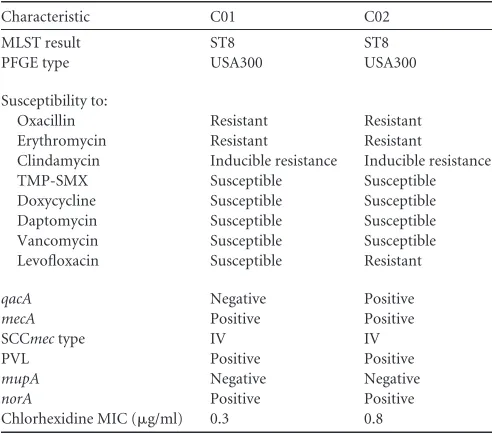
aureus(MRSA) with the BD Phoenix automated microbiology system (Becton, Dickinson, Sparks, MD). The isolate was resistant to oxacillin and erythromycin and had inducible clindamycin
re-sistance, as determined by double-disk diffusion (1), but was
sus-ceptible to trimethoprim-sulfamethoxazole (TMP-SMX),
doxy-cycline, levofloxacin, linezolid, daptomycin, and vancomycin (Table 1).
With no known medication allergies, the patient was treated with a 10-day course of twice-daily double-strength TMP-SMX and underwent serial follow-up examinations and wound care with complete resolution of his abscess within 14 days.
Nine weeks after his initial presentation, the patient returned to the clinic. This time, he complained of a similar painful lesion on his left foot. On physical examination, the patient was again afebrile (37°C) and examination was remarkable only for an in-flamed and fluctuant nodule on the dorsum of his left foot. The patient was again diagnosed with a cutaneous abscess and under-went incision and drainage, with standard wound cultures yield-ing MRSA. This second clinical isolate had the same antibiotic susceptibility pattern as the first MRSA isolate; however, it was
resistant to levofloxacin (Table 1). The patient was treated in a
similar fashion as for the first episode and recovered without ad-ditional recurrences.
The patient was a soldier participating in a prospective cluster-randomized trial aimed at preventing skin and soft tissue
infec-tions (SSTIs), which are common in this population (2). The
pa-tient was in a study group that received chlorhexidine for weekly showering (4% chlorhexidine gluconate, Hibiclens; Mölnlycke Health Care, Norcross, GA). As part of the protocol, the patient
completed a questionnaire at the time of his second episode that queried his chlorhexidine use; he reported using the agent every other week throughout his training. The patient would have used chlorhexidine once or twice before his first episode and four or five times prior to the second episode.
The two MRSA isolates underwent molecular analysis,
includ-ing typinclud-ing by pulsed-field gel electrophoresis (PFGE) (3),
multi-locus sequence typing (MLST) (4), and PCR assays for toxin (5)
and resistance genes (6,7). PFGE findings were resolved and
an-alyzed with BioNumerics (Applied Math, Austin, TX). Both MRSA isolates were sequence type 8 (ST8), USA300,
staphylococ-cal cassette chromosomemectype IV, positive for
Panton-Valen-tine leukocidin (PVL, encoded bylukS-PV), and negative for
high-level mupirocin resistance (mupA). The first clinical isolate (C01)
was negative for the chlorhexidine resistance genes (qacA/B), but
the second clinical isolate (C02) was positive forqacA/B. As part of
the research protocol (2), sampling of the anterior nares at the
second episode revealed that the patient was colonized with a
sep-arate, unrelated, methicillin-susceptibleS. aureusstrain (ST30).
Both clinical isolates underwent chlorhexidine susceptibility
testing. Briefly, about 4⫻104CFU from an overnight culture were
inoculated into 1 ml of cation-adjusted Mueller-Hinton II broth (BD BBL) containing purified chlorhexidine (Sigma) at
concen-trations ranging from 0 to 1g/ml. The cultures were grown
over-night with shaking (220 rpm). Upon visual analysis (Fig. 1), the
MIC of chlorhexidine for the C01 isolate was 0.3g/ml, while that
for the C02 isolate was 0.8g/ml, an approximate 2.7-fold
in-crease over that for C01.
Previous reports have found that mutations in the promoter of
Received2 July 2015 Returned for modification2 August 2015 Accepted6 August 2015
Accepted manuscript posted online19 August 2015
CitationJohnson RC, Schlett CD, Crawford K, Lanier JB, Merrell DS, Ellis MW. 2015. Recurrent methicillin-resistantStaphylococcus aureuscutaneous abscesses and selection of reduced chlorhexidine susceptibility during chlorhexidine use. J Clin Microbiol 53:3677–3682.doi:10.1128/JCM.01771-15.
Editor:K. C. Carroll
Address correspondence to D. Scott Merrell, [email protected], or Michael W. Ellis, [email protected].
Copyright © 2015, American Society for Microbiology. All Rights Reserved.
on May 16, 2020 by guest
http://jcm.asm.org/
thenorAefflux pump can lead to increases innorAtranscription, which result in increased resistance to antiseptic agents such as
chlorhexidine (8,9). The promoter region ofnorAwas PCR
am-plified and sequenced with the 5=-GTCTTGGTCATCTGCAAAG
GTTG-3=and 5=-GACTGGTATTACTAAACCGATACC-3=primers.
Additionally, the 5=-GGTGGTATGAGTGCTGGTATGG-3=and
5=-GCATACGATGTGAAACTTCTGCC-3=primers were used to
assessnorAtranscription via reverse transcription (RT)-PCR.
To-tal RNA was extracted from the C01 and C02 isolates with the
Qiagen EasyRNA kit. Prior to RNA extraction,S. aureuswas lysed
by incubation for 1 h in lysis buffer containing Tris-EDTA buffer,
lysostaphin (20g/ml), and proteinase K (200g/ml). cDNA was
synthesized from total RNA with the QuantiTect RT kit (Qiagen). All PCR and sequencing reactions were performed as previously
described (10). RT-PCR was performed with 10-l reaction
mix-tures containing 1⫻ SYBR green (Qiagen) and 1.5 M each
primer. Reaction mixtures were incubated for 5 min at 95°C, fol-lowed by 35 cycles of 95°C for 10 s and then 50°C for 10 s. Fluo-rescence readings were acquired at the end of each cycle with the Qiagen Rotor-Gene Q RT-PCR machine. Sequencing data
analy-sis revealed that the C01 and C02norApromoters were identical in
nucleotide composition. Not surprisingly,norAexpression in the
C02 isolate was indistinguishable from that in the C01 isolate. Plasmid extraction with the Qiagen Plasmid Purification kit
and subsequent PCR amplification (5=-GCTGCATTTATGACAA
TGTTTG-3= and 5=-AATCCCACCTACTAAAGCAG-3=) (11)
and visualization on a 1% agarose gel revealed that theqacA
gene was detectable only in the C02 isolate. Given the high level
of nucleotide sequence similarity between theqacAandqacB
genes, we determined theqacA DNA sequence from the C02
plasmid and then compared it to the canonicalqacA(accession
no. GU565967.1) and qacB (accession no. AF053772.1) se-quences. Of the seven amino acid differences described by Paulsen
et al. that distinguishqacAfromqacB, six of theqacAresidues were
observed in theqacAgene from C02; this includes a key aspartic
acid residue at amino acid position 323 (12). The one amino acid
residue that differed from theqacAconsensus occurred at the first
position, where an alternative lysine start codon was found. In
total, the data suggest that C02 harbors theqacAgene. Finally, to
ensure that the C02 isolate was the only strain that expressed the
qacAefflux pump, we utilized cDNA as a template forqacAPCR
amplification with the sameqacAdetection/sequencing primers as
mentioned before. Amplicon detection on a 1% agarose gel
con-firmed that the C02 isolate actively expressed theqacA gene
while the C01 isolate did not.
Previous reports have found thatqacAis typically carried on
the pSK1 family of plasmids (13, 14). We therefore sequenced
approximately 550 bp upstream of theqacAgene with the 5=-CT
CCAATCCTTATAGACCGTGC-3=primer and found a high level
of nucleotide sequence similarity to the pSK1 DNA sequence
(GenBank accession no.NC_014369) (⬎99% nucleotide
se-quence similarity). To determine if the plasmid was indeed pSK1, we next used the pSK1 plasmid sequence to design a series of 10
PCR primer pairs that span the entire plasmid (Table 2). We
found that only the primer pair that encompassed theqacAgene
(primer pair 9) yielded a PCR amplicon of the correct size in the
C02 isolate. This led us to conclude that theqacAgene found in the
C02 isolate may be carried on a pSK1-like plasmid but not on pSK1 itself.
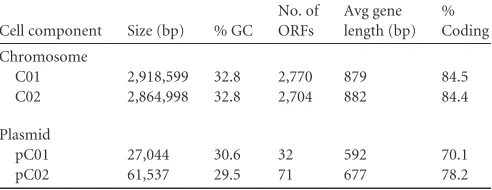
To assess clonality between the two isolates, total DNA from both isolates was prepared via phenol-chloroform extraction and subjected to Pacific Biosciences RS II SMRT whole-genome se-quencing (University of Maryland, School of Medicine, Institute for Genome Sciences). A single closed circular chromosome and plasmid were obtained for each isolate. A comprehensive list of the
chromosome and plasmid characteristics is included inTable 3.
Genome analysis revealed that the C01 isolate contained 2,770 chromosomal open reading frames (ORFs) and was approxi-mately 2.92 Mbp in length. Conversely, the C02 isolate had a re-duced chromosome of 2.86 Mbp encoding 2,704 ORFs. In
addi-tion to whole gene changes, we observed⬎140 single nucleotide
polymorphisms (SNPs) between the two chromosomes, which suggests that the two isolates are genetically distinct. Of note, two
nonsynonymous SNPs in the C02gyrAandgrlAgenes (C251T and
T239A, respectively) were detected. These SNPs result in an S84L amino acid mutation in GyrA and an F80Y mutation in GrlA, which have previously been shown to contribute to quinolone
resistance (15–17) and therefore likely explain the levofloxacin
resistance of the C02 isolate.
[image:2.585.40.286.86.303.2]The pC01 and pC02 plasmid sequences were analyzed with
TABLE 1Molecular characteristics and antimicrobial susceptibilities of clinical MRSA isolates
Characteristic C01 C02
MLST result ST8 ST8
PFGE type USA300 USA300
Susceptibility to:
Oxacillin Resistant Resistant Erythromycin Resistant Resistant
Clindamycin Inducible resistance Inducible resistance TMP-SMX Susceptible Susceptible Doxycycline Susceptible Susceptible Daptomycin Susceptible Susceptible Vancomycin Susceptible Susceptible Levofloxacin Susceptible Resistant
qacA Negative Positive
mecA Positive Positive
SCCmectype IV IV
PVL Positive Positive
mupA Negative Negative
norA Positive Positive
Chlorhexidine MIC (g/ml) 0.3 0.8
FIG 1MICs of chlorhexidine (Clx) forS. aureusabscess isolates C01 and C02. The chlorhexidine concentrations tested ranged from 0 to 1g/ml. All cultures were inoculated with approximately 4⫻104CFU and grown overnight at 37°C with shaking at 220 rpm. The MIC for the C01 strain was determined to be 0.3 g/ml, while that for the C02 isolate was 0.8g/ml.
on May 16, 2020 by guest
http://jcm.asm.org/
[image:2.585.298.544.578.674.2]the Basic Local Alignment Search Tool (BLAST; NCBI). While
the pC01 sequence was nearly perfectly identical to knownS.
aureus plasmids such as SAP046A (GenBank accession no.
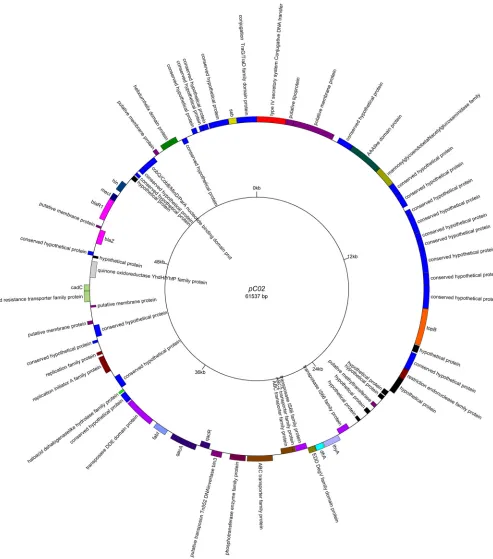
NC_013294.1), the pC02 plasmid was significantly larger and less than 40% of the plasmid contained regions similar to those of other sequences in the NCBI database. Annotation of the pC02 plasmid revealed the presence of numerous proteins involved in a range of cellular processes, including DNA replication (Ssb, TopB), transcriptional regulation (QacR), and substrate
translo-cation (CadC). The fully annotated pC02 map is depicted inFig. 2
(18). TheqacA-containing pC02 plasmid appears to be novel and
may represent an additional class of antimicrobial resistance
plas-mids inS. aureus.
Chlorhexidine is a broad-spectrum topical biguanide cationic
antiseptic agent with activity againstS. aureus(19,20). Although it
has been used for decades in various roles, ranging from hand washing to preoperative skin preparation, chlorhexidine has been increasingly employed for the prevention of both nosocomial (21–24) and community-associated infections (2, 25–27). Evi-dence from large randomized-control trials points to the impor-tance of chlorhexidine in the prevention of the spread of
drug-resistant organisms and hospital-acquired infections (21,24,28).
Indeed, chlorhexidine has also been an integral component of strategies aimed at the prevention of recurrent MRSA SSTIs in
individuals and households (26,29).
Despite its widespread use, the prevalence of chlorhexidine
resistance in the United States is low (approximately 1%) (25,30,
31); this is in contrast to observations in other countries (11,32).
When used in large trials in both community and hospital settings,
chlorhexidine resistance has been only rarely reported (21,24,27,
31). Nevertheless, with the widespread and increasing use of this
agent, experience has shown that concern about the potential
emergence of chlorhexidine resistance is appropriate (32).
Addi-tional studies that investigate the frequency of chlorhexidine use and selection of chlorhexidine-resistant strains must be con-ducted to ensure proper chlorhexidine stewardship.
The plasmid-borneqacAgene, in particular, encodes an efflux
pump that has been shown in numerous reports to confer resis-tance to numerous hydrophobic compounds, including cationic
biocides such as chlorhexidine (20,33,34). While there are no
established breakpoints for chlorhexidine resistance, the presence of these genes has been associated both with increased MICs and
with untoward clinical outcomes (35–38). Interestingly, multiple
reports have identified chlorhexidine-resistantS. aureusisolates
with MICs ofⱖ4g/ml (30,31,38). The isolate described in this
report, however, showed a reduced MIC (ⱕ0.8g/ml). While the
reason for the lower MIC is not clear, this may be due to reduced translation efficiency due to the alternate start codon found in the
C02qacAgene (39). The presence ofqacA/Band an increased MIC
are sometimes poorly correlated (30); however, in our isolates, an
increase in the MIC for theqacA-positive C02 strain was clearly
observed. We cannot determine the overall clinical impact of this reduced chlorhexidine susceptibility in our patient other than to note that he developed a second USA300 MRSA abscess.
Chlorhexidine has residual antibacterial activity, which may be beneficial in reducing the bacterial burden or preventing the
spread of resistant organisms (40); however, this residual activity
may also contribute to an environment that ultimately fosters
re-sistance (11). Since our patient utilized chlorhexidine every other
week, this may have played a part in the selection of reduced chlo-rhexidine susceptibility in the patient. Evidence suggests that the
qacAgene may be able to be horizontally transferred across
vari-ous staphylococcal species (33,41). This typically is plasmid
me-diated since numerous reports have shown that theqacAgene is
often carried on a plasmid from the pSK1 family of vectors (34,
42). Although we do not know its original source, qacAin our
identified clinical MRSA isolate was carried on a large, uncharac-terized plasmid that shows limited similarity to pSK1. This finding
suggests that transmission ofqacAis not limited to the pSK1-like
vectors. Furthermore, the identification of this novelqacA
-contain-ing plasmid combined with the now ubiquitous use of chlorhexidine, highlights the need for increased surveillance programs that would
seek to understand the evolution ofqacAtransmission across MRSA
[image:3.585.41.547.78.212.2]isolates and potentially across other staphylococcal species.
TABLE 2pSK1-like plasmid PCR primer panel
Primer pair
Primer (5=-3=)
Forward Reverse
1 GGAGCACTAGTAGCAACTTTCATC CCAGAGCCGATGCTACGC
2 GCCTTAAAATTCCAGGCGC GCTGAAAGTTATAGAGCGGC
3 GAAGCACTTGCATACGATAGTG GCTCACGCTATACCGACATTC
4 CTAACGTGCGATCAGATGCTTG GCACCCTCAGAAGCCATTC
5 CGCAGTTGGAGCAAGTGAG CTTTATCTTCGACTCTATCACGAAC
6 CATCATAGCACCAGTCATCAG GTGTGCGATCATCGCGTCTATTC
7 CAATTACCTTGGCACTTACCAAATG GGTTGGAAGAACGCACATATG
8 CTTAGATAGTAGCCAACGGCTAC CATCGTATCGATCTTGTTGTCC
9 CGATCGCACGGTCTATAAGG GCTTTGAATCTCTTCGCTTTTCAG
10 CGAAGACGCCTTTCAATATACCG CCTAGAGCTTGCCATGTATATG
TABLE 3Genome and plasmid statistics
Cell component Size (bp) % GC No. of ORFs
Avg gene length (bp)
% Coding
Chromosome
C01 2,918,599 32.8 2,770 879 84.5 C02 2,864,998 32.8 2,704 882 84.4
Plasmid
pC01 27,044 30.6 32 592 70.1 pC02 61,537 29.5 71 677 78.2
on May 16, 2020 by guest
http://jcm.asm.org/
[image:3.585.41.287.628.723.2]In summary, to our knowledge, this is the first report of selec-tion for increased chlorhexidine MICs while using chlorhexidine in a community-based patient with recurrent USA300 MRSA SSTIs. In light of recent clinical trials that show the benefit of chlorhexidine in the prevention of drug-resistant infections, the
medical community should anticipate greater use of this agent and consequently increased resistance. Further study and surveillance for the emergence of chlorhexidine resistance should be consid-ered in health care and community settings that use chlorhexidine for disease prevention.
FIG 2Annotated map of the pC02 plasmid. Sequencing and annotation were performed at the University of Maryland Institute for Genome Sciences and visualized with GenomeVX.
on May 16, 2020 by guest
http://jcm.asm.org/
[image:4.585.45.538.65.624.2]Nucleotide sequence accession numbers.The C01 and C02 genomes and plasmids were submitted to NCBI and given
acces-sion no.CP012118,CP012119,CP012120, andCP012121.
ACKNOWLEDGMENTS
This work (IDCRP-055) was supported by the Infectious Disease Clin-ical Research Program, a Department of Defense (DoD) program exe-cuted through the Uniformed Services University (USU) of the Health Sciences. This project has been funded in whole, or in part, with federal funds from the National Institute of Allergy and Infectious Diseases, Na-tional Institutes of Health (NIH), under interagency agreement Y1-AI-5072. Additional funding was provided by Centers for Disease Control and Prevention, National Center for Emerging and Zoonotic Infectious Diseases, Division of Healthcare Quality Promotion interagency agree-ment 09FED914272 (M.W.E.); DoD Global Emerging Infections Surveil-lance program C0366-11-HS (M.W.E.); and USU DoD program project HT9404-12-1-0019 (D.S.M.). R.C.J. is supported by a fellowship from the Henry M. Jackson Foundation.
The views expressed in this paper are those of the authors and do not necessarily represent the views of the USU of the Health Sciences, the DoD, or other federal agencies.
We thank Kimberly Bishop-Lilly for her expertise and valuable discus-sions.
REFERENCES
1.Fiebelkorn KR, Crawford SA, McElmeel ML, Jorgensen JH.2003. Prac-tical disk diffusion method for detection of inducible clindamycin resis-tance inStaphylococcus aureusand coagulase-negative staphylococci. J Clin Microbiol 41:4740 – 4744. http://dx.doi.org/10.1128/JCM.41.10 .4740-4744.2003.
2.Ellis MW, Schlett CD, Millar EV, Wilkins KJ, Crawford KB, Morrison-Rodriguez SM, Pacha LA, Gorwitz RJ, Lanier JB, Tribble DR. 2014. Hygiene strategies to prevent methicillin-resistantStaphylococcus aureus
skin and soft-tissue infections: a cluster-randomized controlled trial among high-risk military trainees. Clin Infect Dis58:1540 –1548.http://dx .doi.org/10.1093/cid/ciu166.
3.McDougal LK, Steward CD, Killgore GE, Chaitram JM, McAllister SK, Tenover FC.2003. Pulsed-field gel electrophoresis typing of oxacillin-resistantStaphylococcus aureusisolates from the United States: establish-ing a national database. J Clin Microbiol41:5113–5120.http://dx.doi.org /10.1128/JCM.41.11.5113-5120.2003.
4.Enright MC, Day NP, Davies CE, Peacock SJ, Spratt BG.2000. Multi-locus sequence typing for characterization of methicillin-resistant and methicillin-susceptible clones ofStaphylococcus aureus. J Clin Microbiol
38:1008 –1015.
5.Fosheim GE, Nicholson AC, Albrecht VS, Limbago BM.2011. Multiplex real-time PCR assay for detection of methicillin-resistantStaphylococcus aureusand associated toxin genes. J Clin Microbiol49:3071–3073.http: //dx.doi.org/10.1128/JCM.00795-11.
6.McGann P, Milillo M, Kwak YI, Quintero R, Waterman PE, Lesho E.
2013. Rapid and simultaneous detection of the chlorhexidine and mupi-rocin resistance genes qacA/B and mupA in clinical isolates of methicillin-resistantStaphylococcus aureus. Diagn Microbiol Infect Dis77:270 –272.
http://dx.doi.org/10.1016/j.diagmicrobio.2013.06.006.
7.Chen L, Mediavilla JR, Oliveira DC, Willey BM, de Lencastre H, Kreiswirth BN.2009. Multiplex real-time PCR for rapid staphylococcal cassette chromosomemectyping. J Clin Microbiol47:3692–3706.http: //dx.doi.org/10.1128/JCM.00766-09.
8.Noguchi N, Okada H, Narui K, Sasatsu M.2004. Comparison of the nucleotide sequence and expression of norA genes and microbial suscep-tibility in 21 strains ofStaphylococcus aureus. Microb Drug Resist10:197– 203.http://dx.doi.org/10.1089/mdr.2004.10.197.
9.Fournier B, Truong-Bolduc QC, Zhang X, Hooper DC. 2001. A mutation in the 5=untranslated region increases stability ofnorA
mRNA, encoding a multidrug resistance transporter ofStaphylococcus aureus. J Bacteriol183:2367–2371.http://dx.doi.org/10.1128/JB.183.7 .2367-2371.2001.
10. Ellis MW, Johnson RC, Crawford K, Lanier JB, Merrell DS. 2014. Molecular characterization of a catalase-negative methicillin-susceptible
Staphylococcus aureussubsp.aureusstrain collected from a patient with cutaneous abscess. J Clin Microbiol 52:344 –346.http://dx.doi.org/10 .1128/JCM.02455-13.
11. Vali L, Davies SE, Lai LL, Dave J, Amyes SG.2008. Frequency of biocide resistance genes, antibiotic resistance and the effect of chlo-rhexidine exposure on clinical methicillin-resistantStaphylococcus au-reusisolates. J Antimicrob Chemother61:524 –532.http://dx.doi.org/10 .1093/jac/dkm520.
12. Paulsen IT, Brown MH, Littlejohn TG, Mitchell BA, Skurray RA.1996. Multidrug resistance proteins QacA and QacB fromStaphylococcus au-reus: membrane topology and identification of residues involved in sub-strate specificity. Proc Natl Acad Sci U S A93:3630 –3635.http://dx.doi .org/10.1073/pnas.93.8.3630.
13. Noguchi N, Hase M, Kitta M, Sasatsu M, Deguchi K, Kono M.1999. Antiseptic susceptibility and distribution of antiseptic-resistance genes in methicillin-resistantStaphylococcus aureus. FEMS Microbiol Lett172:
247–253.http://dx.doi.org/10.1111/j.1574-6968.1999.tb13475.x. 14. Mayer S, Boos M, Beyer A, Fluit AC, Schmitz FJ.2001. Distribution
of the antiseptic resistance genes qacA, qacB and qacC in 497 methi-cillin-resistant and -susceptible European isolates ofStaphylococcus au-reus. J Antimicrob Chemother47:896 – 897.http://dx.doi.org/10.1093/jac /47.6.896.
15. Tanaka M, Wang T, Onodera Y, Uchida Y, Sato K.2000. Mechanism of quinolone resistance inStaphylococcus aureus. J Infect Chemother6:131– 139.http://dx.doi.org/10.1007/s101560070010.
16. Schmitz FJ, Hofmann B, Hansen B, Scheuring S, Luckefahr M, Klootwijk M, Verhoef J, Fluit A, Heinz HP, Kohrer K, Jones ME.
1998. Relationship between ciprofloxacin, ofloxacin, levofloxacin, sparfloxacin and moxifloxacin (BAY 12-8039) MICs and mutations in grlA, grlB, gyrA and gyrB in 116 unrelated clinical isolates of Staphylo-coccus aureus. J Antimicrob Chemother41:481– 484.http://dx.doi.org/10 .1093/jac/41.4.481.
17. Wang T, Tanaka M, Sato K.1998. Detection ofgrlAandgyrAmutations in 344Staphylococcus aureusstrains. Antimicrob Agents Chemother42:
236 –240.
18. Conant GC, Wolfe KH.2008. GenomeVx: simple web-based creation of editable circular chromosome maps. Bioinformatics24:861– 862.http: //dx.doi.org/10.1093/bioinformatics/btm598.
19. Milstone AM, Passaretti CL, Perl TM.2008. Chlorhexidine: expanding the armamentarium for infection control and prevention. Clin Infect Dis
46:274 –281.http://dx.doi.org/10.1086/524736.
20. McDonnell G, Russell AD.1999. Antiseptics and disinfectants: activity, action, and resistance. Clin Microbiol Rev12:147–179.
21. Climo MW, Yokoe DS, Warren DK, Perl TM, Bolon M, Herwaldt LA, Weinstein RA, Sepkowitz KA, Jernigan JA, Sanogo K, Wong ES.2013. Effect of daily chlorhexidine bathing on hospital-acquired infection. N Engl J Med368:533–542.http://dx.doi.org/10.1056/NEJMoa1113849. 22. Evans HL, Dellit TH, Chan J, Nathens AB, Maier RV, Cuschieri J.2010.
Effect of chlorhexidine whole-body bathing on hospital-acquired infec-tions among trauma patients. Arch Surg145:240 –246.http://dx.doi.org /10.1001/archsurg.2010.5.
23. Chen W, Li S, Li L, Wu X, Zhang W.2013. Effects of daily bathing with chlorhexidine and acquired infection of methicillin-resistant Staphylococ-cus aureusand vancomycin-resistantEnterococcus: a meta-analysis. J Tho-rac Dis5:518 –524.
24. Huang SS, Septimus E, Kleinman K, Moody J, Hickok J, Avery TR, Lankiewicz J, Gombosev A, Terpstra L, Hartford F, Hayden MK, Jernigan JA, Weinstein RA, Fraser VJ, Haffenreffer K, Cui E, Ka-ganov RE, Lolans K, Perlin JB, Platt R, CDC Prevention Epicenters Program, AHRQ DECIDE Network and Healthcare-Associated In-fections Program.2013. Targeted versus universal decolonization to prevent ICU infection. N Engl J Med368:2255–2265.http://dx.doi.org /10.1056/NEJMoa1207290.
25. Fritz SA, Hogan PG, Camins BC, Ainsworth AJ, Patrick C, Martin MS, Krauss MJ, Rodriguez M, Burnham CA.2013. Mupirocin and chlorhexi-dine resistance inStaphylococcus aureusin patients with community-onset skin and soft tissue infections. Antimicrob Agents Chemother57:559 – 568.http://dx.doi.org/10.1128/AAC.01633-12.
26. Miller LG, Tan J, Eells SJ, Benitez E, Radner AB.2012. Prospective investigation of nasal mupirocin, hexachlorophene body wash, and sys-temic antibiotics for prevention of recurrent community-associated me-thicillin-resistantStaphylococcus aureusinfections. Antimicrob Agents Chemother56:1084 –1086.http://dx.doi.org/10.1128/AAC.01608-10.
on May 16, 2020 by guest
http://jcm.asm.org/
27. Whitman TJ, Schlett CD, Grandits GA, Millar EV, Mende K, Hos-penthal DR, Murray PR, Tribble DR.2012. Chlorhexidine gluconate reduces transmission of methicillin-resistantStaphylococcus aureus
USA300 among Marine recruits. Infect Control Hosp Epidemiol33:809 – 816.http://dx.doi.org/10.1086/666631.
28. Milstone AM, Elward A, Song X, Zerr DM, Orscheln R, Speck K, Obeng D, Reich NG, Coffin SE, Perl TM, Pediatric SCRUB Trial Study Group.
2013. Daily chlorhexidine bathing to reduce bacteraemia in critically ill children: a multicentre, cluster-randomised, crossover trial. Lancet381:
1099 –1106.http://dx.doi.org/10.1016/S0140-6736(12)61687-0. 29. Fritz SA, Hogan PG, Hayek G, Eisenstein KA, Rodriguez M, Epplin EK,
Garbutt J, Fraser VJ.2012. Household versus individual approaches to eradication of community-associatedStaphylococcus aureusin children: a randomized trial. Clin Infect Dis54:743–751.http://dx.doi.org/10.1093 /cid/cir919.
30. McDanel JS, Murphy CR, Diekema DJ, Quan V, Kim DS, Peterson EM, Evans KD, Tan GL, Hayden MK, Huang SS.2013. Chlorhexidine and mupirocin susceptibilities of methicillin-resistantStaphylococcus aureus
from colonized nursing home residents. Antimicrob Agents Chemother
57:552–558.http://dx.doi.org/10.1128/AAC.01623-12.
31. Schlett CD, Millar EV, Crawford KB, Cui T, Lanier JB, Tribble DR, Ellis MW.2014. Prevalence of chlorhexidine-resistant methicillin-resistant
Staphylococcus aureusfollowing prolonged exposure. Antimicrob Agents Chemother58:4404 – 4410.http://dx.doi.org/10.1128/AAC.02419-14. 32. Wang JT, Sheng WH, Wang JL, Chen D, Chen ML, Chen YC, Chang
SC.2008. Longitudinal analysis of chlorhexidine susceptibilities of noso-comial methicillin-resistantStaphylococcus aureusisolates at a teaching hospital in Taiwan. J Antimicrob Chemother62:514 –517.http://dx.doi .org/10.1093/jac/dkn208.
33. Horner C, Mawer D, Wilcox M.2012. Reduced susceptibility to chlo-rhexidine in staphylococci: is it increasing and does it matter? J Antimi-crob Chemother67:2547–2559.http://dx.doi.org/10.1093/jac/dks284. 34. Leelaporn A, Paulsen IT, Tennent JM, Littlejohn TG, Skurray RA.1994.
Multidrug resistance to antiseptics and disinfectants in coagulase-negative staphylococci. J Med Microbiol 40:214 –220.http://dx.doi.org/10.1099 /00222615-40-3-214.
35. Batra R, Cooper BS, Whiteley C, Patel AK, Wyncoll D, Edgeworth JD.
2010. Efficacy and limitation of a chlorhexidine-based decolonization strategy in preventing transmission of methicillin-resistantStaphylococcus aureusin an intensive care unit. Clin Infect Dis50:210 –217.http://dx.doi .org/10.1086/648717.
36. Lee AS, Macedo-Vinas M, Francois P, Renzi G, Schrenzel J, Vernaz N, Pittet D, Harbarth S.2011. Impact of combined low-level mupi-rocin and genotypic chlorhexidine resistance on persistent methicillin-resistantStaphylococcus aureuscarriage after decolonization therapy: a case-control study. Clin Infect Dis 52:1422–1430.http://dx.doi.org/10 .1093/cid/cir233.
37. Otter JA, Patel A, Cliff PR, Halligan EP, Tosas O, Edgeworth JD.2013. Selection for qacA carriage in CC22, but not CC30, methicillin-resistant
Staphylococcus aureusbloodstream infection isolates during a successful institutional infection control programme. J Antimicrob Chemother68:
992–999.http://dx.doi.org/10.1093/jac/dks500.
38. Cookson BD, Bolton MC, Platt JH.1991. Chlorhexidine resistance in methicillin-resistantStaphylococcus aureusor just an elevated MIC? An in vitro and in vivo assessment. Antimicrob Agents Chemother35:1997– 2002.
39. O’Donnell SM, Janssen GR.2001. The initiation codon affects ribosome binding and translational efficiency inEscherichia coliof cI mRNA with or without the 5=untranslated leader. J Bacteriol183:1277–1283.http://dx .doi.org/10.1128/JB.183.4.1277-1283.2001.
40. Peterson AF, Rosenberg A, Alatary SD.1978. Comparative evaluation of surgical scrub preparations. Surg Gynecol Obstet146:63– 65.
41. Noguchi N, Nakaminami H, Nishijima S, Kurokawa I, So H, Sasatsu M.
2006. Antimicrobial agent of susceptibilities and antiseptic resistance gene distribution among methicillin-resistantStaphylococcus aureus isolates from patients with impetigo and staphylococcal scalded skin syndrome. J Clin Microbiol44:2119 –2125.http://dx.doi.org/10.1128/JCM.02690-05. 42. Kwong SM, Lim R, Lebard RJ, Skurray RA, Firth N.2008. Analysis of the pSK1 replicon, a prototype from the staphylococcal multiresistance plas-mid family. Microbiology154:3084 –3094.http://dx.doi.org/10.1099/mic .0.2008/017418-0.