Educational Policy Studies Dissertations Department of Educational Policy Studies
Spring 5-11-2012
Academic Culture, Business Culture, and Measuring Achievement
Academic Culture, Business Culture, and Measuring Achievement
Differences: Internal Auditing Views
Differences: Internal Auditing Views
Benjamin S. Roth Georgia State University
Follow this and additional works at: https://scholarworks.gsu.edu/eps_diss
Recommended Citation Recommended Citation
Roth, Benjamin S., "Academic Culture, Business Culture, and Measuring Achievement Differences: Internal Auditing Views." Dissertation, Georgia State University, 2012.
https://scholarworks.gsu.edu/eps_diss/93
MEASURING ACHIEVEMENT DIFFERENCES: INTERNAL AUDITING VIEWS, by BENJAMIN STERLING ROTH, was prepared under the direction of the candidate’s Dissertation Advisory Committee. It is accepted by the committee members in partial fulfillment of the requirements for the degree Doctor of Philosophy in the college of Education, Georgia State University.
The Dissertation Advisory Committee and the student’s Department Chair, as representatives of the faculty, certify that this dissertation has met all standards of excellence and scholarship as determined by the faculty. The Dean of the College of Education concurs.
______________________________ ______________________________ Philo Hutcheson, Ph.D. T. Chris Oshima, Ph.D.
Committee Chair Committee Member
______________________________ ______________________________ Darren J. Pascavage, Ph.D. Robert H. Darville, III, Ph.D.
Committee Chair Committee Member
______________________________
Date
______________________________
William L. Curlette, Ph.D.
Chair, Department of Educational Policy Studies
______________________________
R. W. Kamphaus, Ph.D.
advanced degree from Georgia State University, I agree that the library of Georgia State University shall make it available for inspection and circulation in accordance with its regulations governing materials of this type. I agree that permission to quote, to copy from, or to publish this dissertation may be granted by the professor under whose direction it was written, by the College of Education's director of graduate studies and research, or by me. Such quoting, copying, or publishing must be solely for scholarly purposes and will not involve potential financial gain. It is understood that any copying from or publication of this dissertation which involves potential financial gain will not be allowed without my written permission.
All dissertations deposited in the Georgia State University library must be used in accordance with the stipulation prescribed by the author in the preceding statement. The author of this dissertation is:
Benjamin Sterling Roth 403 Misty Ridge Way Woodstock, GA 30189
The director of this dissertation is:
Dr. Philo Hutcheson
Department of Educational Policy Studies College of Education
ADDRESS: 403 Misty Ridge Way Woodstock, Georgia 30189
EDUCATION:
Ph.D. 2012 Georgia State University Educational Policy Studies M.B.A. 1976 Michigan State University
Accounting
B.S.B.A. 1968 University of North Carolina at Chapel Hill Accounting
PROFESSIONAL EXPERIENCE:
2003 – Present Chief Audit Officer and Director, University Auditing and Advisory Services
Georgia State University, Atlanta, GA 2000 – 2003 Director of Internal Audit
University of Alabama in Huntsville University of Alabama System, Tuscaloosa, AL
1998 – 2000 Internal Auditor
University of Alabama at Birmingham University of Alabama System, Tuscaloosa, AL
PROFESSIONAL SOCIETIES AND ORGANIZATIONS:
2006 – Present American Educational Research Association 2006 – Present Association for the Study of Higher Education 1998 – Present Association of College and University Auditors
1998 – Present The Institute of Internal Auditors
1977 – Present American Institute of Certified Public Accountants
PRESENTATION AND PUBLICATION
Roth, S. (2007, September). U.S. higher education: History, governance, and internal auditing's place. Session presented at the Association of College and University Auditors 2007 Annual Conference, Atlanta, GA.
ACADEMIC CULTURE, BUSINESS CULTURE, AND MEASURING ACHIEVEMENT DIFFERENCES:
INTERNAL AUDITING VIEWS by
Benjamin Sterling Roth
This study explored whether university internal audit directors’ views of culture
and measuring achievement differences between their institutions and a business were
related to how they viewed internal auditing priorities and uses. The Carnegie
Classification system’s 283 Doctorate-granting Universities were the target population.
Directors for 144 institutions (51%) returned questionnaires providing their views of
academic culture and measuring achievement differences; the importance of internal
auditor attributes, and types, subject areas, and determinants of internal auditing work;
and whether operational audits of research, teaching, and public service were appropriate.
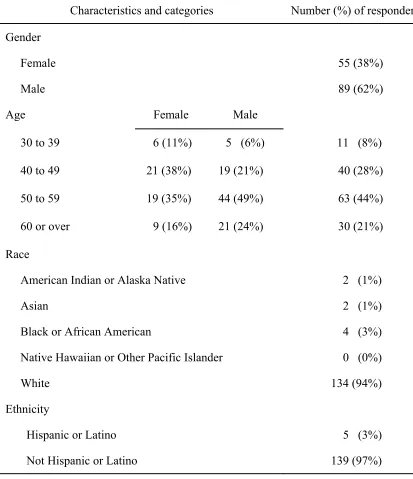
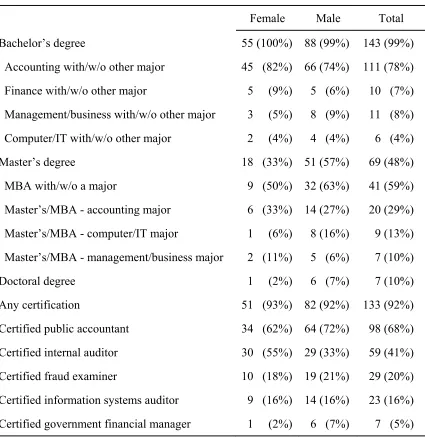
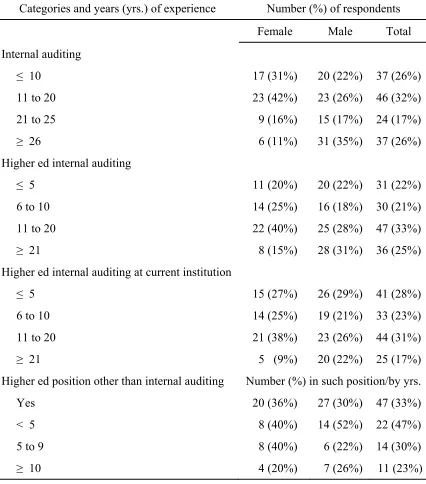
Data collected included directors’ age, gender, race and ethnicity, education,
certifications, and work experience and information on their reporting officials,
boards/audit committees, audit departments, and institutions. Chi-square tests of
independence, p≤ .05, determined statistically significant relationships, and Cramer’s V,
effect size. Dichotomous categories of “businesslike” and “distinct” were used to label
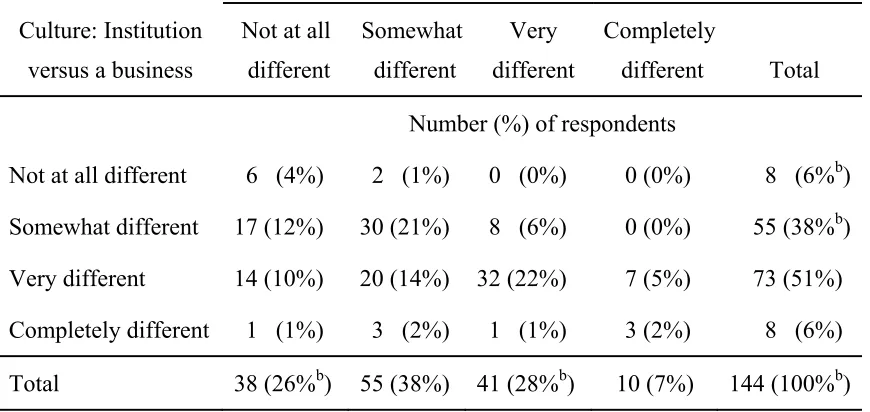
views from the university’s perspective. Fifty-six percent viewed university culture
distinct; 65% viewed measuring achievement businesslike. Thirty-eight percent viewed
both businesslike; 30%, both distinct; 26%, culture distinct and measuring achievement
businesslike; and 6%, culture businesslike and measuring achievement distinct. Culture
views were related to measuring achievement views with medium effect, and with large
Also, with small effects, a distinct culture view favored awareness of culture and
missions; a businesslike culture view favored operational audits; and a businesslike
measuring achievement view favored operational audits in research, teaching, and public
service. Older males had the highest percentages viewing culture businesslike and both
culture and measuring achievement businesslike. CIAs had highest percentages viewing
culture distinct and both culture and measuring achievement distinct. With culture and
measuring achievement views related, internal auditor awareness of university culture
and missions might warrant greater emphasis. Businesslike views favoring operational
audits might encourage management practices historically decried by scholars as
ill-fitting an academy, or might conserve resources to make more available to enhance
INTERNAL AUDITING VIEWS by
Benjamin Sterling Roth
A Dissertation
Presented in Partial Fulfillment of Requirements for the Degree of
Doctor of Philosophy in
Higher Education in
the Department of Educational Policy Studies in
the College of Education Georgia State University
Copyright by Benjamin Sterling Roth
ii
I consider myself extraordinarily fortunate to have had the guidance and support of Dr. Philo Hutcheson as my committee chair. An outstanding professor, advisor, and scholar, he instilled the criticality of questions and reflection in the courses I took from him and in the critiques he gave me. His rigor challenged and inspired. I could never match his example, but gained constantly from it.
All my committee members made special contributions. Dr. Chris Oshima, also one of my professors, provided advice that advantageously streamlined my questionnaire and smartly tempered my statistical ambitions. Her insights made a difference from beginning to end. Dr. Robert Darville, III, offered the wisest of counsel from a college of business dean’s perspective that was invaluable in the early and end stages of the process. Dr. Darren Pascavage, another professor of mine, taught me research skills and practices that served me well throughout. He was a valued encourager.
Despite the excellence of my committee’s advice, deficiencies and misjudgments might remain. All are mine alone.
iii
Page
List of Tables ... vi
Abbreviations ... xi
Chapter 1 THE PROBLEM ... 1
Context ... 1
Internal Auditing Definitions and Standards ... 3
Views of Culture and Measuring Achievement Differences ... 4
Research Initiatives of The IIA and Accounting Academicians ... 5
Indications and Effects of Cultural Differences ... 6
Evolution of Business’s Influence ... 6
Origins and Impact of Management Movements ... 9
21st Century Events ... 12
Culture and Measuring Achievement Differences ... 13
Overarching Research Question ... 14
Nature of Internal Auditing ... 14
Operational Auditing ... 15
Perspectives on the Place of Business in Higher Education ... 17
Internal Auditing’s Definitional Evolution ... 22
Culture and Higher Education Internal Auditing ... 22
Purpose ... 23
Research Questions ... 23
Limitations ... 25
Significance... 25
2 LITERATURE REVIEW ... 27
Dissertations and Journal Articles ... 27
Internal Auditing in Private Institutions ... 27
Operational Auditing in Public Institutions ... 30
Early Journal Articles ... 33
Dissertations in the 1980s ... 34
Journal Articles and Dissertations in the 1990s ... 45
Dissertation and Journal Articles in the 2000s ... 68
Summary and Comments on the Literature ... 75
3 METHOD ... 81
Survey Research... 81
Population ... 84
Testing and Development of the Survey Instrument ... 86
Pilot Study ... 86
Validity and Reliability ... 87
Research Study Survey Instrument ... 92
Purpose ... 92
iv
Demographics and Organizational Characteristics ... 95
Implementation of the Survey ... 96
Notifications and Mailings ... 96
Respondents ... 96
Collection of Data ... 101
Data Analysis ... 103
Primary Independent Variables ... 103
Secondary Independent Variables ... 104
Primary Dependent Variables ... 105
Secondary Dependent Variables ... 106
Transforming Variables ... 106
Primary Null Hypotheses ... 108
Secondary Null Hypotheses ... 111
Chi-Square Test of Independence ... 111
Phi and Cramer’s V ... 112
Descriptive Statistics ... 113
Comparisons With Previous Studies and Replication ... 114
Additional Comments on Data Analysis ... 114
4 RESULTS ... 115
Culture and Measuring Achievement Differences ... 115
Initial Primary Null Hypothesis ... 118
Initial Chi-Square Tests and Hypothesis Test Conclusion ... 118
Rationale for Additional Tests ... 119
Characteristics ... 119
Internal Audit Directors ... 119
Reporting Officials ... 125
Departments, Boards, and Institutions ... 129
Characteristics Excluded from Some Tests and Data Analysis .... 135
Initial Primary Null Hypothesis by Subsets of Respondents ... 137
Internal Audit Director Characteristics ... 137
Reporting Official, Board, and Department Characteristics ... 137
Institution Characteristics ... 137
Culture/Measuring Achievement Views by Subsets of Respondents ... 139
Combinations of Views... 139
Culture Views ... 144
Measuring Achievement Views ... 146
Perceived Views – Board, Administration, and Faculty ... 146
Rankings of Internal Auditing Factors ... 148
Internal Auditor Attributes ... 148
Types of Internal Auditing Work ... 150
Subject Areas of Internal Auditing Work ... 150
v
Operational Audits in Mission Areas ... 156
Primary Null Hypotheses – Culture ... 157
Rankings of Internal Auditing Factors ... 157
Operational Audits in Mission Areas ... 161
Primary Null Hypotheses – Measuring Achievement ... 164
Rankings of Internal Auditing Factors ... 164
Operational Audits in Mission Areas ... 166
Primary Null Hypotheses – Internal Auditing Factors ... 171
Rankings of Internal Auditing Factors ... 171
Operational Audits in Mission Areas ... 176
Secondary Null Hypotheses ... 180
Culture... 181
Measuring Achievement ... 182
Rankings of Internal Auditor Attributes ... 182
Rankings of Types of Internal Auditing Work ... 187
Rankings of Subject Areas of Internal Auditing Work ... 191
Rankings of Determinants of Internal Auditing Work ... 196
Operational Audits in Mission Areas ... 199
Basis for Conclusions, Implications, and Ideas for Future Research ... 205
5 DISCUSSION ... 206
Conclusions ... 206
Culture and Measuring Achievement ... 208
Culture and Internal Auditing Factors ... 214
Measuring Achievement and Mission Operational Audits ... 215
Culture and Characteristics ... 217
Internal Auditing Factors ... 217
Characteristics ... 225
Implications... 243
Relationship Between Culture and Measuring Achievement ... 244
Multiple Factors and Variables ... 246
Operational Audits in General and in Mission Areas ... 247
Other Relationships Involving Internal Auditing Factors and Characteristics ... 248
Future Research ... 252
References ... 257
vi
Table Page
1 Number of Institutions by Level of Effort by Type of Audit ... 44
2 Within Carnegie Subcategories, Independence of Being Private or Public or Having a Medical School, and Responding to the
Survey ... 100
3 Views of Culture and Measuring Achievement Differences ... 116
4 Views of Culture and Measuring Achievement Differences –
Dichotomous Categories ... 117
5 Internal Audit Directors’ Gender, Age, Race, and Ethnicity ... 120
6 Internal Audit Directors’ Education and Certifications ... 122
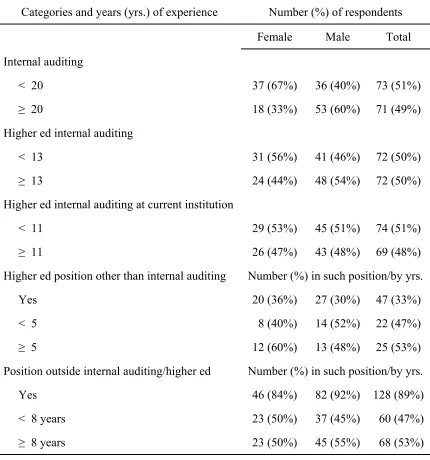
7 Internal Audit Directors’ Experience in Internal Auditing and in
Higher Education ... 123
8 Internal Audit Directors’ Experience Outside of Internal Auditing
and Higher Education ... 124
9 Internal Audit Directors’ Experience in Internal Auditing, in Higher Education, and Outside of Internal Auditing and Higher
Education – Dichotomous Categories ... 126
10 Mean Years of Experience in Internal Auditing, in Higher Education, and Outside of Internal Auditing and Higher
Education by Gender ... 127
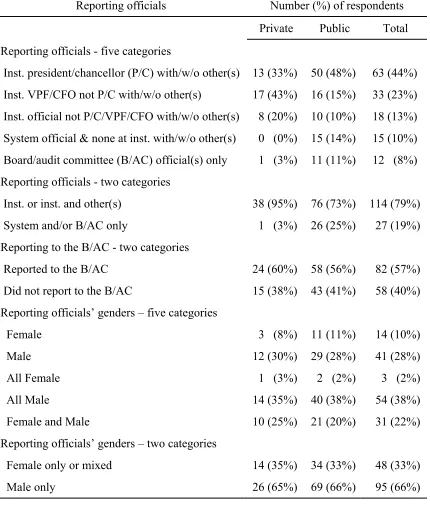
11 Internal Audit Directors’ Reporting Officials and Reporting Official
Genders ... 128
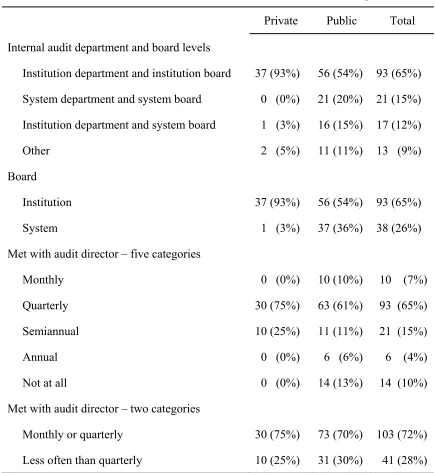
12 Internal Audit Department and Board Organizational Levels and Frequency of Internal Audit Director Meetings With the
Board/Audit Committee ... 130
13 Type of Institution, Presence or Absence of a Medical School, and
Size of Internal Audit Department ... 132
14 Graduate and Undergraduate Enrollment, Federal Sponsored
vii
Dichotomous Categories ... 136
16 Independence of Views of Culture and Measuring Achievement Differences (Dichotomous Categories) by Characteristics Evidencing Large Effect Sizes ... 138
17 Percentages of Views of Culture and Measuring Achievement Differences (Dichotomous Categories) for All Respondents and by Internal Audit Director Characteristics ... 140
18 Percentages of Views of Culture and Measuring Achievement Differences (Dichotomous Categories) by Director, Reporting Official, and Department Characteristics ... 141
19 Percentages of Views of Culture and Measuring Achievement Differences (Dichotomous Categories) by Institution Characteristics ... 142
20 Percentages of Views of Culture and Measuring Achievement Differences (Dichotomous Categories) for All Respondents and for Board Members, Senior Administrators, and Faculty Members as Perceived by Respondents ... 147
21 Rankings of Importance of Internal Auditor Attributes ... 149
22 Rankings of Importance of Types of Internal Auditing Work ... 151
23 Rankings of Importance of Subject Areas of Internal Auditing Work ... 152
24 Rankings of Importance of Determinants of Internal Auditing Work ... 153
25 Rankings of Importance of Types of Internal Auditing Work by Respondents and by Board Members, Senior Administrators, and Faculty Members as Perceived by Respondents ... 154
26 Agreement/Disagreement as to Appropriateness of Operational Audits in Mission Areas ... 157
27 Statistically Significant Relationships Between Views of Culture Difference (Dichotomous Categories) and Ranked Internal Auditing Factors ... 159
viii
Operational Audits in Mission Areas ... 167
30 Levels of Agreement or Disagreement as to Appropriateness of Operational Audits in Mission Areas by Businesslike and
Distinct Measuring Achievement Groups ... 168
31 Rankings of Internal Auditor Attributes Related to Rankings of
Types of Internal Auditing Work ... 173
32 Rankings of Internal Auditor Attributes Related to Rankings of
Subject Areas of Internal Auditing Work ... 174
33 Rankings of Internal Auditor Attributes and Types of Internal Auditing Work Related to Views of the Appropriateness of
Operational Audits of Research and Teaching ... 178
34 Characteristics Related to Rankings of Awareness of Higher
Education Culture and Missions ... 183
35 Characteristics Related to Rankings of Expertise in Management
and Business Subjects ... 185
36 Characteristics Related to Rankings of Expertise in Accounting and Skills in Human Relations and in Oral and Written
Communication ... 188
37 Characteristics Related to Rankings of Compliance Audits,
Investigations, and IT Audits ... 190
38 Characteristics Related to Rankings of Audits of Sponsored
Research ... 192
39 Characteristics Related to Rankings of Audits of Finance and Administration, Athletics, Academic Operations, and
Enrollment Services ... 194
40 Characteristics Related to Rankings of Audit Risk Assessment, Management Risk Assessment, and Fraud/Other Sensitive
Incidents as Determinants of Internal Auditing Work ... 197
41 Characteristics Related to Views of Appropriateness of Operational
Audits of Research ... 200
42 Characteristics Related to Views of Appropriateness of Operational
ix
Those of Respondents as a Whole ... 209
44 Culture Views Favoring Awareness of Higher Education Culture
and Missions and Operational Audits ... 215
45 Measuring Achievement View Favoring Mission Area Operational
Audits ... 216
46 Rankings of Internal Auditor Attributes Favoring Financial, IT, and
Operational Audits ... 218
47 Rankings of Internal Auditor Attributes Favoring Academic Operations, Finance and Administration, and Sponsored
Research Subject Areas ... 220
48 Rankings of Awareness of Higher Education Culture and Missions Favoring Strong Opinions on the Appropriateness of
Operational Audits of Research and Teaching ... 222
49 Rankings of Types of Work Favoring Operational Audits of
Teaching ... 224
50 Characteristics Favoring Awareness of Higher Education Culture
and Missions ... 226
51 Characteristics Favoring Expertise in Management and Business
Subjects ... 227
52 Characteristics Favoring Expertise in Accounting and Skills in
Human Relations and in Oral and Written Communication ... 229
53 Characteristics Favoring Compliance Audits, IT Audits, and
Investigations ... 231
54 Characteristics Favoring Sponsored Research Subject Area ... 233
55 Characteristics Favoring Finance and Administration, Athletics, Academic Operations, and Enrollment Services as Subject
Areas of Internal Auditing Work ... 235
56 Characteristics Favoring Audit Risk Assessment, Management Risk Assessment, and Fraud/Other Sensitive Incidents as
Determinants of Internal Auditing Work ... 238
xi
AAUP American Association of University Professors
ACUA Association of College and University Auditors
AICPA American Institute of Certified Public Accountants
AIR Association for Institutional Research
B/AC board/audit committee
CFE certified fraud examiner
CFO chief financial officer
CIA certified internal auditor
CISA certified information systems auditor
CPA certified public accountant
CUBA College and University Business Administration
DRU Doctoral/Research Universities
IA internal auditing
IIA The Institute of Internal Auditors
IPPF International Professional Practices Framework
IRB Institutional Review Board
IT information technology
MBA master of business administration
NACUBO National Association of College and University Business Officers
NMSU New Mexico State University
P/C president/chancellor
xii
SAS Statement on Auditing Standards
SIAS Statement on Internal Auditing Standards
SOX U.S. Sarbanes-Oxley Act of 2002
SPPIA Standards for the Professional Practice of Internal Auditing
SRIA Statement of Responsibilities of the Internal Auditor
Standards International Standards for the Professional Practice of Internal Auditing
VPF vice president for finance
CHAPTER 1
THE PROBLEM
Context
Internal auditing is a function with business origins and ties, and business may
define its culture. U.S. higher education has business connections, but its origins and
culture lie in the realm of reason and knowledge. Culture differences between business
and higher education, differences widely addressed in the literature, provide context for
my study of how views of culture and measuring achievement of missions relate to the
use of internal auditing in U.S. research universities. Definitionally, culture is a broad
concept associated with cultivation, education, expertise, taste, heritage, and convention.
Schein (1992), as cited by Bergquist and Pawlak (2008) in Engaging the Six Cultures of
the Academy, defined organizational culture as a
pattern of shared basic assumptions that the group learned as it solved its problems of external adaptation and internal integration, that has worked well enough to be considered valid and, therefore, to be taught to new members as the correct way to perceive, think, and feel in relation to those problems. (p. 9)
To facilitate cultural comparisons, van den Berg & Wilderom (2004) in
“Defining, Measuring, and Comparing Organisational Cultures” defined organizational
culture as “shared perceptions of organisational work practices within organisational
units” (p. 570). Because my study involves comparing cultures, the latter definition is
relevant, adding a measure of simplicity and directness to the former definition’s more
thought-provoking breadth and depth. For my purpose, both definitions provide context,
not only for the activities of higher education and internal auditing but also for the
2
Internal auditing has had a place in U.S. higher education for over 50 years. The
Association of College and University Auditors (ACUA) formed in 1958, which was 17
years after establishment of The Institute of Internal Auditors (IIA), internal auditing’s
current international standard-setting body. Scholarly research on higher education
internal auditing began in the 1960s and grew, if not apace, at least steadily. Chapter 2,
Literature Review, discusses that research.
Research universities have teaching, research, and public service missions to
which academic and administrative functions contribute. While mindful of tradition,
these institutions focus on the future. As Alfred North Whitehead declared, “‘The task of
a university is the creation of the future, so far as rational thought and civilized modes of
appreciation can affect the issue’” (as quoted in Bailey, Ramling, & Ramamoorti, 2003,
p. ix).
Rationality should flourish in an environment that embraces openness, scholarly
discipline, and objective counsel. Such counsel from a scholar in another discipline might
advance a researcher’s idea, or an administrator’s pragmatic advice might promote an
academic goal. Internal auditing, practiced in accord with its standards, could offer
comparable counsel and provide other services to move the academic enterprise forward.
Internal auditing’s appropriate use could facilitate accomplishment of teaching, research,
and public service missions, or its underuse or misuse could detract from their
achievement. Part of my context is how this business-originated function fits in an
organization where some constituencies might embrace (or insist upon) and others might
3
Internal Auditing Definition and Standards
Although higher education internal auditing is most associated with financial,
compliance, or internal control matters, some of its practitioners tout it as, and some
accounting scholars have urged it to be, more far-reaching. The IIA’s International
Professional Practices Framework (IPPF) (2011) defined internal auditing as
an independent, objective assurance and consulting activity designed to add value and improve an organization's operations. It helps an
organization accomplish its objectives by bringing a systematic, disciplined approach to evaluate and improve the effectiveness of risk management, control, and governance processes. (p. 2)
The IPPF defined risk management, in part, as “a process to . . . control potential
events . . . to provide reasonable assurance regarding the achievement of . . . objectives”;
control, in part, as “any action . . . to manage risk and increase the likelihood that . . .
objectives . . . will be achieved”; and governance, in part, as “processes and structure to
inform, direct, manage, and monitor the activities of the organization toward the
achievement of its objectives” (IIA, 2011, pp. 42-43).
My study addressed risk management, control, and governance processes, all of
which involve achievement of objectives, within the context of a research university’s
research, teaching, and public service missions. As I discuss in more detail in Chapter 3,
Method, I found university missions and a business’s objectives comparable. My study’s
focus on measuring their achievement facilitated comparisons between the two types of
organizations. Operational audits in the three university mission areas are also an area of
primary emphasis.
According to the International Standards for the Professional Practice of Internal
4
determining the scope of internal auditing, performing work, and communicating results”
(IIA, 2011, p. 17). The Standards also require that
the chief audit executive . . . establish risk-based plans to determine the priorities of the internal audit activity, consistent with the organization’s goals . . . . [I]nput of senior management and the board must be considered . . . . The chief audit executive should consider accepting . . . consulting engagements based on the . . . potential to improve management of risks, add value, and improve the organization’s operations. (IIA, pp. 25-26)
Views of Culture and Measuring Achievement Differences
My study explored internal audit directors’ views of the extent of difference (a)
between their respective institutions’ culture and a business’s culture and (b) between
measuring achievement of their respective institutions’ missions and measuring
achievement of a business’s objectives. In addition, my study captured internal audit
directors’ perceptions of board members’, senior administrators’, and faculty members’
views of the extent of difference (a) between their respective institutions’ culture and a
business’s culture and (b) between measuring achievement of their respective
institutions’ missions and measuring achievement of a business’s objectives.
Although the Standards specify only senior management and the board as sources
of audit planning input, I took into account faculty members also, given their importance
in the academy and their obvious contributions to its culture and missions. I believe
internal audit directors’ perceptions of these three groups’ views on my matters of
interest were adequate for this exploratory study. Moreover, I considered obtaining
responses directly from members of these three groups to be problematic. Representative
samples might not have been obtainable, and group members might have given my
questionnaire a low priority, leading to excessive nonresponses, unreflective responses,
5
Priorities and uses of internal auditing were assessed in terms of internal audit
directors’ rankings of the importance at their respective institutions of the following
internal auditing factors: internal auditor attributes, types of internal auditing work,
subject areas of internal auditing work, and determinants of types and subject areas of
internal auditing work. For comparison purposes, I also examined internal audit directors’
perceptions of board members’, senior administrators’, and faculty members’ rankings of
types of internal auditing work. Internal audit directors’ views on the appropriateness at
their institutions of operational audits in the areas of research, teaching, and public
service were, as previously noted, of primary interest.
Research Initiatives of The IIA and Accounting Academicians
The IIA and accounting academicians addressed internal auditing research at the
start of the 21st century. In fact, Whitehead’s quotation was from the Editorial Preface of
The IIA Research Foundation’s monograph, Research Opportunities in Internal Auditing
(Bailey et al., 2003). The monograph’s purpose was primarily to inspire accounting
academics to do basic and applied research on significant internal auditing topics, and
secondarily to strengthen communication between accounting faculty members and
practicing internal auditors.
The preface evoked higher education’s and internal auditing’s professionalism
and rigor as well as both domains’ open-mindedness. The preface also acknowledged that
the two communities exhibit “two distinct cultures” (Bailey et al., 2003, p. xi) and
concluded that their contrasting theoretical and practical perspectives could produce
“‘creative abrasion,’ . . . [from which] the most conceptually sound and robust practical
6
Indications and Effects of Culture Differences
Indications of culture differences between higher education institutions and their
internal auditing functions could be found in the monograph. For example, the accounting
academic community, almost always within a business school, would tend to reflect a
business culture in its research and in its education of students of accounting, the source
discipline of the vast majority of internal auditors. Thus, internal auditors, even in a
higher education institution, might also tend to reflect, if not endorse, a business culture.
Outside of the business school, such a culture might clash more often than not with the
culture of the realm of reason and knowledge. Cultural commonalities might also exist
between the overall academic community and internal auditing practitioners, however.
For instance, a cardinal characteristic of internal auditing is independence, and of
academia, detachment. Thus, mutual appreciation of apartness might prove productive, or
at least mollify differences.
Whether culture differences between an institution’s academic units and internal
auditing component are obstructive, productive, or reconcilable, the differences, given
internal auditing’s business roots, might mirror culture differences between higher
education and business generally. As it happens, higher education and the world of
business meet regularly at the governance table in universities, where business people
have comprised a majority of board members since the late 19th century (Ricci, 1999).
Evolution of Business’s Influence
After the Civil War, prominent alumni used their sizable financial resources to
support their institutions and to involve themselves in institutional operations as board
7
businessmen founded many postsecondary institutions (Rudolph, 1962), including
business schools. In 1883, businessman Arthur Rodgers created a school of commerce at
his alma mater, the University of California (Haas Web site, 2008). John D. Rockefeller
funded the business school at the University of Chicago in 1910. From 1890 to 1920,
university boards were dominated by businessmen who regarded professors’ work as
countable and controllable (Thelin, 2004).
Between 1920 and 1940, in keeping with the scientific management and
efficiency movements advocated by business, major foundations sought to increase
standardization in higher education. The Rockefeller Foundation and the Carnegie
Foundation for the Advancement of Teaching (Carnegie Foundation) joined “with the
United States Bureau of Education to collect and analyze data, toward the common goal
of rationalizing colleges and universities into effective systems” (Thelin, 2004, p. 238).
The foundations promoted a corporate model for higher education institutions, and boards
and presidencies changed accordingly. In the previous century, presidents and board
members were often clerics, but by 1930, almost three fourths of board members at 15
elite private institutions were corporate executives, lawyers, and bankers. This
triumvirate then also comprised about two thirds of board members in a sample of state,
private, and technical schools—twice the 1880 proportion (Thelin).
Early in the 20th century, Henry Pritchett, former Massachusetts Institute of
Technology president and the first president of the Carnegie Foundation, wrote articles in
national journals envisioning a future where U.S. colleges and universities would be
divided into categories and systematically measured. “Boards were . . . to be filled
8
report and respond. In short, American higher education was scheduled to undergo a
managerial revolution” (Thelin, 2004, p. 239).
The revolt was methodical. The New York City-based Carnegie Foundation
would perform a higher education survey of a state and recommend to the legislature and
governor a flagship university and one governing board for all public colleges and
universities in that state. In defending the corporate form in places like California, where
the corporate power of rail and oil giants threatened progressivism, the new system was
rationalized as necessary for a fair fight. However, politicians in many states fought
attempts to segregate liberal arts and utilitarian subject areas for efficiency purposes,
citing the Morrill Act’s intent to mix fields of study. But sluggish economies in the South
made campus efficiency attractive, for example enabling the Georgia Institute of
Technology to take up “its mission to ‘engineer the New South’” (Thelin, 2004, p. 240).
There were ideas and methods outside the U.S. to consider as well. Flexner (1930)
questioned American universities’ adoption of business methods that ignored
“fundamental differences between business and education” (p. 185). He contrasted the
former’s focus on profits, charting, and tangible resources with the latter’s emphasis on
knowledge, understanding, and creativity. Flexner asserted that “efficiency in
administration and fertility in the realm of ideas have . . . nothing to do with each other”
(p. 186) and touted British and German university systems.
Flexner (1930) noted that in England provincial universities had Oxford and
Cambridge graduates on staff and scholars on governance groups, helping assure
traditional academic disciplines had a bearing on management. He found in German
9
reflecting on the problems of politics, economics, and law . . . as there is . . . on the
problems of disease” (pp. 328 – 329). Accordingly, German universities prepared
graduates to handle practical problems of any occupational calling. He saw the German
university, even in tough times, safeguarded by “law, idea, and tradition” (p. 347).
Flexner even questioned the idea of university standards, offering that “the spirit of a
university is a more effective guarantee of high standard than any mechanical device, any
kind of organization can possibly be” (p. 348).
Unnoticed by Flexner and his associates was the removal of nonconforming
faculty members and students in German universities after the 1920s (Thelin, 2004). In
the U.S., “control, not inquiry, was the consequence of the foundation-based structural
innovations” (Thelin, p. 242). Professors, including renowned scholars, expressed
opposition, as did the American Association of University Professors (AAUP), to no
avail. Foundation efforts imposed a business model on U.S. higher education, creating a
civil service structure. Thelin captured the cost:
The professional expertise of professors was simultaneously a source of envy and of distrust; it represented energy to be defused. Ironically, this attitude created an environment that was particularly hostile to those truly bright and self-starting scholars who could have made novel contributions. At worst, the corporate model promoted an accountable “business as usual” operation that was antithetical to inspired teaching and original research. (p. 243)
Origins and Impact of Management Movements
Higher education institutions through their business schools were often the
source of management movements. Three such movements were scientific management,
originating in the late 19th century; efficiency, extending scientific management ideas
10
critiques after the late 1970s in literature from the United Kingdom that addressed U.S. as
well as British practices. These three movements affected education in general and higher
education in particular.
Called a “mental revolution” (George, 1968, p. 93) by its architect, Frederick
Winslow Taylor, scientific management was a significant part of educational reform in
the Progressive Era (Urban & Wagoner, 2004). Scientific management had four core
principles: create a science for each aspect of a person’s work, scientifically choose and
train each worker, partner with workers to assure work accords with the scientific
principles, and balance the work between managers and workers based on the best fit.
Management told workers what to do, and they were to do as told (Callahan, 1962).
Locke (1996) characterized Taylor’s pioneering of incentive pay programs as
converting “the ‘black art’ of unsubstantiated personal know-how into systems of
objective standards” (p. 20). Taylor developed standard cost accounting and budgeting
methodologies; his widely adopted concepts bred hierarchies of line and staff. “Taylorism
brought the separation of thought (management) from doing (labor) into the workshop,
and with it a ‘science’ based on a moral claim: managers, because they are experts,
exercise legitimate authority over those who work” (Locke, p. 20).
In 1911, Taylor (as cited in Callahan, 1962) claimed his principles applied “‘to all
social activities: . . . the management of . . . our tradesmen, large and small; . . . our
universities, and our governmental departments’” (p. 43). Scientific management and the
ensuing efficiency movement permeated U.S. society. Progressivism equated social
“progress with greater efficiency” (Leonard, 2009, p. 110), seeing in it “‘the merger of
11
the ‘metaphor of system its tremendous twentieth-century potency’” (Rogers, 1982, as
cited in Leonard, p. 128).
Although scientific management and the efficiency movement were widely
promoted by the press, they were occasionally disparaged by it. The Nation (1912)
editorialized: “As the modern efficiency expert pursues his devastating way, the troubled
question is more and more frequently heard: ‘Who of us is safe?’ The old immunity of
the college professor is soon to vanish. He has been asked to punch a time-clock as he
teaches, and to work out a daily sheet showing by curves and percentages whether he is
or is not an unprofitable servant” ( p. 402).
By contrast, an account 50 years later of an Ivy League physics department’s
management found professorial commitment reliant on participation not proportion:
There are 16 major . . . committees and 12 sub-committees . . . staffed largely by senior faculty, but on occasion . . . assistant professors, . . . [an] administrative assistant, or shop specialist. . . . [C]ommittee management spreads decision-making and engulfs all professorial members in a number of time-consuming committee activities. This is possible in a university because faculty members in general work without regard to timechecks. . . . [S]pread of colleague participation is made possible by the heavy working schedule of the faculty members. However, the acceptance of a heavy working schedule is dependent upon the system of participative management. (Marcson, 1962, p. 38)
The third movement, managerialism, promoted aspects of the other two. Pollitt
(1990) defined managerialism as “a set of beliefs and practices, at the core of which
burns the seldom-tested assumption that better management will prove an effective
solvent for a wide range of economic and social ills” (p. 1). But what some viewed
curative, others found abusive. The latter saw a need for greater resources and better
12
proponents, managerialism evoked confidence, promoting clear-eyed leadership as the
means to change—radically if needed—to achieve aims and assure success (Pollitt).
Locke (1996) described managerialism in the U.S. after World War II as follows:
Managerialism has the traits of militarism. It represents “a vast array of customs, interests, prestige, actions, and thought” . . . transcending the needs for the efficient running of commercial and industrial organizations . . . [with] its influence . . . extending into almost every kind of
organization in America, profit and nonprofit, commercial and
educational, governmental and military. Managerialism as it grew up in America came to exhibit “the qualities of caste and cult, authority and belief.” And . . . American management and the mystique it generated . . . denied organizations the means needed to formulate and effectively reach goals. (p. 3)
Pollitt (1990) noted that managerialism after the late 1970s led British and U.S.
public institutions to embrace “management boards, management training, performance
indicators, staff counseling and appraisal schemes” (p. vii). Training became how-to
peddled by pedagogues without a nuanced understanding of management. Principles
“pitched at a high level of generality . . . [were] taken for granted as truths” (pp. 3-4). An
abundant literature provided specifics of tasks, techniques, and priorities (Pollitt).
21st Century Events
The increasing emphasis on risk management, control, and governance processes
over the past several years warrants examination in light of Pollitt’s points. Risk, control,
and governance techniques and tools have flooded the marketplace in the wake of the
U.S. Sarbanes-Oxley Act of 2002 (SOX), the Public Company Accounting Reform and
Investor Protection Act. Passed after frauds at Enron, WorldCom, and other corporations
severely impacted the U.S. economy and financial markets, SOX required publicly traded
companies and their external auditors to review and report on the adequacy of internal
13
In view of the severity of the recession in 2008 and 2009, did SOX assure proper
oversight or perhaps inhibit it? Although SOX did not apply to nonprofit entities, that
question, which will go unanswered by this study, provided further context for exploring
higher education internal auditing, a function sometimes considered synonymous with
oversight. Though not subject to SOX, some government and nonprofit entities, including
higher education institutions, adopted aspects of it (Menditto & Shedd, 2005).
Accordingly, internal auditors in colleges and universities began giving greater attention
to risk management, control, and governance processes and perhaps less attention to other
processes pertinent to institutional progress.
Culture and Measuring Achievement Differences
In addition to the apparent culture differences between higher education and
business already discussed, there may be clear differences between measuring
achievement of university missions and measuring achievement of business objectives. I
considered measuring achievement of both to be logically comparable within my context
and useful in framing my study. As explained in Chapter 3, the construct I used to assess
measuring achievement differences was based on the commonality and centrality of
missions among universities and objectives among businesses. Measuring achievement
difference was a central concept within my study. With higher education missions neither
profit-oriented nor easily measured, many writers and scholars have questioned the
suitability of business practices for colleges and universities (Barzun, 1968; Corson,
1975; Flexner, 1930; Millett, 1962; Rourke & Brooks, 1966; Slaughter, 1990; Veblen,
14
In addition, Slaughter, Archerd, and Campbell (2004) pointed out that research
universities’ increasing commercial activity led to a growing literature on science’s
values and norms. A Mertonian view emphasized scientific openness and skepticism and
the distinctness of science from the business world (Merton, 1942/1973, as cited by
Slaughter et al.). The Committee on Science, Engineering, and Public Policy (1992,
1993), as cited by Slaughter et al., touted the “‘Vannevar Bush’ model, in which
universities did basic science, government laboratories developed the ideas, and industry
applied them” (p. 130).
Overarching Research Question
My overarching research question, which stemmed from this framework of
culture and measuring achievement differences, was whether internal audit directors’
views of the extent of difference (a) between their respective institutions’ culture and a
business’s culture and (b) between measuring achievement of their respective
institutions’ missions and measuring achievement of a business’s objectives were related
to how they viewed the priorities and uses of internal auditing at their institutions.
Nature of Internal Auditing
Internal auditing’s original and ongoing role in protecting commercial interests
plus the function’s emphasis on risk management, control, and governance processes,
which before and after SOX have been primarily corporate concerns, could be indications
that the function embraces business norms. Moreover, with that heritage, internal audit
directors might tend to hold a business point of view in doing their work in the academy.
Their education, experience, and certifications might also impact their culture and
15
In accomplishing their work, however, higher education internal auditors must not
apply any standard or recommend any solution without consideration of all pertinent
factors. The IIA Code of Ethics, which with the definition of internal auditing and the
Standards, form the IPPF for internal auditors, states the following regarding objectivity:
Internal auditors exhibit the highest level of professional objectivity in gathering, evaluating, and communicating information about the activity or process being examined. Internal auditors make a balanced assessment of all the relevant circumstances and are not unduly influenced by their own interest or by others in forming judgments. (IIA, 2011, p. 5)
All the relevant circumstances should include missions because “help[ing] an
organization accomplish its objectives” (IIA, 2011, p. 2) is part of the definition of
internal auditing. Attitudes and values associated with organizational culture would also
appear to be relevant circumstances. Therefore, to comply with the IPPF Code of Ethics,
higher education internal auditors, in helping institutions improve operations and
accomplish objectives, should be expected to consider the culture surrounding those
operations and the missions framing those objectives. My study shed light on whether
they did.
Operational Auditing
My study specifically addressed the use of operational auditing, a type of auditing
often advocated for colleges and universities in the scholarly literature, and a type of
auditing, in contrast to compliance and financial auditing, whose employment might be
especially affected by an organization’s culture and missions. The following definition of
operational auditing, a term not mentioned in the IPPF, appeared on a Web page for the
Office of Audit Services at New Mexico State University (NMSU): “a comprehensive
16
economy of operations and the effectiveness with which those functions achieve their
objectives” (NMSU, 2009, p. 1). I chose this definition, knowing there were countless
others, because it included efficiency, effectiveness, and achievement of objectives—
components characteristic of the broad review represented by an operational audit, as
opposed to the more limited assessments commonly associated with financial and
compliance audits.
As discussed in Chapter 2, operational auditing, commonplace in business and
government, has not been sufficiently used in higher education. My study examined
whether internal audit directors believed operational audits that addressed the
accomplishment of research, teaching, and public service missions and goals were
appropriate at their universities.
According to its IPPF definition, internal auditing provides both assurance and
consulting services. The IPPF definition of assurance services included performance as
an example of a type of engagement. Other examples were financial, compliance, system
security, and due diligence (for mergers, acquisitions, or joint ventures) engagements.
While the IPPF definition of consulting services did not specify performance, that
definition’s inclusion of “client-agreed” as a criterion permitted performance as a
potential type of these services as well, even though counsel, advice, facilitation, and
training were the only examples that the definition specified.
Performance is primarily associated with operational audits, although compliance
and financial audits may have performance components. By the same token, risk
management, control, and governance processes, although intuitively and legally (SOX,
17
operational audits too. In other words, operational or performance auditing may have
significant culture and measuring achievement implications, but such implications may
exist in any type of audit and in any aspect of internal auditors’ work at a university.
Just as an academic accounting department might favor business principles and
practices promoted by the business school of which it is a part, a university internal audit
director might naturally consider that the overall culture and missions of his or her
institution call into question the applicability of business ways in some aspects of campus
operations. My study explored that possibility as well as the possibility that an internal
audit director finds business ways applicable to all aspects of campus operations.
Perspectives on the Place of Business in Higher Education
The literature is replete with the view that a college or university is not a business
and should not be managed as one. Yet abundant literature also argues that business
principles are vital to higher education’s success. The latter perspective has of late
surfaced in the form of a risk management emphasis by business interests and the broader
internal auditing community. Is it possible, however, that an emphasis on business
practice puts higher learning itself at risk?
Veblen’s (1918/1957) The Higher Learning in America: A Memorandum on the
Conduct of Universities by Business Men, written during the efficiency movement,
contended that a system of basic truths is kept by “adepts” (p. 1) in all civilizations, and
that higher learning relied on scholars pursuing, not applying, knowledge. He claimed
universities abandoned the pursuit after the Civil War and yielded to vocationalism.
18
repute became keys to perceived success, putting higher education in the grasp of
business principals and principles (Veblen).
Veblen (1918/1957) declared that governing boards, dominated by businessmen
with no business in academics—where boldness, creativity, and the inexpedient are
essential—deterred the quest for knowledge. He added that “Plato’s classic scheme of
folly, [where] . . . philosophers take over the management of affairs, [had been] . . .
turned on its head” (p. 57), and accused presidents and administrators of stifling scholars
by focusing on statistical accountability. Courses and credits had more measures than
meaning, and the extracurriculum mirrored, and prepped students for, the competitive and
social whirl of business. Growth in enrollments and buildings had publicity value, while
the right resources for academic advances were lacking. Scholars were hired help;
scholarship was mediocre and mundane. The necessary solution was “abolition of the
academic executive and of the governing board [where the] evils sought to be remedied
are inherent . . . and intrinsic” (Veblen, 1918/1957, p. 202).
Millett (1962), in an essay on higher education organization, observed that U.S.
colleges and universities sought efficiency after World War II in the face of a surge of
veterans and a shortage of finances. Noting higher education’s “peculiar function of
intellectual enlightenment” (p. ix) and the little information produced in over 70 years of
studying its organization, Millett provided his thesis: “I believe ideas drawn from
business and public administration have only a very limited applicability to colleges and
universities” (p. 4).
He opposed Weber’s, structuralists’, and behavioralists’ favoring of hierarchical
19
marketplace. The essential purpose of a college or university was “to preserve, transmit,
and advance knowledge” (Millett, 1962, p. 33); its setting, operations, and structure were
distinct. While government, market, and religious forces might spur that purpose,
obstructive oversight could jeopardize institutional autonomy and outcomes (Millett).
He believed colleges and universities required a community of faculty members,
administrators, students, and alumni and alumnae. Faculty members must leave resources
and routine matters to administrators. Student exemplars were residential undergraduates,
who had economic, academic, and social power. They sought reasoning and relevance.
Connected alumni donated and served on boards. Millett (1962) claimed that William F.
Buckley Jr.’s notion that alumni should govern Yale and its errant faculty denied trustees
their moral sense and professors their profession. “An open society . . . must curb the
extremes of competitive performance and protect . . . the least able” (p. 161).
He saw administration as a triad: board, president/academic side, and president/
support side. Boards protected the public’s interest but were not to overreach internally.
He decried selecting presidents based on administrative instead of educational
experience, and advocated faculty judgment in educational policy, student affairs,
business tasks, and development. He saw community as specialized functions operating
“through a dynamic of consensus” (Millett, 1962, p. 235). Millett believed that a higher
education environment of flourishing exploration was a sine qua non for individual
creativity, which determined a society’s outcome. Higher education’s objective was met
in what students learned and could do. Scholars and their community created those
20
Barzun (1968) pointed to “a possible future” (p. x) for U.S. universities. Leading
ones since World War II had grown poor, upset students and the public, faced uneasy
faculties, and become corporations. U.S. universities addressed all of life: social and
business, arts and minds, the needy and needless. Institutional budgets climbed, faculty
ratios dropped, student access and accessories expanded, specialties and courses
abounded, and appeals and accountability increased. Barzun summed up faculty
members’, students’, and administrators’ places in all this. Teaching was undeveloped
and unappreciated, as academic freedom and tenure were questioned and faith put in
research and the practical. Administrators helped professors and others best via controls
and communal consent. Written rules saved time and fostered fairness and continuity.
Trustees must be skeptical, but not enforce business efficiency harmful to a university,
whose output was intangible. Technology, regulation, student aid, and allocated costs
burdened the institution.
Barzun (1968) advocated that administration be more centralized, interconnect
with every element, possess central funds, inform its provost, free its president to lead,
and eschew added complexity. Knowing itself was not enough; the university must help
others know it—most simply as an independent institution with dignity and designs on
truth, even though the public wanted something more practical and productive.
Over 40 years later, universities still may appear to some to favor utility over
ultimate truth. Utility responds to public and boardroom demands. A 1984
Business-Higher Education Forum report, Corporate and Campus Cooperation, asked “the
university . . . to direct its energy to corporate ends. . . . In return, universities can expect
21
1990, p. 186). To Barzun (1968), academic purity required autonomy and apartness.
Knowledge, not kowtowing, was what universities owed the public and the captains of
industry. While universities owed them both useful research, they did not owe it at the
sacrifice of purity (Barzun).
Corson (1975) cited five attributes that led society to turn to universities to meet
public service and research needs: capacity and prestige, signal human talent,
detachment, rigorous curiosity, and values. Because research and public service have
implications, Corson called for these guidelines: protect teaching; avoid sponsor control;
and assure quality, significance, openness, and consistency with institutional goals.
Cowley (1980) offered three views of the professor, president, and trustee
relationship. Radicals wanted universities scholarly, unconstrained by business. Medials
wanted professors central, with boards approving proposals. The ameliorative view was
represented in the phrase “‘joint responsibility and fuller cooperation’” (AAUP, 1920, as
cited in Cowley, p. 218) from an early AAUP Committee T report. Cowley claimed that
the idea that lay control restrained professors’ freedom was a myth. Colleges and
universities operated in the public interest, and faculty members participated in every
aspect of institutional operations. For them to contribute to academic governance to a
much greater extent would distract them from what the public needed them to do
(Cowley).
The above perspectives inform my study but the concurrent and later changes
taking place warrant emphasis. By the 1980s, universities had grown tremendously in
size. Accompanying higher enrollments was a growing number of faculty and staff
22
was over 2,600,000 by 1993 (Hutcheson, 2000). Change and evolution in the definition
of internal auditing also can be seen before and after the 1980s.
Internal Auditing’s Definitional Evolution
The IIA’s 1971 Statement of Responsibilities of the Internal Auditor (SRIA) had
this definition: “Internal auditing is an independent appraisal function within an
organization for the review of operations as a service to management. It is a managerial
control which functions by measuring and evaluating the effectiveness of other controls”
(Brink, Cashin, & Witt, 1973, p. 3). This definition, despite its narrow emphasis on
controls, was broader than the one Brink (1941) had offered 30 years earlier:
a systematic examination of the books and records of a business or other organization, by the employees of that business or organization, in order to ascertain or verify, and to report upon, the facts regarding its financial position and its financial operation. (p. 4)
The latter definition’s focus on financial data could create a perception of internal
auditors as proverbial bean counters. The more expansive 1971 definition still risked
creating a perception of internal auditors as controlling, especially if some controls were
thought to inhibit productivity. The 2011 definition, first promulgated in 1999, mentions
control but nothing financial. The definition’s inclusion of consulting activity, risk
management, and governance processes show(case)s the breadth and reach of internal
auditing.
Culture and Higher Education Internal Auditing
Hermanson and Rittenberg (2003) viewed governance and its effectiveness as
culturally dependent and emphasized that cultural distinctiveness offered important
research opportunities. They also expanded the IIA’s definition of governance to
23
Governance processes deal with the procedures utilized by the
representatives of the organization’s stakeholders to provide oversight of risk and control processes administered by management. The monitoring of organizational risks and the assurance that controls adequately mitigate those risks both contribute directly to the achievement of organizational goals and the preservation of organizational value. Those performing governance activities are accountable to the organization’s stakeholders for effective stewardship. (p. 27)
Purpose
My survey research study explored internal audit directors’ views of culture and
measuring achievement differences between their universities and a business as well as,
to a lesser degree, these directors’ perceptions of board members’, senior administrators’,
and faculty members’ views of these differences. Specifically, internal audit directors’
views were sought on the difference, if any, between their respective institutions’ culture
and a business’s culture as well as between measuring achievement of their respective
institutions’ missions and measuring achievement of a business’s objectives. My purpose
was to explore how internal audit directors’ views of these differences might be related to
the priorities and uses of internal auditing at their institutions, as delineated in the
following research questions.
Research Questions
Primary research questions were drawn from my overarching research question
presented earlier. My initial primary research question was whether the directors’ views
of culture difference were related to their views of measuring achievement difference.
Other primary research questions were whether the directors’ views of these
culture and measuring achievement differences were related to
1. How the directors viewed the relative importance at their institutions of
24
auditing work, subject areas of internal auditing work, and determinants of
types and subject areas of internal auditing work.
2. The directors’ level of agreement or disagreement as to the appropriateness at
their institutions of operational audits that addressed the accomplishment of
missions and goals in research, teaching, and public service, respectively.
Additional primary research questions were whether internal auditor attributes
and types, subject areas, and determinants of internal auditing work were related to (a)
each other and (b) levels of agreement or disagreement as to the appropriateness of
operational audits in the three mission areas.
Secondary research questions addressed whether the directors’ views of these
culture and measuring achievement differences were related to the various characteristics
that follow.
1. Directors’ gender, race and ethnicity, age, education, certifications, and work
experience; the organizational positions of the directors’ reporting officials;
genders of these officials; organizational placements of internal audit
functions, boards, and audit committees; and how frequently directors met
with boards and audit committees.
2. The number of professional staff positions in their internal audit departments;
their institutions’ enrollment, federal research funding, and total operations
funding; and whether their institutions were private or public, or had a
25
Other secondary research questions were whether any of the characteristics above
were related to rankings of internal auditing factors or levels of agreement or
disagreement as to the appropriateness of operational audits in mission areas.
Limitations
The study had the following limitations.
1. It was limited to the Carnegie Classification system’s Doctorate-granting
Universities category from 2005 to 2010. The category included three subcategories:
Research Universities (very high research activity), Research Universities (high research
activity), and Doctoral/Research Universities (DRU). Changes in the universities
included in the category and subcategories were announced in 2011. The changes did not
substantially affect the potential participants for my study. My conclusions cannot be
generalized to other types of higher education institutions.
2. It did not attempt to capture the views of internal auditors other than internal
audit directors or equivalent. Therefore, conclusions were based on management-level
views only.
3. It did not attempt to directly capture the views of board members, senior
administrators, and faculty members, for the reasons discussed.
Significance
This study was important because of the increasing pressures on universities to be
accountable for their performance, financially efficient, technologically advanced, and
properly governed (Lahey & Griffith, 2002). These pressures increase the need for
independent advice that can add value and improve operations. Internal auditing’s