Munich Personal RePEc Archive
Estimation of Dynamic Discrete Games
Using the Nested Pseudo Likelihood
Algorithm: Code and Application
Aguirregabiria, Victor
University of Toronto, Department of Economics
15 September 2009
Online at
https://mpra.ub.uni-muenchen.de/17329/
Estimation of Dynamic Discrete Games Using the
Nested Pseudo Likelihood Algorithm: Code and Application
Victor Aguirregabiria
∗∗University of Toronto
August 20, 2009
Abstract
This document describes program code for the solution and estimation of dynamic discrete games of incomplete information using the Nested Pseudo Likelihood (NPL) method in Aguir-regabiria and Mira (2007). The code is illustrated using a dynamic game of store location by retail chains, and actual data from McDonalds and Burger King.
TABLE OF CONTENTS
1. Introduction
2. Empirical Application
2.1. Model
2.2 Data
2.3. NPL Method
3. Main Program (npl_dyngame.prg)
Part 1: Specification of Some Constants.
Part 2: Reading data. Construction of vectors of observed states and decisions
Part 3: Procedures
Part 4: Initial Estimates of Conditional Choice Probabilities Part 5: NPL Estimation
4. Procedures
4.1. freqprob
4.2. miprobit
4.3. npl_bkmd
5. Output and Empirical Results
Appendix: Gauss code
1
Introduction
This document describes program code for the solution and estimation of dynamic discrete games
of incomplete information using the Nested Pseudo Likelihood (NPL) method in Aguirregabiria
and Mira (2007). The code is written in GAUSS programming language and it is included in
an Appendix and available online at http://individual.utoronto.ca/vaguirre/. Given that
the code uses low-level commands in GAUSS, it should be straightforward to translate it to other
matrix languages such as Matlab, Fortran 90, R, or C+. I illustrate the use of this software using a
dynamic game of store location by retail chains and actual data for McDonalds and Burger King.
The example is intentionally simple and it tries to provide a helpful starting point for the user of
this code. The list of programs (.prg) and procedures (.src) is the following:
Program / Procedure Description
npl_dyngame.prg Main program for the NPL estimation of a dynamic game of store location
npl_bkmd.src Given an initial vector of choice probabilities (CCPs), it computes an NPL
fixed point estimator.
miprobit.src Given a vector of choice probabilities (CCPs), it returns the pseudo ML estimator of a probit model.
freqprob.src Calculates a frequency estimator of Conditional Choice Probabilities (CCPs)
The main program isnpl_dyngame.prg. It includes all the procedures that it calls, such that the
user does not have to create any GAUSS library with the procedures called by the main program.1
The rest of this document is organized as follows. Section 2 presents the model, data, and
the estimation method in the empirical application that we use to illustrate the algorithm and
code. Section 3 describes the different parts of the main program. Section 4 goes through the procedures or subroutines called by the main program. Section 5 describes the estimation output
and comments the estimates in the empirical application. The code is included in an Appendix.
1Alternatively, the user might prefer to remove from the main program all the procedures and place them in a
2
Empirical Application
2.1
Model
Time is discrete an indexed by t ∈ {1,2, ..., T}, where T is the time horizon. There are two
players in the game, and we use the indexesi∈{1,2} and j∈{1,2} to represent a player and his
opponent, respectively. Every period, each player makes a binary choice. Within a given period
players’ actions are taken simultaneously. LetYit∈{0,1}represent the choice of playeriat periodt.
Each player makes this decision to maximize its expected and discounted payoffEt(PTs=0−tβ
s
iΠi,t+s), whereβi ∈(0,1)is playeri’s discount factor andΠit is his payoffat period t. Here we concentrate in Markovian decision models with infinite horizon,T =∞. The payofffunction has the following structure:
Πit =zit(Yit, Yjt) θi−Yit εit (1)
zit(0,0), zit(0,1), zit(1,0), and zit(1,1) are row vectors of known functions of state variables. θi
is a column vector of structural parameters, and θ ≡ (θ1,θ2) is the vector with both players’
parameters. Structural parameters and the vectors zit(Yit, Yjt) are common knowledge to the two
players, up to the action of the other player. The variable εit is private information of firm i at
periodt. A player has uncertainty on the current value of his opponent’s ε, and on future values
of both his own and his opponent’sε0s. The vectors zit(Yit, Yjt) have the following structure:
zit(Yit, Yjt) =z(Wi, Xit, Xjt, Yit, Yjt) (2)
z() is a known vector-valued function. Wi is a vector of time-invariant exogenous characteristics
of playeri. AndXitis an endogenous ’stock’ variable for playerithat evolves over time according
to the transition ruleXit+1 =Xit+Yit. The set of possible values for these stock variables is{0,1,
2, ..., K} where K >1 is a natural number that represents the maximum level of the stock. The
variables ε1t and ε2t are independent of (W1,W2), independent of each other, and independently
and identically distributed over time. Their distribution functions, G1 and G2, are absolutely
continuous and strictly increasing with respect to the Lebesgue measure onR.
The model can easily accommodate depreciation (e.g.,Xit+1 = (1−δ)Xit+Yit, with0< δ <1)
illustrate the algorithm and code, the two retail chains never closed a store during the sample
period. Therefore, we have preferred to present here the simple case without depreciation or
disinvestment because that is the case in the empirical application.
EXAMPLE (Capacity Investment in an Oligopoly Industry). Consider a dynamic game of capacity
investment between twofirms competing in an oligopoly industry of an homogeneous product.2 The
demand function is Qt =St(b0−b1Pt), where b0 and b1 are parameters, Qt represents aggregate
output, St is the exogenous market size, andPt is the product price. There are 2 firms operating
in the industry. Every period t, thesefirms compete in quantities a la Cournot (static game), and
choose whether to invest to increase their capacity (dynamic game). Production costs are linear
in the quantity produced, i.e.,Cit=M Cit qit, whereM Cit is the marginal cost, and qit represents
output. Marginal cost declines with installed capacity, i.e., M Cit=ci−d(Xit+Yit), where ci >0
andd >0are parameters,Xitis the installed capacity at the beginning of periodt, andYit ∈{0,1}
represents capacity investment, that is a binary choice. It is simple to show that the Cournot
equilibrium variable profit offirmiis:
V Pit = St b1
µ
b0+M Cjt−M Cit
3
¶2
= θV P0i St 1{Xit+Yit>0}+θV P1i St(Xit+Yit−Xjt−Yjt) +θV P2i St(Xit+Yit−Xjt−Yjt)2 (3)
where 1{.} is the indicator function, and θV P0i >0, θV P1i , and θV P2i are structural parameters that
are known functions of the ’deep’ parameters b0,b1,ci,cj, andd. More specifically, it is simple to
verify thatθV P0i ≡(b0+cj−ci)2,θV P1i ≡2d(b0+cj−ci), andθV P2i ≡d2. Given a value of the vector
of parameters(θV P0i ,θV P1i ,θV P2i :i= 1,2), we can (over-)identify the ’deep’ structural parametersd,
b0, and(cj−ci). Here we concentrate on the identification and estimation of the parameters(θV P0i ,
θV P1i ,θV P2i :i= 1,2)together with the parameters infixed costs.3 The set of possible capacity levels
2See Besanko and Doraszelski (2004), or Ryan (2009) for related dynamic games of
firm capacity.
3
We may consider a more flexible model of competition between McDonalds and Burger King. Suppose that thesefirms have differentiated products. The demand function form firm iis qi =Ai−b(Pi−Pj), whereAi and
bare structural demand parameters. The specification of the marginal cost function is the same as above. Firms compete in prices a la Nash-Bertrand. It is straightforward to show that variable profit offirmiin the Nash-Bertrand equilibrium is:
V Pi = S
b
2Ai+Aj+b(MCi−MCj) 3
2
is{0,1,2,...,K}whereK−1>1is a natural number that represents the maximum feasible level
of capacity. Afirm’s capacity evolves over time according to the transition rule Xit+1 =Xit+Yit.
The firm’s total profit function is:
Πit=V Pit−θF C0i 1{Yit+Xit>0}−θF C1i (Yit+Xit)−θF C2i (Yit+Xit)2−Yit εit (4)
where θF C0i , θF C1i and θF C2i are parameters in the fixed cost function of firm i. The variable εit is
a private information shock in the firm’s investment cost, and it is normally distributed. In this
example, the vector of structural parameters forfirmi is:
θi ≡(θV P0i , θV P1i , θV P2i , θF C0i ,θF C1i , θF C2i )0 (5)
and the vectorZit(Yit, Yjt) is:
Zit(Yit, Yjt) ≡ ©St1{Xit+Yit >0},St(Xit+Yit−Xjt−Yjt),St(Xit+Yit−Xjt−Yjt)2
(−1{Xit+Yit>0}, −(Xit+Yit), −(Xit+Yit)2
ª
(6)
In our empirical application, we consider the industry of fast-food burger restaurants in UK.
The two companies are McDonalds and Burger King who compete in the number of stores. A local
market is a district. Xit represents the number of installed stores, and Yit is the decision to open
a new store. During the sample period (1991-1996), these firms did not close any existing store.
That is the reason why there is not an exit decision in the model. The model assumes that the
decision to open a new store is completely irreversible.
Players’ strategies are the result of a Markov Perfect Equilibrium (MPE). In a MPE, players’
strategies depend only on payoff relevant state variables. In this model, the payoff-relevant infor-mation of firm i at period t is (St, X1t, X2t, εit). We use Xt to represent the vector of common
knowledge state variables: Xt ≡ (St, X1t, X2t). Let X be set with all the possible values of Xt.
Let σ ≡{σi(Xt, εit) : i= 1,2} be a set of strategy functions, one for each player. σ is a MPE if,
for every player i, the strategy σi maximizes the expected value of firm i at every state (Xt, εit)
and taking as given the opponent’s strategy. It is convenient to represent players’ strategies and
MPE in terms of players’Conditional Choice Probabilities (CCPs). Let Pi(Xt)represents firm i0s
probability of increasing its capacity (i.e., of Yit = 1) given that the state is Xt. This probability
is defined as the integral of the strategy functionσi(Xt, εit) over the distribution ofεit.
Pi(Xt)≡
Z
1{σi(Xt, εit) = 1} dG1(εit) (7)
where 1{.} is the indicator function. We can represent a MPE as a pair of probability functions
P≡{Pi(Xt) :i= 1,2; Xt∈X } such that the strategy Pi maximizes the expected value of firmi
at every stateXttaking as given the opponent’s strategy Pj.
The equilibrium mapping in the space of CCPs is the key component of this class of dynamic
games. It summarizes all the relevant structure in the model. The form of this equilibrium mapping
depends on the payoff function, the transition rule of the state variables, and the distribution of the private information shocks εit. As shown above, in our model the one-period profit of firm i
can be written asΠit=Zit(Yit, Yjt)θi−Yit εit. Therefore, the one-periodexpected profit of firmi
is:
ΠP
it(Yit) = (1−Pj(Xt)) Zit(Yit,0)θi+Pj(Xt) Zit(Yit,1)θi−Yitεit
= zP
it(Yit) θi−Yitεit
(8)
where zP
it(Yit) ≡(St, St(Xit+Yit),(1−Pj(Xt))St(Xjt+ 0) +Pj(Xt))St(Xjt + 1),−Yit,−YitXit). For the sake of illustration, let us consider first the equilibrium mapping for the case when firms
are myopic, i.e., β1=β2= 0). The best response function in the space of a player’s action is:
{Yit= 1}⇔©zPit(1)θi−εit≥zPit(0) θiª (9)
And in the space of CCPs, firmi’s best response is:
Pr (Yit= 1|Xt) =Gi
¡£
zPit(1)−zPit(0)¤θi¢ (10)
A MPE in this static/myopic game (i.e., a Bayesian Nash Equilibrium) is a pair of probability
functions that solves the system of equations:
P1(Xt) = G1
¡£
zP
1t(1)−z
P
1t(0)
¤
θ1
¢
P2(Xt) = G2
¡£
zP2
t(1)−z
P
2t(0)
¤
θ2
¢ (11)
for every value of Xt. Given our assumptions on the distributions Gi, Brower’s Theorem implies
or static game, there is a separate system of equations for every value of Xt. We could say that
for each value of Xt we have a separate equilibrium. As shown below, this is not the case for a
dynamic game. In a MPE of a dynamic game, the whole best response probability function of
player idepends on the whole probability function of playerj at every possible value of Xt.
Now, we describe a MPE in a dynamic game where players are forward-looking, i.e., βi >
0. Following Aguirregabiria and Mira (2007), a MPE can be described as a vector of CCPs,
P≡{Pi(Xt) :i= 1,2; Xt∈X }, such that for every firm iand every stateXt∈X we have that:
Pi(Xt) = Gi
¡£ e
zP
it(1)−ez
P
it(0)
¤
θi−
£ e
eP
it(1)−ee
P
it(0)
¤¢
(12)
whereezP
it(Yit)is the expected and discounted sum of current and futurezvectors{zit+s(Yit+s, Yjt+s) : s= 0,1,2, ...}which may occur along all possible histories originating from the choice ofYitin state
Xt, if every player behaves according to their CCPs inP. More formally,
e
zP
it(Yit)≡ zPit(Yit) + E
̰
X
s=1
βs zP
it+s(Yit+s) |Xt, Yit
!
(13)
Similarly, eeP
it(Yit) is the expected and discounted sum of realizations of{εit+sYit+s :s= 0,1,2, ...} originating from the choice of Yit in state Xt, when players behave according to their CCPs in P:
e
eP
it(Yit) ≡ E
̰
X
s=1
βs εit+sYit+s |Xt, Yit
!
(14)
Now, we describe in detail the exact computation of the valuesezP
it(0),ez
P
it(1),ee
P
it(0), andee
P
it(1),
for every possible value ofXtin the space ofX. LetfP
i (Xt+1|Yit,Xt)be the transition probability of {Xt} from the point of view of player iwho knows his own current action Yit but ignores the
current action of his competitor and only knows that it is a random draw from the probability
distributionPj(Xt). By definition,
fiP(Xt+1|Yit,Xt)≡1{Xit+1=Xit+Yit} Pj(Xt)1{Xjt+1=Xjt+1}(1−Pj(Xt))1{Xjt+1=Xjt} (15)
Define also the value vector WP
Zi(Xt) ≡ (1−Pi(Xt))ez P
it(0) +Pi(Xt)ezPit(1), and the scalar value WP
ei(Xt)≡(1−Pi(Xt))eePit(0) +Pi(Xt)eePit(1). It is straightforward to see that, by definition:
ezP
it(Yit)≡ zPit(Yit) + β
X
Xt+1∈X
fP
and
e
eP
it(Yit) ≡ β
X
Xt+1∈X
fP
i (Xt+1|Yit,Xt) WeiP(Xt+1) (17)
The matrix of valuesWZP
i ≡{W
P
Zi(X) :X∈X }and the vector of valuesW P ei ≡{W
P
ei(X) :X∈X } are obtained by solving systems of linear equations with dimension |X |. The solution to these
systems of equations has the following closed-form analytical expression:
WZP
i =
¡
I−β FPX¢−1£(1−Pi)∗ZP
i (0) +Pi∗ZPi (1)
¤ (18) and WP ei = ¡
I−β FPX¢−1eP
i (19)
Pi is a |X | ×1 vector with the stacked CCPs of player i for every possible value of Xt. ZP
i (0)
and ZP
i (1) are matrices with |X | rows and the same number of columns as z
P
it(Y) such that a
row of ZP
i (Y) is equal to the vector z
P
it(Y) associated with a given value of Xt. ∗ represents the Hadamard or element-by-element product. I represents the identity matrix with dimension |X |.
FP
X is the transition matrix of {Xt} induced by the vector of CCPs P such that the elements
of this matrix are (1−Pi(Xt))fiP(Xt+1|0,Xt) + Pi(Xt))fiP(Xt+1|1,Xt), or what is equivalent,
Q2
i=1Pi(Xt)
1{Xit+1=Xit+1}(1−P
i(Xt))1{Xit+1=Xit}. Finally, ePi is a vector that contains the ex-pected valuesE(εitYit|Xt, Yitis optimal)for every value ofXt. These conditional expectations only
depend on the probability distribution of εit and on the choice probability Pi(Xt). For the logit
and probit models we have the following closed expressions. Whenεit is extreme value distributed
(logit):
E(εitYit|Xt, Yit optimal) =Euler−(1−Pi(Xt)) ln (1−Pi(Xt))−Pi(Xt) ln (Pi(Xt)) (20)
whereEuler represents Euler’s constant. And whenεithas a standard normal distribution (probit):
E(εitYit|Xt, Yit optimal) =φ
¡
Φ−1(Pi(Xt))
¢
(21)
whereφ(.) andΦ−1
(.) are the PDF and the inverse-CDF of the standard normal.
Equation (12) represents a MPE as a fixed point of a mapping in the space of CCPs. Given
our assumptions, Brower’s Theorem guarantees the existence of a MPE. In general, there may be
2.2
Data
To illustrate the algorithm and code, we estimate a dynamic game of store location by McDonalds
(MD) and Burger King (BK) using data for United Kingdom during the period 1991-1995. The
dataset comes from the paper Toivanen and Waterson (2005).4 It is a panel of 422local markets
(districts) andfive years with information on the stock of stores and the flow of new stores of MD
and BK in each local market, as well as local market characteristics such as population, density, age
distribution, average rent, income per capita, local retail taxes, and distance to the headquarters
of the firm in UK.
We index firms by i∈ {BK, M D}, local markets by m, and years by t. The specification of
the model is the one in the Example on Capacity Investment in an Oligopoly Industry in section
2.1 above. Ximt represents the number of installed stores offirm iin marketm at the beginning of
the year. The maximum value ofXimt in the sample is13, and we consider that the set of possible
values ofXimt is{0,1, ...,15}. Therefore, the state spaceX is {0,1, ...,15} × {0,1, ...,15} that has
256 grid points. Yimt is the binary indicator of the event "firm i opens a new store in market m
at yeart". For the code that we provide here, we consider that market characteristics are constant
over time, and use market-specific mean values of these variables. However, it is straightforward
to extend the code to accommodate exogenous state variables that evolve over time according to
first order Markov processes. The measure of market size Sm is total population in the district. For some specifications, we allow the cost of investment to depend on market characteristics such
as average rent, retail taxes, population density, or average income.
2.3
NPL Estimation
For an arbitrary vector of players’ CCPs, P≡{Pi(X) : i = 1,2; X ∈ X }, define the pseudo
log-likelihood function:
Q(θ,P) =
M P m=1 2 P i=1 T P t=1
Yimt lnGi
¡£ e
zP
imt(1)−ez
P
imt(0)
¤
θi−
£ e
eP
imt(1)−ee
P
imt(0)
¤¢
+ (1−Yimt) ln
¡ 1−Gi
¡£ e
zP
imt(1)−ez
P
imt(0)
¤
θi−
£ e
eP
imt(1)−ee
P
imt(0)
¤¢¢
(22)
In this likelihood function, choice probabilities are best responses to an arbitraryP. The arbitrary
probabilities in P may be interpreted as players’ beliefs about other players’ expected behavior.
These beliefsP are parameters to estimate together with θ. When Gi is the logistic function (or
the CDF of the standard normal), the functionQ(θ,P) is the likelihood of a Logit (Probit) model
where the parameter associated with the explanatory variableeeP
imt(1)−ee
P
imt(0)is restricted to be
−1. For every possible value of P, the likelihood Q(θ,P) is globally concave in θ. This property
simplifies significantly the implementation of the NPL algorithm.
LetP0 be the true vector of CCPs in the population under study, and letPˆ0be a nonparametric
consistent estimator of P0. For instance, a frequency estimator of P0 is:
ˆ
Pi0(X) =
PM m=1
PT
t=1Yimt 1{Xmt=X}
PM m=1
PT
t=11{Xmt=X}
(23)
The two-step estimator is defined as the value ofθ that maximizes the pseudo likelihoodQ(θ,Pˆ0).
The estimator is consistent and asymptotically normal. Its main computational cost is in the
calculation of the present values ezPimtˆ0 and eePimtˆ0 following the procedure described in section 2.1.
However, for the example we consider here the dimension of the state space X is small and the
computation of these present values is quite simple. The main limitations of the two-step estimator
are its asymptotic inefficiency, its large finite sample bias, and its problems to accommodate unob-served variables for the econometrician which are common knowledge to players, such as unobunob-served
market characteristics.
If the equilibrium that generates the data is Lyapunov stable,5 then a recursive version of the
two-step estimator, i.e., a K-step estimator, has better asymptotic and finite sample properties
than the two-step estimator (see Aguirregabiria and Mira, 2007 and 2009, and Kasahara and
Shimotsu, 2008). Given an initial nonparametric estimatorPˆ0, the sequence of K-step estimators
{ˆθK,PˆK :K ≥1} is defined as:
ˆ
θK = arg max Q(θ,PˆK−1) (24)
5Let
P=Ψ(θ,P)be thefixed point problem that defines an equilibrium for a given vector of structural parameters
θ. In our model, the equilibrium mappingΨ(θ,P)is Gi([zPit(1)−zitP(0)]θi−[ePit(1)−ePit(0)])for every playeriand
where the probabilities inPˆK are updated using the recursive formula
ˆ
PiK(Xt) = Gi
³h ezPˆK−1
it (1)−ez
ˆ PK−1
it (0)
i
ˆ
θK−heePˆK−1
it (1)−ee
ˆ PK−1
it (0)
i´
(25)
This recursive procedure is called theNested Pseudo Likelihood (NPL) algorithm. The limit K-step
estimator, asK goes to infinity, is anNPL fixed point associated with the initial estimatorPˆ0. In
general, an NPL fixed point (ˆθNP L−F P,PˆNP L−F P) is defined by two conditions: (1)θˆNP L−F P =
arg max Q(θ,PˆNP L
−F P); and (2) PˆNP L−F P is an equilibrium of the model given ˆθNP L−F P. The model may have multiple NPL fixed points. If the equilibrium that generates the data is
Lyapunov stable, then aNPLfixed point that is obtained by initializing the NPL algorithm with a
consistent initial estimatorPˆ0 is consistent, asymptotically normal, and it has smaller asymptotic
variance and finite sample bias than the two-step estimator. If a NPL fixed point is obtained by
initializing the NPL algorithm with an inconsistent initial Pˆ0, then the NPL fixed point is not
necessarily consistent. In that context, theNPL estimator is defined as the NPL fixed point with
the largest value of the pseudo likelihood function. TheNPL estimator is consistent, asymptotically
normal, and it has smaller asymptotic variance andfinite sample bias than the two-step estimator
(Aguirregabiria and Mira, 2007).
The NPL method has been used in different applications of empirical games or single-agent dynamic decision models, such as models of entry in oligopoly markets (Aguirregabiria, Mira,
and Roman, 2007, and Suzuki, 2008), plant turnover and productivity (Collard-Wexler, 2008,
and Tomlin, 2009), supermarket pricing strategies (Ellickson and Misra, 2008, and Kano, 2006),
dynamic games of competition between airline networks (Aguirregabiria and Ho, 2009), competition
between real estate agents (Han and Hong, 2008), adoption of new technologies (Lenzo, 2007), land
use and deforestation (De Pinto and Nelson, 2007 and 2009), quality competition between nursing
homes (Lin, 2008),firm investment (Sanchez-Mangas, 2002), entry and competition in the religion
industry (Walrath, 2008), demand of durable goods (Lorincz, 2005), or dynamic labor demand
3
Main Program (
npl_dyngame.prg
)
The file npl_dyngame.prg contains the main program where all the primitives are specified and
the different procedures are called. This program is divided intofive parts.
PART 1: Specification of Some Constants.
The user should specify the values of the following constants and parameters.
Program Constant Description
filedat Name and address of the datafile. nvar Number of variables in the datafile. nobs Number of observations in the datafile. nmarket Number of markets in the dataset.
nyear Number of years in the dataset.
maxstore Maximum number of stores (i.e., max, value ofXit) namesb1 Vector with names of parameters that vary acrossfirms namesb2 Vector with names of parameters that do not vary acrossfirms nplayer Number of players
maxiter Maximum number of iterations for the NPL algorithm dfact Discount factor parameter,β
Given this information, the program generates the matrix vstate with all the possible values of
the vector of state variables Xt. Each row of vstaterepresents one value of (X1mt, X2mt).
PART 2: Reading Data and Construction of Vectors with observations of state and
decision variables
The vectors x_bk and x_md contain the observations of the state variables X1mt and X2mt. The
vectors a_bk anda_md contain the observations of the decision variables Y1mt and Y2mt.
PART 3: Procedures
This part of the program contains the different procedures called by the main program: freqprob, procedure for the initial estimates of CCPs; miprobit, procedure for the maximum likelihood
estimation of a Probit model with constrains on parameters; andnpl_bkmd, procedure for the NPL
algorithm.
It calls the procedure freqprob for the frequency estimation of CCPs. In the version of the
program that we provide here by default, initial CCPs are estimated separately market by market.
Alternatively, the user could include time invariant market characteristics (i.e., population, average
income, density, etc) as explanatory variables and call the procedure freqprob only once but
including all the markets. The user could also prefer to use a Kernel estimator instead of the
frequency estimator.
By running this part of the program, we get a vector of estimated initial CCPs calledprob_freq.
Alternatively, if we want to search for multiple NPL fixed points, we can replace this estimated
vector by an arbitrary value of prob_freq. For instance, initialized the NPL algorithm with a
vec-tor of constant probabilities, e.g.,prob_freq = (1/2)*ones(nmarket*nstate,nplayer);, or with
random draws from a uniform distribution, e.g.,prob_freq = rndu(nmarket*nstate,nplayer);.
PART 5: NPL Estimation.
This part of the program calls the procedure for NPL estimation,npl_bkmd, that generatesmaxiter
iterations of the NPL algorithm given an initial vector of CCPs.
4
Procedures
4.1
freqprob
This procedure obtains frequency or ’cell’ estimates of the probability distribution of a vector of
Procedure freqprob
Format: { prob } = freqprob(yobs, xobs, xval)
INPUT VARIABLES
Name Description
yobs (nobs ×q) matrix with sample observations ofY =Y1˜Y2˜...˜Y q
xobs (nobs ×k) matrix with sample observations ofX=X1˜X2˜...˜Xq
xval (numx×k) matrix with values ofX at which we want to estimate the conditional probability functionP r(Y|X).
OUTPUT VARIABLES
Name Description
prob (numx×q) matrix with estimates ofP r(Y|X) for every value of /X in xval P r(Y1 = 1|X)˜P r(Y2 = 1|X)˜...˜P r(Y q= 1|X)
Frequency estimators for empty cells (i.e., values in xval for which there are zero observations in
xobs) are defined to be zero. This frequency or ’cell’ estimator of the conditional probability of
discrete random variables is consistent under very weak conditions.
4.2
miprobit
This procedure obtains the Maximum Likelihood estimates (MLE) of a binary Probit model. The
parameters of some explanatory variables can be restricted to take specific values. The algorithm
to obtain the MLE is Newton’s method with analytical expressions for gradient and Hessian. The
log-likelihood function of this Probit model is globally concave in the parameters. Therefore, in
the absence of multicollinearity problems or other numerical issues (e.g., choice probabilities too
close to zero or one), Newton’s algorithm always converges to the MLE regardless the value of the
Procedure miprobit
Format: {best,varest,llike} = miprobit(ydum,x,rest,b0,nombres,out)
INPUT VARIABLES
Name Description
ydum (nobs ×1) vector with sample observations of the dependent variable
x (nobs ×K) matrix with sample observations of explanatory variables associated with the unrestricted parameters
rest (nobs ×1) vector with observations of the sum of the explanatory variables whose parameters are restricted to be 1
b0 (K × 1) vector with values of parameters to initialized Newton’s method
nombres (K × 1) vector with names of parameters to estimate
out Binary scalar that specifies screen output: 0=no table of results; 1=table with estimation results
OUTPUT VARIABLES
Name Description
best (K × 1) vector with maximum likelihood estimates
varest (K × K) matrix with estimated variances-covariances of estimates
llike Scalar with value of log-likelihood function at the MLE
4.3
npl_bkmd
This procedure iterates in the Nested Pseudo Likelihood algorithm given an initial vector of CCPs.
At each NPL iteration, the algorithm performs three main tasks.
Task 1: Computing the matricesztilda_bkandztilda_mdand the vectorsetilda_bk
and etilda_mdfor every market and every sample observation. From a computational
point of view, this is the most demanding part of an NPL iteration. The update of
these matrices and vectors is done market by market because each market has its own
CCPs. This task is divided into three sub-tasks: (a) construction of one-period expected
profits; (b) construction of transition probabilities; and (c) computation of ztilda_bk,
Task 2: Call to the proceduremiprobitfor the pseudo maximum likelihood estimation
of structural parameters.
Task 3: Update of the CCPs.
Procedure npl_bkmd
Format: {thetaest,varest,pchoice,pest_obs} =
npl_bkmd(yobs,xobs,msize,zmarket,pchoice,mstate,beta,kiter,namesb)
INPUT VARIABLES
Name Description
yobs (nobs ×2) matrix with sample observations of players’ choice variables
xobs (nobs ×2) matrix with sample observations of players’ endogenous state variables
msize (nmarket ×1) vector with sample observations of market size (population)
zmarket (nmarket ×Kz) matrix with sample observations of time-invariant market characteristics
pchoice (nstate∗ nmarket ×2) matrix with initial vector of CCPs for each market, each state, and each player
mstate (nstate×2) matrix with all the possible values of the endogenous state variables
beta Scalar with value of the discount factor
kiter Scalar natural number with number of NPL iterations
namesb (K ×1) vector with names of the structural parameters to estimate
OUTPUT VARIABLES
Name Description
thetaest (K ×1) vector with parameter estimates at the last NPL iteration
varest (K ×K) matrix of variances and covariances
pest (nstate∗ nmarket ×2) matrix with estimates of CCPs for every market, state and player
5
Output and Empirical Results
For each NPL iteration, the code provides the following screen output:
- At every Pseudo ML (PML) iteration (within an NPL iteration). Index of the
PML iteration; value of pseudo log-likelihood; value of the criterion for convergence,maxj|ˆθ q j−ˆθ
q−1
j |,
whereq represents the index for the PML iteration. For instance:
Pseudo MLE Iteration = 2.000 Log-Likelihood function = -2883. Criterion = 1.595
- At the end of every NPL iteration.
Total number of PML iterations; Final value of the pseudo log-likelihood; Likelihood Ratio
Index (measure of goodness-of-fit); Pseudo R-square; Parameter estimates and asymptotic standard
errors; Number of NPL iterations and value of the NPL convergence criterion, i.e.,maxj|ˆθ K j −ˆθ
K−1
j |
whereK represents the index for the NPL iteration. For instance:
Number of Iterations = 10.00 Log-Likelihood function = -655.7 Likelihood Ratio Index = 0.3699 Pseudo-R2 = 0.3228
---Parameter Estimate Standard Error t-ratio
---VP0_BK 0.5849 0.1077 5.430
VP1_BK -0.2096 0.0552 -3.792
VP2_BK -0.0110 0.0029 -3.761
FC0_BK 0.0784 0.0213 3.674
FC1_BK 0.0790 0.0445 1.775
FC2_BK -0.0078 0.0059 -1.333
VP0_MD 0.8303 0.2968 2.798
VP1_MD -0.0024 0.0392 -0.0615
VP2_MD 0.0008 0.0027 0.3184
FC0_MD 0.0822 0.0332 2.473
FC1_MD 0.1076 0.0400 2.689
FC2_MD -0.0034 0.0023 -1.435
DENSITY 10.74 2.817 3.811
GDP 0.0003 0.0002 1.374
RENT -0.0016 0.0006 -2.606
TAX -1.746e-005 5.489e-005 -0.3181
The following table contains estimates using the McDonalds-Burger King dataset and the model
described in section 2.
Dynamic Game of Entry for McDonalds and Burger King Under the Assumption that Players’ Beliefs are in Equilibrium
Data: 422 markets, 2firms, 5 years=4,220 observations
β= 0.95 (not estimated)
Two Step Estimates NPL Estimates Burger King McDonalds Burger King McDonalds
Variable Profits:
θV P0 0.5849 (0.1077)∗ 0.8303 (0.2968)∗ 1.098 (0.2169)∗ 0.9737 (0.3091)∗
θV P1 cannibalization -0.2096 (0.0552)∗ -0.0024 (0.0392) -0.0765 (0.0725) 0.2874 (0.0986)∗
θV P2 competition -0.0110 (0.0029)∗ 0.0008 (0.0027) -0.0129 (0.0065)∗ -0.0074 (0.0073)
Fixed Costs:
θF C0 fixed 0.0784 (0.0213)∗ 0.0822 (0.0332)∗ 0.0788 (0.0307)∗ 0.0773 (0.0261)∗
θF C1 linear 0.0790 (0.0420)∗ 0.1076 (0.0400)∗ 0.1509 (0.0282)∗ 0.1302 (0.0185)∗
θF C2 quadratic -0.0078 (0.0059) -0.0034 (0.0023) -0.0054 (0.0026)∗ 0.0001 (0.016)
Log-Likelihood -655.7 -893.4
Distance||PK−PK−1
|| 4831.26 0.00
(a) Convergence: The NPL fixed point reported in this table is the one that we converge to
when the NPL algorithm is initialized with the nonparametric frequency estimator. It takes 31
NPL iterations to converge to this fixed point. Figure 1 presents the NPL convergence criterion,
maxj|ˆθ K j −ˆθ
K−1
j |, at every NPL iteration. We present the convergence criterion both in levels and
in logarithms because the representation in logarithms provides a better picture of the convergence
rate. Notice that convergence is not monotonic. This is because the consistent NPL fixed point is
just a local contraction, and not a global contraction. In fact, as mentioned above, convergence of
the NPL algorithm is not guaranteed. In particular, it is possible that the algorithm converges to
a cycle of two or more than two values of ˆθ. In that case, NPL iterations can be combined with
techniques to deal with cycles in fixed point iteration algorithms. For instance, if we find a cycle,
a possible solution is to re-start the NPL algorithm using as initial probabilities the mean values
of the probabilities in the different point of the cycle. This is a very simple but it tends to be very effective.
Figure 1
(b) NPL Estimator (Global search): The NPL fixed point associated with the initial frequency
estimator is consistent. However, it is not necessarily the NPL estimator because there may be
other NPL fixed points with higher value of the pseudo likelihood function. We have implemented
the NPL algorithm for different values of the initial P0: e.g., P0 = 0.5 for every market, player
and state; P0 = 0.0000001 for every market, player and state; P0 = 0.999999 for every market,
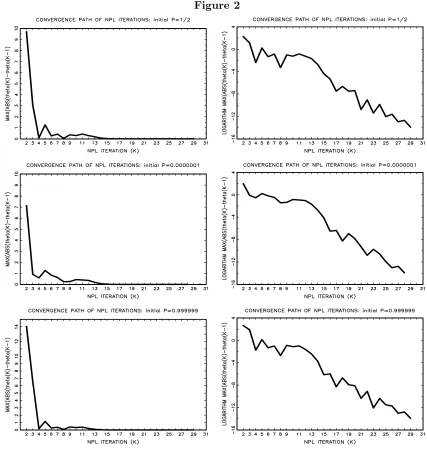
player and state; and P0 =vector of random draws from U nif orm(0,1). In this application, and
convergence path is quite similar in all the cases we have tried. Figure 2 presents the convergence
paths for three cases: P0 = 0.5,P0= 0.0000001, and P0 = 0.999999.
[image:21.612.89.516.132.588.2]Figure 2
Note that convergence to the NPLfixed point is quite slow. In fact, as shown by thefigures in
logarithms, the rate of convergence declines when we approach to the NPLfixed point. Regardless
the vector of CCPs that we use to initialize the NPL algorithm, 15 NPL iterations or less take us
very close to an NPL fixed point. However, it takes other 15 iterations to really converge to that
fixed point. The convergence criterion that we use ismaxj|ˆθ K j −ˆθ
K−1
relax that convergence criterion. Alternatively, it is possible to use "accelerate NPL iterations" as
proposed by Kasahara and Shimotsu (2008). For instance, we can apply more than one iteration
in the best response mapping at each NPL iteration. Iterations in the best response mapping are
computationally costly, but this additional cost might be compensated by a smaller number of NPL
iterations.
(c) Comparing Two-Step and NPL estimators. In this application, we find important differences between the parameter estimates using two-step and NPL methods. Figures 3 presents the
esti-mated variables profit functions andfixed cost functions for BK and MD under the two estimation
Appendix: Gauss code
// ********************************************************************* // NPL_DYNAGAME_150909.prg
//
// THIS PROGRAM ESTIMATES A DYNAMIC GAME OF ENTRY-EXIT USING // THE NESTED PSEUDO LIKELIHOOD (NPL) METHOD, AND ACTUAL DATA // ON MCDONALDS AND BURGER KING LOCATION OF OUTLETS IN UK //
// by VICTOR AGUIRREGABIRIA //
// SEPTEMBER 2009 //
// ********************************************************************* //
// SPECIFICATION OF ONE-PERIOD PROFIT FUNCTION // The profit function for firm i is:
//
// Ui = zi(ai,aj) * thetai - ai * epsi //
// where ai is the new entry decision of firm i, aj is the // new entry decision of firm j, zi(ai,aj) are vectors
// of variables, and thetai is a vector of parameters. More specifically, //
// thetai = (VP0i, VP1i, VP2i, FC1i, FC2i) //
// where VP0i, VP1i, and VP2i are parameters in the variable profit function, // FC1i and FC2i are parameters in fixed costs. And
//
// zi(ai,aj) = { S * 1(xi + ai > 0) } // ~{ S * (xi + ai - xj - aj) }
// ~{ S * (xi + ai - xj - aj)^2 } // ~{ -1(xi + ai > 0) }
// ~{ -(xi + ai) } // ~{ -(xi + ai)^2 } //
new ; closeall ;
library pgraph gauss ; format /mb1 /ros 16,4 ;
// **************************************** // PART 1: SPECIFICATION OF SOME CONSTANTS // **************************************** // Constants of the datafile
// Name and address of data file filedat =
"c:\\mypapers\\arvind_rationalizability\\data\\toivanen_waterson_nolondon_120809.dat";
nobs = 2110 ; // Number of observations in data file nmarket = 422 ; // Number of local markets
nyear = 5 ; // Number of years
nvar = 27 ; // Number of variables in dataset // Constants of the model
dfact = 0.95 ; // Discount factor maxiter = 50 ;
namesb1 = "VP0_BK" | "VP1_BK" | "VP2_BK" | "FC0_BK" | "FC1_BK" | "FC2_BK"
| "VP0_MD" | "VP1_MD" | "VP2_MD" | "FC0_MD" | "FC1_MD" | "FC2_MD" ; namesb2 = "DENSITY" | "GDP" | "RENT" | "TAX" ;
namesb = namesb1 | namesb2 ; // Calculating some constants vstate = seqa(0,1,maxstore) ;
vstate = (vstate.*.ones(maxstore,1)) ~(ones(maxstore,1).*.vstate) ; // Matrix with all possible values of the state variables
nstate = rows(vstate) ; kp1 = rows(namesb1)/2 ; kp2 = rows(namesb2) ; kparam = rows(namesb) ;
// *************************************************** // PART 2. READING DATA AND CONSTRUCTION OF VARIABLES // *************************************************** open dtin = ^filedat for read varindxi ;
data = readr(dtin,nobs); dtin = close(dtin) ; county_name = data[.,1] ; district_name = data[.,2] ; county_code = data[.,3] ; district_code = data[.,4] ; year = data[.,5] ;
mcd_stock = data[.,6] ; mcd_entry = data[.,7] ; mcd_entdum = data[.,8] ; bk_stock = data[.,9] ; bk_entry = data[.,10] ; bk_entdum = data[.,11] ; district_area = data[.,12] ; population = data[.,13] ; pop_0514 = data[.,14] ; pop_1529 = data[.,15] ; pop_4559 = data[.,16] ; pop_6064 = data[.,17] ; pop_6574 = data[.,18] ; avg_rent = data[.,19] ; ctax = data[.,20] ; ecac = data[.,21] ; ue = data[.,22] ; gdp_pc = data[.,23] ;
dist_bkhq_miles = data[.,24] ; dist_bkhq_minu = data[.,25] ; dist_mdhq_miles = data[.,26] ; dist_mdhq_minu = data[.,27] ; // Construction of variables
x_bk = bk_stock ; // Stock of stores for BK x_md = mcd_stock ; // Stock of stores for MD
// Market specific mean values of some exogenous explanatory variables marketsize = meanc(reshape(population,nmarket,nyear)’) ;
zmarket = meanc(reshape(density,nmarket,nyear)’) ~meanc(reshape(gdp_pc,nmarket,nyear)’)
~meanc(reshape(avg_rent,nmarket,nyear)’) ~meanc(reshape(ctax,nmarket,nyear)’) ; // *******************
// PART 3. PROCEDURES // *******************
// ---// A. PROCEDURE for FREQUENCY ESTIMATOR // ---proc (1) = freqprob(yobs,xobs,xval) ;
// ---// FREQPROB.SRC Procedure that obtains a frequency estimation
// of Prob(Y|X) where Y is a vector of binary
// variables and X is a vector of discrete variables // FORMAT:
// freqp = freqprob(yobs,xobs,xval) // INPUTS:
// yobs - (nobs x q) vector with sample observations // of Y = Y1 ~Y2 ~... ~Yq
//
// xobs - (nobs x k) matrix with sample observations of X //
// xval - (numx x k) matrix with the values of X for which // we want to estimate Prob(Y|X).
// OUTPUTS:
// freqp - (numx x q) vector with frequency estimates of // Pr(Y|X) for each value in xval.
// Pr(Y1=1|X) ~Pr(Y2=1|X) ~... ~Pr(Yq=1|X)
// ---local numx, numq, prob1, t, selx, denom, numer ;
numx = rows(xval) ; numq = cols(yobs) ;
prob1 = zeros(numx,numq) ; t=1 ;
do while t<=numx ;
selx = prodc((xobs.==xval[t,.])’) ; denom = sumc(selx) ;
if (denom==0) ;
prob1[t,.] = zeros(1,numq) ; else ;
numer = sumc(selx.*yobs) ; prob1[t,.] = (numer’)./denom ; endif ;
t=t+1 ; endo ;
retp(prob1) ; endp ;
// ---// MIPROBIT - Estimation of a Probit Model by Maximum Likelihood
// The optimization algorithm is a Newton’s method // with analytical gradient and hessian
//
// FORMAT {best,varest,llike} = miprobit(ydum,x,rest,b0,nombres,out) //
// INPUTS
// ydum - (nobs x 1) vector with observations of the dependent variable // x - (nobs x k) matrix with observations of explanatory variables // associated with the unrestricted parameters
// rest - vector with observations of the sum of the explanatory // variables whose parameters are restricted to be 1
// (Note that the value 1 is without loss of generality // if the variable rest is constructed appropriately)
// b0 - (k x 1) vector with values of parameters to initialized // Newton’s methos
// nombres - (k x 1) vector with names of parameters to estimate // out - 0=no table of results; 1=table with estimation results //
// OUTPUTS
// best - ML estimates
// varest - estimate of the covariance matrix
// llike - value of log-likelihood function at the MLE
// ---local myzero, nobs, nparam, eps, iter, llike,
criter, Fxb0, phixb0, lamdab0, dlogLb0,
d2logLb0, b1, lamda0, lamda1, Avarb, sdb, tstat, numy1, numy0, logL0, LRI, pseudoR2, k ;
myzero = 1e-36 ; nobs = rows(ydum) ; nparam = cols(x) ; eps = 1E-6 ;
iter=1 ;
llike = 1000 ; criter = 1000 ;
do while (criter>eps) ; if (out==1) ;
"" ;
"Pseudo MLE Iteration = " iter ; "Log-Likelihood function = " llike ; "Criterion = " criter ;
"" ; endif ;
Fxb0 = cdfn(x*b0+rest) ;
Fxb0 = Fxb0 + (myzero - Fxb0).*(Fxb0.<myzero) + (1-myzero - Fxb0).*(Fxb0.>(1-myzero));
llike = ydum’*ln(Fxb0) + (1-ydum)’*ln(1-Fxb0) ; phixb0 = pdfn(x*b0+rest) ;
lamdab0 = ydum.*(phixb0./Fxb0) + (1-ydum).*(-phixb0./(1-Fxb0)) ; dlogLb0 = x’*lamdab0 ;
d2logLb0 = -((lamdab0.*(lamdab0 + x*b0 + rest)).*x)’*x ; b1 = b0 - inv(d2logLb0)*dlogLb0 ;
b0 = b1 ;
iter = iter + 1 ; endo ;
Fxb0 = cdfn(x*b0 + rest) ;
Fxb0 = Fxb0 + (myzero - Fxb0).*(Fxb0.<myzero) + (1-myzero - Fxb0).*(Fxb0.>(1-myzero));
llike = ydum’*ln(Fxb0) + (1-ydum)’*ln(1-Fxb0) ; phixb0 = pdfn(x*b0 + rest) ;
lamda0 = -phixb0./(1-Fxb0) ; lamda1 = phixb0./Fxb0 ;
Avarb = ((lamda0.*lamda1).*x)’*x ; Avarb = inv(-Avarb) ;
sdb = sqrt(diag(Avarb)) ; tstat = b0./sdb ;
numy1 = sumc(ydum) ; numy0 = nobs - numy1 ;
logL0 = numy1*ln(numy1) + numy0*ln(numy0) - nobs*ln(nobs) ; LRI = 1 - llike/logL0 ;
pseudoR2 = 1 - ( (ydum - Fxb0)’*(ydum - Fxb0) )/numy1 ; if (out==1) ;
"Number of Iterations = " iter ; "Log-Likelihood function = " llike ; "Likelihood Ratio Index = " LRI ; "Pseudo-R2 = " pseudoR2 ;
"" ;
"---"; " Parameter Estimate Standard t-ratios";
" Errors" ;
"---"; k=1;
do while k<=nparam;
print $nombres[k];;b0[k];;sdb[k];;tstat[k]; k=k+1 ;
endo;
"---"; endif ;
retp(b0,Avarb,llike) ; endp ;
// ---// C. PROCEDURE for NPL ESTIMATOR //
---proc (4) = npl_bkmd(yobs, xobs, msize, zmarket, pchoice, mstate, beta, kiter, namesb); //
---// NPL_BKMD
// This procedure iterates in the NPL algorithm given an initial vector // of CCPs. The model is the dynamic game of local market entry for
// McDonalds and Burger King. The procedure returns the vector of parameter // estimates, the variance matrix, and the matrix with players choice
// probabilities at every state, and at every sample point. //
// FORMAT (thetaest,varest,pest,pest_obs) =
// npl_bkmd(yobs, xobs, msize, zmarket, pchoice, mstate, beta, kiter, namesb) //
// yobs - (nobs x 2) matrix with observations of players’ choices // xobs - (nobs x 2) matrix with observations of players’ endogenous // state variables
// msize - (nmarket x 1) vector with observations of market size (population) // zmarket - (nmarket x kz) matrix with observations of time-invariant
// market chracteristics
// pchoice - (nstate*nmarket x 2) matrix with initial vector of CCPs for // every market, state and player
// mstate - (nstate x 2) matrix with all the possible values of the // endogenous state variables
// beta - Scalar with value of the discount factor
// kiter - Scalar natural number with number of NPL iterations // namesb - (K x 1) vector with names of the structural parameters //
// OUTPUTS
// thetaest - (K x1) vector with parameter estimates at the last NPL iteration // varest - (K xK) matrix of variances and covariances
// pest - (nstate*nmarket x 2) matrix with estimates of CCPs for // every market, state and player
// pest_obs - (nobs x 2) matrix with estimates of CCPs for every // observation and state
//
---local myzero, nobs, nmarket, nyear, nplayer, ns, numx, ktot, kvpfc, kz, indxobs, j,
xbk, xmd, npliter, criterion, conv_const, theta0,
p_bk, p_md, ztilda_bk, ztilda_md, etilda_bk, etilda_md, ztilda_obs_bk, ztilda_obs_md, etilda_obs_bk, etilda_obs_md, m, valmsize, valzmarket,
zbk_00, zbk_01, zbk_10, zbk_11, zmd_00, zmd_01, zmd_10, zmd_11, eprofbk_0, eprofbk_1, eprofmd_0, eprofmd_1,
tranxbk_bk0, tranxbk_bk1, tranxmd_md0, tranxmd_md1, tranxmd_bk, tranxbk_md, tottran_bk0, tottran_bk1, tottran_md0, tottran_md1, uncontran,
value_z_bk, value_z_md, value_e_bk, value_e_md, zt_bk, zt_md, et_bk, et_md, count1, count2,
zobs, eobs, thetaest, varest, likelihood, theta_bk, theta_md, pest_obs ; //
---// Some constants //
---myzero = 1e-12 ; // Constant for truncation of CCPs to avoid numerical errors nobs = rows(yobs) ; // Total number of market*year observations
nmarket = rows(msize) ; // Total number of markets in the sample
nyear = nobs/nmarket ; // Number of years in the sample (balanced panel)
if nyear/=int(nyear) ; "ERROR: Number of years is not an integer"; end; endif;
nplayer = cols(yobs) ;
ns = rows(pchoice)/nmarket ; // number of states in a single market
if ns/=int(ns) ; "ERROR: Number of states in a single market is not an integer"; end; endif;
numx = sqrt(ns) ; // number of values of xbk or xmd
if numx/=int(numx) ; "ERROR: Number of values of xbk or xmd is not an integer"; end; endif;
kz = cols(zmarket) ; // Number of parameters associated with the control variables in zmarket
kvpfc = (ktot-kz)/2 ; // Number of parameters in var profits and fixed costs for a single firm
if kvpfc/=int(kvpfc) ; "ERROR: Number of parameters in var profits and fixed costs is not an integer"; end; endif;
xbk = mstate[.,1] ; // vector stock of stores for BK xmd = mstate[.,2] ; // vector stock of stores for MD //
---// Vector with indexes for the observed state // ---indxobs = zeros(nobs,1) ;
j=1 ;
do while j<=ns ;
indxobs = indxobs + j.*prodc((xobs.==mstate[j,.])’) ; j=j+1 ;
endo ;
// ---// NPL algorithm // ---criterion = 1000 ; conv_const = 1e-6 ; theta0 = zeros(ktot,1) ; npliter=1 ;
do while (npliter<=kiter).and(criterion>conv_const) ; "NPL ITERATION =";; npliter ;; "Criterion =";; criterion ; "" ;
// ---// TASK 1: Computing the matrices ztilda_bk and ztilda_md // and the vectors etilda_bk and etilda_md
// for every market and every sample observation
// ---ztilda_bk = zeros(nmarket*ns,kvpfc+kz) ;
ztilda_md = zeros(nmarket*ns,kvpfc+kz) ; etilda_bk = zeros(nmarket*ns,1) ;
etilda_md = zeros(nmarket*ns,1) ; ztilda_obs_bk = zeros(nobs,kvpfc+kz) ; ztilda_obs_md = zeros(nobs,kvpfc+kz) ; etilda_obs_bk = zeros(nobs,1) ;
etilda_obs_md = zeros(nobs,1) ; m=1;
do while m<=nmarket ; valmsize = msize[m] ;
valzmarket = zmarket[m,.] ;
// ---// Selection of probabilities for the market and
// truncation of probabilities to avoid inverse Mill’s ratio = +INF // ---p_bk = pchoice[(m-1)*ns+1:m*ns,1] ;
p_md = pchoice[(m-1)*ns+1:m*ns,2] ; p_bk = (p_bk.<=myzero).*myzero + (p_bk.>=(1-myzero)).*(1-myzero)
+ (p_md.>=(1-myzero)).*(1-myzero)
+ (p_md.>=myzero).*(p_md.<=(1-myzero)).*p_md ; //
---// Vectors of expected profits //
---zbk_00 = (valmsize.*(xbk.>0)) ~(valmsize.*(xbk-xmd)) ~(valmsize.*(xbk-xmd).*(xbk-xmd))
~(-(xbk.>0)) ~(-xbk) ~(-xbk.*xbk) ~(valzmarket.*xbk) ;
zbk_01 = (valmsize.*(xbk.>0)) ~(valmsize.*(xbk-xmd-1)) ~(valmsize.*(xbk-xmd-1).*(xbk-xmd-1))
~(-(xbk.>0)) ~(-xbk) ~(-xbk.*xbk) ~(valzmarket.*xbk) ;
zbk_10 = (valmsize.*((xbk+1).>0))~(valmsize.*(xbk+1-xmd)) ~(valmsize.*(xbk+1-xmd).*(xbk+1-xmd))
~(-((xbk+1).>0)) ~(-(xbk+1)) ~(-(xbk+1).*(xbk+1)) ~(valzmarket.*(xbk+1)) ;
zbk_11 = (valmsize.*((xbk+1).>0))~(valmsize.*(xbk+1-xmd-1)) ~(valmsize.*(xbk+1-xmd-1).*(xbk+1-xmd-1))
~(-((xbk+1).>0)) ~(-(xbk+1)) ~(-(xbk+1).*(xbk+1)) ~(valzmarket.*(xbk+1)) ;
zmd_00 = (valmsize.*(xmd.>0)) ~(valmsize.*(xmd-xbk)) ~(valmsize.*(xmd-xbk).*(xmd-xbk))
~(-(xmd.>0)) ~(-xmd) ~(-xmd.*xmd) ~(valzmarket.*xmd) ;
zmd_01 = (valmsize.*(xmd.>0)) ~(valmsize.*(xmd-xbk-1)) ~(valmsize.*(xmd-xbk-1).*(xmd-xbk-1))
~(-(xmd.>0)) ~(-xmd) ~(-xmd.*xmd) ~(valzmarket.*xmd) ;
zmd_10 = (valmsize.*((xmd+1).>0))~(valmsize.*(xmd+1-xbk)) ~(valmsize.*(xmd+1-xbk).*(xmd+1-xbk))
~(-((xmd+1).>0)) ~(-(xmd+1)) ~(-(xmd+1).*(xmd+1)) ~(valzmarket.*(xmd+1)) ;
zmd_11 = (valmsize.*((xmd+1).>0))~(valmsize.*(xmd+1-xbk-1)) ~(valmsize.*(xmd+1-xbk-1).*(xmd+1-xbk-1))
~(-((xmd+1).>0)) ~(-(xmd+1)) ~(-(xmd+1).*(xmd+1)) ~(valzmarket.*(xmd+1)) ;
eprofbk_0 = (1-p_md).*zbk_00 + p_md.*zbk_01 ; // Expected Profit BK if a=0 eprofbk_1 = (1-p_md).*zbk_10 + p_md.*zbk_11 ; // Expected Profit BK if a=1 eprofmd_0 = (1-p_bk).*zmd_00 + p_bk.*zmd_01 ; // Expected Profit MD if a=0 eprofmd_1 = (1-p_bk).*zmd_10 + p_bk.*zmd_11 ; // Expected Profit MD if a=1 //
---// Transition probabilities //
---// Remember: vstate = xbk ~xmd
// where: xbk = (1|2| ... |14).*.(1|1|....|1) // xmd = (1|1| ... |1) .*.(1|2|....|14)
// Transition xbk for BK: abk = 0
// Pr( xbk’ | xbk, xmd, abk =0) = 1{xbk’ = xbk)
tranxbk_bk0 = eye(numx) ; // Transition of xbk in the space of xbk
// Transition xbk for BK: abk = 1
// Pr( xbk’ | xbk, xmd, abk =0) = 1{xbk’ = xbk+1) tranxbk_bk1 = (zeros(numx-1,1) ~eye(numx-1))
| (zeros(1,numx-1) ~1); // Transition of xbk in the space of xbk
tranxbk_bk1 = tranxbk_bk1.*.ones(numx,numx) ; // Transition of xbk in the space of xbk, xmd
// Transition xmd for MD: amd = 0
// Pr( xmd’ | xbk, xmd, amd =0) = 1{xmd’ = xmd)
tranxmd_md0 = eye(numx) ; // Transition of xmd in the space of xmd
tranxmd_md0 = ones(numx,numx).*.tranxmd_md0 ; // Transition of xmd in the space of xbk, xmd
// Transition xmd for MD: amd = 1
// Pr( xmd’ | xbk, xmd, amd =1) = 1{xmd’ = xmd+1) tranxmd_md1 = (zeros(numx-1,1) ~eye(numx-1))
| (zeros(1,numx-1) ~1); // Transition of xmd in the space of xmd
tranxmd_md1 = ones(numx,numx).*.tranxmd_md1 ; // Transition of xmd in the space of xbk, xmd
// Transition xmd from the point of view of BK who doesn’t know amd // Pr( xmd’ | xbk, xmd) = (1-pmd) * 1{xmd’ = xmd) + pmd * 1{xmd’ = xmd+1) tranxmd_bk = (1-p_md).* tranxmd_md0 + p_md.* tranxmd_md1 ;
// Transition xbk from the point of view of MD who doesn’t know abk // Pr( xbk’ | xbk, xmd) = (1-pbk) * 1{xbk’ = xbk) + pbk * 1{xbk’ = xbk+1) tranxbk_md = (1-p_bk).* tranxbk_bk0 + p_bk.* tranxbk_bk1 ;
// Total transition matrix of (xbk,xmd) for BK if abk = 0
// Pr( xbk’,xmd’ | xbk, xmd, abk=0) = Pr( xbk’ | xbk, abk =0) * Pr( xmd’ | xbk, xmd) tottran_bk0 = tranxbk_bk0 .* tranxmd_bk ;
if sumc(sumc(tottran_bk0’).>(1.00001)) or sumc(sumc(tottran_bk0’).<(0.99999)) ;
"ERROR: Transition matrix does not sum 1" ; end ; endif ;
// Total transition matrix of (xbk,xmd) for BK if abk = 1
// Pr( xbk’,xmd’ | xbk, xmd, abk=1) = Pr( xbk’ | xbk, abk =1) * Pr( xmd’ | xbk, xmd) tottran_bk1 = tranxbk_bk1 .* tranxmd_bk ;
if sumc(sumc(tottran_bk1’).>(1.00001)) or sumc(sumc(tottran_bk1’).<(0.99999)) ;
"ERROR: Transition matrix does not sum 1" ; end ; endif ;
// Total transition matrix of (xbk,xmd) for MD if amd = 0
// Pr( xbk’,xmd’ | xbk, xmd, amd=0) = Pr( xmd’ | xmd, amd =0) * Pr( xbk’ | xbk, xmd) tottran_md0 = tranxmd_md0 .* tranxbk_md ;
if sumc(sumc(tottran_md0’).>(1.00001)) or sumc(sumc(tottran_md0’).<(0.99999)) ;
"ERROR: Transition matrix does not sum 1" ; end ; endif ;
// Total transition matrix of (xbk,xmd) for MD if amd = 1
// Pr( xbk’,xmd’ | xbk, xmd, amd=1) = Pr( xmd’ | xmd, amd =1) * Pr( xbk’ | xbk, xmd) tottran_md1 = tranxmd_md1 .* tranxbk_md ;
if sumc(sumc(tottran_md1’).>(1.00001)) or sumc(sumc(tottran_md1’).<(0.99999)) ;
"ERROR: Transition matrix does not sum 1" ; end ; endif ;
// Unconditional transition matrix
if sumc(sumc(uncontran’).>(1.00001)) or sumc(sumc(uncontran’).<(0.99999)) ; "ERROR: Transition matrix does not sum 1" ; end ;
endif ;
// ---// ztilda_bk, ztilda_md, etilda_bk, etilda_md for every possible state // ---uncontran = inv(eye(ns) - beta*---uncontran) ; // Matrix (I - beta*F)^-1 value_z_bk = (1-p_bk).*eprofbk_0 + p_bk.*eprofbk_1 ;
value_z_bk = uncontran * value_z_bk ; // Value Z function BK
value_e_bk = uncontran * pdfn(cdfni(p_bk)) ; // Value e function BK value_z_md = (1-p_md).*eprofmd_0 + p_md.*eprofmd_1 ;
value_z_md = uncontran * value_z_md ; // Value Z function MD
value_e_md = uncontran * pdfn(cdfni(p_md)) ; // Value e function MD
zt_bk = (eprofbk_1 - eprofbk_0) + beta*(tottran_bk1-tottran_bk0)*value_z_bk ; zt_md = (eprofmd_1 - eprofmd_0) + beta*(tottran_md1-tottran_md0)*value_z_md ; et_bk = beta*(tottran_bk1-tottran_bk0)*value_e_bk ;
et_md = beta*(tottran_md1-tottran_md0)*value_e_md ; //
---// Filling //
---count1 = (m-1)*ns + 1 ; count2 = m*ns ;
ztilda_bk[count1:count2,.] = zt_bk ; ztilda_md[count1:count2,.] = zt_md ; etilda_bk[count1:count2,.] = et_bk ; etilda_md[count1:count2,.] = et_md ; count1 = (m-1)*nyear + 1 ;
count2 = m*nyear ;
ztilda_obs_bk[count1:count2,.] = zt_bk[indxobs[count1:count2],.] ; ztilda_obs_md[count1:count2,.] = zt_md[indxobs[count1:count2],.] ; etilda_obs_bk[count1:count2,.] = et_bk[indxobs[count1:count2],.] ; etilda_obs_md[count1:count2,.] = et_md[indxobs[count1:count2],.] ;
m=m+1; endo ;
// ---// TASK 2: Pseudo Maximum Likelihood Estimation // ---zobs = (ztilda_obs_bk[.,1:kvpfc] | zeros(nobs,kvpfc)) ~(zeros(nobs,kvpfc) | ztilda_obs_md[.,1:kvpfc])
~(ztilda_obs_bk[.,kvpfc+1:kvpfc+kz] | ztilda_obs_md[.,kvpfc+1:kvpfc+kz]) ; eobs = etilda_obs_bk | etilda_obs_md ;
{thetaest,varest,likelihood}
= miprobit((yobs[.,1]|yobs[.,2]),zobs,eobs,zeros(ktot,1),namesb,1) ; //
---// TASK 3: Updating Conditional Choice Probabilities // ---theta_bk = thetaest[1:kvpfc] | thetaest[2*kvpfc+1:ktot] ;
theta_md = thetaest[kvpfc+1:2*kvpfc] | thetaest[2*kvpfc+1:ktot] ;
pchoice = cdfn(ztilda_bk*theta_bk + etilda_bk) ~cdfn(ztilda_md*theta_md + etilda_md) ;
//
---criterion = maxc(abs(thetaest-theta0)) ;
theta0 = thetaest ; npliter = npliter+1 ; endo ;
// ---// Observed Conditional Choice Probabilities: //
---pest_obs = cdfn(ztilda_obs_bk * theta_bk + etilda_obs_bk) ~cdfn(ztilda_obs_md * theta_md + etilda_obs_md) ;
retp(thetaest,varest,pchoice,pest_obs) ; endp ;
// *********************************** // PART 4: ESTIMATION OF INITIAL CCPs // *********************************** prob_freq = zeros(nmarket*nstate,nplayer) ; market = 1 ;
do while market<=nmarket ;
count1 = (market-1)*nstate + 1 ; count2 = market*nstate ;
yyy = a_bk[(market-1)*nyear+1:market*nyear] ~a_md[(market-1)*nyear+1:market*nyear] ;
xxx = x_bk[(market-1)*nyear+1:market*nyear] ~x_md[(market-1)*nyear+1:market*nyear] ;
buff = freqprob(yyy,xxx,vstate) ;
prob_freq[count1:count2,.] = freqprob(yyy,xxx,vstate) ; market = market+1 ;
endo ;
// Alternatively, the user could initialize the NPL algorithm using // a vector of constant probabiliies, e.g.,
// prob_freq = (1/2)*ones(nmarket*nstate,nplayer);
// or using random draws from a uniform distribution, e.g., // prob_freq = rndu(nmarket*nstate,nplayer);
// ************************ // PART 5: NPL ESTIMATION // ************************ {best,varb,pstate,pobs} =
References
[1] Aguirregabiria, V. and C. Alonso-Borrego, 2009, Labor Contracts and Flexibility: Evidence
from a Labor Market Reform in Spain. Manuscript. University of Toronto. Department of
Economics.
[2] Aguirregabiria, V. and C-Y. Ho, 2009, A dynamic oligopoly game of the US airline industry:
Estimation and policy experiments. Manuscript. University of Toronto.
[3] Aguirregabiria, V. and P. Mira, 2002, Swapping the nested fixed point algorithm: A class of
estimators for discrete Markov decision models. Econometrica 70, 1519-1543.
[4] Aguirregabiria, V. and P. Mira, 2007, Sequential estimation of dynamic discrete games.
Econo-metrica 75, 1—53.
[5] Aguirregabiria, V., P. Mira, and H. Roman, 2007, Inter-industry heterogeneity in market
structure and dynamic oligopoly structural models. Manuscript. The University of Toronto.
[6] Besanko, D., and U. Doraszelski (2004): "Capacity Dynamics and Endogenous Asymmetries
in Firm Size,"RAND Journal of Economics,35, 23-49.
[7] Collard-Wexler, A., 2008, Demand Fluctuations in the Ready-Mix Concrete Industry.
Manu-script. New York University.
[8] De Pinto, A., and G. Nelson, 2007, Modelling Deforestation and Land-Use Change: Sparse
Data Environments. Journal of Agricultural Economics. Vol. 58(3), 502 - 516.
[9] De Pinto, A., and G. Nelson, 2009, Land Use Change with Spatially Explicit Data: A Dynamic
Approach. Environmental and Resource Economics. Vol. 43, 209—229.
[10] Ellickson, P. and S. Misra, 2008, Supermarket Pricing Strategies. Marketing Science. Vol.
27(5), 811-828.
[12] Kano, K., 2006, Menu Costs, Strategic Interactions and Retail Price Movements. Manuscript.
Queen’s University.
[13] Kasahara, H. and K. Shimotsu (2008): "Pseudo-likelihood Estimation and Bootstrap Inference
for Structural Discrete Markov Decision Models,"Journal of Econometrics, 146(1), 92-106.
[14] Lenzo, J., 2008, Market Structure and Profit Complementarity: The Case of SPECT and PET.
Manuscript. Northwestern University. Kellogg School of Management.
[15] Lin, H., 2008, Quality Choice and Market Structure: A Dynamic Analysis of Nursing Home
Oligopolies. Manuscript. Indiana University. Business School.
[16] Lorincz, S., 2005, Persistence Effects in a Dynamic Discrete Choice Model: Application to Low-End Computer Servers. Discussion Papers 2005/10. Institute of Economics Hungarian
Academy of Sciences.
[17] Ryan, S. (2009): "The Costs of Environmental Regulation in a Concentrated Industry,"
Man-uscript, MIT Department of Economics.
[18] Sanchez-Mangas, R., 2002, Pseudo Maximum Likelihood Estimation of a Dynamic Structural
Investment Model. Working Paper 02-62, Statistics and Econometrics Series. Universidad
Car-los III de Madrid.
[19] Suzuki, J., 2008, Land Use Regulation as a Barrier to Entry: Evidence from the Texas Lodging
Industry. Manuscript. Department of Economics. University of Minnesota.
[20] Toivanen, O., and M. Waterson (2005): "Market Structure and Entry: Where’s the Beef?,"
RAND Journal of Economics, 36(3), 680-699.
[21] Tomlin, B., 2009, Exchange Rate Volatility, Plant Turnover and Productivity. Manuscript.
Department of Economics. Boston University.
[22] Walrath, M., 2008, Religion as an Industry: Estimating a Strategic Entry Model for Churches.