© 2016, IRJET | Impact Factor value: 4.45 | ISO 9001:2008 Certified Journal
| Page 1029
Convection Flow of Dusty Fluid along a Vertical Stretching Sheet with
Heat Generation
Jadav Konch
1, G. C. Hazarika
21
Research Scholar, Department of Mathematics, Dibrugarh University, Assam, India
2Professor, Department of Mathematics, Dibrugarh University, Assam, India
---***---Abstract -
A numerical study has been carried out on a steady two-dimensional laminar MHD heat and mass transfer free convection flow of a viscous incompressible dusty fluid near an isothermal linearly stretching sheet in the presence of a uniform magnetic field with heat generation. The present work examines the effects of temperature dependent viscosity and thermal conductivity on velocity, temperature and species concentration of the fluid. Effects of viscous dissipation and Joule heating are taken into consideration in the energy equation. Non-linear partial differential equations governing the motion are reduced to a system of ordinary differential equations using suitable similarity transformations. Resultant equations are then solved numerically using fourth order Runge-Kutta shooting method. Some important features of velocity, temperature and species concentration of fluid and solid particles are obtained for various physical parameters involved in the problem which are of physical and engineering interest are analyzed, discussed and presented through graphs. Finally, numerical values of skin-friction coefficient, Nusselt number and Sherwood number are presented in tabular form, which respectively give the wall shear stress, rate of heat transfer and rate of mass transfer.Key Words: Dusty fluid, variable viscosity and thermal conductivity, viscous dissipation, Joule heating.
1.INTRODUCTION
Investigations of two-dimensional boundary layer flow of free convection heat and mass transfer over a vertical stretching surface are important due to its applications in industries, and many manufacturing processes such as aerodynamic extrusion of plastic sheets, cooling of metallic sheets in a cooling bath, which would be in the form of an electrolyte, and polymer sheet extruded continuously from a die are few practical applications of moving surfaces.
A closed form exponential solution for planar viscous flow of linear stretching sheet has been presented by Crane [1]. Initially, Gebhart [2] observed the problem taking into account the viscous dissipation. Effects of MHD and viscous dissipation on heat transfer analysis were studied by many authors such as Mahmoud [3], Vajravelu and Hadjinicalaou [4], Samad et al. [5] and Anjali Devi [6]. Cortell[7] analyzed MHD flow of a power-law fluid over a stretching sheet. Chen [8] studied mixed convection of
power law fluid past a stretching surface with thermal radiation and magnetic field. Cortell [9] observed the influence of viscous dissipation and work done by deformation on MHD flow and heat transfer of viscoelastic fluid over a stretching sheet. Tsai et al. [10] have discussed unsteady flow over a stretching surface with non-uniform heat source.
© 2016, IRJET | Impact Factor value: 4.45 | ISO 9001:2008 Certified Journal
| Page 1030
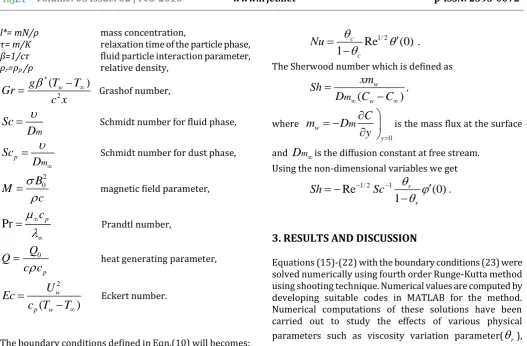
Nomenclature(u,v) velocity components of the fluid, (up,vp) velocity components of dust phase,
density of the fluid,p
density of the particle phase,
coefficient of dynamic viscosity,
coefficient of dynamic viscosity of ambient fluid,
kinematic viscosity of the fluid in the free stream,N number density of the particle phase,
K Stokes’ resistance(drag co-efficient),
m mass of the dust particle,
g acceleration due to gravity,
β* volumetric coefficient of thermal expansion,
T temperature of the fluid inside the boundary layer,
T
temperature of the fluid at free stream,Tp temperature of the dust particles inside the boundary layer,
Tp∞ temperature of the dust particles in the free-stream,
Cpw and Cp∞ species concentration of dust particles at the surface of the plate and sufficiently far away from the flat surface respectively,
density ratio,
electrical conductivity,c stretching rate,
l characteristic length,
cp specific heat of fluid at constant pressure,
cm specific heat of dust particles at constant pressure,
τT thermal equilibrium time and is the time required by the dust cloud to adjust its temperature tothe fluid,
τv relaxation time of the dust particle i.e., the required by a dust particle to adjust its velocity relative to the fluid,
λ thermal conductivity of the fluid,
thermal conductivity of the ambient fluid,C species concentration of the fluid,
Cp concentration of the dust phase within the boundary layer,
Dm coefficient of mass diffusivity of the fluid,
p
m
D
coefficient of mass diffusivity of dust phase,r
viscosity variation parameter,c
thermal conductivity variation parameter,l* mass concentration,
τ relaxation time of particle phase,
β fluid particle interaction parameter,
Gr Grashof number,
M magnetic field parameter,
Re Reynolds number,
Pr Prandtl number,
Ec Eckert number,
Sc Schmidt number for fluid phase,
p
Sc
Schmidt number for dust phase,f
C
skin-friction coefficient,Nu Nusselt number,
Sh Sherwood number.
Evgeny and Sergei [20] discussed the stability of the laminar boundary layer flow of dusty gas on a flat plate. Further, XIE Ming-liang et al. [21] extended the work of [16] and studied the hydrodynamic stability of a particle-laden flow in growing flat plate boundary layer. Palani and Ganesan [22] studied heat transfer effects on dusty gas flow past a semi-infinite inclined plate. Agranat [23] studied dusty boundary layer flow and heat transfer, with the effect of pressure gradient. Ezzat et al. [24] analyzed the space approach to the hydro-magnetic flow of a dusty fluid through a porous medium. Kannan and Venkataraman [25] examined the free convection in an infinite porous dusty medium induced by pulsating point heat source. Recently, Gireesha et al. [26] studied the boundary layer flow and heat transfer of a dusty fluid flow over a stretching sheet with non-uniform heat source/sink.
In all the above mentioned papers on dusty fluid, the thermophysical transport properties of the ambient fluid were assumed to be constant. However, it is well known from the work of Herwig and Wicken[27], Lai and
Kulacki[28], Setayesh and Sahai[29], Attia[30] that these physical properties may change with temperature, especially the fluid viscosity and the thermal conductivity. For lubricating fluids, the properties of the fluid are no longer assumed to be constant. An increase in temperature leads to increase in the transport phenomena by reducing the physical properties across the thermal boundary layer. Therefore to predict the flow and heat transfer characteristics more accurately, it is necessary to take into account the temperature dependent fluid properties.
© 2016, IRJET | Impact Factor value: 4.45 | ISO 9001:2008 Certified Journal
| Page 1031
Consider a steady two-dimensional heat and mass transferflow of an electrically conducting viscous incompressible dusty fluid along an isothermal stretching vertical sheet with heat generation/absorption. The stretching sheet coincides with the plane y = 0 where the flow is confined to y > 0. A uniform magnetic field of strength B0 is applied along the y
-axis. This is the only magnetic field in the problem as the induced magnetic field is neglected by assuming a very small magnetic Reynolds number [31, 32]. The viscous dissipation and Joule heating terms are taken into consideration in the energy equation. Two equal and opposite forces are introduced along the x-axis so that the sheet is stretched keeping the origin fixed as shown in Fig. 1.
Fig.1: Flow configuration and coordinate system
In the present study dust particles are assumed to be spherical and uniform in size and shape and are uniformly distributed throughout the fluid. Also it is assumed that fluid has constant physical properties except viscosity and thermal conductivity. Using the above assumptions and based on Saffman[11] model of the steady motion of an incompressible fluid and following Vajravelu and Nayfeh[17] and Eldable et al.[33], governing equations of the flow are:
For the fluid phase:
0
u
v
x
y
(1)2
* 0
1
( p ) ( ) B
u u u KN
u v u u g T T u
x y y y
(2)
2
2
(
)
p
p p
T
Nc
T
T
T
c
u
v
T
T
x
y
y
y
2 0
(
p)
(
)
v
u
u
Q T
T
y
(3)
m
C
C
C
u
v
D
x
y
y
y
(4)For the dust phase:
(
pu
p)
(
pv
p)
0
x
y
(5)(
)
p p
p p p
u
u
K
u
v
u u
x
y
m
(6)(
)
p p
p p p
v
v
K
u
v
v v
x
y
m
(7)(
)
p p p
p p p
m T
T
T
c
u
v
T
T
x
y
c
(8)p p p
p p mp
C
C
C
u
v
D
x
y
y
y
(9)The appropriate boundary conditions are given by:
At
y
0
:w
u
U
cx
,v
0
,2 w
x
T
T
T
A
l
,2
w
x
C
C
C
B
l
,2
p pw p
x
C
C
C
E
l
Asy
: (10)0
u
,u
p
0
,v
p
v
,
p
,T
T
,T
p
T
,C
C
,C
p
C
pwhere c>0 is the stretching rate, ω is the density ratio, A, B
and E are positive constants and
l
c
is a characteristiclength, Cpw and Cp∞ are the species concentration of the dust particles at the surface of the plate and sufficiently far away from the flat surface respectively.
To convert the governing equations into a set of similarity equations, we introduce the following transformations as,
T∞
u=Dx
T C
Tw
Cw
vw(x)
x
y v/vp
u/up
g
O
B0
B0
u=Dx
© 2016, IRJET | Impact Factor value: 4.45 | ISO 9001:2008 Certified Journal
| Page 1032
( )
u
cxf
,v
c f
( )
,
c
y
,( )
p
u
cxF
,v
p
cG
( )
,
r
H
( )
,( )
wT
T
T
T
,( )
p p wT
T
T
T
,( )
wC
C
C
C
,( )
p p p pw pC
C
C
C
(11)
where
2
( )
x
T
T
A
l
, 2( )
x
C
C
B
l
,2
( )
p p p
x
C
C
E
l
.where r p
is the relative density and the prime(
)denotes derivative with respect to η.
The viscosity of the fluid is assumed to be an inverse linear function of temperature, and it can be expressed as following Lai and Kulacki [14]:
1
1
1
T
T
(12)or,
1
T T
r
,where
andT
rT
1
Also thermal conductivity of the fluid is varying with temperature. Following Choudhury and Hazarika [20], we assumed thermal conductivity of the fluid as:
1
1
1
T
T
(13)or,
1
T
T
c
,where
andT
c
T
1
.Here, α,
,
,
,T
r andT
c are constants and their values depend on the reference state and thermal properties of the fluid i.e.,
( kinematic viscosity) and λ (thermal conductivity).Two dimensionless reference temperatures
randc
can be defined as1
(
)
r r w wT
T
T
T
T
T
and1
(
)
c c w wT
T
T
T
T
T
(14)and called the viscosity variation parameter and the thermal conductivity variation parameter respectively.
Substituting Eqs. (11)-(14) in the Eqs. (2)-(10), we get
2 *
2
(
)
(
)
r r
r r
f
f
ff
f
l
H F
f
Mf
Gr
0
(15)
2
(
)
0
GF
F
F
f
(16)(
)
0
GG
f
G
(17)2
(
)
0
G H
H f
G
GFH
(18)2
2 Pr(2 ) Pr( )
( )
c c
p
c c T
N f f
c
2 2 2
Pr ( ) Pr r Pr Pr 0
v r
N
Ec F f Q Ecf EcMf
c
(19)
2
p(
)
0
p p p
m T
c
G
F
cc
(20)
2
(2
)
0
(
)
r r
r r
Sc
f
f
(21)
2
(2
)
0
(
)
r r
p p p p p
r r
Sc
F
G
(22)
© 2016, IRJET | Impact Factor value: 4.45 | ISO 9001:2008 Certified Journal
| Page 1033
τ= m/K relaxation time of the particle phase,
β=1/cτ fluid particle interaction parameter,
ρr=ρp /ρ relative density,
* 2
(
w)
g
T
T
Gr
c x
Grashof number,m
Sc
D
Schmidt number for fluid phase,p
m
Sc
D
Schmidt number for dust phase,2 0
B
M
c
magnetic field parameter,Pr
c
p
Prandtl number,0 p
Q
Q
c c
heat generating parameter,2
(
)
w
p w
U
Ec
c T
T
Eckert number.The boundary conditions defined in Eqn.(10) will becomes:
0
f
,f
1
,
1
,
1
,
p
1
at
0
0
f
, F=0, G=-f, H=
,
0
,
p
0
,
0
, (23)0
p
as
2.1 Skin-friction, Nusselt number and Sherwood number
Skin-friction coefficient (
C
f), Nusselt number(Nu) and Sherwood number(Sh) are the parameters of physical and engineering interest for the present problem, which physically indicate the wall shear stress, rate of heat transfer and rate of mass transfer respectively.Skin-friction coefficient is defined as
2 0
2
wf
C
u
, where0
w
y
u
y
is the shearing stress.After using the non-dimensional variables we get the skin-friction co-efficient as
1/ 2
2
Re
(0)
1
r f
r
C
f
. The Nusselt number which is defined as(
)
w
w
xq
Nu
T
T
, where w 0y
T
q
y
isthe heat transfer from the sheet.
Using the non-dimensional variables we get
Re
(0)
1
cNu
.The Sherwood number which is defined as
(
)
w w
m
xm
Sh
D
C
C
,where
0 w
y
m
C
m
D
y
is the mass flux at the surfaceand
D
mis the diffusion constant at free stream.Using the non-dimensional variables we get
1/ 2 1
Re
(0)
1
r r
Sh
Sc
.3. RESULTS AND DISCUSSION
Equations (15)-(22) with the boundary conditions (23) were solved numerically using fourth order Runge-Kutta method using shooting technique. Numerical values are computed by developing suitable codes in MATLAB for the method. Numerical computations of these solutions have been carried out to study the effects of various physical parameters such as viscosity variation parameter(
r), thermal conductivity variation parameter(
c), magnetic parameter(M), Prandtl number(Pr) and number density parameter of dust particle(N) on velocity, temperature and species concentration profiles of both the fluid and dust particles. A representative set of numerical results are shown graphically for velocity, temperature and species concentration profiles from Fig.2-Fig.11. In the following discussion some parameters are given the following fixed values: Re=100, Gr=0.5, M=1, Pr=0.71, Q=0.75, Sc=Scp=0.22,l*=0.2, β=0.5, N=0.5, ρ=1, c=0.6, τT=0.5, τv=1, ω=0.1, Ec=0.05,
cp=cm=0.2,
r =5 and
c =3, unless otherwise stated. [image:5.595.36.564.73.419.2]The effect of viscosity variation parameter
ron velocity profiles of fluid phasef
( )
and dust phaseF
( )
verses
is depicted in Fig. 2. It is observed that the velocity profiles decrease with an increasing values of fluid viscosity parameter
rfor both the phases. This is because of the fact that with an increase in the value of fluid viscosity variation parameter decreases the velocity boundary layer thickness.© 2016, IRJET | Impact Factor value: 4.45 | ISO 9001:2008 Certified Journal
| Page 1034
0 0.5 1 1.5 2 2.5 3 3.5
0.1 0.2 0.3 0.4 0.5 0.6 0.7 0.8 0.9 1
f'
,
F
f' F
r= 3, 5, 7
Fig. 2: Velocity profile for different Өr
0 0.5 1 1.5 2 2.5 3 3.5
0.1 0.2 0.3 0.4 0.5 0.6 0.7 0.8 0.9 1
f
',
F
f ' F
c=3, 5, 7
Fig. 3: Velocity profile for different Өc
values of
c and as a result viscosity decreases and so velocity increases.0 0.5 1 1.5 2 2.5 3 3.5
0.1 0.2 0.3 0.4 0.5 0.6 0.7 0.8 0.9 1
f'
,
F
f' F M=0.5, 1,1.5, 2
Fig. 4: Velocity profile for different M
Fig. 4 shows the variation of velocity profile for both the phases with various values of M. From this plot it is seen that the effect of increasing values of M is to decrease the velocity distribution of both the fluid and dust phases. This is due to the fact that the presence of a magnetic field normal to the flow in an electrically conducting fluid produces a Lorentz force, which acts against the flow.
0 0.5 1 1.5 2 2.5 3 3.5
0.1 0.2 0.3 0.4 0.5 0.6 0.7 0.8 0.9 1
f'
,
F
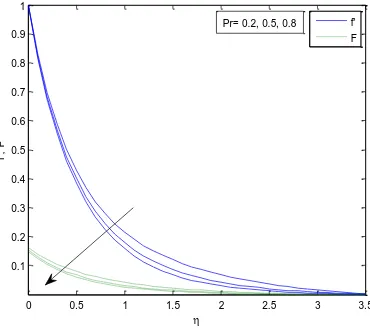
f' F Pr= 0.2, 0.5, 0.8
Fig. 5: Velocity profile for different Pr
Variation of velocity profile for different values of Prandtl number(Pr) and number density of the particle phase(N) are depicted in Fig.5 and Fig. 6, respectively. We observed that the velocity profile decreases with increasing values of both the parameters.
0 0.5 1 1.5 2 2.5 3 3.5
0.1 0.2 0.3 0.4 0.5 0.6 0.7 0.8 0.9 1
f'
,
F
f' F N=1, 2, 3
Fig. 6: Velocity profile for different N
[image:6.595.339.524.202.366.2]© 2016, IRJET | Impact Factor value: 4.45 | ISO 9001:2008 Certified Journal
| Page 1035
0 0.5 1 1.5 2 2.5 3 3.5
0.1 0.2 0.3 0.4 0.5 0.6 0.7 0.8 0.9
,
p
p
r= 3, 7, 11
Fig. 7: Temperature profile for different Өr
From the plots in Fig. 8, one can observed that for increasing values of thermal conductivity variation parameter(
c) enhances the temperature distribution, which is true for both the fluid phase as well as dust phase. Fig. 9 reveals the effect of magnetic parameter M on temperature profile. It is noticed that temperature profile increases for increasing values of magnetic parameter. This is because of the Lorentz force.0 0.5 1 1.5 2 2.5 3 3.5
0.1 0.2 0.3 0.4 0.5 0.6 0.7 0.8 0.9 1
,
p
[image:7.595.68.253.109.269.2] p c=3, 7, 11, 15
Fig. 8: Temperature profile for different Өc
0 0.5 1 1.5 2 2.5 3 3.5
0 0.1 0.2 0.3 0.4 0.5 0.6 0.7 0.8 0.9 1
,
p
p
M=0.5, 1, 1.5, 2
Fig. 9: Temperature profile for different M
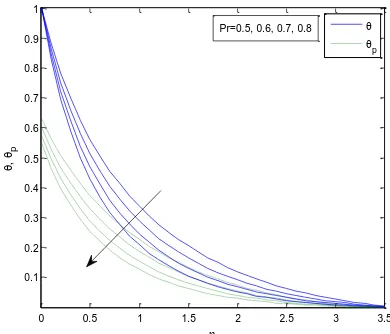
temperature profile. The increase in the value of Pr
decreases the temperature of fluid and dust phase. Physically, by this we mean that for higher Prandtl number fluid has a relatively high thermal conductivity which reduces temperature.
0 0.5 1 1.5 2 2.5 3 3.5
0.1 0.2 0.3 0.4 0.5 0.6 0.7 0.8 0.9 1
,
p
p
[image:7.595.331.526.191.358.2]Pr=0.5, 0.6, 0.7, 0.8
Fig. 10: Temperature profile for different Pr
The fluid and dust particles species concentration profiles presented in Fig. 11 and Fig. 12 for various values of
randc
, respectively. From these plots it is observed that species concentration profiles decreases for increasing values of
r, while it increases with an increasing values of
c.0 0.5 1 1.5 2 2.5 3 3.5
0.1 0.2 0.3 0.4 0.5 0.6 0.7 0.8 0.9 1
,
p
[image:7.595.59.258.405.744.2] p r= 3, 7, 11
Fig. 11: Concentration profile for different Өr
[image:7.595.329.529.494.673.2]© 2016, IRJET | Impact Factor value: 4.45 | ISO 9001:2008 Certified Journal
| Page 1036
0 0.5 1 1.5 2 2.5 3 3.5
0 0.1 0.2 0.3 0.4 0.5 0.6 0.7 0.8 0.9 1
,
p
p c=3, 8, 13
thermal conductivity variation parameter and magnetic parameter. Viscosity variation parameter leads to a decrease in the values of Nusselt number and Sherwood number. It is also noticed that the value of Nusselt number decreases with increase in the value of magnetic parameters, but it increases for the rising value of Eckert number. We observed that Sherwood number decreases with increase in the value of thermal conductivity variation parameter, magnetic parameter, Eckert number and Schmidt number.
Fig. 12: Concentration profile for different Өc
Table1: Effects of
r,
c, M, Ec and Sc on local skin-friction coefficient (C
f),local Nusselt number (
Nu
) and local Sherwood number(Sh
)r
c M Ec Sc Cf Nu Sh5
7
9
3 1 0.05 0.22
3.312662
3.264794
3.239164
1.901111
1.890416
1.88458
3.247656
3.20359
3.179744
5 5
7
9
1 0.05 0.22
2.925444
2.938145
2.944844
1.171352
1.244441
1.284757
2.97049
2.969897
2.969607
5 3 0.5
1.0
1.5
0.05 0.22
3.312662
3.724615
4.094781
1.901111
1.858642
1.82174
3.247656
3.190413
3.142709
5 3 1
0.03
0.05
0.07 0.22
3.724182
3.724616
3.725051
1.851815
1.858642
1.865482
3.190774
3.190413
3.190053
5 3 1 0.05 0.2
0.3
0.4
3.724615
3.724615
3.724615
1.858642
1.858642
1.858642
3.345971
2.777084
© 2016, IRJET | Impact Factor value: 4.45 | ISO 9001:2008 Certified Journal
| Page 1037
From the present investigation the following conclusionswere made:
When the effects of variable viscosity and thermal conductivity are taken into account, the flow characteristics are significantly changed compared to the constant property case.
The velocity profile decreases with the increasing values of viscosity variation parameter and Prandtl number while the opposite effect is observed in the case of thermal conductivity variation parameter.
The effect of magnetic parameter leads to decrease in the velocity profile. On the other hand, it enhances the temperature for both the fluid and dust phases.
An increasing viscosity variation parameter causes increase in the temperature. But species concentration reduces with it for both the fluid and dust phases.
Species concentration field enhances with the increase of thermal conductivity variation parameter.
Skin-friction coefficient increases due to magnetic field.
The wall shear stress increases with the increase of the viscosity variation parameter and thermal conductivity variation parameter.
The rate of heat transfer to the fluid decreases with the increase in
rand M whereas it increases for increasing value of
c and Ec.
An increase in the value of viscosity variation parameter leads to decrease in the values of Sherwood number.
The coefficient of skin-friction and Sherwood number decrease with the increase in
cand M .
Rate of mass transfer decreases with the increase in the thermal conductivity variation parameter.ACKNOWLEDGEMENT
Authors are grateful to the reviewers for their valuable suggestions which helped us to improve the quality of this research paper.Authors are also thankful to the UGC, New Delhi, India for providing financial support to carry out this work.
[1] L. J. Crane, “Flow past a stretching plate”, Z Ange Math Phys (ZAMP), Vol. 21, pp. 645-647, 1970.
[2] B. Gebhart, “Effects of viscous dissipation in natural convection”, J. Fluid Mech, Vol. 14, pp. 225-232, 1962. [3] M. A. A. Mahmoud, “Variable viscosity effects on
hydromagnetic boundary layer flow along a continuously moving vertical plate in the presence of radiation”, Appl. Math. Sci., Vol.1, pp. 799–814, 2007. [4] K. Vajravelu and A. Hadjinicalaou, “ Heat transfer in a
viscous fluid over a stretching sheet with viscous dissipation and internal heat generation”, Int. Comm. Heat Mass Trans., Vol. 20, pp. 417–430, 1993.
[5] M. A. Samad and M. Mohebujjamanr, “MHD heat and mass transfer free convection flow along a vertical stretching sheet in presence of magnetic field with heat generation”, Res. J. Appl. Sci. Eng. Technol,Vol. 1(3), pp. 98-106, 2009.
[6] S. P. Anjali Devi and B. Ganga, “Dissipation effects on MHD nonlinear flow and heat transfer past a porous surface with prescribed heat flux” Journal of Applied Fluid Mechanics, Vol.3 (1), pp. 1-6, 2010.
[7] R. Cortell, “A note on magnetohydrodynamic flow of a power-law fluid over a stretching sheet”, Appl. Math. Comp. Vol.168, pp.557-566, 2005.
[8] C. H. Chen, “MHD mixed convection of a power law fluid past a stretching surface in the presence of thermal radiation and internal heat generation/absorption”, Int. J. Nonlinear Mechanics, Vol. 44, pp. 296-303, 2008. [9] R. Cortell, “Effects of viscous dissipation and work done
by deformation on the MHD flow and heat transfer of a viscoelastic fluid over a stretching sheet”, Phys. Lett. A., Vol. 357, pp. 298-305, 2006.
[10]R. Tsai, K. H. Huang and J. S. Haung, “Flow and Heat Transfer over an Unsteady Stretching Surface with Nonuniform Heat Source,” International Communications in Heat and Mass Transfer, Vol. 35(10), pp. 1340-1343, 2008.
[11]P. G. Saffman, “On the stability of laminar flow of a dusty gas”, Journal of Fluid Mechanics, Vol. 13, pp. 120-128, 1961.
[12]F. E. Marble, “Dynamics of a gas containing small solid particles”, Proceedings of Fifth AGARD Colloquium Combustion and Propulsion (1962), Pergamon Press, Oxford, pp.175-213, 1963.
[13]M. C. Baral, “Plane parallel flow of a conducting dusty gas”, J. Phy. Soc. Japan, 33: 1732, 1968.
[14]K. M. Chakrabarti, “Note on boundary layer in a dusty Gas”, AIAA Journal, Vol. 12(8) pp. 1136-1137, 1974. [15]P. K. Gupta and S. C. Gupta, “Flow of a dusty gas through
a channel with arbitrary time varying pressure gradient”, Journal of Appl. Math. and Phys., Vol. 27, 119, 1976
© 2016, IRJET | Impact Factor value: 4.45 | ISO 9001:2008 Certified Journal
| Page 1038
[17]K. Vajravelu and J. Nayef, “Hydromagnetic flow of adusty fluid over a stretching sheet”, Int. J. Non-Linear Mech., Vol. 27(6), pp. 937-945, 1992.
[18]B. J. Gireesha, G. K. Ramesh and S. M. Abel and C. S. Bagewadi, “ Boundary layer flow and heat transfer of a dusty fluid flow over a stretching sheet with non-uniform heat source/sink”, Int. J. of Multiphase Flow, Vol. 37(8), pp. 977-982, 2011.
[19]B. J. Gireesha, S. Manjunatha, and C. S. Bagewadi, “Unsteady hydromagnetics boundary layer flow and heat transfer of dusty fluid over a stretching sheet”, Afrika Matematika, Vol. 23, pp. 229-241, 2012. [20]Evgeny S Asmolov and Sergei V Manuilovich, “Stability
of a dusty gas laminar boundary layer on a flat plate”, J. Fluid Mechanics, Vol. 365, pp. 137-170, 1998. [21]XIE Ming-liang, LIN Jian-zhong and XING Fu-tang “On
the hydrodynamic stability of a particle laden flow in growing flat plate boundary layer”, Journal of Zhejiang University, A, Science, Vol, 8(2), pp. 275-284, 2007. [22]G. Palani and P. Ganesan, “Heat Transfer Effects on
Dusty Gas Flow past a Semi-Infinite Inclined Plate,” Forsch Ingenieurwes , Vol. 71, pp. 223-230, 2007. [23]V. M. Agranat, “Effect of pressure gradient of friction
and heat transfer in a dusty boundary layer”, Fluid Dynamics, Vol. 23(5), pp.729-732, 1988.
[24]M. A. Ezzat, A. A. El-Bary and M. M., “Morsey, Space approach to the hydro-magnetic flow of a dusty fluid through a porous medium”, Computers and Mathematics with Applications, Vol. 59, pp. 2868-2879, 2010.
[25]K. Kannan and V. Venkataraman, “Free convection in an infinite porous dusty medium induced by pulsating point heat source”, World Academy of Science, Engineering and Technology, Vol. 63, pp. 869-877, 2010.
[26]B. J. Gireesha, G. K. Ramesh, M. Subhas Abel and C. S. Bagewadi, “Boundary layer flow and heat transfer of a dusty fluid flow over a stretching sheet with non-uniform heat source/sink”, Int. J. Multiphase Flow, Vol. 37(8), pp. 977- 982, 2011.
[27]H. Herwig, G. Wicken, The effect of variable properties on laminar boundary layer flow, Warme-und Stoffubertragung 20(1986), 47–57.
[28]F. C. Lai, and F. A. Kulacki, “The effect of variable viscosity on convective heat and mass transfer along a vertical surface in saturated porous media”, Int. J. of Heat and Mass Transfer, Vol. 33, pp. 1028-1031, 1991. [29]A. Setayesh, and V. Sahai, “Heat transfer in developing magneto hydrodynamic Poiseuille flow and variable transport properties”, Int. J. Heat Mass Trans.Vol. 33, pp. 1711-1720, 1990.
[30]H. A. Attia, “Transient and heat transfer between two parallel plates with temperature dependent viscosity”, Mech. Res. Comm., Vol. 26, pp. 115-121, 1999.
[31]A. A. Megahed, A. L. Aboul-Hassan and H. Sharaf El-Din, “Effect of Joule and Viscous Dissipation on Temperature Distributions through Electrically Conducting Dusty Fluid,” Fifth Miami International Symposium on Multi-Phase Transport and Particulate Phenomena, Miami Beach, Florida, USA, Vol. 3, pp. 111, 1988.
[32]G.W. Sutton and A. Sherman, “Engineering Magnetohydrodynamics”, McGraw-Hill, New York, 1965.
[33]N. T. Eldable, K. A. Kamel, G. M. Abd-Allah and S. F. Ramadan, “Peristaltic Motion with Heat and Mass Transfer of a Dusty Fluid Through a Horizontal Porous Channel Under the Effect of wall”, IJRRAS, Vol.15 (3), pp. 300-311, 2013.