Broadcast Encryption Using Probabilistic Key
Distribution and Applications
Mahalingam Ramkumar
Department of Computer Science and Engineering, Mississippi State University Email: [email protected]
Abstract— A family of novel broadcast encryption schemes based on probabilistic key pre-distribution are proposed, that enable multiple sources to broadcast secrets, without the use of asymmetric cryptographic primitives. A com-prehensive analysis of their efficiencies and performance bounds are presented. The paper also suggests a framework for applications of broadcast encryption, depending on 1) the relationship between the size of the network (or the total number of deployed devices) and the group size, and 2) the nature of the devices (stateless or otherwise) in the deployment. The utility of the proposed broadcast encryp-tion schemes is investigated for securing content distribuencryp-tion applications based on the publish-subscribe paradigm.
Index Terms— broadcast encryption, stateless vs stateful, probabilistic key predistribution
I. INTRODUCTION
Broadcast encryption (BE) [2] provides a means of establishing shared secret between g privileged nodes, among of a set of G=g+r nodes, where ther nodes which are not provided with the secret are usually referred to as revoked nodes.
BE schemes involve a set-up phase where secrets are distributed to all nodes in the network. To disseminate a broadcast secret Kb to all nodes (except r specifically
excluded nodes), the source 1) encryptsKb usingnkeys Ke1· · ·Ken, and 2) broadcasts n values1 Kei(Kb),1 ≤ i≤n. The secretsKe1· · ·Ken are chosen in such a way
that none of the r=G−g nodes can (using the secrets they possess) determine any of the keys Ke1· · ·Ken.
However, the privileged G−r nodes should possess, or can determine using the secrets they possess,at least one of the secretsKe1· · ·Ken, and thereby gain access to the
secretKb.
A. Group Secrets
The capability to establish and control access to group secrets has a wide variety of applications like digital rights management (DRM) [3], publish-subscribe systems [4] and multicast communications [5]. For instance, in DRM
This paper is based on “On Broadcast Encryption with Random Key Pre-distribution Schemes,” by M. Ramkumar, which appeared in the Proceedings of the 1st Intl. Conf. Information Systems Security - ICISS 2005, Kolkata, India, Dec. 2005 [1].
This work was supported in part by NSF grants EIA-0103722 and CNS-0448070.
1In the rest of this paper we use the notationK(M) to represent
encryption of a quantity M using a secretK, using some standard symmetric cipher.
applications regulating access to contentCis realized by encrypting content with acontent encryption keyKC. The
content encryption key is encrypted with the group secret KG (andKG(KC)distributed with the content) to ensure
that only members of the group can gain access to KC,
and hence the content.
1) Protecting Group Secrets: The ability to protect any secret depends on the number of nodes that have access to the secret. Obviously, the higher the number of nodes with access to a secret, the higher is the susceptibility of the secret to exposure. With BE,allexcept a few revoked nodes share the group secret. The use of weak security associations calls for assurances of trustworthiness of the entities that are provided with access to the secrets. In other words, entities provided with group secrets are trusted not to reveal the group secrets to unauthorized entities.
In most practical application scenarios involving group secrets, some proactive measures are required to protect the group secrets even from the end-users. For instance, the group secrets (and the pre-distributed secrets used for disseminating the group secrets) could be protected by a trustworthy device like a smart-card or a trustworthy chip housed in a DRM enabled device (DED). Providing assurances of trustworthiness of components that protect and use the group secrets (on behalf of a user or a DED) calls for physical shielding of such components from intrusions aimed at modifying their behavior, or exposing secrets. An unfortunate side effect physical shielding is reduced ability to dissipate heat [6]. If we can reduce the complexity of the protected components to very low levels, we can eliminate the need for proactive approaches for heat dissipation, thereby facilitating inexpensive and fool-proof shielding techniques. In other words, the com-plexity, and hence computational ability, of components that have to be protected, can have a significant effect on the costof such components. Thus limiting such compo-nents to employ only symmetric cryptographic primitives can be a useful strategy.
B. Multi-source Broadcast Encryption
However, BE schemes that cater for broadcasts by multiple sources have some very useful applications. Many multi-source BE schemes employing public key primitives have been proposed [10] - [11]. Furthermore, Naor et al [7] have indicated that at least some tree-based schemes can be readily extended to cater for multi-source BEif asymmetric cryptographic primitives are employed. On of the several advantages of BE using probabilistic key predistribution schemes (PKPS) discussed in this paper, is that they cater for BE by multiple sources withoutthe use of asymmetric cryptographic primitives.
In Section II we provide a overview of tree-based (T-BE) and PKPS based BE schemes (PKPS-BE) and discuss extensions of the schemes to facilitate broadcasts by multiple sources. A comprehensive analysis of the efficiencies of PKPS-BE schemes and bounds on their performance are discussed in Section III.
In application scenarios involving a single source, the number of deployed devices, or the network size N, is the same as the group size G, controlled by the single source. On the other hand, in scenarios involving multiple sources, different sources may control and regulate access to their group secrets. Thus several (possibly overlapping groups) of varying group sizes G << N can exist within the network. In Section IV we discuss some of the fundamental requirements of BE schemes to support the two models - 1)N=Gmodel, and 2)N >> Gmodels. In Section V we elucidate why PKPS-BE is ideally suited for N >> G models, and discuss a publish-subscribe system involving multiple broadcast sources. Conclusions are offered in Section VI.
II. BROADCASTENCRYPTIONSCHEMES
Many tree-based BE schemes (T-BE) have been pro-posed in the literature [7] - [9]. However, in this paper we shall restrict ourselves to the complete-subtree scheme proposed by Noar et al [7].
A. Tree-based Schemes
In the complete-subtree scheme for a system withN= 2L devices, theN devices are assumed to correspond to the leaf nodes of a binary tree of depth L. Associated with each of the2N−1 =PL
i=02
i nodes in the binary
tree, nij,0≤i≤L,0≤j ≤2i−1 are2N−1 secrets Kij, chosen by the KDC.
Apart from the one-to-one correspondence of the N devices Ij,0 ≤ j ≤N −1 in the system with the leaf
nodesnLj,0≤j≤N−1, each device is also associated
withLdirect ancestors - one in each level of the tree. A deviceIlreceivesL+1secrets -Lsecrets associated with
its L ancestor nodes, and the secret KLl corresponding
to the leaf node nLl.
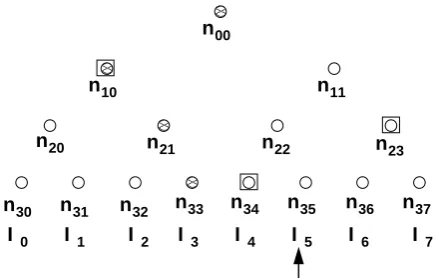
Figure 1 exhibits such a tree for L = 3 (or N = 8). DeviceI3corresponds to the noden33with ancestorsn21, n10 and n00, receives secrets K33, K21, K10 and K00. All devices receive K00, half the devices receive K10, and so on.
n30 n31 n32 n33 n34 n35 n36 n37
n23 n22
n21 n20
n10 n11
n00
I2 I 3 I 4 I5 I 6
I 0 I1 I 7
0 0
1 1
0 0
1 1
0 0
1 1
0 0
1 1
Figure 1. The binary tree used in the complete-subtree scheme. The nodes filled with patterns associated with deviceI3. Keys corresponding to nodes enclosed in boxes are used for revokingI5.
To revokeI5 the KDC encrypts a broadcast secretKb
with3 secrets -K34,K23, andK10, and broadcasts
B= [I5k(K34(Kb), K23(Kb), K10(Kb))]. (1)
Any device receiving the broadcast B can determine which secrets have been used by the source (as the revoked node is explicitly specified). DevicesI0· · ·I3can decryptK10(Kb).I6andI7can decryptK23(Kb).I4can decrypt K34(Kb). In general, revoking any device will
call for L encryptions of the broadcast secret. Note that any number of devices can be revoked together, in one broadcast. Further, while revoking 1 device calls for using log2N encryptions, revoking more than one, say r > 1 devices, will requirelessthanrlog2N encryptions. Noar et al [7] have shown that even in the worst case scenario onlyrlog2(N/r)encryptions are called for.
1) Multi-Source Extensions: Extending T-BE schemes to cater for broadcasts by multiple sources calls for inter-preting the value assigned to each of the2N−1nodes in the binary tree as a publicvalue, corresponding to which secrets (or private keys) are assigned to every device. Thus corresponding to each of the 2N−1 nodesnij, the KDC
generates public-private key pairs {(Uij, Rij)}.
Each device stores L+ 1 private keys. In this case deviceI3stores private keysR33,R21,R10andR00. The public values Uij of all 2N−1 nodes are made public
(provided to all potential sources of broadcasts). Thus any source with knowledge of the public keys can encrypt the broadcast secret using the public keys, which only devices with the corresponding private keys can decrypt.
B. Probabilistic Key Distribution
with simple random allocation strategies with very little penalty. Dyer’s strategy of random allocation has also found applications in broadcast authentication [5]. In this paper, random subset allocation strategies as random preloaded subsets (RPS) as in [16]. Due to random allo-cation of secrets, RPS provides probabilistic assurances.
The first key predistribution scheme with probabilistic assurances was however proposed by Leighton and Micali (LM) [17] in 1993. Unlike RPS where each device is asssigned a subset of the KDC’s secrets, in LM-KPS each device receives a repeatedly hashed version of all P = k KDC’s secrets. In hashed random preloaded subsets (HARPS) [18], Ramkumar et al proposed a generalization of RPS and LM-KPS, where the subset of allocated secrets are successively hashed versions of the KDC’s secrets.
1) RPS and HARPS: In(P, k)RPS, the KDC chooses a set of P keys S={K1· · ·KP}, and a public random
function F(). A device with IDA is assignedk indexes determined by
F(A) ={A1, A2, . . . Ak},1≤Ai≤P, Ai6=Aj∀i6=j.
Corresponding to the public indexes (as F() is public anyone can evaluate F(A) to determine the indexes of secrets with deviceA), deviceAis provided with secrets
SA={KA1, KA2, . . . , KAk}. (2)
In (P, k, L) HARPS, the KDC chooses P keys S =
{K1· · ·KP}, a cryptographic hash functionh(), and two
public functionF()andf(). For a deviceA, the indexes {A1· · ·Ak}are assigned as in RPS. However, each index
assigned to a device is also associated with a “hash depth” ai = f(A, Ai), 1 ≤ i ≤ k, 1 ≤ ai ≤ L∀i, uniformly
distributed between 1 and L. The k secrets assigned to deviceA are now
SA={aiKAi =h ai(K
Ai)},1≤i≤k, (3)
where hj(K
l) =h(h(· · ·jtimes(Kl)· · ·)) represents the
result of applyingj successive hashes (using the crypto-graphic hash functionh()) on the valueKl. Note that any
entity with keydK can determinexKforx≥d(but not for x < d). As earlier, both F()and f()are public. So anyone can determine the indexes (and the hash depth) of secrets assigned to any device.
2) BE Using HARPS: As HARPS is a generalization of RPS (RPS is equivalent to HARPS with L = 1) we shall begin by illustrating the principle behind broadcast encryption using HARPS. First, we shall restrict ourselves to BE by the KDC, and then discuss simple extensions to cater for efficient broadcast of secrets by multiple sources. Consider the illustrative example depicted below with P = 8, k = 4, L = 4. The KDC chooses P = 8 keys K1· · ·K8. DeviceAhas keys with indexesi= 1,2,4,6 at hash depths 4, 2, 1 and 3 respectively - or keys 4K
1,2K2,1K4 and3K6. The row markeddi is the hash
depths the KDC can safely employ for each 1≤i≤P for encrypting Kb. For example, for revoking A and B
the KDC can use keys 3K1, 1K2, 2K5, 1K6, 4K7, and 4K
7as none of the secrets can be determined byAorB, or even by AandB pooling their secrets together. Note that whileAhas a secret4K
1corresponding to index 1,A cannot determine the preimage (under the hash function h()) 3K
1. Device C can determine 4K7 by hashing its secret for the index, 4K7, twice, and thus decrypt Kb.
Device D can determine3K1 or 1K6 or 4K8.
In the case of RPS, hashing is not employed - thus each device either has a key corresponding to some index, or does not. In this case the KDC can choose the key corresponding to indexes 7 and 8 to encrypt the broadcast secret (to revoke Aand B). As it turns out in this case, bothC andD can employ the key with index 7.
i 1 2 3 4 5 6 7 8
A 4 2 x 1 x 3 x x
B x 3 1 x 3 2 x x
di 3 1 x x 2 1 4 4
C x 3 4 1 x x 2 x
D 2 x x x 3 1 4 x
3) BE by Sources Other Than KDC: One of the main advantages of PKPS-BE schemes comes from the fact that they trivially cater for BE by any source2. The KDC can authorize anysource, say a content distributorΘ, to perform broadcast encryption by providing the distributor ΘwithP L“encryption secrets,”
SΘ={jKjΘ=h( jK
ikΘ)},1≤i≤P,1≤j≤L, (4)
or in the case of RPS, just P secrets SΘ = {KiΘ = h(Ki k Θ)}. It is important to note that the encryption
secrets SΘ (which are used to encrypt the broadcast secret) reveal no information about the KDCs secrets or even the “decryption” secrets (the k secrets assigned to any device), as long as the hash function is pre-image resistant.
To revoke r device, just as the KDC can use a sub-set (or hashed subsub-set) of the secrets K1· · ·KP - say d1K
Ii· · ·dnKIn, to encrypt the broadcast secretKb, the
external source Θ can use d1KΘ I1· · ·
dnKΘ
In to encrypt Kb. A device that has a decryption secret dKi can still
compute the corresponding encryption secret d0KΘ
i = h(j0K
i k Θ) for any d0 ≥ d. Thus the efficiency of
BE, whether performed by the KDC or some other source (withP Lencryption secrets), is the same.
Canetti et al [5] suggested a similar technique - in-volving encryption secrets assigned to external sources by the KDC (which reveal no information about the KDCs secrets or the decryption secrets) to facilitate broadcast authentication by external sources.
III. PERFORMANCE OFPKPS BE
The efficiency of PKPS-BE is the same irrespective of whether the source is the KDC with P secrets, or some external source provided with LP secrets derived from
2Recall that while T-BE schemes can be extended to cater for
the P secrets of the KDC. In the rest of this section, we shall therefore assume that the source is the KDC.
A. Efficiency
The KDC has access to all secretsK1· · ·KP (at hash
depth 0, or Ki = 0Ki). Each of the r (to-be-revoked)
devices have k =ξP < P keys each (or ξ=k/P < 1 ). The hash depths of their keys are uniformly distributed between 1 and L.
Now consider a key indexed i, which say u of the r revoked devices possess. Let the hash depths of those u keys be d1· · ·du, with d0 = min(d1· · ·du). In other
words, the union of keys of the revoked devices include
d1K
i,d2Ki, . . . ,duKi (considering only secrets for index i). The KDC can still safely employ keyd0−1Kito encrypt
the broadcast secret.
Let nj be the average number of such safe keys that
the KDC can use at hash depth 1 ≤j ≤L. With these n = PL
j=1nj encryptions of the broadcast secret, the
KDC hopes to “reach” (or convey to secretKb to)every
privileged device.
It is easy to see that forj=L, thenj keys correspond
to the keys that none of the rdevices have (at anyhash depth). The probability that any device has a key indexed iisξ=Pk. Thus the probability that none of therdevices have key iis(1−ξ)r. In other words,n
L=P(1−ξ)r.
For RPS (withL= 1)n=nL=P(1−ξ)ris thetotal
number of safe keys. For HARPS, let us now evaluate the expression fornj for a generalj. As any key is assigned
to any node with probability ξ =k/P, it can be easily seen that the probability that exactly u of r nodes have a secret corresponding to some index i is the binomial probabilityBξ(r, u) = urξu(1−ξ)(r−u).
Let us represent by νij, the probability that the KDC
employs hash depth j for key indexed i. Recalling that for any index i, the KDC will employ depth j if d0 = min(d1· · ·du) =j+ 1, and recognizing that
Pr{d0 =j+ 1} = Pr{d0> j} −Pr{d0> j+ 1}
= (L−j)
u−(L−j−1)u
Lu ,
it can be readily seen that
nj = P νij, where
νij = r
X
u=1
Bξ(r, u) Pr{d0=j+ 1} (5)
1) Outage Probability: While it is guaranteed that none of the rdevices (even if they pool all their secrets together) can decipher the broadcast secret, there is a possibility that some of the g=G−rprivileged devices may not be able to decrypt any of the n = PL
i=1nj
encryptions. Let po be the “outage probability” - the
probability that an arbitrary device among the group of g privileged devices, cannot decrypt any of the n encryptions.
In order to decrypt a secret encrypted with key index i at depth j, the node should have the secret indexed i
at depth d ≤j, which will occur with a probability ξjL. Obviously, encryption keys corresponding to higher hash depths are more useful in conveying the secret to more privileged nodes. Thus for a particular encryption key at hash depth j (or any one of the nj keys) the probability
of outage ispoj = (1−ξ j L).
In general, the KDC may not have to use all the n=
PL
j=1njpossible safe keys. Only a subsetne=P L j=qnj
keys may be used to achieve a target outage probability of p∗o. For instance the KDC will first try to use only
keys at depth L (as they will be more useful for more privileged nodes), and if necessary consider using keys at depth L−1 and so on. In general, the source may use all possible safe keys with depth greater than q, and nq0 ≤ nq keys at depth q. In this case, the probability
of outage for any device, and hence the total number of encryptionsn∗erequired to convey the broadcast secret to all privileged nodes are
p∗o = (1−ξq L)
n0q L
Y
j=q+1
(1−ξj L)
nj, (6)
n∗e = gp∗o+n0q+ L
X
j=q+1
nj, (7)
where the term gp∗o accounts for the accidentally missed devices. For instance, if the KDC chooses a target ofp∗o≈ 1/g ≈ 1/G, one of the g devices will be accidentally missedon an average, for every revocation. To reach the missed devices, either an additional safe key can be added for each missed device (as the source does not typically use all possible safe keys to achieve the target of po), or
they can be conveyed by encrypting the broadcast secret with a unique key provided to each device.
2) Overheads: Apart from the broadcasting several encryptions of the secret, recall that for T-BE schemes the broadcast should indicate the IDs of the revoked nodes (for example I5 in Eq (1)). For PKPS-BE, while this is possible, it is more efficient, both in terms of bandwidth needed and computational complexity at the receiver, to instead provide the indexes and the hash depths of the keys used to encrypt the broadcast secret. If we represent
H(x) =−xlog2(x), the expression for the overheads oI
andoD(in number of bits) for conveying the indexes and
hash-depths respectively (of secrets used) are [1]
oI = P
H
ne P
+H
P−ne
P
(8)
od = ne L
X
j=q H
nj ne
. (9)
B. Performance Bounds
The exact analytical expressions for the relationship between P, k, L and the number of encryptions n∗e
To gain some more insight we shall look more closely at the simpler case (RPS) where no hashing employed.
With P secrets chosen by the KDC, andk=ξP pro-vided to each device, the minimum achievable probability of outage for revokingr devices, is
pmin= (1−ξ)n= (1−ξ)P(1−ξ) r
≈1/Gmax, (10)
where Gmax is the maximum possible group size.
Ob-viously pmin can be reduced to any extent (or Gmax
increased to any extent) by increasing P. The question now is what is the “optimal” choice of ξfor some G, r? 1) MinimizingP: The optimality however depends on whatwe are trying to minimize. For instance, if we wish to minimize P, the optimal choice ofξ should minimize
C= (1−ξ)(1−ξ)r
, which occurs whenξ≈1/r(for large r). Also, for large r
(1−1/r)r→e−1⇒pmin= (1−ξ)P/e. (11)
Making use of the fact thatlog(1−ξ)≈ −ξ for smallξ (or large r≈1/ξ), we thus have
P ≈er logλ k≈e logλ ne≈rlogλ. (12)
where λ = p−min1 ≈ Gmax. For a network size of one
billion (230), where we would desire pmin ≈ 2−30, for r= 128 we requirek≈57,P =rk= 7296, calling for ne≈2661encryptions of the broadcast secret.
2) Minimizing ne: More often, optimality of BE
schemes is measured in terms of the number of encryp-tions,ne, required for revokingrdevices. Now instead of
choosing ξ= 1/r, let us instead chooseξ=a/r, a >1. In this casepmin= (1−a/r)P(1−a/r)
r
≈(1−a/r)Pe−a, or
P ≈reaalogλ k≈ealogλ n
e≈ ralogλ. (13)
In other words, if we increaseP by a factorea−1/a, andk by a factorea−1, we can reduce the bandwidth needed for conveying the broadcast secret by a factor a. For a= 4 for instance,P = 36636, k= 1145, butnereduces to 665
encryptions for revoking 128 devices (for a group size of 1 billion).
C. Over-provisioning Keys
We saw that for a group size of G = 230 (or p
o = 1/G) RPS with parameters P = re log G = 7296,k = e log(G) = 57 can revoker= 128 =P/k device, using rlogGencryptions of a broadcast secret. With this choice of parameters
1 of the P =re log Gpossible secrets of the KDC, only a fraction P/e are “safe” (on an average), when r devices have to be revoked;
2 allne=rlogGsafe secrets arerequiredto achieve
the target outage probability of po = G−1. Thus even
if ris less than 128, the KDC will still need to transmit ne= 1/ξlogGencryptions in order to convey the secrets
to the G−r ≈ G privileged nodes (or achieve outage probabilitypo≈G−1).
In other words, for r <128 the bandwidth efficiency per revoked node reduces (or ne/r increases, as ne
remains the same), and for r much larger than 128, the system is unusable.
However, now consider a scenario where the same P = 7296, k = 57 scheme is used for a group size of G = 210 (thousand, instead of a billion). In this case we are actually employing P and k 3 times larger than what is required to revoke 128 devices3. Alternately, we can interpret this approach as a scheme corresponding to the choice of a = 2.11 (as ealog(210) = 57) to reduce bandwidth by a factor a(see Eq (13)), and designed for r∗=a∗128≈270andG= 210.
Thus for a group size of G= 210 the(P = 7296, k =
57) scheme can revoke upto 270 devices with ne/r = (logG)/a= 3.29encryptions per revoked device. At the same time, 128 devices can be revoked with an efficiency of ne/r = logG= 6.93, as only a fraction of the P/e
safe secrets need to be employed for ensuring outage probabilitypo≈log(G−1).
Thus while a system designed to minimize P, k for someris efficient only for a narrow range ofr,by over-provisioning keys we can realize efficient operation over a wider rangeofr. As an other example, RPS with P = 200×128, k = 200 can cater for efficient operation for a range of r between 128 and 340 for G = 230, and a range of 128 to 460 for G= 220 (a million). For larger ranges, we could increasekfurther, or alternately, employ parallel deployments of RPS with different values ofξ= k/P, so that together, they can be used efficiently for a wide range of r.
D. HARPS vs RPS
Without over-provisioning keys, the KDC cannot re-voke much more thanP/kdevices in a batch as the KDC runs outof then=P(1−ξ)rsafe secrets that can be used
to convey the broadcast secret to the privileged devices in the group. However, in the case of HARPS, in addition to nL =P(1−ξ)rsafe secrets (corresponding to which none
of thernodes have a secret assigned) othernL−1, . . . n1 safe secrets are available. For example, if two revoked devices have the secret corresponding to indexi, say42Ki
and 26Ki (where L = 64), the KDC can use the secret
25K
i (potentially useful toξ
(G−r)25
64 privileged devices). While closed form expressions for the performance bounds of HARPS (akin to Eqs (12) and (13) for RPS) are not readily tractable, the performance of HARPS can still be evaluated using the analytical expressions derived in the previous section (see Eqs (5) - (7)), for the relationships between ne,r,(P, k, L)andG≈1/po.
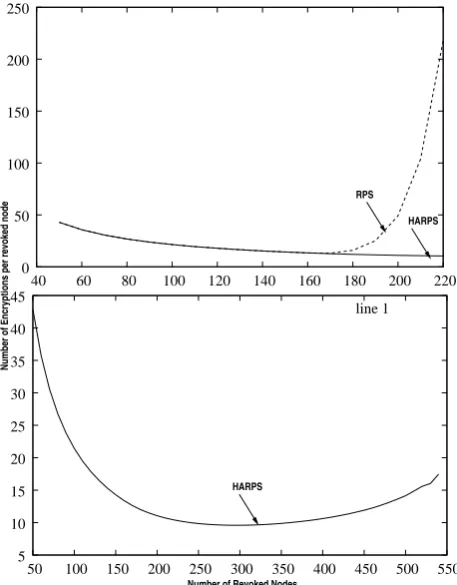
Figure 2 depicts the performance of RPS and HARPS with the same P = 7296, k = 57 (and L = 64 for HARPS) in terms of ne/r (y-axis) and the number of
revoked devices, r(x-axis), for a group size ofG= 230. Note that till the point r is not much larger than 128, both RPS and HARPS perform identically, as only keys at hash depthLare used for HARPS (keys at lower hash depths are not needed yet). But for larger r while RPS
runs out of safe secrets, HARPS can begin using keys at lower hash depths, and thus continue to operate efficiently (even for r >500 as can be seen from the figure)
Just as over-provisioning helped improve the usable range of r for RPS, it can also help to further improve the usable range of HARPS. For example, for P = 25600, k= 200, for values ofL= 1,2,4,6,8,16,32and 64respectively, the range of usable4ris between 128 and rL, whererL for differentLis shown in the table below
(the case L= 1 corresponds to RPS):
L 1 2 6 8 16 64
rL 340 565 1040 1185 1520 2000
Now consider a scenario where we desire to cater for efficient revocation for a range ofrfrom 128 to say 1000, for a group size of 1 billion. With RPS, we can realize this by using two schemes, one with (k = 200, ξ = 1/128), and the second with(k= 200, ξ= 1/360). However (as can be seen from the table above) a single deployment of HARPS with k= 200, ξ = 1/128, L = 6 can meet this requirement (usable range ofr).
In Figure 3 the plot labelled RPS depicts the perfor-mance (in terms of ne/r for different r) when the two
RPS schemes are used in parallel (the first is used forr≤ 155, and second forr >155). The plot labelled HARPS, L= 6 is for the case with a single HARPS deployment (P = 25600, k= 200, L= 6), caters for a slightly larger range ofrthan two deployments of RPS used in parallel. As a quick comparison of the two approaches, 1) HARPS requires 200 secrets to be assigned to each device, RPS requires 400; 2) the KDC requiresP = 25600secrets for HARPS, and 25600 + 360∗200 = 97600 for RPS; 3) to facilitate BE by external sources, each external source requires25600×L= 153600(L= 6) encryption secrets for HARPS,97600 (the same as the KDC) for RPS.
1) Choice of P, k, L for Practical Deployments: A reasonable approach then, to cater for efficient revocation for a wide range ofr, may be to use say four independent deployments, 1)ξ= 1/4, k= 100, 2)ξ= 1/16, k= 100, to cater for small r, 3) ξ = 128 for r between 128 and 1050, and 4) ξ= 1024, k= 200for largerr - for a total of 600 keys per device.
Further, the scheme supporting large r (ξ = 1/1024) could use largeL(say 512) to facilitate batch sizes even upto 30,000. However, depending on the storage ability of the external source, the source does not have to store all L×1024×200 encryption secrets for the scheme with ξ = 1/1024. For instance, if the external source decides to acquire only1024×200secrets at hash depth L, the deployment of HARPS can still be used with the same efficiency as RPS by the external source (while at the same time the KDC can employ much larger batch sizes). Note that in this case the external source has, and can thus use only the nL =P(1−ξ)r safe secrets. Or
the situation is no different from using RPS instead.
4We define the usable ranger
0 = 1ξ to rL, where for revoking
rLdevices the efficiency is the same as revokingr0 = 1/ξdevices. The maximum efficiency (or minimumne/r) occurs at somerbetween
r0= 1/ξandrL.
Number of Revoked Nodes
Number of Encryptions per revoked node
RPS
HARPS
HARPS
0 50 100 150 200 250
40 60 80 100 120 140 160 180 200 220
5 10 15 20 25 30 35 40 45
50 100 150 200 250 300 350 400 450 500 550
line 1
Figure 2. Comparison of HARPS and RPS forP= 7296, k= 57. For HARPSL= 64.
Number of revoked nodes
HARPS, L=6 RPS
Number of encryptions per revoked node
4 6 8 10 12 14 16 18 20
100 200 300 400 500 600 700 800 900 1000 1100
Figure 3. Comparison of two approaches - one using two parallel deployments of RPS and the second using one deployment of HARPS withL= 6.
Thus HARPS can simultaneously be used in the “RPS mode” by external sources that cannot afford to store a large number of secrets. Such a scheme (HARPS used in “RPS mode”) can still be used by external sources for efficient revocation of up to 3000 devices (while the KDC can revoke upto 30,000 devices usingPL
j=1nLsafe secrets). Furthermore, if the source can store 2×1024× 200 encryption secrets (say corresponding to hash depths L and L/2), the external source can support batch sizes upto 5000 nodes (in this case, for the external sources the scheme is equivalent to HARPS with L= 2).
to a million. While this calls for a storage of 5 million keys by the KDC, in practice the KDC does not have to actually store all secrets - it could simply generate any secret on demand using a single (or a few) highly protected secrets using strong hash functions.
Thus with HARPS, there isalmost no practical limita-tion on the maximum batch size for the KDC. External sources, can also support sufficiently large batch sizes r with storage of O(rlogG). In most practical
scenar-ios, even several GBs of storage is an inconsequential requirement for external sources (for example distributors of digital content who may have to deal with thousands of terabytes of content). Furthermore, as we shall argue in the next section, while it is desirable for the KDC to support large batch sizes, it isnotreally necessary for revocation by external sources to support large batch sizes (while it is still desirable for revocations by KDC).
IV. MODELS FORBE
From the perspective of the KDC, the “network size” N is the number of devices that are assigned (or could be assigned) secrets. Most conventional models for BE assume that the group sizeGis the same as the network size N. Furthermore, the devices taking part in such deployments are also assumed to bestatelessdevices [7]. In other words, once keys are distributed to such devices, there is no way to provide them with new secrets. In most cases, the source of the broadcast (the entity which revokes devices) is also the entity that distributes the secrets in the first place - the KDC. On the other hand, there are many application scenarios calling for BE, where N >> G. In such scenarios many independent sources (apart from the KDC) will be able to control group secrets for their specific interest groups consisting of perhaps G << N users / devices.
A. G=N Models
A practical example of aG=N stateless model is the case of DVD content protection, where each DVD player is provided with a set of secrets (that cannot be modified during the lifetime of the device). By default, all DVD players can render all DVDs, unless explicitly revoked. The content in a DVD is encrypted with a content encryption keyKC, and the secretKC is encrypted with
a secret KN. The secret KN is disseminated using BE
(included in every DVD) so that only non-revoked devices can gain access to KN, and henceKC, and thus decrypt
the content. Typically, DVD players that are suspected to have been compromised by attackers are revoked. More specifically, a player is “compromised” when an attacker has exposed (or is suspected to have exposed) secrets from the player.
By using secrets exposed from one or more compro-mised players, say D1· · ·Dn, an attacker cansynthesize
any number of illegitimate players. If such illegitimate players are discovered, it may be possible to employ traitor tracing [7] schemes to determine the original
DVD players D1· · ·Dn, whose secrets were employed
for constructing the illegitimate players. Thus revoking D1· · ·Dnwill simultaneously revokeallsuch illegitimate
DVD players in addition to theD1· · ·Dn.
1) Revocation in G = N Stateless Models: Assume that a month after such a system is deployed,n1 devices have been identified as compromised. For all content distributed from this point onwards, a new group secret KN1 is chosen and conveyed to all devices except then1
devices. At the end of the second month, say n2 more compromised devices are identified. Now a new group secret KN2 is chosen and conveyed to all but n1+n2
devices (in all DVDs pressed after this point; revoked devices can still play older DVDs).
2) G=NStateful Models: InG=Nstatefulmodels, the DVD players can remember (store) changing group secrets. In this case, it may appear at first sight that revocations can be performed in batches. For example, all devices share a secretKN0 initially. At the end of the
first month, a broadcast revokesn1devices by providing a secretKN0
1 to all other devices. Thus the new group secret
shared (and stored) by all N −n1 legitimate devices is KN1 =KN0 ⊕K
0
N1. At the end of the second month a
revocation broadcast revokes n2 devices by broadcasting K0
N2that then2devices cannot decrypt. The group secret
after the second revocation is then KN2 =KN1⊕K
0
N2.
Note that while then1devices revoked in the first batch can still gain access to KN0
2, they cannot gain access to
the new group secretKN2 =KN1⊕K
0
N2 =KN0⊕K
0
N1⊕
KN0
2 as they do not have access toK
0
N1. Unfortunately,
a pirate with access to secrets from one device in the first batch and one device in the second batch can still gain access to the new group secret KN2. Thus if the
purpose of revocation is for excluding devices suspected of key compromises, revocation should not be performed in batches.
B. N >> GModels
However, in many application scenarios where BE can be performed by multiple sources, the network sizeNcan be substantially larger than the group size G. Consider a scenario where a maximum ofN = 232 (about 4 billion) DRM enabled set-top boxes (STB) could be deployed for playing protected video content. Every end-user owns one such STB. A content distributor D may have G << N payingsubscribers(sayG= 220, or a million). From the perspective of the distributor, the group size is a million. Each member of the group (or the STB’s belonging to the Gusers) may be provided with a secretKG0 as part
of the subscription process. Later, when the distributor desires to cancel the membership of r (say 1000) of his Gsubscribers, the distributor can broadcast a new secret KG1 to the G−r continuing subscribers, that explicitly
revokesr subscribers.
can gain access to the secret KG1. To prevent any of the
N−Gnon-members from gaining access to the broadcast secret the entire broadcast may be encrypted with the group secretKG0. Nevertheless, it still does not prevent a
revoked user from colluding with one of theN−Gusers outside the groupGto determine the secret KG1.
In other words, ideallyN−(G−r)≈N users / STBs will have to be revoked, which is obviously impractical (it is far more efficient to unicast the broadcast secret independently to each of theG−rnodes whenN >> G). However, mandating that allN−(G−r)nodes be revoked byD, while impractical, is alsounnecessary.
In the N =Gscenario,and for revocation broadcasts by the KDC for N >> Gmodels, revocation will occur when secrets are (or suspected of being) compromised. However, the purpose of revocation by external sources inN >> G models is to control access to group secrets to paying customers. A revoked user is not necessarily more malicious than a user who is not revoked, or some user outside the group. Given the fact that it is impractical to revoke allN−(G−r)devices in any case, mandating that revocation broadcasts by distributors like D should not be batched, does not help much.
2) Revocation by KDC: However revocation by KDC inN >> Gmodels will still be for the same purpose as N =G models - ejecting devices that are suspected of compromise of secrets. While ideally, revocation broad-casts by the KDC should be able to support unlimitedr, in practice this is not an essential requirement if devices taking part in the deployment are not stateless.
Note that stateless devices are not well suited for N >> G scenarios in any case as external sources will need to provide dynamic group secrets to members of the group. Consider a scenario where broadcasts by KDC supports batch sizes upto rmax = 100,000. Arguably,
irrespective of the network size N, a scenario where such a large number of devices are suspected of being compromised, is a crying need for renewal of secrets. The devices revoked by the KDC will not be allowed to take part in renewal.
In other words, for systems that arenotstateless,rmax
is just the number of devices thattrigger renewal of the system. While we would still likermaxto be high (as the
process of renewal may be expensive), it is sufficient if rmax is “high enough.” In other words, while the BE by
KDCshouldsupport larger, it doesnothave to cater for unbounded r.
C. Batch Sizes for External Sources
For revocation by sources other than the KDC, where revocation can be performed in batches, at first sight it might seem that we could simply employ a scheme optimized to revoke onedevice in each batch, in which case any number of devices can be revoked efficiently. However, there are two very important reasons as to why this is not a good approach: 1) schemes optimized for low
r will employξ very close5 to 1 (or almost every node has almost every KPS secret) - and are thus less secure; 2) the efficiency increases (orne/r reduces) for schemes
optimized for larger r(small ξ).
1) Resistance to Synthesis Attacks: By compromising secrets from a certain number of devices, an attacker can determine a large fraction of the secrets6 of the system.
One measure of the security of any KDS is their resilience to “synthesis attacks.” More specifically, if an attacker needs to compromise secrets from ns devices to
expose allsecrets of a fraction pof the devices (or pN devices that are not part of thenscompromised devices),
the resistance of the KDS to synthesis attacks is p(ns).
For RPS withξ= 1/128andk= 200, by compromising all secrets from ns ≈ 340 devices, an attacker can
synthesize one in a million devices (or p(340) ≈10−6. HARPS performs significantly better under this metric. For ξ = 1/128 and k = 200, L = 64, for HARPS p(1650)≈10−6. On the other hand, ifξ= 200/206(RPS optimized for batch size of 1), even by compromising secrets of one node (or ns= 1), the attacker has access
to all secrets of one in every two thousand devices (or p(1) = 1/2000).
2) Bandwidth Efficiency: In practical application sce-narios it is only the efficiency for large batch sizes that really matters. If a PKPS-BE scheme that is optimized for a batch size of 100 is used for revoking 2 devices, the overhead may be the same as the case of revoking 100 devices. The fact that the overhead is say 20 KB instead of 200 bytes may not however be a serious limiting factor. However, we would certainly desire that the overheads for revoking say 100,000 devices is not prohibitively high.
Let us consider two scenarios 1) HARPS withk= 200 optimized for batch size of one, and 2) HARPS optimized for r >>1, for revoking r nodes. In the first case ther independent broadcasts (even though they can actually be sent togother) revoke one device each. In other words, each privileged device will receive r secrets, while the revoked devices will receive only r −1 secrets. The final group secret then is derived from all r secrets, thus shielding the secret from the r revoked devices. However, in this case the overall outage probability for the privileged devices increases, as outage can happen even if oneof thersecrets “evade” a privileged device.
Thus instead of aiming for an outage probability of po = G−1, with batched revocation (with batch size
of one) our target is to ensure outage probability less than p0o, for each batch, where (1 −p0o)r ≈ G−1, or p0o ≈ (rG)−1) instead. In other words, effectively the
scenario is equivalent to increasing the group sizeGby a factorr. We already know that PKPS can take advantage of reduced group sizes G to improve their efficiency (irrespective of N). Obviously, the effective increase in
5For example, forG= 230, and a batch size of 1, with a limit of 200 keys assigned to each device, the best choice of parameters for RPS is
P = 206, k= 200, andP = 201, k= 200, L= 64for HARPS.
6Even while each device is provided with a unique secret (which will
group size for batched approaches will make them even less efficient.
The table below compares the achievablene/r for two
schemes - one with ξ= 200/201≈1, L= 64for r= 1, and the other with ξ ≈ 1/128, L = 64 for r = 500, for three different group sizes G (a billion, million and thousand). For the batched scheme with ξ≈1, the table also indicates the reduction in efficiency due to the need to cater for reduced outage probability. In other words, row 2 in the table is ne for revoking one devicewithout
taking the need to reduce outage probability into account. Row 3 (labelledξ≈1∗) however, takes this into account.
G= 230 G= 220 G= 210 ξ= 1/128 5.39 2.71 0.62 ξ≈1 5.8 3.81 2.02 ξ≈1∗ 7.68 5.58 3.62
V. APPLICATION: A PUBLISH-SUBSCRIBESYSTEM
A publish-subscribe system [4] consists of a large number of users, who assume the role of publishers (of content), subscribers, or both. In other words, publishers control a group of subscribers, who are provided with a group secret, and hence access to the content published by the publisher. The ability to establish group secrets and regulate access to such group secrets is a very useful feature for any pub-sub system [19].
In such a system, every user may employ a smart-card, which protects 1) the KDS secrets used for disseminating group secrets, and 2) the group secrets themselves, from the end users. Content published by publishers could be encrypted directly or indirectly with the group secret, that only members of the group (legitimate subscribers) can access. For example, the content encryption secret KC could be encrypted with the group secret KG and
distributed with the content.
In all scenarios the KDS secrets and group secrets have to be protected from the subscribers (only their smart-cards will have access to the secrets). In some application scenarios even KC will have to be protected (the secret KC may be handed over only to a trusted DRM enabled
device). However in some scenarios (for example the content may be broadcast of stock-quotes encrypted with dynamic keysKCt encrypted using the group secret) the
session secret KC used for encrypting the content could
be handed over to an untrusted software running on a subscribers desktop / laptop / PDA.
The role of the KDC is to identify compromised smart-cards and revoke such smart-smart-cards from the deployment, by providing all non revoked smart-cards with a time varying universal secretUi. Apart from encrypting session
secrets (or content encryption secrets) with group secrets, all messages will also be encrypted using the secret Ui
to ensure that revoked devices cannot take part in the deployment. When the number of revoked devices crosses a threshold, the KDC could renew the KDS and provide new secrets to every smart-card in the system.
The publishers on the other hand do not have to concern themselves with the possibility of compromised devices.
Furthermore, the system should also support mutual au-thentication of a publisher A and potential subscriber B (by facilitating discovery of a secret KAB that no other
entity can discover), to facilitate initial dissemination of the publishers (A) group secret to the newly inducted subscriber B. Thereafter, revoking privileges of node B (once B cancels his subscription) can be realized by employing BE. In addition the system also need to cater for authentication of broadcasts (of both content and revocation messages).
A. Desirable Features
A very desirable feature in such large scale application scenarios is practically unlimited scalability. Even while the total number of users (say N0) in the system may never exceed a few billions, it is still desirable to assign large IDs each user (for example 160-bit IDs) to facilitate ID-based approaches.
ID-based Approaches: For example, a smart-card be-longing to a user described by a string S = “Alice B. Cryptographer, AnyTown, USA,” could be conveniently assigned a 160-bit ID A =h(S), where h() is a secure hash function. Further in situation where it is necessary to bind a DRM enabled device, say with manufacturers serial number M X −435768AF23, and owned by the userA to the userA, such a device can be provided and ID D = h(A k M X −435768AF23). Thus with ID based approaches with 160-bit IDs, even say N0 = 260 IDs could be issued (or N0 devices deployed) withvery low possibility of collisions. However the need for large ID-space is not for supporting very large network sizes (after all it is inconceivable that network sizes of the order of 260 will ever be needed). The reason for large ID-space is to ensure that users cannot choose arbitrary pre-images to misrepresent themselves (as only their IDs are authenticated).
Dynamic Group Sizes: In practice N0 may be of the order of billions. The group sizes however can have a wide range. Even very large distributors may have only millions of subscribers. Thus it is desirable that the KDS operates efficiently for smaller group sizes, while still supporting any conceivable group or network size.
Privacy:As revocation broadcasts are accessible to any one, even users outside the system, it is undesirable for such broadcasts to explicitly indicate the identities of revoked nodes.
B. PKPS-BE vs T-BE for Pub-Sub Systems
N = 230 devices belong to a group, to revokerof theG devices, the number of encryptions required is still30×r - orlog2(N) = 30encryptions per revoked device. Unlike T-BE schemes, PKPS-BE can take advantage of reduced group sizes to increase their efficiency. Recall that for small group sizes (say 1000), the number of encryptions required per revoked device can be substantially smaller than 1.
2) Scalability: Even if we ignore the primary disad-vantage of T-BE schemes for multi-source BE - the need for asymmetric cryptographic primitives, T-BE does not scale as well as PKPSs, due to the storage complexity to be borne by external sources. For multi-source T-BE schemes, sources other than the KDC need to store
O(N) public values (more specifically 2N −1 public
values corresponding to the 2N−1 nodes in the binary tree). This may not be a problem in practice even for network sizes of billions. After all, storing billions of public keys will call for a (mere) few hundreds of GBs of storage - a trivial requirement for any content distrib-utor. Nevertheless, calling for storage proportional to N certainly certainly cramps the scalability of the network (for example, making the use of identity based approaches impractical). Further, for T-BE schemes we have to take future scalability into account before we decideN.
On the other hand, for PKPSs, the storage required for external sources7 is P L ∝ rlog(N0), where r is
the maximum number of nodes that can be revoked in a single batch. As far as the KDC is concerned, revocation broadcasts by the KDC should reach all nodes. If the system actually hasN0 nodes at some point in time, the KDC has to ensure outage probability po ≈ 1/N0 to
convey the secret to every node with a high probability. Similarly, the publishers (with group sizeG) only have to cater for po≈1/G0. Thus irrespective of the theoretical
maximum network size N ≈ 2160 (to facilitate ID-based approaches) the KDS just has to cater only for the maximum number of users currently in the system.
3) Privacy: While in T-BE schemes the revoked de-vices have to be explicity specified in the revocation broadcast, recall that for PKPS-BE we only need to spec-ify the indexes (and hash depths) of thenesecrets used in
the broadcast (to encrypt the broadcast secret). Apart from protecting privacy of group membership information, we can also afford to use large IDs without adding to the bandwidth overheads.
4) Storage for Secrets: The advantages of PKPS-BE over schemes are achieved primarily by increasing the number of secrets assigned to every device (smart-card). Even for network size of 260, T-BE schemes like the complete-subtree scheme require only storage for 60 se-crets per node. However, a PKPS scheme requiringn par-allel deployments defined by parameters (Pi, ki, Li),1≤ i≤ncalls forPn
i=1kisecrets to be stored in each device
(for example 800 secrets if n= 4 and each deployment has 200 secrets).
7typically of the order of tens or hundreds of MB.
However, in any scenario calling for protection of multiple secrets, a very common approach (dating back to at least 1978 [20]) is to employ a single host master secret to encrypt all other secrets. Thus the smart-card A be-longing to a user Alice could store just one master secret MA, and all other P
n
i=1ki decryption secrets assigned
to A could be encrypted using MA and stored outside
the smart-card - for example in the hard-disk of Alice’s desktop / laptop (or even a SD card that can be plugged into a PDA). Obviously, the storage complexity for the decryption secrets is not an issue. In other words we can increase the number of decryption secrets substantially to facilitate bandwidth efficient revocation (for example increasing k by a factor50 =ea−1 to reduce bandwidth requirement by a factor 5.
It is pertinent to point out that tree-based schemes substantially more efficient (ne/r ≈1.25) [7] have also
been proposed which call for a storage complexity of log2(N)2/2keys (about 512 keys per device forN = 232, and 1800 keys for N = 260). However, such schemes extend less readily to BE by external sources.
C. Pub-Sub Operation
A pub-sub system employing PKPS-BE will consist of a KDC who chooses a set of n HARPS systems and public functions Fi() and fi(). Every participant in the
system employs a smart-card, which uses and protects the Pn
i=1ki PKPS decryption secrets and group secrets
on behalf of the participant. The smart card is plugged into a general purpose computer - for example desktop, laptop or PDA. Each smart card, associated with a user is assigned a 160-bit ID, based on the identity of the owner. For instance Alice has smart-card with ID Awith decryption secretsSAand Bob has smart-card with IDB
and decryption secretsSB.
All users who desire to be publishers are also provided with a maximum ofPn
i=1PiLiencryption secrets. To
off-set the cost involved generation and distribution of secrets by the KDC (the pub-sub operator) for this purpose, the KDC (or the pub-sub operator) could charge publishers a nominal fee to utilize the system for content distribution. Thus a publisher Alice also receives encryption secrets
SA. However operations involving encryption secrets
are not performed by the smart card. The encryption secrets of Alice need not be protected from Alice. Thus operations involving SA can be performed by Alice’s
desktop computer. The secrets that are protected (hidden from the owner of the smart-card) by the smart-cards are 1) decryption secrets used for decrypting the broadcast secret, 2) the group secrets, and 3) the broadcast secrets (which are used to modify the group secrets).
system over insecure networks (in which revoked devices will not be allowed to participate), is beyond the scope of this paper. Some possible approaches for renewal have however been investigated in [23] - [25].
1) Establishing Group Secrets: Consider a scenario where a publisher Alice, with smart-card A inducts a member Bob with smart-card B. Apart from catering for BE, HARPS also facilitates establishment of shared secrets between any publisher (or any user who has encryption secrets) with any user with decryption secrets. For example, for using the system withP = 204800, k= 200, L= 64 for mutual authentication, Alice determines thekindexes and the hash depths of the decryption secrets
SB. Thus usingkofP Lencryption secretsSA, Alice can
encrypt a session secret KS that only Bob’s smart-card
can decrypt [18].
The publisher Alice chooses a group secretKGA0 and
supplies the group secret to her smart-card A, which encrypts the secretKGA0 with the universal secretUi. The
secret Ui(KGA0)is now provided to the newly inducted
member, over a channel secured using the established session secret KS. Note that smart-cards revoked by
the KDC (that do not have access to the secret Ui)
cannot decrypt the group secret, and thus cannot become members of any group. By using the secret shared be-tween the publisher and the subscriber to authenticate a commitment, hash-chain based approaches [21], [22] could be used for authenticating subsequent revocation broadcasts by the publisher.
2) Revoking Users from Publishers Groups: For revok-ing a set of rusers who have have access to the current group secretKGAj of the publisher Alice, Alice chooses a
new group secretKGAj+1, and encrypts it with the current
universal revocation secret Ui (by providing KGAj+1 to
her smart-card A).
The secret Kb = Ui(KGAj+1) is broadcast by
en-crypting it with ne encryption secrets. Note that the
primary complexity associated with PKPS-BE lies in the determining the indexes and hash depths of thenesecrets
to use, for revoking a specific set ofrnodes (by evaluating the public functions). However, for purposes of creating the revocation broadcast, the only operation performed by the smart-card is encrypting the secretKGAj+1to provide
the publisher with the secret Ui(KGAj+1). All other
operations are performed by Alice’s desktop computer. Decryption of Group Secrets:Depending on the nature of content distributed by the publisher, the revocation broadcast can be posted in the website of the publisher or distributed with the content. With PKPS-BE the distribu-tor only indicates the indexes and the hash depths of the keys used.
At the other end, a subscriber Bob, using his desktop / PDA accesses the broadcast withneencrypted versions of
the broadcast secret, and a header indicating the indexes of the PKPS secrets. Bob’s computer can evaluate public functions F(B) (and f()) to determine an index of the secret that can be used by his smart-card B to decrypt the broadcast secretKb.
For instance, assume that 1) the broadcast includes Ke(Kb) where Ke =h(63K46 k A), 2) F(B) includes the index 46, and 3)f(B,46) = 42<63. In other words, one ofB’s decryption secretsSBis42K46, which is stored in Bob’s desktop computer as MB(42K46)(or encrypted with the master secretMBstored inside the the smart-card B). Thus Bob provides his smart-card with the values
[MB(42K46)kKe(Kb)k21kA] (14)
The sequence of operations to be performed by the smart-card to gain access to the group secret are as follows:
1) perform one decryption to determine 42K46, and
21 = 63−42repeated hashes to evaluate63K46. 2) compute Ke=h(63K46kA)
3) decrypt Ke(Kb)to determineKb
4) decrypt Kb withUi to determine new group secret KGAj+1
5) encrypt KGAj+1 withMB, and
6) handMB(KGAj+1)back to Bob’s desktop for
stor-age
Thus the smart-card stores only the master secretMB and
if necessary8the current universal secretUi(controlled by
revocation broadcasts by KDC).
Any content distributed by the publisher Alice (with smart-card A), meant exclusively for her subscribers, is encrypted with a secret KC. The secret KC is then
encrypted with the group secret KGAj+1, and distributed
along with the encrypted content. Thus Bob provides his smart-cardBwithMB(KGAj+1)andKGAj+1(KC). The
smart-card performs two decryption operations to evaluate KC. Depending on the nature of the specific application
scenario and type of content, the secret KC may be
handed over to untrusted (by the smart-card B) Bob, or only to a trusted DRM enabled device.
3) Very-Low-Complexity Smart-Cards: The scope of operations performed by smart-cards are restricted to a few symmetric cipher operations. The smart-cards are employed by publishers only for encrypting their group secret with the universal secret Ui. The subscribers
em-ploy it only for deciphering one of the neencryptions of
the broadcast secret. Thus even very low power processors (with a dedicated hardware block cipher) can be used, with practically no restrictions on the type of protection (in the form of shielding) that can be provided to protect the secrets and the operation of the processor in the smart-card. Apart from making it virtually impossible for attackers to successfully expose secrets from smart-cards, this can also result in inexpensive smart-cards. This one of the main reasons for avoiding the use of asymmetric cryptographic primitives inside the smart-card.
VI. CONCLUSIONS
In this paper we proposed and investigated the perfor-mance of a family of BE schemes employing probabilistic
8While the universal secret can also be stored outside, it is necessary
key pre-distribution. Some of the very desirable properties of the proposed schemes include their ability to
1) permit broadcast by any source without the use of asymmetric cryptographic primitives;
2) cater for practically unlimited network sizes, and thus easily amenable to identity based approaches; and
3) conceal identities of revoked nodes - a useful feature in scenarios where privacy is a crucial.
Furthermore, PKPS-BE offers useful trade-offs between bandwidth, computation, and storage, which can make them useful for a wide variety of application scenarios. However in this paper we restricted ourselves to one (albeit with a broad scope) application scenario - secure content distribution under the publish-subscribe paradigm. Apart from novel BE schemes, comprehensive analysis of their performance and bounds, and a broad application of PKPS-BE, the contributions of this paper also include a framework for BE applications depending on the relation-ships between the network sizeN and group sizeG, and whether the devices are stateless of stateful. We argued that tree-based schemes are more suitable for stateless models with N = G, while PKPS-BE is ideally suited for N >> Gmodels with stateful devices.
REFERENCES
[1] M. Ramkumar, “On Broadcast Encryption with Random Key Pre-distribution Schemes,” the Proceedings of the 1st Intl. Conf. Information Systems Security - ICISS 2005, Kolkata, India, December 2005.
[2] A. Fiat, M. Noar, “Broadcast Encryption,” Lecture Notes in Computer Science, Advances in Cryptology, Springer-Verlag,773, pp 480–491, 1994.
[3] J. Lotspiech, S. Nusser, F. Pestonoi, “Anonymous Trust: Digital Rights Management using Broadcast Encryption,” Proceedings of the IEEE,92(6), pp 898–909, 2004. [4] P.T. Eugster, P.A. Felber, R. Guerraoui, A-M. Kermarrec,
“The Many Faces of Publish/Subscribe,” Technical Report, URL citeseer.ist.psu.edu/649723.html.
[5] R. Canetti, J. Garay, G. Itkis, D. Micciancio, M. Naor, B. Pinkas, “Multicast Security: A Taxonomy and Some Efficient Constructions,” INFOCOMM’99, 1999. [6] S. W. Smith, Trusted Computing Platforms: Design and
Applications,Springer, New York, 2005.
[7] D. Noar, M. Noar, J. Lotspiech, “Revocation and Tracing Routines for Stateless Receivers,” Lecture Notes in Com-puter Science, Advances in Cryptology, Springer-Verlag,
2139, 2001.
[8] D. Halevy, A. Shamir, “The LSD Broadcast Encryption Scheme,” Advances in Cryptology - CRYPTO 2002: 22nd Annual International Cryptology Conference, Santa Bar-bara, California, USA, August 18-22, 2002.
[9] C.K. Wong, M. Gouda, S. Lam, “Secure Group Commu-nications using Key Graphs,” Proceedings of SIGCOMM 98, pp 68–79, 1998.
[10] J. Anzai, N. Matsuzaki, T. Matsumoto, “A method for masked sharing of group keys (3),” IEICE Technical Re-port, ISEC99-38, 1999.
[11] J. Anzai, N. Matsuzaki, T. Matsumoto, “A quick group key distribution scheme with entity revocation,” Proc. ASIACRYPT’99, LNCS1716, pp.333347, Springer-Verlag, 1999.
[12] L. Gong, D.J. Wheeler, “A Matrix Key Distribution Scheme,”Journal of Cryptology,2(2), pp 51-59, 1990.
[13] C.J. Mitchell, F.C. Piper, “Key Storage in Secure Net-works,” Discrete Applied Mathematics, 21 pp 215–228, 1995.
[14] M. Dyer, T. Fenner, A. Frieze and A. Thomason, “On Key Storage in Secure Networks,” Journal of Cryptology, 8, 189–200, 1995.
[15] P. Erdos, P. Frankl, Z. Furedi, “Families of Finite Sets in which no Set is Covered by the Union ofrOthers,”Isreal Journal of Mathematics,51, pp 79–89, 1985.
[16] M. Ramkumar, N. Memon, R. Simha, “Pre-Loaded Key Based Multicast and Broadcast Authentication in Mobile Ad-Hoc Networks,” Globecom-2003.
[17] T. Leighton, S. Micali, “Secret-key Agreement with-out Public-Key Cryptography,”Advances in Cryptology -CRYPTO 1993, pp 456-479, 1994.
[18] M. Ramkumar, N. Memon, “An Efficient Random Key Pre-distribution Scheme for MANET Security,” IEEE Journal on Selected Areas of Communication, March 2005. [19] C. Wang, A. Carzaniga, D. Evans, A. L. Wolf,
“Secu-rity Issues and Requirements for Internet-Scale Publish-Subscribe Systems,” Hawaii International Conference on System Sciences, January, 2002.
[20] S. M. Matyas, C. H. Meyer, “Generation, Distribution and Installation of Cryptographic Keys,” IBM Systems Journal,
2, pp 126 – 137, 1978.
[21] R.J. Anderson, F. Bergadano, B. Crispo, J.H. Lee, C. Manifavas and R.M. Needham, “ A New Family of Au-thentication Protocols,” ACM Operating Systems Review, vol. 32, n. 4, pp. 9-20, October 1998, ACM Press. [22] A. Perrig, R. Canetti, D. Song, D. Tygar, “Efficient and
Secure Source Authentication for Multicast,” in Network and Distributed System Security Symposium, NDSS ’01, Feb. 2001.
[23] B. Gassend, D. Clarke, M. van Dijk, S. Devadas, “Con-trolled Physical Random Functions,” 18th Annual Com-puter Security Applications Conference, San Diego, CA, Dec 2002.
[24] M. Ramkumar, “DOWN with Trusted Devices,” IA Newsletter, 8 (4), Information Assurance Technology Analysis Center (IATAC), http://iac.dtic.mil/iatac/. [25] M. Ramkumar , “Safe Renewal of a Random Key
Pre-distribution Scheme for Trusted Devices,” the 6th IEEE Information Assurance Workshop (The West Point Work-shop), United States Military Academy, West Point, New York, June 2005.
Mahalingam Ramkumar obtained his PhD in electrical engineering from New Jersey Institute of Technology, Newark, NJ, in 2000.
He has been an Assistant Professor in the Department of Computer Science and Engineering, Mississippi State Uni-versity, since August 2003. He was a co-founder and Chief Technology Officer of PixWave.com Inc., between March 2000 and August 2002, and Research Professor in the Department of Computer and Information Science, Polytechnic University, Brooklyn, NY, between September 2002 and August 2003.