R E S E A R C H A R T I C L E
Open Access
Studying the potential impact of automated
document classification on scheduling a
systematic review update
Aaron M Cohen
*, Kyle Ambert and Marian McDonagh
Abstract
Background:Systematic Reviews (SRs) are an essential part of evidence-based medicine, providing support for clinical practice and policy on a wide range of medical topics. However, producing SRs is resource-intensive, and progress in the research they review leads to SRs becoming outdated, requiring updates. Although the question of how and when to update SRs has been studied, the best method for determining when to update is still unclear, necessitating further research.
Methods:In this work we study the potential impact of a machine learning-based automated system for providing alerts when new publications become available within an SR topic. Some of these new publications are especially important, as they report findings that are more likely to initiate a review update. To this end, we have designed a classification algorithm to identify articles that are likely to be included in an SR update, along with an annotation scheme designed to identify the most important publications in a topic area. Using an SR database containing over 70,000 articles, we annotated articles from 9 topics that had received an update during the study period. The algorithm was then evaluated in terms of the overall correct and incorrect alert rate for publications meeting the topic inclusion criteria, as well as in terms of its ability to identify important, update-motivating publications in a topic area.
Results:Our initial approach, based on our previous work in topic-specific SR publication classification, identifies over 70% of the most important new publications, while maintaining a low overall alert rate.
Conclusions:We performed an initial analysis of the opportunities and challenges in aiding the SR update planning process with an informatics-based machine learning approach. Alerts could be a useful tool in the planning, scheduling, and allocation of resources for SR updates, providing an improvement in timeliness and coverage for the large number of medical topics needing SRs. While the performance of this initial method is not perfect, it could be a useful supplement to current approaches to scheduling an SR update. Approaches specifically targeting the types of important publications identified by this work are likely to improve results.
Background
Evidence-based medicine (EBM) is the process of apply-ing the best available evidence gained from clinical re-search to the practice of medicine [1]. While this is certainly a desirable goal, a typical physician’s heavy workload can make it difficult to realize. Practicing phy-sicians may not have time to consult the primary litera-ture to identify the best-available evidence for each and
every patient. Therefore the actual practice of EBM is dependent upon clinicians having access to syntheses of the best-available primary evidence applicable to their patients. These syntheses, such as systematic reviews (SRs), make the available evidence more accessible and usable in clinical practice. The Cochrane Collaboration states that an SR:
“. . .attempts to collate all empirical evidence that fits pre-specified eligibility criteria in order to answer a specific research question. It uses explicit, systematic methods that are selected with a view to minimizing * Correspondence:[email protected]
Department of Medical Informatics and Clinical Epidemiology, Oregon Health & Science University, Portland, OR, USA
bias, thus providing more reliable findings from which conclusions can be drawn and decisions made [2].”
SRs are literature reviews designed to locate, appraise and synthesize the best-available evidence from clinical studies of diagnosis, treatment, prognosis, or etiology, and provide informative empirical answers to specific medical questions. SRs inform medical recommenda-tions, guiding both practice and policy, such as in the creation of published practice guidelines [3].
The process of creating and maintaining SRs is resource-and labor-intensive, typically requiring 6–12 months of ef-fort, with the main expense being personnel time. There is ample evidence that SRs become outdated as research pro-gresses, and thus need to be periodically updated [4,5]. Best practice in medicine is continually changing, requir-ing incorporation of new information as it becomes avail-able, so SRs must undergo periodic updates in order to remain useful and accurate. Updates are costly in terms of both time and money, and can take as much time and ef-fort as the original SR [6]. Typically SR programs, such as the Drug Effectiveness Review Project (DERP) can only as-sess a past SR topic for new literature once or twice a year, leading to a 6–12 month lag in recognizing new evidence and beginning the planning of an SR update.
Although there exists research guidance on when and how to update SRs [6,7], the process is not well understood. A comparison by Shekelle of two methods (known as RAND and Ottawa) for determining the need for an SR to be updated found that both begin with an initial literature search [8]. Neither method provides guidance onwhen to conduct the required literature search. The machine learn-ing method proposed here provides exactly this guidance, and fits into the SR update process ahead of review commit-ment decision methods such as those assessed by Shekelle.
A survival analysis study of SRs by Shojania [5] found that the median duration of an SR not needing an update was 5.5 years. However, there was quite a lot of variation around this median– 23% of reviews needed an update within 2 years, and 15% within just 1 year of publication. While a more active SR research topic area would logic-ally require more frequent updates, Shojania also found that areas with more heterogenous research tended to require more frequent updates as well, because new evi-dence is more likely to alter the previous findings by re-ducing the variation across results. Clearly, there is a strong need for informatics support in determining when an SR topic is due for an update.
Building on our prior work in applying automated docu-ment classification to work prioritization for SRs [9-11], in this paper we perform an initial investigation of the poten-tial impact of automated document classification to the SR logistical process. While other researchers have investi-gated the use of machine learning in supporting EBM,
most notably Aphinyanaphongs [12], Kilicoglu [13,14], and Matwin [15], this is the first study that we are aware of which specifically looks at the impact of machine learning methods on SR update scheduling. We seek to study the potential effect of automated document classification on the process of SR update, in terms of need recognition, planning, and scheduling.
Here, we define a document classification task called
New Update Alert. The idea behindNew Update Alertis that as publications become available to the SR team, an automated document classification system may be able to determine which ones are most likely to be included in the SR update. When an article is detected that is likely to be included in the SR update, the system alerts the SR leader, perhaps via an automatically generated email message, or using a custom RSS (Really Simple Syndication) feed. For the purposes of this work, a publi-cation becomes available to the review team when it is indexed in MEDLINE, and therefore is findable using the search queries previously designed for the SR topic. The algorithm looks at each article meeting the original re-view search criteria, and notifies the team about articles that it predicts as likely to be included in an update.
We define a correct alert to be one that notifies the SR team about a publication that will be included in the eventual SR report update. These are publications that include new evidence regarding interventions, popula-tions, or study designs relevant to the report. An incor-rect alert is an alert about publication that is not eventually included in the SR update; these are “false alarms”. The machine predictions are not perfect, and a range of settings trading off sensitivity and specificity are possible. Greater sensitivity means that the team will be notified about the publication of a greater fraction of articles that will be ultimately included in the review up-date (true positives,TP), at the cost of more false alarms (false positives,FP). Furthermore, some publications may be more important than others, in that, in addition to being included in the final SR, they may include specific novel, or higher quality evidence that could motivate the scheduling, priority, or initiation of a review update. We specifically annotate and study these important publica-tions in the work described below. For the work described here, alerts are trigged when any potentially included publication is detected, whether this is a motiv-ating publication or not.
New Update Alerts could be useful to the process of SR in several ways. For example, the alerts could be used by the SR team to determine whether an SR needs an update, the urgency of the update, or when an update should be scheduled. Seeing potentially includable arti-cles accumulate as they are published may be helpful in scheduling a review update. With a system providing
studies potentially impacting the SR scope, conclusions, or recommendations at an earlier time. By examining the articles that result in alerts the reviewers could get a bet-ter initial idea of the quantity and quality of new infor-mation pertinent to an SR before actually scheduling or conducting the review update.
This would provide support for determining when to schedule an SR update. For example, whether a review update is needed as soon as possible, or could be post-poned for a time. Given that the resources to conduct SRs are specialized and limited, the ability to coordinate review update scheduling across the full set of a team’s review topics would be a great advantage in best applying those resources and supporting the current needs of the practice of EBM. Furthermore, this could play an import-ant role in obtaining funding to support the review. Since many SRs are dependent upon outside funding, new update alerts could provide the SR team lead with timely and important information to share with a fund-ing organization.
Here we study the performance of an initial classifica-tion system forNew Update Alert, leaving the issues sur-rounding exactly what kind of user interface to use with the alerts for future work.
Methods
Data sets
We created two separate data sets based on SR inclusion data collected by our automated SYstematic Review In-formation Automated Collection (SYRIAC) system, which has been described elsewhere [16]. The collection contains the titles, abstracts, and MeSH terms for over 70,000 documents that have been judged by experts for inclusion eligibility in various SRs performed for the DERP by researchers at Oregon Health & Science Uni-versity’s Evidence-based Practice Center (EPC). Each re-view comprises hundreds to thousands of journal article judgments on a specific review topic. These topics are usually focused on drug therapy, and often are con-strained to a particular class of drugs across multiple indications. In order to perform this work, we created time-segregated training and testing data sets for several SR topics. The training and testing data sets for each topic were mutually exclusive, and separated in time.
We define two specific time events in the SR process. The End of the Report Cycleoccurs for a topic when an SR has had its peer review completed and it is published on the Internet (www.ohsu.edu/drugeffectiveness). The
Report Search Begins event occurs when the first litera-ture search for a subsequent review update is begun. We use the term Pre-Update Period to describe the time period between theEnd of the Report Cyclefor the prior report, and the Report Search Begins. During this time, relevant studies and articles are published and new
medical evidence accumulates. Some of these publica-tions will eventually be included in the next report up-date for the topic. Relatively few expert resources are available to follow the SR topic during this period; the DERP conducts a yearly literature scan for each topic.
For each topic, we used the DERP review inclusion judg-ments for articles with MEDLINE entry dates prior to the
End of the Report Cycle(for the prior report) as the classifi-cation system training data for that topic. We used the DERP review inclusion judgments for articles indexed in MEDLINE during thePre-Update Period(after theEnd of the Report Cycledate and prior to theReport Search Begins
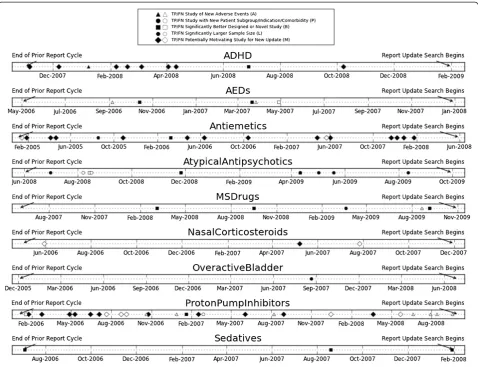
for the next update) as the testing data for that topic. Note that, for this data set, these articles were retrieved and in-clusion judgments assigned after the Pre-Update Period, but they apply to articles that were published, indexed in MEDLINE, and are therefore potentially available to the SR team during the pre-update period. ‘Potentially avail-able’ means that if the SR team re-ran their MEDLINE query during this time period, they would retrieve these documents, along with many others. These events and time periods are listed in temporal order and defined in Table 1 (see Figure 1 for the actual corresponding dates for each of the studied topics).
In this way, we can simulate both the data available for training the machine learning system for predictingNew Update Alerts, as well as apply the trained models to documents made available within MEDLINE during the pre-update period. Since this work is actually being done after the report update of interest has been completed, we know which documents indexed in MEDLINE during thePre-Update Periodwere actually included in the sub-sequent report update. This allows us to measure the performance of the classifier system on articles published during this period.
Of course, the above-described evaluation approach requires that we have SR topics for which both a prior report and a report update have been completed by the DERP investigators, and that we have the inclusion/
Table 1 Definition of temporal events and periods of a systematic review update relevant to this study
Name Type Definition
End of the Report Cycle
Event A report has had its peer review completed and is published on the Internet.
Pre-update Period
Time Period
Between the End of the Report Cycle and the Report Search for a report update. Little work on the topic, beyond a yearly literature search, is conducted.
Report Update Search Begins
Event Date on which literature search for a report update begins.
Report Update Period
Time Period
exclusion judgments for these topics within these periods in our data collection window. For this work we used a cross-sectional snapshot of the SYRIAC database, in-corporating all inclusion decisions made up to February 12, 2010. In reviewing the DERP records, we found that 11 topics met these requirements. For two of the topics,
Antiplatelets and NSAIDs an insufficient number of newly included and/or excluded articles were found in the update (fewer than 10), preventing adequate analysis. Therefore we excluded these two topics from the present study, leaving us with nine topics. See Table 2 for a sum-mary of the training and test data sets.
For these nine topics, we separated out the data into training and test sets, as noted above, and annotated the test collection. We wanted to understand both the overall performance of the machine learning system on identifying publications forNew Update Alert,as well as how the clas-sifier performs on the “important” publications. These
important publications are the ones that are most likely to motivate SR experts to decide that a new update is needed for the topic. These publications could change or influence the conclusions or recommendations of the SR. This could be due, for example, to a new study providing additional evidence for meta-analysis, or studying a new harm, or a new indication or patient population for a drug. We term these publications update-motivating publications, realiz-ing that it may be an individual or a collection of these publications that provide the actual motivation to the SR expert to recommend an update on a review topic.
Therefore, we designed an annotation scheme to identify the important studies in the test collection. The scheme shown in Table 3 was designed using an iterative consen-sus process between the two senior authors (AC and MM), one an expert on EBM and conducting SRs, the other a researcher experienced in data set creation and an-notation for biomedical machine learning. The anan-notation
scheme includes four specific (A, P, B, and L) annotation codes, and one general (M) code intended to cover the dif-ferent kinds of new evidence that an article might provide. This evidence could motivate the SR expert to consider (e.g., schedule, or try to pursue funding to support) an update of the SR topic. The annotation codes A, P, B, and L represent specifically-identified ways in which a study may contribute significant new information to the evidence base of an SR topic, and thereby potentially change the state of EBM on the topic. The M annotation represents new information that is not as uniquely impactful on its own, but combined with other informa-tion (for example, from addiinforma-tional articles such as other articles that meet the M annotation criteria) may also change the state of evidence on a topic and therefore in-crease the need for an SR update on this topic. These cat-egories were determined in an iterative manner after discussing the types of new evidence that can contribute to a review update and examining publications from the update period of each topic. Certain aspects of the annota-tion definiannota-tions rely on the SR experience and expertise of the annotator. For example, “significantly larger sample
size”must be interpreted by the annotator in the context of all prior studies performed in the given domain.
We then annotated each of the publications from the
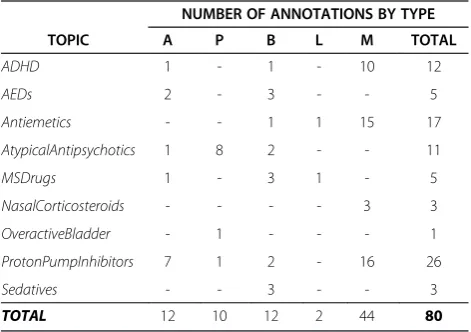
Pre-Update Periodthat were included in the report update according to these criteria. The two senior authors (AMC and MM) discussed and modified the article annotation assignments until consensus was reached. The annotations were assigned before the machine learning models were created from the training data or applied to the test data. Therefore, none of the authors had prior information about the machine learning performance on the test data that could have biased annotation assignments. Only pub-lications meeting the specific criteria given in Table 3 were annotated, while the remaining publications had no anno-tation assigned to them. Note that the training data were not annotated in this manner—the classification models used here were not specifically trained for the important publications. Instead, the test data set was annotated in this way in order to evaluate and understand the current systems performance on important studies for the New Update Alerttask. The number and types of annotations assigned for each topic in the data set are shown in Table 4.
Table 3 Annotation guide for articles that were deemed to potentially motivate a review update on their topic
Annotation Description
A Study includes evidence on new or serious adverse events relevant to this topic.
P Study includes new patient subgroup, new indication, or evidence specific to new comorbidity.
B Study is notably better designed, or uses novel methods, compared to prior studies.
L Study uses a significantly larger sample size than prior studies for this topic.
M Study includes other significant evidence that may motivate a review update, when taken in combination with other studies.
Each article included in the actual systematic review update was analyzed and assigned either the single most descriptive annotation, or no annotation, if the article was not deemed to be potentially motivating for a review update.
Table 2 Data sets used in this study
TOPIC
TRAINING SET TESTING SET
INCLUDED EXCLUDED TOTAL INCLUDED EXCLUDED TOTAL STUDIED
ADHD 285 2542 2827 43 245 288 Yes
AEDs 96 1436 1532 39 476 515 Yes
Antiemetics 133 2364 2497 29 334 363 Yes
Antiplatelets 20 0 20 5 0 5 No
AtypicalAntipsychotics 659 3829 4488 67 785 852 Yes
MSDrugs 138 1774 1912 38 601 639 Yes
NasalCorticosteroids 13 82 95 15 62 77 Yes
NSAIDs 79 106 185 1 3 4 No
OveractiveBladder 103 823 926 25 229 254 Yes
ProtonPumpInhibitors 204 2333 2537 50 375 425 Yes
Sedatives 145 1657 1802 26 206 232 Yes
Only the 332 included publications out of the 3654 publi-cations in the test set were considered for annotation. After manual review, out of these, only 80 were assigned “important publication”annotations.
Classification system
To classify the samples according to whether they should be used to display a New Update Alert for each SR, we applied the support vector machine (SVM)-based classi-fication system that we have described in detail in our prior work [10]. Briefly, this is an SVM-based machine learning method that classifies samples based on the signed-margin distance from the separating hyperplane. Samples with large positive margin distances are ranked strongly positive for inclusion, and samples with very negative margin distances are highly ranked as excluded. The cutoff between positive inclusion and negative ex-clusion predictions is adjustable. Features input to the classifier include uni- and bi-grams, from the title and abstract, and MeSH terms associated with the publica-tion. We use the SVMLight implementation of the SVM algorithm (http://svmlight.joachims.org/), with a linear kernel at default settings [17]. See Additional file 1 on-line for further details. For this work, publications classi-fied as positive would be used to signal a New Update Alert, and those classified as negative would not.
For theNew Update Alerttask, we adjusted the classi-fication cutoff threshold in the following manner. Previ-ously, and in ongoing work, we have studied the user preferences of systematic reviewers in terms of docu-ment classification system tradeoffs for New Update Alert. It has been determined that, in general, review experts are more willing to trade off recall for precision for the New Update Alert task, as compared to the work prioritization task that we have previously studied. In particular, the principle investigator of the DERP (one of
the senior authors of this paper) consistently preferred a recall of 0.55 and the achievable precision corresponding to that level of recall over all other available levels of re-call between 0.99 and 0.55. The context of DERP is im-portant in the choice of 0.55. The team lead would be reviewing multiple topics every month for years – not just a one-off SR every now and then. The level of the continual workload is an important factor. This means that the reviewer found 0.55 as the lowest acceptable re-call for this task, leading to the highest precision that the current system can deliver at an acceptable recall. We therefore targeted a recall of 0.55 to study the perform-ance of the classification system on the important publi-cations in each topic.
For each topic, we performed 5 repetitions of two-way cross-validation on the training data, and determined the threshold that lead to a recall of 0.55 for each repetition. These thresholds were averaged together to determine the threshold to use when applying the classifier to the test data set for each topic. Then, for each topic, we trained a classification model on that topic’s training data. We next classified each document in the corre-sponding test collection, using the computed threshold as a cutoff between a document predicted to raise aNew Update Alert and a document not predicted to raise an alert. We analyzed the performance of the trained classi-fiers—both overall, as well as on the designated motivat-ing publications.
Results
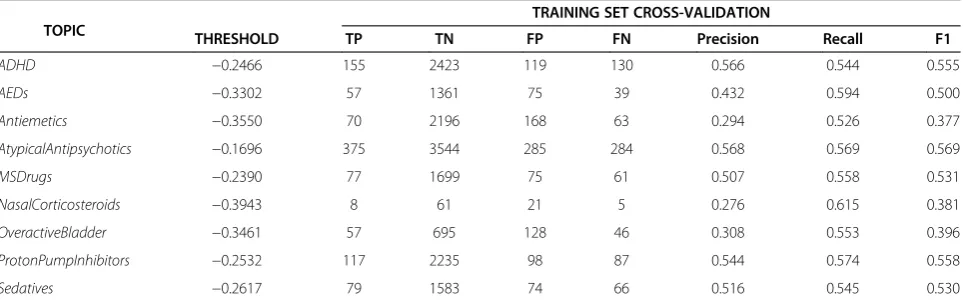
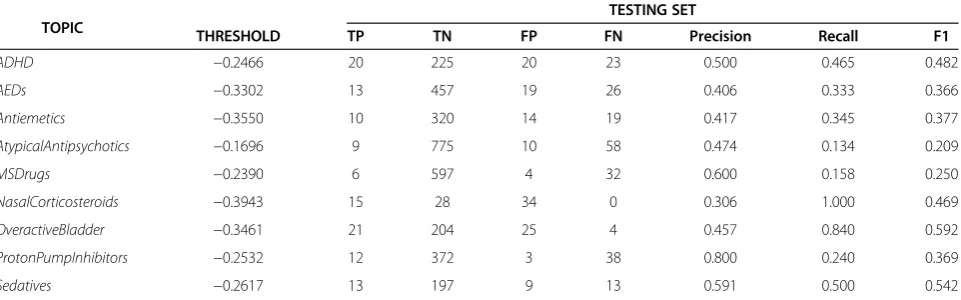
Tables 5, 6 and 7 show the overall performance of the classification models on each of the topics, using the chosen threshold on the training and test sets. While we were able to consistently achieve the target recall of 0.55 on the training sets, recall performance varied widely on the test sets, from a low of 0.134 on AtypicalAntipsycho-tics to a high of 1.0 on NasalCorticosteroids. Precision also varied greatly, both on the training data as well as the test set, varying from a low of 0.306 on the Nasal-Corticosteroids test collection to a high of 0.800 on
ProtonPumpInhibitors.
Figure 1 shows a timeline view of all of the annotated positive samples (studies with a decision to include in the SR update) in the test collection. For each topic, the left end of the timeline shows the end of the prior SR cycle for that topic, and the right end shows the date that the SR update literature search began. The period in between is what we have defined as the Pre-Update Period. Each annotation code is represented by a differ-ent marker shape, as indicated in the figure legend. Black, filled in markers designate important annotated publications that were correctly recognized by the classi-fication system and therefore could be used to initiate a new update alert (TP, true positives). White, unfilled
Table 4 Annotation counts by type and systematic review topic
NUMBER OF ANNOTATIONS BY TYPE
TOPIC A P B L M TOTAL
ADHD 1 - 1 - 10 12
AEDs 2 - 3 - - 5
Antiemetics - - 1 1 15 17
AtypicalAntipsychotics 1 8 2 - - 11
MSDrugs 1 - 3 1 - 5
NasalCorticosteroids - - - - 3 3
OveractiveBladder - 1 - - - 1
ProtonPumpInhibitors 7 1 2 - 16 26
Sedatives - - 3 - - 3
markers represent important, annotated publications that were missed by the classification system and are there-fore not able to be used to initiate a new update alert (FN, false negatives). Most of the annotated publications are identified by the classification system. Overall there are 57 out of 80 annotated publications identified by the classification system, a recall of 0.7125 on the most im-portant publications. The vast majority of the misses are on articles in theProtonPumpInhibitorstopic.
The timeline view shows that there are important differ-ences between the topics. From the figure it is clear that for some topics, substantial new evidence that may motivate a review update begins to accumulate essentially immediately after the prior review is published. This is especially appar-ent for the topicsADHD,Antiemetics, and ProtonPumpIn-hibitors. Conversely, some topics do not rapidly accumulate new evidence motivating a review update. Sedatives and
NasalCorticosteriodsonly have three annotated as import-ant studies during thePre-Update Period, and these topics each only have one publication that would be a year old at the time of the performed review update.
The topics with the most publications annotated as motivating an SR update are ADHD, Antiemetics, Atypi-calAntipsychotics, andProtonPumpInhibitors. ForADHD, all of the annotated publications are captured for alert. For Antiemetics, 15 of 17 motivating publications are correctly predicted. For AtypicalAntipsychotics, 8 are correctly predicted and 3 are missed (overlap in the timeline plot obscures some of the points). Finally, for
ProtonPumpInhibitors,only 12 of the 26 annotated pub-lications are captured for alert. It is interesting to note that for AEDs and ProtonPumpInhibitors the set of missed publications include not only the M category of generically motivating publications, but the more specific and perhaps more important categories of new or serious adverse events (A) and better designed or novel study (B). For the other topics, the classifier performs well on the more specific annotation categories (A, P, B, and L), and it is only the more general M potentially motivating studies that are missed.
Table 5 summarizes the mean overall, correct, and incor-rect alert rates per month, along with recall of important
Table 6 Classifier performance on the training and test sets at the closest threshold to a recall of 0.55 on the training set for each topic
TOPIC
TRAINING SET CROSS-VALIDATION
THRESHOLD TP TN FP FN Precision Recall F1
ADHD −0.2466 155 2423 119 130 0.566 0.544 0.555
AEDs −0.3302 57 1361 75 39 0.432 0.594 0.500
Antiemetics −0.3550 70 2196 168 63 0.294 0.526 0.377
AtypicalAntipsychotics −0.1696 375 3544 285 284 0.568 0.569 0.569
MSDrugs −0.2390 77 1699 75 61 0.507 0.558 0.531
NasalCorticosteroids −0.3943 8 61 21 5 0.276 0.615 0.381
OveractiveBladder −0.3461 57 695 128 46 0.308 0.553 0.396
ProtonPumpInhibitors −0.2532 117 2235 98 87 0.544 0.574 0.558
Sedatives −0.2617 79 1583 74 66 0.516 0.545 0.530
True positives (TP), true negatives (TN), false positives (FP), false negatives (FN), F1 measure (F1, the harmonic mean of precision and recall). Table 5 Overall, correct, and incorrect alert rates as well as recall of important publications for each topic
TOPIC PRE-UPDATE PERIOD IN MONTHS
OVERALL ALERTS PER MONTH
CORRECT ALERTS PER MONTH
INCORRECT ALERTS PER MONTH
IMPORTANT ARTICLE RECALL
ADHD 15 2.67 1.33 1.33 1.00
AEDs 20 1.60 0.65 0.95 0.40
Antiemetics 41 0.59 0.24 0.34 0.88
AtypicalAntipsychotics 16 1.19 0.56 0.63 0.72
MSDrugs 29 0.34 0.21 0.14 0.80
NasalCorticosteroids 19 2.58 0.79 1.79 0.33
OveractiveBladder 31 1.48 0.68 0.81 1.00
ProtonPumpInhibitors 31 0.48 0.39 0.10 0.46
Sedatives 19 1.16 0.68 0.47 1.00
publications, for each of the topics. This can be interpreted under the premise that alerts might be reviewed on a monthly basis. The total number of included (TP) publica-tions (shown in Table 6 and 7) and therefore potentially correct alerts, as well as the number of motivating publica-tions (shown in Table 4) varies widely across topics. How-ever, from a practical point of view, the actual correct and incorrect alert rates shown in Table 5 do not vary much. The alert rates range from a low of about 0.50 alerts per month for ProtonPumpInhibitors to a high of 2.67 alerts per month for ADHD. The number of correct alerts exceeds the number of incorrect alerts on three topics, has about the same number of correct and incorrect alerts on one topic, and a higher number of incorrect alerts on six topics. However, the imbalance between correct and incor-rect alerts is understandable, since included documents are a small percentage of documents returned by the ori-ginal query. The relative frequency of excluded documents is typically vastly higher than included documents for SR topics (see Table 2). Because of this, for the New Update Alert task, the alert rate for the included and important publications, combined with the absolute number of incor-rect alerts is a more relevant metric of performance than a comparison between the correct and incorrect alert rate.
While the number of update-motivating publications annotated for each topic varies quite a bit, the overall rate of alerts that need to be monitored is small, with most of the motivating publications recognized and lead-ing to a correct alert. For example, OveractiveBladder
only has one annotated publication during the pre-up-date period, and this publication is correctly recognized by the classifier. The annotation type of this publication is P, a new patient population subgroup, indication, or comorbidity. From Table 7 it can be seen that, out of 254 potential publications in the test set for this topic and a test set precision of 0.457, 46 alerts would be initiated over the 31 month time period. Twenty-one of
these alerts would be true positives and 25 of the alerts would be false positives. One of the true positive alerts would be for the update motivating publication. Over the 31 month pre-update period, this works out to about 1.5 alerts per month, with a true alert occurring approxi-mately every 1.5 months, and a false alert occurring about every 1.25 months.
Discussion
While there are noticeable differences between the topics, in terms of the performance of the classifier, these differences do not seem to translate into large practical differences in the overall rate of theNew Update Alerts, nor in the overall rate of correct alerts or false alarms. The per-month alert rates are low, which implies that the overhead of monitoring these alerts would also be low. While the precision performance of the classifier is far from perfect, the large numbers of negative publica-tions captured by the SR topic query means that moder-ate precision performance results in filtering out quite a large number of these false negatives–preventing them from signalling an alert.
The recall of the classification system is also far from perfect. However, the vast majority of the update motiv-ating publications– the most important to recognize as
New Update Alerts –are identified by the classifier, and are therefore available to initiate an alert. The overall re-call of the important publications is 0.73. This is good enough to recognize one or more update motivating publications for each topic at least 6 months before the beginning of the scheduled review update. The number of new articles in an SR topic is not nearly as important for scheduling an update as the impact of the informa-tion in specific articles. A single important article may be enough to motivate a review update. This will occur if the evidence in the article changes the recommendations or strength of conclusions in the SR. Conversely, the
Table 7 Classifier performance on the training and test sets at the closest threshold to a recall of 0.55 on the training set for each topic
TOPIC
TESTING SET
THRESHOLD TP TN FP FN Precision Recall F1
ADHD −0.2466 20 225 20 23 0.500 0.465 0.482
AEDs −0.3302 13 457 19 26 0.406 0.333 0.366
Antiemetics −0.3550 10 320 14 19 0.417 0.345 0.377
AtypicalAntipsychotics −0.1696 9 775 10 58 0.474 0.134 0.209
MSDrugs −0.2390 6 597 4 32 0.600 0.158 0.250
NasalCorticosteroids −0.3943 15 28 34 0 0.306 1.000 0.469
OveractiveBladder −0.3461 21 204 25 4 0.457 0.840 0.592
ProtonPumpInhibitors −0.2532 12 372 3 38 0.800 0.240 0.369
Sedatives −0.2617 13 197 9 13 0.591 0.500 0.542
publication of many new articles in a topic that do noth-ing but reiterate previously existnoth-ing evidence may not motivate a review update, as the recommendations or strength of conclusions in the SR are much less likely to change based on those articles. Therefore, while the per-formance of the system certainly would benefit from additional research and development, the ability to focus reviewer attention on publications within an SR topic that individually motivate a review update is a useful property of the current system.
Even given the variations in performance across topics, a notable number of annotated publications are captured for alert for all topics. This is accomplished with an over-all low alert rate. We think that, given the rate of alerts we found, an SR expert using a live alert system could quickly review the alerts, identify from this set the im-portant publications, and use this information in plan-ning and scheduling review updates. This information could also be shared with agencies funding SRs and updates, to provide context and motivation at the appro-priate time when a topic has new evidence that needs to be incorporated into the SR in order to better and more efficiently support the practice of EBM.
Furthermore, this kind of information could be useful for prioritization of review updates between different topics. It may be necessary to make tradeoffs considering which of a number of SR topics are most in need of up-date. Expert SR resources are limited, and it seems rea-sonable to update the topics that have not only a large number of relevant publications, but, more significantly, a number of important publications. The most important publications add new information to the evidence base for a given topic. These publications are the ones that are most likely to inform the medical community about new indications or potential harms, and influence the conclusions or recommendations of an evidence report or meta-analysis. New update alert information could be used to prioritize one review update over another, based on the newly published information in each of these areas, and the level of importance of this information to the medical community. At the current level of perform-ance we expect that our approach will be most useful to the senior reviewer or leader of an SR team. The senior review team lead will be in the best position to effectively combine their domain expertise and other SR topic knowledge with results of our system to best determine when to schedule a review update.
For example, looking back at the timeline for Overactive-Bladder, there is only one publication designated as import-ant according to the annotation schema. This publication is marked with category M,“potentially motivating for review update”, the most general, and typically the weakest of the annotation categories. On the other hand, for ProtonPum-pInhibitors new relevant publications start becoming
available almost as soon as the original report is published. The report for this topic is at risk of quickly becoming out of date, especially because the new publications represent several of the annotation categories. If a choice about assigning SR update resources needed to be made, it would be reasonable to assume thatProtonPumpInhibitorswould have a higher priority than OveractiveBladder. Note that this is true for this example even given that both topics have a preupdate period of about two and a half years -about half the median lifespan of an SR found by Shojania and colleagues as described in the Introduction. The update for ProtonPumpInhibitors was likely needed immediately, while the OveractiveBladder update perhaps could have been postponed.
This study has several limitations and opportunities for future work. First and foremost, as far as generalizability is concerned, the work was done using the publication inclusion decisions from a single SR group, and the only topics that were available to be studied were those with a review completed by the DERP as well as a completed update within the time window of our study. All of these SRs performed by the DERP focus on drug therapy, and certainly there are a wide range of other topics for which there are, and need to be, SRs. Future work should in-clude studying a larger set of SR teams, as well as a more diverse set of SR topics.
Secondly, the classification system was not specifically optimized in any way for the most important publica-tions for new update alert. In this article we are propos-ing a new classification task, statpropos-ing why it is important, and how it can be used to improve the EBM process. While the present system does identify most of the pub-lications annotated as important for each topic, it did tend to miss articles with certain annotations more than others. There are significant numbers of misses, particu-larly in theAEDsandProtonPumpInhibitortopics.
recognize new forms of evidence. For example, this would include data such as previously unreported or un-studied adverse events within the literature for an SR topic.
Finally, the recall and precision of the classifier varied much more widely in the test set than in the cross-valid-ation estimates obtained on the training set. We attribute at least some of this variation to the small sample sizes in the test sets. For the largest test set topic, Sedatives, the achieved recall of 0.50 is reasonably close to the tar-get recall of 0.55, and the achieved precision of 0.591 on the test set is reasonably close to that predicted on the training set, 0.516. Further study will be required to de-termine whether additional effects, such as topic drift [18,19] (the change in the language or essential concepts within topic discourse over time), are also coming into play here.
Conclusions
This work is an initial analysis of the opportunities and challenges in aiding the SR update planning process with an informatics-based machine learning approach. We have demonstrated that automated document classifica-tion has the potential to be useful in the period between the publication of an SR and the beginning of the litera-ture search for the next update for that review, a period we termed the Pre-Update Period. We have defined a classification task useful to the SR processing during this time period, called New Update Alert, and studied the performance of current machine learning models to the significant articles published during this time period for nine SR topics. In terms of their potential to motivate a review update, some publications are more important than others, and contribute specific types of new know-ledge to the topic evidence base. Therefore we have designed and applied an annotation schema to identify and characterize the publications particularly important in motivating the need for an SR review. Finally, we have analyzed the performance of our pre-existing classifica-tion system on these review-update motivating publica-tions, and identified important areas for future improvement and optimization.
The system proposed here could be used continually after a topic is completed, with very little additional manpower required. This would provide a clear indica-tion on which topics need updating before the typical two-year cycle, and which are unlikely to need it. This 1) saves time on the part of reviewers, 2) reduces time delays in updating topics that develop faster, and 3) pre-vents time and effort spent on reviewing topics not yet in need of an update. The system fits in well with the current RAND and Ottawa approaches, serving as a con-tinuous prior step before the decision is made to allocate the substantial resources required by these approaches.
New Update Alert has the potential to change how SR review resources are scheduled, planned, and allocated, and future work will further study how to best incorpor-ate this approach into the overall SR planning workflow.
Additional file
Additional file 1:Appendix 1 for Studying the Potential Impact of Automated Document Classification on the Systematic Review Update Scheduling Process.
Competing interests
The authors declare that they have no competing interests.
Acknowledgements
This work was supported by grant numbers 5R01LM009501 and 5R01LM010817 from the National Library of Medicine.
Authors’contributions
All authors contributed to the construction of the SR datasets. AMC and MM designed and applied the annotation guide. AMC and KA built the automated text processing system and ran the machine learning
experiments. All authors contributed to the writing and to the editing of the manuscript. All authors read and approved the final manuscript.
Received: 26 August 2011 Accepted: 19 April 2012 Published: 19 April 2012
References
1. Sackett DL, Rosenberg WM, Gray JA, Haynes RB, Richardson WS:Evidence based medicine: what it is and what it isn’t.BMJ1996,312(7023):71–72. 2. Higgins, JPT, Green, S. Cochrane Handbook for Systematic Reviews of
Interventions Version 5.1.0 [updated March 2011] [Internet]. 2011;Available from: [www.cochrane-handbook.org]
3. Haynes RB:Of studies, syntheses, synopses, summaries, and systems: the
“5 S”evolution of information services for evidence-based healthcare decisions.Evid Based Med2006,11(6):162–164.
4. Sampson M, Shojania KG, McGowan J, Daniel R, Rader T, Iansavichene AE,et al:Surveillance search techniques identified the need to update systematic reviews.J Clin Epidemiol2008,61(8):755–762.
5. Shojania KG, Sampson M, Ansari MT, Ji J, Doucette S, Moher D:How quickly do systematic reviews go out of date? A survival analysis.Ann Intern Med 2007,147(4):224–233.
6. Moher D, Tsertsvadze A, Tricco AC, Eccles M, Grimshaw J, Sampson M,et al: When and how to update systematic reviews.Cochrane Database Syst Rev 2008,1:MR000023.
7. Moher D, Tsertsvadze A, Tricco AC, Eccles M, Grimshaw J, Sampson M,et al: A systematic review identified few methods and strategies describing when and how to update systematic reviews.J Clin Epidemiol2007,60 (11):1095–1096.
8. Shekelle PG, Newberry SJ, Wu H, Suttorp M, Motala A, Lim YW,et al: Identifying Signals for Updating Systematic Reviews. Rockville (MD): Agency for Healthcare Research and Quality (US); 2011.
9. Cohen AM:Optimizing feature representation for automated systematic review work prioritization.AMIA Annu Symp Proc2008 Nov 6: 121–125. 10. Cohen AM, Ambert K, McDonagh M:Cross-topic learning for work
prioritization in systematic review creation and update.J Am Med Inform Assoc2009,16(5):690–704.
11. Cohen AM, Ambert K, McDonagh M:A prospective evaluation of an automated classification system to support evidence-based medicine and systematic review.AMIA Annu Symp Proc2010,2010:121–125. 12. Aphinyanaphongs Y, Aliferis CF:Text categorization models for retrieval of
high quality articles in internal medicine.AMIA Annu Symp Proc2003, 31–5. 13. Kilicoglu H, Demner-Fushman D, Rindflesch TC, Wilczynski NL, Haynes RB:
14. Kilicoglu H, Demner-Fushman D, Rindflesch TC, Wilczynski NL, Haynes RB: Towards automatic recognition of scientifically rigorous clinical research evidence.J Am Med Inform Assoc2009,16(1):25–31.
15. Matwin S, Kouznetsov A, Inkpen D, Frunza O, O’Blenis P:A new algorithm for reducing the workload of experts in performing systematic reviews.J Am Med Inform Assoc2010,17(4):446–453.
16. Yang J, Cohen A, McDonagh MS:SYRIAC: The systematic review information automated collection system a data warehouse for facilitating automated biomedical text classification.AMIA Annu Symp Proc2008, 825–9.
17. Joachims T:Text categorization with support vector machines: learning with many relevant features.In:Proceedings of the 10th European Conference on Machine Learning. 1998. p. 137–142.
18. Srinivasan P:Adaptive classifiers, topic drifts and GO annotations.AMIA Annu Symp Proc2007, 681–5.
19. Cohen AM, Hersh WR, Bhupatiraju RT. Feature generation, feature selection, classifiers, and conceptual drift for biomedical document triage [Internet]. In: Proceedings of the Thirteeth Text Retrieval Conference - TREC 2004. Gaithersburg, MD: 2004. Available from: [http://trec.nist.gov/pubs/trec13/ papers/ohsu-hersh.geo.pdf]
doi:10.1186/1472-6947-12-33
Cite this article as:Cohenet al.:Studying the potential impact of automated document classification on scheduling a systematic review update.BMC Medical Informatics and Decision Making201212:33.
Submit your next manuscript to BioMed Central and take full advantage of:
• Convenient online submission
• Thorough peer review
• No space constraints or color figure charges
• Immediate publication on acceptance
• Inclusion in PubMed, CAS, Scopus and Google Scholar
• Research which is freely available for redistribution