2806
Development Learning Design Lift Material Flap
With Character Education To Improve Problem
Solving Abilities
Siti Suprotun, Suparman
Abstract: The success of education is not only measured by the achievement of student academic targets. Mathematics learning must be well designed so that the goal of forming students' character through mathematics learning can be achieved. Then the importance of pr oblem-solving is goals the process learning in terms of aspects of the curriculum. The importance of problem-solving in learning is also conveyed with National Council of Mathematics Teacher. Based on previous research, solving mathematical problems of students at school is still low. This is because all this time learning has not provided opportunities for students to develop their ability to solve problems. One of the learning to shape char acter and improve problem-solving skills is by using teaching materials lift the flap with characters. The purpose from this study is determine to improve of students problem-problem-solving abilities before and after using teaching materials. The sampling technique uses a random sample. The subject of this research is mentally retarded students.
Index Terms: Lift the Flap, Problem-Solving, Retardation
————————————————————
1.
INTRODUCTION
The 21st century is the century that is can be seen the development of science and technology. So learning must follow the development of the age [1]. The 21st-century learning is expected to produce human resources that have cognitive abilities and skills [2]. Mental retardation is characterized by the intellectual function below the average during development and disruption of a child's behavior [3].Then the role of parents in mentally retarded children's education is no less important because the existence of parental support for children's learning activities can foster the spirit of learning [4]. Therefore, to encourage their learning abilities, a conducive learning environment is needed, both the place of learning, the method, the assessment system, the facilities and infrastructure, and equally important is the availability of adequate educational media in accordance with the needs of students. The National Council of Teacher Mathematics (NCTM) which states that in implementing mathematics learning in schools, there are five standards that must be achieved in learning, which include: (1) mathematical communication; (2) mathematical reasoning; (3) solving mathematical problems; (4) mathematical connections; and (5) mathematical representation [5]. In addition, increased problem-solvingskills will improve student learning outcomes themselves, and thus will advance math education quality [6]. Mathematics has relevance to everyday life. Given the importance of mathematics education, the main goal of the purpose of mathematics education is to be able to apply it to everyday life [7, 8].
In Permendikbud No. 58 Year 2013 on the junior school curriculum mentioned that the purpose of learning mathematics in junior high among students is to understand the concept, using a pattern, using the reasoning in problem solving, communication of ideas, have an attitude appreciate the usefulness of mathematics, has the attitude and behavior in accordance with the values in mathematics, performing motor activities that use mathematical knowledge, and use simple props and technology in math activities.The relevance of the curriculum content by 2013 aims to have students' problem-solving skills, using thoughts and communicating ideas. In addition, students, use reasoning and communicate ideas. The language of mentally retarded children is also different from normal children's language. Not infrequently they use sign language or language that is imperfect in pronunciation but contains certain intentions [9]. Based on the results of observations and information provided by teachers at SMPLB class VII, it is still difficult to understand the material and associate it with everyday life. These problems are in line with previous studies which say that students experience difficulty in relating the material obtained in schools to everyday life [10]. The ability of mathematical connection involves connecting between theoretical knowledge in the mathematical sphere and outside mathematics or other topics involving daily activities [11]. The teachers hope that there are media that specifically design to improve math skills and student behavior. Therefore learning media in the form of illustrated books and texts are used to provide a moral message that is related to mathematics to express messages to readers [12]. The moral message that was given to students is related to child-friendly learning namely about the importance of mutual respect for differences in peers and communities, nondiscrimination, care about the natural environment, and discipline. The starting point of making the classroom child-friendly is to capture the interest of a child and then to sustain and extend it [13]. Furthermore, one way to overcome these problems is using lift the flap to increase problem-solving. Lift the flap media can improve students' abilities [14]. Based on the problems described above, in learning requires interesting media for students that are useful to improve the ability of the problem, especially in the story. The lift the flap book learning media contains many characters ————————————————
Siti Suprotun, is currently pursuing master’s degree program in mathematics education in Universitas Ahmad Dahlan, Indonesia, PH-085268685813. E-mail: [email protected]
2807 or images that contain daily stories experienced by students.
In the book lift the flap has almost the same as the popup. But, the difference is lifted the two-dimensional flap and the three-dimensional popup. Then, the elements in the pop-up are almost the same as lift the flap, namely, pull, fold, spiral and double-layer tabs [15]. This is in line with the statement that pop-up is a three-dimensional structure formed from folds [16]. Based on the two statements above that the pop-up is three-dimensional and lifts the two-three-dimensional flap. Then, we can mean that flaps are open to the right and left [14]. The concept of lift the flap has often been used [17]. Based on some of the statements above, it can be seen that the lift the flap book learning media is very interesting because there is animation, students can play while learning, and contain mathematical story questions that relate directly to student life [19]. Therefore, this study was conducted to produce lift the flap learning media story questions to improve problem-solving skills [20].
2 RESEARCH METHOD
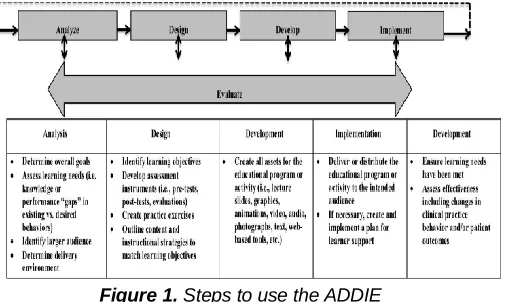
The design of this study uses the ADDIE model (analysis, design, development, implementation, and evaluation) [21]. The research and development steps are shown in the following Figure 1.
Figure 1. Steps to use the ADDIE
3 DISCUSSION
The media for learning mathematics to increase students problem-solving. Problem-solving is a process to find problems or solutions that are accepted [19]; [20]. Mathematics is always requires problem-solving skills, and this is one of the tasks from which it is not easy to grow a creative mind in developing problem-solving [3]; [4]. This research is in line with previous studies, namely by using the elevator the flap book story effectively can improve students' mathematical connection ability [22]. Problem-solving is used as a guideline by researchers, namely Polya problem-solving steps. This strategy that has been recognized by most people as a way to solve a problem solving [5] there are four stages of Polya's steps, namely,
1. Understand the problem. in the first stage, students can what is known, what is asked, can write what they know in the given problem.
2. Arrange a plan. After going through the first stage, students can develop a plan or a way to solve a problem so that the problem is resolved correctly.
3. Implement the plan. at this stage students already have a plan chosen to solve the problem or can be called the application of the plan.
4. Look back. after all, stages have been carried out, the last step is to look back on whether there is an error in solving the problem or it can be called a correction of problem-solving steps.
In the curriculum used in the SMPLB is an adaptive curriculum. The adaptive curriculum is a curriculum that is modified and adapted or adapted to the needs or conditions of abilities and limitations of student participants, with the aim of making it easier for ABK students to participate in teaching and learning activities in inclusive schools. The adaptive curriculum consists of four models, namely duplication models, modification models, substitution models, and omission models.
Researcher : "Does the SMPLB use a curriculum such as public schools?"
Source : "No"
Researcher : "What curriculum is used in learning?" Source : "The curriculum used is adaptive curriculum" Researcher : "What is the adaptive curriculum?"
Source : "Adaptive curriculum is a 2013 curriculum but an adaptive model that is a curriculum tailored to the characteristics of students"
Researcher : "Are there components in the adaptive all students it is difficult to remember, this is in line with the story of the teacher of the Pembina Negeri Pembina Yogyakarta
Source : "There is, that is a model of duplication, modification, substitution, and omission"
Researcher : "Are all these components in accordance with the characteristics of students?"
Source : "From some of the components that the Omisi model was omitted, because it did not allow to be replaced with another and not in accordance with the characteristics of students"
Researcher : "What is not appropriate so that the omission model is removed?"
Source : "Like the contents of the material in it, because students are given more skill material, so practice immediately."
From the interview above, the SMPLB uses an adaptive curriculum that is tailored to the characteristics of students, school conditions, and students' abilities. In addition, students at SMPLB learn more about skills, not just theories but direct applications. The procedure carried out in this study includes several stages, namely [20].
1. Analyzed
2808 retardation students is easy to forget. In line with the daily
journal made by the SMPLB teacher. Next, the researchers describe in Table 1.
TABLE 1
BASED ON THE ANALYSIS OF THE CHARACTERISTICS OFCHARACTERISTICS OF STUDENTS IN SMPLB
Source: Daily Journal of Skill Class Fashion Formation Even Semester 2017-2018 Academic
Researcher: "What properties do the SMPLB students have?" Source : "The nature it has is that students lack focus,
difficult to distinguish size and shape, and often forget"
Researcher: "What does it look like?"
Source : "Like putting things in, in terms of lessons, and sometimes forgetting people's names"
Researcher: "Is it forgetful or difficult to remember it's one of the characteristics of mentally retarded students?" Source : "Yes, it is one of its properties, bio or difficult to
remember or easy to forget."
2.
DESIGN
The design phase established learning objectives, exercises, content, lesson planning, and media selection via a design document, which served as the blueprint for building the training program.
2.1 Pocketbook Cover
The pocketbook cover is made interesting so students are interested in reading and doing it. cover lift the flap there are some differences before and after validation by experts. The validator in this journal includes the lecturer and one of the mentor retaining student teachers. Before and after validation in Figure 2 and Figure 3.
Figure 2. Before Figure 3. After
2.2 Forward
The preface explains the contents in lift the flap about addition and subtraction. This is explain Figure 4.
Figure 4. Foreword
The forward about introduction lift the flap
2.3 Table of Contents
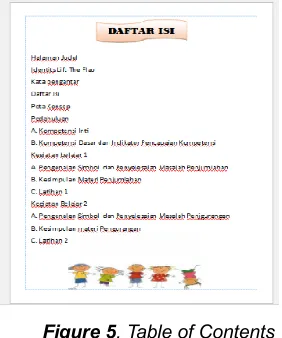
The table of contents in this ability of probem solving mathematics learning lift the flap contains the topic discussed. The topic appears based on the sequences in the lift the flap. Students can also see the overall topic discussed in the lift the flap as well as printed page numbers to make it easier for readers to find topics. Following design in the Figure 5.
Figure 5. Table of Contents
2.4 Concept Map
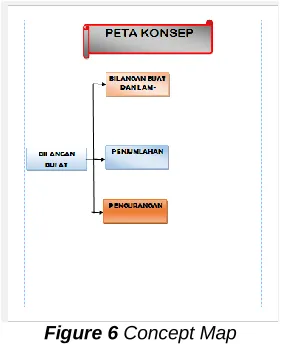
The concept maps are used to find out the details of learning activities by using the lift the flap. More details are found in the Figure 6.
No Special Characteristics
1 Come late, quite slow in following instructions, moody, difficult to remember
2 Come late, find it hard to receive instructions, lack focus on lessons, difficult to remember
3 It is quite slow in following instructions, quite nimble and skilled, difficult to interact, difficult to remember 4 Moody, difficult to accept instructions, less focus on
lessons, difficult to remember
5 It is quite slow in following instructions quite nimble and skilled like normal students, difficult to remember
2809
Figure 6 Concept Map
2.5 About the Author
Figure 7 about the author of a pocketbook about the author lift the flap.
Figure 7: About the Author
3.
DEVELOPMENT
In this stage of development that is developing learning design that must be reviewed and the author makes a design of the elevator the flap development.
4. Implementation
Lift the flap is tested to find out its usefulness and later can be revised again. After passing the development stage, left the flap learning media can be tested.
5. Evaluation
Researcher applied quantitative and qualitative methods as part of formative and summative evaluation in the ADDIE process. Formative evaluations consisted of qualitative feedback received from recipients and providers during early pilot work, which identified research needs.
5.1 Practice Questions
The following is a Figure 8 and Figure 9. an example of a student practice question.
Figure 8. Before Figure 9. After
The media expert consisted of two people, Dr. Andriyani, M.Si. as the lecturer of multimedia learning courses in Ahmad Dahlan University Mathematics Education, Yuli Yanti, S.Pd. as Mathematics Teacher at SMPLB. The following are some input provided by media experts related to the learning material can be seen in Table 2.
TABLE 2
COMMENTS AND SUGGESTION FROM EXPERTS
Feasibility of learning material is assessed by two media experts. The following are the results of the questionnaire calculation of the feasibility of instructional media by the material experts shown in Table 3.
TABLE 3
QUESTIONNAIRE CALCULATION RESULTS FEASIBILITY OF MEDIA
No Appraisal Position Score
Criteria for Quantitative Data 1. Dr.
Andriyani, M.Si.
Lecturer of UAD Mathematics
Education
85 Very Good
2. YuliYanti, S.Pd.
Teacher in
Mathematics study at SMPLB
90 Very Good
4
CONCLUSION
That the lift the flap design was carried out at the analysis and design stages. At the analysis stage the researcher grouped into three namely curriculum analysis, material analysis and analysis of student characteristics. In curriculum analysis, it was found that the curriculum used was an adaptive based 2013 curriculum. In the material analysis, it was found that students experienced difficulties in the subject of the counting operation. While the analysis of student characteristics is obtained that students have difficulty memorizing and easy to forget. At the design stage the researcher designed three
No. Expert Comments and suggestions
1 Dr. Andriyani,
M.Si. Must be consistent between the table of contents and contents KD should fit syllabus adaptifand customized indicators
More about the story 2 YuliYanti,
S.Pd
Lift the flap make interesting Using character animation Used color match with story Delete ―SMPLB‖
2810
parts in outline, namely the opening part consisting of cover, introduction, competence, concept map, table of contents. The core part consists of introduction, material, and sample questions. The closing section which consists of the final test, and references that will be tested by media experts. Lift the flap has the advantage of excellence to improve problem solving skills and contain student character education on the subject of calculating operations because each indicator of the ability of problem-solving abilities is included in the questions in lift the flap. After this research was carried out, the next study was the development of character-filled elevator the flap to improve problem solving abilities.
ACKNOWLEDGMENT
In the preparation of this full paper the researcher received help, guidance and encouragement from various parties. Therefore, on this occasion the researchers would like to express their gratitude to both my parents, sister, and friends, lecturer Research Methodology.
REFERENCES
[1] Daughter, DH, Risdianto, E., & Sutarno, S. (2017). Pre-Service Physics Teachers' Perception toward the Hands-on Lab Activity and 21st Century Skills. In the Journal of Physics: Conference Series (Vol. 895, No. 1, p. 012 015). IOP Publishing.
[2] Handajani, S., & Pratiwi, H. (2018). The 21st Century Skills With Linear Models Of Eliciting Activities On The Program. In the Journal of Physics: Conference Series (Vol. 1008, No. 1, p. 012 059). IOP Publishing.
[3] Solanki, J., Khetan, J., Gupta, S., Tomar, D., & Singh, M. (2015). Oral Rehabilitation & Management of Metallyretarted. Journal of clinical & diagnostic research, 9(1).1-6.
[4] Naeem, M.M. Tariq M.K, Ashiq, H.D. Ahmed, S.H (2011), Role of Parents in Training of Children with Intelelectual Disability. International Journal of Humanities and Social Science vol 1, No 9. pp. 80– 81.
[5] NCTM (2000), Principles and Standards for School Mathematics. USA: Association Drive, Reston.
[6] Simamora, R. E., Sidabutar, D. R., & Surya, E. (2017). Improving Learning Activity and Students‘ Problem-Solving Skill through Problem Based Learning (PBL) in Junior High School. International Journal of Sciences: Basic and Applied Research (IJSBAR), 33(2), 321-331.
[7] Parveva, T., Noorani, S., Ranguelov, S., Motiejunaite, A., &Kerpanova, V. (2011). Mathematics Education in Europe: Common Challenges and National Policies. Education, Audiovisual and Culture Executiv Agency, European Commission. Available from EU Bookshop.
[8] Mann, E. L. (2014). Review of Principles to Actions: Ensuring Mathematical Success for All.
[9] Tansley, A. E., & Gulliford, R. (2018). The education of slow learning children (Vol. 53). Routledge.
[10] Surya, E., & Putri, F. A. (2017). Improving Mathematical Problem-Solving Ability and Self-Confidence of High School Students through Contextual Learning Model. Journal on Mathematics Education, 8(1), 85-94. [11] Gravemeijer, K., Stephan, M., Julie, C., Lin, F. L., &
Ohtani, M. (2017). What mathematics education may prepare students for the society of the future? International Journal of Science and Mathematics Education, 15(1), 105-123.
[12] Gauri, P (2013), Language Development in Children with Mental Retardation. National Council of Educational Research and Training, Vol 25, No 1, pp. 109.
[13] Rosa, M. & Orey, D. C (2011), Ethnomathematics: The Cultural Aspects of Mathematics. Revista Latinoamericana de Etnomatemática, Vol 4, No 2, pp. 32-54.
[14] Meylana, D. A., Pujiastuti, P., & Sartono, K. E. (2018) Lift the Flap Story Book Based on Child-Friendly: Improving the Ability of Students Mathematical Connection. IOPInternational Conference on Mathematics and Science Education: Journal of Physics.
[15] Hasibuan, A. M., Saragih, S., & Amry, Z (2018), Development of Learning Materials Based on Realistic Mathematics Education to Improve Problem Solving Ability and Student Learning Independence. International Electronic Journal of Mathematics Education, vol 14, No, 1, pp. 243-252.
[16] Puleo, B (2011), Next Stop: Pop-Ups (The Influence of Paper Engineeringon Visual Media) [Online]
[17] Daynes, K. (2016). Lift-the-flap first questions and answers: How do flowers grow? London, England: Usborne.
[18] Farndon, J. (2016). Project Body. Thaxted, Essex, UK: Miles Kelly Publishing.
[19] Sotgiu, G., Tiberi, S., Centis, R., D‘Ambrosio, L., Fuentes, Z., Zumla, A., &Migliori, G. B (2017), Applicability of The Shorter ‗Bangladesh Regimen‘in High Multidrug-Resistant Tuberculosis Settings. International Journal of Infectious Diseases, 56, pp. 190-193.
[20] Walker, V. L., Douglas, K. H., & Chung, Y. C. (2017). An Evaluation of Paraprofessionals' Skills and Training Needs in Supporting Students with Severe Disabilities. International Journal of Special Education, 32(3), 460-471. [21] Patel, S. R., Margolies, P. J., Covell, N. H., Lipscomb,
C., & Dixon, L. B. (2018). Using Instructional Design, Analyze, Design, Develop, Implement, And Evaluate (ADDIE), To Develop E-Learning Modules to Disseminate Supported Employment for Community Behavioral Health Treatment Programs In New York State. Frontiers in public health, 6, 113.