https://doi.org/10.5194/jsss-7-267-2018
© Author(s) 2018. This work is distributed under the Creative Commons Attribution 4.0 License.
Temperature estimation of induction machines based
on wireless sensor networks
Yi Huang and Clemens Gühmann
TU Berlin, Chair of Electronic Measurement and Diagnostic Technology, Sekr. EN13, Einsteinufer 17, 10589 Berlin, Germany
Correspondence:Yi Huang ([email protected])
Received: 29 September 2017 – Revised: 26 March 2018 – Accepted: 26 March 2018 – Published: 16 April 2018
Abstract. In this paper, a fourth-order Kalman filter (KF) algorithm is implemented in the wireless sensor node to estimate the temperatures of the stator winding, the rotor cage and the stator core in the induction machine. Three separate wireless sensor nodes are used as the data acquisition systems for different input signals. Six Hall sensors are used to acquire the three-phase stator currents and voltages of the induction machine. All of them are processed to root mean square (rms) in ampere and volt. A rotary encoder is mounted for the rotor speed and Pt-1000 is used for the temperature of the coolant air. The processed signals in the physical unit are transmitted wirelessly to the host wireless sensor node, where the KF is implemented with fixed-point arithmetic in Contiki OS. Time-division multiple access (TDMA) is used to make the wireless transmission more stable. Compared to the floating-point implementation, the fixed-point implementation has the same estimation accuracy at only about one-fifth of the computation time. The temperature estimation system can work under any work condition as long as there are currents through the machine. It can also be rebooted for estimation even when wireless transmission has collapsed or packages are missing.
1 Introduction
Electrical machines are widely used in the industry, espe-cially with the increasing interest in electric and hybrid elec-tric vehicles. The thermal behavior of an induction machine largely determines the maximum lifetime, to cope with over-load conditions and also the accuracy in a high-performance controller (Sonnaillon et al., 2010). Normally, three methods are used for the temperature monitoring. The most common method is the measurement by construction of a tempera-ture measurement system using a mounted sensor. Even the rotor temperature can be measured by a wireless sensor net-work (WSN) (Ben Brahim et al., 2016; Brahim et al., 2016), or by some optimized optical fiber sensors (Hudon et al., 2016; Wang et al., 2009). An indirect approach is the tem-perature calculation based on the estimation of resistive pa-rameters. Based on the stator windings resistance variation with temperature, a sensorless internal temperature monitor-ing method for an induction motor is introduced (Sabaghi et al., 2007). Thermal analysis based on a lumped-parameter
thermal network (Haumer et al., 2012) is a third way which can be used for the temperature monitoring directly.
Meanwhile the WSNs have many applications, such as in-dustry, environment monitoring, tracking of things and inter-net of things. A number of methods for temperature moni-toring of induction machines can be found in the literature. Some of the methods do not provide satisfying results or can only estimate the temperatures of stator winding and rotor cages without a stator core (Ozsoy et al., 2010). Other meth-ods require powerful computation capabilities which cannot be run on a resource-limited node.
Psw Prc Psc
Csw Crc Csc
Rsw Rrc
Rsc Coolant air
Tsw Trc Tsc
Figure 1.The thermal network of the machine.
to the host node, where the algorithm is implemented. Sec-tion 2 gives a descripSec-tion of the system. The implementaSec-tion of a wireless transducer interface module (WTIM) and a net-work capable application processor (NCAP, IEE, 2007a) is described in Sects. 3 and 4. The communication of the WSN system is described in Sect. 5. Experimental results are dis-cussed in Sect. 6 and the conclusions are followed in Sect. 7.
2 The system description
2.1 The thermal model of the asynchronous machines
The thermal network of the machine can be summarized as the following Fig. 1, which is based on the thermal model (Haumer et al., 2012).
From the above figure, the state-space equations of the sys-tem are defined as the following equations:
d1Tsw
dt =
−Rsw1Tsw
Csw
+Rsw1Tsc
Csw
+Psw
Csw
, (1)
d1Trc dt =
−Rrc1Trc
Crc
+Rrc1Tsc
Crc
+Prc
Crc
, (2)
d1Tsc dt =
−Rsw1Tsw
Csc
+Rrc1Trc
Csc
+Rsc1Tc
Csc
+(Rsw+Rrc+Rsc)1Tsc
Csc
+Psc
Csc
, (3)
where subscript sw indicates the stator winding, rc the rotor cage, sc the stator core and c the coolant air.1T is the tem-perature above ambient,Ris the thermal resistance,Cis the thermal capacitance andP is the power loss in the parts of the machine (indicated by the indices). The lossesPsw,Prc, andPsccan be calculated from Eqs. (4) to (8).
In the simplified thermal model, Psw, Prc are ohmic loss, andPsc is the frequency-dependent iron loss, which are de-scribed in the paper by Haumer et al. (2009).Rs,Rrare the ohmic resistances, between any two line terminals,ωmis the mechanical speed of the rotor in rad s−1, andkironis the iron
loss constant.
Psw(t)=Is2Rs(t) (4)
Psc(t)=kironω2m(t) (5)
As the currents of the rotor cage are not available to be mea-sured or to be estimated using a simple method, the rotor cage losses can be calculated indirectly, which is defined by the IEEE Power Engineering Society (Society, 2004).
Prc(t)=(Pin(t)−Psw(t)−Psc(t))×s(t), (6)
Pin(t)= √
3×UL(t)×IL(t)×cos(φ), (7)
s(t)=ws−wr(t)
ws
×100 %, (8)
wherePinis the input power of the machine, andULandIL are the line voltage and the line current, respectively.ωs is the synchronous speed,ωris the rotor speed, andsis the slip of the machine.
The temperatures of the stator winding and rotor cage will increase largely. Normally it will be much higher than the ref-erence ambient temperature. The rising temperature makes the resistance greater by more than 40 %. The electrical resis-tances will increase as the machine is running. So the ignored increasing temperature should be considered to calculate re-sistance, which is with respect to time. All in all, the stator winding loss can be calculated much more accurately than that of the constant value of the electrical resistance.Rscan be replaced by Eq. (9):
Rs(t)=RsRef(1+αs1Tsw(t)), (9)
whereRsRefis the stator winding resistance in the reference ambient temperature.αsis the temperature coefficient of the stator winding, with the value of 0.004041 1 K−1for the cop-per.
model form:
x0(t)=Ax(t)+Bu(t), (10)
z(t)=Cx(t)+Du(t), (11)
where
x= [Tsw, Trc, Tsc, Tc]T, (12)
z=Tc, (13)
u= [Psw, Prc, Psc,0]T, (14)
A=
−Rsw
Csw 0
Rsw
Csw 0
0 −Rrc
Crc
Rrc
Crc 0
Rsw Csc
Rrc Csc
−(Rsw+Rrc+Rsc) Csc
Rsc Csc
0 0 0 1
, (15)
B=
1
Csw 0 0 0
0 C1
rc 0 0
0 0 C1
sc 0
0 0 0 0
, (16)
C=1, (17)
D=0. (18)
In the state equations,x(t) is the state vector,u(t) is the control vector,Ais the system transition matrix which is a constant matrix, and Bis the input matrix which is also a constant matrix. In the measurement equation,Cis the out-put matrix which is a constant in this system, and Dis the feedthrough matrix which is zero here. The coolant air tem-perature Tc is considered a constant parameter due to the slow variation with time.
2.2 The target platform
The platform is the Preon32 wireless sensor node produced by Virtenio GmbH. It contains a 32-bit ARM Cortex-M3 micro-controller with 256 kB flash memory for program-ming and 64 kB RAM memory for data. A 2.4 GHz wireless transceiver which is compliant with the IEEE 802.15.4 stan-dard can for example be used for ZigBee or 6LoWPAN com-munication. Two 12-bit analog-to-digital converters (ADCs) with a maximum sampling rate of 1 M samples/s are pro-vided by the platform (Preon32, 2016). The clock for time keeping is generated from a low-power watch crystal and has a resolution of 2−14s=61.035 µs and a width of 32 bit. The ADC of the Preon32 has a resolution of 12 bit and an input range of 0 . . . 3.3 V. Its sampling period is derived from the CPU clock and can be set with a resolution of 1 µs (Funck and Guehmann, 2017).
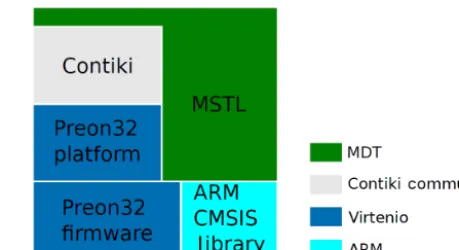
The whole software package is comprised as follows: Contiki, ARM CMSIS Library, Preon32 platform, Preon32 firmware and the MDT Smart Transducer Library (MSTL). Figure 2 shows the components of the WSN software. On the top layer of the Contiki MSTL, which is implemented by Jürgen Funck from the Chair of Electronic Measurement and
Figure 2.The architecture of the WSN software.
Diagnostic Technology (MDT) of the Technical University of Berlin. It provides the management of the data acquisition for a variety of sensors and actuators of the wireless sensor nodes. It is inspired by the IEEE1451 family of standards for smart transducers.
2.3 Structure and topology of the system
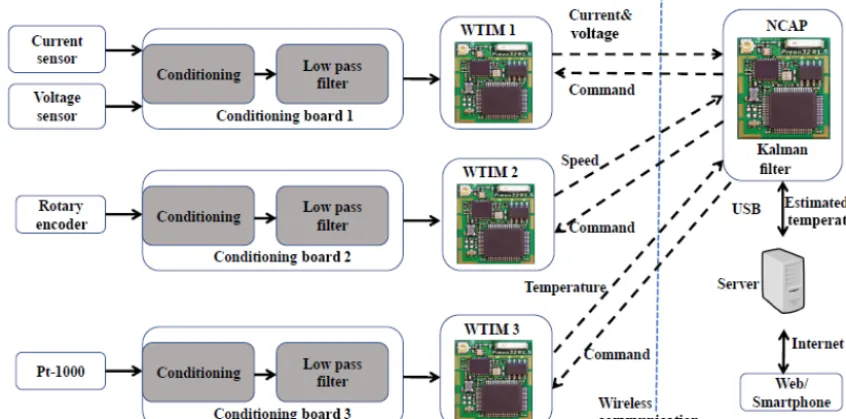
Based on the proposed KF algorithm, four types of signals are acquired as the inputs of the algorithm. Three Preon32 nodes are implemented as the WTIMs to acquire coolant air temperature, rotor speed, effective current and voltage. Data acquisition, data preprocessing and data transmission are per-formed by these WTIMs. Another node is implemented as the NCAP to receive the data from different WTIMs and to process the KF algorithm for temperature estimation. The structure of the temperature estimation system on WSN is shown in Fig. 3.
2.4 The hardware
Preon32 provides multiple I/O interfaces for connection to external peripheral digital I/O pins which could be used for the acquisition of rotor speed. Analog signals such as the coolant air temperature, the three-phase currents and voltages can be captured with the integrated ADC with a resolution of 12 bits and a possible sampling rate of up to 1 million sam-ples per second. The conditioning boards were designed for connecting the sensors with Preon32 sensor nodes and con-ditioning the analog signal.
2.4.1 The conditioning board for three-phase currents and voltages
Figure 3.Structure of the wireless sensor system.
Figure 4. Conditioning board of currents and voltages without housing.
board connecting to Preon32 was developed in a masters the-sis (Hopp, 2013). They are shown in Figs. 4 and 5.
2.4.2 The conditioning board for coolant air temperature
The coolant air temperature is one of the inputs which should be measured and transmitted wirelessly by a Preon32
sen-Figure 5.Conditioning board currents and voltages with housing.
Figure 6.Conditioning board for the rotary encoder.
Figure 7.Hardware of the rotor speed acquisition.
2.4.3 The conditioning board for rotor speed
In order to acquire the speed of the rotor, a rotary encoder “ROD 426 B-6000” from HEIDENHAIN GmbH is used. A conditioning circuit board shown in Fig. 6 is designed by an-other project. The construction of the rotor speed acquisition system is shown in Fig. 7. A Preon32 sensor node is inserted on the board which is powered by 12 V and connected with the rotary encoder via a serial port.
3 Implementation of the data acquisition system in distributed WTIMs
The data acquisition system (DAQ) is implemented in WTIMs based on the MSTL which provides a universal in-terface to a variety of transducers. The implementation also follows the IEEE1451 family of standards in many places.
ThestartTriggerorstartStream commands are broadcasted
from the NCAP to trigger the WTIMs simultaneously (IEE, 2007b). When WTIMs receive the command, data will be acquired periodically.
3.1 Analog sensor data acquisition
Hall sensors are mounted on the conditioning board with low-pass filters to process analog three-phase currents and voltages (Hopp, 2013). The Hamming window method is used for the FIR low-pass filter design, with the cut-off frequency of 120 Hz. The sampling rate is 2000 Hz. The instantaneous values of currents and voltages are ac-quired in a block once a second. The size of the block is 50 samples block−1. The effective values are used for loss calculation based on Eqs. (4)–(7). The average value of the coolant air temperatureTc is calculated once a second from the sampled and filtered signals. The frequency of the out-put values is decimated to 10 Hz. The values of the slope and intercept of the transformation equation of the sensors are stored in the TEDS (Transducer Electronic Data Sheet, IEE, 2007a), making it possible to transfer the values to SI units before transmission.
The measurement chain of the effective current and volt-age is taken as an example to illustrate the measurement pro-cess, which is shown in Fig. 8. Firstly, three-phase analog currents and voltages are filtered by an anti-aliasing filter with the cut-off frequency of 100 Hz. Then analog signals are acquired and converted to digital signals with a sam-pling rate of 2000 Hz. A low-pass FIR filter is used to fil-ter digital signals and to pass them for the RMS calculation. The effective value is calculated every 50 samples. In this way, the bandwidth is reduced such that it can be represented by 40 samples s−1. Another decimator is used to further re-duce the signal bandwidth such that it can be represented by 10 samples s−1. The power consumption would be largely re-duced due to the lower transmission frequency.
As data are acquired, filtered and transmitted continuously, the calculation time for each step must be considered. Buffers for data storage are allocated using MEMB memory block allocators, which is described in the documents (Allocation, 2016). On the other hand, the computation time of the fil-ter must be shorfil-ter than the acquisition time for one filfil-tered block. The detailed signal processing time division is shown in Fig. 9.
ADC f = 2000 Samples/s FIR
50 samples /block
RMS calculation Decimator
4
Fout = 10 samples s
Current/
voltage
40 Samples s -1
-1
Figure 8.Measurement chain of the effective current and voltage.
tsampling tsampling
Δt
t1 t2
tblock
tacquir tfilter tsend
t
sampling
Figure 9.Detailed processing time division of analog signals.
9200 µs. The total filtering and sending time istfilter+tsend= 4890 µs. As a result, the time of data acquisition is longer than the time of data processing, and the analog data acqui-sition system can process and transmit the data periodically from WTIM to the NCAP.
3.2 Digital sensor data acquisition
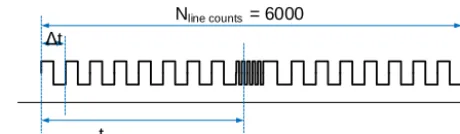
A rotary encoder (ROD 426B-6000) is mounted to the end of the machine shaft and connected to a conditioning board. A WTIM node is used to transfer the number of the pulse into the real rotor speed usingetimerof Contiki. The acquisition of the generated pulses is shown in Fig. 10.
The rotation speed can be defined in Eq. (19), whereτ is the time between two neighboring pulses, NLine counts is the number of encoder lines per revolution, andtsampleis the time period in one session, which is 12◦for the encoder.
Speed= 60
τ NLine counts
(19)
3.3 Implementation of the processes in WTIMs
The general structure of the implemented WTIM is shown in Fig. 11. The IEEE1451.5 process is used to manage the ra-dio module and to handle the communication of the WSN. The IEEE1451.0 process is used to manage the TEDS infor-mation and sample data of the sensors. It is a generic acquisi-tion system for both rotaacquisi-tion sensor and analog sensor, which
t Δt
tsampl e
Nl ine counts = 6000
Figure 10.The acquisition of the generated pulses.
IEEE1451.5 process
IEEE1451.0 process
Sensor type
Analog sensor Rotation
sensor
rotation_sensor_proce ss()
analog_sensor_continu ous_process()
analog_sensor_filterin g_process() Rotation
sensor
Analog sensor
TYPE=”R” TYPE=”A”
Speed
Current_RMS Voltage_RMS Temperature N otifyMsg /
notifyRsp
Decoding
Figure 11.The structure of the implemented WTIMs.
is implemented in all the WTIMs. Which type of process to be used is determined by the sensor type in the command from the NCAP. The values acquired and processed by the acquisition system are sent back to the IEEE1451.0 process periodically as soon as the WTIM receivesstartTrigger or
startStreamcommands. The values are stored in the package
and sent back to the NCAP wirelessly via the IEEE1451.5 process.
4 Implementation of the Kalman filter algorithm in the NCAP
6LoWPAN/IPv6
IEEE802.15.4 ContikiMAC
IEEE802.15.4 PHY
TCP/UDP IEEE1451/
KF algorithm HTTP protocol
Physical layer Data link layer Network layer Transport layer Application layer
Figure 12.The integration of the KF into the Contiki system stack of the NCAP.
4.1 The Kalman filter algorithm
The Kalman filter is a set of mathematical equations that pro-vides an efficient computational (recursive) means to esti-mate the state of a process, in a way that minimizes the mean of the squared error (Welch and Bishop, 1995). In general, both the process noise and the measurement noise should be taken into account in the system model and measurement model.
xk=Axk−1+Buk−1+wk−1 (20)
zk=Hxk+vk (21)
It is necessary to assume that the processwk and the mea-surement noisevk are independent of each other, a random white Gaussian noise with zero mean. Their variance can be described by the covariance matrix QandR, respectively. The Kalman filter estimates a process by using a feedback control: the filter estimates the process state at some time and then obtains feedback in the form of (noisy) measure-ments (Welch and Bishop, 1995). As such, the equations of the Kalman filter can be divided into two groups: prediction equations and correction equations.
The prediction stage of the Kalman filter
The equations of the prediction stage shown in Eqs. (22) and (23) are responsible for projecting forward (in time) the current state and error covariance estimates to obtain a pri-ori estimates for the next time step. Equation (22) is used for updating the state vector from previous sampling timek−1 to current timek. Equation (23) is the state of the updating error covariance matrix.
ˆ
x−k =Axˆk−1+Buk−1 (22)
ˆ
Pk−=APk−1AT +Q (23)
The discretization of the model
The model above is a continuous time system which cannot be processed by computer. Euler’s approximation is used to
messages _buffer kf_data_gen () run_kf (){ matrix_init() kf_filter_predict() kf_filter_update() kf_filter_state() } kf_process start
struct kf_filter {}
struct kf_data {}
Tsw
shell_process
Tsw, Trc, Tsc
Psw, Prc, Psc, Tc
X, P
Figure 13.The workflow of the KF algorithm process.
Table 1.The data range and the resolution of the variables.
Variable/1000 Max Min Resolution
Input 0.2303 −0.0006 6×10⁻⁶
Output 0.4995 −0.1884 5×10⁻⁵
discretize the model, so that the sampled data can be used in the KF algorithm. According to the definition of the deriva-tive, Eq. (20) can be rewritten as
x(k)=Adx(k−1)+Bdu(k−1) (24)
whereAd=E+τAandBd=τB,Eis a 4×4 unit matrix, Cdis equal toC, andτ is the sampling time.
Ad=
1−Rswτ
Csw 0
Rswτ
Csw 0
0 1−Rrcτ
Crc
Rrcτ
Crc 0
Rswτ
Csc
Rrcτ
Csc 1−
(Rsw+Rrc+Rsc)τ
Csc
Rscτ
Csc
0 0 0 1
(25)
Bd=
τ
Csw 0 0 0
0 Cτ
rc 0 0
0 0 Cτ
sc 0
0 0 0 0
(26)
The correction stage of the KF
estima-IEEE1451.5 process IEEE1451.0 process
KF_algorithm process
TIMDiscovery process
Serial- shell-process
Buffer for d ata TEDS
Application process
KF_start process
NCAP
USB
Figure 14.The structure of the implemented NCAP.
tion (Welch and Bishop, 1995).
Kk=Pk−HkT(HkPk−HkT+R)
−1, (27)
ˆ
xk= ˆxk−+Kk(zk−Hxˆk−), (28) Pk+1=(I−KkHk)Pk−, (29)
where Kk is the Kalman gain and Hk is the measurement matrix.
In our application, the KF algorithm is integrated into the NCAP to estimate the temperatures of stator windings, the rotor cage and the stator core of an induction machine. The Preon32 sensor node is resource restricted with respect to low costs, low power consumption and small memory size. In order to be implemented in the NCAP, the algorithm should be simple and efficient. The integration of the KF layer into the Contiki system stack is shown in Fig. 12.
6LoWPAN is defined encapsulation and header compres-sion mechanisms that allow IPv6 packets to be sent to and received from IEEE802.15.4 links, whose full name is IPv6 over Low power Wireless Personal Area Networks (Shelby and Bormann, 2010). It is an adaptation layer of the Ipv6 protocol for WSN. The 6LoWPAN protocol has been im-plemented together with the IEEE802.15.4 Mac layer and IEEE802.15.4 PHY layer by Contiki OS. And the Trans-port layer is responsible for data transmission from an ap-plication layer between the client and server sides. In the application, IEEE1451.0 and IEEE1451.5 standards are im-plemented which are compatible with the stack. The KF al-gorithm is connected to the transport layer and application layer based on the API of the IEEE1451 standard. The effi-ciency of the messages is largely improved and the overhead of the IP address is reduced by using the header compression in the User Datagram Protocol (UDP). Users can manage the WTIM by sending the commands to the NCAP via the In-ternet, and the NCAP will send commands to WTIM for the information. All the API and commands are defined in the standard (IEE, 2007a, b).
14.3 %
KF algorithm 15.3 kB
Contiki 7.6 kB
Firmware 9.2 kB
Unused 23.4 kB
MSTL 4.7 kB
Device 0.4 kB
Others 3.4 kB
Figure 15.The usage of RAM on the NCAP (total memory: 64 kB).
KF algorithm 4.9 kB
Contiki 31.5 kB
Firmware 16.1 kB
Unused 173.8 kB
MSTL 7.9 kB
Device 5.4 kB Others 16.4 kB
Figure 16.The usage of flash memory on the NCAP (total memory: 256 kB).
4.2 KF algorithm implementation in the NCAP using fixed-point arithmetic
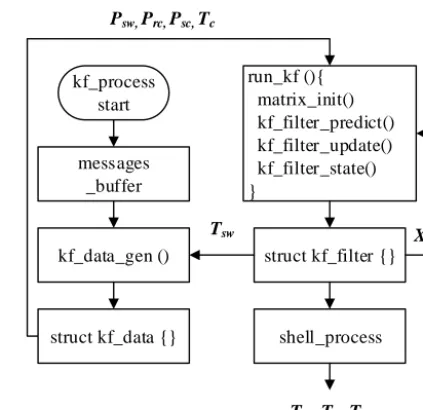
The KF algorithm is first implemented in MATLAB. It proved both in simulation and offline experiments on the test bench that the temperatures can be accurately estimated. In order to be implemented on the resource-restricted sensor node, the same KF algorithm is implemented in the C pro-gramming language using floating-point arithmetic on the Eclipse IDE platform. The workflow of theKF-Algorithm
different messages from different WTIMs are stored. The functionkf_data_gen()is then called to calculate the losses
Psw, Prc, Pscfrom the rotor speed and the preprocessed cur-rents and voltages, and to generate the inputs with Tc. The inputs are stored in the structure kf_dataand passed to the
run_kf() function where the main Kalman filter process is
performed. The DSP (Digital signal processing) library is used for the fixed-point matrix calculation. The state vector Xand error covariance matrixP are stored in the structure
kf_filter and sent back to the next recursion. The estimated temperaturesTsw,Trc,Tscare sent out for storage and display.
Tswis sent back to calculate the losses of the stator winding so that the resistance rising due to temperature can be com-pensated.
Compared to the implementation in MATLAB and Eclipse in the C language, implementation on the Preon32 sensor node using Contiki OS faces several challenges.
Firstly, the methods to allocate and free memory space are different between the standard C library and Contiki OS. The standard C library allocates heap memory using themalloc()
function. However, the Contiki platform specifies a small area of its memory space for the heap because of the re-source restriction (Hopp, 2013). If the malloc()function is used for memory allocation, the heap could easily overflow. The MEMB memory block allocator is used to allocate a block of static memory to constructkf_data, which contains
Psw, Prc, Psc, Tc as the inputs for the algorithm. The struc-ture kf_filterholds all the variables and matrixes which are used during the prediction stage and update stage of the KF algorithm.
The second challenge is that the Preon32 does not have a floating-point unit. It is clear that the floating-point imple-mentation cannot run online. As a result, fixed-point arith-metic is used for the implementation. In order to transfer the existing KF algorithm from floating-point to fixed-point rep-resentation, the proper Q format (Qm.n) defined in the docu-ment (Rein, 2008) has to be considered. Both the range and the resolution of the data are the key factors for choosing the type of Q format. The system can avoid computation over-flow by the saturation modes provided by CPUs, or by de-signing the arithmetic operations. The number of overflow checks is minimized by the division of the variables by 1000, which scaled all the variables and auxiliaries to[−1,1−2n]. By checking the computation in MATLAB step by step, the minimum value of a number is 6×10⁻⁶, which is larger than the Q1.31 format resolution. The data range and the resolu-tion of variables are listed below in Table 1.
Thus the Q1.31 format is used for the arithmetic with a res-olution of 2−31 and a range of[−1,0.999999999534]. This means that one bit is used to designate the integer portion of the number, and the remaining 31 bits are used to designate the two’s complement fractional part of the number (Rein, 2008).
The third challenge is the estimation time for every step. The ARM Cortex-M3 processor provides the CMSIS DSP
Table 2.Comparison of TDMA and CSMA.
CSMA TDMA
Synchronization – Crucial
Dynamic Good Poor
Radio channel utilization ratio High Low
Transmission collision Low Latency
NCAP IEEE1451.0
NCAP KF algorithm NCAP
app
NCAP
IEEE1451.5 WTIM
TIMDiscovery
WTIM_IDs
S tart_KF
WriteMsg
6LoWPAN
notifyRsp
KF algorithm Estimated
temperatures
DAQ 6LoWPAN Error_code
WriteMsg:return Request
Response
notifyRsp:return readRsp readRsp:return
Figure 17.The sequence on the NCAP side.
library, which contains matrix functions in fixed point (CM-SIS, 2016). These functions are optimized for checking the overflow and improving the calculation. By using these ma-trix functions in fixed-point arithmetic, the KF estimation time for every step (1 s step−1) is only 600 µs. As a result, on-line temperature estimation can be performed quite fluently.
4.3 The implementation of processes in the NCAP
Contiki OS is an event-driven system which is managed by protothreads. In order to operate different WTIMs, to man-age the messman-age transmission and to process the KF algo-rithm, several functional processes are implemented in the NCAP. The structure of the implemented processes is shown in Fig. 14.
The Serial-Shell process is implemented for connecting
WTIM IEEE1451.5
WTIM IEEE1451.0
NCAP WTIM
DAQ Request notifyMsg
Start stream
Data streaming
Response 6LoWPAN
6LoWPAN
WriteRsp notifyMsg:return
readMsg
readMsg:return
WriteRsp:return
Figure 18.The sequence on the WTIM side.
Table 3.Error and NRMSE of the estimated temperatures under S1.
Parameters Maximum error NRMSE
Stator winding 2.3◦C 3.2 %
Rotor cage 3.5◦C 2.08 %
Stator core 2◦C 2.71 %
The buffer for storing data from different WTIMs is allocated in this process. The receivedIrms, Vrms, ωr, Tcwill be passed to the KF-Algo process for the temperature estimation and the results will be sent out through theSerial-Shellprocess.
4.4 Memory usage and calculation time
In the implementation of the KF algorithm in the NCAP, all the memory blocks are allocated statically so that fragmen-tation can be avoided (Haumer et al., 2012). By using this way, it is easy to analyze the memory usage of both RAM and Flash. The usage of RAM on the NCAP sensor node is shown in Fig. 15. The buffers of the KF algorithm take up about 24 % of the total memory space. The basic system, which consists of the Contiki OS, the firmware provided by Virtenio, and other parts from the standard C library, con-sumes about 32 %. The MSTL takes up 7.4 %. About 37 % of the space is unused.
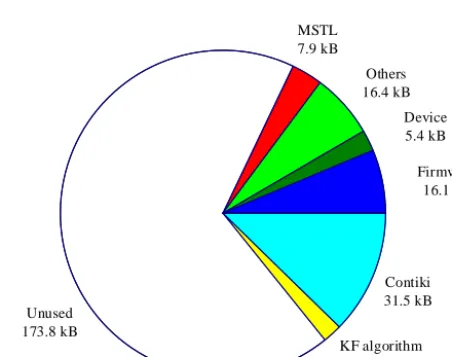
The usage of the flash memory for programming on the NCAP is shown in Fig. 16. Only about 5 % of the memory is used for the KF algorithm and the MSTL. The system takes up most of the used memory. The rest of about 62 % of the total memory is not used.
The system gets the data from different buffers to generate the input, which costs 120 µs, and the computation time of the KF algorithm for one step is about 600 µs. The total time of data generation and KF computation is much shorter than the calculation interval 1 s.
Table 4.Error and NRMSE of the estimated temperatures under S6.
Parameters Maximum error NRMSE
Stator winding 3.5◦C 2.69 %
Rotor cage 3.5◦C 2.45 %
Stator core 1.5◦C 1.36 %
0 1000 2000 3000 4000 5000 6000 7000
0 50 100
Time [s]
Stator
wingding
[°C]
Measurement Estimation
0 1000 2000 3000 4000 5000 6000 7000
0 50 100
Time [s]
Rotor
cage
[°C]
Measurement Estimation
0 1000 2000 3000 4000 5000 6000 7000
0 50
Time [s]
Stator core [°C]
Measurement Estimation
Figure 19.Comparison of measured and estimated temperatures under S1.
5 The communication of the WSN system
In the WSN system, the IEEE1451.5 standard defines the communication interfaces between the NCAP and WTIMs. The 6LoWPAN communication protocol is implemented in the network layer and UDP is used at the transport layer to comply with this specification in the standard.
5.1 Channel access method – the WSN system
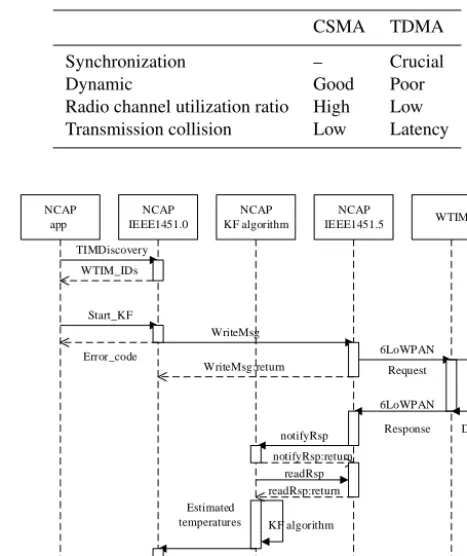
Three WTIMs continuously transmit data streaming to the NCAP. Radio channel collision, which is caused by two of the nodes sending data at the same time, is a great concern in the implementation. Carrier-sense multiple access (CSMA) and time-division multiple access (TDMA) are implemented in the MAC layer as the channel access methods, which can be selected according to different requirements of the appli-cation. The mechanism and the implementation of these two methods are out of the scope of this paper. Both CSMA and TDMA can be applied in this system through the experiment. Table 2 shows the comparison of these two channel access methods (Cionca et al., 2008).
0 1000 2000 3000 4000 5000 6000 7000 0
50
Time [s]
Stator wingding [°C]
Measurement Estimation
0 1000 2000 3000 4000 5000 6000 7000
0 50 100
Time [s]
Rotor cage [°C]
Measurement Estimation
0 1000 2000 3000 4000 5000 6000 7000
0 50
Time [s]
Stator core [°C]
Measurement Estimation
Figure 20. Comparison of measured and estimated temperatures under S6.
NCAP, collisions would happen or packages would be lost. Either of these events can influence the estimation results or block the process of the algorithm.
TDMA is an alternative mechanism to coordinate each node which is divided into time frames and each time frame is further divided into a fixed number of time slots. By us-ing TDMA, data transmissions operate in a completely pre-dictable way, which can largely reduce the collisions and al-most prevent the packages from missing. Fewer collisions and more stable transmission have higher priority when de-termining channel access method. As a result, TDMA is used for this WSN system.
5.2 The sequence of the WSN system
The sequence on the NCAP side is shown in Fig. 17. The
TIMDiscovery command is first used to discover the
avail-able WTIMs in the network. After calling thestart_KF func-tion, the message is passed from the IEEE1451.0 layer to the IEEE1451.5 layer and then broadcasted to the WTIMs. Acquired data from different WTIMs are sent back to the NCAP and stored in a queue in different buffers which are identified by the WTIM_ID. The data from different buffers will be fetched by a data generation function according to the timestamps. Preprocessed data with the same or nearest timestamps will be passed and processed by the KF algo-rithm processed by the KF. Finally, the temperatures are es-timated.
The sequence on the WTIM side is shown in Fig. 18. The message is notified and decoded by the IEEE1451.0 process. The data acquisition system can be triggered by the
start-Streamcommand for continuous data acquisition. The DAQ
is out of the scope of the IEEE1451 standard. The filtered
and processed data are converted to the value in SI units and are sent back to the NCAP for the KF algorithm.
6 Experiments
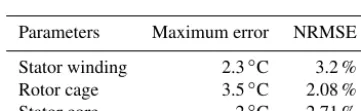
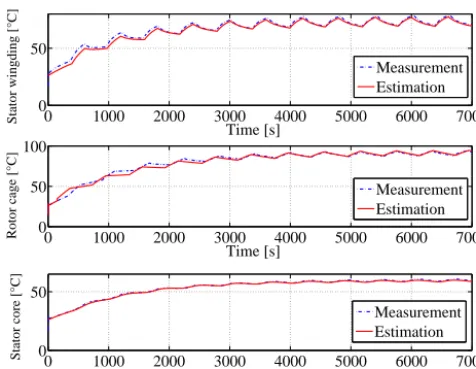
The structure of the test bench is shown in Fig. A1. Two experiments are performed on the test bench (Siemens ma-chine: 1 LA5107-4AA20) using the WSN temperature es-timation system. Wireless sensor nodes TIM2, TIM3 and TIM4 are used to acquire rotor speed, coolant air temper-ature, three-phase currents and voltages. The KF algorithm is implemented in the wireless sensor node as the NCAP to estimate the temperatures. The sampling time is 1 s. The sampling period is about 2 h, after which the temperatures of the estimated parts stay stable. The ambient temperature is 26◦C. The maximum errors and the normalized root-mean-square error (NRMSR)eNRMSdefined in Eq. (30) are sum-marized in Table 3. The maximal deviation is 3.5◦C and the maximum NRMSR is 3.2 %. The comparisons of the esti-mated and measured temperatures under the continuous full-load test S1 condition are shown in Fig. 19.
eNRMS= v u u t
1
N N
X
i=0
y
mea(i)−yest(i) max(ymea)−min(ymea)
2
(30)
The other experiment under intermittent-load S6 (6 min no load followed by 4 min full load) is also performed on the test bench. The estimated and measured temperatures are shown in Fig. 20 and the maximum errors and NRMSE are listed in Table 4. The temperatures are estimated accurately under S6 with a maximum error of 3.5◦C, with the accuracy of 97 %. The difference may be due to the installation of PT1000 on the rotor cage, which influences the flux density and gen-erates excessive losses (about 55 w) compared to a healthy machine (Bangura and Demerdash, 2000).
7 Conclusions
Appendix A
Rotary encoder
DC motor
Torque/speed (HBM T30FM)
Inverter Current
/voltage
Current /voltage
Current /voltage
NI PCI-6023E Tsw
Trc
Measurement b ox
DC-power-supply (SM6020)
NI USB-6009
Tsc Tc TIM1
TIM2
NCAP
RS232 USB
USB
TIM3
PCI
TIM4
Asynchronous machine
sw: Stator windings
rc: Rotor cage
sc: Stator core
c: Coolant air
Competing interests. The authors declare that they have no con-flict of interest.
Special issue statement. This article is part of the special issue “Sensor/IRS2 2017”. It is a result of the AMA Conferences, Nurem-berg, Germany, 30 May–1 June 2017.
Acknowledgements. I would like to express my appreciation to my doctoral thesis advisor, Clemens Gühmann, who kept giving me invaluable guidance for the research. I would like to thank my colleague, Jürgen Funck, and my student Wenjun Zhu for their help.
Edited by: Andreas König
Reviewed by: three anonymous referees
References
Allocation: Memory allocation, available at: https://github.com/ contiki-os/contiki/wiki/Memory-allocation, last access: 15 June 2016.
Bangura, J. F. and Demerdash, N. A.: Effects of broken bars/end-ring connectors and airgap eccentricities on ohmic and core losses of induction motors in ASDs using a coupled finite element-state space method, IEEE T. Energy Conver., 15, 40–47, https://doi.org/10.1109/60.849114, 2000.
Ben Brahim, S., Bouallegue, R., David, J., Vuong, T. H., and David, M.: A Wireless On-line Temperature Monitoring System for Ro-tating Electrical Machine, Wireless Personal Communications, 1–21, https://doi.org/10.1007/s11277-016-3808-5, 2016. Brahim, S. B., Bouallegue, R., David, J., and Vuong, T. H.:
Modelling and characterization of rotor temperature moni-toring system, in: 2016 International Wireless Communica-tions and Mobile Computing Conference (IWCMC), 735–740, https://doi.org/10.1109/IWCMC.2016.7577148, 2016.
Cionca, V., Newe, T., and Dadaerlat, V.: TDMA Proto-col Requirements for Wireless Sensor Networks, in: 2008 Second International Conference on Sensor Tech-nologies and Applications (sensorcomm 2008), 30–35, https://doi.org/10.1109/SENSORCOMM.2008.69, 2008. CMSIS: CMSIS – Cortex Mircrocontroller Software Interface
Standard, avaiable at: http://www.keil.com/pack/doc/CMSIS/ General/html/index.html, last access: 20 June 2016.
Funck, J. and Guehmann, C.: A flexible filter for synchronous angu-lar resampling with a wireless sensor network, Measurement, 98, 393–406, https://doi.org/10.1016/j.measurement.2016.07.062, 2017.
Funck, J. and Nowoisky, S.: MDT Strom- und Spannungswandler-Modul, unpublished, 2011.
Haumer, A., Kral, C., Kapeller, H., Baeuml, T., and Gragger, J. V.: The AdvancedMachines library: Loss models for electric ma-chines, in: Proceedings of the 7th Modelica Conference, 847– 854, 2009.
Haumer, A., Kral, C., Vukovic, V., David, A., Hettfleisch, C., and Huzsvar, A.: A Parametrization Scheme for High Performance Thermal Models of Electric Machines using Modelica, Proceed-ings of the 7th Vienna Conf. on Math. Modeling, Vienna, Austria, 15–17 February 2012.
Hopp, T.: Intelligenter Sensor zur Leistungsmessung im Dreiphasennetz, MS thesis, Technische Universitaet Berlin, 2013.
Hudon, C., Guddemi, C., Gingras, S., Leite, R. C., and Mydlarski, L.: Rotor temperature monitoring using fiber Bragg gratings, in: 2016 IEEE Electrical Insulation Conference (EIC), 456–459, https://doi.org/10.1109/EIC.2016.7548636, 2016.
IEEE: Standard for a Smart Transducer Interface for Sen-sors and Actuators – Common Functions, Commu-nication Protocols, and Transducer Electronic Data Sheet (TEDS) Formats, IEEE Std 1451.0-2007, 1–335, https://doi.org/10.1109/IEEESTD.2007.4338161, 2007a. IEEE: Standard for a Smart Transducer Interface for Sensors and
Actuators Wireless Communication Protocols and Transducer Electronic Data Sheet (TEDS) Formats, IEEE Std 1451.5-2007, C1–236, https://doi.org/10.1109/IEEESTD.2007.4346346, 2007b.
Ozsoy, E., Gokasan, M., and Bogosyan, S.: Simultaneous rotor and stator resistance estimation of squirrel cage induction machine with a single extended kalman filter, Turk. J. Electr. Eng. Co., 18, 853–864, 2010.
Preon32: Datasheet Preon32, available at: http://www.virtenio.com/ en/products/radio-module.html (last access: 25 November 2015), 2016.
Rein, S.: Fixed-Point Arithmetic in C: A Tutorial and an Example on Wavelet Filtering, unpublished, 2008.
Sabaghi, M., Farahani, H. F., Hafezi, H. R., Kiani, P., and Jalil-ian, A. R.: Stator winding resistance estimation for tempera-ture monitoring of induction motor under unbalance supply-ing by DC injection method, in: Universities Power Engineer-ing Conference, 2007, UPEC 2007. 42nd International, 217–222, https://doi.org/10.1109/UPEC.2007.4468949, 2007.
Shelby, Z. and Bormann, C.: 6LoWPAN: The Wireless Embedded Internet, Wiley Publishing, 2010.
Society: IEEE Standard Test Procedure for Polyphase Induction Motors and Generators, ISBN: 0-7381-3977-7 SH95211, 2004. Sonnaillon, M. O., Bisheimer, G., Angelo, C. D., and
Gar-cía, G. O.: Online Sensorless Induction Motor Tempera-ture Monitoring, IEEE T. Energy Conver., 25, 273–280, https://doi.org/10.1109/TEC.2010.2042220, 2010.
Wang, L., Yang, X., and Sheng, B.: Distributed Optical Fiber Sensor for Virtual Monitoring of Turbine Rotor’s Temperature, in: 2009 International Conference on Measur-ing Technology and Mechatronics Automation, 1, 16–19, https://doi.org/10.1109/ICMTMA.2009.215, 2009.