Indian J.Plant Physiol., Vol. 5, No.3, (N.S.) pp. 223-227 (July-Sept., 2000)
SUCROSE UPTAKE AND ACCUMULATION BY INTERNODE TISSUE OF HIGH
AND LOW SUGAR CUL TIVARS OF SUGARCANE FROM EXOGENOUSLY
SUPPLIED SUCROSE MEDIUM
H. L. SEHTIYA AND J. P. S. DENDSAY
Regional Research Station, CCS Haryana Agricultural University, Kamal Received on 26 March., 1999, Revised on 23 May, 2000
SUMMARY
Sucrose uptake and accumulation from exogenously supplied sucrose medium by internode tissue. of two contrasting sugarcane cultivars i.e. CoJ64 (high sugar and early maturing) and Co1148 (low sugar and late maturing) was studied. Cell sap sucrose concentration of the tissue from 3rd internode of Co1148 after incubation for 3 h in 100 mM sucrose solution increased from 99 mM to 116 mM while in CoJ64 it decreased from 223 to 205 mM. However, when the tissue was osmotically equilibrated prior to incubation in sucrose medium with PEG-6000 of equivalent osmolarity as that of the sucrose bathing medium, both the cultivars actively took up sucrose and final cell sap sucrose concentration increased many folds after incubation for 24h. From 400 and 200 mM sucrose bathing medium similar final cell sap sucrose concentration was maintained by both the cultivars. However, from 100 and 50 mM sucrose bathing medium, tissue from CoJ64 attained 529 and 227 mM final cell sap sucrose concentration as compared to 183 and 94 mM attained by tissue from Co1148. Lower concentration (25 mM) of the bathing medium caused a decrease in final cell sap sucrose concentration in both the cultivars. When tissue from internodes of variable age after osmotic equilibration with PEG-6000, were incubated in 200 mM sucrose bathing medium, the younger internodes of both the cultivars were more efficient in sucrose uptake and the two cultivars were similar in final·cell sap sucrose concentration. However, the 5th and lower internodes down the stalk of CoJ64 showed no significant change in final cell sap sucrose concentration as compared to pre-incubation cell sap sucrose concentration. In Col148 where the initial cell sap sucrose was less, the tissue continued increasing the sucrose in the lower internodes as well. The results are discussed in context of sugar content and maturity group of the two cultivars.
Key words :Maturity group, sugarcane, sucrose accumulation
INTRODUCTION
Sugarcane cultivars vary in their potential of sucrose accumulation.Early maskingofvacuolar invertaseactivity is responsiblefor high sucrose accumulation in internode tissue of high sugar and early maturing cultivar CoJ64 (Sehtiyaet. al., 1991; Dendsayet.al, 1995). Sugarcane storage tissue accumulate sugar against a concentration gradient using energy provided by respiration (Bieleski, 1960;Burg and Bielski, 1962), Kinetic and tracer studies showthat tissue disks placed in sugar solution have three
Indian J.Plant Physiol., Vol. 5, No.3, (N.S.) pp. 223-227 (July-Sept., 2000)
distinct compartments (Glasziou, 1960; Glasziouet al.,
1965). These compartments are redefined with specific reference to s.ugar accumulation. The outer space which includes the cell walls is the zone of the tissue in rapid diffusion equilibrium with sugar and ions of the bathing solution. The metabolic compartment is a zone in which hexoses are phosphorylated and interconverted. Vacuole is considered the actual storage compartment of excess sugar. It is generally believed that lateral movement of solutes through parenchyma cells of plant tissue occurs via the plasmodesmata (Webb and Gorham, 1965) and
the concentration of metabolites in the aqueous phase of cell walls and intercellular spaces of tissue is very low. However, Cormack and Lemay (1963) have presented in mustard that sugars being translocated through intercellular spaces and cell walls in the root apex. From studies of a diphasic loss of reducing sugar from tissue slices, Burg and Marks (1964) concluded that the concentration of reducing sugar in the free space of whole McIntosh apples is approximately the same as that occurring in the vacuole. In sugarcane stems which contain large amounts of sucrose, the concentration of sucrose in the volume external to the vacuoles was found to approach the concentration present in the vacuoles (Hawker, 1965; Hawker and Hatch, 1965). Therefore, the total sucrose accumulation potential of sugarcane internodes includes the cell walls, metabolic compartments as well as the vacuoles. Ourearlierreports (Sehtiyaet. aI.,
1991; Dendsay et al., 1995) explained difference in invertase activity of the metabolic and vacuolar compartments of high sugar and low sugar cultivars. However, difference in the cell wall and free space of the two group of cultivars were not studied. The present work is an estimate of over all sucrose uptake potential (inclusive of cell wall, free spaces, metabolic and vacuolar compartments) of high sugar and low sugar cultivars of sugarcane from exogenously supplied sucrose medium.
MA TERIALS AND METHODS
Two Saccharum spontaneum L. x S. officinarum L. hybrids. CoJ64 (high sugar and early maturing) and Co 1148 (low sugar and late maturing) were planted at the regional research station, Kamal, following recommended cultivation and plant protection practices. Stalks of 5 months old crop during grand growth stage were taken for in vitro studies of sucrose uptake by the tissue from different internodes. The uppermost internode that was 1 cm long was numbered as internode 1, the next lower as internode 2 and so on. After removing the rind, a section midway along the length of the internode was used for in
vitro sucrose uptake studies.
In experiment 1 the tissue from 3rd internode was incubated in 100 mM sucrose solution for 3 hat 30±2°C. Sucrose concentration ofthe cell sap squeezed from a set ofthree replicates prior and post incubation in exogenously supplied sucrose medium was assayed as described by
224
Huber (1983). In 2nd experiment the tissue from the third internode of CoJ64 and Col148 was osmotically equilibrated with PEG-6000 solution of equivalent osmotic concentration as that of the bathing sucrose medium for 2h. Osmotic potential of the PEG solution was determined by the method of depression in freezing point estimated by Osmometer from Fiske Associate, USA. The osmotically equilibrated internode tissue was incubated for 24h in 25 to 400 mM sucrose solution. Prior and post incubation, the tissue was washed with distilled water wiped with a tissue paper and cell sap squeezed and sucrose concentration detenllined as in experiment 1. In 3rd experiment tissue from 1st to 8th internodes ofCol64 and Co1148 were osmotically equilibrated and incubated with 200 mM sucrose medium as in experiment 2. Sucrose concentration of the cell sap prior and post incubation was determined as in experiment 1.
Sucrose was estimated by measuring the fructose due to acid hydrolysis of sucrose from the cell sap as described by Huber (1983). Prior to hydrolysis, free fructose was destroyed by boiling 20 I-Llof the cell sap with 50 I-Llof2.4 N NaOH in a boiling water bath for 10 min. After cooling 0.75 ml of 1% resorcinol in ethanol and 1.5 m130% HCl were added, and the tubes were incubated at 80°C for 8 min. After cooling As20 was measured.
RESUL TS AND DISCUSSION
Tissue from third internode of two contrasting cultivars of sugarcane i.e. CoJ64 (high sugar and early maturing) and Co 1148 (low sugar and late maturing) during active growth and sucrose accumulation stage were incubated with 100 mM exogenously supplied sucrose medium for 3h. The Cell sap sucrose concentration dropped from 222 mM to 205 mM inCol64as compared to increase in the sap sucrose concentration from 99 mM to 116 mM in Co1148 under similar conditions (TableI). Obviously low osmotic concentration of the medium (100 mM compared to 223 mM tissue sap concentration) inCol64might have resulted osmotic equilibration causing uptake of water from the medium and diluting the sap sucrose concentration. Leakage of sucrose from cell wall and free space which are known to have the same sucrose concentration as that of the vacuoles (Hawker, 1965) might also contribute to dilution of cell sap sucrose concentration. In Col148 where the tissue sucrose
SUCROSE UPTAKE IN SUGARCANE concentration was almost similar to that of the medium,
increase in sap sucrose concentration suggests involvement of active uptake system of sucrose from the medium. During subsequent experiments, the tissue was osmotically equilibrated with PEG 6000 solution of equivalent osmotic concentration as that of the sucrose bathing medium.
Co 1148 was either slow in uptake or a major part of the sucrose taken up was simultaneously being utilised in growth of the tissue. Up to 50 mM sucrose bathing medium sucrose was taken up actively against the concentration gradient, and the same trend was observed as in lOa mM. CoJ64 acquired higher sap sucrose concentration (227 mM) as compared to that in Col148
Table I. Sucrose uptake from 100 mM sucrose solution by internode tissue of sugarcane
Cultivar
CoJ64 Col148
Initial
222.7±3.0 98.8±0.4
Sucrose concentration of cell sap (mM)
Final
205.3±7.0 116.4±2.8
Uptake
-17.4
17.6
Sugarcane slices from middle of 3rd internodes of high sugar (CoJ64) and low sugar (Co 1148) cultivars were incubated in 100 mM sucrose solution for 3 h at 30°C
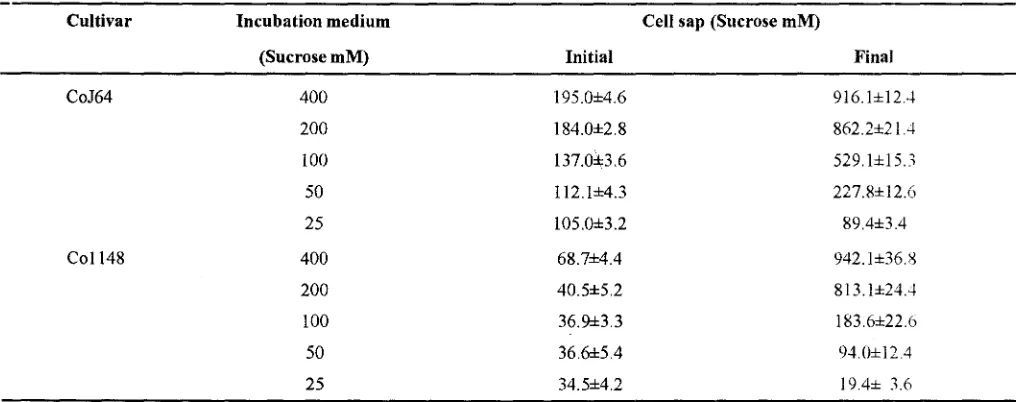
In experiment where the tissue was incubated in variable osmotic concentration sucrose medium for 24h, the uptake was maximum in highest concentration (400 mM bathing medium) in both the cultivars. Final cell sap concentration of 916 and 942 mM was recorded in CoJ 64 and Co1l48respectively (Table II). This behaviour suggests that if sufficient sucrose was available from the source, even the low sugar cultivar has equally good or even higher potential of sucrose uptake and accumulation as that of high sugar cultivar CoJ64. The sugarcane stem tissue studied consists of approximately 92% storage parenchyma cells, 7.5% xylem and sclerenchyma, and 0.5% phloem (Hawker, 1965; Hawker and Hatch, 1965). The vacuoles of the storage parenchyma cells constitute about 80% of the total tissue volume. The cytoplasm of these cells constitutes less than 2.5% of the total tissue volume (Hawker 1965). From the results presented, it is obvious that the bulk of the sucrose retained in the tissue is situated in the vacuoles of the storage parenchyma cells. As the bathing medium sucrose concentration decreased the final cell sap sucrose concentration was higher in high sugar cultivar CoJ64. It means if the source carbohydrate supply was limited, high sugar cultivar CoJ 64 was more efficient in sucrose uptake and accumulation while high growth, low sugar cultivar
Indianl. Plant Physiol.,Vol. 5, No.3, (N.S.) pp. 223-227 (July-Sept., 2000)
(94 mM) with 50 mM sucrose bathing medium. However, the trend of active uptake of sucrose was reversed when the bathing medium sucrose concentration was decreased to 25 mM where the final sucrose concentration of the cell sap was less than the initial concentration in both the cultivars. This behaviour could be due to either leakage of sucrose from free space (intercellular spaces and cell walls) to the very dilute bathing medium or a part of the sucrose stored might be utilised for grmvth of the cells when uptake from very dilute bathing medium was limited. Glaziou et al. (1965) also observed that the sugar accumulated in the sugarcane stem could be fast utilised into growth when sucrose from the source "vas limited.
Different internodes of sugarcane represent tissue of different age; the first internode being the youngest and the last, the oldest. Younger tissue is actively engaged in growth while the older is involved in sucrose accumulation. When tissue from these internodes were incubated in 200 mM sucrose medium the upper internodes actively took up sucrose and final concentration of cell sap increased many folds. The fincHcell sap concentration was maximum in 3rd and 4th internode showing the tissue of these internodes were most active in sucrose uptake and accumulation. Both the cultivars were similar in final cell sap sucrose concentration. Since the initial cell sap sucrose
Table II. Sucrose uptake from variable concentration sucrose solution by osmotically equilibrated internode tissue of sugarcane.
CuItivar
CoJ64
Col 148
Incubation medium Cell sap (Sucrose mM)
(Sucrose mM) Initial Final
400 195.0±4.6 9l6.l±12A
200 l84.0±2.8 862.2±2IA
100 137.0~3.6 529.1±15.3
50 112.l±4.3 227.8±12.6
25 105.0±3.2 89.4±34
400 68.7±4.4 942.l±36.8
200 40.5±5.2 813.l±24.4
100 36.9±3.3 l83.6±22.6
50 36.6±5.4 940±12.4
25 34.5±4.2 19.4± 3.6
(Experiment as in table I, except the sucrose bathing medium was of variable concentration and the tissue was osmoticaly equilibrated with PEG 6000 of equivalent osmolarity prior to incubation in sucrose bathing medium.)
Table III. Sucrose uptake from 200 mM sucrose medium by osmotically equilibrated internode tissue of different internodes of sugarcane.
CuItivar Internode number Cell sap sucrose concentration (mM)
Initial Final
CoJ64
Col 148
1st 30.6±3.2 258.2±164
2nd 36.2±4.7 341.9±32.4
3rd 206.5±6.3 747.2±54.0
4th 341.9±8.4 752.l±63.0
5th 695.8±8.8 748.6±42A
6th 758.7±12.6 701.4±48.l
7th 769.2±24.6 770.7±53.2
8th 790.4±26.3 758.7±42.6
1st 45.3±3.8 205.l±24.1
2nd 28.6±6.0 397.8±37.3
3rd 75.5±3.6 743.0±42.1
4th 112.3±7.5 705.5±36A
5th l46.5±21.3 464.8±46.9
6th 268.8±35.5 537.2±53.2
7th 374.2±32.8 507.4±47A
8th 507.3±38.8 542.0±40.5
(Experiment as in table II, except the sucrose bathing medium was 200 mM and the tissue from different internodes was taken. )
SUCROSE UPTAKE IN SUGARCANE concentration was lower in Co1148 the net uptake of
sucrose were higher in these internodes. Lower internodes of Col64 did not show significant change in sucrose concentration due to the incubation. However, in Co 1148, lower internode cell sap sucrose concentration was not as high as in Col64 and the final sucrose concentration continued increasing indicating that gradient of sucrose concentration between the free space of the cell and the bathing medium affects uptake of sucrose.
The above experiments suggest that the potential of sucrose accumulation in high and low sugar cultivars are not much different. When sufficient carbohydrates were available from the source (200 and 400 mM) the final cell sap sucrose concentration in low sugar cultivar Col148 was as high or even slightly better than the high sugar cultivar Col64. However, under limited sucrose availability (less than 200 mM bathing medium) high sugar cultivar was efficient in sucrose uptake and attained a significantly higher cell sap sucrose concentration as compared to that in low sugar cultivar co1148. Thus, for increasing recovery of sugar from late maturing sugarcane cultivars, emphasis should be made to increase the availability of source i.efactors affecting photosynthesis should be exploited rather than factors affecting sucrose accumulation in the sink.
REFERENCES
Bieleski, RL. (1960). The physiology of sugarcane. III Characteristics of sugar uptake in slices of mature and immature storage tissue. Aust. J.Bioi. Sci., 13: 203-220.
IndianJ. Plant Physiol., Vol. 5, No.3, (N.S.) pp. 223-227 (July-Sept., 2000)
Burg, S.P. and Bieleski, RL. (1962). The physiologvofsugarcane. V. Kinetics of sugar accumulation. Australian 1.Bioi. Sci .. 15: 429-444.
Burg, EA and Marks, R (1964). Relationship of solute leakage to solution toxicity in fruits and other plant tissu<.:s.Plant p'hysiol., 38: 185-195.
Cormack, RG.H. and Lemay, P. (1963). Sugar in the intercellular spaces of white mustard roots. J.Exp. BOI .. 14: 232-236. Dendsay, J.P.S., Singh, P., Dhawan, AK. and Sehti'.u, H.L. (1995)
Activities ofintemodal invertases during matmu lion of sugarcane stalks. Sugarcane, No 6: 17-19.
Glasziou, K. T. (1960). Accumulation and transformat ion of sugars in sugarcane. Origin of glucose & fructose in tJle imler space. Plant Physiol., 36:175-179.
Glasziou, K.T., Buli, TA, Hatch, M.D., and Whiteman, P.C. (1965) Physiology of sugarcane. Effect of temperature, photoperiod duration, and dililllal and seasonal temperature changes on growth and ripening. Aust. J. BioI. Sci ..18: 53-66.
Hawker, J.S. (1965). The sugar content of cell walls and intercellular spaces in sugarcane stems mld its relation to sugar transport. Aust. J.BioI. Sci., 18: 959-969.
Hawker, J.S. mld Hatch, M.D. (1965). Mechanism of511garstorage bv mature stem tissue of sugarcane. Physiol. Planl., 18: 444-453. Huber, S. C. (1983). Role of sucrose phosphate S)11thasl.':in partitioning
of carbon in leaves. Plant Physiol., 71: 818-821
Sehtiya, H.L., Dendsay, J.P.S mld Dhawan, AK. (1991). Intemodal invertases and stalk maturity in sugarcane. j. A.gric. Sci. (Cambridge), 166 : 239-243.
Webb, J.A mld Gorham, P.R. (1965). Radial movement of Cl4 trmlslocates trom squash pholem. Call.1.Bot.,43: 97-103.