LHD Bootstrap Current Coe
ffi
cient Calculations with
the VENUS
+
δ
f
code
Maxim Yu. ISAEV, Kiyomasa Y. WATANABE
1), Masayuki YOKOYAMA
1), Nobuyoshi OHYABU
1),
Craig D. BEIDLER
2), Henning MAASSBERG
2), Wilfred A. COOPER
3), Trach-Minh TRAN
3)and Mikhail I. MIKHAILOV
Russian Research Center “Kurchatov Institute”, Moscow, 123182, Russia
1)National Institute for Fusion Science, Toki, 509-5292, Japan
2)Max-Planck Institute f¨ur Plasma Physik, D-17491, Greifswald, Germany
3)Centre de Recherches en Physique des Plasmas, CH-1015, Lausanne, Suisse
(Received 18 November 2007/Accepted 16 April 2008)
Normalized bootstrap current coefficients are calculated for Large Helical Device (LHD, Japan) plasma configurations with different magnetic axis positions using the VENUS+δf code [Fusion Sci. Technol.50, 440 (2006)]. The dependences on the different collisionality regimes (over the full experimental range of LHD plasma discharges) and the plasma radii are presented. The comparison of the VENUS+δf, SPBSC and DKES codes results is shown. The approach to the LHD experimental results is discussed. The bootstrap current effect on the iota=1 islands is considered.
c
2008 The Japan Society of Plasma Science and Nuclear Fusion Research
Keywords: heliotron, stellarator, magnetic configuration, neoclassical transport, bootstrap current, 3D numerical orbit,δf method
DOI: 10.1585/pfr.3.036
1. Introduction
The LHD is a superconducting large helical device with a helical field with poloidal winding numberl=2 and m = 10 toroidal field periods [1]. The LHD super dense core (SDC) plasma with a density 4.5×10²⁰m−3, the in-ternal diffusion barrier (IDB) with a very high density gra-dient maintains a core region with high density and a tem-perature of 0.85 keV was achieved when a series of pellets were injected [2]. This operational regime may extrapolate to a high-density and low-temperature ignition scenario for heliotron/stellarator devices.
To study the confinement properties of SDC/IDB plas-mas, the accurate reproduction of the MHD equilibrium including the calculations of the bootstrap current is nec-essary. The local bootstrap current is due to the nature of particle orbits in the presence of local magnetic fields and Coulomb collisions. For nonaxisymmetric toroidal systems, there are several bootstrap current models and approaches. One quasi-analytical fluid moment, the so-called Shaing-Callen approach [3], describes the collision-less asymptote in which the bootstrap coefficient becomes independent of collisionality. This approach is the basis for several numerical tools with self-consistent iterative equi-libria: the SPBSC code [4] (NIFS, Japan) and the TERPSI-CHORE - BOOTSP code [5] (CRPP, Switzerland). These codes can serve to analyze the impact of the bootstrap cur-rent on the MHD stability for quite different magnetic con-figurations in the collisionless (or extreme long-mean-free-author’s e-mail: [email protected]
path, lmfp) regimes.
Typical LHD experimental discharges and super dense core discharges belong to collisional and highly collisional regimes. For these regimes the Drift Kinetic Equation Solver (DKES) code [6] can perform the bootstrap current calculations, however, for the lmfp regime this code often provides transport coefficients with large uncertainties de-pending on the specific magnetic configuration [7].
Recently a new tool, the 3D code VENUS+δf, based on the VENUS numerical orbits, the Monte Carlo tech-nique using the Lorentz collision operator, and the δf weighting scheme for gyrokinetic particle simulation was presented [8]. The VENUS+δf code calculates the dif-fusion and the bootstrap current coefficients for the gen-eral 3D case and for all collisionality regimes without semi-analytical formulas and approximations applied in the SPBSC and TERPSICHORE-BOOTSP codes. For the Wendelstein-7X configuration, the universal VENUS+δf code was able to perform the bootstrap current calcu-lations in the transition region [9] between the extreme lmfp semi-analytical Shaing-Callen limit and the low col-lisionality regime, where the DKES code provided the results with large error bars. The extensive benchmark-ing of the mono-energetic bootstrap current coefficients with the radial electric field for Wendelstein-7X, NCSX and old LHD heliotrons/stellarators configurations was ob-tained recently [9] by quite different codes — VENUS+δf, DKES, GSRAKE and NEO.
In this paper we present the LHD experimental boot-c
strap current results and the bootstrap current coefficients, calculated with the VENUS+δfcode for real LHD vacuum configurations with different magnetic axes, on different magnetic surfaces and in different collisionality regimes. These coefficients provide us the base for the accurate cal-culations of the total bootstrap current in the LHD experi-ments in the near future.
The paper is organized as follows. Section 2 describes the LHD experimental bootstrap current results for the typ-ical collisional regime, the SPBSC code theorettyp-ical predic-tions and the bootstrap current coefficient results with the VENUS+δf code. Section 3 describes the VENUS+δf re-sults for the super dense (high collisionality) regime. Sec-tion 4 shows the benchmark of the bootstrap current co-efficient calculations between the known DKES code re-sults and with the VENUS+δf code for one old test LHD model configuration. Section 5 describes the bootstrap cur-rent effect on the iota = 1 islands, calculated with the VENUS+δf code. In Sec. 6, the main results and future plans are discussed.
2. The Bootstrap Current in the
Typi-cal LHD Collisional Regime
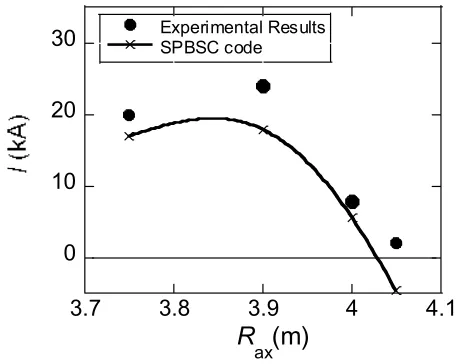
For the bootstrap current in LHD configurations, there are some early papers. From theoretical predictions based on the quasi-analytical fluid moment approach, the de-pendence of the bootstrap current on the magnetic con-figurations and collisionalities has been calculated [4, 10]. From experimental measurements of the non-inductive current, the dependence of the bootstrap current on the beta value and the magnetic configurations were studied, and compared with the theoretical expectations [11]. Fig-ure 1 shows the dependence of the total bootstrap (non-inductive) current obtained experimentally for LHD
mag-Fig. 1 The magnetic axis position dependence of the experimen-tal bootstrap current and the bootstrap current from the SPBSC predictions.
netic configurations with different magnetic axis locations. In Fig. 1, the electron temperature on the axisTe0 = 1 ∼
2 keV and the electron density ne0 = 1 - 3 ×10¹⁹m−3.
These parameters correspond to the normalized collision frequencyν* ≤ 1; the βvalues lay in the range 0.33 -0.41%. Additional experimental setup description and the details are given in [11].
Circles in Fig. 1 denote the experimental data and a line denotes the theoretical predictions of the bootstrap current by the SPBSC code. The experimentally obtained bootstrap currents are from 5 - 8 kA larger than the SPBSC predictions. The maximal positive bootstrap current 25 kA was experimentally obtained for the configuration with the magnetic axisRax=3.90 m. An outward shift of the
mag-netic axis leads to a decreasing of the toroidal current. According to SPBSC predictions, the configuration with theRax =4.05 m can have a negative bootstrap current of
−5 kA, however, the experimental measurements yield be-tween−2 and+2 kA (depending on the different tempera-ture and density values).
In order to approach the LHD experimental results in this paper, we calculate for the same LHD configura-tions with the VENUS+δf code the dimensionless boot-strap current coefficientD31*, normalized to the
collision-less asymptoteΔ0[7, 12, 13], Δ0=0.9733
R/r/(ιB0), (1)
of an equivalent large-aspect-ratio tokamak with circular cross section. Energy convolution with the Maxwellian distribution function yields a factor 1.46 instead of 0.9733. The dimensionless bootstrap current coefficientD31* is a
convenient parameter to compare the sign, the scale and the configuration dependence of the bootstrap current in the different systems. D31* depends on the collision
fre-quency, plasma major and minor radii, the radial electric field, and is proportional to the geometric factor of the magnetic configuration [12]. The total bootstrap current will be obtained via the energy convolution and the inte-gration over the flux surface of the local bootstrap current density database for the different plasma surfaces [4, 6].
To calculate the dependence of the LHD bootstrap cur-rent coefficientsD31* (Rax) with the VENUS+δfcode, we
take several LHD plasma boundary spectra with different magnetic axes, obtained using the real LHD coils as the in-puts for the 3D MHD equilibrium code VMEC [14] with fi-niteβ=0.06%. As the next step, the TERPSICHORE [15] mapping to Boozer magnetic coordinates is performed to obtain the accurate representation of values needed in the drift equations. Solving the drift equations for each par-ticle together with the linear Fokker-Planck equation for the particle weight along the VENUS numerical trajectory, we get the steady-state solution for the bootstrap current coefficient after several collision times. The detailed de-scriptions of theδf methods for the transport coefficients can be found in Refs. [13, 16].
normalized frequencyν* ≤ 1 can be reproduced by the VENUS+δf code using the Lorentz pitch angle scatter-ing [17] with inverse mean-free-path valuesν/V =0.003 -0.01 [1/m]. The relationships between the temperature, the density, the effective normalized frequencyν* and the in-verse mean-free-path valuesν/V are presented in Fig. 2, whereν*=X*ft/(1−ft)*ν/V,ftis the fraction of trapped
particles, X coefficient approximately equals to 100 [10]. Zone A corresponds to the typical collisionality regime, described in Fig. 1 of this section, zone B calculations (high collisionality regime, ν* 1) corresponds to the typical SDC/IDB plasmas, where the electron temperature is almost flat in the core, and the density is peaked.
Bootstrap current coefficients D31* as a function of
normalized plasma radiir/a =0.2, 0.5, 0.8 (r/a =1 cor-responds to the plasma boundary) with different magnetic axes positions, calculated with the VENUS+δf code for the collisional regime with the uniform inverse mean free pathν/V = 0.003 [1/m] are shown in Fig. 3 (a); Fig. 3 (b) shows the same set of results for the uniform inverse mean free pathν/V=0.010 [1/m].
The largest positive bootstrap current coefficient, equal to 0.4, is obtained for the LHD configuration with the magnetic axisRax = 3.90 m andν/V = 0.003 [1/m].
Forν/V=0.010 [1/m] the largest positiveD31* is about 4
times smaller. An outward shift of the magnetic axis de-creases the value ofD31*, the configurations with the
mag-netic axesRax=4.05 m and 4.10 m have negative bootstrap
current coefficient for all plasma radii. The bootstrap cur-rent coefficient for the configuration with the magnetic axis Rax=3.95 m is positive near the plasma edge and negative
in the middle of the plasma column.
Such tendency of the bootstrap current coefficient be-havior agrees qualitatively with the LHD experimental
Fig. 2 Typical collisional (zone A,ν*∼1) and high collisional regimes (zone B,ν*1) of LHD plasmas in temperature
Teand densitynediagram with the inverse mean free path
ν/V=0.100, 0.030, 0.010, 0.003 [1/m] contours.
results and with the SPBSC predictions (compare with Fig. 1). In Figs. 3 (a), 3 (b) we do not take into account that in real LHD experiments the collisionality regime is not uniform with respect to the plasma radius. Accurate calcu-lations of the total bootstrap current with the VENUS+δf code using theD31* (r/a,Rax,ν/V,Er) database together
with the experimental LHD temperature and density pro-files, and the radial electric fieldEr, will be performed in
the near future.
SPBSC code results in the case ofν/V =0.003 [1/m] shows the same effect that the outward shift has on the nor-malized geometric factor [4] as we have obtianed with the VENUS+δf code forD31* (Fig. 4). In the SPBSC code,
the bootstrap current in the wide collisional regime is cal-culated based on a connection formula for the collision-alities [10]. ForRax=3.90 m this factor is positive for all
plasma radii and for the outward shifted configuration with
Fig. 3 VENUS+δf bootstrap current coefficients D31* versus
the normalized plasma radiusr/afor the LHD configura-tions with different magnetic axes positionsRax=3.90 m
(diamonds), 3.95 m (circles), 4.00 m (squares), 4.05 m (crosses), 4.1 m (triangles) for the collisional regime with
Fig. 4 SPBSC bootstrap current coefficients D31* versus the
normalized plasmas radiusr/afor the LHD configura-tions with different magnetic axes positionsRax=3.90 m
(diamonds), 3.95 m (circles), 4.00 m (squares), 4.05 m (crosses), 4.10 m (triangles) for the collisional regime withνth/Vth=0.003 [1/m].
Rax = 4.10 m the geometric factor is always negative. In
these SPBSC calculations we used the same temperature profiles for both electrons and ions, so the radial electric field effects on the bootstrap current were eliminated [11].
3. The Bootstrap Current in the High
Collisionality LHD Super Dense
Core Plasma
The LHD SDC/IDB plasma has a set of specific prop-erties [2, 18], and was observed in the LID (Local Island Divertor) configurations. The internal diffusion barrier with a very high-density gradient maintains a core region with high density. A self-consistent free-boundary 3D equilibrium solution with such a large density gradient and externally imposed large island (m/n = 1/1) extending over 15% of the minor radius with large Shafranov shift has not yet been found with the existing numerical tools. The plasma configuration has a large Shafranov shift and the magnetic axis is located at the pointRax=4.05 m.
The VENUS+δf bootstrap current calculations, which assume nested magnetic surfaces as input, cannot exactly reproduce these experimental data. However, in order to approximate the problem, we can consider fixed boundary finiteβequilibrium inputs with nested magnetic surfaces, corresponding to the super dense core vacuum plasma boundaries for the high collisionality regime with a uniform inverse mean free pathν/V = 0.03 - 0.1 [1/m]; see zone B in Fig. 2.
Bootstrap current coefficients D31* as a function of
normalized plasma radiir/a=0.2, 0.5, 0.8 (r/a=1 corre-sponds to the plasma boundary) for the different magnetic axes, calculated with the VENUS+δf code for the high
Fig. 5 VENUS+δf bootstrap current coefficients D31* versus
the normalized plasmas radiusr/afor the LHD config-urations with different magnetic axes positions Rax =
3.90 m (diamonds), 3.95 m (circles), 4.00 m (squares), 4.05 m (crosses), 4.10 m (triangles) for the high colli-sional regime withν/V=0.03 [1/m] (a) and withν/V = 0.10 [1/m] (b).
collisionality (super dense) regime with uniform inverse mean free pathν/V = 0.03 [1/m] are shown in Fig. 5 (a). The bootstrap current coefficient is negative and almost linear with respect to the plasma radius in the configura-tions with the magnetic axesRax=3.95 m, 4.00 m, 4.05 m
and 4.10 m. For the configuration with the magnetic axis Rax = 3.95 m the bootstrap current coefficient is positive
only close to the magnetic axis. The largest negative value ofD31*=−0.11 is found near the plasma edge for the
con-figuration with the magnetic axis at 4.10 m. Figure 5 (b) shows the same set of results for the uniform inverse mean free pathν/V = 0.10 [1/m]. The largest negative coeffi -cientD31* =−0.035 is still observed in the configuration
with the magnetic axis at 4.10 m, but for this collisionality regime this value is smaller than forν/V =0.03 [1/m].
-cient for the high collisionality regimeν/V=0.10 [1/m] is quite small for all LHD configurations and for all plasma radii, so it is not clear yet whether the total bootstrap cur-rent for the super dense core discharges will influence the equilibrium and other plasma properties. Accurate calcu-lations of the total bootstrap current for the super dense core LHD plasmas should take into account the experi-mentally obtained profiles of the collisionality, density and temperature and will be performed in the near future. Ad-ditional problems are connected with the island structure of the magnetic surfaces for the LHD super dense core discharges. We plan to include the island effects into the VENUS+δf code in near future.
4. The Collisionality Dependence of
the Geometric Factor of Bootstrap
Current
As shown in Sec. 2, the dependence of the D31* on
the magnetic configuration shows qualitatively similar be-havior for the VENUS+δf and SPBSC low collisionality results, but quantitative agreement can not be claimed. A partial explanation is that the VENUS+δf results are for mono-energetic simulation particles whereas SPBSC as-sumes a Maxwellian distribution of the energies. Addi-tionally, Fig. 6 illustrates that the VENUS+δf and DKES results exceed the LHD Shaing-Callen asymptote over a considerable range of collisionalities and then approach this limit from above at very smallν/V; a similar behav-ior of theD31* results was also obtained for W7-X
sim-ulations [7]. The SPBSC algorithm, however, assumes a monotonic increase of D31* as one moves from high to
low collisionality and thus approaches the Shaing-Callen asymptote from below. As a future task, it is necessary
Fig. 6 DKES bootstrap current coefficients (squares), VENUS+δf bootstrap current coefficients (line with circles) and Shaing-Callen limit (dotted line) for the test LHD configuration atr/a=0.5 withRax=3.75 m as
a function of the inverse mean free pathν/V[1/m] with zero radial electric field.
to investigate the importance of this effect by comparing VENUS+δf results with energy convolution to those of SPBSC result.
The comparison of VENUS+δf and DKES results given in Fig. 6 show excellent agreement except at very low collisionality. In this limit the variational princi-ple employed by DKES indicates inclreasingly poor con-vergence of the results; for ν/V = 10−6[1/m] the
up-per and lower bounds on the DKES results differ by
+/−10% from their average value which is plotted here. For VENUS+δf, the calculations at these collisionalities require significant computer resources. For example, the VENUS+δf code uses 24 Woodcrest 2.66 GHz processors on the Pleiades2.epfl.ch cluster during 188 hours to get a steady-state bootstrap current coefficient with 10000×24 particles and 1.5×10⁷time steps for the inverse mean free
pathν/V=3×10−6[1/m].
The effect of the radial electric field on the bootstrap current coefficient has been benchmarked using DKES and the VENUS+δf with results for W7-X shown in Ref. [9]. The agreement between the two codes is again good for these comparisons except for similar discrepancies found at the lowest collisionalities investigate.
5. Bootstrap Current E
ff
ect on
Mag-netic Islands
The bootstrap current density plays an important role in the magnetic islands dynamics, including the possible self-healing of the islands width in nearly current-free he-lical plasmas such as in LHD. According to theoretical predictions (see, for example, [19]), a positive bootstrap current density suppresses the island width when the shear is positive (ι’>0), a negative bootstrap current density will increase the island size provided the same positive sign of the shear.
Such bootstrap current effects on the magnetic islands have been calculated with the VENUS+δfcode for the un-perturbed VMEC equilibria with nested magnetic surfaces that have lowβand positive shear near the magnetic sur-faces with the rational values of the rotational transform
ι = 1. As follows from Eq. (1), the sign of the boot-strap current coefficientD31* corresponds to the sign of the
bootstrap current density due to a negative pressure gradi-ent dp/dr, provided a constant ions and electrons temper-ature profile. So with these strong restrictions a positive sign of theD31* coefficient near the surfaces withι = 1
will decrease the island size; a negative sign of theD31*
coefficient will increase the islands size.
Figure 7 predicts the island dynamics from the D31*
calculations performed with the VENUS+δf code near magnetic surfaces withι = 1 for the LHD configurations with different magnetic axes positions. The configura-tions with different inward shifted magnetic axes positions Rax=3.50 m, 3.55 m have negativeD31* coefficient, for all
Fig. 7 VENUS+δf bootstrap current coefficients D31* as a
function of the inverse mean free pathν/Vnear the ratio-nal surfacesSiwithι=1.0 for the LHD configurations
withRax =3.50 m (stars,Si =0.83),Rax =3.55 m
(cir-cles,Si = 0.80),Rax =3.60 m (diamonds,Si = 0.75),
Rax =3.65 m (squares,Si =0.76),Rax =3.70 m
(trian-gles,Si=0.81),Rax=3.75 m (solid line,Si=0.83).
the island width will be increased.
For the configurations with the magnetic axes posi-tionsRax=3.55 m, 3.60 m, 3.65 m, 3.70 m and 3.75 m, the
bootstrap current coefficientD31* changes sign depending
on the collisionality regime. For a high collisionality of the plasma withν/V =0.03 - 0.1 [1/m], the bootstrap current coefficient is negative (the island width will be increased) for cases withRax = 3.60 m, 3.65 m, 3.70 m and 3.75 m.
For collisionless regimes withν/V = 0.003 - 0.01 [1/m], these configurations have positiveD31*, so the island width
will be decreased.
These bootstrap current coefficients calculations pro-vide the base for the future bootstrap current density pre-dictions with the experimental temperature and density profiles. Combination of these different profiles can give either negative or positive sign of the bootstrap current [4]. Since the beta effect on the island width as well as the ra-dial electric field effects also should be taken into account, a detailed comparison between the bootstrap current cal-culations and the LHD experimental data for the different magnetic axes positions, different collisionality regimes and different values of beta will be undertaken in the near future.
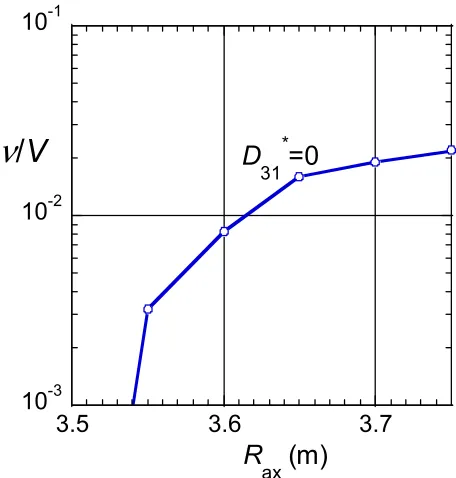
Figure 8 shows theD31*=0 line as a function of the
inverse mean free pathν/Vand the LHD magnetic axisRax
near the rational surfaces where the rotational transform,
Fig. 8 VENUS+δfbootstrap current coefficientsD31*=0
con-tour as a function of the inverse mean free pathν/Vand the magnetic axis positionRaxnear the rational surfaces
Siwithι=1.0 for the LHD configuration.
equals to 1.0. The zone below this line corresponds to pos-itive bootstrap current density (the island width will be de-creased), the zone of parameters above the lineD31* =0
corresponds to a negative bootstrap current density (the is-land will be enlarged).
6. Main Results and Future Plans
This paper describes the bootstrap current coeffi -cient calculations performed with the VENUS+δf code for LHD configurations in different collisionality regimes. Good qualitative agreement of the VENUS+δf code re-sults with the LHD experimental rere-sults and with the SPBSC predictions has been obtained provided significant simplifying assumptions for the collisional regime with the inverse mean free pathsν/V = 0.003 - 0.010 [1/m], which are typical for LHD discharges. The main experi-mental dependence of the bootstrap current with respect to the magnetic axis outward shift has been reproduced both with the SPBSC and VENUS+δf codes. In accordance with the VENUS+δf calculation in the wide collision-ality range, the SPBSC code predictions (semi-analytical Shaing-Callen limit) correspond to the VENUS+δf re-sults for the extreme long-mean-free-path regime (ν/V 10−6[1/m]).
for the bootstrap current coefficient. The VENUS+δfcode consumes large computer resources to achieve a steady-state solution with small fluctuations. Large fluctuations of the solution are connected with the Monte Carlo method and with a large number of lost particles in the LHD con-figurations [20]. Possible solutions for the VENUS+δf code are further improvement of the code performance, the usage of new large scalar clusters or vectorisation of the code for corresponding supercomputers [21].
For high collisional regime, the negative bootstrap current is also predicted in the torus-outward shifted mag-netic axis configuration. The magmag-netic axis location, of which bootstrap current is negative, moves more torus-outwardly. However, the IDB/SCD plasma, with ν/V = 0.03 - 0.10 [1/m], which is the typical high collisionality plasmas in LHD, poses additional difficulties for the boot-strap current calculations connected with the complicated island structure of the magnetic surfaces. The bootstrap current coefficient, calculated for this regime with nested magnetic surfaces by VENUS+δf is relatively small. This result confirms the DKES code calculations, performed for the LHD model configuration. However, accurate calcula-tions of the total bootstrap current for such configuracalcula-tions with an island structure and with real experimental col-lisionality profiles constitute a future programmatic task. This task is considered as part of a more general problem, meaningful both for tokamaks and stellarators — the prob-lem of transport calculations in real 3D configurations with self-consistent island equilibria [22].
On the bootstrap current effects on the island in ι = 1 surface, the direction of bootstrap current is sensitive to the magnetic configurations and the collisionality. In more torus-outward shifted magnetic axis configuration with more collisionless plasmas, the healing effect due to bootstrap current is expected more effective.
Acknowledgements
The authors thank S.P. Hirshman for providing us the VMEC code. The work was supported by NIFS/NINS under the Project of Formation of International Network
of Scientific Collaborations (Japan), by NIFS under Con-tract No. NIFS06ULHH519, by the Fond National Su-isse pour la Recherche Scientifique, by Max-Planck Insti-tute f¨ur Plasmaphysik, by Euratom, by the Department of Atomic Science and Technology, RosAtom (Russia).
The computational results were performed at the Pleiades2 cluster (EPFL, Switzerland), on the NEC-SX8 and Opteron cluster (NIFS, Japan), and at the RZG (Garch-ing, Germany).
[1] O. Motojimaet al., Nucl. Fusion43, 1674 (2003). [2] N. Ohyabuet al., Plasma Phys. Contr. Fusion 48, B383
(2006).
[3] K. Shaing and J. Callen, Phys. Fluids26, 3315 (1983). [4] K.Y. Watanabeet al., Nucl. Fusion32, 1499 (1992). [5] W.A. Cooperet al., Plasma Phys. Control Fusion44, B357
(2002).
[6] W.I. Van Rij and S. Hirshman, Phys. Fluids B 1, 563 (1989).
[7] C.D. Beidleret al., Proc. 14th Int. Stellarator Workshop, Greifswald, Germany 2003.
[8] M.Yu. Isaevet al., Fusion Sci. Technol.50, 440 (2006). [9] K. Allmaieret al., CDROM with Proc. Of Joint Conf. of
17th Int. Toki Conf. on Physics of Flow and Turbulence in Plasmas and 16th Int. Stellarators/Heliotrons Workshop, 2007, P2-029. P.615.
[10] K.Y. Watanabeet al., Nucl. Fusion35, 335 (1995). [11] K.Y. Watanabeet al., J. Plasma Fusion Res. SERIES5, 124
(2002).
[12] F. Hinton and R. Hazeltine, Rev. Mod. Phys. 48, 239 (1976).
[13] A. Boozer and H. Gardner, Phys. Fluids B2, 2408 (1990). [14] S. Hirshman and J. Whitson, Phys. Fluids26, 3553 (1983). [15] D. Andersonet al., J. Supercomput. Appl.4, 34 (1990). [16] A. Bergmann, A. Peeters and S. Pinches, Phys. Plasmas8,
5192 (2001).
[17] A. Boozer and G. Kuo-Petravich, Phys. Fluids 24, 851 (1981).
[18] N. Ohyabuet al., Phys. Rev. Lett.97, 055002 (2006). [19] M. Mikhailov and V. Shafranov, Nucl. Fusion 30, 413
(1990).
[20] A. Wakasaet al., J. Plasma Fusion Res. SERIES6, 203 (2004).
[21] S. Satakeet al., Nucl. Fusion45, 1362 (2005).
![Fig. 3VENUS+δ f bootstrap current coefficients D31* versusthe normalized plasma radius r/a for the LHD configura-tions with different magnetic axes positions Rax = 3.90 m(diamonds), 3.95 m (circles), 4.00 m (squares), 4.05 m(crosses), 4.1 m (triangles) for the collisional regime withν/V = 0.003 [1/m] (a) and ν/V = 0.010 [1/m] (b).](https://thumb-us.123doks.com/thumbv2/123dok_us/8445572.1703084/3.595.313.544.313.681/bootstrap-coecients-versusthe-normalized-congura-dierent-positions-collisional.webp)
![Fig. 4SPBSC bootstrap current coefficients D31* versus thenormalized plasmas radius r/a for the LHD configura-tions with different magnetic axes positions Rax = 3.90 m(diamonds), 3.95 m (circles), 4.00 m (squares), 4.05 m(crosses), 4.10 m (triangles) for the collisional regimewith νth/Vth = 0.003 [1/m].](https://thumb-us.123doks.com/thumbv2/123dok_us/8445572.1703084/4.595.316.544.65.452/coecients-thenormalized-congura-dierent-positions-triangles-collisional-regimewith.webp)
![Fig. 6DKESbootstrapcurrentcoefficients(squares),VENUS+δ fbootstrapcurrentcoefficients(linewith circles) and Shaing-Callen limit (dotted line) for thetest LHD configuration at r/a = 0.5 with Rax = 3.75 m asa function of the inverse mean free path ν/V [1/m] withzero radial electric field.](https://thumb-us.123doks.com/thumbv2/123dok_us/8445572.1703084/5.595.55.281.526.691/dkesbootstrapcurrentcoecients-fbootstrapcurrentcoecients-linewith-circles-conguration-function-withzero-electric.webp)