http://www.ijcmph.com pISSN 2394-6032 | eISSN 2394-6040
Original Research Article
Mothers’ knowledge, attitude and self efficacy of clean home birthing
practices in a rural community of Kenya
Julius K. Mwangi
1, Anne M. Pertet
2*
INTRODUCTION
Globally, 33% of children are born home, and in sub-Saharan Africa, 55% of women deliver at home1. In Kenya, 38% of the children are born at home. A quarter (25%) of the mothers are delivered by a Traditional Birth Attendant (TBA), 21% are assisted by relatives or friends while 7% give birth by themselves 2. Hygienic practices during home birthing are essential in the prevention of infections to the mother and baby and prevention of neonatal deaths. The World Health Organization (WHO) stipulates six cleans which should be implemented during
the birthing process. These include hand washing by birth attendants before birth, clean cord tie, and clean delivery service, clean perineum, clean cord cutting instruments and clean clothing for draping,3. These practices could be facilitated at the health centre by nurses, midwives, and at home by TBAs or family members, who have the necessary skills and knowledge.
A systematic review of multiple databases on a clean birth and postnatal care practice to reduce neonatal deaths from sepsis and tetanus, estimated that neonatal tetanus mortality was reduced by 15% by clean birth practice at ABSTRACT
Background: In Kenya, approximately 38% of the children are delivered at home. Thus, hygienic practices during home birthing are essential in the prevention of infections to the mother and baby as well as prevention of neonatal deaths. The purpose of our study was to establish mothers’ knowledge, attitude and self-efficacy of clean birthing which would help her influence the behaviour of those assisting her during child birth. We used a correlational, cross-sectional design to examine the relationships knowledge, attitude, and self-efficacy and clean birthing practices.
Methods: We collected data using a structured questionnaire through face to face interviews in Olkalou sub-county, Nyandarua County, Kenya. They consisted of 374 mothers of reproductive who had delivered at home six months before the start of the study. Multi-stage sampling technique was used to select the study sample. Likert scale was used to assess attitude and self-efficacy.
Results: Close to 2/3rd of the babies were delivered at home by friends, relatives, traditional birth attendants (TBAs) or self-delivered. Cleanliness during home birthing was sub-optimal. Clean home birthing was associated with mothers’ knowledge (odds ratio=1.70) and marital status (OR=2.9).
Conclusions: Despite the advocacy on skilled birth attendants, women continue to deliver at home, thus the need to empower mothers with knowledge, positive attitudes and self-efficacy on clean home birthing to reduce infections during childbirth.
Keywords: Clean home delivery, Home birth, Skilled birth attendant, Attitude, Self-efficacy, Perceptions, Knowledge, Marital status
1
Ministry of Health, 2Research Department, Great Lakes University of Kisumu
Received: 23 February 2018
Revised: 21 March 2018
Accepted: 22 March 2018
*Correspondence:
Dr. Anne M. Pertet, E-mail: [email protected]
Copyright: © the author(s), publisher and licensee Medip Academy. This is an open-access article distributed under the terms of the Creative Commons Attribution Non-Commercial License, which permits unrestricted non-commercial use, distribution, and reproduction in any medium, provided the original work is properly cited.
home and 27% in a health facility. The authors concluded that clean birth and particularly postnatal care practices are effective in reducing neonatal deaths from sepsis and tetanus.4 Mothers are a critical factor in influencing clean birth practices during home delivery if she has the proper knowledge, attitude and self-efficacy to change clean birth by the person attending her during home delivery.
Recent studies conducted in Africa show variations in the proportion of home birth attendants who washed their hands before the birth of the baby. These ranged from 30 to 79%. Use of clean razor blade to cut the cord was almost universal (over 90%), except in Uganda where it was 57%.5,8,9 Applying unsterile substance to the cord such as mustard oil, oil, ghee, turmeric and disinfectants baby powder, spirit, herbs, soapy water or salty water can cause cord infections was almost.6,10
Recent studies conducted in Africa show that the proportion of women with knowledge or aware cleanliness during home-based births was low (20 to 29%).6,11,12 However, a study carried in Ghana found higher proportions (71%). Empirical studies indicate that a small percentage age of mothers had the confidence to suggest proper cleanliness to the home birth attendants. These ranged from 3% to 37%.5,6,12,13 Other authors have found that marital status and religion of the mother had an association with hygienic practices.13 Another study from Uganda showed new-born care practices did not differ much from the socioeconomic group.9
Most of the studies we came across were mainly descriptive and qualitative and were not analytical they did not establish relationships. The studies furthermore, focused on behaviour and knowledge of Traditional Birth Attendants and not the knowledge of mothers they were assisting. In other words, ‘did the mother know what to expect from the people assisting her during delivery as far as cleanliness was concerned? The purpose of our study was to establish the knowledge, attitude and self-efficacy of mothers regarding clean home birthing practices.
METHODS
Design and setting of the study
We used a correlational, cross-sectional design to examine the relationships between knowledge, attitude, and self-efficacy and clean birthing practices. We used a structured questionnaire to collect quantitative data through face to face interviews. Olkalou sub-county which has eleven health facilities, one district hospital, four health centers and six dispensaries was selected for the study. The number of women of reproductive age in the sub-county is estimated to be 36,488. The proportion of women who deliver children at home is approximately 60%.
Study participants
The study targeted mothers of reproductive age 15 to 49 years who had delivered at home six months before the start of the study (September 2014). These mothers were the study respondents, and they also served as the unit of analysis. Mothers who had given birth at home in the past six months but were mentally unsound had lost a child during that period or could not communicate in either English Swahili or Kikuyu were excluded from the study.
Fisher et al. (1998) Formulae n=z2 pq/d2 was used to calculate the sample size. n=sample size. z=standard derivation which corresponds to a confidence interval (1.96), the p=proportion of study population who deliver at home (.60) and d=degree of accuracy (0.05), giving a sample size of 374 mothers.
Simple random sampling technique was used to select Olkalou Sub-County from Nyandarua's five sub-counties. Kaimbaga division of Olkalou sub-county was purposively selected from the five divisions comprises because it had the highest number of home deliveries.14 Kaimbaga division has three community units (CUs) which keep monthly registers of home births. The records contain the village and household number. We started with the community unit which had the highest number of home births and moved to the other community units. The first mother on the register who had delivered at home in the previous six months at the beginning of the study was picked, and other mothers who fitted the study criteria were chosen consecutively until the required sample was achieved. The mothers were interviewed in their homes.
Data collection methods
“do you know giving birth at home is wrong or not
acceptable?” We avoided references to unpleasant
occurrences such as death from home-based childbirths. Creating discomfort, by compelling the respondents to say something they did not intend to say was also avoided. Interviews ranged from 15 to 25 minutes. Due to low literacy levels, the survey was administered through a face-to-face meeting.
Measurement of variables
Attitudes are determined by behavioral beliefs that the behavior leads to specific outcomes and his or her evaluations of these outcomes. For this study, the attitude was measured by statements covering the five cleans, e.g.
‘How certain are you that washing hands with soap and
water reduces the risks of spreading the infection to the infant during delivery. Each belief had a strength: not at all certain (0), slightly certain= +1, quite certain+2 extremely certain +3. Self-efficacy s was measured using statements based on the five cleans, e.g. ‘if a home birth attendant starts delivering me without washing hands with soap and water I would feel comfortable to remind them’. A 5 point Likert scale (1) strongly disagree (2) Disagree (3) Unsure (4) Agree (5) strongly agree was used. Knowledge was computed using a set of yes/no statements related to five cleans such as ‘risk of spreading an infection to infant decrease if the birth attendant does not wash hands with soap and water’.
Clean home birth practices were measured using the actual practice of the home birth attendant as recalled by the mother with yes/no questions like ‘who delivered your last baby? Did she wash her hands’? The social demographic characteristics were measured using variables such as marital status; age, religion, and education as the highest level reached using the Kenyan education system.
The research proposal was approved Great Lakes University of Kisumu, University's Institution Review Board (IRB). Permission to conduct the research was given by the County health ministry and local leaders. Codes were used against the names and households to facilitate follow up, which was kept by the principal researcher. Only codes appeared on the survey tool. The voluntary and informed consent form was used. Mothers had the option to refuse to answer sensitive questions and were free to withdraw from the study at any time. Informed consent included information regarding the purpose of research, study, and guarantee of confidentiality.
Data management and analysis
Software package for social sciences (SPSS) Version 20 was used to enter and analyse the quantitative data. Descriptive statistics such as mean, mode, and median were used to describe continuous variables such as age, Likert scores derived for cleanliness practices; and self-efficacy, attitude, and knowledge. Likert scales were used as continuous variables. Social demographic
characteristics were also divided into categories. Contingency tables and chi-squares were then used to show the associations between the dichotomous variables. Pearson Chi squire statistics were used to test for associations between the independent variables and the dependent variable. Fisher test was used when a category in the cells had less than five counts. Binary logistic regression was used to indicate which of the categorical variables were important in explaining the cleaning practices. The Wald statistic which has a chi-square distribution provided an index of the significance of each predictor in the equation. A significance p value of less than 0.05 was used. The odds ratio (OR) >1 was used to measure effect size.
RESULTS
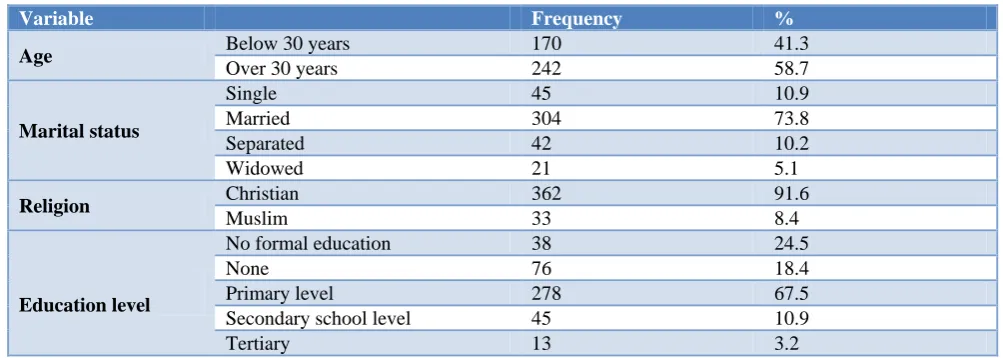
Socio-demographic characteristics of the sample Table 1 shows the social demographic characteristics of the study sample. Mother’s age ranged from 15 to 49 years, with a mean of 32±7.5 years. Four (4%) of the mothers were teenagers. About 1/5th (18%) had no formal education, 2/3rds (68%) had primary school education, and only 3% had tertiary education. The majority of the mothers were Christians (87%) while the rest were Muslims. Three quarters (74%) of the mothers were married. Demographic characteristics of the index child show that the proportion of boy children was 49.8% and for girls 50.2%.
Choice of home birth attendants (HBA)
Results indicate that close to two thirds (64%) of the babies were delivered by a friend or relative; 15% by TBAs, 18% of the mothers delivered by themselves while a skilled midwife delivered 4% of the mothers. Chi squire tests show a significant association between the choice of birth attendant and education of the mother, marital status, mothers age, and parity (p<0.05). A woman who had given birth more than two times was twice likely to deliver at home than women with less than two births. The odds of a woman who was more than 30 years delivering by herself was twice that of a woman aged less than 30 years, while the odds of a woman who was single delivering by herself was three times that of a woman who was married.
Clean delivery practices ofHBAs
Overall 60% of the HBAs washed their hands before delivery, only 9% used soap and water; 58% wore clean gloves; 12% had a clean home delivery kit (CHDK). However, the kit was in most cases incomplete as only 47% had new razor blades, 20% had soap, and 33% had a thread. Half (50%) of the women were delivered on a clean polythene sheet; 30% used a new razor blade and almost used a clean thread to tie the cord. About 1/5th (26%) applied methylated on the cord. The rest applied substances like powder 37%, oil, 36% and saliva %.
Table 1: Socio-demographics of the study sample (n=412).
Variable Frequency %
Age Below 30 years 170 41.3
Over 30 years 242 58.7
Marital status
Single 45 10.9
Married 304 73.8
Separated 42 10.2
Widowed 21 5.1
Religion Christian 362 91.6
Muslim 33 8.4
Education level
No formal education 38 24.5
None 76 18.4
Primary level 278 67.5
Secondary school level 45 10.9
Tertiary 13 3.2
Following factors were associated with clean home birthing: knowledge of clean birthing (adjusted odds ratio [OR]=1.70), marital status (OR=2.9). Attitude and self-efficacy and other social demographic factors were
Binary logistic regression was used to show which of the categorical variables were important in explaining the cleaning practices. Statistical tests of each regression coefficients (i.e., s) were tested using the Wald chi-square statistic. The results show that only the marital status explained the choice of birth attendant (p<0.0.001). Coefficients (i.e s) was however less than 1 (0.309).
DISCUSSION
Most studies on clean home births have focused on traditional birth attendant (TBAs). Our study focused on whether the woman being assisted during birth possess the necessary knowledge, attitude and self-confidence related to clean birthing to influence those assisting her.
Cleanliness during home birthing was sub-optimal. Though hands were washed in 2 out of 3 deliveries only 1 in 10 home births was soap and water used. Marital status and knowledge of clean birthing were crucial factors explaining the clean home birthing. Mothers’ knowledge was significantly associated with clean birthing, indicating that the importance of empowering mothers with knowledge to improve clean birthing practices. The mother’s attitude, self -efficacy, knowledge were not related to clean home birthing.
Hand washing before delivery of 60% was much higher compared to that found from other African studies which ranged from 30 to 46. However, these other African studies did not report the use of water and soap. Use of new razor to cut the cord was much lower, than that found in other African countries which were over 90%,%, except in Uganda (57%).5,6 However, use of new thread to tie the cord high, which was consistent with that found in other African countries of over 90%. Application of
substances was relatively low compared to that found in other African studies where the application was nearly universal.6,9 Low level of knowledge of clean birthing practices was found in other descriptive studies from Africa.6,11,12 Low self-efficacy found in our study was also consistent with that found from other parts of Africa.6,12
Virtually all the studies reviewed were descriptive. However, we demonstrated a positive relation between knowledge and marital status clean birthing practices.
Strengths
Though many studies have focused on the behaviour of traditional birth attendants (TBAs), we did not come across any study which focuses on significant others who assist mothers to deliver babies at home. It is particularly crucial to empower the mothers themselves so they have a say insist on clean birthing practices when she is being delivered. This study contributed additional knowledge on the role these other persons play in the clean delivery of new-borns at the household level in Kenya. The study, therefore, provided a unique contribution to the literature in relation this aspect. On the other hand, most of the reviews on this topic were descriptive, thus our study which is analytical highlights cultural factors of attitude and self-efficacy as areas that need to be addressed in interventions.
Limitations
of information provided in any self-reported recall practice. Our research design was cross-sectional and as such the data limits the ability to draw any causal conclusions on the relationships found. Though unclean handling of the cord opens opportunities for sepsis, we were not able to immediately ascertain adverse effects of unclean handling of the cord. However, despite these limitations, our results have shed light on critical areas of home birthing that need urgent pragmatic intervention.
CONCLUSION
Despite the advocacy on skilled birth attendants, women continue to deliver at home, thus the need to put more emphasis on clean home birthing.
Given that home birthing may continue for some time in developing countries, strategies to ensure clean home deliveries need to focus on all women of reproductive age. Particular focus is necessary for attitude and self-efficacy as these are not addressed in interventions.
ACKNOWLEDGEMENTS
We would like to acknowledge Ol Kalou sub-county staff for facilitating the data collection. Our thanks also go to the women for cooperating in the study. We also appreciate the data collectors for the excellent work. We acknowledge the technical input from Dr. Ngatiri
Funding: No funding sources Conflict of interest: None declared
Ethical approval: The study was approved by the
Institutional Ethics Committee of The Great Lakes
University of Kisumu
REFERENCES
1. UNICEF. The State of the World’s Children 2014; 2014. Available at: http://www.unicef.org/sowc2014 /numbers/documents/english/SOWC2014%7B_%7 DIn%5CnNumbers%7B_%7D28%5CnJan.pdf. Accessed on 3 January 2018.
2. KDHS. Kenya 2014 Demographic and Health Survey.
3. WHO World Health Organization, Cooper P, Johnson R, et al. Managing newborn problems: a guide for doctors, nurses and midwives. WHO Libr Cat Data. 2003: 338.
4. Blencowe H, Cousens S, Mullany LC, Lee AC, Kerber K, Wall S, et al. Clean birth and postnatal
care practices to reduce neonatal deaths from sepsis and tetanus: A systematic review and Delphi estimation of mortality effect. BMC Public Health. 2011;11(3):11.
5. Saaka M, Iddrisu M. Patterns and Determinants of Essential Newborn Care Practices in Rural Areas of Northern Ghana. Int J Popul Res. 2014;2014:1-10. 6. Penfold S, Hill Z, Mrisho M, Manzi F, Tanner M,
Mshinda H, et al. A large cross-sectional community-based study of newborn care practices in Southern Tanzania. PLoS One. 2010;5(12):e15593.
7. Hill Z, Tawiah-Agyemang C, Okeyere E, Manu A, Fenty J, Kirkwood B. Improving hygiene in home deliveries in rural Ghana: How to build on current attitudes and practices. Pediatr Infect Dis J. 2010;29(11):1004-8.
8. Adelaja LM. A Survey of Home Delivery and Newborn Care Practices among Women in a Suburban Area of Western Nigeria. ISRN Obstet Gynecol. 2011;2011:1-9.
9. Waiswa P, Peterson S, Tomson G, Pariyo GW. Poor newborn care practices - a population based survey in eastern Uganda. BMC Pregnancy Childbirth. 2010;10:9.
10. Mrisho M, Schellenberg JA, Mushi AK, et al. Understanding home-based neonatal care practice in rural southern Tanzania. Trans R Soc Trop Med Hyg. 2008;102(7):669-78.
11. Shamba DD, Schellenberg J, Penfold SC, et al. Clean home-delivery in rural southern tanzania: Barriers, influencers, and facilitators. J Heal Popul Nutr. 2013;31(1):110-117.
12. Tann CJ, Kizza M, Morison L, et al. Use of antenatal services and delivery care in Entebbe, Uganda: A community survey. BMC Pregnancy Childbirth. 2007;7.
13. Bream KDW, Gennaro S, Kafulafula U, Mbweza E, Hehir D. Barriers to and facilitators for newborn resuscitation in Malawi, Africa. J Midwifery Women’s Heal. 2005;50(4):329-34.
14. Republic of Kenya Nyandarua County Integrated Development Plan. 2013.
Cite this article as: Mwangi JK, Pertet AM. Mothers’ knowledge, attitude and self efficacy of clean home birthing practices in a rural community of Kenya. Int J Community Med Public Health