http://www.ijcmph.com pISSN 2394-6032 | eISSN 2394-6040
Original Research Article
Factors associated with utilization of antenatal care services among
rural women, Telangana, India
Biranchi Narayan Das
1, Seshasai Kanakamedala
2, Mahesh Kumar Mummadi
1*
INTRODUCTION
Maternal mortality ratio (MMR) is an important indicator of women health, both morbidity and mortality. It represents the risk associated with each pregnancy and childbirth.1
It is also a key priority in the new Sustainable Development Goals (SDGs), to be achieved through ending preventable maternal mortality (EPMM) strategies by 2030. The target is to reduce the MMR to less than 70 globally and to two-thirds from their 2010 baseline at national level.2
ABSTRACT
Background: Antenatal care is the essential health care extended to pregnant women. Complete antenatal health care includes four antenatal visits, 2 TT injections, and consumption of 100 Iron and Folic acid tablets. In Telangana state the proportion of mothers received full ante natal care in rural area is only 37.3%. Hence, the present study conducted with an objective to assess the factors associated with utilization of antenatal care services among rural women in Telangana state.
Methods: The study is a community based cross sectional study. It was conducted in villages of Moinabad Mandal of Telangana state. Sample size was calculated to 373.Out of 26 villages 20 villages were chosen randomly and from each village 20 houses were selected by stratified random method. Married women delivered at least one child during last five years were included. Pretested questionnaire was administered. The data were tabulated in MS Excel and analyzed by SPSS.
Results: Among 373 participants, 89.3% mothers registered during 1st trimester, 92.8% confirmed their pregnancy in the Government sector, 81.3% mothers had four or more antenatal visits, nearly 87.7% mothers received two doses of TT and 77.2% had taken more than 100 Iron tablets. The factors identified to be having statistically significant (p< 0.05) association with better utilization of antenatal care were age at child birth >25 years, education10th class and above, Working mothers, first child birth, Socioeconomic class I- IV and early registration. On application of simple logistic regression predictors were found to be age, education, occupation, birth order, SES and early registration.
Conclusions: Awareness should be made by the ASHA workers, ANMs and Anganwadi workers through better education and motivation of the target groups such as young mothers, homemakers, low socio-economic status groups and late registered mothers for better utilization.
Keywords: Utilization, Antenatal care, Rural Telangana, Maternal health, EPMM
1Department of Community Medicine, Apollo Institute of Medical Sciences, Jubliee hills, Hyderabad, Telangana, India 2
MBBS, Apollo Institute of Medical Sciences, Jubliee hills, Hyderabad, Telangana, India
Received: 16 May 2018
Revised: 03 June 2018
Accepted: 04 June 2018
*Correspondence:
Dr. Mahesh Kumar Mummadi, E-mail: [email protected]
Copyright: © the author(s), publisher and licensee Medip Academy. This is an open-access article distributed under the terms of the Creative Commons Attribution Non-Commercial License, which permits unrestricted non-commercial use, distribution, and reproduction in any medium, provided the original work is properly cited.
Antenatal care (ANC) is the essential preventive health care which allows regular check-ups to pregnant mothers by the doctors or midwives throughout the course of the pregnancy to achieve a healthy mother and healthy baby, thus reducing both maternal and infant mortality and morbidity.3 It is the endeavour of World Health Organization (WHO) and all national governments to provide the antenatal care to all pregnant women irrespective of their cast, creed and paying ability.4
WHO on antenatal care for positive pregnancy experience recommends basic ANC model which includes four ANC visits occurring between 8 and 12 weeks of gestation, between 24 and 26 weeks, at 32 weeks, and between 36 and 38 weeks which include physical, abdominal examination, laboratory investigations, ultrasound of the pregnant women and protection against anaemia, tetanus along with prenatal advice.5
As per National Family Health Survey (NFHS) -4 Indian guidelines the complete antenatal care includes minimum four antenatal visits at least one in first trimester, two injections of tetanus toxoid and consumption of 100 tablets of iron & folic acid or equivalent syrup.6
In the year April 2005 the government of India launched National Rural Health Mission (NRHM) to strengthen the primary health care. To address the problem of safe motherhood government created post of Accredited Social Health Activist (ASHA) worker to be interface between the pregnant women and health care system7.
India has successfully reduced maternal mortality ratio from 212 deaths per 100,000 live births in 2007 to 167 deaths in 2013.8 This advance is largely due to key government interventions such as the Janani Suraksha Yojana (JSY) scheme under RCH programme which encompasses pregnancy tracking, early registration, free antenatal care, free Institutional delivery and financial assistance.9
Despite sustained effort by the government of India, the utilization of antenatal care services is not up to satisfactory level especially in rural areas. As per the National data of last decade, utilization of antenatal care services was as poor as 60% in rural India.10-12 As per NFHS-4 Telangana guidelines (2015- 16) the proportion of mothers who had received full Antenatal care in rural Telangana is only 37.3% which is much below despite existing facilities.9,13
Lot of research activities have been done by many authors to find out the various socio demographic factors which play a significant role in determining the determinants for utilization. Studies conducted by Roy, Danasekaran, Augus, Singh, Abosse, Edward, Viddler, Munuswamy, Gupta, Adhikari, Bhatia, etc. found that age, education, socio economic status, timing of registration, birth order, geographic areas, cultural factors, etc have significant association with complete utilization of antenatal care.14-24
In view of above, the present study is planned to study the factors associated with the utilization of antenatal care among women of rural Telangana.
Aims and objectives
To assess the factors associated with utilization of antenatal care services among rural women in Telangana state.
METHODS
The study is a community based cross sectional study. It was conducted in villages of Moinabad Mandal of Ranga Reddy district of Telangana state from July to September 2017. Moinabad has got 26 villages having population of 56,025. The total population constitutes 29,032 Male and 27,173 female with sex ratio of 936 female to 1000 male.
Population is mostly Hindu (84%) and Muslims (16%). The literacy rate of male and female are 82.11% and 69.4% respectively. Main occupations are agriculture and daily laborers. Majority of people are below poverty line (BPL) category. About 25% of populations were scheduled casts and scheduled tribes.
The prevalence rate of complete utilization of antenatal care services in rural Telangana is 37.3 percent as per NFHS 4 data. On the basis of prevalence, the sample size was calculated with 95% confidence interval by the formula 4 PQ/L2 where P=37 and Q=(100–37=63) and L=5. It comes out to be 373. The sample size was rounded to 400 to cater for the dropouts and the unwilling.
For the study married women aged 15-49 yrs who has delivered at least one child during last five years preceding the survey was considered. A woman was considered as having complete ANC, if she had made four ANC visits, received two doses of tetanus toxoid (TT) injections and consumed 100 iron& folic acid (IFA) tablets or equivalent syrup during the last pregnancy.
Out of 26 villages in Moinabad 20 villages were chosen by simple random method. The lists of recently delivered women of selected villages were collected from ASHA workers and Anganwadi centres. From each selected village 20 houses were selected by stratified random sampling method, starting from the centre of village as first house. The interview of women was conducted through a pretested structured questionnaire. Before interview she was explained about the study and her willingness was taken in a written consent form. Any house found locked or the woman is unwilling next house was interviewed.
time of registration, number of antenatal visits, number of tetanus injection taken, number of iron and folic acid were taken, basic investigations done, any complications, place of delivery preferred.
The study was carried out after obtaining clearance from the Institutional Ethical committee. For Socio-economic classification modified BG Prasad scale was applied.
Statistical analysis was done by entering data in Microsoft Excel work sheet. It was analyzed by using SPSS Version 19.0. The percentages of independent variables were found out. Chi square value and p value were found out to see any degree of association between the independent variables and outcome variable i.e. full antenatal care. Simple logistic regression was applied and odds ratio and 95% confidence interval were calculated to find out the predictors.
RESULTS
The study included 373 mothers from rural Moinabad area (Table 1). Among them, 48.3% (180) were in the age below 25 years, 51.7% (193) were above 25 years at the time of childbirth. Among mother’s religion 85.3% (318) were Hindus and 14.37% were Muslims. As per caste of study mothers 35.7% (133) were scheduled castes / Scheduled tribes and 64.3% (240) were backward and other classes.
Table 1: Socio-demographic factors of antenatal care utilization mothers (n=373).
Factors Number %
Age of mother
Below 25 years 180 48.3
Above 25 years 193 51.7
Education
Below 10th class 186 49.9
10th class and above 187 50.1
Occupation
Home maker 169 45.3
Working 204 54.7
Religion
Hindu 318 85.3
Muslim & others 55 14.7
Caste
SC/ST 133 35.7
Others 240 64.3
Birth order of child
1 199 53.4
>1 174 46.6
Socio-economic class
Class I- IV 209 56.0
Class V 164 44.0
Early registration
Yes 333 89.3
No 40 10.7
Among the study participant’s education 49.9% (186) were below 10th class, 50.1% (187) were 10th class and above. With regards to their occupation, 45.3% (169) of the mothers were homemakers and 54.7% (204) were unskilled/skilled workers. Among the study mothers 53.4% (199) were having their first child (primi), 46.6% (174) having more than one child. According to modified B. G. Prasad classification, 56.0% (209) of the study subjects belong to socioeconomic class up to IV, 44% (164) belong to class V. Among study mothers 89.3% (333) mothers having early registration (registered during 1st trimester) and 10.7% (40) mothers registered after 1st trimester.
Table 2: Utilization of antenatal care services (n=373).
Variables Number %
Confirmation of pregnancy
Government 346 92.8
Private 27 7.2
Pregnancy registration
Government 345 92.5
Private 28 7.5
Number of ante natal visits
Below 4 visits 70 18.7
4 visits 303 81.3
Number of TT taken
1 Injection 46 12.3
2 Injections 327 87.7
Number of IFA tablet taken
Below 100 85 22.8
100 and above 288 77.2
Basic investigations done
Yes 346 92.8
No 27 7.2
Complications during pregnancy
Yes 172 46.1
No 201 53.9
Delivery preferred
Government Hospital 167 44.8
Private hospital 206 55.2
Full antenatal care availed
Yes 288 77.2
No 85 22.8
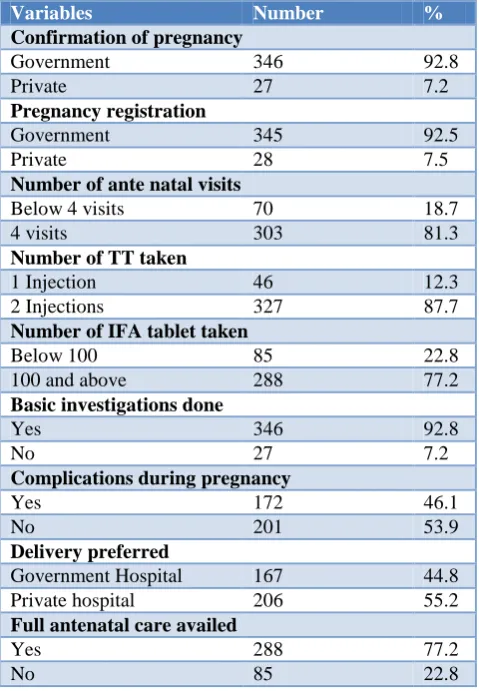
Among the study population, 92.8% (346) have confirmed their pregnancy in the Government sector, 7.2% (27) in Private sector (Table 2).
Regarding the place of registration, around 92.5% (345) got registered with the government sector, 7.5% (28) with private hospital. Of the total mothers, 81.3% (303) had four or more antenatal visits, 18.7% (70) had less than four visits. Nearly 87.7% (327) of the mothers have received two doses of TT, 12.3% (46) have received a single dose. Regarding the intake of IFA tablets, 77.2% (214) had taken more than 100 tablets, 22.8% (85) had less than 100 tablets.
Table 3: Comparison of factors with complete antenatal care services.
Factors Complete antenatal care used Test of significance
Yes (n=288) No (n=85) Total
No. % No. %
Age
<25 years 124 68.9 56 31.1 180 χ2 (df)=13.695 (1) p=0.0002
>25 years 164 85.0 29 15.0 193
Religion χ2 (df)=2.491 (1) p=0.1144
Hindu 241 75.78 77 24.22 318
Muslim 47 85.45 08 14.55 55
Caste χ2 (df)=3.929 (1) p=0.0474
SC/ST 95 71.42 38 28.58 133
Others 193 80.4 47 19.6 240
Education χ2 (df)=14.858 (1) p=0.0001
Below 10th class 128 68.8 58 31.2 186
10th class and above 160 85.6 27 14.4 187
Occupation χ2 (df)=4.43 (1) p=0.3531
Home maker 122 72.18 47 27.82 169
Working 166 81.37 38 18.63 204
Birth order of child χ2 (df)=11.409 (1) p=0. 0007
1 118 67.8 56 14.8 174
>1 170 85.42 29 29.65 199
S.E. status χ2 (df)=4. 603 (1) p=0. 0319
Up to class IV 17011 81.5 39 18.5 209
Class V 8 71.9 46 28.1 164
Early registration χ2 (df)=15.55 (1) p=0. 00008
Yes 267 77.3 66 22.7 333
No 21 52.5 19 47.5 40
Table 4: Comparison of factors associated with complete antenatal care services on simple logistic regression.
Variables Crude OR 95% CI P value
Age
<25 years 1 1.540-4.233 0.0003
>25 years 2.553
Religion
Hindu 0.532 0.241- 1.176 0.119
Muslim 1
Caste
SC/ST 1 1.003-2.689 0.486
Others 1.642
Education
Below 10thclass 1 1.608-4.482 0.0002
10th class & above 2.685
Occupation
Home maker 1 1.033-2.739 0.0363
Working 1.68
Birth order of child
1 1 1.677-4.615 0.0001
>1 2.782
S.E. status
Up to class IV 1.699 1.0441-2.765 .0326
Class V 1
Early registration
Yes 3.660 1.8607-7.199 0.0002
No 1
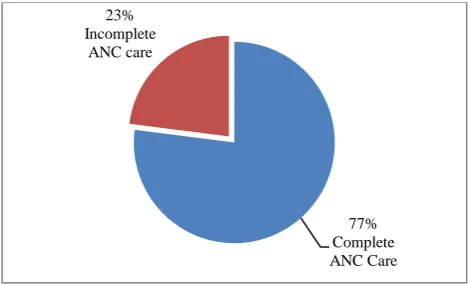
Among the investigations being done during antenatal period, 92.8% (346) have undergone the basic investigations such as Hb%, urine, and weight measurement and 7.2% (27) have not undergone basic investigations. During the antenatal period, 46.1% (172) of the mothers had some complications and 53.9% (201) mothers had no complications. Among study mothers 44.8% (167) mothers preferred private hospitals for delivery than 55.2% (206) who delivered in Government hospital. In the study population 77.2% (288) of the mothers utilized full antenatal care service where as 22.8% (85) mothers did not use the complete care (Figure 1). Comparison of socio-demographic factors of studied mothers with complete utilization of antenatal care services (Table 3).
Figure 1: Proportion of complete utilization of antenatal care and non utilization.
The factors which were identified to be having statistically significant (p<0.05) association with better utilization of antenatal health services were age at child birth - Age >25 years (χ2-13.695; p-0.0002), caste-Others (χ2-3.929; p-0.047), education- 10th class and above (χ2– 14.858; p-0.0001), occupation - working mothers (χ2 -4.43; p-0.3531), birth order of the child- First child (χ2 -14.4227; p-0.0001), socioeconomic class - class I- IV (χ2 -4.603; p-0.031) and early registration- Yes (χ2-15.550; p-0.366.This study did not show Religion of mother statistically significant (χ2-2.491; p-0.1144) in relation to complete utilization of ANC services.
Application of simple logistic regression ( Table-4).On application of simple logistic regression significant association was found between age (OR- 2.553, 95% CI=1.540-4.233), education (OR- 2.685, 95% CI=1.608-4.482), occupation (OR- 1. 68, 95% CI=1.033-2.739) Birth Order (OR- 2.603, 95% CI=1.574-4.305) SES (OR- 1.699, 95% CI=1.441-2.765), early registration (OR- 3.660, 95% CI=1.860-7.199) and caste (OR- 1.642, 95% CI=1.003-2.689.
DISCUSSION
In present study about 92.5% mothers got registered with Government health centers which are little higher in
comparison to 90% mothers as per NFHS-4 Rural India and 92.2% mothers as per NFHS-4 Rural Telangana.
89.3% mothers had registered in 1st trimester which is more than 54.2% as per NFHS-4 Rural India and 79.2% as per NFHS-4 Rural Telangana.
81.3% of study population had 4 antenatal visits or more which is higher than 44.8% as per NFHS-4 Rural India and 72.7% as per NFHS-4 rural Telangana.
87.7% mothers had taken 2 tetanus injections which is similar to both NFHS-4 rural India and Telangana.
Iron and folic acid tablet consumption by 77.2% mothers in the study group is much higher than 25.9% as per NFHS-4 Rural India and 47.5% as per NFHS-4 rural Telangana.
This study found 77.2% mother had complete utilization of ANC care which is much better than16.7% as per NFHS-4 Rural India and 37.3% as per NFHS-4 rural Telangana.
The better utilization of antenatal care services in this study area were found to be due to better education, awareness, motivation by ASHA workers, higher socio-economic status of people, good connectivity and easy accessibility to primary health care center and sub centers. The area is also proximity to urban Hyderabad and also the training area of four private medical colleges in the near vicinity.
The study also observed that 55.2% of antenatal mothers preferred private hospitals for delivery than Government health care centers. The reasons are better care, availability of investigation facility, specialists, availability of emergency care transport service and also affordable charges in private hospitals. Government hospitals though free of charge do not meet requirement because of far off, high travelling time and lack of advance specialist care.
Sub centers and Anganwadi are preferred by the mothers for early detection and initial registration for pregnancy to get the benefits of government incentives and the immunization.
Many studies have been conducted by various authors to find out the determinants of utilization of antenatal care services in underserved areas.
Study conducted by Roy et al found 85.5% beneficiaries received three antenatal visits in rural Lucknow, Uttar Pradesh, despite all the facilities available.14 Danasekaran et al observed 59.51% of mothers in fishermen community in Kanchipuram were found having three or more antenatal visits.15 Study conducted by Adhikari et al found that the utilization is from 4% to 14% in tribal
77% Complete ANC Care 23%
areas of Rajasthan, Chattisgarh, Orissa and Madhya Pradesh.23
Most of the authors such as, Auguset al zeine Abosse et al, Edward et al Munnuswamy et al, Gupta et al observed education and socio-economic status are the main determinants of utilization of antenatal care services which is similar in present study.16,18,19,21,22
CONCLUSION
The conclusion of this study is the maternal age above 25 years, maternal education above 10th class, higher socio-economic status, first birth, working mothers and early registration of pregnancy play statistically significant role in better utilization of complete antenatal care. Religion has got no role in better utilization though the caste of pregnant mother plays a significant role.
Summary
In summary, in this study in Moinabad village it was found that though the full utilization of antenatal care is higher in comparison to NFHS 4 India and Telangana data, but still 22.8% beneficiaries are not utilizing it. So, more awareness should be made by the ASHA workers, ANMs and Anganwadi workers through better education and motivation of the target groups such as young mothers, homemakers, low socio-economic status groups, scheduled castes and the beneficiaries coming late for registration.
ACKNOWLEDGEMENTS
I would like to Thank to Dr Dilip Mathai, Dean, AIMSR, Hyderabad, Dr Snigdha Patnaik, HOD, Community medicine, AIMSR, Hyderabad for giving me the moral support in conducting present study. I would also like to thank all my participants in the present study.
Funding: Indian Council of Medical Research- Short Term Studentship
Conflict of interest: None declared
Ethical approval: The study was approved by the Institutional Ethics Committee
REFERENCES
1. WHO/ Maternal Mortality Ratio (per 100,000 child births). Available at: http://www.who.int/health info/statistics/indmaternalmortality/en/. Accessed on 17 April 2018.
2. The Sustainable Development Goals and Maternal Mortality. Available at: https://www.mhtf.org/ topics/the-sustainable-development-goals-and-maternal-mortality/. Accessed on 17 April 2018. 3. Antenatal Care Routine Care for the Healthy
Pregnant Woman, NICE Clinical Guidelines, No. 62. Available at: https://www.ncbi.nlm.nih. gov/pubmed/. Accessed on 21 May 2018.
4. Government of India Guidelines for Antenatal care & Skilled Attendance at Birth by ANM /LHV / SNS, Ministry of Health & Family Welfare New Delhi. Accessed on 21 May 2018.
5. WHO Recommendations on Antenatal Care for a Positive Pregnancy Experience. Available from ww.ncbi.nlm.nih.gov/books/NBK409108/, Accessed on 25 April 2018.
6. National Family Health Survey-4 (NFHS-4) 2015-16, India, IIPS, Mumbai, available from http://rchiips.org/NFHS/pdf/NFHS4/India.pdf, accessed on 21 May 2018.
7. National Rural Health Mission RHM - National Health Mission - Government of India, available fromwww.nhm.gov.in/nhm/nrhm.html. Accessed on 18 May 2018.
8. Maternal health/UNICEF available from http://unicef.in/what we do/1/Maternal health. Accessed on 15 May 2018.
9. Janani Suraksha Yojana (JSY), Available at: https://nhp.gov.in/janani-surakshayojana-jsy-_pg-sep 28,2015. Accessed on 15 April 2018.
10. Maternal Mortality, Key facts, 16 Feb 2018, accessed from http://www.who.int/en/news-room/fact-sheets/detail/maternal-mortality.
Accessed on 15 April 2018.
11. Maternal Mortality Ratio (MMR) (per 100000 live births.www.niti.gov.in/content/maternal-mortality-ratio-mmr. Accessed on 15 April 2018.
12. Back ground –Government of India- National health mission- Criteria for Assessment, available from,
nrhm.gov.in/nrhm-components/rmnch-/maternalhealth/background.html. Accessed on 23 January 2017.
13. National Family Health Survey-4 (NFHS-4) 2015-16, state Fact Sheet Telangana, IIPS, Mumbai, rchiips.org/nfhs/pdf/NFHS4/TG_FactSheet
Accessed on 17 May 2018.
14. Roy MP, Mohan U, Singh SK, Singh VK, Srivastava AK. Determinants of utilization of Antenatal Services in rural India. J Family Med Prim Care. 2013;2(1):55–9.
15. Danasekaran R, Raja P, Ranganathan K. Utilization of Antenatal HealthCare Services among Fishermen Population in Kanchipuram District, Tamil Nadu: A Cross-sectional Study. Indian J Community Med. 2017;42(3):159–62.
16. Yenita A, Shigeko H. Factors influencing the use of antenatal care in rural West Sumatra, Indonesia BMC Pregnancy Childbirth. 2012;12:9.
17. Singh PK, Rai RK, Alagarajan M, Singh L. Determinants of Maternity Care Services Utilization among Married Adolescents in Rural India PLoS One. 2012;7(2):e31666.
18. Abosse Z, Woldie M, Ololo S. Factors Influencing Antenatal Care Service Utilization in Hadiya Zone. Ethiop J Health Sci. 2010;20(2):75–82.
20. Vidler M, Ramadurg U, Charantimath U, Katageri G, Karadiguddi C, Sawchuck D, et al. Utilization of maternal health care services and their determinants in Karnataka State. India Reproductive Health. 2016;13(Suppl 1):37.
21. Munuswamy S, Nakamura K, Seino K, Kizuki M. Inequalities in Use of Antenatal Care and Its Service Components in India. J Rural Med. 2014;9(1):10–9. 22. Gupta RK, Shora TN, Verma AK, Jan R.
Knowledge regarding antenatal care services, its utilization, and delivery practices in mothers (aged 15-49 years) in a rural area of North India. Trop J Med Res. 2015;18:89-94.
23. Adhikari T, Sahu D, Nair S, Saha KB, Sharma RK, Pandey A. Factors associated with utilization of
antenatal care services among tribal women: A study of selected States. Indian J Med Res. 2016;144(1):58–66.
24. Bhatia JC, Cleland J. Determinants of maternal care in a region of South India, Health Transition Rev. 1995;5(2):127-42.
Cite this article as: Das BN, Kanakamedala S, Mummadi MK.Factors associated with utilization of antenatal care services among rural women,