A Fuzzy Graph-based Heuristic Algorithm of
Possibilistic Clustering
Dmitri A. Viattchenin
United Institute of
Informatics Problems
of the NAS of Belarus
Evgeny Nikolaenya
United Institute of
Informatics Problems
of the NAS of Belarus
Aliaksandr Damaratski
United Institute of
Informatics Problems
of the NAS of Belarus
ABSTRACT
In this paper, a heuristic algorithm of possibilistic clustering based on fuzzy graph decomposition is proposed. For the purpose, concepts of fuzzy graph and fuzzy tolerance relation are considered and basic definitions of the heuristic approach to possibilistic clustering are described. An application of the proposed algorithm to the Tamura’s portrait data set is provided and some concluding remarks are stated.
General Terms
Pattern Recognition, Clustering, Algorithm.
Keywords
Fuzzy Graph, Fuzzy Tolerance, Heuristic Possibilistic Clustering, Fuzzy Cluster, Allotment, Tolerance Threshold, Typical Point.
1.
INTRODUCTION
Some notes on fuzzy approach to cluster analysis are presented in the first subsection of the section. The second subsection includes a brief review of investigations in the area of graph-theoretical approach to clustering.
1.1
Preliminary Remarks
Determining a partition of given sample data is an important part in data analysis tasks. Clustering methods use a mathematical model based on similarity measure to determine a suitable partition of the data set. In fuzzy clustering the data is not only partitioned in a number of clusters, but each object is assigned a degree of membership for each cluster.
Heuristic methods, hierarchical methods and objective function-based methods are main approaches in fuzzy clustering. In objective function-based clustering the mathematical model is stated in form of an objective function that evaluates the partition of data with respect to the membership degrees and the underlying similarity or dissimilarity measure. Different assumptions and constraints lead to a variety of basic clustering concepts. If the objective function is differentiable, necessary conditions for the membership degrees and other cluster parameters used in the distance or similarity measure can be derived in order to optimize the objective function. The resulting equations are then alternatively applied in an algorithm to determine the data fuzzy partition [1].
A possibilistic approach to clustering was proposed by Krishnapuram and Keller [2] and the approach can be considered as a special case of fuzzy approach to clustering because all methods of possibilistic clustering are objective function-based methods. On the other hand, constraints in the possibilistic approach to clustering are less strong than
constraints in the fuzzy objective function-based approach to clustering and values of the membership function of a possibilistic partition can be considered as typicality degrees. So, the possibilistic approach to clustering is more general and flexible approach to clustering than the fuzzy approach.
Objective function-based approach in fuzzy clustering is most common and widespread approach. However, heuristic algorithms of fuzzy clustering display low level of complexity and high level of essential clarity. Some heuristic clustering algorithms are based on a definition of the cluster concept and the aim of these algorithms is cluster detection conform to a given definition. Such algorithms are called algorithms of direct classification or direct clustering algorithms [3]. A heuristic approach to possibilistic clustering is proposed in [4].
1.2
Related Works
The problem of finding structures in graphs is an area that has been applied with success to topics as diverse as social networks, the internet and different military applications, to name a few. The problem was considered in detail, for example, by Schaeffer [5] and Fortunato [6].
Since the fundamental Zadeh’s [7] paper was published, fuzzy set theory has been applied to many areas and new concepts were introduced. In particular, fuzzy graphs were considered by Kaufmann [8] and Rosenfeld [9]. So, fuzzy graph-based clustering procedures were elaborated by different researchers.
For example, the method of classification developed from the creation of the subclasses up to their fusion which implies the use of a proximity graph built according to a graduated hierarchy [10]. The method was called unsupervised fuzzy graph clustering and the corresponding UFGC-algorithm is proposed in [10].
On the other hand, an algorithm for hierarchical clustering based on fuzzy graph connectedness algorithm is proposed in [11]. The algorithm applies fuzzy et theory to hierarchical clustering method so as to discover clusters with arbitrary shape. It first partitions the data sets into several sub-clusters using a partitioning method, and constructs a fuzzy graph of sub-clusters by analyzing the fuzzy-connectedness degree among sub-clusters. By computing the
-cut graph, the connected components of the fuzzy graph can be obtained, hence resulting the desired clustering.of fuzzy tolerance relations and fuzzy graphs is presented, basic definitions of the heuristic approach to possibilistic clustering are considered, the general plan of the clustering procedure is proposed, an illustrative example is given and preliminary conclusions are formulated.
2.
A PROPOSED ALGORITHM FOR
FUZZY GRAPH CLUSTERING
Fuzzy tolerance relations and fuzzy graphs are considered in brief in the first subsection of the section. The second subsection includes a consideration of basic concepts of the heuristic approach to possibilistic clustering. A general plan of the proposed FG-AFC-algorithm is presented in the third subsection of the section.
2.1
Fuzzy Tolerances and Fuzzy Graphs
LetX
{
x
1,...,
x
n}
be the initial set of elements and]
1
,
0
[
:
X
X
T
some binary fuzzy relation on}
,...,
{
x
1x
nX
with
T(xi,xj)[0,1], xi,xjXbeing its membership function. Fuzzy tolerance is the fuzzy binary intransitive relation which possesses the symmetry property
T(xi,xj)
T(xj,xi), xi,xjX and the feeble reflexivity property
T(xi,xj)
T(xi,xi),X x
xi j
, .
The
-level
T
of the fuzzy relationT
is defined as the setof ordered pairs of objects (xi,xj)XX at which
T(xi,xj) , where0
1
. In other words, the
-level
T
of the fuzzy relationT
can be defined as}
)
,
(
|
)
,
{(
x
ix
j
X
X
Tx
ix
j
T
.Let
X
be a finite universe andT
be a fuzzy relation onX
with
T(xi,xj) being its membership function. The
-level fuzzy relation ( )
T
of the fuzzy relationT
on theuniverse
X
is defined as
(
,
)
,
(
,
)
(
,
)
) (
)
(
x
ix
jT
Tx
ix
j Tx
ix
jT
, where
1
0
. So, the membership function
T()(
x
i,
x
j)
ofthe
-level fuzzy relationT
() can be defined as follows:
)
,
(
,
0
)
,
(
),
,
(
)
,
(
) ( j i T j i T j i T j i Tx
x
if
x
x
if
x
x
x
x
, (1)where
(
0
,
1
]
. The definition of the
-level fuzzyrelation ( )
T
was proposed in [4].A fuzzy graph, which was considered by Kaufmann [8] and Rosenfeld [9], is a weighted graph. There is a fuzzy tolerance graph
G
(
X
,
T
)
, whereX
{
x
1,...,
x
n}
is the set ofvertices and
T
is fuzzy tolerance on X.Let
G
(
X
,
T
)
is a fuzzy tolerance graph,
T(xi,xj) is membership function ofT
, and
T
is the
-level ofT
.So, a usual graph
(
,
)
X
T
G
is the
-level of thefuzzy tolerance graph
G
(
X
,
T
)
.An
-level fuzzy graphG
()
(
X
,
T
())
can be definedas a fuzzy tolerance graph, where
X
{
x
1,...,
x
n}
is the setof vertices and ( )
T
is the
-level fuzzy tolerance on X.Let
0
0
1
Z
1
be an ordered sequences of threshold values. Thus, we have an orderedsequence of fuzzy graphs
) ( ) ( ) ( )
(
G
G
1G
0G
Z
, because we havethe ordered sequence of fuzzy tolerances
) ( ) ( ) ( )
(
T
T
1T
0T
Z
andT
(0)
T
[4].Let A Ac
1 , , are subsets of vertices, Al,AmX,
}
,
,
1
{
,
m
c
l
,A
l
A
m
, lm, and A Xc l l
1 .So, a connected fuzzy sub-graph ( ) ( , ( ))
A T
Gl l is a
component of the
-level fuzzy graphG
()
(
X
,
T
())
.That is why a family of connected fuzzy sub-graphs
) , ( ( ) )
( A T
Gl l
,
l
1
,
,
c
, ( )1 )
(
G Gc
l
l
is a
classification on the level
(
0
,
1
]
.2.2
Basic Concepts of the Heuristic
Approach to Possibilistic Clustering
Let us remind basic concepts of a heuristic method of possibilistic clustering which was proposed in [4]. The essence of the heuristic approach to possibilistic clustering is that the sought clustering structure of the set of objects is formed based directly on the formal definition of fuzzy cluster and possibilistic memberships are determined also directly from the values of the pair wise similarity of objects.Let
X
{
x
1,...,
x
n}
be the initial set of objects. LetT
be afuzzy tolerance on
X
and
be
-level value ofT
,]
1
,
0
(
. Columns or lines of the fuzzy tolerance matrix arefuzzy sets {A1,...,An}
. Let {A1,...,An}
be fuzzy sets on
X
, which are generated by a fuzzy tolerance
T
. The
-levelfuzzy set ()
{(
i,
A(
i))
|
A(
i)
}
l
x
x
x
A
l l ,l
[
1
,
n
]
isfuzzy
-cluster or, simply, fuzzy cluster. SoA
(l)
A
l,]
1
,
0
(
,A
l
{
A
1,
,
A
n}
and
li is the membershipdegree of the element
xi
X
for some fuzzy clusterA
(l),]
1
,
0
(
,l
[
1
,
n
]
. Value of
is the tolerance threshold of fuzzy clusters elements.The membership degree of the element
x
i
X
for some
otherwise
A
x
x
l i i A li l,
0
),
(
, (2)where an
-level
{
i
|
A(
i)
}
l
x
X
x
A
l ,
(
0
,
1
]
of a fuzzy set Al is the support of the fuzzy cluster
A
(l). So,condition
(
( ))
l l
A
Supp
A
is met for each fuzzy clusterl
A
(),
(
0
,
1
]
,l
[
1
,
n
]
. Membership degree can be interpreted as a degree of typicality of an element to a fuzzy cluster.Let
T
is a fuzzy tolerance onX
, whereX
is the set ofobjects, and
{
,...,
( )}
1) (
n
A
A
is the family of fuzzy clusters forsome
(
0
,
1
]
. The point
el
A
l, for whichli x l e i
argmax ,
x
i
A
l, (3)is called a typical point of the fuzzy cluster
A
(l),
(
0
,
1
]
,]
,
1
[
n
l
. A fuzzy clusterA
(l) can have several typical points. That is why symbol e is the index of the typical point.Let ( )
(
)
{
()|
1
,
,
2
,
(
0
,
1
]}
n
c
c
l
A
X
R
l zc be a
family of fuzzy clusters for some value of tolerance threshold
,
(
0
,
1
]
, which are generated by some fuzzy toleranceT
on the initial set of elementsX
{
x
1,...,
x
n}
. If a condition 0 1
c l li
,
x
i
X
(4)is met for all fuzzy clusters
A
( )R
c(z)(
X
)
l
,l
1
,
c
,n
c
, then the family is the allotment of elements of the set}
,...,
{
x
1x
nX
among fuzzy clusters}
2
,
,
1
,
{
A
( )l
c
c
n
l
for some value of the tolerance threshold
. It should be noted that several allotments)
(
)(
X
R
сz can exist for some tolerance threshold
. That iswhy symbol
z
is the index of an allotment.Allotment
(
)
{
()|
1
,
,
(
0
,
1
]}
n
l
A
X
R
I l of the set ofobjects among n fuzzy clusters for some tolerance threshold
]
1
,
0
(
is the initial allotment of the setX
{
x
1,...,
x
n}
. In other words, if initial data are represented by a matrix of some fuzzyT
then lines or columns of the matrix are fuzzysets Al X
,
l
1
,
n
and
-level fuzzy setsA
(l),l
1
,
c
,
(
0
,
1
]
are fuzzy clusters. These fuzzy clusters constitute an initial allotment for some tolerance threshold
and they can be considered as clustering components.If some allotment
R
( )(
X
)
{
A
( )|
l
1
,
c
,
c
n
}
l z с
,]
1
,
0
(
corresponds to the formulation of a concrete problem, then this allotment is an adequate allotment. In particular, if a conditionX A c l l
1 (5)
and a condition
0
)
(
A
l
A
m
card
,
A
(l),
A
(m), lm,
(
0
,
1
]
(6)are met for all fuzzy clusters
A
(l),l
1
,
c
of some allotment}
,
,
1
|
{
)
(
( ) )(
X
A
l
c
c
n
R
lz
с
for a value
(
0
,
1
]
, then the allotment is the allotment among fully separate fuzzy clusters.Fuzzy clusters in the sense of definition (2) can have an intersection area. If the intersection area of any pair of different fuzzy clusters is an empty set, then conditions (5) and (6) are met and fuzzy clusters are called fully separate fuzzy clusters. Otherwise, fuzzy clusters are called particularly separate fuzzy clusters and
w
{
0
,
,
n
}
is the maximum number of elements in the intersection area of different fuzzy clusters. Forw
0
fuzzy clusters are fully separate fuzzy clusters. Thus, the conditions (5) and (6) can be generalized for a case of particularly separate fuzzy clusters. So, a conditionc X R card X R A X card A card z c z с l c l l
)) ( ( ], 1 , 0 ( ), ( ), ( ) ( ) ( ) ( ) ( 1
(7)and a condition
]
1
,
0
(
,
,
,
,
)
(
( ) ( )
m
l
A
A
w
A
A
card
l m l m(8)
are generalizations of conditions (5) and (6). Obviously, if
0
w
in conditions (7) and (8) then conditions (5) and (6) are met.The adequate allotment
R
с(z)(
X
)
for some value of tolerancethreshold
(
0
,
1
]
is a family of fuzzy clusters which areelements of the initial allotment
R
I(
X
)
for the value of
and the family of fuzzy clusters should satisfy the conditions (7) and (8). So, the construction of adequate allotments}
,
,
1
|
{
)
(
( ) )(
X
A
l
c
c
n
R
сz
l
for every
is a trivial problem of combinatorics.Allotment
R
(
X
)
{
A
( )|
l
1
,
c
}
l
P
of the set of objects
among the minimal number c,
2
c
n
of fully separate fuzzy clusters for some tolerance threshold
(
0
,
1
]
is theprincipal allotment of the set
X
{
x
1,...,
x
n}
.Several adequate allotments can exist. Thus, the problem consists in the selection of the unique adequate allotment
)
(
X
R
c
from the set
B
of adequate allotments,)}
(
{
R
()X
B
cz
, which is the class of possible solutions of the concrete classification problem. The selection of theunique adequate allotment
R
c(
X
)
)}
(
{
R
( )X
B
cz
of adequate allotments must be made on the basis of evaluation of allotments. In particular, the criterion
c l n i li l z cc
n
X
R
F
l 1 1 ) (1
)
),
(
(
(9)where c is the number of fuzzy clusters in the allotment
)
(
)(
X
R
сz and(
)
l
l
card
A
n
,A
( )R
c(z)(
X
)
l
is thenumber of elements in the support of the fuzzy cluster
A
(l),can be used for evaluation of allotments.
Maximum of criterion (9) corresponds to the best allotment of objects among c fuzzy clusters. So, the classification problem can be characterized formally as determination of the
solution
R
c(
X
)
satisfying)
),
(
(
max
arg
)
(
( ) ) ( ) (
F
R
X
X
R
czB X R c z c
. (10)
The problem of cluster analysis can be defined in general as
the problem of discovering the unique allotment
R
c(
X
)
, resulting from the classification process and detection of fixed or unknown number c of fuzzy clusters can be considered as the aim of classification.
2.3
A Plan of the FG-AFC-Algorithm
Let introduce some important concepts. Let)
,
(
( ) )(
X
T
G
is the
-level fuzzy graph for somevalue of tolerance threshold
(
0
,
1
]
and fuzzy sub-graphs) , ( ( ) )
( A T
Gl l ,
l
1
,
,
c
are components of the
-level fuzzy graph
G
()
(
X
,
T
())
. So, the condition (5)and the condition (6) are met.
On the other hand, let
(
)
{
,
,
( )}
1) ( )
( c
c
X
A
A
R
be the
unique adequate allotment among
c
fully separate fuzzy clusters for the value
(
0
,
1
]
. Obviously, that a condition
c
l l
c
X
card
A
R
card
(
)
{
}
1
is met. If a condition
l
lA
card
A
Supp
card
)
(
( ) ,
l
{
1
,
,
c
}
is met,then the allotment
R
c( )(
X
)
is the corresponding allotment
for the
-level fuzzy graphG
()
(
X
,
T
())
.Let G() (A,T())
l l
,
l
{
1
,
,
c
}
is a component of the
-level fuzzy graphG
()
(
X
,
T
())
for some value oftolerance threshold
(
0
,
1
]
. Obviously, that a fuzzycluster A(l )Rc( )(X)
corresponds to the component
) , ( ( ) )
( A T
Gl l
. Thus, constructing
-level fuzzygraphs
G
() and corresponding allotments(
)
) (X
Rc
for
different values of tolerance threshold
(
0
,
1
]
is the aim of classification.The corresponding FG-AFC-algorithm for detecting components of
-level fuzzy graphs ( )
G
and thecorresponding allotments R( ) (X)
c
is a six-step procedure of classification.
1. Calculate
-level values of the fuzzy toleranceT
and construct the sequence
1
0
0
1
Z
of
-levels; set
:
0
;2. Construct the
-level fuzzy graph ( )
G
;3. The following condition is checked:
if a condition
Z
is metthen the following condition is checked:
if a condition is met
T(xi,xj)
forsome arc (xi,xj), i,j{1,...,n}
then the arc should be deleted from the fuzzy graph ( )
G
else stop;
4. The following condition is checked:
if the fuzzy graph ( )
G
can be divided intounknown number c of components
) , ( ( ) )
( A T
Gl l
,
l
1
,
,
c
then go to step 5
else set
:
1
and go to step 2;5. Construct allotment
R
c( )(
X
)
among unknown number c of fully separated fuzzy clusters as follows:
5.1 Set l1
5.2 Construct fuzzy sub-relation T(l) for a
component ( ) ( , ( ))
A T
Gl l ,
l
{
1
,
,
c
}
5.3 Columns or lines of the fuzzy sub-relation T(l )
matrix are fuzzy sets {Al(1),...,Al(j)} on Al X
;
5.4 Calculating the cardinality
F
(
A
l(k))
of eachfuzzy set
A
l(k),k
{
1
,
,
j
}
according to aformula
n i i A k l x
A lk
1 ) ( ) ( ) (
() F ,
k
{
1
,
,
j
}
, xi Al
;
if for some unique fuzzy set
A
l(k) a condition( )
arg
max
()(
( ))
k l
A j
l
A
A
lkF
is metthen the fuzzy set
A
l(k) should be selected asa basic fuzzy set for constructing the fuzzy
cluster A(l )
and the element of the basic fuzzy
set
A
l(j) for which argmax ()( i)A x l
x k l
i
,xi Al
is the typical point of the fuzzy
cluster A(l)
else the fuzzy cluster A(l) is not exists and
stop;
5.6 The membership degree of the element
xi Al
for the fuzzy cluster A(l )
should be
constructed as follows:
if the element xi Al
is a vertex of the
shortest path
(
,
i)
l
x
then the value of the membership degree
li ofthe element xi Al
for the fuzzy cluster
A(l)is equal to the value of minimal value
of
the membership function ( , )
)
( i j
Tl x x
ofarc
from the shortest path
(
,
i)
l
x
;5.7 The following condition is checked:
if the membership degree assigned to each
element xi Al
then the fuzzy cluster A(l )
is formed and
A(l )Rc( )(X)
else if all elements xi Al
are not verified
thenl:l1 and go to step 5.2
else go to step 6;
6. The following condition is checked:
if the unique allotment
R
c( )(
X
)
which
correspond to the
-level fuzzy graphG
() isconstructed
then the
-level fuzzy graphG
() and thecorresponding allotment
R
c( )(
X
)
are a solution
of the classification problem for the value
; set1
:
and go to step 2;else the
-level fuzzy graph ( ) 1
G
and thecorresponding allotment
Rc
(1)(
X
)
for the value
1
are resulting solution of the classification problem and stop.It should be noted, that the set
B
of adequate allotments is not constructed in the FG-AFC-algorithm and the criterion (9) is not used in the clustering procedure.So, a family of
-level fuzzy graphG
()
(
X
,
T
())
andcorresponding allotments
R
c( )(
X
)
for different values of
the tolerance threshold
(
0
,
1
]
is a result of classification process.The proposed FG-AFC-algorithm should be explained by illustrative examples.
3.
EXPERIMENTAL RESULTS
A simple example is considered in the first subsection of the section. The second subsection includes a consideration of application of the proposed FG-AFC-algorithm to Tamura’s portrait data set.
3.1
A Simple Illustrative Example
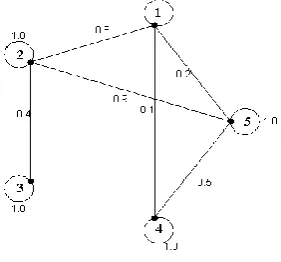
Let us consider a simple numerical example [12]. Let
}
,...,
{
x
1x
5X
be the initial set of elements andT
is afuzzy tolerance relation on X. So,
G
(
X
,
T
)
is a fuzzytolerance graph and
T(xi,xj),i
,
j
1
,
,
5
is membership function ofT
. The fuzzy graphG
(
X
,
T
)
is shown in Fig. 1.Fig 1: An initial fuzzy graph
The corresponding fuzzy tolerance relation
T
is presented in Table 1.Table 1. An initial fuzzy tolerance relation
T
x
1x
2x
3x
4x
51
x
1.02
3
x
0.0 0.4 1.04
x
0.1 0.0 0.0 1.05
x
0.2 0.9 0.0 0.5 1.0So, an ordered sequence of values of tolerance threshold
1
9
.
0
8
.
0
5
.
0
4
.
0
2
.
0
1
.
0
0
can beconstructed.
The initial graph is divided into two components for the value of tolerance threshold
3
0
.
5
. So, the
-level fuzzy graph) (
G
is shown in Fig. 2.Fig 2: An α-level fuzzy graph obtained from the FG-AFC-algorithm for the value α=0.5
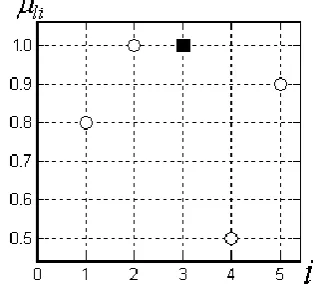
The allotment among two fully separated fuzzy clusters corresponds to the fuzzy graph. The fuzzy cluster
(
1,
0
.
8
),
(
2,
1
.
0
),
(
4,
0
.
5
),
(
5,
0
.
9
)
1) 5 . 0
(
x
x
x
x
A
correspondsto the first class and the object
x
2 is the unique typical point1
of the fuzzy cluster. The fuzzy cluster
(
3,
1
.
0
)
3) 5 . 0
(
x
A
corresponds to the second class and the unique object which
belongs to the class is its typical point,
x
3
3.The corresponding allotment
R
c( )(
X
)
for the value
5
.
0
is presented in Fig. 3, where membership values of the first class are represented by ○ and membership values of the second class are represented by ■.Fig 3: Membership functions of two fuzzy clusters obtained from the FG-AFC-algorithm
It should be noted, that the allotment among two fully separated fuzzy clusters obtained by the FG-AFC-algorithm is differ from the allotment among two fully separated fuzzy clusters obtained by the direct D-AFC(c)-algorithm of possibilistic clustering [4]. By executing the D-AFC(c)-algorithm for
c
2
, the allotment was obtained for the tolerance value
0
.
1
. The corresponding allotment)
(
X
R
c
is presented in Fig. 4, where membership values of the first class are represented by ○ and membership values of the second class are represented by ■.
Fig 4: Membership functions of two fuzzy clusters obtained from the D-AFC(c)-algorithm
By executing the FG-AFC-algorithm, the resulting graph was obtained for the value of tolerance threshold
4
0
.
8
. The graph is shown in Fig. 5.Fig 5: A resulting graph obtained from the FG-AFC-algorithm
The allotment among three fully separated fuzzy clusters corresponds to the fuzzy graph. The fuzzy cluster
(
1,
0
.
8
),
(
2,
1
.
0
),
(
5,
0
.
9
)
1) 5 . 0
(
x
x
x
A
corresponds to the firstfuzzy cluster. The fuzzy cluster
(
3,
1
.
0
)
3) 5 . 0
(
x
A
corresponds to the second class and the unique object which
belongs to the class is its typical point,
x
3
3. The fuzzycluster
(
4,
1
.
0
)
4) 5 . 0
(
x
A
corresponds to the third class andthe unique object
x
4 is the typical point
4 of the class. The result can be presented by the diagram of Fig. 6 where membership functions of three fuzzy clusters of the allotment)
(
) (X
R
c
are shown.
Fig 6: Membership functions of three fuzzy clustersobtained from the FG-AFC-algorithm
Membership values of the first class are represented by ○, membership values of the second class are represented by ■ and membership values of the third class are represented by □ in Fig. 6.
The allotment
R
c(
X
)
obtained from the
D-AFC(c)-algorithm for
c
3
is presented in Fig. 7.The allotment was obtained for the value of tolerance threshold
0
.
5
. Membership values of the first class are represented by ○, membership values of the second class arerepresented by ■ and membership values of the third class are represented by □ in Fig. 7. So, the allotment obtained from the FG-AFC-algorithm of fuzzy graph clustering is different from the allotment obtained by using the direct D-AFC(c)-algorithm.
Fig 7: Membership functions of three fuzzy clusters obtained from the D-AFC(c)-algorithm
A performance of the proposed FG-AFC-algorithm can be explained by other illustrative example.
3.2
An Example of Tamura’s Portrait Data
Set
Let us consider an application of the proposed FG-AFC-algorithm to the classification problem for the following illustrative example. The problem of classification of family portraits coming from three families was considered by Tamura, Higuchi and Tanaka in [12]. The number of portraits was equal to 16 and the real portrait assignment among three classes is presented in Fig. 8.
The data were originally analyzed in order to identify families with the technique of first transforming the matrix of a fuzzy tolerance into a matrix of a fuzzy similarity relation and then taking an appropriate
-level of the fuzzy similarity relation [12].The partition proved to be obtained with
-level equal to6
.
0
. The partition identified the three families}
,
,
,
,
{
1 6 8 13 16 1x
x
x
x
x
A
,{
2,
5,
7,
11,
14}
2
x
x
x
x
x
A
and}
,
,
,
,
{
4 9 10 12 15 3x
x
x
x
x
A
.However, person
x
3 is not a member of any of the three families. The subjective similarities assigned to the individual pairs of portraits collected in the tabular format are presented in Table 2.The presented matrix of subjective similarities is the matrix of the fuzzy tolerance relation on
X
{
x
1,...,
x
16}
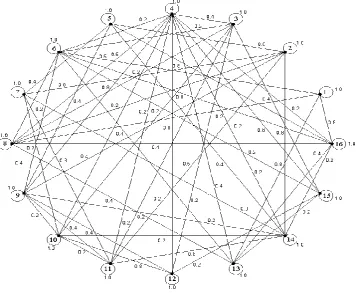
. So, theinitial fuzzy graph
G
(
X
,
T
)
is shown in Fig. 9Table 2. The matrix of subjective similarities
T
x
1x
2x
3x
4x
5x
6x
7x
8x
9x
10x
11x
12x
13x
14x
15x
161
x
1.02
x
0.0 1.03
x
0.0 0.0 1.04
x
0.0 0.0 0.4 1.05
x
0.0 0.8 0.0 0.0 1.06
x
0.5 0.0 0.2 0.2 0.0 1.07
x
0.0 0.8 0.0 0.0 0.4 0.0 1.08
x
0.4 0.2 0.2 0.5 0.0 0.8 0.0 1.09
x
0.0 0.4 0.0 0.8 0.4 0.2 0.4 0.0 1.010
x
0.0 0.0 0.2 0.2 0.0 0.0 0.2 0.0 0.2 1.011
x
0.0 0.5 0.2 0.2 0.0 0.0 0.8 0.0 0.4 0.2 1.012
x
0.0 0.0 0.2 0.8 0.0 0.0 0.0 0.0 0.4 0.8 0.0 1.013
x
0.8 0.0 0.2 0.4 0.0 0.4 0.0 0.4 0.0 0.0 0.0 0.0 1.014
x
0.0 0.8 0.0 0.2 0.4 0.0 0.8 0.0 0.2 0.2 0.6 0.0 0.0 1.015
x
0.0 0.0 0.4 0.8 0.0 0.2 0.0 0.0 0.2 0.0 0.0 0.2 0.2 0.0 1.016
Fig 9: The initial fuzzy graph
An ordered sequence of values of tolerance threshold
1
8
.
0
6
.
0
5
.
0
4
.
0
2
.
0
0
can be constructed. The initial graph cannot be divided into components for values2
.
0
and
0
.
4
. The
-level fuzzy graph ( )
G
forthe value
0
.
5
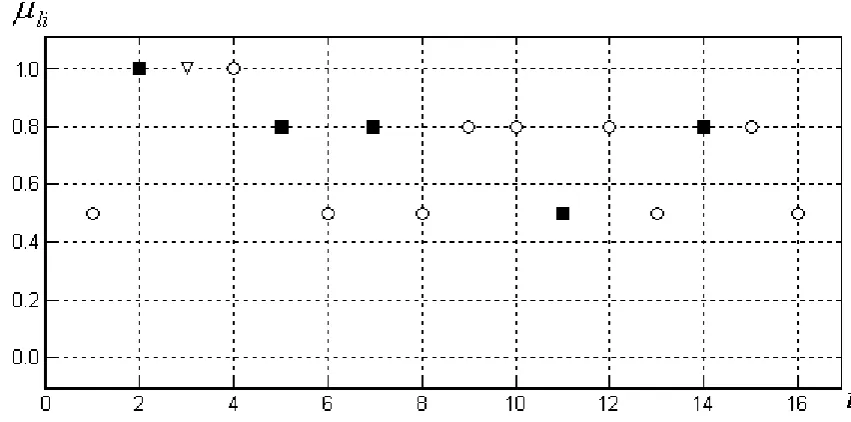
is shown in Fig. 10. Membership functions of corresponding fuzzy clusters of the obtained allotment are presented in Fig. 11.Fig 11: Membership functions of three fuzzy clusters obtained from the FG-AFC-algorithm,
which correspond to the obtained allotment
Membership values of the first class are represented by ○, membership values of the second class are represented by ■ and membership values of the third class are represented by
in Fig. 11. So, the fourth object is the typical point of the first class, the second object is the typical point of the second class, and the third object is the typical point of the third class.The second class is corresponds to Family 2 and all members of Family 1 is included to the first class. So, the first class is
the union of the Family 1 and Family 3 and the third object is a unique element of the third class. So, the results obtained by the proposed FG-AFC-algorithm seem to be appropriate.
It should be noted, that the allotment among particularly separated fuzzy clusters was obtained by using the D-AFC(c)-algorithm for
c
3
[4]. The corresponding membership functions are presented in Fig. 12.Fig 12: Membership functions of three partially separated fuzzy clusters obtained from the D-AFC-algorithm
So, by executing the D-AFC(c)-algorithm for three classes,
we obtain the allotment
R
c(
X
)
among particularly separated fuzzy clusters, which corresponds to the result, is received for the tolerance threshold
0
.
2
. The ninth element of the set of objects is belonging to the second class and to the third class and membership values are equal,
29
390.4.4.
FINAL REMARKS
4.1
Discussions
The novel FG-AFC-algorithm of possibilistic clustering is proposed in the paper. The algorithm is based on the idea of detecting of components of the initial fuzzy graph and constructing fuzzy clusters of the sought allotments from the components directly. So, the criterion of quality of the sought allotment is not used in the FG-AFC-algorithm. The results of application of the proposed FG-AFC-algorithm to the data sets show that the algorithm is an effective tool for solving the classification problem.
4.2
Perspectives
A transitive approximation of the initial fuzzy tolerance relation can be obtained by the TAGA-algorithm [13]. So, the TAGA-algorithm can be implemented into the FG-AFC-algorithm and a new fuzzy graph-based heuristic FG-AFC-algorithm of possibilistic clustering can be elaborated.
5.
REFERENCES
[1] Höppner, F., Klawonn, F., Kruse, R. and Runkler, T. 1999. Fuzzy Cluster Analysis: Methods for Classification, Data Analysis and Image Recognition. Chichester: John Wiley & Sons.
[2] Krishnapuram, R. and Keller, J.M. 1993. A Possibilistic Approach to Clustering. IEEE Transactions on Fuzzy Systems. 1, 98-110.
[3] Mandel, I.D. 1988. Clustering Analysis. Moscow: Finansy i Statistica. (in Russian)
[4] Viattchenin, D.A. 2013. A Heuristic Approach to Possibilistic Clustering: Algorithms and Applications. Heidelberg: Springer.
[5] Schaeffer, S. 2007. Graph Clustering. Computer Science Review. 1, 27-64.
[6] Fortunato, S. 2010. Community Detection in Graphs. Physics Reports. 486, 75-174.
[7] Zadeh, L.A. 1965. Fuzzy Sets. Information and Control. 8, 338-353.
[8] Kaufmann, A. 1975. Introduction to the Theory of Fuzzy Subsets. New York: Academic Press.
[9] Rosenfeld, A. 1975. Fuzzy Graphs. In Fuzzy Sets and Their Applications to Cognitive and Decision Processes. New York: Academic Press, 77-95.
[10]Devillez, A., Billaudel, P. and Villermain Lecolier, G. 2002. A Fuzzy Hybrid Hierarchical Clustering Method with a New Criterion Able to Find the Optimal Partition. Fuzzy Sets and Systems. 128, 77-95.
[11]Dong, Y., Zhuang, Y., Chen, K. and Tai, X. 2006. A Hierarchical Clustering Algorithm Based on Graph Connectedness. Fuzzy Sets and Systems. 157, 1760-1774.
[12]Tamura, S., Higuchi, S. and Tanaka, K. 1971. Pattern Classification Based on Fuzzy Relations. IEEE Transactions on Systems, Man, and Cybernetics. 1, 61-66.