ISSN (Online): 2320-9364, ISSN (Print): 2320-9356 www.ijres.org Volume 4 Issue 7 ǁ July. 2016 ǁ PP. 05-10
Research on Trajectory Planning Method of Spraying Robot
Based on NC Tool Path
Bing Zhang, Yong Xu
College of Mechanical Engineering, Shanghai University of Engineering Science,Shanghai 201600,China
Abstract: Robot trajectory planning is the basis of robot's task, and it is also the foundation of trajectory tracking control. Trajectory planning of the goal is to satisfy the path constraints, obstacles and kinematic constraints, the robot capable of moving fast, accurate and stable and there are no dead angle of spraying the workpiece and uniform in spraying thickness. This paper aimed at free surface and uniform spraying problems, utilization of NC machining process and spraying process similarity is proposed using NC tool path generate spray path method for the trajectory planning. Establishment of the growth of spraying coating thickness mathematical model, to improve the coating thickness uniformity as the goal, research on the impact of spraying uniformity factor .And through the experimental result to prove the spray path planning of rationality and speed optimization of coating thickness uniform validity.
Index Terms: robot trajectory planning, free-form surface,NC tool path ,coating thickness
I.
INTRUCTION
In order to improve the quality and performance of products, many products are often required to spray a layer of uniform protective coating on the surface of many products. The research of coating on the surface of an object is called uniform spraying [1]. As the thickness and uniformity of the coating has an important influence on the quality, appearance and performance of the product, such as aircraft, automobile and many other products with large free surface, the thickness of the coating has strict requirements to them[2]. The process of spraying , the formation of film thickness not only with the paint itself characteristics, spray gun spray model, process parameters of spraying,[3] spray gun trajectory factors, but also relevant of the complex freeform surface characteristics , so it is a multi-factors coupling nonlinear problems about the spraying of free surface uniformly.[4]
The key of the trajectory planning of robot is the spray gun, that is, the change of the spray gun position, posture and velocity of the joint of the spray gun with time. [5]In the process of spraying, to ensure the rotation of the joint to maintain a smooth motion in the process of rotation[6], aim at to avoiding that rapidly change of the spray gun position, the joint speed and acceleration .
According to the CNC machining process is very similar with the trajectory planning, so a new method of using the NC tool path to generate the spray gun is presented. On the basis of the existing spraying mathematical model, the path of the spray gun and the optimization of the spray gun speed are studied. The rationality and effectiveness of trajectory planning is proved by spraying experiments.
II.
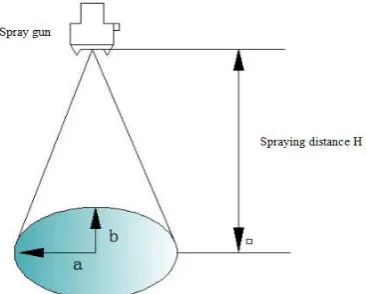
MATHEMATICALMODELOFNCTOOLPATHspraying as a tool, the bottom of the spray mist cone center as the tip, as shown in Figure 1.So the spray gun’s movement and the NC machining tool’s is very similar. But the difference is as follows:
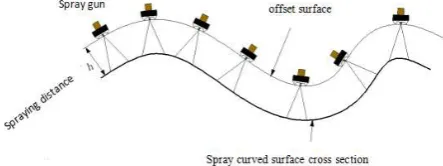
Tip is in direct contact with the machined surface, and the surface machining is the process of cutting thickness, the cutting process would not stop until the entire surface of the model and the required target surface is completed. NC milling as shown in Figure 2.In the spraying operation, the spray distance between the spray gun and the workpiece surface is required to be kept constant distance is h.The spray gun axis is required always perpendicular to the surface of the workpiece. After the spraying process parameters are determined, the robot trajectory planning is planned, in order to get the good uniformity of spray coating and spraying process has no dead angel.
FIG 1 The sketch map of spary gun and spary cone
FIG 2 The sketch map of NC milling
Taking the free curved surface of workpiece as an example, by using the process of the numerical control tool to calculate the trajectory of the gun. Firstly, according to the process parameters, the NC file is programmed in the PRO-E 3D software, and the cutter location path is generated on the free surface. Table 1 is the program parameters of NC tool bit,as follows:
Table 1 the program parameters of NC tool bit
program notes
1 20 1 21.4 45 5
N G X Y Z Initial position coordinates of cutting(21.4, 45, 5)
0.48 0.86 0.29
x y z
a a a Cutter axis vector (0.48, 0.86, 0.29)
1 30 18 12.5 10
N X Y Z Initial position coordinates of cutting(18,12.5,10)
0.58 0.76 0.63
x y z
The cutter location trajectory is derived as a standard code file, and the cutter location coordinates and the tool axis vector are extracted as a collection Ui.
There are n points of cutter location,
i i i
x y z is the cutter location coordinate value,a i a i a ix( ) y( ) z( ) is the
cutter axis vector. In the base of collection Ui,which can generate continuous tool path, and continuous tool path can be transformed into the spray gun path.Suppose
p
j as a point in the path, the cutter location coordinate valueand the cutter axis vector is:V [x y z a a ax y z]III.
PATH PLANNING OF SPRAY GUNPath planning is the basis of the spraying task, and it is also the foundation of trajectory tracking control. Trajectory planning is the planning ideal task space and joint space trajectory [7-8], makes the end of the spray gun moving fastly, accurately and stably, movement efficiency is high enough, trajectory tracking accuracy is high enough and satisfy path constraints, constraints and kinematic constraints.
A. Determination of spraying distance
Due to in the actual spraying, the spray gun axis is always perpendicular to the surface of the workpiece, the distance between the nozzle and the workpiece surface keeps a constant distance of h.[9]As shown in Figure 3.
FIG 3. The relationship between the position of the spray gun and the workpiece surface
B. Establish the mathematical model of the spray gun
The establishment of the mathematical model of the spray gun is the premise of the trajectory planning of the spray gun. The mathematical model of the spray gun includes the shape of the film and the film thickness distribution function when the spray gun is static spraying[10-11]. In the actual air spraying, usually in the mouth spray gun are arranged at both sides of the compressed air, spray cone is compressed into an oval mallet, The working surface area covered by the spray cone formed by the spray cone is an ellipse, and its length and short axis radius are a and b respectively. Here suppose the elliptic region edge curve equation is :
2 2
2 2 1 ( ; )
x y
a x a b y b
a b
Formula for calculating the area of an ellipse is:
2 2 0
4 ab ( ) (0 )
s a x dx x a
a
In the actual measurement, it is found that the boundary is blurred due to the splash of paint mist.
,
, ,
( ),
( ),
( ) ,
i i i i x y z
U
x y z a i a i a i
1, 2,
,
1, .
Therefore, the value can not be directly measured, which is determined by the analysis of the measurement data of the paint film.
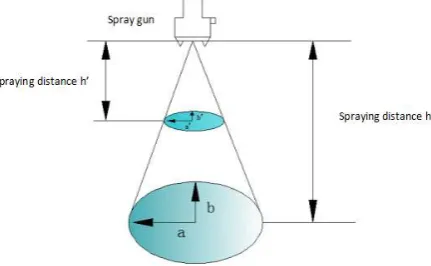
According to change the spary distance h to adjust the width and area of the spray.As shown in Figure 4.
FIG 4 Change the spary distance
When the spary distance change fromhtoh',the area of ellipse change from
s
tos
'
, the relationship between ofs
ands
'
is: '2 '
(
)
h hh
s
s
h
So it can adjuste the spray distance of H to change the width of the paint, so as to adapt the different working conditions, the different surface spraying lap width can be adjusted to satisfy the overlap between spraying thickness uniformity.
C. Description Of The Spray Path
Suppose the total length of the motion path of the gun is
L
, the total time of the gun movement isT
,set the path of spray gun movement is equally divided into part ofm
micro-segment path, set partj
of micro-segment path is j,1
j
m
, the length ofj
is l,and the moment of spray gun get start at j
is
t
j,it takes the total time for spray gun to finish the distance of j is
t
j,so the expression of
t
j isj j l t v
.Suppose arbitrary discrete points on curved surface is
s
i,Judge the points
iis in the spray cone coverageor not ,if it satisfies the condition, the film thickness can be obtained in the time of
t
j by the followingequation. If not satisfies,the growth of thickness is zero.Set the total thickness is
d
i at the point ofs
i.III.
APPLICATION EXAMPLE
OF
SPRAYING
It provided the model of the H44H gate by Shanghai kaisite Valve Co., Ltd , the 3D model is shown in Figure 5 as follows. The outer surface of the valve near the surface is ellipsoid, in order to calculate easily, the
2 1 1 1 2 2 max 2 2 2 2 ,
1 . 1
( )
( ) [1 ]
( )
i
i
s j
i s s
j
s
d f t
d x y
outer surface of the valve is fitted with spherical surface.
FIG 5 The model of H44H gate valve
Select the process parameters as shown in Table 2, using the above method to plan the path of the spray gun, take the spraying test for valve ellipse surface .
Table 2:The process parameters in spraying
The process parameters numerical values Width of spraying/mm 80 Spraying distance/mm 90 Overlap distance/mm 50 Spraying velocity 60mm s/
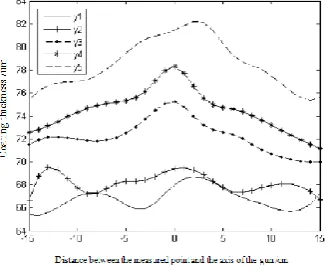
Choose five groups of different spraying speeds in spraying test for valve, The distribution of coating thickness at the same interface were obtained[12].The relationship between the spraying velocity and the thickness of the coating can be shown in Figure 6.coating is reduced, coating thickness uniformity variation.
Distance between the measured point and the axis of the gun /cm
FIG 6 The relationship between the spraying velocity and thickness
IV.
CONCLUSION
For mature methods of NC programming to generate a new method of trajectory planning for spraying robot, it is well to avoid the model of surface re-construction and CAD model re-processing, based on extraction the coordinates of the cutter location value in the NC tool path and the tool axis vector continuous spray path planning, it gets greatly improved for saving the time and spraying accuracy.
REFERENCE
[1]. Atkar P N, Greenfield A, Conner D C, et al. Uniform coverage of automotive surface patches [J]. The International Journal of Robotics Research, 2005, 24(11);883-898.
[2]. Seegmiller N A, Bailiff J A, Franks R K. Precision robotic coating application and thickness control optimization for F-35 final finishes [J]. SEA International Journal of Aerospace, 2009,2(1);284-290. [3]. CHEN YAN , YAN Hua, WANG Liqiang, et al Coating uniformity with a uniform robotic spray
gun velocity[J]. Tsinghua University: Sci and Tech , 2010, 50(8):1210 -1213.
[4]. Chen H, Fuhlbrigge T, Li X. Automated industrial robot path planning for spray painting process: A review IEEE International Conference on Automation Science and Engineering. Arlington,VA, USA, 2008.
[5]. Klein A. CAD-based off-line programming of painting robots [J]. Robotica, 1987,5(4):267 -271 [6]. ZHANG Yonggui, HUANG Yumei, GAO Feng, et al. NEW model for air spray gun of robotic
painting [J]. Chinese Journal of Mechanical Engineering, 2006. 42(11):226 -233.
[7]. Chen H, Xi N. Automated tool trajectory planning of industrail robots for painting composite surfaces [J]. The International Journal of Advanced Manufacturing Technology,2008.35(7):680-696.
[8]. LI Fazhong, ZHAO Dean, ZHANG Chao, et al. Trajectory optimization of spray painting robot based on CAD [J]. Transactionsof the Chinese Society of Agricultural Machinery, 2010, (5):213-217.
[9]. CAI Zixing. Robotics [M]. Beijing: Tsinghua University Press. 2009.
[10]. Goodman E D, Hoppensteradt L. A method for accurate simulation of robotic spray application using empirical parameterization [C]// Proceeding of IEEE International Conference on Robotics and Automation. Sacramento,CA, USA. 1991: 1357-1386.
[11]. Sheng W, Xi N, Song M, et al. Automated CAD-guided robot path planning of IEEE/RSJ International Conference on Intelligent Robots and Systems. Kagawa University, Japan, 2000,3:1918-1923.
[12]. SUN Wenyu, XU Chenxian, ZHU Detong. Optimization Method [M]. Beijing: Higher Educat ion Press.2004:149-152.
Author introduction
Bing Zhang was born in January.1992 in Anhui province. He has got a bachelor’s degree of Mechanical Design Manufacture and Automation in Wenzhou University in 2014 and now he is a postgraduate in Shanghai University of Engineering Science.