ISSN (e): 2250-3021, ISSN (p): 2278-8719
Vol. 08, Issue 6 (June. 2018), ||V (I) || PP 74-81
Effects of Different Drying Condition on Microstructure and
Drying Characteristics of Ginger
Olaoye, O.S
1*, Oyetunji, O.
R
1and Ayo-Ajagbe, A.O
11
Mechanical Engineering Department, Ladoke Akintola University of Technology, P.M.B. 4000, Ogbomoso, Nigeria
Corresponding Author: Olaoye, O.S
Abstract:
Ginger and its products have marked its importance in most households and industries in Nigeria. Ginger is always harvested with high moisture content and because of this, it is highly perishable. Farmers have tried various means to reduce moisture content to acceptable limit for proper handling. Drying methods that are being used may affect the major essential ingredients if not properly controlled. This study investigates effects of three different drying methods (open sun, solar dryer and electric dryer) on the microstructure of ginger sliced into 10 mm thickness longitudinally. Solar intensity, humidity, temperature (inner ginger and carbinet), weight reduction initial and final moisture content, drying time and microstructure (before and after drying for the three methods) were measured. The average solar intensity was found to be 168.52 W/m2. The average drying temperatures and weight reduction for open sun, solar and electric dryers are 45oC, 51oC and 58oC and 0.329 kg, 0.339 kg and 0.341 kg respectively. Also the final moisture contents are 19, 12 and 10% for sun drying, solar drying and electric dryer respectively. It took the average time of 12 h, 6 days and 9 days to dry ginger to safe moisture content in electric, solar and open sun dryer. The physical appearance for the drying products of the three dryer shows that open sun drying was better. Microscopic evaluation of the dried products show that electric drying method has the highest bond breaking capacity and consequently least essential nutrient trapping ability followed by solar and open sun. Electric dryer was faster and less contaminated, therefore, it saves energy and can be used for mass production if properly managed.Keyword:
Solar Energy, Electric, Dryer, Microstructure, Sun, Ginger--- --- Date of Submission: 28-05-2018 Date of acceptance: 10-06-2018 --- ---
I.
INTRODUCTION
Ginger (Zingiber officinale) is a tropical spice and is cultivated in countries such as India, China, Japan, Indonesia, Australia, Nigeria and West Indies islands[1]. In Nigeria, it is grown majorly in states such as Gombe, Nasarawa and Kaduna state which is responsible for about 95% of the country’s total production [2]. It is usually planted at the start of the year and it is generally harvested after 9-11 month of planting. Ginger grown in different parts of the country (Nigeria) varies considerably in its intrinsic properties and its suitability for processing. The important quality parameters of ginger are its fibre content, volatile oil content and non-volatile ether extract. It has constituent elements such as oleoresin, moisture (water) and essential oils such as zingiberene, limonene, linalool, geraniol and nerolidol which were obtained from gas chromatography [3].
Ginger and its products are useful to both households and industries and have varied applications in culinary preparation, bakery products, toiletry products, perfume industries, meat products, wine, and soft drinks making, spice and medicinal purposes [4].
However, over 85% of industrial dryers are of the convective type with hot air or direct combustion gases as the drying medium and over 99% of its applications involve removal of water [9].
There are various post-harvest methods of moisture removal from ginger and it can be classified into two; traditional and modern methods. Traditionally, open air drying is the most common method for post-harvest preservation (for most farmers in Nigeria) because it is a natural occurring method for the conservation of the qualities of the plant material. However, due to methodical defects such pest infestation, scale of production, drying duration etc., new techniques of drying became necessary. Modern methods are commercial energy based drying techniques of moisture removal. It provided solutions to the aforementioned difficulties encountered in the use of traditional methods. These techniques employs drying processes such as forced convective drying, fluidized bed drying, heat pump drying, microwave drying, freeze drying etc. to dry agricultural products to a safe moisture content.
With the introduction of post-harvest modern techniques comes need for quality control of ginger product obtained from each of these methods. Rate of dehydration is an important quality parameter for dried products. During these processes different microstructure can be obtained showing changes to the cell structure [10]. Therefore, to have knowledge of what happens, there is the need to do microstructural examination of the dried products under different drying methods with the aid of microscope.
The objective of this study is to determine the drying characteristics of ginger samples dried using different drying methods, to investigate the effects of the methods on physical appearance of the products, and to analyse the effects of drying methods on ginger microstructure using microscope.
II.
METHODOLOGY
Material preparation
8.50 kg fresh and mature ginger used was procured from Waso market, Ogbomoso, Oyo State, Nigeria. It was washed in cold water to remove soil and dust particles, after which the fingers washed ginger rhizomes, was sliced with knives longitudinally to a uniform thickness of 10 mm. Initial moisture content of batch of ginger bought was determined using oven method and it was found to be 78.3% wet basis. The sample was divided into three for the three experimental procedures.
Physical properties (such as colour, texture, surface roughness etc.) of fresh sliced ginger were observed before the commencement of drying.
Experimental procedure
Drying was performed through three methods which are open sun drying, solar dryer and electric dryer. Both solar dyer and electric dryer were locally fabricated. In the experiment 0.45 kg of samples were placed in the open sun, solar dryer and electric dryer. Moisture loss of the sample was recorded as a result of weight reduction at one hour interval using digital balance with 0.01 g precision. The three drying process was repeated three times and continue until the moisture content of the samples is constant. The air flowing inside the solar dryer was due to natural convection process while the air flow in electric dryer was due to forced convection (fan). The temperature inside the electric drying chamber was regulated using a pyrometer.
Drying chamber and ambient temperatures, relative humidity, air flow rate and weight reduction were measured using mercury thermometer, thermo-hygrometer, hot wire anemometer and weighing balance respectively. Also the internal temperature of ginger was measured using type K thermocouple attached to twelve channel temperature recorder (model: BTM- 4208SD) and incident solar energy was measured during solar drying by solar power meter (model: SPM-1116SD, ±0.4%+ 1oC accuracy).
Mathematical calculation for dryer and drying parameters
(1) Amount of moisture to be removed from a given quantity of ginger (Ww) is given by [11] as:
f f i g w
M
M
M
W
W
100
(1) Where, Wg =Initial mass of wet ginger (kg), Mi = Initial moisture content (%)
Mf = Final moisture content (%). The moisture content on wet basis (Mi) and on dry basis (Mf) are
given by [12,13]
i f i i
m
m
m
M
(2)f f i f
m
m
m
Final relative humidity or equilibrium relative humidity ERH (%) was determined as follows according to [14]:
ERH
100
a
w (4)
a
w
1
exp
exp
0
.
914
0
.
5639
ln
M
f f
M
M
M
100
Where,
aw = water activity and M = moisture content kgw/kgs (dry basis)
(2) Quantity of heat needed to evaporate water from ginger is given by [14,15] as:
fg
w
h
W
Q
(5) Where,
Q = Amount of energy required for drying process (kJ) Ww = Mass of water (kg)
hfg = latent heat of evaporation
but,
h
fg4
.
186
10
597
0
.
56
T
pr
3
(6) Where,
Tpr = Product temperature (0C)
The total heat energy, E (kJ) required to evaporate water was calculated as follows:
d i
f
h
t
h
m
E
(
)
Where E = total heat energy, kJ m = mass flow rate of air, kg/hr
hf and hi = final and initial enthalpy of drying and ambient air respectively, kJ/kg dry air
td = drying time, hrs
Enthalpy of moist air in drying air at temperature T is given as [16]
h
1006
.
9
T
w
2512131
.
0
1552
.
4
T
Microstructure Analysis
An electric microscope (XJL-17) was used to observe the effect of different drying methods on microstructure of ginger samples. Microstructural studies may improve the understanding of drying mechanisms and the knowledge of food properties. Observing what happens at the microscopic level during drying results not only on qualitative information, but also on quantitative data suitable to modelling. Understanding the relationship between food microstructure and food perceived characteristics is of increasing importance to produce attractive food products [17].
III.
RESULTS AND DISCUSSION
Comparative studies of effects of different drying methods on drying rate
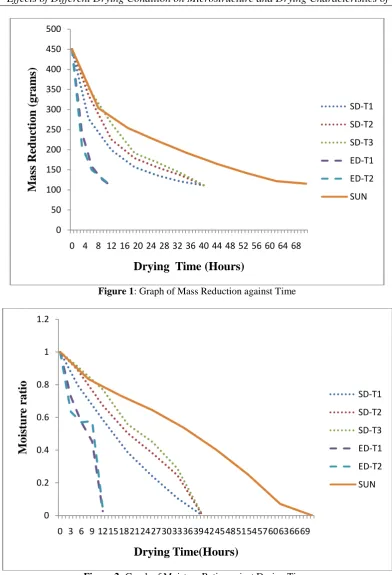
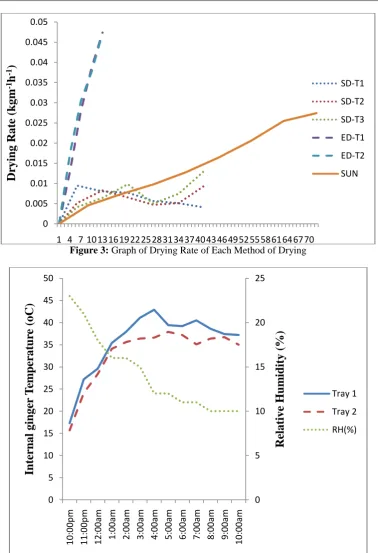
From figures 1 and 2 mass reduction and moisture ratio with time during ginger drying for sun, solar and electric dryer can be seen. It was observed that for both figures the rate of moisture ratio and mass reduction is faster in electric dryer followed by solar and the least is the sun. This is as a result of almost constant heat supplied and air movement leading to moisture transport out of dryer in electric dryer at constant rate unlike both solar and open sun. The average drying temperatures and weight reduction for open sun, solar and electric dryers are 45oC, 51oC and 58oC and 0.329 kg, 0.339 kg and 0.341 kg respectively. Also the final moisture contents are 19, 12 and 10% for sun drying, solar drying and electric dryer respectively from initial moisture content of 78.3 %. It took the average time of 12 h, 6 days(40h) and 9 days(53h) to dry ginger to safe moisture content in electric, solar and open sun dryer. The final moisture content after drying for both solar and electric dryer is within the acceptable limit which is 7-12 %. From the results electric dryer will be better for mass production at lower moisture constant and short time.
Figure 1: Graph of Mass Reduction against Time
Figure 2: Graph of Moisture Ratio against Drying Time.
0 50 100 150 200 250 300 350 400 450 500
0 4 8 12 16 20 24 28 32 36 40 44 48 52 56 60 64 68
M
ass
Re
d
u
ction (gr
am
s)
Drying Time (Hours)
SD-T1
SD-T2
SD-T3
ED-T1
ED-T2
SUN
0 0.2 0.4 0.6 0.8 1 1.2
0 3 6 9 1215182124273033363942454851545760636669
M
oistu
re
r
at
io
Drying Time(Hours)
SD-T1
SD-T2
SD-T3
ED-T1
ED-T2
Figure 3: Graph of Drying Rate of Each Method of Drying
Figure 4: Graph of Electric Ginger Temperature and Relative Humidity against Time
Table 1: Electric Dried Ginger Experimental Results
Time Internal Ginger
Temperature(0C) Mass (grams) Relative Humidity
Tray 1 Tray 2 Tray 1 Tray 2 RH(%)
10:00pm 17.3 15.7 450 450 23
11:00pm 27.2 24.1 21
12:00am 29.6 28.4 18
1:00am 35.4 34.1 242.1 209.1 16
2:00am 41.1 36.4 16
3:00am 36.4 21.6 15
0 0.005 0.01 0.015 0.02 0.025 0.03 0.035 0.04 0.045 0.05
1 4 7 101316192225283134374043464952555861646770
4:00am 42.9 36.6 158.2 149.5 12
5:00am 39.4 21.4 12
6:00am 39.2 37.2 11
7:00am 40.5 35.1 126.5 128.9 11
8:00am 38.6 36.4 10
9:00am 37.4 36.7 10
10:00am 37.2 35.0 108.9 109.2 10
Physical observation
From plate 1, fresh ginger sample obtained was found to be yellowish with its cells neatly arranged. Having a comparative physical examination, it was discovered that electric dried ginger had the most ruptured surface and bending stress. Furthermore, electric dried ginger had a rough evaporation surface and the lowest particle density which could be attributed to short drying time and minimal handling of the material during the experiment
.
Histological Changes
Plate 2a reveals the cross sectional micrograph of freshly harvested sliced ginger rhizome. The essential oils have a grain-like structure and the bonding between oily cells and moisture was observed to be stable. Drying initiated the breaking of bonds to permit the escape of moisture and a re-bonding of the oil and starch cells was needed to preserve the essential nutrients which accounts for the clustering of oil and starch cells at different regions of plates 2b, 2c and 2d.
IV.
CONCLUSION
Ginger is a condiment that has its uses in medicine and industries. Improper drying has a great impact in affecting the major constituents of ginger as most of it will be evaporated at high temperature. Also when drying is done unhygenically it will affect the acceptability in the market. Drying rate in electric dryer is the fastest way of drying out of the three followed by solar and open sun is the least. The fast rate of drying in electric dryer affect the microstructure of the ginger more that the other mode of drying. Both electric and solar dried products shrink the same way by the open sun was a little better. Environmental impact affects the final product of the open sun dried products. The scanning microscope images revealed that electric dryer has the highest bond breaking capacity and this causes deformation in the microstructure of the ginger.
However, drying period in electric dryer was found to be 12 h, followed by solar (40 h) and the least open sun (53 h). Electric dryer saves time more than the other forms of dryers and its drying process could be controlled properly unlike the two other that depends on the availability of the sun.
REFERENCES
[1]. Chanchal, R. D. Evaluation of Air Drying Characteristics of Sliced Ginger (Zingiber officinale) in a Forced Convective Cabinet Dryer and Thermal Conductivity Measurement. Food Processing &
Technology, (2012). 1.
[2]. Okafor E.A. Processing and Utilization of Ginger: Effect of processing methods on product quality, and its application in fruit and bakery products. American Journa of Scientific and Industrial Research , (2002). 32.
[3]. Jayashree, V. R. Quality of dry ginger (Zingiber officinale) by different drying methods.Journal of food Science and Technology, (2012). 51(11): 3190 -3198.
[4]. Hoque, B. B. Drying Kinetics of Ginger Rhizome (Zingiber officinale). Bangladesh Journal od Agricultural Research, (2013). 38(2): 301 -319.
[5]. Eze,J.I. and Agbo, K.E. Comparative Studies of Sun and Solar Drying of Peeled and Unpeeled Ginger. American Journal of Scientific and Industrial Research, (2011). 2(2), pp. 136-143.
[6]. Wakjira, M. Solar Drying of Fruits and Windows of Opportunities in Ethiopia, African Journal of Food Science, (2010).4(13), pp.790-802.
International organization of Scientific Research
81 | P a g e
[8]. Olaoye, O.S, Waheed, M.A and Lucas, E.B. Experimental studies of effects of geometry on drying rate and properties of ginger (zingiber officinale Rosc) with solar-hybrid dryer. Journal of Biology, Agriculture and Healthcare, (2014).Vol. 4(24) pp. 45 -56.
[9]. Mundada, M, Hathan, B.S. and Maske, S. Convective dehydration kinetics of osmotically pretreated pomegranate arils. Biosystems Engineering, (2010).107, pp. 307316
[10]. Senadeera W. B and Young, W. B. Physical property changes of fruits and vegetables during hot air drying. Mujumdar Arun S. (Ed) Drying technology in Agriculture and Food Sciences, (2000).149-166. [11]. Alonge, A.F. and Hammed R.O.,. A Direct Passive Solar Dryer for Tropical Crops. African Crop
Science Conference Proceedings (2007).Vol. 8 pp 1643 -1646.
[12]. Hellevang, K.J. Grain Moisture Content Effects and Management. North Dakota State University (NDSU), Fargo, NDSU Extension Service. (1995).
[13]. Venkatesan, N and Arjunan, T.V. An Experimental Investigation and Performance Analysis of a Solar Drying of Bitter Gourd Using an Evacuated-Tube Air Collector. International Journal of Chem Tech Research CODEN, (2014). 6(14) pp 5510 -18.
[14]. Ogheneruona, D. E. and Yusuf M. O.L., Design and Fabrication of a Direct Natural Convection Solar Dryer for Tapioca. Leonardo Electronic Journal of Practices and Technologies. (2011). Vol: 10 (18) pp 95-104.
[15]. Youcef-Ali, S. M. Determination of the Average Coefficient of Internal Moisture Transfer During the Drying of a Thin Bed of Potato Slices. Journal of food engineering, (2001). Vol.48 (2), 95-101 .
[16]. Brooker, D. B., Bakker-Arkema, F.W., and Hall, C.W., Drying and Storage of Grains and Oilseeds. Avi, Van Nostrand Reinhold. USA. (1992).
[17]. Wilkinson C. D. From food structure to texture. Trends in Food Science & Technology, (2000). 442-450.