Page 254
INDUSTRY-READY ENGINEERING GRADUATES – THE DRIVING FORCE OF INNOVATION
Irena Rashkova, Tsvetelina Petrova
Technical University of Gabrovo, 4 H. Dimitar Str. Gabrovo, 5300, Bulgaria
Abstract
The present paper considers the challenges which Industry 4.0 imposes on business and its young engineering pool. On the basis of the findings of two focus groups, independently held in Bulgaria and Poland, a skills mismatch between industry demands and university education supply in the area of Mechanical Engineering and Mechatronics is identified, which turns out to be one of the main obstacles to creative thinking and innovation. According to industry gap between engineering skills offered and those searched by employers is related to both hard and soft skills. Young engineers in both countries find it difficult to apply the academic knowledge acquired into a real-life business setting, especially in terms of analyzing an engineering problem, finding the best possible solution, applying critical and creative thinking, leading a multidisciplinary team, etc. In order to respond to the above engineering skills mismatch, a new educational model for improving the qualification of engineering graduates is proposed. It is based on work-based learning and apprenticeship, It is the first attempt to introduce dual studies, also called cooperative studies, at tertiary level in Bulgaria and Poland – an approach which has proved to be very successful for both higher education and business in some of the developed countries worldwide.
Keywords: skills mismatch, industry-ready graduates, work-based learning, apprenticeship, WBL curriculum
1. INTRODUCTION
Today Industry 4.0 poses radical challenges, such as innovation, creativity, critical thinking, multi- and inter-disciplinarity, to the manufacturing sector, where processes and organization have completely changed. It requires a new generation of engineers that combine excellent technical, generic and entrepreneurial competences so as to become the driving force of innovation and advanced technologies.
Unfortunately, there is a shortage of a talented engineering pool impeding the march towards Industry 4.0. According to a number of EU documents and surveys in Bulgaria “engineers” is the first on the top job list employers have difficulty filling. In addition, Bulgaria has the second highest skills mismatch and 22% of engineering graduates are unemployed. One of the main reasons for the current situation is the broken link between the worlds of higher education and business. The present gap could be bridged by introducing work-based learning (WBL) and apprenticeship which have already proved themselves successful in some European countries, where they are commonly referred as “cooperative learning ” in English speaking countries or “dual studies” in German speaking countries.
Page 255
2. CURRENT SITUATION OF SKILLS MISMATCH OF ENGINEERING GRADUATES IN MECHATRONICS
In December 2017 focus groups were held in Bulgaria and Poland so as to identify the skills mismatch at regional level (Gabrovo and Pomerania) in the sector of Mechatronics so that the curriculum and study programmes to be developed better reflect the immediate labour market needs. The findings show that the ratio between theory and practice offered in the bachelor degree programme in Mechatronics is inconsistent. Moreover, the method of learning by doing is stated not to be exploited to the full and the project work assigned is not based on industry case studies and does not reflect the current problems and needs of the enterprises. The teaching content and methods are not practice-oriented and do not meet the needs of both enterprises and the new generation of engineering learners. Students are not prior aware of the manufacturing processes, work discipline and safety at work, which often results in hazardous situations and accidents. Furthermore, young university graduates lack not only industry-oriented skills but also key soft skills such as creativity, critical and analytical thinking, problem solving, communication skills, etc.
The cooperation between academic and company mentors is ineffective since academic mentors do not spend enough time on guiding and supervising their students and are not very interested in getting feedback from company mentors on students’ progress, which in turn demotivates enterprises to accept university students on work placements and invest in the training of company mentors.
In general, the results from the focus groups confirm the mismatch between the supply and demand of engineering skills on the labour market.
3. AN INNOVATIVE WBL CURRICULUM IN MECHATRONICS - OVERVIEW
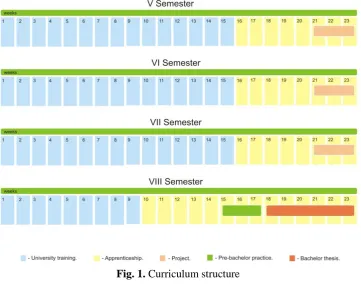
Taking the current situation into consideration, a new Curriculum based on WBL and apprenticeship has been developed for 3rd and 4th year students following a Bachelor programme in Mechatronics. It comprises 4 semesters (starting from the fifth one and ending to the eighth one). Each semester covers two parts: an academic one (implemented at the university in the form of lectures, seminars, laboratory exercises and self-study) and a practical one, called apprenticeship, (implemented at the company in the form of projects and other WBL activities); and provides 30 ECTS, where 1 ECT equals 25 hours. Each student is assigned an academic mentor and an in-company trainer who supervise their performance during the apprenticeship.
The current WBLA Curriculum, in particular the apprenticeship, covers studying on the job. From the fifth semester students alternate between academic studies at the Technical University of Gabrovo and apprenticeship (on-the-job studies) in an industrial firm. In addition to extensive practical experience the students receive appropriate financial remuneration and are usually employed by the company throughout the whole period from the fifth to the eighth semester.
The content of the practical training in the company is geared to the theoretical content at the university. Students choose the company and the relevant departments and divisions themselves and can thus tailor their training to their own interests. The company selection process and student application process are implemented through an Apprenticeship Cluster, specifically designed for this purpose. During their apprenticeship they get aware of company organization and culture and make valuable contacts within the company where they could continue their professional career after graduating. Actually, this boosts their company loyalty, positive attitude to co-workers and better contribution to company performance in the future.
Page 256
apprenticeship for the specific semester, their overall performance is evaluated by the in-company trainer and the academic mentor.
In the eighth semester students decide on an assignment together with the training company and the academic mentor and choose the topic of their Bachelor thesis which they complete in the eighth semester at the company. The apprenticeship is implemented as follows:
Apprenticeship 1 (Fifth semester): January – February
Apprenticeship 2 (Sixth semester): June-July
Apprenticeship 3 (Seventh semester): January-February
Apprenticeship 4 (Eighth semester): May-July
Fig. 1. Curriculum structure
4. WBL CURRICULUM IN MECHATRONICS – DESCRIPTION BY SEMESTERS 4.1. Fifth semester – Design of a mechatronic product
The training during this semester is based on the knowledge and skills acquired by students within the previous four semesters and gradual knowledge enhancement in the current semester. It is divided into two parts – Part 1 – academic studies (lasting 15 weeks) and Part 2 - apprenticeship (lasting 8 weeks). Part 1 aims at acquiring theoretical knowledge and basic skills. It includes six compulsory subjects, which are structured in such a way that they serve as a theoretical and practical foundation for the next module. Moreover, it covers two optional subjects that add value to students’ abilities and performance both in an academic and business environment.
Page 257
documentation. In this way the knowledge linked to the technical calculations, feasibility analysis, interchangeability and accuracy of specific components and measurement methods will be further developed. Project work is organized on the basis of cutting-edged calculations, analysis and design software.
The training also allows students to improve their social, foreign language and learning skills. Within the fifth semester students acquire the following knowledge, skills and competences:
basic knowledge of technical optics in the context of its implementation in mechatronic systems;
knowledge in the field of electronics: simultaneous optic and electronic data processing, storage and transmission;
knowledge of sensor characteristics as a constituent part of the generalized logical chain of mechatronic systems;
knowledge of basic mechatronic mechanisms and modules and their characteristics;
knowledge of the state-of-the-art intelligent measuring systems, built on the basis of the mechatronic approach;
knowledge in the field of industrial robotic systems of series and parallel structures;
knowledge of communication and behavior patterns in a real-life work environment, that a team worker/leader should follow to successfully develop, manufacture and sell mechatronic products;
knowledge of working out specifications, job-related presentations and job application documents in compliance with the respective national, European and international regulations;
knowledge of the structure and the single successive procedures of the design process of a mechatronic product, which includes all basic stages: assignment, structural analysis, parametric synthesis, completed engineering project;
ability to use iterative design processes;
ability to use geometric standard deviation when standardizing the geometric accuracy of a mechatronic product;
ability to design a mechatronic product in CAD environment;
ability to select the best optoelectronic elements and sensors, on the basis of their characteristics and the nature of the engineering assignment, when embedding them in a mechatronic product;
ability to precisely define the characteristics of a robotic system depending on the engineering assignment;
ability to operate with three-coordinate measuring systems for linear and angular dimensions;
ability to properly select measuring instruments depending on the nature of the measurement assignment;
ability to work in a multi-disciplinary team following the principles of respect, tolerance and empathy;
ability to gradually build their self-confidence, self-esteem, self-motivation and higher level of responsibility;
ability to adapt quickly to changes;
ability to elaborate CVs, motivation letters and presentations according to the respective rules;
Page 258
4.2. Sixth semester – Development of a technological project of a mechatronic product
The training during this semester is based on the knowledge and skills acquired by students within the previous five semesters and gradual knowledge enhancement in the current semester. It is divided into two parts – Part 1 – academic studies (lasting 15 weeks) and Part 2 - apprenticeship (lasting 8 weeks). Part 1 aims at acquiring theoretical knowledge and basic skills in the area of industrial technologies and process management: basic manufacturing processes and equipment, as well as in the field of production organization and quality assurance. It includes six compulsory subjects, which are structured in such a way that they serve as a theoretical and practical foundation for the next module. Moreover, it covers two optional subjects that add value to students’ abilities and performance both in an academic and business environment.
Apprenticeship is done in a real-life industrial setting enabling the students to develop practical skills and implement the acquired theoretical knowledge in the enterprise. Students work in different production-related departments/divisions performing various activities assigned by their in-company trainer. Moreover, students expand their knowledge and apply their skills into practice by participating in a technological project where technological documentation of a specific mechatronic product is developed.
In addition, the training allows students to improve their social, foreign language and learning skills. Within the sixth semester students acquire the following knowledge, skills and competences:
knowledge of the technology of mechatronic products and the successive steps to design the technological process;
knowledge of the basic components and modules of displacement and positioning systems, as well as of their characteristics and the software used in this area;
knowledge of hydraulic and pneumatic components, their characteristics and application in mechatronics;
knowledge of basic mechatronic mechanisms and modules and their characteristics, as well as ability in designing kinematic and block diagrams in a modular manner in a software medium;
knowledge of electric drives and advanced smart servo systems which are used in mechatronics;
knowledge of quality management systems and their introduction in enterprises, and organization of processes according to international standards;
ability to develop, design and manage efficient manufacturing processes;
ability to design and produce work pieces, components, products, tools, machinery and equipment using CAD/CAM software;
ability to control materials, work pieces, products and manufacturing processes;
ability to implement quality control and assurance;
ability to effectively introduce electric, hydraulic- and pneumatic drives in the driving of manipulators and robots;
ability to express opinion and show understanding regarding issues in the field of mechanical, electronic and computer systems closely linked to the realization of a complete mechatronic product;
ability to work in a multi-disciplinary team following the principles of respect, tolerance and empathy;
ability to enhance their self-confidence, self-esteem, self-motivation and higher level of responsibility;
Page 259
ability to write specifications and conduct short talks on engineering issues in a foreign language.
4.3. Seventh semester – Development of a module of an automatic system
The training during this semester is based on the knowledge and skills acquired by students within the previous six semesters and gradual knowledge enhancement in the current semester. It is divided into two parts – Part 1 – academic studies (lasting 15 weeks) and Part 2 - apprenticeship (lasting 8 weeks). Part 1 aims at acquiring theoretical knowledge and basic skills in the area of automation and information and control systems in mechatronics. It includes six compulsory and two elective subjects, which are structured in such a way that they serve as a theoretical and practical foundation for the next module. Moreover, it covers one optional subject that add value to students’ abilities and performance both in an academic and business environment.
Apprenticeship is done in a real-life industrial setting enabling the students to develop practical skills and implement the acquired theoretical knowledge in the enterprise. Students work in different production-related departments/divisions performing various activities assigned by their in-company trainer. In addition, students expand their knowledge and apply their skills into practice by participating in a project where they investigate the operation and application of the existing elements of automated systems or design new ones. They are also able to consolidate and put into practice their knowledge in relation to the design, adjustment and employment of the automated systems in the manufacturing process. Project work is based on advanced software for calculating, analyzing and designing.
Furthermore, the training allows students to improve their social, foreign language and learning skills. Within the seventh semester students acquire the following knowledge, skills and competences:
knowledge of automated control systems, automation components and their introduction into mechatronics;
knowledge of methods for analysis and synthesis of automatic systems;
knowledge of the principles, methods and instruments for measuring basic physicomechanical quantities used in the field of mechatronics;
knowledge of process modeling in mechatronic systems and their simulation under various initial conditions and loads by using advanced modelling and simulation software;
knowledge of modern industrial control systems based on ISO 9000 and linked to quality control and management in the field of mechatronics; as well as of tools and methods for control and improvement;
knowledge of how to register, protect and use objects of intellectual property;
knowledge of economics and finance;
knowledge of engineering logistics and modern concepts of organizing and planning deliveries;
knowledge of European standardization in the area of logistics, as well as the methods and requirements for elaborating technical documentation;
ability to use automatic components in mechatronic systems;
ability to analyze automatic systems;
ability to develop and use automatic control systems in the area of mechatronics;
ability to use appropriate measuring instruments in relation to physicomechanical quantities;
ability to verify and calibrate instruments for measuring physicomechanical quantities;
Page 260
ability to design, manufacture, use, administer and manage logistics information systems;
ability to do simulations using advanced modelling and simulation software;
ability to manage revenues and expenditure, to plan and allocate budget in relation to an engineering project.
ability to express opinion and show understanding regarding issues in the field of mechanical, electronic and computer systems closely linked to the realization of a complete mechatronic product;
ability to work in a multi-disciplinary team following the principles of respect, tolerance and empathy;
ability to demonstrate self-confidence, self-esteem, self-motivation and higher level of responsibility;
ability to show adaptability and flexibility in crises;
ability to understand and write instructions on how to use a particular mechatronic product, as well as to formulate arguments, in a foreign language.
4.4. Eighth semester – Bachelor thesis, Find a solution for an engineering problem related to the area of Mechatronics
The training during this semester is based on the knowledge and skills acquired by students within the previous seven semesters. Its aim is to support students to gain an insight into the engineering jobs so that they could easily and smoothly enter business settings related to the area of Mechatronics..
It is divided into two parts – Part 1 – academic studies (lasting 9 weeks) and Part 2 - apprenticeship (lasting 14 weeks).
Part 1 aims at acquiring theoretical knowledge and basic skills. It includes four compulsory and two elective subjects, which are structured in such a way that they serve as a theoretical and practical foundation for the next module. An emphasis is placed on specialized subjects such as cutting-edge technologies in mechatronics, digital control systems, safety engineering, manipulators and industrial robots.
Apprenticeship is done in a real-life industrial setting enabling the students to develop practical skills and implement the acquired theoretical knowledge in the enterprise. Students work in different production-related departments/divisions performing various activities assigned by their in-company trainer. Furthermore, students expand their knowledge and apply their skills into practice by participating in a larger multidisciplinary project where they should investigate the situation given, analyze an engineering problem set by the respective enterprise, and find a solution. Their Bachelor Thesis is based on that research where the students are supported by both their academic mentors and in-company trainers.
The training also allows students to improve their social, foreign language and learning skills. Within the eighth semester students acquire the following knowledge, skills and competences:
knowledge of innovative manufacturing operations related to the treatment of electrically conductive materials;
knowledge of how to build models of digital objects and discrete processes, as well as of methods for their design and testing in software medium;
knowledge of the specific moving and controlling functions of manipulators and industrial robots used in manufacturing;
knowledge of safety analysis techniques;
Page 261
ability to build and test models of digital objects and discrete processes;
ability to analyze safety and apply national, European and international safety regulations in manufacturing;
ability to collect, classify, evaluate and interpret engineering data;
ability to develop a complete mechatronic product by using computer technology and virtual engineering;
ability to introduce and effectively use information technologies and CAD/CAM/CAE and DAQ systems in enterprises in the area of mechatronics;
ability to solve engineering problems both independently and in a team regarding the design, manufacture and operation of mechatronic systems, products and processes;
ability to diagnose the state of mechatronic components, assemblies and systems and to effectively use the data obtained;
ability to apply critical thinking, creativity and innovativeness when solving unconventional engineering problems in the course of designing, manufacturing, deploying and selling mechatronic products;
ability to successfully work in a team developing a mechatronic product or searching an engineering solution for a given product by cooperating with their co-workers on the principle of respect, tolerance and empathy, as well as by building positive relationships at the work place;
ability to clearly articulate, communicate and visualize ideas, problems and solutions before experts and non-experts;
ability to express opinion and show understanding regarding issues in the field of mechanical, electronic and computer systems closely linked to the realization of a complete mechatronic product by using methods based on qualitative and quantitative description and evaluation;
ability to write a bachelor thesis according to set rules regarding structure, consistency, methodology, literature review, references, etc.;
ability to demonstrate self-motivation and positive attitude to both work and study thus performing their tasks with a higher level of self-confidence, self-reliance and responsibility;
ability to work under stress in crises and show adaptability and flexibility upon changes imposed by external factors;
ability to communicate, both in writing and orally, in a multinational and multicultural work environment;
ability to assess the level of their own qualification thus properly planning and updating their further professional development;
ability to choose appropriate lifelong learning forms and programmes in line with the National and European qualification framework
5. CONCLUSIONS
Page 262
Moreover, the universities themselves will bolster their image by offering more attractive industry-relevant bachelor programmes thus satisfying the skills demands of both engineering students and business so as to meet the challenges of Industry 4.00.
ACKNOWLEDGMENTS
The paper is co-funded by the aCIRET project developed within the ERASMUS+ Programme of the European Union.
“The European Commission support for the production of this publication does not constitute endorsement of the contents which reflects the views only of the authors, and the Commission cannot be held responsible for any use which may be made of the information contained therein.”
REFERENCES
1. European Commission. (2012). Work-Based Learning in Europe. Practices and Policy Pointers. URL: http://ec.europa.eu/dgs/education_culture/repository/education/policy/vocational-policy/doc/alliance/work-based-learning-in-europe_en.pdf
2. F. et al. (2014). Intermediate Report on Work-Based Learning Needs and Gaps. URL: http://www.erasmusplus.it/wp-content/uploads/2015/07/3_NetWBL_WBL_Needsgaps.pdf
3. ManpowerGroup. (2015). 2015 Talent Shortage Survey. URL: