by
Mpho Refilwe Keletso Clothilda Manca
December 2018
Thesis presented for the degree of Masters of Arts (General Linguistics) in the Faculty of Arts and Social Sciences at Stellenbosch University
Supervisor: Dr Frenette Southwood Faculty of Arts and Social Sciences Department of General Linguistics
i
Declaration
By submitting this thesis electronically, I declare that the entirety of the work contained therein is my own, original work, that I am the sole author thereof, that reproduction and publication thereof by Stellenbosch University will not infringe any third-party rights and that I have not previously in its entirety, or in part, submitted it for obtaining any qualification.
Mpho Refilwe Keletso Clothilda Manca Date: December 2018
Copyright © 2018 Stellenbosch University All rights reserved
ii
Abstract
This study had two aims. The first was to identify the most useful data elicitation technique/s to use when eliciting data from multilingual South African pre-adolescents who have an African language as their mother tongue, and the second was to ascertain what those pre-adolescents’ language ideologies pertaining to English and Afrikaans as additional languages were. Data was collected in the cosmopolitan Wolmer area of Pretoria North from 10 participants (5 male, 5 female) ranging from 10 to 12 years of age. A comparison was made between the number of themes pertaining to language ideology successfully elicited by five data elicitation techniques, namely language portraits, the telling of short stories, open-ended interviews, closed-ended interviews, and commenting on short language-related video clips. Despite various methodological challenges, the results revealed that closed-ended interviews yielded the highest quantity of themes of the above-stated data elicitation techniques, with half of all elicited themes elicited by means of this method. Open-ended questions was the second-most successful elicitation technique, with 40% of the themes elicited via this technique. The other three techniques each elicited 4% or less of the themes, with the telling of short stories proving ineffective and eliciting no relevant themes. Regarding the second research question, concerned with the participants’ language ideologies, no negative themes relating to English as their second or additional language were prevalent among the participants. However, the data did reveal that at least 60% of the participants held at least one negative outlook towards Afrikaans. The thesis concludes by making recommendations on how to improve future research on language ideologies of pre-adolescents by refining the elicitation techniques and addressing the issue of mismatch in language proficiency between the participants and the data collectors in the study. Another recommendation is that future research should include monolingual pre-adolescents and do a cross-comparative analysis between the language ideologies of multilingual and monolingual pre-adolescent South Africans.
iii
Opsomming
Hierdie studie het twee doelstellings gehad. Die eerste was om vas te stel watter data-ontlokkingstegniek mees suksesvol is in die ontlokking van data onder veeltalige Suid-Afrikaanse pre-adolessente wat ‘n Afrikataal as moedertaal het, en die tweede was om vas te stel watter taal-ideologieë daardie pre-adolessente uitdruk teenoor Afrikaans en Engels as addisionele tale. Data is in die kosmopolitaanse Wolmer-gebied van Pretoria-Noord ingesamel onder 10 deelnemers (5 manlik, 5 vroulik) wat 10 tot 12 jaar oud was. 'n Vergelyking is gemaak tussen die aantal temas rakende taal-ideologieë wat suksesvol ontlok is deur vyf data-ontlokkingstegnieke, naamlik taalportrette, die vertel van kort stories, oop-antwoord onderhoude, geslote-antwoord onderhoude en die lewer van kommentaar op kort taalverwante videosnitte. Ten spyte van metodologiese uitdagings het die resultate getoon dat geslote-antwoord onderhoude die hoogste aantal temas ontlok het van al die bogenoemde data-ontlokkingstegnieke, met die helfte van alle ontlokte temas wat deur hierdie tegniek ontlok is. Oop-antwoord vrae was die tweede mees suksesvolle ontlokkingstegniek, met 40% van alle temas wat deur hierdie tegniek ontlok is. Die ander drie tegnieke het elk 4% of minder van die temas ontlok, met die vertel van kort stories wat oneffektief blyk te wees aangesien dit geen relevante temas ontlok het nie. Rakende die tweede navrosingsvraag, wat verband hou met die deelnemers se taal-ideologieë, was geen negatiewe temas oor Engels as hul tweede of addisionele taal algemeen onder die deelnemers nie. Die data het egter getoon dat ten minste 60% van die deelnemers minstens een negatiewe uitkyk op Afrikaans as addisionele taal het. Die tesis sluit af deur aanbevelings te maak oor hoe toekomstige navorsing oor die taal-ideologieë van pre-adolessente verbeter kan word deur die ontlokkingstegnieke te verfyn en die kwessie van verskille in die taalvaardigheid van die deelnemers teenoor die taalvaardigheid van die data-insamelaars aan te spreek. Nog 'n aanbeveling is dat toekomstige navorsing eentalige pre-adolessente insluit en ‘n kruisvergelykende analise maak van die taal-ideologieë van veeltalige en eentalige pre-adolessente Suid-Afrikaners.
iv
Table of Contents
Declaration... i Abstract ... ii Opsomming ... iii Chapter 1: Introduction ... 11.1. Background to the Study: Data Elicitation in Adolescents ... 1
1.2. Research Questions ... 2
1.3. Rationale of the Study ... 2
1.4. Context of the Study ... 4
1.4.1. City of Tshwane Metropolitan Municipality ... 5
1.4.2. Poverty ... 6
1.4.3. Sepitori ... 11
1.5. Thesis Outline ... 14
1.6. Definition of Core Terms Used in this Thesis ... 15
Chapter 2: Literature Review ... 16
2.1. Outline of the Chapter ... 16
2.2. Second Language Acquisition and Motivation Models ... 16
2.3. Process Model of L2 Motivation ... 21
2.3.1. Pre-Actional Phase ... 22
2.3.2. Actional Phase ... 25
2.3.3. Post-Actional Phase ... 27
2.4. Existing Research on the Language Ideologies of School Children ... 28
2.4.1. Case Studies: Language Ideologies and the South African Language Policy ... 30
2.5. Chapter Conclusion ... 34
Chapter 3: Methodology... 36
3.1. The Nature of the Study ... 36
3.2. Participant Selection ... 37
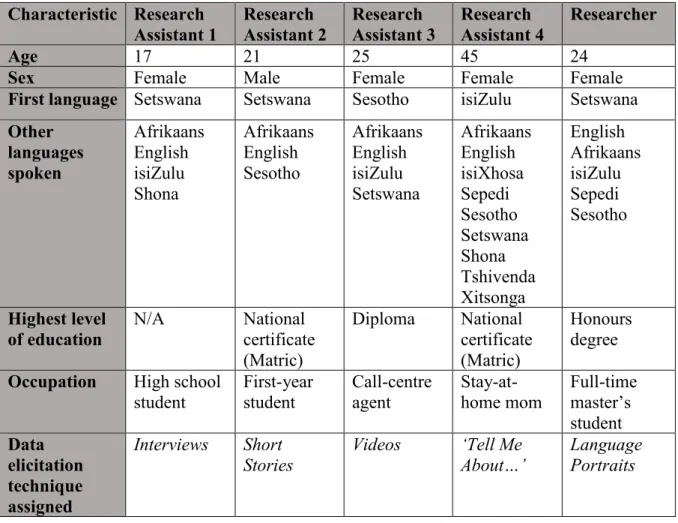
3.3. Participant Characteristics ... 39
3.4. Data Collection and Elicitation Techniques ... 40
v
3.4.2. Short Stories ... 44
3.4.3. ‘Tell Me About…’ ... 47
3.4.4. Interviews ... 48
3.4.5. Videos ... 50
3.5 Data Collector Training ... 52
3.6 Data Transcription Procedure ... 54
3.7 Data Analysis Procedure ... 55
3.8 Ethical Considerations ... 57
3.9 Methodological Challenges ... 58
Chapter 4: Data and Analysis ... 61
4.1. Language Portraits ... 62 4.2. Short Stories ... 65 4.3. ‘Tell Me About…’ ... 67 4.3.1. Mother Tongue... 69 4.3.2. English ... 71 4.3.3. Afrikaans ... 73 4.4. Interviews ... 75 4.5. Video Descriptions... 81
Chapter 5: Discussion and Conclusion ... 84
5.1. Introduction ... 84
5.2. What Ideologies Do 10 to 12-Year-Old Black Multilingual South African Children Demonstrate Towards English and Afrikaans as Additional Languages? ... 84
5.3. Which Data Elicitation Technique/s Yield/s the Most Themes from 10-12-Year-Old Pre-Adolescent Multilinguals Regarding Their Language Ideology? ... 87
5.4. Directions for Further Research on the Topic of Pre-Adolescents’ Language Ideology ... 91
5.5. Limitations of the Study... 93
5.6. Conclusion ... 94
References ... 97
Annexure A: Permission to Conduct Research ... 102
vi
Annexure C: Background Questionnaire ... 106
Annexure D: REC Assent Form ... 110
Annexure E: Language Portraits ... 113
Annexure F: Short Stories... 116
Annexure G: ‘Tell Me About…’ ... 119
Annexure H: Interviews ... 122
1
Chapter 1: Introduction
1.1.Background to the Study: Data Elicitation in Adolescents
Identifying and successfully implementing relevant data elicitation techniques is an important aspect of any research project, as the actual data forms an integral part of an empirical study. As a researcher, one wants to use tools that will help one obtain the most relevant and high-quality data to use in one’s study; consequently, acquiring data can be a complex process that
may involve many activities from a variety of available techniques, approaches, and tools for successful elicitation (Hickey & Davis 2003, p. 10).
Prompting data from adolescents is especially challenging when one factors in the contextual issues that often play a role in successful data elicitation. The techniques used to elicit data from adults may not necessarily yield the same quality or quantity of data from younger participants, so data elicitation techniques used in especially qualitative research need to take a number of factors into account. These can include the participants’ age group and/or social
context/s. Similarly, a research gap exists in the comparison of different elicitation methods, mostly due to the infinite variety of research topics which would require the implementation of different combinations of elicitation techniques (Nielsen, Keil & Zeller 2013, p. 255).
Against this background, this thesis will focus on techniques that can be utilised to elicit relevant data from young participants. Specifically, the study will attempt to extract themes about pre-adolescents’ ideologies pertaining to languages by using a variety of techniques, as
well as evaluate the quantity and quality of those themes elicited by the data elicitation techniques, effectively identifying and ranking the techniques researchers could use to elicit
2 the highest quantity of themes on language ideology from pre-adolescents. The techniques used in this research study were Language Portraits, Telling ShortStories, ‘Tell Me About…’(viz. open-ended interviews), Interviews (closed-ended questions), and Commenting on Video Clips
(each discussed in detail in Chapter 3). This study also aimed to contribute to the narrowing of the knowledge gap that persists in academia regarding such data elicitation techniques and their efficiency.
The aims of this research study were four-fold, namely to (i) contribute to narrowing the above-mentioned knowledge gap, (ii) investigate the language ideologies of black multilingual pre-adolescents, (iii) evaluate and rank the effectiveness of (five) data elicitation techniques in terms of the number of themes derived from using each technique, and (iv) inform future research on the language ideologies of pre-adolescents.
1.2.Research Questions
Considering the aims mentioned above, the two research questions that guided this research study were:
1. What ideologies do 10 to 12-year-old black multilingual South African children demonstrate towards English and Afrikaans as additional languages?
2. Which data elicitation technique/s yield/s the most themes from 10 to 12-year-old pre-adolescent multilinguals regarding their ideologies about languages?
1.3.Rationale of the Study
According to available literature, little is known about the ideologies of primary school learners about the languages they are taught at school, specifically English and Afrikaans. Furthermore,
3 it is not yet known which techniques work best to capture the language ideologies of these primary school learners. So, this study compared the effectiveness of five data elicitation techniques in black pre-adolescent multilingual children by means of collecting information on their language ideologies. An effective technique would be one that can be used by researchers to collect information from young participants that is both relevant (in terms of the themes discussed by the participants) and substantial (in terms of the quantity of themes documented). Assessing the effectiveness of data elicitation techniques will assist researchers in collecting qualitative data and aid in the production of quality research in future.
The study was also interested in the language ideologies of black South African 10 to 12-year-old multilinguals – particularly their ideologies towards their mother tongues1 and towards
English and Afrikaans as additional languages, as well as their views on the additional
languages’ (potential) usefulness in their lives as mother tongue speakers of South African
Bantu languages. The data for this study was collected from 10 pre-adolescent participants residing in the Wolmer area in Pretoria North, Gauteng. The participants were black second language (L2) speakers of English, and they all had Afrikaans as an L2 at their primary schools (which offered the option of either English- or Afrikaans-medium classrooms). Note that all schools in and around the Wolmer area only offer English and Afrikaans as languages of tuition from Grade R onwards, thus South African Bantu language speakers are not afforded the opportunity to be taught in their mother tongues. This meant that learners (including the participants in this study) are expected to study through the mediums of English (as the Home Language) and Afrikaans (as the First Additional Language) or vice versa. The only avenue towards mother tongue education leads to the kasi (township) schools which, as in many other
1 In this thesis, I use both mother tongue and home language. I am aware that these concepts are not synonymous
4 areas of South Africa, are known to be under-resourced. For instance, Probyn (2009, p. 127) revealed that 83% of township schools do not have libraries or adequate reading resources. For these and other reasons, parents in Wolmer (again, as in many other areas of the country) who speak Bantu languages prefer to send their children to English-medium, or so-called ex-Model C, schools (see, e.g. De Klerk 2000; Heugh 2000; Jordaan 2011; Meirim, Jordaan, Kallenbach & Rijhumal 2010; Webb 2002). Accordingly, through the study, I wanted to ascertain what ideologies young learners hold pertaining to their additional languages which they have no choice of learning and studying as school subjects. The learners would probably be surrounded by discourse on English being the language of upward mobility (see, e.g. Hibbert 2016), Afrikaans being the language of oppression (see, e.g. Willemse 2017) and their mother tongues not being languages of advancement and development (see, e.g. Prah 2018). Potgieter (2011, p. 1) explained that the negative stigma of the apartheid era has “tainted the concept of mother
tongue education for many black South Africans… [and that] the African schools that have
affected changes in their language policy, have generally chosen to incorporate English as the language of learning and teaching at an even earlier stage, completely disregarding recommendations to the contrary”. This serves as a possible explanation for the
abovementioned point regarding English as the language of upward mobility, and maybe even the tendency of non-English speaking parents to prefer English as a medium of instruction,
over the child’s mother tongue. (This is discussed in section 2.4.1 of Chapter 2). Fundamentally,
I wanted to establish whether these ideologies about English and Afrikaans would be present in the learners who have no choice but to study (through medium of) these languages instead of their mother tongues in school.
5 The study took place in the City of Tshwane Metropolitan Municipality (CTMM)2, specifically
in a Pretoria North area not unfamiliar with poverty. It is also an area in which Sepitori is commonly spoken. In this section, I describe the research context by discussing the metropolitan area, poverty and Sepitori.
1.4.1. City of Tshwane Metropolitan Municipality
The administrative capital of South Africa, Pretoria, which is in the City of Tshwane Metropolitan Municipality (CTMM), is located in the Magaliesberg mountain range on the prairies of the Apies River Valley (Corten & Van Dun 2010, p. 11). The history of the administrative capital city dates back to the 1840s, when the Boers (who arrived in the area in 1841) established Pretoria as the capital city of the Zuid-Afrikaansche Republiek (ZAR; which
is Dutch for “South African Republic”) after the British colonisers granted them independence
in 1852. Although the AmaNdebele ethnic group is believed to be the original inhabitants of Pretoria, militant growth and battles dispersed them, and the Boers took over the land (Corten & Van Dun 2010, p. 11). After gold was discovered in the Witwatersrand in 1886, the economy boomed, and the gold rush resulted in a major influx of immigrant mine workers into the region as well as an economic and social transformation of the entire country (Corten & Van Dun 2010, p. 12).
Corten and Van Dun (2010) explained that the gold rush had a political impact on the country,
which led to military conflict. This saw Pretoria become the site of “several disputes during the
second half of the 19th century; among the Boers, between Boers and indigenous tribes and
2 Although Pretoria was renamed to Tshwane in 2005, the former is still used to refer to the city. It is worth noting
that Pretoria, established in the 1840s, is much older than the City of Tshwane Metropolitan Municipality (CTMM), which was established in the mid-2000s (https://www.sahistory.org.za/place/pretoria).
6 between the Boers and the British rulers over the South of Africa. These conflicts culminated in the second Anglo-Boer war (1899-1902), bringing the ZAR under British rule” (Corten &
Van Dun 2010, p. 12). Pretoria managed to recover during the first half of the 20th century and
regained economic stability, although racial segregation and economic inequality took their toll on the integrity of the city and, by the time the then prime minister, Hendrik Verwoerd, withdrew South Africa from the Commonwealth in 1961, black people and other people of colour were forced to live in racially segregated townships, with no option of living in the city quarters (which were better resourced but reserved for whites only). In addition to this, black males had to walk around with their identity books (then called a dompas). The remnants of those laws are, unfortunately, still felt today, some 24 years after the abolishment of apartheid. Today, the Union Buildings in the city, which were once the homestead of the racist apartheid regime, serve as the mark of cultural diversity and reconciliation (Corten & Van Dun 2010, p. 13), as well as a constant reminder of the progress that has been made to abolish racism and economic inequality in South Africa.
The research site, Wolmer, is situated within 15 km from the Union Buildings, in an area that is traditionally considered Afrikaans-speaking, as can be seen from the names of the schools in the area, e.g., Primary Schools Danie Malan, Rachel de Beer and Voortrekker Eeufees
(“Pioneer trekker Centenary”), and High Schools Gerrit Maritz and Pretoria-Noord (“Pretoria
North”). Wolmer was historically a transport hub, and today is an area affected by poverty.
Poverty in Pretoria as a whole will be discussed in the next section.
1.4.2. Poverty
Blaauw, Louw and Schenck (2006, p. 460) investigated the little-researched topic of day labour in Pretoria. Day labour is a section of the informal sector which includes an array of activities
7 like gardening, street vending, painting, sewing, sidewalk hairdressing, driving, welding, selling traditional medicine, and running spaza shops (informal tuckshops). The researchers were interested in the day labourers who stood on the sides of roads and waited for possible informal job opportunities to receive any remuneration, from as little as R50 per day. Maisel (2003 in Blaauw et al. 2006, p. 458) suggested, 15 years ago already, that there were approximately 500 places in South Africa where day labourers (some as young as 16 years old) could be picked up for casual labour. This is usually on an hourly or daily basis and, with around 50 to 100 individuals at a single site per day, there were between 25 000 and 50 000 individuals looking for work every day.
Blaauw et al.’s (2006) findings revealed that 98% of day labourers in Pretoria were male, and
of those that were South African natives, almost 60% were not originally from Pretoria. Also,
“a significant percentage” of the participants were born in Zimbabwe or Mozambique and
entered South Africa through land borders (Blaauw et al. 2006, p. 462). A third of the participants indicated Sepedi as their home language, 16% spoke isiNdebele, and 10% spoke Xitsonga. Close to three quarters of the workers interviewed were younger than 35 years, with 61% reported as younger than 30 years. On average, 56% of the day labourers indicated that they were financially responsible for up to four people (including themselves), whilst 4% reported being financially responsible for more than nine people (Blaauw et al. 2006, p. 462). 57% of the day labourers earned less than R700 per month, and a quarter of them earned less than R300 per month, which was 15% below the then national food poverty line of R354 per adult per month (Blaauw et al. 2006, p. 468). A later infographic chart by Grant (2015) for Mail & Guardian (see Table 1.1 below) suggested that the poverty line for people living in the Gauteng province was higher than this figure, at R963.
8
Table 1.4.1: Poverty in South Africa (Grant, 2015)
Provinces Poverty line (in ZAR/month)
Eastern Cape R678 Free State R718 Gauteng R963 KwaZulu-Natal R757 Limpopo R627 Mpumalanga R974 North West R767 Northern Cape R705 Western Cape R804
These statistics offered bleak, yet informative insight into the lives of some Pretorians. Today, the 240 participants in Blaauw et al.’s (2006) study form part of the 10.7 million people living
in abject poverty within South Africa (Grant, 2015). Another infographic chart by Statistics South Africa (see Figure 1.1) gives an indication of the distribution of no-income households per province between 2001 and 2011. The Wolmer area in Pretoria North (the research site) is not a particularly affluent community, so it is easy to imagine how these statistics could be a lived reality for some of the people in the community.
9
Figure 1.1: Provincial distribution of households in the no-income category (2001 and 2011) (Statistics South Africa 2015a, p. 15)
According to Figure 1.1, 30% of households who reported having no income in 2011 were in Gauteng; this statistic increased by 9% from 2001. Statistics South Africa tried to explain this trend by stating that “the increases in the proportions of households without income in Gauteng
and Western Cape can be partly attributed to population growth in both provinces. Both Gauteng and Western Cape reported the biggest population growth trends from 2001 to 2011... The population of Gauteng grew from 21,9% of the total population of South Africa in 2001 to 23,7% in 2011, whereas the population of [the] Western Cape grew from 10,1% of the total
population in 2001 to 11,2% in 2011” (Statistics South Africa 2015a, p. 15).
In Figure 1.2 below, Gauteng boasts the highest proportion of upper-income households (i.e. households with an annual income of R307,201 and upwards). This is not surprising since Gauteng is the economic hub of South Africa. However, it is worth noting that the province also hosts the largest proportions of the poorest people in the country. Gauteng has over 13,2
10 million inhabitants (24% of the national population) (Statistics South Africa 2015b, p. 1), with over 4 million of those (30%) living in abject poverty (i.e. in no-income households).
Figure 1.2: Provincial distribution of households in the upper-income category (2001 and 2011) (Statistics South Africa 2015a, p. 20)
Wolmer, situated in Gauteng, is a low-cost housing area, in a larger area in which dire poverty is present (see www.wolmercommunityproject.co.za). Poverty alleviation and employment creation organisations are active in Wolmer and surrounds, and the participants for this research were sourced from one non-profit aftercare facility for school children. It is known that poverty-situated children fare less well in first language acquisition than their affluent peers (see, e.g. Hoff & Tian 2005; Noble, McCandiss & Farah 2007; Whitehurst 1997) and the influence of the socio-economic status of the participants on their L2 learning of Afrikaans and English can thus not be ruled out and might even have had an influence on their ideologies about their non-mother tongues.
11 1.4.3. Sepitori
Sepitori (also called Pretoria Sotho) is a mixed language found predominantly in Pretoria, and is the lingua franca of many of its inhabitants (Ditsele & Mann 2014, p. 159). According to Finlayson et al. (1998 in Ditsele & Mann 2014, p. 161), a mixed language is a distinctive style of language use amongst the residents of black townships in South Africa and may include words or constituents of other languages. Similarly characterised as a Black Urban Vernacular, Sepitori is comprised of two mutually intelligible languages – Setswana and Sepedi. A Black
Urban Vernacular can best be described as a language variety that can be used to facilitate communication between interlocutors who do not share the same mother tongue (Ditsele & Mann 2014, p. 161). However, the definition of a lingua franca is very similar to that of a Black Urban Vernacular. Ditsele and Mann (2014, p. 161) add that a Black Urban Vernacular identifies someone as belonging to a particular township (although the use of the vernacular can be extended beyond informal domains) – thereby conveying group membership and
solidarity between members of a speech community.
Roughly 38% (i.e. two in every five) of Pretoria inhabitants are first language speakers of Setswana or Sepedi, and only 13% of the Pretoria population speaks English as their first language, whereas 21% are first language speakers of Afrikaans (Ditsele & Mann 2014, p. 159). The Language Policy of the City of Tshwane (2012, p. 6), however, recommends the use of English in official inter- and intra-departmental communication. This is notwithstanding the fact that, of the 11 official languages in South Africa (namely Afrikaans, English, isiNdebele, isiXhosa, isiZulu, Sepedi (Northern Sotho), Sesotho, Setswana, siSwati, Tshivenda, and Xitsonga), English and Afrikaans are not Black South African languages, and are classified as Indo-European languages (Ditsele & Mann 2014, p. 159).
12 Pretoria is colloquially referred to as Pitori and since, in Setswana and Sepedi, the prefix se- is used to indicate the language spoken by a people (for example, Setswana indicating that the language is spoken by the Tswana people), the term Sepitori can be loosely translated as ‘the
language spoken by the people of Pretoria’ (Ditsele & Mann 2014, p. 159). Appreciation for
this dialect rose in popularity on social media platforms as users coined the hashtag #learnpitori (Learn Sepitori) in 2017, online. This resulted in humorous displays of appreciation for the originality of the language and its quirky rationalisations. Comparisons like the ones given below were made on the social media platform Twitter between Sepitori and other official South African languages:
1a) English: Can I please have R10?
b) Setswana: Ke kopa R10?
I (am) asking (for) R10
c) Sepitori: Mfe jacket
Give me (a) jacket [the colloquial term for R10]
2a) English: Are you okay?
b) Setswana: O phetse sentle?
You lived okay?
c) Sepitori: Smoko?
Problem?
3a) English: He is Indian
b) Setswana: Ke le India
S/he is Indian
c) Sepitori: Ke my friend
S/he’s “my friend” [alluding to the stereotypical notion that Indian store
13 In the above examples, one can clearly see Finlayson et al.’s (1998 in Ditsele & Mann 2014)
point being illustrated. The Sepitori examples include both English words (e.g. my friend) and Setswana elements (such as the word-order).
Schuring (1985 in Ditsele & Mann 2014, p. 160) explained that Sepitori came from the Kgatla3
dialect of Hammanskraal within Pretoria, with elements from Sepedi, Afrikaans, and English added to Setswana. Hymes (1971 in Ditsele & Mann 2014, p. 160) also suggested that Setswana formed the substrate of Sepitori, whilst Sepedi was the initial superstrate of the mixed language. Ditsele and Mann (2014, p. 160) illustrated Hymes’ impression and the interactions between
the different languages in the sentences below:
4. English: I know this man; he likes to wear one shoe.
Afrikaans: Ek ken dié man; hy hou daarvan om een skoen te dra.
Setswana: Ke a mo itse monna yo; o rata go rwala setlhako se le sengwe.
Sepedi: Ke a mo tseba monna yo; o rata go APARA seeta se le tee.
Sepitori: Ka mo itse dié man; o rata ho APARA setlhako se one.
- Ditsele and Mann (2014, p. 160; Afrikaans MM) -In the Sepitori example above, one notes the borrowed words from the different languages like English (one), Afrikaans [dié man (‘this man’)], Setswana [itse (‘know’), setlhako (‘shoe’)],
and Sepedi [apara (‘wear’)], as well as the fact that the word order for declaratives in Sepitori
is identical to that of the Black South African languages (i.e. Subject-Verb-Object).
3 The Kgatla are one of a number of tribes of Setswana-speaking people that originates from South Africa and
14 As a lingua franca, Sepitori is habitually used by the black citizens of Pretoria with different mother tongues to facilitate communication amongst themselves (hence it is called a Black South African language) (Ditsele & Mann 2014, p. 161).
In conclusion, while Pretoria has a rich, yet equally sad, history (specifically from 1910 to 1994) as one of the four capital cities of South Africa, poverty and unemployment are a lived reality for many, more especially within the Wolmer community where this research was conducted. The dynamics between Sepitori and the other official languages spoken within Pretoria should be interesting to note, but this will not be explored purposely in the study. This study is primarily interested in the language ideologies of learners in Pretoria partially pertaining to their mother tongues and wholly pertaining to their Indo-European languages as well as how to successfully elicit relevant themes from these learners about their language ideologies.
1.5.Thesis Outline
Chapter 2 offers an overview of the literature relevant to the topic of the thesis. The chapter gives a basic summary of models of motivation related to SLA, after which it turns to a discussion of the motivation model that inspired this research study, namely Dörnyei and Ottó’s
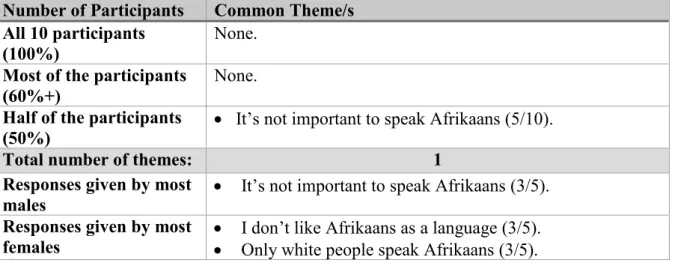
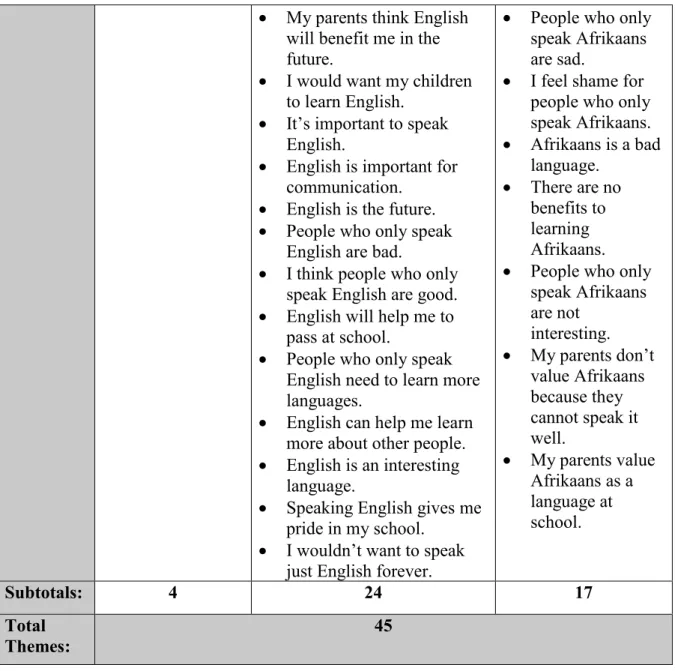
1998 Process Model of L2 Motivation. Studies on language ideologies of school children are also detailed in the chapter. Chapter 3 looks at the methodology and the challenges faced during completion of this research, and Chapter 4 comprises the full data presentation and analysis. Here, I provide all the relevant themes elicited by each data elicitation technique and quantify them in terms language (mother tongue, English, Afrikaans) and prevalence amongst at least 50% of either the male or the female participants, or both. The concluding remarks and an evaluation of the overall results are provided in Chapter 5, where I also make recommendations for future research to avoid the shortcomings experienced throughout this research study.
15 1.6.Definition of Core Terms Used in this Thesis
Data elicitation technique: Data elicitation is the process of collecting knowledge (data) from a human source of knowledge considered capable of sharing that (relevant) knowledge required for the purpose of a study (Cooke 1994, p. 802). Therefore, a data elicitation technique is the means or the instrument that is utilised by a researcher to extract relevant knowledge from a participant to inform their study.
Language ideology: A language ideology is a set of beliefs about a language’s perceived
structure and use, which are deemed justifiable or rational by the user (Silverstein 1979, p. 193).
Motivation:Motivation is a combination of an individual’s desires and efforts to achieve a set
goal (McGroarty 1996, p. 5).
Pre-adolescent: Pre-adolescent is the period of human development occurring from approximately the age of nine to the age of 12 years (Preadolescence, Merriam-Webster.com).
Second language acquisition (SLA): Second language acquisition (or second-language learning) is, in the broader sense, the learning and subsequent acquisition of the ability to speak a language other than one’s own mother tongue. This process often, although not always,
involves meaningful interaction with the target language, in the form of exposure to natural communication (Krashen 1981, p. 1).
16
Chapter 2: Literature Review
2.1.Outline of the Chapter
In this chapter, I will discuss motivation models in L2 learning, second language acquisition (SLA), and language ideology. The first part of the chapter will discuss our current understanding of SLA and present a historic overview of the theories in the field of motivation in L2 learning. In this section, I will provide examples of theories on motivation, as well as a detailed discussion of one main theory, namely Dörnyei and Ottó’s 1998 Process Model of L2
Motivation. The reason for discussing motivation in L2 learning is that the participants in the study and their classmates have no choice as regards L2 learning. Their Language of Learning and Teaching (LoLT) (which is not their mother tongue) has been chosen for them by their parents, and the L2s that they learn at school (one as a Home Language and one as a First Additional Language, as required by the Curriculum Assessment Policy Statements in place in South African government schools) have been predetermined and need to be passed. Consequently, their language ideology (how they view English and Afrikaans, their school L2s) might influence their motivation and vice versa. I will then conclude the chapter with a discussion on existing research on language ideologies of school children.
2.2.Second Language Acquisition and Motivation Models
L2 learning is an interesting phenomenon that is typically studied within the fields of psycholinguistics, sociolinguistics, and social psychology. Various factors have been identified as influencing the success of L2 learning and, of these, motivation has emerged as one of the most important influencing factors. The study of motivation in L2 learning has led to a number of theories, such as Gardner’s 1985 Socio-educational Model, the 1985 self-determination
17 theory of Deci and Ryan, Bernard Weiner’s 1985 attribution theory, and Locke and Latham’s
1994 goal-setting theory. Stemming from the Canadian scholarly tradition on the topic of motivation in L2 learning, L2 motivation is seen as having a largely socio-psychological approach and emphasis. Robert Gardner and Wallace Lambert (1972 in Dörnyei 2003, p. 5), who were pioneers in this field, described L2s as mediating factors that were flanked by ethnolinguistic groups in multi-cultural settings, meaning that the motivation to learn an L2 is a key factor in the success or failure of intercultural communication and/or association.
Whereas an L2 is considered a ‘learnable’ topic at school, seeing that “discrete elements of the
communication code (e.g. grammatical rules and lexical items) can be taught explicitly, it is also socially and culturally bound, which makes language learning a deeply social event that
requires the incorporation of a wide range of elements of the L2 culture” (Dörnyei 2003, p. 4).
For many decades, researchers have looked for L2 motivation models that can explain the different aspects involved in SLA. Dörnyei and Ottó (1998, p. 43), for example, strove to find a motivation model that could serve as a theoretical basis for their methodological applications intended for classroom interventions in L2 education. Their endeavour proved unsuccessful, because the models they investigated did not provide a “sufficiently comprehensive and
detailed summary of all relevant motivational influences… and they did not do justice to the
fact that motivation is not static, but dynamically evolving and changing in time” (Dörnyei and
Ottó 1998, p. 43). This later inspired them to develop their own motivation model that addressed the inadequacies of previous models (see Dörnyei & Ottó 1998). The resulting
Process Model of L2 Motivationwas also, in part, enthused by Heckhausen and Kuhl’s Action
Control Theory (Dörnyei & Ottó 1998, p. 46). Heckhausen and Kuhl’s theory of volition
(which ultimately inspired the Action Control Theory) states that any enquiry into motivation should be divided into two main categories, namely the study of how intentions are formed,
18
and the study of how intentions are implemented, because “why one wants to do something
and that one wants to do it is one thing, but its actual implementation and successful completion
is another” (Dörnyei & Ottó 1998, p. 46). Another guiding principle for the theory of volition
is the metaphorical ‘Rubicon’. The Rubicon separates (i) the decision-making stage (choice
motivation), where a positive evaluation results in an intention to act and then guides that action sequence until a goal is achieved, from (ii) the implementation stage (executive motivation), where motivational maintenance and control during implementation are vital (Dörnyei & Ottó 1998, p. 46). We return to the Rubicon below, because it features strongly in Dörnyei and Ottó’s (1998) model.
Briefly explained, the Action Control Theory “attempts to explain the common observation
that people’s actual behaviour does not always correlate with the priorities set by their
expectancy and value beliefs, and that even when the expectancies and values remain constant, the accompanying motivational tendencies show a marked waxing and waning… [T]here is
also the phenomenon that people sometimes persist in pursuing an activity in spite of more
attractive alternative goals” (Dörnyei & Ottó 1998, p. 46). On this theory, the main element is
intention, or the so-called activated plan of action a person commits him/herself to. This element requires the simultaneous activation of two memory systems, namely the motivation memory system (which can provide a continuous source of activation independently of other structures) and the action memory system (which holds the behavioural maps for the performance of specific acts). Consequently, the activated plan, in conjunction with the motivation memory, becomes a dynamic plan, signifying the instigation of an executional process, after which the motivation memory assumes a maintenance role (which is an important part of the Action Control Theory). This motivation memory is turned off once an action has been successfully executed (Dörnyei & Ottó 1998, p. 46).
19 A final distinction is made between action–when the person’s focus is on a “fully-developed
and realistic action plan” – and state orientations (similar to learned helplessness) – when the
person’s attention is focussed on the present state (such as the status quo), past state (like
failure), and/or a future state (such as unrealistic goals). Therefore, state orientations prove to be counterproductive dispositions, although various other factors like individual differences may render some people more inclined towards one orientation than the other (Dörnyei & Ottó 1998, p. 47).
One more well-developed and researched aspect of L2 motivation is the integrative aspect of
Gardner’s 1985 motivation theory. Gardner has often used, and emphasised the importance of,
this concept in three different forms in his work: as integrativeness, integrative orientation, and integrative motion (Dörnyei 2003, p. 5). He explained that, although the term is often utilised in literature, a closer look at it reveals that “it has slightly different meanings to many different
individuals” (2003, p. 5). This renders the concept somewhat problematic since it has no one
precise meaning or parallels in any of the mainstream fields of motivational (social) psychology. So, broadly explained, an integrative disposition concerns “a positive interpersonal/affective
disposition towards the L2 group and the desire to interact with, and even become similar to, valued members of a speech community. It implies an openness to, and respect for, all other cultural groups (that the person is interested in) and their ways of life. In the extreme, it might
involve complete identification with the community” (Dörnyei 2003, p. 5). Integrativeness thus
indicates the extent of emotional identification with an L2 group, although, in the absence of
the physical L2 community (within the speaker’s immediate environment), the emotional
identification may be transferred to the intellectual and/or cultural values associated with the L2 (2003, p. 6). An example can be given of first language speakers of Mandarin living in China, who wish to learn English due to an association with or a desire to associate with the
20 English-speaking world’s values, in the absence of an actual native English-speaking
community in their city.
Alternative, well-known theoretical approaches to Gardner’s motivation theory are the Self
-determination theory, Goal theories, as well as the Attribution theory. Self--determination theory, the brainchild of Deci and Ryan (1985), is one of the most influential models of motivational psychology; the main aspects of this theory are intrinsic motivation and extrinsic motivation. Kim Noels, a prominent researcher in this field, has done extensive work that has offered insights into these two concepts of motivation, how they complement the theory, as well as how they should be tested in L2 learning (Dörnyei 2003, p. 8). Attribution theory (chiefly developed by Bernard Weiner 1985) is also one of the main models used in studies related to student motivation, after it successfully challenged Atkinson’s classic achievement
motivation theory in the 1980s (Dörnyei 2003, p. 8). This theory attempted to link individuals’
historical experiences with their efforts at forthcoming achievement, by means of so-called causal attributions as mediating links. The reasoning supporting this idea was that the idiosyncratic reasons to which we often attribute our historical achievements and failures
“considerably shape our motivational disposition” (Dörnyei 2003, p. 9). Therefore, if a person
views and attributes their previous shortcomings in certain activities as being beyond their control, they may not try harder to complete those activities in the future. Thus, the locus of
one’s control plays a major role in motivation according to this theory.
Lastly, Goal theories centralise the importance of goals (classically referred to as orientations)
in L2 motivation. These theories typically look at the specificity of learners’ goals as well as
21 2.3.The Process Model of L2 Motivation
As mentioned above, the Process Model of L2 Motivation was inspired by Heckhausen and
Kuhl’s Action Control Theory. The Process Model constitutes two dimensions, namely the
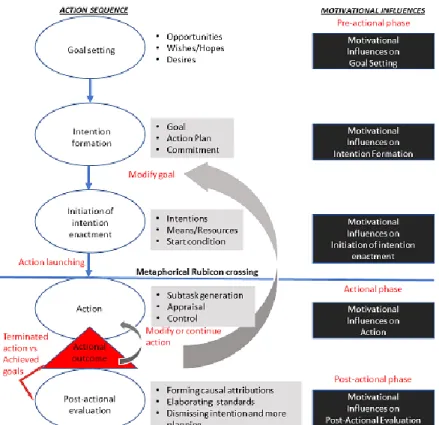
Action Sequence, and the Motivational Influences (Dörnyei & Ottó 1998, p. 47). The Action Sequence comprises behavioural processes where “initial wishes, hopes, and desires are first
transformed into goals, then into intentions, and then, hopefully to the accomplishment of the
goals” (Dörnyei & Ottó 1998, p. 47) which subsequently leads to a final evaluation. The second
dimension, according to the model, includes the energy and motivational reserves that underlie behavioural processes (Dörnyei & Ottó 1998, p. 47). Figure 2.1 below offers a schematic representation of this Process Model of L2 Motivation.
Figure 2.1: Schematic representation of the Process Model of L2 Motivation (Dörnyei & Ottó 1998, p. 48)
22 Above, we can see the different components that make up the two dimensions. Both dimensions are comprised of three chief phases: the pre-actional phase, actional phase, and post-actional phase.
2.3.1. Pre-Actional Phase
During the pre-actional phase of the action sequence, the main act that takes place is goal setting, made up of three preceding groupings4: our wishes and hopes; the desires we might
have; as well as the opportunities that become available to us before we even have the desire to pursue them. The motivational influences (which effectively act as energy sources that either inhibit or enhance the actional sequence; Dörnyei & Ottó 1998, p. 51) at play here include our subjective values and norms, the expectations of others (such as our family), as well as the perceived incentive value of reaching the goal (pertaining to instrumentality) and language attitudes (also pertaining to our desire for integration or our lack of such desire). Our beliefs and ideas about the L2, and what we believe about the language and its speakers are thus
important. These attitudes form “influential predispositions in the learners about the learning
process, stemming from the learners’ families, peer groups, and prior learning experiences”
(Dörnyei & Ottó 1998, p. 55). In the event where there is no commitment to a goal, even with all the above-mentioned influential factors, the final push – namely urgency or a unique
opportunity – may be the only required component to instil a sense of commitment in the
individual.
Goal represents the actual realisation of the preceding sub-phase (goal setting). Although considered ill-defined in theories of motivation, goal has varying constructs that range from
4 Note, in Figure 2.1 above, that the groupings in goal setting (opportunities, wishes/hopes and desires) are not
shaded grey as they are not yet considered to have reached a state of concrete reality (Dörnyei & Ottó 1998, p. 49).
23 being categorised as a primary to even a secondary determinant of action (Dörnyei & Ottó 1998, p. 49). The Process Model views goals as the initial mental representation of a desired outcome; these are an integral step to the successful achievement of any action5 (1998, p. 49). However,
to fully realise goals, another crucial component is necessary in the equation, namely the action plan. Dörnyei and Ottó (1998, p. 49) argue that it is not enough to merely catalyse action if the concrete steps to be taken have not been planned out by the individual beforehand; therefore, an adequate and realistic action plan containing all the technical details and requirements needs to be made. We thus need to formulate intentions, and when we do so, our expectations of success would be influenced by the amount of confidence we have in ourselves and our abilities, how difficult we think the goal will be to achieve, how much support we receive or expect to
receive from those around us, our anxiety levels, the quality and quantity of L2 contact we’ve
had, as well as how proficient we think we are in the L2. These form part of the motivational influences during the pre-actional phase (Dörnyei & Ottó 1998, p. 52). The relevance of the goal we set for ourselves as well as the cost-benefit calculations we have made to determine the benefits of pursuing this goal are also important (Dörnyei & Ottó 1998, p. 54). Our constant need to achieve and avoid failure also plays an integral part, as well as the extent to which we believe we can achieve these goals through our own efforts and strategies, which refers to having an internal locus of control (Dörnyei & Ottó 1998, p. 55). The actual goal and its different components (viz. goal proximity, goal specificity, goal harmony/conflict, and the level of aspiration) and how these are evaluated also play an influential role. We similarly need to believe that there will be opportunities or options available to us that will help us achieve this goal.
5 Dörnyei and Ottó (1998, p. 49) also highlight that a goal is not parallel to an intention. The qualitative difference
between the two concepts, according to the authors, is that an intention already involves commitment. This distinction is made to highlight the fact that, while we may have numerous hopes, wishes, and desires, we only make a concerted effort to realise a selection of those.
They go on to describe commitment-making as a “highly responsible personal decision [that] entails a significant qualitative change in one’s goals-related attitudes” (Dörnyei & Ottó 1998, p. 49).
24 When considering whether or not to launch into action and cross the metaphorical Rubicon, those individuals with a state orientation tend to be hindered by “intrusive thoughts about bugs,
slips in strategy, and failure” (Dörnyei & Ottó 1998, p. 56). These types of individuals tend to
put things off or delay intention enactment. Conversely, action-oriented people are proactive and more likely to carry out their intentions without undue delays. Perceived behavioural control is how easy or difficult individuals think a goal will be to achieve; it is vital for an individual to believe that they have the capacity and control to achieve a desired outcome (Dörnyei & Ottó 1998, p. 56).
Distracting influences and obstacles are the negative powers individuals often encounter and constantly have to deal with; individuals should be headstrong and be able to fight ‘temptations’
(Dörnyei & Ottó 1998, p. 56). Individuals ought to learn to be discerning and know when to
downgrade and/or reassess an intention’s priority in the face of extreme difficulties or hurdles
(Dörnyei & Ottó 1998, p. 56). Lastly, a final push that could help an individual, should they feel the need to give up, can come from simply imagining what would ensue should the goal not be reached; those perceived consequences of their inaction could act as a driving force to initiate action.
Operationalised intention is the “immediate antecedent of action, but… action does not follow
automatically from it” (1998, p. 49), because some intentions can remain unfulfilled because
of various reasons, such as the lack of opportunity, or an inability to act. To address this, Dörnyei and Ottó (1998) recommended two necessary conditions for a so-called ‘
25 second is the start condition (specified by the action plan, which assigns importance to one’s
intentions, subsequently determining the action sequence). 2.3.2. Actional Phase
The actional phase of the action sequence involves the application of the action plan. This is conceptualised as the crossing over of the metaphorical Rubicon, where the individual commits himself to carrying out the steps set out in the action plan, thus committing to moving from planning to action (Dörnyei & Ottó 1998, p. 50). Dörnyei and Ottó (1998, p. 49) further explained that “during the actional phase, three basic processes come into effect: subtask
generation and implementation, a complex ongoing appraisal process, and the application of a variety of action control mechanisms”. Briefly explained, subtask generation and
implementation are concerned with action initiation and application, as well as the continuous generation of subtasks as we try to complete the action plan. Appraisal concerns the constant
evaluation of one’s progress (ideal outcomes versus actual outcomes) and the stimuli provided
by the environment (such as the varying physical and psychological contexts in which we find ourselves and which affect our progress). It is important to note that the appraisal of one area/situation can be transferred to the appraisal of another, different area/situation. For example, Dörnyei and Ottó (1998, p. 49) explained how failure in one language task could result in a generalised negative outlook on the entire language learning process. A learner struggling with the pronunciation of English articles may, for instance view the entire English language learning process as being too difficult for him/her, and maybe not even worth the effort.
Lastly, action control guards against the replacement of intentions should we suddenly find ourselves attracted to something new. Corno (1993, p.16) summarised this point as a “dynamic
26
face of personal and/or environmental distractions, and so aid learning and performance”. To
address this, Dörnyei and Ottó (1998, p. 50) identified three types of self-regulatory strategies, namely action maintenance, language learning,and goal setting strategies, and labelled these especially important for analysing the educational component of L2 learning.
The intensity of the “action-launching impulse”, which allows one to cross the metaphorical
Rubicon and enter the actional phase, is determined by the force of the motivational influences that occurred in the pre-actional phase (Dörnyei & Ottó 1998, p. 57). Concerning the executive motivational influences on the actional phase, apart from the individual learner’s self
-determination and self-perceptions, other external factors that affect motivational quality are the presence and actions of teachers and parents. How parents and teachers encourage and model certain behaviours for the individual, represent tasks, and/or provide feedback to the individual affects the overall quality of the executive motivational influence. This notion effectively ties in with the concept of language ideology, which will be discussed in section 2.4 of Chapter 2 below. Individuals also tend to have a so-called affiliative motive, which is the desire to do well and impress their superiors (Dörnyei & Ottó 1998, p. 59), therefore the role of teachers and parents should be emphasised.
Conflict can obviously weaken motivation in language learners; therefore, healthy conflict resolution strategies are vital. Knowledge of, and skills in using, self-regulatory strategies provide an important source of scaffolding against conflict and distractions, and helps to enhance motivation (Dörnyei & Ottó 1998, p. 59). Effective action control strategies are also handy when dealing with conflict, distractions, competing action tendencies, as well as one’s
natural tendency to lose sight of the goal and get bored/tired of the activity (Dörnyei & Ottó 1998, p. 59). Essentially, all the above-mentioned points are important executive motivational
27 influences, and so is the ability to maintain the motivation and protect the active intention to achieve a goal.
2.3.3. Post-Actional Phase
The post-actional phase commences after goal attainment or action termination. What essentially occurs during this phase is that the completed goal undergoes evaluation to draw the next steps from the results. During this phase, the individual is not engaging in any action, but merely comparing his/her initial expectations (before the action) to the general outcome of the action and how well the action plan was followed (Dörnyei & Ottó 1998, p. 51). This is a vital phase as it makes a significant contribution to the individual’s overall experience and
allows him/her to “elaborate his/her internal standards and the repertoire of action-specific
strategies. It is through such evaluation that an individual can develop a stable identity as a
successful learner” (Dörnyei & Ottó 1998, p. 51).
Motivational influences during the post-actional phase include attributional factors, which refer to the different attributional styles people have that affect how they perceive and process events, as well as self-concept beliefs, which have to do with self-confidence and the degree to which some individuals think they are capable of reaching/achieving a goal. Self-concept beliefs also affect how individuals handle failure and/or success, with individuals who have high self-confidence and self-perception handling failures far better than individuals with low self-confidence levels (Dörnyei & Ottó 1998, p. 62). Evaluational/attributional cues and feedback are external factors that affect motivation. The quality of these evaluations and feedback is important as they can either enhance or lower motivation; again, the role of teachers and parents is vital in this phase (Dörnyei & Ottó 1998, p. 62). In conclusion, a solid action
28 plan, honest evaluation, positive self-perceptions, adequate conflict resolution strategies and a strong support system are all vital ingredients to successful L2 learning.
2.4.Existing Research on the Language Ideologies of School Children
The concept of language ideology will prove both important and relevant in informing this thesis and our understanding of language use by the participants. Silverstein (1979, p. 193)
described language ideologies as “any sets of beliefs about language articulated by the users as
a rationalisation or justification of perceived language structure and use”. Woolard (1992, p.
235) later elaborated on this concept by describing language ideology as a “mediating link
between social structures and forms of talk… Ideology stands in dialectical relation with, and
thus significantly influences, social, discursive, and linguistic practices”. Language ideologies
can therefore inform the ways in which we conceptualise and represent language as well as how language is used, effectively providing a link between the social structures within our communities, power relations and language use, even at the micro-level (Makoe & McKinney 2014, p. 659). This micro-level in the education system, as explained by Makoe and McKinney (2014, p. 659), can start as early as Grade 1 and constitutes reproducing the communicative practices that are informed by, and reinforce, the existing language ideologies in our societies. This is an important concept to study in schools, because it is within the school contexts that certain ideologies are reinforced to learners, which then feed into how they interact with, and within, their broader society, beyond the educational environment. We will see how the linguistic practices in schools can influence language ideologies in the case studies that follow.
The manner in which we communicate is thus influenced by our beliefs and ideas towards the languages we speak as well as our uses of those languages (Layton 2014, p.19). Layton further
29 languages or speakers using languages in particular ways. Rather, they include the values, practices and beliefs associated with language use by speakers, and the discourse which
constructs values and beliefs at state, institutional, national and global levels” (Layton 2014, p.
20). However, Woolard (1992, p. 238) stated that there are multiple other conceptualisations of the term and one cannot assume that any one understanding is relevant to all people. She therefore offered four perspectives on the concept of ideology and how it has been understood
in discourse. The first understanding of ideology is that it is concerned with “consciousness,
beliefs, notions, or ideas… the more intellectual and conceptual constituent of culture, the basic
notions that the members of society hold about a fairly definite area… and the implications of
such sets of notions” (Woolard 1992, p. 237). The second understanding is that ideological
concepts originate from, are entrenched in, reflective of, or receptive to the experience or interests of a particular social position (Woolard 1992, p. 237). Thirdly, ideologies are
understood by some as encompassing “distortion, mystification, or rationalisation” (Woolard
1992, p. 238). This conceptualisation of ideology is, of course, a more negative stance towards the notion, found in early French idéologues and empiricist American sociology (Woolard 1992,
p. 238). Finally, the fourth understanding of ideology is that it is an “intimate connection to
social power and its legitimisation” (Woolard 1992, p. 238). This understanding suggests that
ideologies are essential for sustaining asymmetrical relations to power, domination, and legitimising or distorting relations (Thompson 1984 in Woolard 1992, p. 238). On this latter
understanding, ideology is continually “the tool or property of dominant social groups; cultural
conceptions belonging to oppositional or subordinate groups are by definition non-ideological”
30 2.4.1.Case Studies: Language Ideologies and the South African Language Policy
In her 2014 study, Layton investigated language ideologies in a linguistically diverse primary school classroom and took the stance that, for better comprehension, languages should be observed within their respective socio-historical contexts, instead of categorising them as bound and separate entities (Layton 2014, p. 20). Layton stated that language ideology in South Africa tends to privilege English and English speakers, much like in the United States of America (Layton 2014, p. 19). This gives the impression that English, as a language, and one’s
ability to speak it fluently will more likely be revered than one’s knowledge of, and proficiency
in, other languages, even one’s own mother tongue. It would be interesting to observe whether
this ideology is prevalent in the results of this research. Layton (2014, p. 20) also took note of the manner in which primary school students used different languages to “gain social power in
the classroom”, as well as construct their own social identities and positions within their groups.
Her research found that, although the goal of the Language in Education Policy was to promote
multilingualism in the educational environment, literature showed that “teachers and school
administrators frequently spread a discourse of stigma and deficit toward speakers of other
languages in the classroom” (Layton 2014, p. 27). This goes back to the abovementioned
statement that English and native-like proficiency therein are highly regarded in South Africa, which also ties in with Makoe’s (2007) own findings in her research study on language
discourses and identity construction in primary schools (discussed below).
Makoe, in 2007, conducted an investigation into the discourses around English in a Grade 1
classroom in a suburban area east of Johannesburg, in a bid to illustrate how “English has been
discursively constructed in everyday classroom life [and] why particular discourses come to dominate and what particular knowledge hierarchies become endorsed” (Makoe 2007, p. 234).
31
learners who seemingly spoke English ‘well’ as well as the students’ consequent resistance to
“speaking in their home languages because this was portrayed as a ‘deficit’ in English if they
had to resort to their home language” (Layton 2014, p. 27). Further investigations and an
interview with the school’s deputy head teacher on the institution’s language policy also
revealed that the learners were ranked as ‘successful’ or ‘unsuccessful’ primarily based on their
linguistic capabilities in English (Layton 2014, p. 27). The extract below illustrates these observations.
5. Ayanda: My puppy is sick and my mother said we will take it to the vet when I come back from school.
Teacher: Good, my girl. Listen to Ayanda’s English. That’s why you got a certificate…
- See Makoe (2007, p. 234)
Makoe suggested that this extract offered valuable insight into the manner in which learners
were socialised into “different identity positions and how they respond to the constraints and
possibilities the classroom offers” (Makoe 2007, p. 234). Also, Makoe broke this down to it
being a situation where “the value attached to English language proficiency is immeasurable
and those who decipher the rules of the ‘game’ become winners… Thus Ayanda received
official school recognition and validation” (Makoe 2007, p. 240). The second extract, below,
documented during ‘story time’, offers another example of this emphasis on English
proficiency in the school and how the ability to speak English well could earn the learners
accolades and favour with the educator. In Makoe’s own words, “categorisations, such as
‘Good, my girl’; ‘Listen to Ayanda’s English’; and ‘Your English is good too’, illustrate the
type of dominant discourse that operates in this school” (Makoe 2007, p. 241):
6. Teacher: Well done, my boy. Tell your mummy that you read the whole book. Your English is good too. Let’s thank him.
32
Class: Thank you. Very much. Keep it up. Shine. (singing at the top of their voices)
Bobby: Can I take the book home? I want to read to her.
Teacher: That is fine, my boy. Tell her I am very proud of you.
- See Makoe (2007, p. 241)
Conversely, improper or ‘insufficient’ English proficiency elicited a more negative response
from the educator towards the learners, as illustrated in the extract below:
7. Koketso: I went to the pet shop then my mother buyed me…
Teacher: bought me.
Koketso: bought me . . . then . . . they buyed me…
Teacher: I said bought, bought [with emphasis]. Speak in your language.
Koketso: bought…
Teacher: What did you find in the pet shop?... (Inaudible).
Koketso: Fish.
Teacher: Fish. Right. Now, what does that mean? It is very nice to bring home a pet but what does that mean to you? What is your, your job now?
Teacher: (Inaudible). Speak in your language. If it is hard, speak in your language.
- See Makoe (2007, p. 242)
Considering the above extract, Makoe (2007, p. 242) penned how it was interesting to note that, although the educator spoke only English, she encouraged the learner, a mother tongue speaker of Setswana, to ‘speak it’ in her language – a prompt which the learner did not reciprocate,
seemingly due to the perceived and perpetuated culture of speaking only English in the
classroom. The educator’s tone was also much less congratulatory than in the first two extracts,
evidently due to the learner’s inability to speak English ‘well’. Observing such interactions
between a person in a position of power (the educator, in this case) and a learner will leave an impression on the other learners who observed such interactions and shape their ideology towards English inside, and outside of, the classroom – that, “in the ‘market place’ of the