Pricing Software Development Services
YossiLichtenstein
Department of Management Information Systems University College Dublin, Dublin 4
+353-1-7164715 Ireland
Alan McDonnell
Department of Management Information Systems University College Dublin, Dublin 4
+353-1-7164715 Ireland
Abstract
This paper studies the pricing of software development outsourcing. Two pricing techniques – time and material and fixed price – are described and the economic conditions for selecting between them are discussed. Using agency theory and transaction cost economics, it is predicted that risky and specific systems will be priced on time and material basis while other projects will be fixed price. An additional prediction is that confidence in the vendor’s auditing of resources is essential for time and material contracts.
The predictions are tested on fourteen external software development projects in two large corporations. Quantitative measures of risk, specificity and confidence are utilised, but the data-set does not support the theoretical predictions. In order to explain this result, interviews with senior managers at the two corporations have been conducted. Both disagree with the theoretical prescriptions: one contracts risky projects on fixed price basis, preferring to pay a risk-premium rather than to re-budget. The second expert allows fixed price only with trusted vendors, preferring time and material with all other vendors.
Keywords
Software Development, Outsourcing, Pricing, Agency Theory, Transaction Cost Economics
1. Introduction
Outsourcing is a popular way for organizations to develop software as it gives access to expertise and scale unavailable internally (Nelson, Richmond & Seidmann 1996, Lacity, Willcocks & Feeny 1996). In this paper we ask how such development services are priced. The two basic pricing techniques are Fixed Price, when a price is set in advance for the specified system and services, and Time and Material where the customer pays the vendor’s costs, typically on an hourly rate per programmer (Kutten 1998, Roditti 1998). The trade literature mentions several variations on these techniques, for example, flexible fixed price where the functional specification is priced in advance and the reminder of the project will be priced after the completion of the specification. Another example is time and material with a cap, either for the
entire project or for specified major deliverables. A recent study of 167 external off-shore projects reports that fixed price contracts are the most frequent, contracts which mix the two pricing techniques are less frequent, and time and material contracts are the least used (Banerjee & Duflo 2000).
The Economics literature see these two basic pricing techniques as demonstrating the trade-off in external procurement (Laffont & Tirole 1993). Under a fixed price contract, the supplier bears the full cost; thus, he has an incentive to exert optimal effort but is also encouraged to overstate expected cost. Under a time and material contract, the supplier has no reason to overstate expected cost but has no incentive to exert effort. This trade-off results in using fixed price for standardised products with low cost uncertainty, while time and material is used for one-off projects which involve considerable cost uncertainty (Baron & Besanko 1987). An alternative explanation does not assume pre-contractual cost uncertainty, but show that time and material pricing is preferred to fixed price when post-contractual changes and adaptations are probable (Bajari & Tadelis 2001). A third explanation for the two pricing techniques is centred on firm reputation – established firms are trusted with time and material contracts while new firms are not (Banerjee & Duflo 2000).
These various theoretical models seem to be relevant to software development. In particular, cost uncertainty as well as adaptations and changes are typical of software development. For example, Boehm et al. (2000) estimate that at the very initial phase of a project (‘concept of operation’) estimated cost is between 50% and 200% of the actual cost; at the requirements specification stage, estimated cost is between 75% and 150% of the actual cost. These observations agree with the advice in the computer contracting literature; for example, Roditti (1998, p. 7-24) explains that ‘pricing is very difficult for the vendors and ill understood by users’; the difficulty stems from the vendor’s uncertainty about the amount of work required to achieve operational software.
Our research question regards the conditions that influence the choice between time and material and fixed price contracts. Two micro-economic theories, Agency Theory (Laffont and Martimort, 2002) and Transaction Cost Economics (Williamson 2000), are used to study possible decision criteria. These are phrased as predictions: fixed price contracts are predicted for low risk and non-specific systems and time and material contracts are predicted for high risk and specific projects with trusted vendors.
In order to test these predictions, we accessed two large Irish companies with considerable experience in outsourcing software development. The seven largest recent projects were selected and a senior procurement manager in each company was asked to assess the projects’ risk and specificity. The data showed considerable differences between the companies, so a separate analysis of each data-set was required. However, the simple statistical analysis used could not support the predictions.
As a final stage in this research, we conducted open interviews with managers at the two companies. Their views are considerably different from our theoretical predictions. Although they mostly accept the importance of the theoretic constructs, some of their conclusions are opposite to the theoretical prescriptions. In particular, one of these experts prefers fixed price when risk is high, and one is willing to consider fixed price only with reputable and trusted vendors while she prefers time and material contracts with all other vendors.
The paper continues in Section 2 with a brief theoretical exposition and three predictions. Section 3 presents the method and Section 4 the quantitative results and
analysis. Section 5 presents a summary of the open interviews and a simple qualitative analysis. We discuss the results, contributions and limitations in Section 6.
2. Predictions
This study focuses on the economic criteria for pricing software development contracts and uses two theories of contracting – Agency Theory and Transaction Cost Economics. For recent reviews of the theories, see Laffont and Martimort (2002) and Williamson (2000); both theories do not assume full information and full rationality, and both have been extensively tested (Eisenhardt 1993, Salanié 1997, Shelanski & Klein 1995, Boerner & Macher 2002). In the next paragraphs, the theories are described very briefly, their application to software development pricing is discussed and the resulting predictions are presented.
Agency theory assumes an uncertain venture that is owned by a principal and performed by an agent whose actions are not fully observable. Outsourcing of software development fits this description well as uncertainty is significant and performance is difficult to measure. A linear agency model (Holmstrom 1989) demonstrates the trade-off between incentives and risk sharing – if the venture is sold to the agent, he would exert maximum effort, but will bear the full risk; however, if the agent is paid a flat fee, he would bear no risk but would have no incentive to exert effort. The model shows then that a combination of a flat fee and performance-tied payments is optimal, and that risk reduces the likelihood and size of the performance-based payments. The reason is that for a risky project the agent would require a high premium to accept the risk of performance-based payments.
We interpret fixed price contracts as performance-based with respect to the development cost. This is because the vendor keeps cost savings and pays cost overruns. Namely, fixed price contracts reward the vendor for his cost performance and are thus performance-based. Consequently, using the linear model proposition, it is predicted that fixed price and time and material contracts are related to risk in the following manner:
H1: Fixed price contracts are likelier for low risk projects; time and material contracts are likelier for high risk projects.
An intuitive way to think about the prediction is to consider the risk premium a vendor charges for fixed price. If the risk and the resulting premium are high, a large customer with many projects would prefer to take the risk and save the premium. There are several assumptions implicit in our agency reasoning. Firstly, we assume that the system functionality can be defined well enough to negotiate (and compete) on a fixed price. Secondly, although our reasoning is centred on cost, we assume that the overall risk of the project should be considered. Namely, difficulties with achieving the required functionality (or quality, or effectiveness) are assumed to increase costs as more resources are needed to overcome the difficulties. Thirdly, a useful simplifying assumption is that customer and vendor share the same information about the project, in particular their assessments for cost and risk are similar. This should be plausible for large enough projects which are thoroughly discussed between customer and vendor.
Turning now to transaction cost economics, it assumes that all complex contracts are incomplete (as result of bounded rationality) and are constructed to protect against post-contractual opportunism (Williamson 1998). The theory asserts that any issue that can be formulated as a contracting problem is usefully addressed by considering transaction costs; these include the cost of negotiating a contract, consummating and
safeguarding it. The main prediction of the theory is then the discriminating alignment hypothesis: transactions which differ in their attributes are aligned with governance structures so as to economise on transaction costs (Williamson 2000). Of the many attributes for describing transactions, one is the primary focus of the theory – a higher degree of relationship specific assets is associated with more hierarchical contracts. Namely, when customer-specific investment is needed, contracts include (hierarchical) controls to ensure such investment and to reduce the likelihood and costs of vendor opportunism. On the other hand, when a transaction does not require much customer-specific investment, a simple market transaction is sufficient. In addition to specific investment, greater uncertainty, more complex transactions and more frequent exchange increase the contractual hazards brought on by specific investment and result in more hierarchical contracts (Boerner & Macher 2002).
We interpret time and material contracts as a relatively hierarchical governance structure, and fixed price contracts as relatively close to a market transaction. The reason is that a time and material contract entails monitoring and some controlling of the vendor actions and costs. Because a resource rather than a final outcome is contracted (Lacity et al 1996), time and material pricing is quite close to an internal hierarchical control of a project. In contrast, a fixed price contract must pre-specify a system in great detail, but does not entail hierarchical control along the project progress.
We then choose to focus on the primary attribute associated with hierarchical governance, and predict that fixed price is likely for projects which do not entail high customer-specific investment. If such investment is needed, the customer will prefer a more hierarchical governance structure by contracting on a time and material basis: H2: Fixed price contracts are likelier for projects which are not customer-specific; time and material contracts are likelier for customer-specific projects.
In addition to risk and specificity, we consider a third construct – the customer’s confidence in a vendor’s time and material accounting. Lack of confidence was identified in a previous study (Lichtenstein 1999) as a possible reason for rejecting time and material contracts. Although confidence is not explicitly studied in the economic theories used, it fits both of them well. Agency theory postulates that long-term relationships lessen the agency costs (Eisenhardt 1993); long long-term relationship may be interpreted as a way to build confidence. The transaction cost economics assumption about the vendor opportunism and the possibility of a hold-up (Williamson 1998) may also be qualified when confidence specific to time and material accounting has been built. The result of this reasoning is our final prediction: H3: Time and material contracts are likelier if the customer has confidence in the vendors’ time and material accounting.
3. Method
We had access to two large Irish corporations with considerable portfolios of external software projects. In each company, a senior IS procurement manager served as our respondent. The respondents were first asked to delineate the portfolios of all external IS projects during the last two years which included a substantial custom-made software component. The seven largest projects in each portfolio were selected; we ensured that our respondents knew these projects well. The respondents were asked to answer a questionnaire for each of these projects. The first questionnaires were filled-in by us, and the respondents were asked to answer the remaining
questionnaires at their own convenience. The small number of projects and the self-administration of questionnaires were due to time and access restrictions in the two companies.
The questionnaire includes about thirty questions that cover pricing, risk, specificity and confidence. A version of the questionnaire was pre-tested by discussing it with two experienced IT project managers. Several questions were changed and clarified and several items were removed because they did not fit the outsourcing context. The final questionnaire is given in the appendix.
The risk instrument is a condensed version of the Barki, Rivard and Talbot (1993) questionnaire. Risk is defined as the product of uncertainty surrounding a project and the magnitude of potential loss associated with project failure. Uncertainty is then measured by five factors including eighteen items: newness, scope, expertise, complexity and organisational environment. The potential loss measure asks for the impact on six functional areas if the system is not implemented or has operational problems. Subjective items are measured by a seven point Likert scale with the following labels: strongly disagree, disagree, somewhat disagree, neutral attitude, somewhat agree, agree, strongly disagree. Items are normalised and averaged to get uncertainty and loss scores; the risk score is calculated as the product of uncertainty and loss.
The specificity instrument follows Ang and Beath (1993) by asking about the effort needed to convey the system requirements, the training a system-analyst would need and the delay caused by hiring a new analyst.
Confidence in the vendors time and material accounting is measured by nine questions. The objective items follow the agency literature (Eisenhardt 1993) and ask about the length of time relationship with the vendor existed, the number and size of previous projects and whether any of them was on a time and material basis. The subjective items measure agreement with statements about confidence with respect to time and material accounting, reputation and familiarity with the development team. The confidence score is the average of the normalised nine items.
4. Quantitative data and analysis
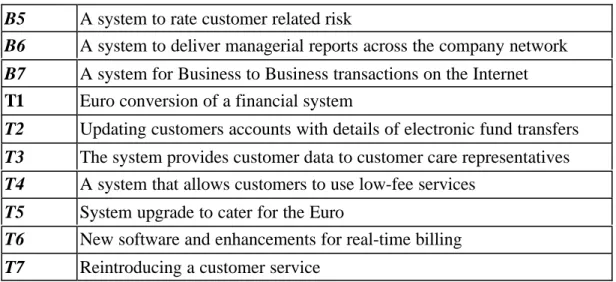
The first research site is denoted by B, it is a service organisation with about two million customers, ten thousand employees and a relatively large IS department. The second site is T, another service organisation, with about two million customers, fifteen hundred employees and a small IS department. For both companies, information systems are strategic and external software development has been common for many years. Our respondents are senior managers at the IS departments, with about ten years of IT experience and business academic education. From 2000 to 2002, B had about 20 external IS projects and T about 60. The data-set consists of the seven largest projects, by cost, in each company; data about these projects is summarised in tables 1 and 2.
Contract Description
B1 An enhancement to a bookkeeping system
B2 A follow on for a Customer Relationship Management system
B3 A Data-Base of project commitments
B5 A system to rate customer related risk
B6 A system to deliver managerial reports across the company network
B7 A system for Business to Business transactions on the Internet
T1 Euro conversion of a financial system
T2 Updating customers accounts with details of electronic fund transfers
T3 The system provides customer data to customer care representatives
T4 A system that allows customers to use low-fee services
T5 System upgrade to cater for the Euro
T6 New software and enhancements for real-time billing
T7 Reintroducing a customer service Table 1. Project descriptions
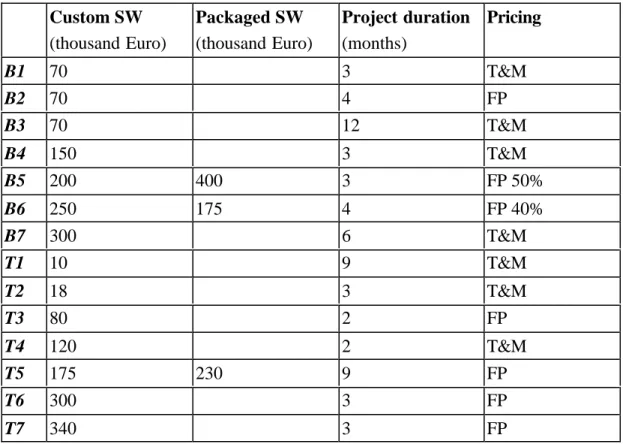
In Table 2, the pricing column for T uses FP to denote fixed-price and T&M to indicate time and material; at B, some of the contracts are a combination of the two pricing techniques, so the relative size of the fixed price is given.
At site B, the median project costs 150k Euro; the average is 159k Euro. At T, the median cost of custom-made software is 120k Euro, with average of 149k. Only three projects include packages – with cost between 70% and 200% of the custom-made software. Average project duration is about five months at B and four months in T, although this data may be problematic as the duration of the few costly projects is surprisingly short.
The pricing at the two sites differ, entailing separate analysis for each company; because the number of data points in each site is very small, only basic statistical inference is possible. At company T, the data-set is divided into two groups, four fixed price contracts and three time and material contracts. Table 3 presents the mean (and standard deviation) for the independent variables for the two groups. Contrary to our predictions, there is no significant difference between the two groups. The analysis has been repeated for subjective and objective subsets of the variables to find similar results.
Custom SW (thousand Euro) Packaged SW (thousand Euro) Project duration (months) Pricing B1 70 3 T&M B2 70 4 FP B3 70 12 T&M B4 150 3 T&M B5 200 400 3 FP 50% B6 250 175 4 FP 40% B7 300 6 T&M T1 10 9 T&M T2 18 3 T&M T3 80 2 FP T4 120 2 T&M T5 175 230 9 FP T6 300 3 FP T7 340 3 FP
Table 2. Project data
Interestingly, the two groups differ by the software price: 162k Euro average in the fixed price group and 224k Euro average in the time and material group. However, the standard deviations of around 120k do not allow to conclude that larger projects are likelier to be time and material.
Fixed price Time and material
Risk .12 (.06) .12 (.07)
Uncertainty .42 (.06) .42 (.06)
Loss .27 (.11) .27 (.13)
Specificity .35 (.10) .39 (.11)
Confidence .74 (.05) .77 (.04)
Table 3. Group comparison at T
At company B, many contracts include both fixed price and time and material elements. In our data-set, there are four time and material contracts, one fixed price and two which include both pricing techniques. The two mixed pricing contracts include packages, possibly hinting that custom made software is mostly priced on time and material basis while packages at fixed price. However, to accommodate the variability of pricing in the seven B contracts, we use the ratio between fixed price and time and material as the dependent variable. It should be noted that it is possible to compute this ratio after the completion of a project when the time and material costs are known. Thus, the ratio is (ex-ante) meaningful when actual and expected
costs do differ considerably, at it is the case in our data-set. Testing the correlation between the ratio and the independent variables, has not found any of the predicted relations. We see a similar phenomenon to the observation at T, risk, specificity and confidence scores do not relate to the pricing of a project.
5. Qualitative data and analysis
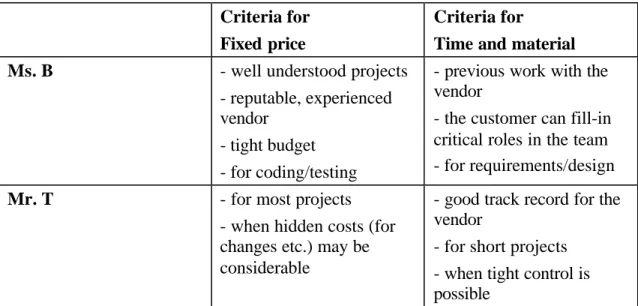
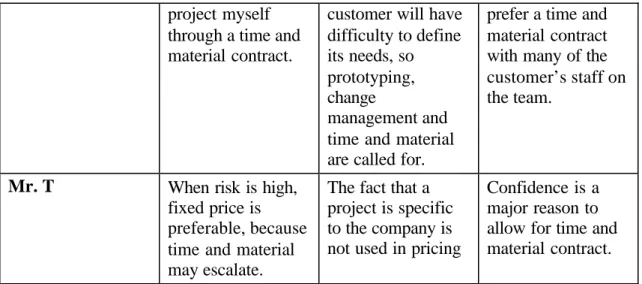
As our theoretical predictions have not been supported, we have looked for possible explanations by asking experienced project managers for their views. This may be seen as a simple example of a sequential multi-method (Mingers 2001) where the statistically analysed questionnaire is followed up by some open interviews to better understand the results. Two managers have been interviewed, the contact person at T (Mr. T) and a senior IT project manager at B (Ms. B); both with ten years or more of experience in external software development. We raised two issues in the two separate interviews: Firstly, what are the criteria for fixed price and for time and material pricing? Secondly, are risk, specificity and confidence relevant in deciding about pricing? As a follow up, we asked how the two managers think of or define the concepts of risk, specificity and confidence. After these two wide questions the interview was unstructured, however, we asked the experts to reason from a customer’s perspective. A summary of their answers to the first question is presented in Table 4, and a synopsis of the reaction to the second question is given in Table 5.
Criteria for Fixed price
Criteria for
Time and material
Ms. B - well understood projects
- reputable, experienced vendor
- tight budget - for coding/testing
- previous work with the vendor
- the customer can fill-in critical roles in the team - for requirements/design
Mr. T - for most projects
- when hidden costs (for changes etc.) may be considerable
- good track record for the vendor
- for short projects - when tight control is possible
Table 4. Expert views about pricing criteria
There is agreement between the two as both consider time and material only when controlling the project by the customer is possible. Both also consider confidence (previous work, track record) as necessary for time and material . Risk is hinted by both in discussing lower risk phases (coding/testing), hidden costs, and short projects as criteria for fixed price. Indeed, as Mr. T tells us, at T smaller and shorter projects are more likely to by on time and material basis.
Risk Specificity Confidence
Ms. B When risk is high, I
prefer to control the
For very specific projects, the
If the vendor is not trusted, I would
project myself through a time and material contract.
customer will have difficulty to define its needs, so prototyping, change
management and time and material are called for.
prefer a time and material contract with many of the customer’s staff on the team.
Mr. T When risk is high,
fixed price is preferable, because time and material may escalate.
The fact that a project is specific to the company is not used in pricing
Confidence is a major reason to allow for time and material contract.
Table 5. Expert interpretations of the theoretical constructs
The view of the experts regarding the theoretical constructs is surprising. T prefers fixed price contracts for very risky projects to prevent overruns. However, B prefers time and material for high risk projects because it allows tight control of the project. Other contrasts with the theoretical prescriptions are Mr. T’s indifference regarding specific systems, and Ms. B preference of fixed price when confidence is high. Table 6 accentuate these observations.
High Risk Very Specific High Confidence
THEORY T&M T&M T&M
Ms. B T&M T&M. FP
Mr. T FP - T&M
Table 6. Summary of construct interpretations
Although Mr. T is aware of the various elements of risk, he emphasises cost uncertainty and is ready to pay the risk premium embedded in fixed price contracts. Thus, he prefers fixed price for risky projects. In contrast, Ms. B sees fixed price contracts as setting up confrontational relationships between vendor and customer. Thus, she accepts fixed price only when there is strong confidence and long relationship with the vendor (in contrast to the prediction by Banerjee and Duflo (2000)). In discussing risk, she emphasises functionality uncertainty and does not see fixed price as an answer to cost uncertainty (“The only thing that is fixed about fixed price contracts is that this is the least you pay”). She prefers time and material contracts, in particular while ensuring tight customer control of the project.
6. Discussion
This paper studies the economic conditions for pricing software development services on either fixed price or time and material basis. We could not support the theoretical predictions by a small survey of projects.
One explanation of this result is the weaknesses of the study, in particular our simple theoretical setting analysing only three constructs, the small number of contracts studied, the partial version of the risk instrument, and issues related to the validity of
the specificity and confidence instruments. An alternative explanation is that pricing of software services falls short of the sophistication assumed by economic theory. For example, there is no clear relation of pricing to risk, but pricing at one site is related to rough proxies like project size or duration.
Both these explanations are supported by the interviews with the two experts. Starting with the study limitations, the experts emphasised issues of control that we ignored. Clearly, the availability of control mechanisms should be a criterion in deciding about the pricing of a project. The interviews also revealed the need for more subtle measurement of risk. Cost uncertainty is central to the pricing decision and should be measured separately from the general risk items we used.
The interviews also demonstrate some problems in the practice of pricing software development. One respondent prefers fixed price for risky projects not because of economic efficiency, but because of organisational considerations. He prefers to pay a high premium to prevent the possibility of re-budgeting. He also considers a narrow cost-centred concept of risk and ignores wider functional risks. Interestingly, the expert at B suggested that the narrow interpretation of risk may result from the relatively simple nature of information systems at T (see Table 1), while her wider concept of risk results from the more complex information systems at B.
The contribution of this paper is a careful study of an important decision related to the outsourcing of software development services. There is little empirical research about such arrangements and any additional evidence should be useful. Although we have not produced clear prescriptions, the paper should help practitioners in thinking about software development pricing.
As our understanding of the studied phenomenon is limited, further research is called for. In particular the study of more contracts, if possible in greater detail. Also, case studies of the pricing process should be useful, especially for projects that include multiple pricing techniques.
References
Ang, S. & Beath C. M. (1993), ‘Hierarchical Elements in Software Contracts’, Journal of Organizational Computing, vol. 3, no. 3, pp. 329-361.
Bajari P. & Tadelis S. (2001), ‘Incentives versus Transaction Costs: A Theory of Procurement Contracts’, RAND Journal of Economics, vol. 32, no. 3, pp. 387-407.
Banerjee A. & Duflo E. (2000), ‘Reputation Effects and the Limits of Contracting: A Study of the Indian Software Industry’, Quarterly Journal Of Economics, vol. 115, no. 3, pp. 989-1017.
Barki, H., Rivard S. & Talbot J. (1993), ‘Toward an Assessment of Software
Development Risk’, Journal of Management Information Systems, vol. 10, no. 2, pp. 203-225.
Baron, D. P. & Besanko D. (1987), ‘Monitoring, moral hazard, asymmetric
information, and risk sharing in procurement contracting’, RAND Journal of Economics, vol. 18, no. 4, pp. 509-532.
Boehm, B. W., Abts C., Brown A. W., Chulani S., Clark B. K, Horowitz E., Madachy R., Reifer D. J. & Steece B. (2000), Software Cost Estimation with COCOMO II, Prentice-Hall, New-York.
Boerner, C. S. & Macher J. T. (2002), ‘Transaction Cost Economics: An Assessment of Empirical Research in the Social Sciences’, Working Paper, Georgetown University http://www.msb.georgetown.edu/faculty/jtm4/Papers/eTCE.pdf
Eisenhardt, K. (1989), ‘Agency Theory: An Assessme nt and Review’, Academy of Management Review, vol. 14, no. 1, pp. 57-74.
Holmstrom, B. (1989), ‘Agency Costs and Innovation’, Journal of Economic Behaviour and Organisation, vol. 12, no. 3, pp. 305-327.
Kutten, L. J. (1998), Computer Software, Protection/Liability/Law/Forms, West Group, St. Paul, Minnesota.
Lacity, M. C., Willcocks L. P. & Feeny D. F. (1996), ‘The Value of Selective IT Sourcing’, Sloan Management Review, vol. 37, no. 3, pp. 13-25.
Laffont J. J. & Tirole J. A. (1993), Theory of Incentives in Procurement and Regulation, MIT Press.
Laffont, J. J. & Martimort D. (2002), The Theory of Incentives: The Principle-Agent Model, Princeton University Press.
Lichtenstein Y. (1999), ‘Outsourcing of Software Development: An Empirical Study Through Contracting Theory Propositions’, Unpublished Dissertation, Tel-Aviv University, http://mis.ucd.ie/staff/YLichtenstein/dissertation.doc
Mingers J. (2001), ‘Combining IS Research Methods: Towards a Pluralist Methodology’, Information Systems Research, vol. 12, no. 3, pp. 240-259. Nelson P., Richmond W. & Seidmann A. (1996), ‘Two Dimensions of Software
Acquisition’, Communication of The ACM, vol. 39, no. 7, pp. 29-35.
Roditti E. C. (1998), Computer Contracts, Negotiating, Drafting, Matthew Bender - Times Mirror Books, New-York.
Salanié, B. (1997), The Economics of Contracts: A Primer, MIT Press.
Shelanski H. A. & Klein P. G. (1995), ‘Empirical Research in Transaction Cost Economics: A Review and Assessment’, The Journal of Law, Economics and Organization, vol. 11, no. 2, pp. 335-361.
Williamson O. E. (1998), ‘Transaction Cost Economics: How It Works; Where It Is Headed?’, De Economist, vol. 146, pp. 23-58.
Williamson, O. E. (2000), ‘The New Institutional Economics: Taking Stock, Looking Ahead’, Journal of Economic Literature, vol. 38, pp. 595-613.
Appendix: The Research Questionnaire
Uncertainty
The programming language was the most current available (agree/disagree) The computer hardware was the most current available (agree/disagree) What is the number of internal/external users?
What is the number of information systems linked to this system?
This project was larger than the typical project in the company (agree/disagree) Resources for the project were sufficient (agree/disagree)
An effective development methodology existed (agree/disagree) The system was highly complex (agree/disagree)
Project scope and objectives were clearly understood (agree/disagree)
Conflicts arose between departments involved with the project (agree/disagree) Did the new system warrant changes to user tasks?
This project had a high level of top management commitment (agree/disagree) How large is the vendor (number of employees)?
Potential loss
If the system was not implemented, or had operational problems, what was the impact on the following areas (high- impact, low- impact):
Customer relations Profitability
Organisational efficiency Current daily operations
Reputation of the IS departments Reputation of the user departments
How specific was the system
Much time and effort was invested in verbally conveying system requirements to the developers and or business analysts (agree/disagree)
A newly hired system analyst needed detailed training in order to develop the system (agree/disagree)
What was the delay caused by hiring and training a new system analyst to the development team (estimate in months)?
Confidence
How long has the company known this vendor?
How many projects did your company have with the vendor? Were any of these projects Time and Material (yes/no)?
What was the price of the largest project this vendor did for you? Previous projects with this vendor were successful (agree/disagree)
I have confidence in the vendor’s auditing of time and materials (agree/disagree) I knew the development team well (agree/disagree)
The vendor had a very high reputation (agree/disagree)