A solution to the problem of clustered objects compact
partitioning
D V Pogrebnoy, Al V Pogrebnoy, O V Deeva, I A Petrukhina
Tomsk Polytechnic University, 30, Lenina ave., Tomsk, 634050, Russia E-mail: [email protected]
Abstract. The urgency of the study consists in the fact that an object arrangement topology of
a distributed system is often nonuniform. Objects can be placed at different distances from each other, thus forming clusters. That is why solving the problem of compact partitioning into sets containing thousands of objects requires the most effective way to a better use of natural structuring of objects that form clusters. The aim of the study is the development of methods of compact partitioning of sets of objects presented as clusters. The research methods are based on applied theories of sets, theory of compact sets and compact partitions, and linear programming methods with Boolean variables. As a result, the paper offers the method necessary to analyze composition and content of clusters. It also evaluates cluster compactness, which results in the decision to include clusters into the sets of partitions. It addresses the problem of optimizing the rearrangement of objects between compact sets that form clusters, which is based on the criteria of maximizing the total compactness of sets. The problem is formulated in the class of objectives of linear programming methods with Boolean variables. It introduces the example of object rearrangement.
1. Introduction
The development of territorially distributed systems that incorporate hundreds and thousands of objects implies representing the system as a hierarchical structure. At the lower level of such structure, objects are united into separated sets and connected to their centers. These objects could be sensors of distributed control systems [1], monitoring systems [2] and sensor networks motes [3]. The closeness of object arrangement inside the set is evaluated by its compactness [4]. This evaluation can be calculated in two, almost the same, ways. The first way involves defining the coordinates of the center and evaluating the compactness as a sum of distances from the center to the objects of the set. The second way consists in evaluating the compactness as a sum of distances between all pairs of objects in the set.
The task is to divide all objects of the system into separated sets with a minimal sum of their compactness evaluations. This task is referred to as compact partitioning [4]. Approximate algorithms for solving this problem are proposed in [4, 5]. These algorithms work effectively with sizes up to 100 objects. When this number starts to increase we need to apply some additional procedures to reduce the size, which noticeably deteriorates the speed of solving the problem.
An object arrangement in the territory called a topological field is most of the time nonuniform [6]. Areas, where objects are arranged more compactly, are selected in this field. That is why a topological graph which represents a topological field can be presented as a group of relatively compact subsets of vertices called clusters. The awareness of the clusters structure and their parameters can help in
forming restrictions for solving the problem of compact partitioning. First of all, it concerns the variety of subsets, as well as the interval of their cardinalities [7, 8].
The article proposes the solution to the problem of compact partitioning in such conditions when a topological graph of a big size consists of clusters, while limitations introduced to the number of partition sets and their cardinality are either just recommendations or not given at all. The resulting partition can be accepted by the system developer either as a final solution, or as information to make some other decisions concerning a structuring procedure.
Let us also note that if there are no restrictions to the number of sets and their cardinality, it is particularly useful to get a row of compact partitions for selecting the one that would fully satisfy the conditions of the project. Achieving such partition deserves a special study.
2. Clusters topology analysis
Solving the problem of compact partitioning will be considered for the case when the number of sets K and the range of their capacities [α, β] are just recommendations. It is also assumed that clusters representing a topological graph were obtained as a result of a continuous increase of the compact sets (KMs) cardinality. The incremental increase of cardinality g=2,3,…,β allows forming a КМ(g) list which includes КМs, each containing g vertices. Resulting from the isolation effect [5], the КМ(g) list is divided into many KM sets forming cluster s, where s=1,2,…,S.
A cluster topology that we denote as Т(g) describes the structure, content and arrangement of clusters in the topological field. We assume that the process of the КМ’s cardinality increase and formation of the КМ(g) list were executed with limitations К and [α, β].
Let us consider the situation when ( )n g ≤K. It is obvious that such situation is quite possible, because the cardinality increase process, while growing from g to g=n, leads to n(g)=1. If the number of КМs in the КМ(g) list is equal or close to K and value g is within the range of [α, β], then we can consider that the compact partitioning problem has been solved. We just need to rearrange the objects which, at the same time, belong to several KMs. This problem will be described in the next section.
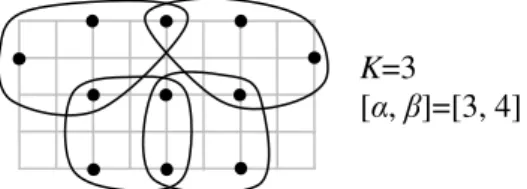
The situation when g≥β and n(g)>K can also emerge, and it means that object arrangement in the topological field is getting closer to its being uniform and, as a consequence, the clusters isolation effect is weak. In this case, the number of objects owned by different KMs is increasing and the problem of object rearrangement between KMs is getting harder. The example of such situation is shown in Figure 2.
Figure 1. The example of the weak cluster isolation effect.
In the example, proposed Т(g) consists of one cluster achieved for g=β=4 and n(4)>K. For analyzing the quality of cluster s containing several КМs, cluster density evaluation P(g)s is applied:
( )s ( ( )s s) / s
P g = n g ⋅ −g n n , (1)
where ns is the number of objects in cluster s and n(g)s is the number of KMs which form cluster s.
Averaged density evaluation P(g) is also used:
1 ( ) 1 / ( ) . S s s P g S P g = =
∑
(2)According to (1), density evaluation ( ) 1P g ≤ . Maximum density P(g)s=1 refers to the situation
when cluster s consists of one KM. This happens in case two KM clusters unite into one in going from
K=3
(g‒1) to g. Those clusters are recognized in (2) with density P(g)s=1. For the cluster in Figure 1,
density P(4) equals (4·4‒11)/11=5/11.
While analyzing the structure of clusters in T(g), we should consider the situation when n(g)=K, and g are within the range of [α, β] as both a rare and lucky case. The process of the KM cardinality increase generally ends when n(g) maximum approximation is reached from up or down to value K. In any case, each cluster s in Т(g) is analyzed in terms of being included in partition sets. If a cluster consists only of one КМ, then it is considered as a set and is excluded from the КМ(g) list. Clusters of several КМs with high density P(g)s, containing ns ≤β , are also considered as sets. For the residual
clusters, the operation of object rearrangement between KMs is executed.
3. The problem of object rearrangement between KMs
It is assumed that following the analysis of the object structure, each cluster of KMs will correspond with the partition set. The analysis influences the objects owned by two or more KMs. It is necessary to decide to what KMs we will assign these objects in order to maximize the compactness of the resulting sets. Besides, the number of objects in each set should be kept within the range of [α, β].
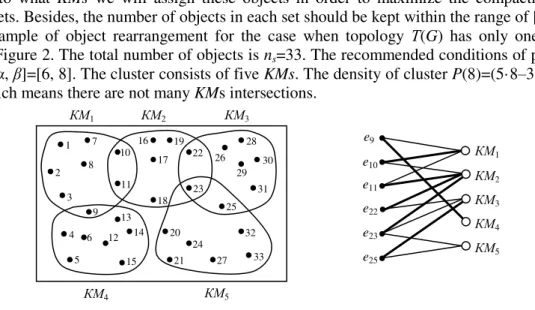
The example of object rearrangement for the case when topology Т(G) has only one cluster is shown in Figure 2. The total number of objects is ns=33. The recommended conditions of partitioning
are К=5, [α, β]=[6, 8]. The cluster consists of five KMs. The density of cluster P(8)=(5·8‒33)/33=7/33
is low, which means there are not many KMs intersections.
Figure 2. The example of object rearrangement between KMs.
Figure 2 shows that objects {e9, e10, e11, e22, e23, e25} should be rearranged. The solution to this
problem can be achieved by conducting an incremental review of each object and assigning it to the closest one among all possible KMs. For example, if the distance from e23 to the objects in КМ5 is less
than to the objects in КМ2 or in КМ3, then we should assign e23 to КМ5. While doing this we must not
forget that the number of objects in КМ1, КМ2, КМ3 would not become less than α=6.
The given problem can be written as an optimization problem [9]. For this purpose, we introduce variable xij=1, if object ei, which should be rearranged, is assigned to КМj and xij=0, otherwise. The
evaluation of the distance between object ei and the objects in КМj is denoted as cij. Then the problem
of object rearrangement can be written as a linear programming problem with Boolean variables [10]:
1 1 min; q q n m ij ij i j c x = = ⇒
∑∑
(3) 1 1, 1, 2,... ; q m ij q j x i n = = =∑
(4) 1 , 1,2,.., . q n ij j q i x s j m = ≥ =∑
(5)nq is the number of objects which should be rearranged;
mq is the number of KMs participating in the rearrangement process; 1 2 3 4 5 6 7 8 9 10 11 12 13 14 15 17 16 19 18 20 21 24 23 22 25 27 33 32 31 30 29 28 26 e9 e10 e11 e22 e23 e25 КМ1 КМ2 КМ3 КМ4 КМ5 КМ1 КМ2 КМ3 КМ5 КМ4
sj is the minimal number of objects which is necessary to be assigned to КМj to make it contain
more than αobjects.
Equations (4) ensure the assignment of each object ei to one of КМj. Inequality (5) keeps the
number of objects in КМj within the range of [α, β].
Let us note that solving the problem with condition g>β requires an additional limitation:
1 , 1,2,..., q n ij j q i x p j m = ≤ =
∑
. (6)Here pj is the maximum number of objects which can be assigned to КМj to guarantee that it does
not have more than β objects.
Limitation (6) implies that when condition g>β is enabled, the cardinality of each cluster is
1 2 2
j j
KM ∪KM ≤ β . This ensures compatibility of the (3) – (6) problem. It is not obvious whether the above condition is followed while executing the algorithm of the KM cardinality increase. That is why, the question of compatibility of the (3) ‒ (6) problem requires some more research and is not
considered in the article. We can also assume that we need to introduce some additions to the problem description for the g>β condition.
In Figure 2 on the right, we can see the illustration to the rearrangement problem. Edges (ei, КМj)
match possible variants of assigning ei to КМj and have cij weight. Values sj for the example are:
s1=s3=1, s2=2, s4=s5=0. Bold edges represent the allowed variant of assigning ei to КМj. As a result, 33
objects are divided into 5 subsets having 6, 7, 6, 8, 6 cardinality, respectively.
It is obvious, that the alternate solution for the given example even in formulation (3) ‒ (5) is not
the best. This is due to the fact that values cij are calculated relatively to initial КМj and do not take
into account objects rearrangement resulting from the problem solution. The attempts to continuously specify centers in new sets and solve the problem of object rearrangement relative to those centers can improve the compactness of sets, but this will cause the computation problem of the big size.
The computation problem depends on the number of KMs and the number of objects which have to be rearranged. The number of sets in practical applications even for thousands of objects is commonly restricted to tens. The number of objects in rearrangement depends on the excess of g over the average value of the range of [α, β]. The number of such objects is limited, first of all, by excluding duplicate KMs. It is also important that the problem is solved for each cluster separately. Some clusters with high density can be included in compact partition sets in certain conditions.
All this eventually decreases the total size of the computation problem. Let us also note that the solution of the (3) ‒ (6) problem is not required for the algorithm. It is possible to continuously
rearrange the objects by analyzing each for including it to one of alternative KMs, while keeping to the conditions of the problem.
4. Conclusion
The article is devoted to the solution of the problem of compact set partitioning. The set contains hundreds and thousands of objects distributed within the given territory and is formed as a group of clusters. Each cluster consists of one or more intersected compact sets. The article examines the possibility of using nonuniformity of object arrangements in the topological field as a basis for achieving compact partitioning. In addition, the structure and cardinality of sets, relying on parameters of clusters and requirements to compact partitioning parameters, are considered as recommendations.
The article introduces the evaluation of cluster density, which is used for making decisions to include clusters to partition sets. It also proposes the technique used for clusters topology analysis. Besides, the article deals with the problem of object rearrangement between compact sets inside the cluster as a linear programming problem with Boolean variables.
The research showed that it is advisable to use the proposed analysis of the clusters topology while allocating the clusters, thus providing the project developer with different variants of compact partitions. Each variant has different partitioning parameters and describes the topology of nonuniform
object arrangement. In this case, the selected variant of partitioning is more complete to comply with the goals and requirements to the system project.
References
[1] Botygin I A , Popov V N , Tartakovsky V A and Sherstnev V S 2015 Proc. SPIE 21st Int. Symp.
Atmospheric and Ocean Optics: Atmospheric Physics 9680 1–4
[2] Popov V N, Botygin I A and Koshelev N V 2016 Key Eng. Mat. 685 925–929
[3] Reizlin V I 1981 Sov. Phis. J. 24(5) 401–405
[4] Pogrebnoy V K and Pogrebnoy A V 2004 In. Proc. 8th
Korean-Russia International Symposium
on Science and Technology (KORUS-2004) Vol 1(Tomsk: Tomsk Polytechnic University) рр 137–141
[5] Reizlin V I and Nefedova A A 2016 IOP Conf. Ser.: Mater. Sci. Eng. 124 012090
[6] Pogrebnoy Al V and Pogrebnoy An V 2016 Key Eng. Mat. 685 952-956
[7] Tadao Murata 1989 Proc. of the IEEE 77(4) 541-580
[8] Demin A Yu and Dorofeev V A 2014 12th International Conference on Actual Problems of
Electronics Instrument Engineering (APEIE) (Novosibirsk) pp 624 –627
[9] Natalinova N. M 2016 Proc. of the XII International Siberian Conference (Moscow) p 6 [10] Richárd Dévai, Judit Jász, Csaba Nagy, and Rudolf Ferenc 2014 Acta Cybernetica 21 419-437