COMPUTATIONAL MODELS OF PROBLEMS WITH
WRITING OF ENGLISH AS A SECOND LANGUAGE
LEARNERS
by
Huichao Xue
B.S. in Computer Science, Fudan University, 2008
Submitted to the Graduate Faculty of
the Kenneth P. Dietrich School of Arts and Sciences in partial
fulfillment
of the requirements for the degree of
Doctor of Philosophy
University of Pittsburgh
2015
UNIVERSITY OF PITTSBURGH
KENNETH P. DIETRICH SCHOOL OF ARTS AND SCIENCES
This dissertation was presented
by
Huichao Xue
It was defended on
Sep 26, 2014
and approved by
Rebecca Hwa, PhD, Dietrich School of Arts and Sciences
Milos Hauskrecht, PhD, Dietrich School of Arts and Sciences
Janyce Wiebe, PhD, Dietrich School of Arts and Sciences
Joel Tetreault, PhD, Yahoo! Labs
COMPUTATIONAL MODELS OF PROBLEMS WITH WRITING OF ENGLISH AS A SECOND LANGUAGE LEARNERS
Huichao Xue, PhD
University of Pittsburgh, 2015
Learning a new language is a challenging endeavor. As a student attempts to master the grammar usage and mechanics of the new language, they make many mistakes. Detailed feedback and corrections from language tutors are invaluable to student learning, but it is time consuming to provide such feedback. In this thesis, I investigate the feasibility of building computer programs to help to reduce the efforts of English as a Second Language (ESL) tutors. Specifically, I consider three problems: (1) whether a program can identify areas that may need the tutor’s attention, such as places where the learners have used redundant words; (2) whether a program can auto-complete a tutor’s corrections by inferring the location and reason for the correction; (3) for detecting mis-usages of prepositions, a common ESL error type, whether a program can automatically construct a set of potential corrections by finding words that are more likely to be confused with each other (known as aconfusion set).
The viability of these programs depends on whether aspects of the English language and com-mon ESL mistakes can be described by computational models. For each task, building computa-tional models faces unique challenges: (1) In highlighting redundant areas, it is difficult to pre-cisely define “redundancy” in a computer’s language. (2) In auto-completing tutors’ annotations, it is difficult for computers to correctly interpret how many writing problems were addressed dur-ing revision. (3) In confusion set construction, it is difficult to infer which words are more likely confused with the given word. To address these challenges, this thesis presents different model alternatives for each task. Empirical experiments demonstrate the degrees of success to which computational models can help with detecting and correcting ESL writing problems.
TABLE OF CONTENTS
1.0 INTRODUCTION . . . 1
1.1 Thesis Statement . . . 1
1.2 A Summary of Approaches and Results . . . 2
1.2.1 The Problem: Generating Writing Feedback . . . 2
1.2.2 My Approach: Computational Models of Tutor Feedback . . . 3
1.2.2.1 Models for Redundancy Detection . . . 4
1.2.2.2 Models for Correction Rationale . . . 5
1.2.2.3 Models for Confusion Set Construction . . . 6
1.2.3 Contributions . . . 6
2.0 BACKGROUND . . . 8
2.1 Natural Language Processing in Computer Assisted Grammar Learning . . . 8
2.2 Grammar Error Correction (GEC) . . . 8
2.2.1 Single-word Error Correction . . . 9
2.2.2 Phrasal Error Correction . . . 9
2.2.3 Correction Detection . . . 11
2.2.4 Shared Tasks . . . 12
2.3 Computational Models for GEC Problems . . . 13
2.3.1 Classification Models . . . 14
2.3.2 Sequence Labeling Models . . . 14
2.3.3 Machine Translation Models . . . 15
2.3.4 Multi-task Learning and Domain Adaptation . . . 16
3.0 DATASETS AND SOFTWARES . . . 19
3.1 GEC Datasets . . . 19
3.1.1 Desiderata . . . 19
3.1.2 Available Corpora . . . 21
3.1.3 GEC Datasets Used in This Thesis . . . 23
3.2 Software Packages Used in This Thesis . . . 23
3.2.1 Preprocessing Software Packages . . . 24
3.2.2 Software Packages for Classification . . . 24
3.2.3 Machine Translation Packages . . . 25
4.0 LOCAL REDUNDANCY DETECTION . . . 27
4.1 Chapter Overview . . . 27
4.2 Main Problem: Single Word Redundancy Detection . . . 28
4.3 Task 1: Word-Level Redundancy Detection . . . 31
4.3.1 System Framework . . . 31
4.3.2 Corpus Development . . . 33
4.3.3 Features for Describing Word-Level Redundancy . . . 35
4.3.3.1 Features: Shallow Redundancy Patterns . . . 36
4.3.3.2 Features: Contributions to Meaning and Fluency . . . 38
4.3.4 Experiments . . . 44
4.3.4.1 Data and Tools . . . 45
4.3.4.2 Experiment Results . . . 46
4.4 Task 2: Sentence-level Redundancies . . . 49
4.4.1 System Framework . . . 50
4.4.2 Corpus Collection . . . 51
4.4.3 Features: Sentence-Level Redundancy Measures. . . 51
4.4.4 Experiment . . . 54
4.5 Related Work . . . 55
4.6 Chapter Summary . . . 58
5.0 CORRECTION DETECTION IN ESL REVISIONS . . . 59
5.2 Correction Detection . . . 61
5.3 A Classifier for Merging Basic-Edits . . . 64
5.3.1 Features . . . 65 5.3.2 Training . . . 65 5.4 Experimental Setup . . . 67 5.4.1 Dataset. . . 67 5.4.2 Evaluation Metrics . . . 68 5.5 Experiments . . . 69
5.5.1 A Less Strict Evaluation . . . 72
5.5.2 Error Analysis for Correction Detection . . . 72
5.6 Related Work . . . 74
5.7 Chapter Summary . . . 74
6.0 CONFUSION SET CONSTRUCTION . . . 75
6.1 Chapter Overview . . . 75
6.2 Confusion Sets . . . 76
6.3 Automatic Confusion Sets Construction . . . 77
6.3.1 Learning Words’ Out-Of-Context Meanings – Distributional Models . . . . 78
6.3.2 Learning Words’ In-Context Usages – Preposition Selector . . . 79
6.3.3 Learning Both Out-Of-Context Meanings and In-Context Usages – RCA . . 80
6.4 Experimental Setup . . . 83
6.4.1 Data . . . 83
6.4.2 Metrics . . . 84
6.4.2.1 Extrinsic Evaluation . . . 84
6.4.2.2 Intrinsic Evaluation: Coverage . . . 85
6.4.3 Confusion Set Construction Methods . . . 85
6.4.3.1 Fixing Sizes of Confusion Sets . . . 86
6.5 Experiments . . . 86
6.5.1 Discussions . . . 88
6.5.1.1 Precision . . . 89
6.6 Related Work . . . 90
6.7 Chapter Summary . . . 92
7.0 CONCLUSIONS . . . 93
APPENDIX. . . 96
A.1 Solving the Optimization Problem for Word Usage Similarity . . . 96
A.2 Approximating the Translation Probability for Redundant Word Detection . . . . 97
LIST OF TABLES
1 Error types and corpora being used in recent HOO and CoNLL shared tasks. . . 12
2 A summary of annotated ESL corpora that are used in this thesis. . . 22
3 Percentage of single word redundancies in NUCLE and FCE. . . 29
4 Length distribution of redundant parts in my filtered corpus. . . 36
5 List of numerical and binary features proposed for word-level redundancy detection. 38 6 Comparison of different redundancy measure combinations for our word-level task. 47 7 Top models’ performance for our sentence level redundancy detection. . . 55
8 Top performing sentence level redundancy measures. . . 56
9 Fluency/meaning features do not add to prediction accuracy during the sentence-level task. . . 56
10 My proposed classifier’s features for merging decisions during correction detection. 66 11 Basic statistics of the corpora that I consider in correction detection. . . 67
12 Error type selection accuracies on different corpora. . . 68
13 Extrinsic evaluation for correction detection. . . 70
14 Breakdown of errors made by the proposed merging model. . . 70
15 Correction detection experiments by building the model on one corpus, and apply-ing it onto another. . . 71
16 More strict evaluation for building a correction detection model on one corpus, and applying it onto another. . . 72
17 Error break-down of correction detection models in development datasets. . . 73
LIST OF FIGURES
1 Pipeline for single word GEC systems. . . 10
2 Example annotations in NUCLE corpus. . . 20
3 Illustration of preprocessing.. . . 24
4 Translations and alignments fetched by Google translate. . . 26
5 Distributions of the number of local redundancy feedback within single sentences, in NUCLE and FCE. . . 29
6 Distribution of single word redundancies over word classes in annotated corpora. . . 30
7 System infrastructure of a redundant word detector.. . . 32
8 Constructing training instances from an annotated sentence. . . 32
9 Word level redundancy annotation. . . 34
10 Using five Turkers’ annotations to filter unclear cases in NUCLE annotations.. . . . 35
11 Roles of each word’s contribution to fluency and meaning in determining whether it is redundant. . . 39
12 Configurations my system consider as redundant. . . 40
13 Illustration of Approximation 1 – alignments. . . 42
14 Illustration of Approximation 2 – IBM model. . . 43
15 HowA(k)is calculated for an input sentence. . . 44
16 List ofLM+MeanRprediction accuracies using different pivot languages. . . 48
17 Single feature classifier for sentence level redundancy detection. . . 50
18 Amazon Mechanical Turk annotation interface for the sentence-level redundancy detection. . . 52
20 We expect redundancy scores to have higher variations in redundant sentences. . . . 54
21 False positive example forHigh−Avg. . . 56
22 False negation example forHigh−Avg. . . 57
23 Detecting corrections from revisions. . . 60
24 The two-step correction detection process. . . 62
25 Ambiguity when interpreting revisions. . . 62
26 Basic edits extracted by the edit-distance algorithm not matching our linguistic in-tuition. . . 63
27 Merging mistakes by the algorithm proposed in S&Y. . . 63
28 Patterns indicating whether two edits address the same writing mistake. . . 65
29 Extracting training instances for the merger. . . 66
30 Performance of correction detection systems trained on subsets of FCE corpus. . . . 71
31 Mathematical formulation of ESL learners’ word learning process in my proposed model. . . 81
32 F1-Scores of different confusion set construction methods. . . 87
33 F1-scores of models using different feature sets to build confusion sets for all 36 prepositions. . . 89
34 Precision when using confusion sets generated by different methods on NUCLE. . . 91 35 Coverage of confusion sets in different models using featuresGov,Obj,L1-Trans . 91
PREFACE
PhD study is such a unique life experience. As this work comes to an end, I would like to bring my sincere thanks to people accompanied me throughout the journey. You made my journey joyful and complete.
I first thank my advisor Dr. Rebecca Hwa. You patiently guided me through the scientific discovery process. You taught me how to manage time and to communicate clearly. In moments of depression, it was your continuous encouragement that moved me forward. Your positive attitude toward challenges also benefits me beyond academic researches.
I extend my gratitude to my dissertation committee: Dr. Janyce Wiebe, Dr. Milos Hauskrecht and Dr. Joel Tetreault. Your valuable comments and suggestions during my study kept me on the right track. Also many thanks to my intern mentors Dr. Richard Zens, Dr. Su-Youn Yoon and Dr. Suma Bhat. The working experience with you broadened my sight, and equipped me with powerful tools.
Thank all members in Pitt NLP group. NLP is an exciting field. I was lucky to explore this field with you all. For the fun after-hour discussions, I specially thank my excellent colleagues Fan Zhang, Lingjia Deng and Huma Hashemi.
My final thanks to my friends and families, for all the joy and tear. I thank Huadong Wang, Yu Du, Miao Zhou, Yao Sun, Lei Jin, Yinglin Sun, Zitao Liu and Xiangmin Fan. We together enjoyed a colorful time. Finally I thank my wife Yafei Wei and my parents, for your never ending support.
1.0 INTRODUCTION
English as a Second Language (ESL) learners need feedback from their language tutors in order to learn to write better. However, providing high-quality feedback takes up a great deal of time and effort. This is challenging for tutors who have to instruct many students. Although there are more and more computer systems that attempt to assist human tutors with their tasks, these systems, too, are developed based on the knowledge of the human tutors; therefore, there is at least a one-time cost on some tutors’ time and effort when these systems are being developed.
This thesis investigates methods for developing computational models of language tutors’ feed-back in order to reduce their efforts. My work addresses problems from two major categories: (1) how to model different types of tutors feedback for students; and (2) how to simulate tutor knowl-edge for training an automated system. In the first category, I tackle two problems: helping tutors to detect redundant words or phrasesin student writings; and helping tutors to auto-complete their feedback byinferring the rationale behind each correction– that is, identify the locations and reasons of their edits. For the second category, I have developed models to facilitate the con-struction of an integral component of an automatic feedback generation system, calledconfusion sets, without requesting additional input from human tutors.
1.1 THESIS STATEMENT
Computational models of ESL errors can make language tutoring more efficient, both by helping to automate instructional feedback directly and by facilitating the development of such assistive systems without time-consuming annotation efforts from language experts.
1.2 A SUMMARY OF APPROACHES AND RESULTS
1.2.1 The Problem: Generating Writing Feedback
There are two main types of writing feedback from language tutors. General feedback comment on the more abstract aspect of the writing (e.g., is it fluent?). Localized feedback offer more concrete suggestions on improving a specific piece of writing (e.g. instead of “to,” the preposition “for” should have been used in “a gift you”.). My thesis focuses on modeling localized feedback.
Localized feedback may come from computers or humans. Computer programs are cheap at operation time; they are available 24/7 and fast to respond. However, current computerized systems can only handle a limited subset of grammatical errors, and with limited accuracy. Most of the current systems focus on single word confusion errors such as preposition errors (Tetreault et al., 2010a; Han et al., 2010; Dahlmeier and Ng, 2011b), determiner errors (Rozovskaya and Roth,2010c) and verb mis-usage errors (Liu et al.,2010). For more comprehensive coverage, ESL learners still rely on language tutors.
While human tutors are much more capable, they need to stay focused on handling writing mistakes, which may take on many forms. One particularly challenging writing mistake to spot isredundancy detection. Unlike other frequent types of mistake (e.g. preposition/determiner mis-takes), more than a single word might be redundant at a time (e.g.,Ex1), and redundant words are
not limited to a closed class set (e.g. verbsEx2, nounsEx3).
Ex1: There should be a careful consideration about what are the things that governments should
pay for .
Ex2: . . . the price of crude oil will keep continue to go higher .
Ex3: So the usage amount of chemical substances will be largely reduced .
As a result, tutors cannot rely on obvious signals to indicate error prone areas; they must be con-stantly alert in order to identify these problems.
Just finding errors in ESL learners’ writings is not enough – language tutors need to clearly indicate the location and reason for the writing mistakes. For example, in the sentence “He pick on a book”, instead of suggesting that “pick on” needs to be replaced into “picks up”, it would be better to indicate that two individual mistakes have occurred: a verb form error and a preposition mis-usage.
1. To fix the verb form error, we should replace “pick” into “picks”. 2. To fix the preposition mis-usage, we should replace “on” with “up”.
However, this is tedious in practice. Moreover, for ESL learners who are paired with a lan-guage partner instead of a lanlan-guage tutor, the partner may not even have the pedagogical vo-cabulary to describe the mistakes. Language partners prefer to edit the sentences in-place instead (Fregeau, 1999). For example, on popular language exchange social networking forums such as lang-8.com, language partners’ feedback often do not indicate the location and reasons of the writing mistakes. Educational researches suggest that not telling learners enough information of-ten demotivates them, harming their learning (Williams, 2003). Therefore, providing sufficient correction rationales is important for language learners.
Even building automated feedback generation systems requires repetitive efforts on the part of the language tutors. Many current automated feedback generation systems employ a supervised training framework. The idea is to “train” the system to act in a similar way as language tutors do, by tuning them with data containing language tutors’ annotations. Language tutors need to annotate mistakes in many cases. For example, they need to mark that “for” needs to be replaced with “to” in the contexts “solution for”, “give securities for”, “harmful for people”. Building certain system components however, does not require such annotations. I consider confusion set, an important component in Grammatical Error Correction (GEC) systems. Confusion set is a data structure that informs us which words are more likely confused with which. A confusion set is a rough figure of the instances of confusion. However, building confusion set often means that we have to collect statistics from a large annotated corpus.
1.2.2 My Approach: Computational Models of Tutor Feedback
This work’s objective is to build computational models to reduce language tutors’ efforts. In a nutshell, computational models are mathematical equations, and are designed to assign scores, classify and simulate. For example, underlying search engines such as Google and Yahoo!, a computational model helps choose which page is more likely to be the one we are looking for, by assigning scores to them (Page et al.,1999). In an automated essay grader, the computational model can assign a score to an essay by classifying it into different categories (Attali and Burstein,
2006). In a weather forecast system, a computational model simulates the movement of weather objects (e.g. clouds, wind), to help make its predictions (Lynch, 2008). When repetitive tasks can be described by a series of regular, predictable patterns, we may be able to develop computational models to automate them.
The aforementioned language tutors’ tasks all have repetitive elements that computational models can handle. For redundancy detection, the computational model is a scorer that is ap-plied repeatedly over every word; we can then select the word/phrase with the highest score as redundant (Chapter4). For providing correction rationales, the computational model is a classifier that is applied repeatedly over each correction (Chapter 5). When building a GEC system, one repetitive work is to specify which words are most likely confused with a given word – building the confusion sets. In this case, the computation model is a simulation model that iterates over each confusable word (Chapter6).
1.2.2.1 Models for Redundancy Detection Redundancies are very common in ESL writings. Among the different types of feedback from language tutors in a learner’s corpus, called NUCLE (Dahlmeier and Ng,2011b), approximately 13% suggest addressing redundancy issues. By redun-dancies, I mean those words or phrases that do not add further meaning to a sentence, but instead make the sentence harder to read. Many redundant phrases can simply be removed directly without further changes.1 I hypothesize that many of the redundant errors can be detected by a system that
highlights the most redundant word in a sentence. Such a system might make a good first-pass filter to streamline a tutor’s mental load on deciding whether to remove it.
To the best of my knowledge, there has not been any previous work that explicitly focuses on automatic redundancy detection. This may partly be because redundancy is a stylistic concept – I find that people tend to have their own opinions on whether certain words are considered redundant. To begin this work on more clear-cut cases, I have developed a corpus containing sentences in which the most redundant word is agreed upon by multiple annotators.
I have developed a system for this proposed task. At the core of my system is a model that assigns high scores to words that are more likely to be redundant. The scorer is trained using supervised machine learning techniques. In my exploration, I have identified two features to help
describing how much a word contributes to the sentence – in terms of fluency and meaning. The fluency-centric feature is based on n-gram language models while the meaning-centric feature analyzes alignments between words and their translations into some other language. Selecting the word with the highest redundancy score is shown to have a 37% accuracy for identifying the most redundant word within a sentence known to have one.
Determining whether one sentence contains redundancies at all, however, is a different prob-lem. We hypothesize the task needs a different feature set. I began the research on automating this task by first collecting clear-cut “good” sentences. Among the features we tried, sentence length and unigrams are the most predictive, together achieving a 70% accuracy in our balanced dataset.
1.2.2.2 Models for Correction Rationale The more tedious aspect of providing localized feed-back is in the detailed markings of the location of the errors and citing the reasons for the changes. Building a system to automate interpreting these correction rationales is challenging because there may be several possible interpretations for one small change. For example, suppose a tutor rewrites the phrase “previous work” into “studies.” Some possible rationales for this change include: (1) a single correction fixing a phrase mis-usage; (2) deletion of a redundant word (“previous”), fol-lowed by a word replacement (“work” ⇒ “studies”); or (3) a word replacement (“previous” ⇒
“studies”) followed by the deletion of a redundant word (“work”). Although it is easy for humans to determine that the second interpretation is more plausible, this is less obvious to computers.
I hypothesize that there are common patterns in interpreting the rationales for tutor rewrites. We may build computer programs to automate these interpretations by memorizing these patterns. Such a system may auto-complete tutors’ rewrites, allowing them to focus on coming up with the best rewrites.
I have built a model to help computers come up with the right set of corrections for 80% of the input sentences. The model focuses on determining whether two adjacent edits are fixing the same issue. Internally, it matches the adjacent edits against patterns such like “the edit is within the same word class” and “the edit is deleting a preposition”. It then weighs the matching patterns, to make the right decision.
1.2.2.3 Models for Confusion Set Construction Previously, most feedback generation sys-tems have been developed using supervised machine learning methods. This often requires at least some parts of the system to work through “training examples,” which must be annotated by a knowledgeable human, such as language tutors.
One component that is used in many grammar error correction systems is a module for con-structing confusion sets. The confusion set of a word is the set of other words that students often confuse with the given word. The confusion set is needed so that a feedback generation system can select the most compatible word within the confusion set as an alternative. I hypothesize that con-fusion sets can be generated without the need for human intervention. Most of the concon-fusions occur while learning the new language. Developing a simulation model for learning the new language would help capture which words are most commonly confused with each other.
I have employed a model that simulates the way words become confusable during learning. My model encodes words into vectors. If two words often occur within similar contexts, they are more likely to be confused with each other. I have adopted algorithms to adjust word vectors, to push together words that often occur within similar contexts. My empirical studies show that the resulting word vectors reflect confusions about word usage.
1.2.3 Contributions
1. I have shown the feasibility of detecting writing redundancy with computational models. a. I have constructed a balanced corpus to facilitate research on redundancy detection. This
corpus contains ”clear-cut” cases: half the sentences are judged by multiple annotators as containing no redundant words; the other half contain a word that most annotators agreed to be the redundant one.
b. I have derived a measure for estimating the likelihood that a word might be redundant within a sentence.
c. I have trained classifiers to detect redundant words in sentences. Through empirical val-idations, I have shown my proposed measure to contribute to the detection of the most redundant word within a sentence known to contain one.
at the word-level (how likely is a word to be redundant?) and at the sentence-level (does this sentence contain any redundant word?). My empirical results suggest that while the two are correlated, sentence-level redundancy predictions are equally correlated with other factors, such as the length of the sentence.
2. I have improved a computational model for detecting individual corrections within sentence revisions.
3. I have reduced the reliance on human annotations when developing a computational model for buildingconfusion sets, an important component within a GEC system.
2.0 BACKGROUND
2.1 NATURAL LANGUAGE PROCESSING IN COMPUTER ASSISTED GRAMMAR LEARNING
Building computer systems that serve as automated tutors to help students to learn a new language has long been the focus of many research work in the area of Computer Assisted Language Learn-ing (CALL) (Beatty,2003). There has been a great deal of work in CALL aiming to help learners to improve in their listening, speaking, reading and writing skills (Levy,2009). The most relevant area to this dissertation is on intelligent tutoring for writing; of particular interest are systems that help ESL learners with addressing grammar errors.
A key component within an intelligent tutor for writing is a mechanism to automatically assess student writing, detect any errors within the writing, and possibly propose corrections for these errors. To do so, many systems rely on natural language processing (NLP) techniques (Heift and Schulze,2007;Leacock et al.,2010;Attali and Burstein,2006). In the following sections, I review some recent NLP work in the area of grammar error detection and correction. I will first present the main types of problems that NLP methods try to address; then I will introduce some common computational methods used to tackle these problems.
2.2 GRAMMAR ERROR CORRECTION (GEC)
For a computer system to detect grammar errors, must it “understand the English grammar?” This is not an easy problem. One difficulty lies with defining what “English grammar” means. On the other hand, it is well known that learners are more likely to make certain types of errors (Leacock
et al.,2010). Among the most frequent errors are in the following four categories: Preposition errors: . . . very promising and will likelyto be the . . .
Determiner errors: However, as thea result ofthehigher operating temperature of . . . Verb choice errors: . . . more people are acquiredequippedwith the knowledge . . .
Interleaving errors: . . . curb the problem a population’s aging and decliningof an aging anddeclining population.
Because these errors have some regular patterns to them, it is possible for computers to automat-ically point out some of these errors to ESL learners. Instead of trying to teach computer what “English” is or is not generally, many grammar error correction (GEC) systems take an empirical approach and focus on specific grammatical challenges(Tetreault et al., 2010a; Liu et al., 2010; Rozovskaya and Roth,2010c;Dahlmeier and Ng,2011b).
2.2.1 Single-word Error Correction
Preposition and determiner errors are among the most frequent errors in ESL writings (Leacock et al.,2010;Dahlmeier et al.,2013;Yannakoudakis et al.,2011). One commonality between them is that these errors involve single-word choices between a small set of words. For example, the determiner mis-usage “as thea result” is caused by the speaker mistakenly choosing “the” instead of “a”. The confusion is more likely to happen between the determiners; but not likely between a determiner and another word, say between “the” and “theoretical”. The mistaken insertions (e.g. to here) or deletions (e.g. will likelytobe) can also be seen as confusions between an empty word and a preposition/determiner. Therefore, one way to solve preposition/determiner error correction is with a word selector (Tetreault et al., 2010a;Han et al., 2010;Gamon et al., 2008). The word selector chooses the right word from aconfusion set. For example,to’s confusion set would contain
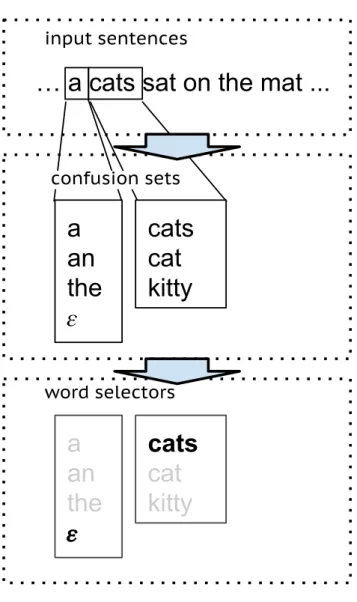
towardandfor. A common GEC pipeline is illustrated in Figure1.
2.2.2 Phrasal Error Correction
Not all errors occur independently on single word level, or between small word sets. In theVerb choice errorsexample, the confusion is between verbs in a open class. In theinterleaving errors
confusion sets
word selectors
… a cats sat on the mat ...
a
an
the
cats
cat
kitty
a
an
the
cats
cat
kitty
input sentencesFigure 1: For single word mistakes, the GEC system considers each word individually – first looking up that word’s confusion set, then using the word selector to choose the most appropriate replacement.
although we may decompose a correction into multiple single word choices, these single word choices are dependent on each other. For example, the following correction
a population’s aging and decliningof an aging anddeclining population
can be decomposed into: (1) inserting an of (2) replacing a into an (3) deleting population’s
(4) inserting population. These fixes are not independent: (1) replacinga into anhas to happen once we decide to delete population’s (2) deleting population’s need to co-occur with inserting
populationin the end. For open class errors, the word selector would need to select from many candidates, making its task even harder.
To correct these errors, recent work have employed two strategies. The first strategy still fo-cuses on correcting individual errors, but additional models are used to detecting the dependencies between errors. This can be done with sequence models such as Hidden Markov Models (HMMs) (Gamon,2011) and linear programming (Wu and Ng,2013). A second strategy is to employ more flexible models that can rewrite a phrase/sentence entirely. Recent researches applied machine translation models into solving these problems (Knight and Chander, 1994;Brockett et al.,2006; Xue and Hwa, 2010; Madnani et al., 2012b). In this paradigm, the error correction problem is formalized into “translating from a non-native language into well-formed English”.
2.2.3 Correction Detection
A related GEC task turns the detect-then-correct pipeline on its head; instead, it tries to predict the rationale behind a particular correction. If a system were given theinterleaving errorsexample from above, its output ought to be: (1)of is added to fix the missing preposition mistake (2)aneeds to be removed for violating determiner usage rules. (3)population’s aging and decliningneeds to be reversed to makepopulationthe center noun. We may use computer programs to automate this – we call this taskCorrection Detection(Swanson and Yamangil, 2012;Xue and Hwa, 2014). In
correction detection, the computer first figures out how many individual errors are fixed. Then the computer will then categorize these individual fixes based on their reasons, with acorrection type categorizer.
Shared task error types corpus
HOO 2011
All “light copy-edits”, including spelling errors, lexical choices, basic grammar errors, reduction of syntactic complexity etc.
HOO 2011
HOO 2012 preposition and determiner errors FCE
CoNLL 2013 preposition, determiner, noun number, verb form, subject-verb agreement errors
NUCLE
CoNLL 2014 All error types NUCLE
Table 1: Error types and corpora being used in recent HOO and CoNLL shared tasks.
2.2.4 Shared Tasks
Recently there have been competitions among GEC researchers, which helped boosting discussions within the community. These competitions are built around shared tasks, where organizers build a common playground to evaluate participating systems’ performance. Two series of shared tasks are HOO (2011 and 2012) and CoNLL (2013 and 2014). The tasks include building GEC systems for all types of grammar errors (Dale and Kilgarriff, 2011; Ng et al., 2014), or a common subset (Dale et al., 2012; Ng et al., 2013). The task organizer put up corpora to evaluate participating system’s output. Parts of these corpora are also distributed to the participating teams to help them develop GEC systems. I summarize the error types and corpora being used in these shared tasks in Table1.
These shared tasks introduce evaluation metrics to compare GEC systems from different an-gles. A common framework is to compare system’s output with a gold-standard, usingFαscores:
Fα =
(1 +α2)P R
α2P +R
P = number of system’s output matching with the gold standard
size of system output
R = number of system’s output matching with the gold standard
By default we useα = 1to achieve a balance between precision (P) and recall (R); but recently people lean toward reducing systems’ false alarms (e.g. CoNLL 2014), and therefore prefer lower α values (e.g. 0.5). Depending on whether the goal is to let GEC systems detect (i.e. find error locations), recognize (i.e. categorize the error) or correct writing mistakes (i.e. fix the error), we may define “matching” differently (Dale and Kilgarriff, 2011;Dahlmeier and Ng, 2012). To provide a more comprehensive view of different systems, organizers often report evaluation results on multiple aspects. For example HOO 2011 evaluated participants’ systems on three perspectives: detection, recognition and correction.
So far the winning teams have been using classification based models as well as machine translation based models. The winning teams in HOO 2011 (Rozovskaya et al., 2011), HOO 2012 (Dahlmeier et al.,2012) and CoNLL 2013 (Rozovskaya et al.,2013) all built upon classifiers trained to correct single word errors. The common features in their systems include n-grams, POS tags and phrase chunks. Please note that even the HOO 2011 task includes all error types, the leading team did not try to handle them all at once. They instead build classifiers for the most common error types including preposition and determiner errors. Recently there is a trend to apply translation based models for broader error types. The winning team in CoNLL 2014 (Felice et al., 2014), for example, applied a hybrid system containing manually crafted rules, machine translation systems and language models.
2.3 COMPUTATIONAL MODELS FOR GEC PROBLEMS
Computational models are mathematical equations that, when taken together, formalize how we make decisions in certain contexts. In GEC, for example, we need them to decide (1) whether to report an error, and (2) how to correct it. Computational models often contain many parameters, which are tuned by “training” to optimize the model’s performance for a particular task. Training is often performed on datasets, containing example decisions. GEC systems are trained on datasets that contain real ESL writings, along with language tutors’ annotations, including the locations of errors and how to correct them. Because datasets are limited, researchers also seek for ways to reduce the number of model parameters.
2.3.1 Classification Models
A classifier assigns something into one of several pre-defined categories by considering itsfeatures. For GEC tasks, classifiers can be used to implement a word chooser or an error type categorizer. For example, in the phraseasthe? result,a determiner-chooser has to select an appropriate word from a list of possible determiners for the position currently taken up by the word the?; two possible features to help it to make the decision might be: the word before the position (in this example: as), and the word after it (in this example:result).
Computationally, the classification problem is typically formalized as maximizing the likeli-hood that the categorizations for a set of training examples are correct (Bishop et al.,2006). For-mally, suppose we want to choose the right determinerwunder some contextc, the classification decision is to find the most appropriate word:
¯
w= arg maxw∈{the, this, an, . . .}Pr(w|c, λ)
Hereλis the classifier’s parameters. Different classifiers have their own definitions ofPr(w|c, λ). For example, in a Maximum Entropy model, the classification probability is expressed as:
Pr(w|c, λ) = exp
P
iλifi(w, c)
P
w0expPiλifi(w0, c)
Here each feature functionfi extracts a value fi(w, c)for a determiner choicewunder context c.
For example, we may define a feature f1 to determine whether the previous word, current word
and the next word will together form the phrase “as a result”.
2.3.2 Sequence Labeling Models
Hidden Markov Model (HMM) and Integer Linear Programming (ILP) are two ways to express dependencies between individual decisions. HMM can be used to detect error regions for GEC problems(Gamon, 2011). ILP can be used to make sure the system proposes corrections that do not conflict with each other (Wu and Ng, 2013). When detecting error regions, the problem becomes making decisions on whether each word is in the error region or not. On top of knowing which words are more error-prone, HMM helps us incorporate knowledge such as (1) a determiner error is likely not immediately followed by another determiner error (2) it is rare to have too many
corrections in one region. ILP is similar with HMM, with the slight difference that it enforces hard constraints. As a result, an HMM “discourages” two consecutive determiner corrections, but ILP “prohibits” two consecutive determiner corrections.
Computationally, ILP represents decisions (e.g. whether to replace a “the” into “a”) as binary variables (“yes” or “no”), and formalize relations between these variables. Take (Wu and Ng, 2013)’s treatment on “a cats sat on the mat” as an example. We may represent whether we want to fix “a” as a determiner mistake as one variablex1 ∈ {0,1}; at the same time, we may represent
whether we want to fix “cats” as a plural-form mistake as another variablex2 ∈ {0,1}. In ILP, we
may enforce thatx1+x2 ≤1to make sure that we do not apply these two fixes at once. This helps
us to deal with sentences that have interleaving errors .
HMM enables us to formalize the relation between two adjacent labels. Gamon (2011) uses a sequential labeling model to detect error regions. Here they annotate the error parts as “I”, and correct parts as “O”. Error detection then becomes a sequence labeling problem. During sequence labeling, our algorithm will search for the sequence of labels has the highest probability. The probability is proportional to the product of (1) emission probability and (2) transition probabil-ity. Emission probability is the probability of, for example, the word “of” is in the error region. Transition probability is the probability of, for example, one word labeled “I” followed by another word labeled “I”. HMM has variations that enable it to incorporate more features. These variations include Conditional Random Fields (CRF) (Lafferty et al.,2001) and Maximum Entropy Markov Model (MEMM) (McCallum et al.,2000) (which is applied inGamon(2011)).
2.3.3 Machine Translation Models
Machine Translation (MT) concerns translating texts within one language into another. It has re-ceived much attention not only because of the importance of translation itself, but also because of its ability to generalize to other tasks (Wubben et al., 2012; Coster and Kauchak, 2011). In GEC systems, for example, we treat the “ill-formed” language by ESL learners as a special lan-guage. Correcting grammar mistakes then becomes “translating” from ill-formed English into well-formed English (Knight and Chander, 1994;Brockett et al., 2006). Because machine trans-lation concerns full sentence rewriting, these resulting systems can be made capable of handling
complex error types. The training corpora can be either collected from human annotations, or from automatically generated corpora, where we populate errors into well written texts (Foster and Andersen,2009;Brockett et al.,2006).
Many machine translation models are also probabilistic models, which assign a probability to a pair of sentences (Brown et al.,1993;Koehn et al., 2003). The system will translate by finding the sentence with the greatest translation probability. For example, consider translating a Foreign language sentencefinto English. A translation model can calculate the probabilityPr(e|f), thate is a translation off, for any English sentencee. During translation, a machine translation system searches fore0 = arg maxePr(e|f).
One straightforward way of constructing the translation model is to build a huge table contain-ing translation probabilities between any two sentences in the two languages. But this is impractical because of the near-limitless number of potential sentences in both languages. We often seek to decomposePr(e|f)in ways that it be computed from smaller components. In this thesis I in par-ticular consider word-alignment models (Brown et al., 1993) and phrase-based translation models (Koehn et al.,2003), two most frequently used models that formalize this idea. Instead of building a table of sentence-level translations, word-alignment build a table of how words in two languages map to each other. Phrase-based translation models is even more general in that it builds a table of corresponding phrases in two languages. During operation, word-alignment based systems looks up each word’s translation in the translation table, and groups them into a fluent sentence in the target language. Phrase-based MT systems operate similar except that they need to chunk the input sentences before phrase look-ups. Google translate1 adopts a phrase-based model. Also, we can
use the open-source tools GIZA2++ and Moses3 to build customized MT systems (Koehn et al., 2007).
2.3.4 Multi-task Learning and Domain Adaptation
One challenge in building GEC systems is that we have many model parameters, but limited train-ing data. As a result, the trained models may over-fit. One way to relieve this problem is to reduce
1http://translate.google.com/
2https://code.google.com/p/giza-pp/
3
the number of model parameters. The key observation in GEC systems is that many tasks are similar: either between GEC tasks, or between GEC and other tasks. For example, correcting the misusedof is similar with correcting the misusedto, in that the right choice under the context might be the same. Also, GEC is similar with machine translation in that they both involve rewriting a sentence into a grammatical target sentence.
Multi-task learning allows us to share parameters between different GEC tasks. Dahlmeier and Ng(2011b) uses Alternating Structure Optimization (ASO) (Ando, 2006) that formalizes the relation between preposition error correctors. Normally we would have 36 word selectors for detecting the mis-usage of every frequent preposition (e.g. the mis-usage of to etc.). We would therefore need 36 separate sets of parameters. Alternating Structure Optimization compresses these parameter sets into one shared set, using Singular Value Decomposition (SVD). It then augments the shared set with a smaller set of parameter for each individual preposition mis-usage corrector. In the end, the total number of free variables will be reduced.
Domain Adaptation allows us to build GEC models on top of models for similar tasks. In domain adaptation, instead of starting from scratch, we only model the difference between the new tasks and the existing task. Two models that GEC researches commonly build upon include language models and paraphrasing models. Language models can tell us the probabilities of a word (e.g.a) occurring under a certain context (e.g. as result) in native English. Paraphrasing models can rephrase the input sentence into a set of other English sentences that have the same meaning. To adapt these models to GEC systems, we come up with models for picking the output from these models that are likely to fix grammar errors. To adapt a language model for GEC purposes, we model what errors are more likely to occur in ESL writings. InPark and Levy(2011), the authors uses the error model and the language model to together choose corrections that: (1) proposes to fix an error that is likely to occur (2) proposes a correction that matches English grammars. To adapt a paraphrasing model for GEC purposes, we may use models to combine the paraphrase that best fixes the problems . In (Madnani et al.,2012b), the authors in particular paraphrased the input sentence by round-trip translation: first translating the input sentence into another language, and then back to English. Then, the authors combined the paraphrases via multiple languages by first aligning them together, and then developing metrics to choose the best combination. Because the underlying language models, translation models are well-studied, the combined model tend to
work well even with a rough domain adaptation model.
2.4 GEC CHALLENGES
Relying on a fully automated system to provide writing feedback to learners is still impractical as of now. Current systems are limited in both coverage and accuracy. Many systems focus on one specific error type rather than interleaving error types (Chodorow et al., 2007; Tetreault and Chodorow, 2008;Gamon et al., 2009;Liu et al., 2010; Rozovskaya and Roth, 2010d;Dahlmeier and Ng,2011b). Moreover, even within preposition error detection, systems do not perform with a high accuracy. In a recent shared task, HOO2012 (Help Our Own), the best performing system is reported to have a 33.23%F1 score (Dale et al., 2012). At this level of performance, a system
cannot reliably correct all learner errors; therefore, language students still need to consult human tutors.
To move GEC systems forward, several challenges needs to be addressed. First, systems ought to cover a wider variety of error types. This may mean that we need to consider different compu-tational models. Despite a wide variety of compucompu-tational models we already have (Section2.3), adapting them to new error types often need much research/development effort. Second, there ought to be better data to support building GEC systems. Data on real ESL errors help us to both develop and evaluate GEC system building. As I will discuss in Chapter 3, current datasets are limited in both their qualities and quantities. Finally, in addition to developing fully automated systems, we also ought to come up with better ways to support language tutors to perform their tasks.
3.0 DATASETS AND SOFTWARES
As discussed in the previous chapter, the success of many NLP methods depend on having the appropriate data resources. In this chapter, I present an overview of the existing datasets that are relevant to the development of GEC technologies. I discuss the extent to which these resources could be used to support the work in this dissertation. I also present some common software packages used in this thesis work.
3.1 GEC DATASETS
Data-driven approaches to GEC require realistic examples of student errors. Therefore, a par-ticularly useful type of dataset is alearner’s corpus, a collection of learners’ texts that has been annotated with suggested corrections. Figure2illustrates a portion of the learner’s corpus, the NU-CLE corpus (Dahlmeier et al., 2013). In learners’ corpora, teachers will mark errors in learners’ writings, suggest fixes for them. To help learners understand the rationale, they also annotate the error type that has been fixed.
3.1.1 Desiderata
At the core of many modern GEC systems is a supervised machine learning method. The annotated examples serve as training instances for the system to learn to make predictions so that it can perform language tutors’ tasks. A good corpus, therefore, should help us to train computers to generate corrections as human tutors do, and to validate our systems by comparing the systems’ outputs against the human annotated examples.
Figure 2: Example annotations in NUCLE corpus. English teachers have marked error words/phrases (crossed-out red words), and their corrections (green words). Along with each cor-rection, teachers will also specify the error type. Take the first correction as an example: the teacher suggested to reviseyearsintoyears’to fix a noun possessive form error.
There are many questions to address with respect to the exact form of the annotations, however. Consider the following sentence:
However, have you ever thought that: what if it poses a great challenge for the public?
The three underlined parts read awkward. The phrase “have you ever thought that:” reads wordy, should we keep it, or delete it, or rewrite the sentence into “However, it may pose . . . ”? The preposition “for” needs to be replaced by “to”, should we tell the learner why? If so, should we say it is because “for” is misused preposition, or should we say it collocates incorrectly with “challenge”? The phrase “the public” is too vague: if we decide to also replace into “public resources”, should that be treated as one whole correction, or two separate corrections (i.e. deleting “the” and then adding “resources”)?
In general: (1) What types of errors should be corrected? Should we only consider grammatical errors, or also awkward usages? Note that whether something is awkward may be subjective; there may also be multiple ways of correcting it. (2) Should the annotation be just the corrected phrase or should it also include a rationale for the correction. (3) If a category is given for each corrections, how finely should different error types be distinguished? (4) How should complicated interleaving errors be addressed?
More broadly, in terms of creating a learner’s corpus, there are additional decisions to be made. First, who should do the annotation? Here are some options:
1. Language tutors: They provide high quality annotations (Dahlmeier and Ng,2011b); the qual-ity can be further improved when the same text is annotated by multiple language tutors (Nicholls, 2003). However, this is the most expensive option. Therefore, the resulting cor-pus may not be very large.
2. Language peers. An example of this is a social network learning forum like Lang-8.com (Mizu-moto et al.,2011). These social network system have large user bases, and so is the volume of annotations. However, it is harder to control the quality of the annotations, as the backgrounds of both learners and annotators often vary.
3. Crowd-sourced non-experts from the Internet (e.g., Amazon Mechanical Turkers). This way of gather annotations is quick and cheap, but the overall quality may not be as reliable (Tetreault et al.,2010b).
Second, what are the characteristics of the collection of learner texts themselves?
1. the learners’ native language (L1). This is an important factor because error types/frequencies are influenced by learners’ L1’s (Rozovskaya and Roth,2010c).
2. the learner’s level of proficiency. A collection of texts from highly proficient learners will have different error distributions than a collection of texts from learners who just started studying the new language.
3. genre of the text. The distribution of the types of errors may also be influenced by Whether the text is a general composition or an argumentative essay or a technical articles.
For each of the above issues, one may opt to develop a balanced corpus (e.g., an equal representa-tion of learners with different L1s) or not (e.g., only include texts by highly proficient learners).
3.1.2 Available Corpora
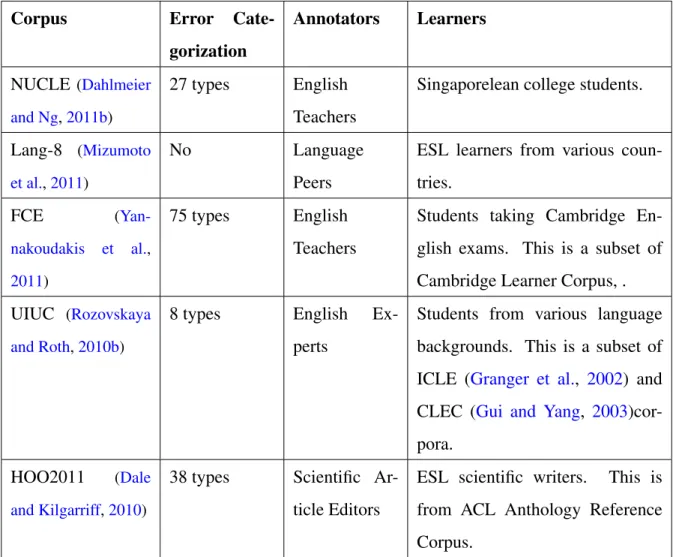
In Table2, I enumerate some widely available corpora and compare their corpus design decisions. Depending on the target application we plan to build, using these corpora expose different advan-tages. When building GEC systems on top of machine learning systems trained on large datasets,
Corpus Error Cate-gorization Annotators Learners NUCLE(Dahlmeier and Ng,2011b) 27 types English Teachers
Singaporelean college students.
Lang-8 (Mizumoto et al.,2011)
No Language
Peers
ESL learners from various coun-tries. FCE ( Yan-nakoudakis et al., 2011) 75 types English Teachers
Students taking Cambridge En-glish exams. This is a subset of Cambridge Learner Corpus, . UIUC (Rozovskaya
and Roth,2010b)
8 types English Ex-perts
Students from various language backgrounds. This is a subset of ICLE (Granger et al., 2002) and CLEC (Gui and Yang, 2003)cor-pora.
HOO2011 (Dale and Kilgarriff,2010)
38 types Scientific Ar-ticle Editors
ESL scientific writers. This is from ACL Anthology Reference Corpus.
Table 2: A summary of annotated ESL corpora that are used in this thesis. NUCLE corpus is large and contains error categorizations, so it is a very good resource for tuning systems that target at specific error types. Lang-8 contains a huge number of revisions from peers online, making it a good resource for tuning more flexible/general GEC models. FCE contains many grammar error annotations, along with overall scores of each articles. This makes FCE also a good development corpus for research on the correlation between grammar errors and overall English sophistication. UIUC corpus contains high quality annotations on essays written by students of different back-ground, making it a good resource for researches on native language (L1)’s influence on grammar errors. Unlike other corpora, HOO2011 actually contains articles written by highly sophisticated writers – scientific article writers. This makes HOO2011 a good resource for building systems for sophisticated ESL speakers.
Lang-8 and NUCLE can help, as they contain the biggest volume of annotations. When build-ing GEC systems focusbuild-ing on explainbuild-ing the rationales behind each corrections, FCE can help, as it has carefully constructed fine-grained error categorizations. When evaluating GEC systems on detecting preposition/determiner errors, UIUC can help, as it contains high-quality annotations constructed by three sophisticated English experts. When building GEC systems for highly so-phisticated users, HOO2011 can help, as it contains editors’ suggestions on highly soso-phisticated articles.
Researchers have used GEC datasets in different scenarios, in addition to building GEC sys-tems. Yannakoudakis et al. (2011) uses the FCE corpora for building automated scoring sys-tems. Their model incorporates language learners’ grammar error rate as a factor in predicting the learner’s text score. Swanson and Yamangil (2012) uses these corpora to study how to generate suggestions and error categorizations from revisions. They use tutors’ suggestions in annotated corpora as the gold standard.
3.1.3 GEC Datasets Used in This Thesis
In this thesis, most experiments are conducted on the NUCLE and FCE corpora because they are considerably larger than others, and because they contain real ESL learners’ writings with English experts’ annotations. However, existing annotations do not sufficiently or robustly identify redundancy errors (Chapter4). In order to have an appropriate dataset to validate my experiments, I have commissioned additional annotations to be performed on NUCLE sentences so that unreliable cases may be filtered out. To address the problem of the lack of a unified coding standard, I use HOO2011 and UIUC in supplemental experiments for additional validations.
3.2 SOFTWARE PACKAGES USED IN THIS THESIS
I have conducted my thesis experiments with the help of several off-the-shelf software packages for some common NLP and machine learning tasks such as part-of-speech tagging, syntactic parsing, machine translation, and classification.
I went to the church on Sunday .
PRP VBD TO DT NN IN NN . Sentence #10
… I went to the church on Sunday . Then ...
ESL text
…
PreprocessedSentences
…
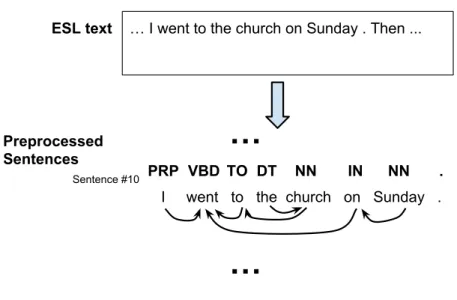
Figure 3: After preprocessing, we will have individual sentences, individual words, their POS tags, the dependency structure between words.
3.2.1 Preprocessing Software Packages
All the sentences in the datasets have been preprocessed with the OpenNLP toolkit1and the
Stan-ford parser (Klein and Manning,2003). The OpenNLP toolkit is used to perform some preliminary analysis of the text. For example, it breaks up a student essay into a collection of individual sen-tences; it also assigns a part-of-speech tag (such asnoun, verb, determiner, etc.) for every word in each sentence. The Stanford parser is used to provide syntactic analyses of the sentences. Specif-ically, I used it to generate the dependency structure of each sentence. Figure3illustrates the my preprocessing pipeline.
3.2.2 Software Packages for Classification
Classification is an integral part of this dissertation. It is needed for tasks throughout the thesis, including:
1. binary classification of whether a word is likely to be redundant or not (Chapter4); 1
2. binary classification of whether two adjacent edits address the same grammar error (Chapter 5);
3. multi-label classification of choosing the most appropriate preposition under a specific context (Chapter6).
I choose to work with a probabilistic classifier – Maximum Entropy classifier (MaxEnt, or log-linear model) for these purposes; in addition to giving a classification, it also gives a likelihood estimate for its answer. The particular implementation I used is in C++/Python, and it is written by Le Zhang2.
3.2.3 Machine Translation Packages
Translators are used in this thesis to gather additional features for our models. In particular:
1. In Chapter 4, I use translators to examine the number of words that an English word would translate into. This helps our model to roughly examine the word’s importance.
2. In Chapter6, I use translators to examine what a preposition would translate into. This helps our model to “understand” whether the preposition is misused.
There are several statistical machine translation systems that are publicly available. I chose to work with Google translate 3 because it provides decent translations along with the word alignments
between source/target sentences. An example of its translation output is shown in Figure4. Additionally, post-processing on the translated foreign language is sometimes necessary. For instance, many Asian languages, such as Chinese and Japanese, do not use space delimiators to indicate word boundaries. For example, the Chinese sentence in Figure4would be displayed as: “我周日去得教堂。” In these cases, a word tokenizer is needed to split up the sentence into words, e.g. “我 周日 去 得 教堂 。” I used a state-of-the art tokenizer Chang et al. (2008) to tokenize Chinese translations.
2http://homepages.inf.ed.ac.uk/lzhang10/maxent_toolkit.html
3
I went to the church on Sunday .
我 在 周 日 去 得 教 堂 。
Figure 4: With Google translate, we are able to fetch sentences’ translation, along with the align-ment between the words in both languages. This figure in particular illustrates the alignalign-ment between English words and their translations in Simplified Chinese.
4.0 LOCAL REDUNDANCY DETECTION
4.1 CHAPTER OVERVIEW
“Writing concisely” is a time-honored advice for writing. However, ESL writings often contain unnecessary or redundant words and phrases. Because ESL learners are still inefficient at commu-nicating in English, perhaps they use extra words to ensure that they communicate their messages; or perhaps they do not have the right language model to know when to refrain from using con-nective words. Sometimes, the extra words are semantically unnecessary; other times, they violate English grammar rules. Below are some examples of what we refer to aslocal redundancies.
Ex4: . . . the usage amount of chemical substances will be largely reduced . . .
Ex5: . . . is a new term for us. . . .
Ex6: . . . the citizens can request for higher salaries . . .
InEx4,usageis implied when we mentionamount of chemical substances. InEx5,for usis
extra-neous because readers would not assume otherwise. InEx6, forshould be removed syntactically:
“request” should go directly before its object; semantically, the meaning “for” is already implied by “request”.
Analyzing existing ESL corpora, we observe that a significant proportion of the feedback from language tutors is on removing local redundancies. In the NUCLE corpus (Dahlmeier and Ng, 2011b), 13.7% of the annotations are tagged as “local redundancy errors” (Rloc), making it the second most common feedback type. In the FCE corpus, 14.0% of errors are tagged starting with “U” (unnecessary). To help reducing the efforts of language tutors, my objective is to develop a redundancy detector. Can a system automatically identify words or phrases that a tutor will likely eliminate?
While previous work in the GEC literature (Tetreault et al., 2010a; Rozovskaya and Roth, 2010d) do handle some cases of redundancies in which grammatical rules were violated (e.g.,
Ex6), my work is the first to explicitly focus on redundancy detection. I investigate two questions:
whether a system can automatically identify the most redundant word in a sentence; and whether a system can determine if the sentence contains any redundant word. A machine learning approach is taken in both cases. Experimental results show that the method I developed can identify the most redundant word within a sentence known to contain one 37% of the time, which is 7-times more accurate than a baseline of random choice. For the broader distinction of whether a sentence contains any redundant word, my classifier predicts correctly with 70% accuracy on a balanced dataset.
4.2 MAIN PROBLEM: SINGLE WORD REDUNDANCY DETECTION
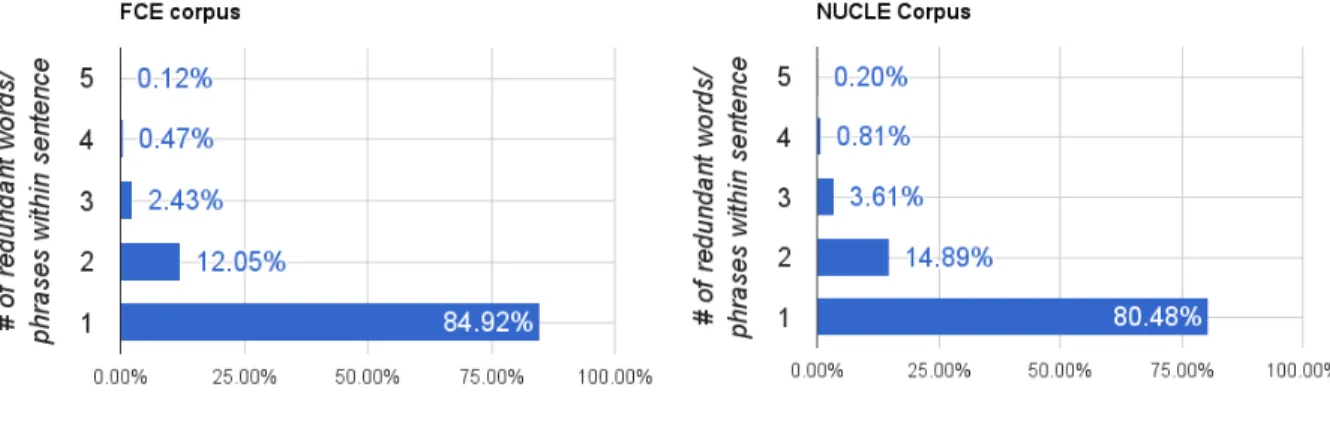
Annotations from existing ESL corpora suggest that language tutors rarely identify more than one region within a sentence as redundant (Figure 5). Moreover, most redundant phrases consist of just a single word (Table 3). As a first step toward developing a fully automated redundancy detector, my work focuses on the prevalent cases of single occurrences of a redundant word within a sentence: A successful detector should highlight the most redundant word (if any) within an input sentence. Even within this more restricted problem space, redundancy detection is still very challenging.
As we have discussed earlier, a word might be considered “redundant” for many reasons. It is not restricted to any particular part-of-speech category (Figure6shows the distribution of part-of-speech categories of redundant words in two corpora); it might be removed for grammatical reasons, for semantic clarity, or for brevity. My work does not explicitly distinguish between dif-ferent reasons for redundancy because I believe they all still share some common patterns. Namely, the removed words do not contribute as much as other words in the sentence toward the overall fluency or meaning of the sentence.
On the other hand, this work does not aim to addressall possible casesof single-word redun-dancy either. As we have discussed earlier, judgments of some cases of redunredun-dancy are subjective.
(a) Distribution bar chart in FCE corpus. (b) Distribution bar chart in NUCLE corpus.
Figure 5: Distributions of the number of local redundancy feedback within single sentences, in NUCLE and FCE. This distribution graph only includes statistics from sentences with at least one redundant word/phrases. In both corpora, the majority of these sentences contain one redundant region.
Corpus Percentage of single word redundancies
NUCLE 67.55%
FCE 86.93%
Table 3: Of all the phrases the language tutors marked as “redundant”, the majority has a phrasal length of one.
(a) FCE corpus. (b) NUCLE corpus.
Figure 6: Distribution of single word redundancies over word classes in annotated corpora. The minority word types add up to a large proportion.
ConsiderEx4again. When asked the following two questions about it, people do not have uniform
responses.
1. Which word in this sentence do you think is the most redundant?
2. Does this sentence contain a redundant word?
For the first question, among five native English speakers I asked, three foundusagemore redun-dant while the other two foundamountmore redundant; still there may be people who pick some entirely different word in the sentence (e.g. chemical or largely). Moreover, even if two people agree on “the most redundant word” in a sentence, it does not mean that they agree on the severity of the redundancy within the sentence. One might acknowledge that some word’s role in a sentence is not strictly necessary but still not want to delete it.
To make the problem more tractable, my research examines redundant cases that most people would agree on. Moreover, I tackle each of the above questions separately so as to minimize the influence of subjectivity from the other question. I refer to addressing the first question as a word-levelsub-task; and the second as asentence-levelsub-task. There are many clear-cut cases in each
sub-task, where people tend to agree. For example, most people would agree that “also” is the most redundant word in “I like apples and also oranges” and that the sentence “I like apples” is not redundant. If both sub-tasks can be successfully accomplished, their solutions point to a system that forms a detection pipeline for identifying single word redundancies. My work focuses more on the first sub-task than the second because the development of a computational model that can reliably estimate the potential for redundancy of a single word might be considered a prerequisite for deciding whether a sentence contains any redundancy over all.
4.3 TASK 1: WORD-LEVEL REDUNDANCY DETECTION
4.3.1 System Framework
To identify the most redundant word within a sentence, we first measure each word’s potential for redundancy, then pick the highest one. At the core of this system is a component that assigns a
redundancy scoreto a word. We may use arbitrary measures (e.g. proportion of the word marked to be redundant in NUCLE) directly as the scorer. I also propose a supervised machine learning model to incorporate multiple features.
Figure7is an illustration of the proposed system’s infrastructure. The scorer is developed using a probabilistic classification model: the Maximum Entropy (MaxEnt) model (Malouf, 2002). I train the model to predict the likelihood (between 0 and 1) that a word might be the most redundant one in its sentence. Like other machine learning endeavors, having appropriate training examples (details in Section 4.3.2) and features (details in Section 4.3.3) are the key to the success of the redundancy detector.
The training examples are from sentences in which one word has been manually annotated as the most redundant. As illustrated in Figure 8, for a sentence of n words, I constructn training instances, where each instance corresponds to one word. The redundant word corresponds to the only one instance where we want the MaxEnt model to output 1. Other words will turn into instances where we want the MaxEnt model to output 0.
Figure 7: Redundant word detector system infrastructure. The system assigns a redundancy score to every word in the input sentence. The word with the highest score is picked as the most redun-dant word. The key component is the redundancy scorer.
context. Some example features are: a binary value indicating whether the given word occurs more than once in the input sentence; a numerical value representing the language model score of the sentence if the given word were omitted.
4.3.2 Corpus Development
Because current ESL corpora are not developed with redundancy detection in mind, the annotated instances within those corpora (e.g. “Rloc” in NUCLE, and “U” in FCE) are subject to inconsis-tencies and subjective judgments. As a result, the same word/phrase may be annotated differently in similar contexts. For example, consider the word “quite”, which appears in the following three contexts, all following the same pattern: “a quiteadj. noun”:
. . . it is a quite safe design . . . . . . a quite small mistake . . .
. . . to a quite largequite a large(adjective word order error)extend.
Though quite is used in similar ways in all three contexts, the language tutors’ annotations are different. For the purpose of this study, these cases should be excluded.
To develop a more clear-cut corpus of redundant words and phrases, I decide to further filter the NUCLE corpus to obtain a set of sentences for which multiple outside annotators agree with the original NUCLE annotations. I begin with 341 randomly selected essays in the NUCLE corpus. From these, I looked for sentences that have been marked as having exactly one redundant region (it may contain one or more words). There are 863 such sentences. For each sentence, I ask five outside annotators to identify the most redundant phrase in the sentence independent of the NUCLE annotations. Specifically, I rely on the Amazon Mechanical Turk crowd-source service to provide multiple annotators for this task. Although they are not professional linguists or language tutors, the “Turkers” have shown to be helpful annotators for many NLP problems (Callison-Burch,2009; Callison-Burch and Dredze, 2010;Tetreault et al., 2010b;Akkaya et al., 2010). Figure9shows a screen-shot of the annotation gathering interface used by the Turkers.
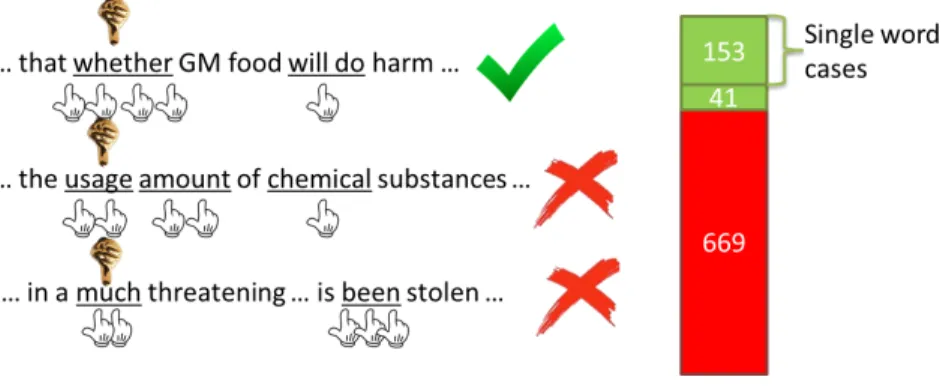
For a sentence to be included in my “clear-cut” corpus, a majority of the five Turkers must agree with the original NUCLE annotation (Figure 10). In other words, I retain the sentence if and only if at least three Turkers agree on the same span as the NUCLE annotator. This type of
Figure 9: Word level redundancy annotation. Annotators are asked to pick the most redundant word/phrase within a given sentence.