HAL Id: tel-02318899
https://hal.archives-ouvertes.fr/tel-02318899
Submitted on 17 Oct 2019HAL is a multi-disciplinary open access archive for the deposit and dissemination of sci-entific research documents, whether they are pub-lished or not. The documents may come from teaching and research institutions in France or abroad, or from public or private research centers.
L’archive ouverte pluridisciplinaire HAL, est destinée au dépôt et à la diffusion de documents scientifiques de niveau recherche, publiés ou non, émanant des établissements d’enseignement et de recherche français ou étrangers, des laboratoires publics ou privés.
application à la détection de fraude
Guillaume Metzler
To cite this version:
Guillaume Metzler. Apprentissage dans un contexte déséquilibré : une application à la détection de fraude. Artificial Intelligence [cs.AI]. Université Jean Monnet Saint-Étienne, 2019. English. �tel-02318899�
´
Ecole Doctorale ED488 Sciences, Ing´enierie, Sant´e
Learning from Imbalanced Data:
Application to Bank Fraud Detection
Apprentissage dans un Contexte D´
es´
equilibr´
e:
Application `
a la D´
etection de Fraude Bancaire
Th`ese pr´epar´ee parGuillaume Metzler
au sein de l’Universit´e Jean Monnet de Saint-´Etienne
pour obtenir le grade de :
Docteur de l’Universit´e de Lyon
Sp´ecialit´e : Informatique
Univ Lyon, UJM-Saint-Etienne, CNRS, Institut d’Optique Graduate School, Laboratoire Hubert Curien UMR 5516, F-42023, SAINT-ETIENNE, France.
Blitz Business Services, 38090, VILLEFONTAINE, France.
Th`ese soutenue publiquement le25 septembre 2019 devant le jury compos´e de :
Marianne CLAUSEL Professeure, Universit´e de Lorraine Rapporteure
Marc TOMMASI Professeur, Universit´e de Lille Rapporteur
Yves GRANDVALET Professeur, Universit´e de Technologie de Compi`egne Examinateur
´
Elisa FROMONT Professeure, Universit´e de Rennes I Co-encadrante
Amaury HABRARD Professeur, Universit´e de Saint-´Etienne Co-encadrant
Marc SEBBAN Professeur, Universit´e de Saint-´Etienne Directeur
Xavier BADICHE Pr´esident Directeur G´en´eral de Blitz Business Services Membre invit´e
3
Remerciements
Je tiens tout d’abord `a remercier Marc Sebban mon directeur de th`ese ainsi que Elisa Fromont et Amaury Habrard pour avoir accept´e de diriger cette th`ese, ainsi que Xavier, de l’entreprise Blitz, pour le financement de cette th`ese.
Je voulais ´egalement remercier les rapporteurs Marc Tommasi et Marianne Clausel pour leur travail de relecture du manuscrit et pour leurs retours. Je les remercie aussi, ainsi que Yves Grandvalet, d’avoir accept´e d’´evaluer mon travail en acceptant l’invitation pour faire partie de mon jury de th`ese.
Cette th`ese a marqu´e un tournant dans ma vie en terme de formation, ou comment “quit-ter” les math´ematiques pour se diriger vers l’informatique th´eorique ! Les d´ebuts furent difficiles, tr`es difficiles mais vous avez toujours cru que cela pouvait aboutir et me motiver en ce sens. Vous avez finalement eu raison car la fin contraste totalement avec le d´ebut de th`ese. Je ne peux que vous remercier pour cela, pour m’avoir pouss´e `a ne jamais baisser les bras. Elisa, tu as ´etais une ’“seconde m`ere” comme tu aimes `a le dire `a tes doctorants, tu m’as toujours remont´e le moral et a toujours gard´e le sourire avec moi et en toutes circonstances, tu fais preuve d’une joie et d’un optimisme qui pousse `a ne pas se d´ecourager et multiplier les efforts. Je remercie ´egalement Amaury avec qui les ´echanges techniques furent toujours aussi int´eressants qu’enrichissants. Tu as toujours ´etais l`a pour me guider d’un point de vue technique et me diriger vers des branches du domaine que je ne connaissais. Finalement, Marc, comme Elisa qui fait toujours preuve d’optimisme mˆeme si je pense qu’il s’est demand´e ce que l’on allait bien pouvoir faire de moi au cours des deux premi`eres ann´ees de th`ese. Au moment o`u j’´ecris ces quelques lignes, tu continues de croire en moi et en mes capacit´es en me proposant des d´ebouch´ees dont ce fameux post-doc que je vais pouvoir effectuer au sein de votre ´equipe. Tout comme Amaury, tu fais preuve d’une culture tr`es large dans le domaine et beaucoup d’id´ees ´emergent de ton esprit `a chaque r´eunion permettant ainsi de d´evelopper de nouveaux axes de recherches. J’esp`ere que nous aurons toujours l’occasion de travailler ensemble par la suite et ce mˆeme apr`es mon d´epart du laboratoire. Et enfin . . . bah on va finir par faire ce marathon ensemble ! Cette ann´ee c’est la bonne ! Je remercie ´egalement R´emi (Bob) pour les moments d’´echanges que nous avons eu ensemble concernant les travaux de recherches, tu as su te montrer disponible pour moi. Merci ´egalement de m’avoir donn´e la possibilit´e de travailler avec Kevin, une collaboration qui a port´e ses fruits et qui m’a permis de reprendre beaucoup de plaisir au travail de recherche.
Mais la th`ese, ce n’est pas que de la recherche, c’est aussi un moment d’´epanouissement o`u l’on rencontre beaucoup de gens comme ses coll`egues doctorants qui sont dans la mˆeme ”mis`ere” que toi mais avec qui tu partages d’excellents moments (surtout en conf´erence !). Mention sp´eciale `a R´emi (Alice) et Kevin avec qui j’ai eu l’occasion de collaborer pour la r´edaction de plusieurs articles et avec qui j’esp`ere rester en contact en d´epit du d´epart
im-minent de certains. Nous avons su nous montrer compl´ementaires, vous avez su combler mes lacunes et mon goˆut pour le “code” en effectuant cette partie et en me laissant m’occuper de la partie “th´eorique”. Finalement ce mariage a bien fonctionn´e et a montr´e `a quel point le travail d’´equipe porte ses fruits. Je n’oublie bien sˆur pas les autres doctorants comme Jordan, avec qui j’ai pu ´echanger des difficult´es de la th`ese CIFRE et la conciliation entre l’entreprise et le laboratoire de recherche. Tanguy qui pose toujours des questions int´eressantes et dont les r´eponses ne sont pas n´ecessairement triviales. Julien qui m’a marqu´e par sa discr´etion mais aussi par son humour, qui, disons-le, est parfois particulier mais que nous avons le plaisir de voir pendant notre semaine pass´e au Japon avec Kevin.
Mais surtout . . . que serait notre bureau de doctorants sans . . . L´eo ! The PhD Student que je ne pourrai jamais oublier, un humour totalement bizarre mais une patience d’ange et toujours d’une grande aide quand je suis confront´e `a des probl`emes informatiques . . . mˆeme triviaux. Je crois que tu ne cesseras de me surprendre `a chacune de tes d´ecouvertes de la vie :) Je dois ´egalement te remercier pour tes pr´ecieuses relectures qui ont permis d’am´eliorer l’esth´etisme du manuscrit mais aussi de corriger des fautes persistantes. Merci `a toi aussi Valentina pour les moments d’´echanges que nous avons pu avoir et j’esp`ere que nous aurons l’occasion de nous croiser `a San Francisco. Et la liste ne s’arrˆete pas l`a, je ne vous oublie pas : Thomas, Jules, R´emi (oui encore un autre) qui ont rendu les soir´ees doctorantes m´emorables. Il y a ´egalement nos fameux “stagiaires” que nous avons vu passer dans notre bureau. Ils sont su se d´emarquer par leur humour . . . parfois . . . tr`es sp´ecial disons-le, n’est-ce pas Paul ! Mais aussi par leur connaissance comme Fabien. Et j’en n’oublie bien d’autres . . .
Mais cette th`ese ´etait ´egalement l’occasion de . . . courir ! Je remercie tous mes coll`egues de course `a pied du laboratoire : Ugo, Pierre-Louis, R´emi, Manu, Christophe, Brice, Thomas, J-P, Mathias, Damien, . . .
Merci ´egalement `a toute l’´equipe de l’entreprise Blitz pour leur accueil. Je suis content d’avoir fait la connaissance de Benjamin et Jonathan pour que nous puissions courir ensemble les midis (d’ailleurs . . . il y a toujours une Saint´e-Lyon `a faire les gars). Ils ont depuis quitt´e le nid et j’esp`ere qu’ils s’´epanouissent dans leur travail respectif. Marc . . . alors comment dire . . . tu sais que l’Alsace n’est plus allemande depuis longtemps quand mˆeme ! Tu ´etais un peu le “Paul de l’entreprise” qui racontait des anecdotes `a propos de ses s´eances de Pi-lat assez drˆoles x). Je remercier ´egalement mon encadrant Brahim pour le temps qu’il a su m’accorder mˆeme si cela n’´etait pas toujours ´evident. Hichem et Brahim pour les nombreuses requˆetes SQL et les diff´erentes demandes concernant les bases de donn´ees. Simon et Xavier pour m’avoir recrut´e pour cette th`ese. Merci aussi `a Zakia pour l’organisation d’´ev`enements et de repas pour les salari´es de l’entreprise, cela a toujours permis de ressouder les liens et d’apporter de la bonne humeur dans l’´equipe !
5
quelque soit le chemin emprunt´e et ont toujours fait en sorte que les moments pass´es avec eux soient reposants. Bon ok . . . ils y avaient quelques pics de tensions par moment mais c’est normal.
Maman, tu as su toujours me pousser pour que j’aille jusqu’au bout pour mes ´etudes . . . aujourd’hui je crois que c’est le cas, je ne peux pas aller plus loin. Cela n’´etait pas forc´ement des plus agr´eables mais tu avais raison de le faire.
Papa, tu ´etais plutˆot la force tranquille et tu m’as aid´e dans les diff´erentes ´etapes de la vie qui m’ont permis d’en arriver l`a. Merci beaucoup `a tous les deux. Je remercie plus g´en´eralement toute ma famille pour m’avoir soutenu tout au long de mon parcours.
Enfin, je tiens `a remercie la personne qui m’a support´e pendant ces quatre ann´ees de th`ese et ce, malgr´e les ´epreuves : Mathieu. Cela fait maintenant presque cinq ans que nous partageons notre vie ensemble et tu n’as jamais cess´e de croire que je parviendrai au bout de cette th`ese. Elle nous a fait connaˆıtre beaucoup de difficult´es, elle a empi´et´e sur nos vacances mais tu as su accept´e cela afin que je puisse r´eussir cette derni`ere ´etape de mes ´etudes. Tu t’es montr´e patient quand il s’agissait de supporter l’ascenseur ´emotionnel dans lequel je me trouvais, les soir´ees et ´eventuelles nuits au cours desquelles je t’ai laiss´e seul. Tu as ´et´e, tu es et tu resteras un vrai pilier pour moi et c’est un vrai bonheur que de partager mon quotidien avec toi. Merci du fond du coeur.
Table of Contents
List of Figures 9 List of Tables 11 Introduction 13 I Background 19 1 Preliminaries 211.1 Statistical Learning Theory . . . 21
1.2 Learning Algorithms . . . 30
2 Learning from Imbalanced Data 43 2.1 Introduction . . . 43
2.2 Performance Measures . . . 45
2.3 Pre-Processing . . . 49
2.4 Algorithms for Learning in Imbalanced Settings . . . 54
2.5 Conclusion . . . 61
II Geometric Approaches 63 3 Learning Maximum Excluding Ellipsoids 65 3.1 Introduction . . . 66
3.2 Support Vector Data Description . . . 67
3.3 M E2: a Metric Learning-based Algorithm for Optimizing Excluding Ellipsoids 68 3.4 Generalization Guarantees . . . 75
3.5 Experiments . . . 82
3.6 Conclusion . . . 86
4 A Corrected Nearest Neighbor Algorithm 89 4.1 Introduction . . . 90
4.2 Related Work . . . 92
4.3 Our Proposed Strategy . . . 94 7
4.4 Experiments . . . 97
4.5 Conclusion . . . 102
III Cost-Sensitive Approaches 105 5 From Cost-Sensitive Classification to Tight F-measure Bounds 107 5.1 Related Work . . . 108
5.2 Theoretical Bounds . . . 110
5.3 CONEAlgorithm . . . 121
5.4 Experiments . . . 124
5.5 Conclusion . . . 129
6 Tree Based Cost-Sensitive Learning 131 6.1 Introduction . . . 131
6.2 Problem Formulation . . . 132
6.3 Cost Sensitive Decision Trees . . . 133
6.4 Cost Sensitive Gradient Boosting . . . 134
6.5 Experiments . . . 138
6.6 Conclusion . . . 142
Conclusion and Perspectives 143
List of Publications 147
A Extensions of Chapter 5 149
B French Translations 155
List of Figures
1.1 Evolution of risk according to the complexity . . . 24
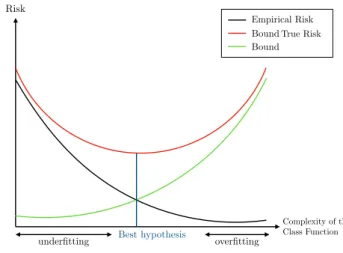
1.2 Bound on the True Risk . . . 28
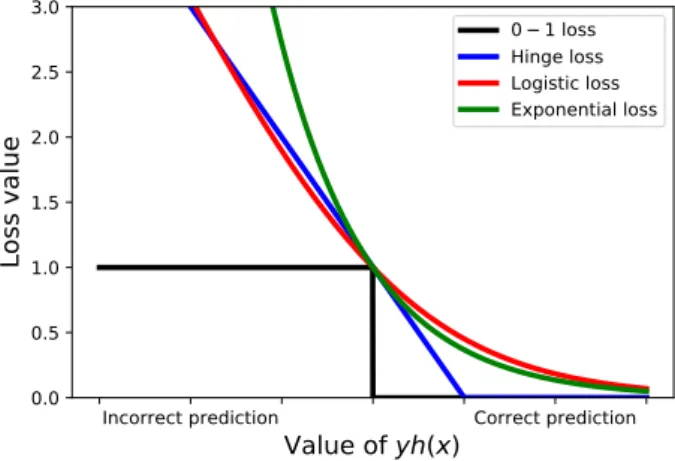
1.3 Loss Functions for Classification Tasks . . . 31
1.4 Illustration of the k-NN algorithm . . . 32
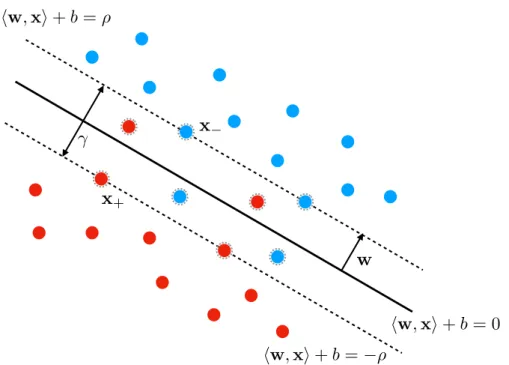
1.5 Illustration of the SVM algorithm . . . 34
1.6 Example of Classification Tree . . . 39
1.7 Illustration of Gini Gain . . . 40
1.8 Standards Algorithms vs. Imbalance . . . 42
2.1 Representation of the F-measure . . . 47
2.2 ROC Curves . . . 49
2.3 Under-sampling Strategies . . . 51
2.4 Oversampling Strategies . . . 53
3.1 The Minimum Enclosing Ball Problem . . . 67
3.2 Ellipsoids vs Spheres . . . 70
3.3 Impact of the hyperparameters on the learned Ellipsoids . . . 71
3.4 Comparison Ellipsoids with Decision Tree . . . 72
3.5 Results: average ranks over the datasets . . . 85
3.6 False positive and false negative rates vs. β . . . 87
4.1 Voronoi regions. . . 90
4.2 Voronoi regions with and without sampling . . . 91
4.3 Evolution of the Decision Boundary. . . 95
4.4 Decision Boundary according to the gamma Values . . . 95
4.5 Results using different sampling strategies . . . 100
4.6 Heatmap on gamma Values . . . 101
4.7 γ1-NN with Sampling Strategies . . . 103
4.8 γ3-NN with Sampling Strategies . . . 104
5.1 Level sets of the F-measure . . . 113
5.2 Geometric representation of the optimization problem . . . 118
5.3 Geometric interpretation of theoretical results . . . 121
5.4 Illustration ofCONE Algorithm . . . 124 9
5.5 Bounds on F-measure vsε1 . . . 127
5.6 Unreachable region ofCONEand Grid . . . 128
5.7 Training performance ofCONEvs. Grid . . . 129
5.8 F-measure vs. computing budget/number of iteration . . . 130
6.1 Evolution of the benefits, Precision, Recall andF1 according to ζ . . . 141
List of Tables
1 Notations . . . 18
2.1 Confusion Matrix . . . 45
2.2 Cost Matrix . . . 54
3.1 Dataset details . . . 83
3.2 Results: F-measure of each algorithms . . . 84
4.1 Description of the used datasets. . . 98
4.2 Results of the 3−NN algorithm . . . 99
4.3 γk-NN vsM E2 . . . . 102
5.1 Dataset details . . . 125
5.2 Results: F-measure forβ= 1 of all algorithms . . . 130
6.1 Cost Matrix for Binary Classification . . . 132
6.2 Results of Tree Based Cost-Sensitive Methods . . . 141
A.1 Mean F-Measure when limiting the number of iterations . . . 154
Introduction
Machine Learning is a subfield of artificial intelligence at the frontier of computer science and applied mathematics (statistics and as optimization). This discipline also partially overlaps Data Science as it is based on collecting data which are analyzed and studied in order to extract the substantial information that can be used for application at hand. Depending on that application, the nature of the data can be multiple: it can consists of images, videos, raw data, categorical data, trees, graphs, times series, etc.
Once the data are collected, and often completed and cleaned, they can be used for several machine learning tasks such asregression when it comes, e.g. to predict the price of a share or the price of a house according to its characteristics. They can also be exploited for classification tasks when, e.g. one aims to discriminate a spam from a ham when receiving an email, identify if a transaction is fraudulent or genuine, detect anomalies in a medical examination such as a blood test. In both cases, the data are labeled using a variable y. When we have a genuine transaction or a ham email, the example is usually labeled −1 (also called negative example) while it is labeled 1 (positive example) when it is an object of interest like a spam or a fraudulent transaction. When such a labeled information is used in a Machine Learning algorithm, we talk about supervised learning, and unsupervised learning otherwise.
Driven by the application of fraud detection, we will focus, in this document, on binary classification tasks. Our objective will be to learn a classifier h, also called an hypothesis, using a collection of labeled data {xi, yi}mi=1 to classify new instances, where xi is a set of
descriptors.
This CIFRE thesis has been carried out in the context of a collaboration with the Blitz SA company working in the field of bank fraud detection. When a customer pays for his purchases in a store, he/she can use different payment medium, including checks. Blitz offers its clients (mainly companies of the mass distribution) a way to secure checks transactions by detecting so-called fraudulent payments which can be of two types: the use of a false check (a check not produced by the bank) or an unpaid check, i.e. the use of check for which there is not enough money on the bank account of the customer. Blitz only provides an advice and the final decision is always made by the client.
The difficulty of this task is two fold: the first one is the huge amount of transactions the company has to deal with per year as well as the response time of the algorithm which must be of the order of ten milliseconds. Second, a fraud constitutes an extremely rare event: it
represents less than 0.4% of the transactions while they cover 1% of the mass distribution turnover.
This thesis is therefore part of the so-called imbalanced learning field, in other words, where the class of interest is much less represented than the negative class. In such a context, most classification algorithms, mainly based on the minimization of the error rate, lead to the trivial solution of predicting all examples as negative. Thus, due to the imbalance in the data, a way to achieve high performances (i.e. 99.6% in our context) is to predict all in-stances as genuine, that is obviously totally inacceptable because one misses all the fraudulent transactions.
More generally, learning in an unbalanced context is an important issue for the Machine Learning community because of its wide range of applications (e.g. in bank, insurance and tax fraud, in health, etc.) but also because of the intrinsic methodological difficulty of this type of problem. There are many techniques to address this type of problem: learning a good representation of the data in which the classification task is easier; assigning costs to different classes to provide algorithms with a way to focus on the minority class; using sampling methods to reduce the imbalance as done in Blitz.
Our objective in this thesis is to propose new strategies to tackle the issue of learning from highly imbalanced data and apply them on fraud detection problem. We aim to propose new algorithms which perform well in this setting and which improve the model used by the Blitz company. We also dedicate a part of this thesis to theoretical contributions of learning from imbalanced data by proposing new ways to optimize performance measures that are suited for this context.
Our contributions are essentially divided into two parts. The first one focuses on the development of so-called geometric algorithms, which determine a better representation for discriminating transactions, by learning new features with which the classification is easier to do. The second one uses theoretically founded costs assign to each class in order to improve well suited performance measures for this context using a theoretical analysis. We also provide a concrete application of that type of methods in order to improve the check fraud detection process of the Blitz company by improving the benefits of its retailers.
Context of the thesis. This thesis was carried out in both in the Data Intelligence team
of the Laboratoire Hubert Curien UMR CNRS 5516, affiliated to the University Jean Monnet in Saint-Etienne and the University of Lyon, and in the Blitz Business Services company in Villefontaine, France. This work has been conducted under a CIFRE contract funded by the ANRT (National Agency of Research and Technology).
About the Blitz Business Services company. The Blitz Business Services company
is located in Villefontaine, France. Its main activity is the check fraud detection and its costumers are the mass distribution. It is also working on the optimization of the passage at the payment office or the granting of payment facilities, such as the agreement of a payment in several installments on online sales sites for example. Finally, Blitz develops an activity
15
which consists of optimizing the use of reminder letters and calls when a report has been drawn up for a person who does not have a valid ticket in public transports.
Contributions
This manuscript presents different contributions from both theoretical and practical aspects to address the imbalanced learning issues. The main body of this thesis contains the contri-butions of this thesis. Extensions and extended experiments are given in Appendix for the sake readability.
This first part is composed of two chapters:
Chapter 1. In the first chapter, we introduce the field of Statistical Learning starting
from the learning of a model to its capacity of performing well on unseen data. It presents the definition and notations useful for the rest of the document. We end this chapter by introducing the problem of learning from imbalanced data and by illustrating the behavior some Machine Learning algorithms when they face imbalanced data.
Chapter 2. The second chapter focuses on the state of the art techniques used to tackle the
imbalanced learning issue. It introduces generalities on both anomaly and fraud detection in the highly imbalanced learning scenarios. It is also dedicated to the presentation of relevant performance metrics used in such a context.
In the second part of this thesis, we present two contributions based on geometrical approaches to deal with imbalanced data. Both of them aim to learn the influence regions around the positive examples, using (i) a metric learning approach in Chapter 3 and (ii) an adjusted distance to positives in Chapter 4.
Chapter 3. Based on the assumption that frauds are locally closed to each other1, our first
contribution proposed a novel strategy based on Support Vector Data Description, a SVM variant which aims to encompass a set of examples. We propose to modify the standard formulation in order to create the largest area around each positive instances. The surface of this area is optimized using a metric learning strategy and leads to ellipsoids in the feature space for which size and orientation are controlled by a regularization term. By solving the dual formulation of our optimization problem, we show that, compared to most metric learning techniques, we have the semi definite positiveness of the learned metric for free. We also derive generalization guarantees on the proposed method using the uniform stability framework and show its effectiveness, in terms of F-Measure, compared to standard machine learning algorithms combined with sampling methods. On the private dataset of Blitz, we show that it possible to control either the recall and the precision of the model.
1
Even though frauds are rare, a given fraudster usually acts quickly with the same strategy, leading to a few positive examples in the same region of the feature space.
Chapter 4. The positive examples of the training set have an important role when it comes to detect new positives at test time. When we are working with distance-based algorithms, such as thek-Nearest Neighbor algorithm, the distance to these positives is key. Instead of applying a linear transformation of the data as it is usually done, we show that modifying the distance of a new query only to positive examples is enough to significantly improve the k -Nearest Neighbor algorithm. Our method has also the ability to control to false positive rate and the false negative one. Furthermore, we show, on several datasets, that the performance of the proposed algorithm can also be improved when it is combined with sampling strategies and achieves at least better results than a metric learning approach or other modification of thek-NN.
The third and last part of this thesis focuses on two contributions on cost-sensitive methods. In Chapter 5, we optimize the F-measure and provide bounds on its optimality. Chapter 6 uses this approach for a practical application: the optimization of the retailers benefits.
Chapter 5. The use of specific measure such as the F-measure has been shown to be more
relevant in the context of imbalanced learning. But its optimization remains a challenging task due to its non linearity and non convexity. However, due to one property of the F-measure, we are able to make link between its optimization and cost-sensitive learning, i.e. learning by assigning different costs to each class. Using this fact, we propose new bounds on the difference of F-measures between two classifiers. Thus, we are able to give bounds on the optimal reachable F-measure. We also provide a geometric interpretation of the derived bounds in the form of asymmetric cones. This last point is used to derive an iterative algorithm which chooses the right costs to assign to each class in order to optimize the F-measure. We show that the presented method is effective or even better than its competitors and only requires a small number of iterations. From a theoretical aspect, we also show that the proposed bounds are much tighter than the ones proposed in the literature
Chapter 6. Cost-sensitive approaches are relevant to address the imbalanced classification
issue. In this chapter, we propose to combine these approaches to tree-based algorithms for the real application of the Blitz Company: the optimization of the retailers benefits. The amount of money of a transaction is a relevant information for the classification task and more attention should be paid on transactions with a large amount of money, something that previous models did not take into account. Furthermore, a miss-classification on that type of transactions has heavier consequences than the one with a small amount. We propose a cost matrix and, thus, a loss function which aims to optimize the retailers benefits. We also propose different tree-based methods to optimize such a loss. The experiments made in this chapter show that it is possible to drastically increase the retailers benefits by the use of a cost-sensitive approach and that the proposed gradient tree boosting algorithm achieves better results than random forest algorithms.
17
Appendix A We provide an extension to the multi-class setting of the work presented in
Chapter 5. This extension includes the proofs and extended experiments.
Notations
Notation Description
m Number of training instances
d Dimension of the feature space
x Scalar
x Vector or a set of vectors
xi Entryiin vector x
xi Vector iin the set of Vectorsx
X Matrix
Xij Entry in rowiand columnj of matrix X
y Label
X,Y,H Input space, Output space, Hypothesis space
D=X × Y Distribution of the data
R,R+ Sets of real and non negative real numbers
S+ Set of Positive Semi Definite matrices
S Sample
R,RS True Risk, Empirical Risk overS
f(·) Function
k·k Norm
|·| Absolute value [·]+ Hinge loss function
h·,·i Dot product between vectors
E[·] Expectation
Pr [·] Probability
`(·) Loss function
A Algorithm
Part I
Background
Chapter 1
Preliminaries
Abstract
In Machine Learning, the data and the loss function used to train a given model are fundamental. In this chapter, we introduce Machine Learning by presenting the different types of problems we meet throughout this thesis. First, we introduce the definition of Risk, the quantity we aim to minimize in most of the optimization problems. We will see that it is possible to provide theoretical guarantees on the performance of the learned model using statistical tools such as concentration inequalities.
The second part of this introduction is dedicated to the loss functions and algorithms. We detail the presentation of the latter as we will meet them all along this thesis. This chapter ends by studying the behavior of some of them when one class becomes over-represented compared to the other one, i.e. when the dataset becomes imbalanced.
1.1
Statistical Learning Theory
In this first section, we introduce the concept of empirical risk minimization, the key point of the supervised learning algorithms in Machine Learning.
Let us consider X the input space of our data, also called the feature space and Y the output space.1 The input space, i.e. the features used to describe the data can be of different types: it can consist of continuous or discrete descriptors. In this thesis, we will focus on continuous features, i.e. X ⊂Rd.The output space can also vary from a task to another. It
can be discrete, real, or even a structured data. The nature of the output gives important information on the nature of the problem and leads the user to choose the appropriate tools.
• When Y ⊂ R or Y = [0,1], i.e. when the output is a real value, the aim is to learn
either a score, a probability or to estimate a quantity as it is usually done inregression tasks.
1
Note that there may be no output space, i.e. Y=∅as inunsupervised learning.
• When Y = {−1,+1} or {0,1} , i.e. the output is binary, we aim to classify the data in two categories, also called classes. This type of tasks is called binary classification. Note that the output can take more than two values, i.e. Y ={1, . . . , q}where q is the number of classes. In this case, we talk about multi-class classification.
To solve these different tasks, we use an algorithm A which aims at learning a function
h:X → Y calledhypothesis. From a practical point of view, the joint distribution of the data
D= X × Y is unknown and we only have access to a collection of sample points, i.e. a set of observations S = {(xi, yi)}mi=1, drawn i.i.d. from D. The goal is then to learn a function
husing the sampleS which is “good enough” on the given training sample but which is also able to perform well on a new sample (x, y).
In the next section, we explain how the function h is learned and the meaning of perfor-mance of an algorithm.
1.1.1 Empirical Risk Minimization
In order to solve a given task, the algorithm A needs a criterion to optimize, also called a loss function usually denoted by `(h(·),·) : X × Y → R. In a regression task, it can be
based on the difference between the estimated value,h(x), and the true valuey, for example
`(h(x), y) = |h(x)−y| or (h(x)−y)2. In a classification task, the most natural way is to consider the number of errors made by the classifier h. The considered loss function is then defined by`(h(x), y) =1{h(x)6=y} and is called0-1 loss. However, because of its non convexity
and non differentiability, minimizing this loss is known to be NP-hard. That is why, we usually change the0-1 loss by a surrogate function (see Section 1.2).
Whatever h, we need to minimize its expected value over the distribution D, leading to theTrue Risk.
Definition 1.1 (True Risk). Let `:X × Y →R a loss function andD the distribution of the
data. The True RiskR of an hypothesish is defined by:
R`(h) =
E
(x,y)∼D[`(h(x), y)].
However, we can not compute this quantity in practice because the joint distribution D of the data is unknown. We rather minimize theEmpirical Risk, the average error over the sampleS.
Definition 1.2 (Empirical Risk). Let S = {(xi, y)}mi=1 a collection of m examples drawn
i.i.d. fromD and `:X × Y :→R. The Empirical Risk risk of an hypothesis h is defined by:
R` S(h) = 1 m m X i=1 `(h(xi), yi).
1.1. Statistical Learning Theory 23
We aim to minimize the empirical risk with the hope that the sampleS is representative of the unknown distribution. At the first glance, minimizing the empirical risk might be then equivalent to minimizing the true/generalization risk. But this is not sufficient in general, and the risk is to tend to an overfitting phenomenon.
It shows that it is important to fix some constraints on the hypothesis we can learn to avoid such a situation. We present below a non exhaustive list of ways to constrain the learned hypothesis.
Empirical risk minimization. The most straightforward solution is to fix in advance the
hypothesis space H, called a Set of Hypotheses or Class Function. Then, given this set of hypothesesH, a sample S and a loss function`, we are looking for the hypothesis h?
S as the solution of: h?S = argmin h∈H R ` S(h).
If the size ofH is small enough, we can avoid the situation previously described. However, without any side information on the data, it is hard to choose the appropriate set of hypotheses for the task at hand.
Structural risk minimization. [See Section 4.1 of Vapnik (1995)] The idea here is to
choose a growing sequence of sets of hypotheses{Hn}n∈N, i.e. the complexity or the number
of hypotheses is growing with n, and to choose the hypothesis h? solution of the following
minimization problem:
h?S = argmin
h∈Hn, n∈N
R`S(h) +pen(n, d).
Compared to the previous formulation, apenalty term is added to the empirical risk. This term measures the complexity/size of the set of hypothesesHn and is a growing function of
n (note that it also depends on the dimension of the data). The aim is then to learn the best hypothesis in the smallest setHn. With such a formulation, we are able to find a good
trade-off between the empirical risk minimization and the complexity of the learned model, i.e. find a hypothesis that is able to generalize well. But choosing a sequence of sets of hypotheses remains hard in practice.
Regularized risk minimization. The preferred solution in practice, because easier to
im-plement, is to choose a set of hypothesesHsufficiently large enough and to add a constraint on the parametersθof the learned model. The added constraint,λkθk, is called aregularization term and is associated to a regularization constant λ.
h?S= argmin
h∈H R
`
S(h) +λkθk.
Complexity of the Class Function
<latexit sha1_base64="y+WYoyjePo5SsYAA8geBZmxUIDc=">AAAC8XicjVHNThsxGJxsaRvSv1COXKxGlXqool0u9IgaCfUYJAKRElTtOg5YeO3V2ouIEC/BjRvqtS/Qa/sSiDeAt+Czs5HaRqj1anfH882M/dlZoaR1cXzbiJ6sPH32vLnaevHy1es37bW3+9ZUJRcDbpQph1lqhZJaDJx0SgyLUqR5psRBdtLz9YNTUVpp9J6bFeIwT4+0nEqeOqK+tj+OtZF6IrRjPZMXSpxJN2NmytyxGI9bPZVay3YqzefyTtyNw2DLIKlBB/Xom/YNxpjAgKNCDgENR1ghhaVnhAQxCuIOcU5cSUiGusAFWuStSCVIkRJ7Qt8jmo1qVtPcZ9rg5rSKorckJ8N78hjSlYT9aizUq5Ds2ceyz0Om39uM/lmdlRPrcEzsv3wL5f/6fC8OU3wKPUjqqQiM747XKVU4Fb9z9ltXjhIK4jyeUL0kzINzcc4seGzo3Z9tGup3QelZP+e1tsK93yVdcPL3dS6D/c1uEneT3c3O9uf6qpvYwDt8oPvcwja+oI8BZV/iB37iV2Sjq+g6+jaXRo3as44/RvT9AdOFoV8=</latexit><latexit sha1_base64="y+WYoyjePo5SsYAA8geBZmxUIDc=">AAAC8XicjVHNThsxGJxsaRvSv1COXKxGlXqool0u9IgaCfUYJAKRElTtOg5YeO3V2ouIEC/BjRvqtS/Qa/sSiDeAt+Czs5HaRqj1anfH882M/dlZoaR1cXzbiJ6sPH32vLnaevHy1es37bW3+9ZUJRcDbpQph1lqhZJaDJx0SgyLUqR5psRBdtLz9YNTUVpp9J6bFeIwT4+0nEqeOqK+tj+OtZF6IrRjPZMXSpxJN2NmytyxGI9bPZVay3YqzefyTtyNw2DLIKlBB/Xom/YNxpjAgKNCDgENR1ghhaVnhAQxCuIOcU5cSUiGusAFWuStSCVIkRJ7Qt8jmo1qVtPcZ9rg5rSKorckJ8N78hjSlYT9aizUq5Ds2ceyz0Om39uM/lmdlRPrcEzsv3wL5f/6fC8OU3wKPUjqqQiM747XKVU4Fb9z9ltXjhIK4jyeUL0kzINzcc4seGzo3Z9tGup3QelZP+e1tsK93yVdcPL3dS6D/c1uEneT3c3O9uf6qpvYwDt8oPvcwja+oI8BZV/iB37iV2Sjq+g6+jaXRo3as44/RvT9AdOFoV8=</latexit><latexit sha1_base64="y+WYoyjePo5SsYAA8geBZmxUIDc=">AAAC8XicjVHNThsxGJxsaRvSv1COXKxGlXqool0u9IgaCfUYJAKRElTtOg5YeO3V2ouIEC/BjRvqtS/Qa/sSiDeAt+Czs5HaRqj1anfH882M/dlZoaR1cXzbiJ6sPH32vLnaevHy1es37bW3+9ZUJRcDbpQph1lqhZJaDJx0SgyLUqR5psRBdtLz9YNTUVpp9J6bFeIwT4+0nEqeOqK+tj+OtZF6IrRjPZMXSpxJN2NmytyxGI9bPZVay3YqzefyTtyNw2DLIKlBB/Xom/YNxpjAgKNCDgENR1ghhaVnhAQxCuIOcU5cSUiGusAFWuStSCVIkRJ7Qt8jmo1qVtPcZ9rg5rSKorckJ8N78hjSlYT9aizUq5Ds2ceyz0Om39uM/lmdlRPrcEzsv3wL5f/6fC8OU3wKPUjqqQiM747XKVU4Fb9z9ltXjhIK4jyeUL0kzINzcc4seGzo3Z9tGup3QelZP+e1tsK93yVdcPL3dS6D/c1uEneT3c3O9uf6qpvYwDt8oPvcwja+oI8BZV/iB37iV2Sjq+g6+jaXRo3as44/RvT9AdOFoV8=</latexit><latexit sha1_base64="y+WYoyjePo5SsYAA8geBZmxUIDc=">AAAC8XicjVHNThsxGJxsaRvSv1COXKxGlXqool0u9IgaCfUYJAKRElTtOg5YeO3V2ouIEC/BjRvqtS/Qa/sSiDeAt+Czs5HaRqj1anfH882M/dlZoaR1cXzbiJ6sPH32vLnaevHy1es37bW3+9ZUJRcDbpQph1lqhZJaDJx0SgyLUqR5psRBdtLz9YNTUVpp9J6bFeIwT4+0nEqeOqK+tj+OtZF6IrRjPZMXSpxJN2NmytyxGI9bPZVay3YqzefyTtyNw2DLIKlBB/Xom/YNxpjAgKNCDgENR1ghhaVnhAQxCuIOcU5cSUiGusAFWuStSCVIkRJ7Qt8jmo1qVtPcZ9rg5rSKorckJ8N78hjSlYT9aizUq5Ds2ceyz0Om39uM/lmdlRPrcEzsv3wL5f/6fC8OU3wKPUjqqQiM747XKVU4Fb9z9ltXjhIK4jyeUL0kzINzcc4seGzo3Z9tGup3QelZP+e1tsK93yVdcPL3dS6D/c1uEneT3c3O9uf6qpvYwDt8oPvcwja+oI8BZV/iB37iV2Sjq+g6+jaXRo3as44/RvT9AdOFoV8=</latexit>
Risk <latexit sha1_base64="XOxl6+kXMmR8m1ZsIalhEluH5qI=">AAACx3icjVHLTsJAFD3UF+ILdemmkZi4Ii0bXRLd6A6NgAkS05YBJvSV6ZRIiAt/wK3+mfEP9C+8Mw6JSoxO0/bMufecmXuvn4Y8k47zWrAWFpeWV4qrpbX1jc2t8vZOK0tyEbBmkISJuPa9jIU8Zk3JZciuU8G8yA9Z2x+dqnh7zETGk/hKTlLWjbxBzPs88KSiLnk2ui1XnKqjlz0PXAMqMKuRlF9wgx4SBMgRgSGGJBzCQ0ZPBy4cpMR1MSVOEOI6znCPEmlzymKU4RE7ou+Adh3DxrRXnplWB3RKSK8gpY0D0iSUJwir02wdz7WzYn/znmpPdbcJ/X3jFRErMST2L90s8786VYtEH8e6Bk41pZpR1QXGJdddUTe3v1QlySElTuEexQXhQCtnfba1JtO1q956Ov6mMxWr9oHJzfGubkkDdn+Ocx60alXXqboXtUr9xIy6iD3s45DmeYQ6ztBAk7yHeMQTnq1zK7HG1t1nqlUwml18W9bDB4yKkLo=</latexit> <latexit sha1_base64="XOxl6+kXMmR8m1ZsIalhEluH5qI=">AAACx3icjVHLTsJAFD3UF+ILdemmkZi4Ii0bXRLd6A6NgAkS05YBJvSV6ZRIiAt/wK3+mfEP9C+8Mw6JSoxO0/bMufecmXuvn4Y8k47zWrAWFpeWV4qrpbX1jc2t8vZOK0tyEbBmkISJuPa9jIU8Zk3JZciuU8G8yA9Z2x+dqnh7zETGk/hKTlLWjbxBzPs88KSiLnk2ui1XnKqjlz0PXAMqMKuRlF9wgx4SBMgRgSGGJBzCQ0ZPBy4cpMR1MSVOEOI6znCPEmlzymKU4RE7ou+Adh3DxrRXnplWB3RKSK8gpY0D0iSUJwir02wdz7WzYn/znmpPdbcJ/X3jFRErMST2L90s8786VYtEH8e6Bk41pZpR1QXGJdddUTe3v1QlySElTuEexQXhQCtnfba1JtO1q956Ov6mMxWr9oHJzfGubkkDdn+Ocx60alXXqboXtUr9xIy6iD3s45DmeYQ6ztBAk7yHeMQTnq1zK7HG1t1nqlUwml18W9bDB4yKkLo=</latexit> <latexit sha1_base64="XOxl6+kXMmR8m1ZsIalhEluH5qI=">AAACx3icjVHLTsJAFD3UF+ILdemmkZi4Ii0bXRLd6A6NgAkS05YBJvSV6ZRIiAt/wK3+mfEP9C+8Mw6JSoxO0/bMufecmXuvn4Y8k47zWrAWFpeWV4qrpbX1jc2t8vZOK0tyEbBmkISJuPa9jIU8Zk3JZciuU8G8yA9Z2x+dqnh7zETGk/hKTlLWjbxBzPs88KSiLnk2ui1XnKqjlz0PXAMqMKuRlF9wgx4SBMgRgSGGJBzCQ0ZPBy4cpMR1MSVOEOI6znCPEmlzymKU4RE7ou+Adh3DxrRXnplWB3RKSK8gpY0D0iSUJwir02wdz7WzYn/znmpPdbcJ/X3jFRErMST2L90s8786VYtEH8e6Bk41pZpR1QXGJdddUTe3v1QlySElTuEexQXhQCtnfba1JtO1q956Ov6mMxWr9oHJzfGubkkDdn+Ocx60alXXqboXtUr9xIy6iD3s45DmeYQ6ztBAk7yHeMQTnq1zK7HG1t1nqlUwml18W9bDB4yKkLo=</latexit> <latexit sha1_base64="XOxl6+kXMmR8m1ZsIalhEluH5qI=">AAACx3icjVHLTsJAFD3UF+ILdemmkZi4Ii0bXRLd6A6NgAkS05YBJvSV6ZRIiAt/wK3+mfEP9C+8Mw6JSoxO0/bMufecmXuvn4Y8k47zWrAWFpeWV4qrpbX1jc2t8vZOK0tyEbBmkISJuPa9jIU8Zk3JZciuU8G8yA9Z2x+dqnh7zETGk/hKTlLWjbxBzPs88KSiLnk2ui1XnKqjlz0PXAMqMKuRlF9wgx4SBMgRgSGGJBzCQ0ZPBy4cpMR1MSVOEOI6znCPEmlzymKU4RE7ou+Adh3DxrRXnplWB3RKSK8gpY0D0iSUJwir02wdz7WzYn/znmpPdbcJ/X3jFRErMST2L90s8786VYtEH8e6Bk41pZpR1QXGJdddUTe3v1QlySElTuEexQXhQCtnfba1JtO1q956Ov6mMxWr9oHJzfGubkkDdn+Ocx60alXXqboXtUr9xIy6iD3s45DmeYQ6ztBAk7yHeMQTnq1zK7HG1t1nqlUwml18W9bDB4yKkLo=</latexit> Empirical Risk <latexit sha1_base64="tXbzb+oNRolrmhfphyOc/2OQO+E=">AAAC0XicjVHLSsNAFD2Nr1pfVZdugkVwVRI3uiyK4LI++oBaJZlO69C8mEyEUgRx6w+41Z8S/0D/wjtjBLWITkhy7rn3nJk7108CkSrHeSlYU9Mzs3PF+dLC4tLySnl1rZnGmWS8weIglm3fS3kgIt5QQgW8nUjuhX7AW/7wQOdb11ymIo7O1Cjh3dAbRKIvmKeIujgMEyEpCOwTkQ4vyxWn6phlTwI3BxXkqx6Xn3GOHmIwZAjBEUERDuAhpacDFw4S4roYEycJCZPnuEGJtBlVcarwiB3Sd0BRJ2cjirVnatSMdgnolaS0sUWamOokYb2bbfKZcdbsb95j46nPNqK/n3uFxCpcEfuX7rPyvzrdi0Ife6YHQT0lhtHdsdwlM7eiT25/6UqRQ0Kcxj3KS8LMKD/v2Taa1PSu79Yz+VdTqVkds7w2w5s+JQ3Y/TnOSdDcqbpO1T3eqdT281EXsYFNbNM8d1HDEepokLfEAx7xZJ1aI+vWuvsotQq5Zh3flnX/DvfelNQ=</latexit>
<latexit sha1_base64="tXbzb+oNRolrmhfphyOc/2OQO+E=">AAAC0XicjVHLSsNAFD2Nr1pfVZdugkVwVRI3uiyK4LI++oBaJZlO69C8mEyEUgRx6w+41Z8S/0D/wjtjBLWITkhy7rn3nJk7108CkSrHeSlYU9Mzs3PF+dLC4tLySnl1rZnGmWS8weIglm3fS3kgIt5QQgW8nUjuhX7AW/7wQOdb11ymIo7O1Cjh3dAbRKIvmKeIujgMEyEpCOwTkQ4vyxWn6phlTwI3BxXkqx6Xn3GOHmIwZAjBEUERDuAhpacDFw4S4roYEycJCZPnuEGJtBlVcarwiB3Sd0BRJ2cjirVnatSMdgnolaS0sUWamOokYb2bbfKZcdbsb95j46nPNqK/n3uFxCpcEfuX7rPyvzrdi0Ife6YHQT0lhtHdsdwlM7eiT25/6UqRQ0Kcxj3KS8LMKD/v2Taa1PSu79Yz+VdTqVkds7w2w5s+JQ3Y/TnOSdDcqbpO1T3eqdT281EXsYFNbNM8d1HDEepokLfEAx7xZJ1aI+vWuvsotQq5Zh3flnX/DvfelNQ=</latexit><latexit sha1_base64="tXbzb+oNRolrmhfphyOc/2OQO+E=">AAAC0XicjVHLSsNAFD2Nr1pfVZdugkVwVRI3uiyK4LI++oBaJZlO69C8mEyEUgRx6w+41Z8S/0D/wjtjBLWITkhy7rn3nJk7108CkSrHeSlYU9Mzs3PF+dLC4tLySnl1rZnGmWS8weIglm3fS3kgIt5QQgW8nUjuhX7AW/7wQOdb11ymIo7O1Cjh3dAbRKIvmKeIujgMEyEpCOwTkQ4vyxWn6phlTwI3BxXkqx6Xn3GOHmIwZAjBEUERDuAhpacDFw4S4roYEycJCZPnuEGJtBlVcarwiB3Sd0BRJ2cjirVnatSMdgnolaS0sUWamOokYb2bbfKZcdbsb95j46nPNqK/n3uFxCpcEfuX7rPyvzrdi0Ife6YHQT0lhtHdsdwlM7eiT25/6UqRQ0Kcxj3KS8LMKD/v2Taa1PSu79Yz+VdTqVkds7w2w5s+JQ3Y/TnOSdDcqbpO1T3eqdT281EXsYFNbNM8d1HDEepokLfEAx7xZJ1aI+vWuvsotQq5Zh3flnX/DvfelNQ=</latexit><latexit sha1_base64="tXbzb+oNRolrmhfphyOc/2OQO+E=">AAAC0XicjVHLSsNAFD2Nr1pfVZdugkVwVRI3uiyK4LI++oBaJZlO69C8mEyEUgRx6w+41Z8S/0D/wjtjBLWITkhy7rn3nJk7108CkSrHeSlYU9Mzs3PF+dLC4tLySnl1rZnGmWS8weIglm3fS3kgIt5QQgW8nUjuhX7AW/7wQOdb11ymIo7O1Cjh3dAbRKIvmKeIujgMEyEpCOwTkQ4vyxWn6phlTwI3BxXkqx6Xn3GOHmIwZAjBEUERDuAhpacDFw4S4roYEycJCZPnuEGJtBlVcarwiB3Sd0BRJ2cjirVnatSMdgnolaS0sUWamOokYb2bbfKZcdbsb95j46nPNqK/n3uFxCpcEfuX7rPyvzrdi0Ife6YHQT0lhtHdsdwlM7eiT25/6UqRQ0Kcxj3KS8LMKD/v2Taa1PSu79Yz+VdTqVkds7w2w5s+JQ3Y/TnOSdDcqbpO1T3eqdT281EXsYFNbNM8d1HDEepokLfEAx7xZJ1aI+vWuvsotQq5Zh3flnX/DvfelNQ=</latexit>
True Risk<latexit sha1_base64="EYqKhzXxVzOImg269yPI6gy73Ao=">AAACzHicjVHLSsNAFD2Nr/quunQTLIKrknSjy6IbV1KlL6lFkum0Ds2LyUQopVt/wK1+l/gH+hfeGVNQi+iEJGfOvefM3Hv9JBCpcpzXgrWwuLS8UlxdW9/Y3Nou7ey20jiTjDdZHMSy43spD0TEm0qogHcSyb3QD3jbH53pePuey1TEUUONE94LvWEkBoJ5iqjrhsy4fSXS0W2p7FQcs+x54OagjHzV49ILbtBHDIYMITgiKMIBPKT0dOHCQUJcDxPiJCFh4hxTrJE2oyxOGR6xI/oOadfN2Yj22jM1akanBPRKUto4JE1MeZKwPs028cw4a/Y374nx1Hcb09/PvUJiFe6I/Us3y/yvTteiMMCJqUFQTYlhdHUsd8lMV/TN7S9VKXJIiNO4T3FJmBnlrM+20aSmdt1bz8TfTKZm9Z7luRne9S1pwO7Pcc6DVrXiOhX3slquneajLmIfBziieR6jhnPU0STvEI94wrN1YSlrYk0/U61CrtnDt2U9fAB8vJKs</latexit><latexit sha1_base64="EYqKhzXxVzOImg269yPI6gy73Ao=">AAACzHicjVHLSsNAFD2Nr/quunQTLIKrknSjy6IbV1KlL6lFkum0Ds2LyUQopVt/wK1+l/gH+hfeGVNQi+iEJGfOvefM3Hv9JBCpcpzXgrWwuLS8UlxdW9/Y3Nou7ey20jiTjDdZHMSy43spD0TEm0qogHcSyb3QD3jbH53pePuey1TEUUONE94LvWEkBoJ5iqjrhsy4fSXS0W2p7FQcs+x54OagjHzV49ILbtBHDIYMITgiKMIBPKT0dOHCQUJcDxPiJCFh4hxTrJE2oyxOGR6xI/oOadfN2Yj22jM1akanBPRKUto4JE1MeZKwPs028cw4a/Y374nx1Hcb09/PvUJiFe6I/Us3y/yvTteiMMCJqUFQTYlhdHUsd8lMV/TN7S9VKXJIiNO4T3FJmBnlrM+20aSmdt1bz8TfTKZm9Z7luRne9S1pwO7Pcc6DVrXiOhX3slquneajLmIfBziieR6jhnPU0STvEI94wrN1YSlrYk0/U61CrtnDt2U9fAB8vJKs</latexit><latexit sha1_base64="EYqKhzXxVzOImg269yPI6gy73Ao=">AAACzHicjVHLSsNAFD2Nr/quunQTLIKrknSjy6IbV1KlL6lFkum0Ds2LyUQopVt/wK1+l/gH+hfeGVNQi+iEJGfOvefM3Hv9JBCpcpzXgrWwuLS8UlxdW9/Y3Nou7ey20jiTjDdZHMSy43spD0TEm0qogHcSyb3QD3jbH53pePuey1TEUUONE94LvWEkBoJ5iqjrhsy4fSXS0W2p7FQcs+x54OagjHzV49ILbtBHDIYMITgiKMIBPKT0dOHCQUJcDxPiJCFh4hxTrJE2oyxOGR6xI/oOadfN2Yj22jM1akanBPRKUto4JE1MeZKwPs028cw4a/Y374nx1Hcb09/PvUJiFe6I/Us3y/yvTteiMMCJqUFQTYlhdHUsd8lMV/TN7S9VKXJIiNO4T3FJmBnlrM+20aSmdt1bz8TfTKZm9Z7luRne9S1pwO7Pcc6DVrXiOhX3slquneajLmIfBziieR6jhnPU0STvEI94wrN1YSlrYk0/U61CrtnDt2U9fAB8vJKs</latexit><latexit sha1_base64="EYqKhzXxVzOImg269yPI6gy73Ao=">AAACzHicjVHLSsNAFD2Nr/quunQTLIKrknSjy6IbV1KlL6lFkum0Ds2LyUQopVt/wK1+l/gH+hfeGVNQi+iEJGfOvefM3Hv9JBCpcpzXgrWwuLS8UlxdW9/Y3Nou7ey20jiTjDdZHMSy43spD0TEm0qogHcSyb3QD3jbH53pePuey1TEUUONE94LvWEkBoJ5iqjrhsy4fSXS0W2p7FQcs+x54OagjHzV49ILbtBHDIYMITgiKMIBPKT0dOHCQUJcDxPiJCFh4hxTrJE2oyxOGR6xI/oOadfN2Yj22jM1akanBPRKUto4JE1MeZKwPs028cw4a/Y374nx1Hcb09/PvUJiFe6I/Us3y/yvTteiMMCJqUFQTYlhdHUsd8lMV/TN7S9VKXJIiNO4T3FJmBnlrM+20aSmdt1bz8TfTKZm9Z7luRne9S1pwO7Pcc6DVrXiOhX3slquneajLmIfBziieR6jhnPU0STvEI94wrN1YSlrYk0/U61CrtnDt2U9fAB8vJKs</latexit>
overfitting
<latexit sha1_base64="fUkyu0JsgrqAdyqMuIqsHtCvtp0=">AAACz3icjVHLSsNAFD2Nr1pfVZdugkVwVZJudFl047IF+4BaJJlO69C8SCZKKYpbf8Ct/pX4B/oX3hmnoBbRCUnOnHvPmbn3+kkgMuk4rwVrYXFpeaW4Wlpb39jcKm/vtLM4TxlvsTiI067vZTwQEW9JIQPeTVLuhX7AO/74VMU71zzNRBydy0nC+6E3isRQME8SdRFTbCikFNGodFmuOFVHL3seuAZUYFYjLr/gAgPEYMgRgiOCJBzAQ0ZPDy4cJMT1MSUuJSR0nOMWJdLmlMUpwyN2TN8R7XqGjWivPDOtZnRKQG9KShsHpIkpLyWsTrN1PNfOiv3Ne6o91d0m9PeNV0isxBWxf+lmmf/VqVokhjjWNQiqKdGMqo4Zl1x3Rd3c/lKVJIeEOIUHFE8JM62c9dnWmkzXrnrr6fibzlSs2jOTm+Nd3ZIG7P4c5zxo16quU3WbtUr9xIy6iD3s45DmeYQ6ztBAi7wTPOIJz1bTurHurPvPVKtgNLv4tqyHD0ZOlCw=</latexit>
<latexit sha1_base64="fUkyu0JsgrqAdyqMuIqsHtCvtp0=">AAACz3icjVHLSsNAFD2Nr1pfVZdugkVwVZJudFl047IF+4BaJJlO69C8SCZKKYpbf8Ct/pX4B/oX3hmnoBbRCUnOnHvPmbn3+kkgMuk4rwVrYXFpeaW4Wlpb39jcKm/vtLM4TxlvsTiI067vZTwQEW9JIQPeTVLuhX7AO/74VMU71zzNRBydy0nC+6E3isRQME8SdRFTbCikFNGodFmuOFVHL3seuAZUYFYjLr/gAgPEYMgRgiOCJBzAQ0ZPDy4cJMT1MSUuJSR0nOMWJdLmlMUpwyN2TN8R7XqGjWivPDOtZnRKQG9KShsHpIkpLyWsTrN1PNfOiv3Ne6o91d0m9PeNV0isxBWxf+lmmf/VqVokhjjWNQiqKdGMqo4Zl1x3Rd3c/lKVJIeEOIUHFE8JM62c9dnWmkzXrnrr6fibzlSs2jOTm+Nd3ZIG7P4c5zxo16quU3WbtUr9xIy6iD3s45DmeYQ6ztBAi7wTPOIJz1bTurHurPvPVKtgNLv4tqyHD0ZOlCw=</latexit><latexit sha1_base64="fUkyu0JsgrqAdyqMuIqsHtCvtp0=">AAACz3icjVHLSsNAFD2Nr1pfVZdugkVwVZJudFl047IF+4BaJJlO69C8SCZKKYpbf8Ct/pX4B/oX3hmnoBbRCUnOnHvPmbn3+kkgMuk4rwVrYXFpeaW4Wlpb39jcKm/vtLM4TxlvsTiI067vZTwQEW9JIQPeTVLuhX7AO/74VMU71zzNRBydy0nC+6E3isRQME8SdRFTbCikFNGodFmuOFVHL3seuAZUYFYjLr/gAgPEYMgRgiOCJBzAQ0ZPDy4cJMT1MSUuJSR0nOMWJdLmlMUpwyN2TN8R7XqGjWivPDOtZnRKQG9KShsHpIkpLyWsTrN1PNfOiv3Ne6o91d0m9PeNV0isxBWxf+lmmf/VqVokhjjWNQiqKdGMqo4Zl1x3Rd3c/lKVJIeEOIUHFE8JM62c9dnWmkzXrnrr6fibzlSs2jOTm+Nd3ZIG7P4c5zxo16quU3WbtUr9xIy6iD3s45DmeYQ6ztBAi7wTPOIJz1bTurHurPvPVKtgNLv4tqyHD0ZOlCw=</latexit>
<latexit sha1_base64="fUkyu0JsgrqAdyqMuIqsHtCvtp0=">AAACz3icjVHLSsNAFD2Nr1pfVZdugkVwVZJudFl047IF+4BaJJlO69C8SCZKKYpbf8Ct/pX4B/oX3hmnoBbRCUnOnHvPmbn3+kkgMuk4rwVrYXFpeaW4Wlpb39jcKm/vtLM4TxlvsTiI067vZTwQEW9JIQPeTVLuhX7AO/74VMU71zzNRBydy0nC+6E3isRQME8SdRFTbCikFNGodFmuOFVHL3seuAZUYFYjLr/gAgPEYMgRgiOCJBzAQ0ZPDy4cJMT1MSUuJSR0nOMWJdLmlMUpwyN2TN8R7XqGjWivPDOtZnRKQG9KShsHpIkpLyWsTrN1PNfOiv3Ne6o91d0m9PeNV0isxBWxf+lmmf/VqVokhjjWNQiqKdGMqo4Zl1x3Rd3c/lKVJIeEOIUHFE8JM62c9dnWmkzXrnrr6fibzlSs2jOTm+Nd3ZIG7P4c5zxo16quU3WbtUr9xIy6iD3s45DmeYQ6ztBAi7wTPOIJz1bTurHurPvPVKtgNLv4tqyHD0ZOlCw=</latexit>
underfitting<latexit sha1_base64="CK9fOgb5gcBxX2fHM98QL5LqIOk=">AAAC0XicjVHLSsNAFD2NrxpfVZdugkVwVZJudFl047KifUCtkqTTOjRNwmQilCKIW3/Arf6U+Af6F94Zp6AW0QlJzpx7z5m59wZpxDPpuq8Fa25+YXGpuGyvrK6tb5Q2t5pZkouQNcIkSkQ78DMW8Zg1JJcRa6eC+aMgYq1geKzirRsmMp7E53Kcsu7IH8S8z0NfEnWZxz0m+lxKHg9s+6pUdiuuXs4s8Awow6x6UnrBBXpIECLHCAwxJOEIPjJ6OvDgIiWuiwlxghDXcYZb2KTNKYtRhk/skL4D2nUMG9NeeWZaHdIpEb2ClA72SJNQniCsTnN0PNfOiv3Ne6I91d3G9A+M14hYiWti/9JNM/+rU7VI9HGoa+BUU6oZVV1oXHLdFXVz50tVkhxS4hTuUVwQDrVy2mdHazJdu+qtr+NvOlOxah+a3Bzv6pY0YO/nOGdBs1rx3Ip3Wi3Xjsyoi9jBLvZpngeo4QR1NMhb4BFPeLbOrLF1Z91/ploFo9nGt2U9fACcZZSs</latexit><latexit sha1_base64="CK9fOgb5gcBxX2fHM98QL5LqIOk=">AAAC0XicjVHLSsNAFD2NrxpfVZdugkVwVZJudFl047KifUCtkqTTOjRNwmQilCKIW3/Arf6U+Af6F94Zp6AW0QlJzpx7z5m59wZpxDPpuq8Fa25+YXGpuGyvrK6tb5Q2t5pZkouQNcIkSkQ78DMW8Zg1JJcRa6eC+aMgYq1geKzirRsmMp7E53Kcsu7IH8S8z0NfEnWZxz0m+lxKHg9s+6pUdiuuXs4s8Awow6x6UnrBBXpIECLHCAwxJOEIPjJ6OvDgIiWuiwlxghDXcYZb2KTNKYtRhk/skL4D2nUMG9NeeWZaHdIpEb2ClA72SJNQniCsTnN0PNfOiv3Ne6I91d3G9A+M14hYiWti/9JNM/+rU7VI9HGoa+BUU6oZVV1oXHLdFXVz50tVkhxS4hTuUVwQDrVy2mdHazJdu+qtr+NvOlOxah+a3Bzv6pY0YO/nOGdBs1rx3Ip3Wi3Xjsyoi9jBLvZpngeo4QR1NMhb4BFPeLbOrLF1Z91/ploFo9nGt2U9fACcZZSs</latexit><latexit sha1_base64="CK9fOgb5gcBxX2fHM98QL5LqIOk=">AAAC0XicjVHLSsNAFD2NrxpfVZdugkVwVZJudFl047KifUCtkqTTOjRNwmQilCKIW3/Arf6U+Af6F94Zp6AW0QlJzpx7z5m59wZpxDPpuq8Fa25+YXGpuGyvrK6tb5Q2t5pZkouQNcIkSkQ78DMW8Zg1JJcRa6eC+aMgYq1geKzirRsmMp7E53Kcsu7IH8S8z0NfEnWZxz0m+lxKHg9s+6pUdiuuXs4s8Awow6x6UnrBBXpIECLHCAwxJOEIPjJ6OvDgIiWuiwlxghDXcYZb2KTNKYtRhk/skL4D2nUMG9NeeWZaHdIpEb2ClA72SJNQniCsTnN0PNfOiv3Ne6I91d3G9A+M14hYiWti/9JNM/+rU7VI9HGoa+BUU6oZVV1oXHLdFXVz50tVkhxS4hTuUVwQDrVy2mdHazJdu+qtr+NvOlOxah+a3Bzv6pY0YO/nOGdBs1rx3Ip3Wi3Xjsyoi9jBLvZpngeo4QR1NMhb4BFPeLbOrLF1Z91/ploFo9nGt2U9fACcZZSs</latexit><latexit sha1_base64="CK9fOgb5gcBxX2fHM98QL5LqIOk=">AAAC0XicjVHLSsNAFD2NrxpfVZdugkVwVZJudFl047KifUCtkqTTOjRNwmQilCKIW3/Arf6U+Af6F94Zp6AW0QlJzpx7z5m59wZpxDPpuq8Fa25+YXGpuGyvrK6tb5Q2t5pZkouQNcIkSkQ78DMW8Zg1JJcRa6eC+aMgYq1geKzirRsmMp7E53Kcsu7IH8S8z0NfEnWZxz0m+lxKHg9s+6pUdiuuXs4s8Awow6x6UnrBBXpIECLHCAwxJOEIPjJ6OvDgIiWuiwlxghDXcYZb2KTNKYtRhk/skL4D2nUMG9NeeWZaHdIpEb2ClA72SJNQniCsTnN0PNfOiv3Ne6I91d3G9A+M14hYiWti/9JNM/+rU7VI9HGoa+BUU6oZVV1oXHLdFXVz50tVkhxS4hTuUVwQDrVy2mdHazJdu+qtr+NvOlOxah+a3Bzv6pY0YO/nOGdBs1rx3Ip3Wi3Xjsyoi9jBLvZpngeo4QR1NMhb4BFPeLbOrLF1Z91/ploFo9nGt2U9fACcZZSs</latexit>
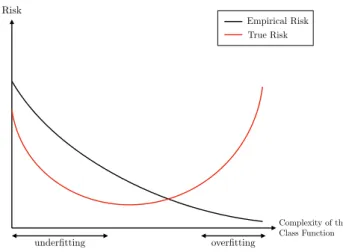
Figure 1.1: Evolution of the Empirical and True Risks according to the complexity of the set of hypotheses.
of hypotheses by constraining the norm of the parameters of the model for instance2.
In this last expression, the smaller the value ofλis, the more importance we give on fitting well the data.
In the same way, the greater λ, the more importance we give on the complexity of the learned model. The errors made by the algorithm become insignificant compared to the control of the magnitude of the parametersθ. The risk is that, when λ→ ∞ we lead to an under-fitting phenomenon without a good generalization capacity.
The aim is to learn a model with the appropriate value of λ, i.e. to find a good trade-off between the minimization of the empirical risk and the complexity of the hypothesis as depicted in Figure 1.1. To tune the value of λ, we typically use a k-fold cross-validation on the training set: we separate the dataset into k−folds of regular size. We learn a hypothe-sis/model using k−1 folds and test its performance on the remaining one. The process is repeatedk−times and we keep the hypothesis/model which achieves the lowest empirical risk in average.
Even if we can empirically assess the performance of a model on a test set, it is also important to provide generalization guarantees in order to bound the performance of the learned algorithm regarding its behavior at training time. The next section is dedicated to this point and presents generalization bounds based on the complexity of the set of hypotheses or on some properties on the loss function.
2
In the rest of the thesis such a regularization constant will be calledhyper-parameter instead of parameter
1.1. Statistical Learning Theory 25
1.1.2 Generalization Bounds
A generalization bound has the following general form and is often referred to a Probably Approximately Correct (PAC) bound (Valiant, 1984):
P r(|R(·)− RS(·)| ≥ε)≤δ, (1.1)
where ε ≥ 0 and δ ∈ [0,1]. δ is an upper bound on the probability that the true risk deviates from at least ε from its empirical value. Looking at this bound, an immediate consequence is that the lower the value of ε, the greater (i.e. the closer to 1) the value of δ. Furthermore, the closer from 0 both δ and ε are, the more reliable our estimation is. Such a bound is usually derived using concentration inequalities such as Hoeffding (Hoeffding, 1963) or McDiarmid (McDiarmid, 1989) inequalities. The bound (1.1) can be rewritten as a probabilistic bound of convergence from the empirical estimate to its mean (Vapnik and Chervonenkis, 1982; Valiant, 1984) R `( ·)− R`S(·) ≤ε(δ, m),
whereδ is the rate of confidence on the given bound and εis a function of the rate of con-fidence and a decreasing function on the number of training examples. Such a bound holds with probability at least 1−δ and the aim is to build a function ε(·) with a high rate of convergence.
In the following, we will see how we can build such generalization bounds and that their con-vergence rate is often∼ O(ln(m)/√m) or evenO(1/√m). Some of the presented frameworks will be used in our contribution in Chapter 3.
Uniform Deviation
As stated before, generalization bounds are based on the convergence of empirical quantities to their means (Vapnik and Chervonenkis, 1971) and resort on the law of large numbers. Intuitively, the larger our training set is, the closer the empirical risk will be to the expected value, i.e.: lim m→∞ 1 m m X i=1 `(yi, h(xi)) =E[`(y, h(x))].
The bound is said to beuniform because it holds for any hypothesis h∈ H.
To get such a bound when the size ofH is finite, we need to estimate the probability of the following event: sup h∈H R `(h) − R`S(h) ≥ε .
The probability of such an event can be estimated using the Hoeffding inequality and the Union bound. It leads to the following result.
Theorem 1.1. [Uniform generalization bound] Let H be a set of hypotheses of finite size, S
a training sample of size m drawn i.i.d. from D, ` a loss function which takes its values in [0,1] and δ >0. Then, for anyh∈ H, with probability at least 1−δ, we have:
R`(h)≤ R` S(h) +
r
ln|H|+ ln(2/δ) 2m .
When the space H is not finite, e.g. in the case of a set of linear classifiers in Rd where
the parameters which define a linear separator belong to Rd+1, we need another method to
measure the size or complexity of the set of hypotheses. A way to measure the complexity is the VC-dimension, notedV C(H) and introduced by Vapnik and Chervonenkis (1971).
Definition 1.3. LetX={xi}mi=1denotes a set ofmexamples and letHbe a set of hypotheses.
The VC-dimension of H, V C(H) is the largest value of m such that, for any labelization of the setX, there is h∈ H which correctly classifies all the instances.
Roughly speaking, V C(H) measures the risk of overtfitting the data whatever the labels assigned. It allows to bound the generalization performance given a set of hypotheses without any information on the used algorithm.
Theorem 1.2. [Uniform generalization bound with VC-dimension] LetHbe a set of
hypothe-ses of VC-dimension V C(H), S ={xi, yi}mi=1 a training sample of size m drawn i.i.d. from
D and ` a loss function which takes its values in [0,1] Then, for any hypothesis h ∈ H and for allδ >0, with probability at least 1−δ, we have
R`(h)≤ R` S(h) + v u u u t V C(H) ln 2m V C(H) + 1 + ln(4/δ) m . (1.2)
Note that the bound uniformly converges to zero when the size of the training set grows. The convergence is faster when the VC-dimension of H is small. However, the rate of con-vergence of this bound is O(ln(m)/√m), so the rate of convergence is lower than previously stated in Theorem 1.1. Thus, one drawback of such a complexity measure is to decrease the rate of convergence. Furthermore the VC-dimension remains hard to compute in general except for simple families of hypotheses, such that linear classifiers, or decision trees (Asian et al., 2009).
To overcome these limitations, we can resort to the Rademacher complexity.
Rademacher complexity
The Rademacher complexity (Bartlett and Mendelson, 2003; Koltchinskii and Panchenko, 2000) has been also introduced to measure the complexity of a set of hypotheses. Informally, it measures how the set of hypotheses is able to fit noise in the dataset.
1.1. Statistical Learning Theory 27
Definition 1.4. [(Empirical) Rademacher complexity] Let H be a family of functions and
S={xi}mi=1 a fixed sample of sizem. Then, the empirical Rademacher complexity of Hwith respect toS is defined as:
RS(H) =E σ " sup h∈H 1 m m X i=1 σih(xi) # ,
where σ = (σ1, . . . , σm) is a vector of Rademacher random variables, i.e. random variables
taking values in {−1,+1} both with probability 1/2.
The Rademacher complexity is the expectation of the above quantity on the distribution D of the data:
Rm(H) = E
S∼Dm[RS(H)].
Note that a similar measure of complexity has been introduced by Bartlett and Mendelson (2003) using Gaussian variables instead of Rademacher ones.
Using Definition 1.4, we can derive the following generalization bound.
Theorem 1.3. Let H be a family of hypotheses, ` a loss function taking its values in [0,1]
and S a training set of examples of size m. Then, for all δ > 0 and for all h ∈ H, with probability at least 1−δ, we have:
R`(h) ≤ R` S(h) + 2Rm(H) + r ln(1/δ) 2m , (1.3) R`(h) ≤ R` S(h) + 2RS(H) + 3 r ln(1/δ) 2m . (1.4)
Even if the first bound remains impossible to compute, the second can be evaluated because it only depends on the dataset. Compared to the bound based on the VC-dimension, we can note that the Rademacher complexity accounts the training examples, and it can lead to a higher convergence rate inO(1/√m).
Despite the validity of the previous bounds, (1.2) to (1.4), for all hypotheses, both remain impossible to compute in some cases and require a huge number of examples to be relevant. Indeed, they do not take into account the learning algorithm Aand its main properties and thus lead to pessimistic bounds. The two following results present generalization guarantees that take into account the learning algorithm A.
Uniform Stability
This framework is more recent (Bousquet and Elisseeff, 2002) and is not directly based on a measure of complexity of the set of hypotheses. It resorts on the concept ofstability. Roughly speaking, an algorithm is stable if its output does not change significantly under a small modification of the training sample. More precisely, we focus on uniform stability: we are looking for the greatest modification in the loss function under a small modification of the training sample. A more formal definition is given below.
Complexity of the Class Function
<latexit sha1_base64="y+WYoyjePo5SsYAA8geBZmxUIDc=">AAAC8XicjVHNThsxGJxsaRvSv1COXKxGlXqool0u9IgaCfUYJAKRElTtOg5YeO3V2ouIEC/BjRvqtS/Qa/sSiDeAt+Czs5HaRqj1anfH882M/dlZoaR1cXzbiJ6sPH32vLnaevHy1es37bW3+9ZUJRcDbpQph1lqhZJaDJx0SgyLUqR5psRBdtLz9YNTUVpp9J6bFeIwT4+0nEqeOqK+tj+OtZF6IrRjPZMXSpxJN2NmytyxGI9bPZVay3YqzefyTtyNw2DLIKlBB/Xom/YNxpjAgKNCDgENR1ghhaVnhAQxCuIOcU5cSUiGusAFWuStSCVIkRJ7Qt8jmo1qVtPcZ9rg5rSKorckJ8N78hjSlYT9aizUq5Ds2ceyz0Om39uM/lmdlRPrcEzsv3wL5f/6fC8OU3wKPUjqqQiM747XKVU4Fb9z9ltXjhIK4jyeUL0kzINzcc4seGzo3Z9tGup3QelZP+e1tsK93yVdcPL3dS6D/c1uEneT3c3O9uf6qpvYwDt8oPvcwja+oI8BZV/iB37iV2Sjq+g6+jaXRo3as44/RvT9AdOFoV8=</latexit><latexit sha1_base64="y+WYoyjePo5SsYAA8geBZmxUIDc=">AAAC8XicjVHNThsxGJxsaRvSv1COXKxGlXqool0u9IgaCfUYJAKRElTtOg5YeO3V2ouIEC/BjRvqtS/Qa/sSiDeAt+Czs5HaRqj1anfH882M/dlZoaR1cXzbiJ6sPH32vLnaevHy1es37bW3+9ZUJRcDbpQph1lqhZJaDJx0SgyLUqR5psRBdtLz9YNTUVpp9J6bFeIwT4+0nEqeOqK+tj+OtZF6IrRjPZMXSpxJN2NmytyxGI9bPZVay3YqzefyTtyNw2DLIKlBB/Xom/YNxpjAgKNCDgENR1ghhaVnhAQxCuIOcU5cSUiGusAFWuStSCVIkRJ7Qt8jmo1qVtPcZ9rg5rSKorckJ8N78hjSlYT9aizUq5Ds2ceyz0Om39uM/lmdlRPrcEzsv3wL5f/6fC8OU3wKPUjqqQiM747XKVU4Fb9z9ltXjhIK4jyeUL0kzINzcc4seGzo3Z9tGup3QelZP+e1tsK93yVdcPL3dS6D/c1uEneT3c3O9uf6qpvYwDt8oPvcwja+oI8BZV/iB37iV2Sjq+g6+jaXRo3as44/RvT9AdOFoV8=</latexit><latexit sha1_base64="y+WYoyjePo5SsYAA8geBZmxUIDc=">AAAC8XicjVHNThsxGJxsaRvSv1COXKxGlXqool0u9IgaCfUYJAKRElTtOg5YeO3V2ouIEC/BjRvqtS/Qa/sSiDeAt+Czs5HaRqj1anfH882M/dlZoaR1cXzbiJ6sPH32vLnaevHy1es37bW3+9ZUJRcDbpQph1lqhZJaDJx0SgyLUqR5psRBdtLz9YNTUVpp9J6bFeIwT4+0nEqeOqK+tj+OtZF6IrRjPZMXSpxJN2NmytyxGI9bPZVay3YqzefyTtyNw2DLIKlBB/Xom/YNxpjAgKNCDgENR1ghhaVnhAQxCuIOcU5cSUiGusAFWuStSCVIkRJ7Qt8jmo1qVtPcZ9rg5rSKorckJ8N78hjSlYT9aizUq5Ds2ceyz0Om39uM/lmdlRPrcEzsv3wL5f/6fC8OU3wKPUjqqQiM747XKVU4Fb9z9ltXjhIK4jyeUL0kzINzcc4seGzo3Z9tGup3QelZP+e1tsK93yVdcPL3dS6D/c1uEneT3c3O9uf6qpvYwDt8oPvcwja+oI8BZV/iB37iV2Sjq+g6+jaXRo3as44/RvT9AdOFoV8=</latexit><latexit sha1_base64="y+WYoyjePo5SsYAA8geBZmxUIDc=">AAAC8XicjVHNThsxGJxsaRvSv1COXKxGlXqool0u9IgaCfUYJAKRElTtOg5YeO3V2ouIEC/BjRvqtS/Qa/sSiDeAt+Czs5HaRqj1anfH882M/dlZoaR1cXzbiJ6sPH32vLnaevHy1es37bW3+9ZUJRcDbpQph1lqhZJaDJx0SgyLUqR5psRBdtLz9YNTUVpp9J6bFeIwT4+0nEqeOqK+tj+OtZF6IrRjPZMXSpxJN2NmytyxGI9bPZVay3YqzefyTtyNw2DLIKlBB/Xom/YNxpjAgKNCDgENR1ghhaVnhAQxCuIOcU5cSUiGusAFWuStSCVIkRJ7Qt8jmo1qVtPcZ9rg5rSKorckJ8N78hjSlYT9aizUq5Ds2ceyz0Om39uM/lmdlRPrcEzsv3wL5f/6fC8OU3wKPUjqqQiM747XKVU4Fb9z9ltXjhIK4jyeUL0kzINzcc4seGzo3Z9tGup3QelZP+e1tsK93yVdcPL3dS6D/c1uEneT3c3O9uf6qpvYwDt8oPvcwja+oI8BZV/iB37iV2Sjq+g6+jaXRo3as44/RvT9AdOFoV8=</latexit>
Risk
<latexit sha1_base64="XOxl6+kXMmR8m1ZsIalhEluH5qI=">AAACx3icjVHLTsJAFD3UF+ILdemmkZi4Ii0bXRLd6A6NgAkS05YBJvSV6ZRIiAt/wK3+mfEP9C+8Mw6JSoxO0/bMufecmXuvn4Y8k47zWrAWFpeWV4qrpbX1jc2t8vZOK0tyEbBmkISJuPa9jIU8Zk3JZciuU8G8yA9Z2x+dqnh7zETGk/hKTlLWjbxBzPs88KSiLnk2ui1XnKqjlz0PXAMqMKuRlF9wgx4SBMgRgSGGJBzCQ0ZPBy4cpMR1MSVOEOI6znCPEmlzymKU4RE7ou+Adh3DxrRXnplWB3RKSK8gpY0D0iSUJwir02wdz7WzYn/znmpPdbcJ/X3jFRErMST2L90s8786VYtEH8e6Bk41pZpR1QXGJdddUTe3v1QlySElTuEexQXhQCtnfba1JtO1q956Ov6mMxWr9oHJzfGubkkDdn+Ocx60alXXqboXtUr9xIy6iD3s45DmeYQ6ztBAk7yHeMQTnq1zK7HG1t1nqlUwml18W9bDB4yKkLo=</latexit><latexit sha1_base64="XOxl6+kXMmR8m1ZsIalhEluH5qI=">AAACx3icjVHLTsJAFD3UF+ILdemmkZi4Ii0bXRLd6A6NgAkS05YBJvSV6ZRIiAt/wK3+mfEP9C+8Mw6JSoxO0/bMufecmXuvn4Y8k47zWrAWFpeWV4qrpbX1jc2t8vZOK0tyEbBmkISJuPa9jIU8Zk3JZciuU8G8yA9Z2x+dqnh7zETGk/hKTlLWjbxBzPs88KSiLnk2ui1XnKqjlz0PXAMqMKuRlF9wgx4SBMgRgSGGJBzCQ0ZPBy4cpMR1MSVOEOI6znCPEmlzymKU4RE7ou+Adh3DxrRXnplWB3RKSK8gpY0D0iSUJwir02wdz7WzYn/znmpPdbcJ/X3jFRErMST2L90s8786VYtEH8e6Bk41pZpR1QXGJdddUTe3v1QlySElTuEexQXhQCtnfba1JtO1q956Ov6mMxWr9oHJzfGubkkDdn+Ocx60alXXqboXtUr9xIy6iD3s45DmeYQ6ztBAk7yHeMQTnq1zK7HG1t1nqlUwml18W9bDB4yKkLo=</latexit><latexit sha1_base64="XOxl6+kXMmR8m1ZsIalhEluH5qI=">AAACx3icjVHLTsJAFD3UF+ILdemmkZi4Ii0bXRLd6A6NgAkS05YBJvSV6ZRIiAt/wK3+mfEP9C+8Mw6JSoxO0/bMufecmXuvn4Y8k47zWrAWFpeWV4qrpbX1jc2t8vZOK0tyEbBmkISJuPa9jIU8Zk3JZciuU8G8yA9Z2x+dqnh7zETGk/hKTlLWjbxBzPs88KSiLnk2ui1XnKqjlz0PXAMqMKuRlF9wgx4SBMgRgSGGJBzCQ0ZPBy4cpMR1MSVOEOI6znCPEmlzymKU4RE7ou+Adh3DxrRXnplWB3RKSK8gpY0D0iSUJwir02wdz7WzYn/znmpPdbcJ/X3jFRErMST2L90s8786VYtEH8e6Bk41pZpR1QXGJdddUTe3v1QlySElTuEexQXhQCtnfba1JtO1q956Ov6mMxWr9oHJzfGubkkDdn+Ocx60alXXqboXtUr9xIy6iD3s45DmeYQ6ztBAk7yHeMQTnq1zK7HG1t1nqlUwml18W9bDB4yKkLo=</latexit><latexit sha1_base64="XOxl6+kXMmR8m1ZsIalhEluH5qI=">AAACx3icjVHLTsJAFD3UF+ILdemmkZi4Ii0bXRLd6A6NgAkS05YBJvSV6ZRIiAt/wK3+mfEP9C+8Mw6JSoxO0/bMufecmXuvn4Y8k47zWrAWFpeWV4qrpbX1jc2t8vZOK0tyEbBmkISJuPa9jIU8Zk3JZciuU8G8yA9Z2x+dqnh7zETGk/hKTlLWjbxBzPs88KSiLnk2ui1XnKqjlz0PXAMqMKuRlF9wgx4SBMgRgSGGJBzCQ0ZPBy4cpMR1MSVOEOI6znCPEmlzymKU4RE7ou+Adh3DxrRXnplWB3RKSK8gpY0D0iSUJwir02wdz7WzYn/znmpPdbcJ/X3jFRErMST2L90s8786VYtEH8e6Bk41pZpR1QXGJdddUTe3v1QlySElTuEexQXhQCtnfba1JtO1q956Ov6mMxWr9oHJzfGubkkDdn+Ocx60alXXqboXtUr9xIy6iD3s45DmeYQ6ztBAk7yHeMQTnq1zK7HG1t1nqlUwml18W9bDB4yKkLo=</latexit>
Empirical Risk
<latexit sha1_base64="tXbzb+oNRolrmhfphyOc/2OQO+E=">AAAC0XicjVHLSsNAFD2Nr1pfVZdugkVwVRI3uiyK4LI++oBaJZlO69C8mEyEUgRx6w+41Z8S/0D/wjtjBLWITkhy7rn3nJk7108CkSrHeSlYU9Mzs3PF+dLC4tLySnl1rZnGmWS8weIglm3fS3kgIt5QQgW8nUjuhX7AW/7wQOdb11ymIo7O1Cjh3dAbRKIvmKeIujgMEyEpCOwTkQ4vyxWn6phlTwI3BxXkqx6Xn3GOHmIwZAjBEUERDuAhpacDFw4S4roYEycJCZPnuEGJtBlVcarwiB3Sd0BRJ2cjirVnatSMdgnolaS0sUWamOokYb2bbfKZcdbsb95j46nPNqK/n3uFxCpcEfuX7rPyvzrdi0Ife6YHQT0lhtHdsdwlM7eiT25/6UqRQ0Kcxj3KS8LMKD/v2Taa1PSu79Yz+VdTqVkds7w2w5s+JQ3Y/TnOSdDcqbpO1T3eqdT281EXsYFNbNM8d1HDEepokLfEAx7xZJ1aI+vWuvsotQq5Zh3flnX/DvfelNQ=</latexit><latexit sha1_base64="tXbzb+oNRolrmhfphyOc/2OQO+E=">AAAC0XicjVHLSsNAFD2Nr1pfVZdugkVwVRI3uiyK4LI++oBaJZlO69C8mEyEUgRx6w+41Z8S/0D/wjtjBLWITkhy7rn3nJk7108CkSrHeSlYU9Mzs3PF+dLC4tLySnl1rZnGmWS8weIglm3fS3kgIt5QQgW8nUjuhX7AW/7wQOdb11ymIo7O1Cjh3dAbRKIvmKeIujgMEyEpCOwTkQ4vyxWn6phlTwI3BxXkqx6Xn3GOHmIwZAjBEUERDuAhpacDFw4S4roYEycJCZPnuEGJtBlVcarwiB3Sd0BRJ2cjirVnatSMdgnolaS0sUWamOokYb2bbfKZcdbsb95j46nPNqK/n3uFxCpcEfuX7rPyvzrdi0Ife6YHQT0lhtHdsdwlM7eiT25/6UqRQ0Kcxj3KS8LMKD/v2Taa1PSu79Yz+VdTqVkds7w2w5s+JQ3Y/TnOSdDcqbpO1T3eqdT281EXsYFNbNM8d1HDEepokLfEAx7xZJ1aI+vWuvsotQq5Zh3flnX/DvfelNQ=</latexit><latexit sha1_base64="tXbzb+oNRolrmhfphyOc/2OQO+E=">AAAC0XicjVHLSsNAFD2Nr1pfVZdugkVwVRI3uiyK4LI++oBaJZlO69C8mEyEUgRx6w+41Z8S/0D/wjtjBLWITkhy7rn3nJk7108CkSrHeSlYU9Mzs3PF+dLC4tLySnl1rZnGmWS8weIglm3fS3kgIt5QQgW8nUjuhX7AW/7wQOdb11ymIo7O1Cjh3dAbRKIvmKeIujgMEyEpCOwTkQ4vyxWn6phlTwI3BxXkqx6Xn3GOHmIwZAjBEUERDuAhpacDFw4S4roYEycJCZPnuEGJtBlVcarwiB3Sd0BRJ2cjirVnatSMdgnolaS0sUWamOokYb2bbfKZcdbsb95j46nPNqK/n3uFxCpcEfuX7rPyvzrdi0Ife6YHQT0lhtHdsdwlM7eiT25/6UqRQ0Kcxj3KS8LMKD/v2Taa1PSu79Yz+VdTqVkds7w2w5s+JQ3Y/TnOSdDcqbpO1T3eqdT281EXsYFNbNM8d1HDEepokLfEAx7xZJ1aI+vWuvsotQq5Zh3flnX/DvfelNQ=</latexit><latexit sha1_base64="tXbzb+oNRolrmhfphyOc/2OQO+E=">AAAC0XicjVHLSsNAFD2Nr1pfVZdugkVwVRI3uiyK4LI++oBaJZlO69C8mEyEUgRx6w+41Z8S/0D/wjtjBLWITkhy7rn3nJk7108CkSrHeSlYU9Mzs3PF+dLC4tLySnl1rZnGmWS8weIglm3fS3kgIt5QQgW8nUjuhX7AW/7wQOdb11ymIo7O1Cjh3dAbRKIvmKeIujgMEyEpCOwTkQ4vyxWn6phlTwI3BxXkqx6Xn3GOHmIwZAjBEUERDuAhpacDFw4S4roYEycJCZPnuEGJtBlVcarwiB3Sd0BRJ2cjirVnatSMdgnolaS0sUWamOokYb2bbfKZcdbsb95j46nPNqK/n3uFxCpcEfuX7rPyvzrdi0Ife6YHQT0lhtHdsdwlM7eiT25/6UqRQ0Kcxj3KS8LMKD/v2Taa1PSu79Yz+VdTqVkds7w2w5s+JQ3Y/TnOSdDcqbpO1T3eqdT281EXsYFNbNM8d1HDEepokLfEAx7xZJ1aI+vWuvsotQq5Zh3flnX/DvfelNQ=</latexit>
True Risk
<latexit sha1_base64="EYqKhzXxVzOImg269yPI6gy73Ao=">AAACzHicjVHLSsNAFD2Nr/quunQTLIKrknSjy6IbV1KlL6lFkum0Ds2LyUQopVt/wK1+l/gH+hfeGVNQi+iEJGfOvefM3Hv9JBCpcpzXgrWwuLS8UlxdW9/Y3Nou7ey20jiTjDdZHMSy43spD0TEm0qogHcSyb3QD3jbH53pePuey1TEUUONE94LvWEkBoJ5iqjrhsy4fSXS0W2p7FQcs+x54OagjHzV49ILbtBHDIYMITgiKMIBPKT0dOHCQUJcDxPiJCFh4hxTrJE2oyxOGR6xI/oOadfN2Yj22jM1akanBPRKUto4JE1MeZKwPs028cw4a/Y374nx1Hcb09/PvUJiFe6I/Us3y/yvTteiMMCJqUFQTYlhdHUsd8lMV/TN7S9VKXJIiNO4T3FJmBnlrM+20aSmdt1bz8TfTKZm9Z7luRne9S1pwO7Pcc6DVrXiOhX3slquneajLmIfBziieR6jhnPU0STvEI94wrN1YSlrYk0/U61CrtnDt2U9fAB8vJKs</latexit><latexit sha1_base64="EYqKhzXxVzOImg269yPI6gy73Ao=">AAACzHicjVHLSsNAFD2Nr/quunQTLIKrknSjy6IbV1KlL6lFkum0Ds2LyUQopVt/wK1+l/gH+hfeGVNQi+iEJGfOvefM3Hv9JBCpcpzXgrWwuLS8UlxdW9/Y3Nou7ey20jiTjDdZHMSy43spD0TEm0qogHcSyb3QD3jbH53pePuey1TEUUONE94LvWEkBoJ5iqjrhsy4fSXS0W2p7FQcs+x54OagjHzV49ILbtBHDIYMITgiKMIBPKT0dOHCQUJcDxPiJCFh4hxTrJE2oyxOGR6xI/oOadfN2Yj22jM1akanBPRKUto4JE1MeZKwPs028cw4a/Y374nx1Hcb09/PvUJiFe6I/Us3y/yvTteiMMCJqUFQTYlhdHUsd8lMV/TN7S9VKXJIiNO4T3FJmBnlrM+20aSmdt1bz8TfTKZm9Z7luRne9S1pwO7Pcc6DVrXiOhX3slquneajLmIfBziieR6jhnPU0STvEI94wrN1YSlrYk0/U61CrtnDt2U9fAB8vJKs</latexit><latexit sha1_base64="EYqKhzXxVzOImg269yPI6gy73Ao=">AAACzHicjVHLSsNAFD2Nr/quunQTLIKrknSjy6IbV1KlL6lFkum0Ds2LyUQopVt/wK1+l/gH+hfeGVNQi+iEJGfOvefM3Hv9JBCpcpzXgrWwuLS8UlxdW9/Y3Nou7ey20jiTjDdZHMSy43spD0TEm0qogHcSyb3QD3jbH53pePuey1TEUUONE94LvWEkBoJ5iqjrhsy4fSXS0W2p7FQcs+x54OagjHzV49ILbtBHDIYMITgiKMIBPKT0dOHCQUJcDxPiJCFh4hxTrJE2oyxOGR6xI/oOadfN2Yj22jM1akanBPRKUto4JE1MeZKwPs028cw4a/Y374nx1Hcb09/PvUJiFe6I/Us3y/yvTteiMMCJqUFQTYlhdHUsd8lMV/TN7S9VKXJIiNO4T3FJmBnlrM+20aSmdt1bz8TfTKZm9Z7luRne9S1pwO7Pcc6DVrXiOhX3slquneajLmIfBziieR6jhnPU0STvEI94wrN1YSlrYk0/U61CrtnDt2U9fAB8vJKs</latexit><latexit sha1_base64="EYqKhzXxVzOImg269yPI6gy73Ao=">AAACzHicjVHLSsNAFD2Nr/quunQTLIKrknSjy6IbV1KlL6lFkum0Ds2LyUQopVt/wK1+l/gH+hfeGVNQi+iEJGfOvefM3Hv9JBCpcpzXgrWwuLS8UlxdW9/Y3Nou7ey20jiTjDdZHMSy43spD0TEm0qogHcSyb3QD3jbH53pePuey1TEUUONE94LvWEkBoJ5iqjrhsy4fSXS0W2p7FQcs+x54OagjHzV49ILbtBHDIYMITgiKMIBPKT0dOHCQUJcDxPiJCFh4hxTrJE2oyxOGR6xI/oOadfN2Yj22jM1akanBPRKUto4JE1MeZKwPs028cw4a/Y374nx1Hcb09/PvUJiFe6I/Us3y/yvTteiMMCJqUFQTYlhdHUsd8lMV/TN7S9VKXJIiNO4T3FJmBnlrM+20aSmdt1bz8TfTKZm9Z7luRne9S1pwO7Pcc6DVrXiOhX3slquneajLmIfBziieR6jhnPU0STvEI94wrN1YSlrYk0/U61CrtnDt2U9fAB8vJKs</latexit>
overfitting
<latexit sha1_base64="fUkyu0JsgrqAdyqMuIqsHtCvtp0=">AAACz3icjVHLSsNAFD2Nr1pfVZdugkVwVZJudFl047IF+4BaJJlO69C8SCZKKYpbf8Ct/pX4B/oX3hmnoBbRCUnOnHvPmbn3+kkgMuk4rwVrYXFpeaW4Wlpb39jcKm/vtLM4TxlvsTiI067vZTwQEW9JIQPeTVLuhX7AO/74VMU71zzNRBydy0nC+6E3isRQME8SdRFTbCikFNGodFmuOFVHL3seuAZUYFYjLr/gAgPEYMgRgiOCJBzAQ0ZPDy4cJMT1MSUuJSR0nOMWJdLmlMUpwyN2TN8R7XqGjWivPDOtZnRKQG9KShsHpIkpLyWsTrN1PNfOiv3Ne6o91d0m9PeNV0isxBWxf+lmmf/VqVokhjjWNQiqKdGMqo4Zl1x3Rd3c/lKVJIeEOIUHFE8JM62c9dnWmkzXrnrr6fibzlSs2jOTm+Nd3ZIG7P4c5zxo16quU3WbtUr9xIy6iD3s45DmeYQ6ztBAi7wTPOIJz1bTurHurPvPVKtgNLv4tqyHD0ZOlCw=</latexit><latexit sha1_base64="fUkyu0JsgrqAdyqMuIqsHtCvtp0=">AAACz3icjVHLSsNAFD2Nr1pfVZdugkVwVZJudFl047IF+4BaJJlO69C8SCZKKYpbf8Ct/pX4B/oX3hmnoBbRCUnOnHvPmbn3+kkgMuk4rwVrYXFpeaW4Wlpb39jcKm/vtLM4TxlvsTiI067vZTwQEW9JIQPeTVLuhX7AO/74VMU71zzNRBydy0nC+6E3isRQME8SdRFTbCikFNGodFmuOFVHL3seuAZUYFYjLr/gAgPEYMgRgiOCJBzAQ0ZPDy4cJMT1MSUuJSR0nOMWJdLmlMUpwyN2TN8R7XqGjWivPDOtZnRKQG9KShsHpIkpLyWsTrN1PNfOiv3Ne6o91d0m9PeNV0isxBWxf+lmmf/VqVokhjjWNQiqKdGMqo4Zl1x3Rd3c/lKVJIeEOIUHFE8JM62c9dnWmkzXrnrr6fibzlSs2jOTm+Nd3ZIG7P4c5zxo16quU3WbtUr9xIy6iD3s45DmeYQ6ztBAi7wTPOIJz1bTurHurPvPVKtgNLv4tqyHD0ZOlCw=</latexit><latexit sha1_base64="fUkyu0JsgrqAdyqMuIqsHtCvtp0=">AAACz3icjVHLSsNAFD2Nr1pfVZdugkVwVZJudFl047IF+4BaJJlO69C8SCZKKYpbf8Ct/pX4B/oX3hmnoBbRCUnOnHvPmbn3+kkgMuk4rwVrYXFpeaW4Wlpb39jcKm/vtLM4TxlvsTiI067vZTwQEW9JIQPeTVLuhX7AO/74VMU71zzNRBydy0nC+6E3isRQME8SdRFTbCikFNGodFmuOFVHL3seuAZUYFYjLr/gAgPEYMgRgiOCJBzAQ0ZPDy4cJMT1MSUuJSR0nOMWJdLmlMUpwyN2TN8R7XqGjWivPDOtZnRKQG9KShsHpIkpLyWsTrN1PNfOiv3Ne6o91d0m9PeNV0isxBWxf+lmmf/VqVokhjjWNQiqKdGMqo4Zl1x3Rd3c/lKVJIeEOIUHFE8JM62c9dnWmkzXrnrr6fibzlSs2jOTm+Nd3ZIG7P4c5zxo16quU3WbtUr9xIy6iD3s45DmeYQ6ztBAi7wTPOIJz1bTurHurPvPVKtgNLv4tqyHD0ZOlCw=</latexit><latexit sha1_base64="fUkyu0JsgrqAdyqMuIqsHtCvtp0=">AAACz3icjVHLSsNAFD2Nr1pfVZdugkVwVZJudFl047IF+4BaJJlO69C8SCZKKYpbf8Ct/pX4B/oX3hmnoBbRCUnOnHvPmbn3+kkgMuk4rwVrYXFpeaW4Wlpb39jcKm/vtLM4TxlvsTiI067vZTwQEW9JIQPeTVLuhX7AO/74VMU71zzNRBydy0nC+6E3isRQME8SdRFTbCikFNGodFmuOFVHL3seuAZUYFYjLr/gAgPEYMgRgiOCJBzAQ0ZPDy4cJMT1MSUuJSR0nOMWJdLmlMUpwyN2TN8R7XqGjWivPDOtZnRKQG9KShsHpIkpLyWsTrN1PNfOiv3Ne6o91d0m9PeNV0isxBWxf+lmmf/VqVokhjjWNQiqKdGMqo4Zl1x3Rd3c/lKVJIeEOIUHFE8JM62c9dnWmkzXrnrr6fibzlSs2jOTm+Nd3ZIG7P4c5zxo16quU3WbtUr9xIy6iD3s45DmeYQ6ztBAi7wTPOIJz1bTurHurPvPVKtgNLv4tqyHD0ZOlCw=</latexit>
underfitting<latexit sha1_base64="CK9fOgb5gcBxX2fHM98QL5LqIOk=">AAAC0XicjVHLSsNAFD2NrxpfVZdugkVwVZJudFl047KifUCtkqTTOjRNwmQilCKIW3/Arf6U+Af6F94Zp6AW0QlJzpx7z5m59wZpxDPpuq8Fa25+YXGpuGyvrK6tb5Q2t5pZkouQNcIkSkQ78DMW8Zg1JJcRa6eC+aMgYq1geKzirRsmMp7E53Kcsu7IH8S8z0NfEnWZxz0m+lxKHg9s+6pUdiuuXs4s8Awow6x6UnrBBXpIECLHCAwxJOEIPjJ6OvDgIiWuiwlxghDXcYZb2KTNKYtRhk/skL4D2nUMG9NeeWZaHdIpEb2ClA72SJNQniCsTnN0PNfOiv3Ne6I91d3G9A+M14hYiWti/9JNM/+rU7VI9HGoa+BUU6oZVV1oXHLdFXVz50tVkhxS4hTuUVwQDrVy2mdHazJdu+qtr+NvOlOxah+a3Bzv6pY0YO/nOGdBs1rx3Ip3Wi3Xjsyoi9jBLvZpngeo4QR1NMhb4BFPeLbOrLF1Z91/ploFo9nGt2U9fACcZZSs</latexit><latexit sha1_base64="CK9fOgb5gcBxX2fHM98QL5LqIOk=">AAAC0XicjVHLSsNAFD2NrxpfVZdugkVwVZJudFl047KifUCtkqTTOjRNwmQilCKIW3/Arf6U+Af6F94Zp6AW0QlJzpx7z5m59wZpxDPpuq8Fa25+YXGpuGyvrK6tb5Q2t5pZkouQNcIkSkQ78DMW8Zg1JJcRa6eC+aMgYq1geKzirRsmMp7E53Kcsu7IH8S8z0NfEnWZxz0m+lxKHg9s+6pUdiuuXs4s8Awow6x6UnrBBXpIECLHCAwxJOEIPjJ6OvDgIiWuiwlxghDXcYZb2KTNKYtRhk/skL4D2nUMG9NeeWZaHdIpEb2ClA72SJNQniCsTnN0PNfOiv3Ne6I91d3G9A+M14hYiWti/9JNM/+rU7VI9HGoa+BUU6oZVV1oXHLdFXVz50tVkhxS4hTuUVwQDrVy2mdHazJdu+qtr+NvOlOxah+a3Bzv6pY0YO/nOGdBs1rx3Ip3Wi3Xjsyoi9jBLvZpngeo4QR1NMhb4BFPeLbOrLF1Z91/ploFo9nGt2U9fACcZZSs</latexit><latexit sha1_base64="CK9fOgb5gcBxX2fHM98QL5LqIOk=">AAAC0XicjVHLSsNAFD2NrxpfVZdugkVwVZJudFl047KifUCtkqTTOjRNwmQilCKIW3/Arf6U+Af6F94Zp6AW0QlJzpx7z5m59wZpxDPpuq8Fa25+YXGpuGyvrK6tb5Q2t5pZkouQNcIkSkQ78DMW8Zg1JJcRa6eC+aMgYq1geKzirRsmMp7E53Kcsu7IH8S8z0NfEnWZxz0m+lxKHg9s+6pUdiuuXs4s8Awow6x6UnrBBXpIECLHCAwxJOEIPjJ6OvDgIiWuiwlxghDXcYZb2KTNKYtRhk/skL4D2nUMG9NeeWZaHdIpEb2ClA72SJNQniCsTnN0PNfOiv3Ne6I91d3G9A+M14hYiWti/9JNM/+rU7VI9HGoa+BUU6oZVV1oXHLdFXVz50tVkhxS4hTuUVwQDrVy2mdHazJdu+qtr+NvOlOxah+a3Bzv6pY0YO/nOGdBs1rx3Ip3Wi3Xjsyoi9jBLvZpngeo4QR1NMhb4BFPeLbOrLF1Z91/ploFo9nGt2U9fACcZZSs</latexit><latexit sha1_base64="CK9fOgb5gcBxX2fHM98QL5LqIOk=">AAAC0XicjVHLSsNAFD2NrxpfVZdugkVwVZJudFl047KifUCtkqTTOjRNwmQilCKIW3/Arf6U+Af6F94Zp6AW0QlJzpx7z5m59wZpxDPpuq8Fa25+YXGpuGyvrK6tb5Q2t5pZkouQNcIkSkQ78DMW8Zg1JJcRa6eC+aMgYq1geKzirRsmMp7E53Kcsu7IH8S8z0NfEnWZxz0m+lxKHg9s+6pUdiuuXs4s8Awow6x6UnrBBXpIECLHCAwxJOEIPjJ6OvDgIiWuiwlxghDXcYZb2KTNKYtRhk/skL4D2nUMG9NeeWZaHdIpEb2ClA72SJNQniCsTnN0PNfOiv3Ne6I91d3G9A+M14hYiWti/9JNM/+rU7VI9HGoa+BUU6oZVV1oXHLdFXVz50tVkhxS4hTuUVwQDrVy2mdHazJdu+qtr+NvOlOxah+a3Bzv6pY0YO/nOGdBs1rx3Ip3Wi3Xjsyoi9jBLvZpngeo4QR1NMhb4BFPeLbOrLF1Z91/ploFo9nGt2U9fACcZZSs</latexit>
Bound
<latexit sha1_base64="YIoSlA5Gnd5fFGh1sUuJInb+2s8=">AAACyHicjVHLSsNAFD2Nr1pfVZdugkVwVZJudFnqRlxVMK1QiyTTaR2aF8lEKcWNP+BWv0z8A/0L74xTUIvohCRnzr3nzNx7gzQUuXSc15K1sLi0vFJeraytb2xuVbd3OnlSZIx7LAmT7DLwcx6KmHtSyJBfphn3oyDk3WB8ouLdW57lIokv5CTl/cgfxWIomC+J8lpJEQ+uqzWn7uhlzwPXgBrMaifVF1xhgAQMBSJwxJCEQ/jI6enBhYOUuD6mxGWEhI5z3KNC2oKyOGX4xI7pO6Jdz7Ax7ZVnrtWMTgnpzUhp44A0CeVlhNVpto4X2lmxv3lPtae624T+gfGKiJW4IfYv3SzzvzpVi8QQx7oGQTWlmlHVMeNS6K6om9tfqpLkkBKn8IDiGWGmlbM+21qT69pVb30df9OZilV7ZnILvKtb0oDdn+OcB51G3XXq7nmj1myZUZexh30c0jyP0MQp2vDIW+ART3i2zqzUurMmn6lWyWh28W1ZDx+VcZEj</latexit><latexit sha1_base64="YIoSlA5Gnd5fFGh1sUuJInb+2s8=">AAACyHicjVHLSsNAFD2Nr1pfVZdugkVwVZJudFnqRlxVMK1QiyTTaR2aF8lEKcWNP+BWv0z8A/0L74xTUIvohCRnzr3nzNx7gzQUuXSc15K1sLi0vFJeraytb2xuVbd3OnlSZIx7LAmT7DLwcx6KmHtSyJBfphn3oyDk3WB8ouLdW57lIokv5CTl/cgfxWIomC+J8lpJEQ+uqzWn7uhlzwPXgBrMaifVF1xhgAQMBSJwxJCEQ/jI6enBhYOUuD6mxGWEhI5z3KNC2oKyOGX4xI7pO6Jdz7Ax7ZVnrtWMTgnpzUhp44A0CeVlhNVpto4X2lmxv3lPtae624T+gfGKiJW4IfYv3SzzvzpVi8QQx7oGQTWlmlHVMeNS6K6om9tfqpLkkBKn8IDiGWGmlbM+21qT69pVb30df9OZilV7ZnILvKtb0oDdn+OcB51G3XXq7nmj1myZUZexh30c0jyP0MQp2vDIW+ART3i2zqzUurMmn6lWyWh28W1ZDx+VcZEj</latexit><latexit sha1_base64="YIoSlA5Gnd5fFGh1sUuJInb+2s8=">AAACyHicjVHLSsNAFD2Nr1pfVZdugkVwVZJudFnqRlxVMK1QiyTTaR2aF8lEKcWNP+BWv0z8A/0L74xTUIvohCRnzr3nzNx7gzQUuXSc15K1sLi0vFJeraytb2xuVbd3OnlSZIx7LAmT7DLwcx6KmHtSyJBfphn3oyDk3WB8ouLdW57lIokv5CTl/cgfxWIomC+J8lpJEQ+uqzWn7uhlzwPXgBrMaifVF1xhgAQMBSJwxJCEQ/jI6enBhYOUuD6mxGWEhI5z3KNC2oKyOGX4xI7pO6Jdz7Ax7ZVnrtWMTgnpzUhp44A0CeVlhNVpto4X2lmxv3lPtae624T+gfGKiJW4IfYv3SzzvzpVi8QQx7oGQTWlmlHVMeNS6K6om9tfqpLkkBKn8IDiGWGmlbM+21qT69pVb30df9OZilV7ZnILvKtb0oDdn+OcB51G3XXq7nmj1myZUZexh30c0jyP0MQp2vDIW+ART3i2zqzUurMmn6lWyWh28W1ZDx